belt NISSAN LEAF 2015 1.G Manual PDF
[x] Cancel search | Manufacturer: NISSAN, Model Year: 2015, Model line: LEAF, Model: NISSAN LEAF 2015 1.GPages: 412, PDF Size: 8.81 MB
Page 343 of 412
head restraints/headrests move up and down
smoothly and that the locks (if so equipped) hold
securely in all latched positions.
Seat belts:Check that all parts of the seat belt
system (for example, buckles, anchors, adjusters
and retractors) operate properly and smoothly,
and are installed securely. Check the belt web-
bing for cuts, fraying, wear or damage.
Steering wheel: Check for changes in the
steering conditions, such as excessive free play,
hard steering or strange noises.
Warning lights and chimes: Make sure that all
warning lights and chimes are operating properly.
Windshield defroster: Check that the air emits
from the defroster outlets properly and in suffi-
cient quantity when operating the heater or air
conditioner.
Windshield wiper and washer*: Check that
the wipers and washers operate properly and
that the wipers do not streak.
Under hood and vehicle
The maintenance items listed here should be
checked periodically. 12-volt battery (for serviceable battery)*:
Check the fluid level in each cell. It should be
between the MAX and MIN lines. Vehicles oper-
ated in high temperatures or under severe condi-
tions require frequent checks of the 12–volt bat-
tery fluid level.
NOTE:
Care should be taken to avoid situations
that can lead to potential battery discharge
and potential no-start conditions such as:
1. Installation or extended use of electronic ac-
cessories that consume battery power when
the engine is not running (Phone chargers,
GPS, DVD players, etc.)
2. Vehicle is not driven regularly and/or only driven short distances.
In these cases, the battery may need to be
charged to maintain battery health.
Brake fluid level*: Make sure that the brake
fluid level is between the “MAX” and “MIN” lines
on the reservoir.
Coolant level*: Check the coolant level when
the motor compartment is cold. Fluid leaks:
Check under the vehicle for water
or other fluid leaks after the vehicle has been
parked for a while. Water dripping from the air
conditioner after use is normal. If you should
notice any leaks, check for cause and have it
corrected immediately.
Radiator and hoses: Check the front of the
radiator and clean off any dirt, insects, leaves,
etc., that may have accumulated. Make sure that
the hoses have no cracks, deformation, rot or
loose connections.
Underbody: The underbody is frequently ex-
posed to corrosive substances such as those
used on icy roads or to control dust. It is very
important to remove these substances, other-
wise rust will form on the floor pan and frame. At
the end of winter, the underbody should be thor-
oughly flushed with plain water, being careful to
clean those areas where mud and dirt may accu-
mulate. For additional information, see “Cleaning
exterior” in the “Appearance and care” section.
Windshield washer fluid*: Check that there is
an adequate amount of fluid in the reservoir.
8-4Maintenance and do-it yourself
Page 373 of 412
Replacing wheels and tires
When replacing a tire, use the same size, tread
design, speed rating and load carrying capacity
as originally equipped. See “Specifications” in
the “Technical and consumer information” sec-
tion for recommended types and sizes of tires
and wheels.
WARNING
• The use of tires other than those rec- ommended or the mixed use of tires of
different brands, construction (bias,
bias-belted or radial) , or tread patterns
can adversely affect the ride, braking,
handling, ground clearance, body-to-
tire clearance, tire chain clearance,
speedometer calibration, headlight
aim and bumper height. Some of these
effects may lead to accidents and
could result in serious personal injury.
• If your vehicle was originally equipped with 4 tires that were the same size
and you are only replacing 2 of the 4
tires, install the new tires on the rear
axle. Placing new tires on the front
axle may cause loss of vehicle control
in some driving conditions and cause
an accident and personal injury. • If the wheels are changed for any rea-
son, always replace with wheels which
have the same off-set dimension.
Wheels of a different off-set could
cause premature tire wear, degrade
vehicle handling characteristics
and/or interference with the brake
discs. Such interference can lead to
decreased braking efficiency and/or
early brake pad/shoe wear. See
“Wheels and tires” in the “Technical
and consumer information” section of
this manual for wheel off-set dimen-
sions.
• When a wheel is replaced, the TPMS will not function and the low tire pres-
sure warning light will flash for ap-
proximately 1 minute. The light will re-
main on after 1 minute. Contact your
NISSAN certified LEAF dealer as soon
as possible for tire replacement
and/or system resetting.
• Replacing tires with those not origi- nally specified by NISSAN could affect
the proper operation of the TPMS.
• Do not install a damaged or deformed wheel or tire even if it has been re-
paired. Such wheels or tires could have
structural damage and could fail with-
out warning. • The use of retread tire is not recom-
mended.
• For additional information regarding tires, refer to “Important Tire Safety
Information” (US) or “Tire Safety Infor-
mation” (Canada) in the Warranty In-
formation Booklet.Wheel balance
Unbalanced wheels may affect vehicle handling
and tire life. Even with regular use, wheels can get
out of balance. Therefore, they should be bal-
anced as required.
Wheel balance service should be per-
formed with the wheels off the vehicle.
Spin balancing the wheels on the vehicle
could lead to mechanical damage.
For additional information regarding tires, refer to
“Important Tire Safety Information” (US) or “Tire
Safety Information” (Canada) in the Warranty In-
formation Booklet.
Care of wheels
See “Cleaning exterior” in the “Appearance and
care” section for details about care of the wheels.
8-34Maintenance and do-it yourself
Page 385 of 412
WARNING
•
It is extremely dangerous to ride
in the cargo area inside the ve-
hicle. In a collision, people riding
in these areas are more likely to
be seriously injured or killed.
•Do not allow people to ride in
any area of your vehicle that is
not equipped with seats and seat
belts.
•Be sure everyone in your vehicle
is in a seat and using a seat belt
properly.
TERMS
It is important to familiarize yourself with
the following terms before loading your
vehicle:
• Curb Weight (actual weight of your ve- hicle) - vehicle weight including: stan-
dard and optional equipment, fluids,
emergency tools, and spare tire assem-
bly. This weight does not
include passen-
gers and cargo.
• GVW (Gross Vehicle Weight) - curb weight plus the combined weight of pas-
sengers and cargo.
• GVWR (Gross Vehicle Weight Rating) - maximum total combined weight of the
unloaded vehicle, passengers, luggage,
hitch, trailer tongue load and any other
optional equipment. This information is
located on the F.M.V.S.S./C.M.V.S.S.
label. • GAWR (Gross Axle Weight Rating) -
maximum weight (load) limit specified
for the front or rear axle. This information
is located on the F.M.V.S.S./C.M.V.S.S.
label.
• GCWR (Gross Combined Weight Rat- ing) - The maximum total weight rating of
the vehicle, passengers, cargo, and
trailer.
• Vehicle Capacity Weight, Load limit, To- tal load capacity - maximum total weight
limit specified of the load (passengers
and cargo) for the vehicle. This is the
maximum combined weight of occu-
pants and cargo that can be loaded into
the vehicle. If the vehicle is used to tow a
trailer, the trailer tongue weight must be
included as part of the cargo load. This
information is located on the Tire and
Loading Information label.
• Cargo capacity - permissible weight of cargo, the subtracted weight of occu-
pants from the load limit.
VEHICLE LOADING INFORMATION
9-10Technical and consumer information
Page 393 of 412
interruption of data transmission and, as a result,
certain features may be temporarily unavailable.
Even if areas with good signal reception, cellular
connectivity can be adversely affected by things
such as tall buildings, apartments, tunnels, un-
derground parking, mountainous areas, etc. Even
if the signal strength bar of the in-vehicle data
communication module indicates good recep-
tion, connectivity may be disrupted. This does not
indicate a malfunction. Operate the system again
after a few minutes to restore connectivity. CAR-
WINGS™ telematics features are offered as a
convenience to the vehicle owner. NISSAN is not
responsible for, and owner assumes all risk of,
interruptions in service or errors based on incom-
plete or inaccurate data. CARWINGS™ commu-
nications may be received at a verified e-mail
address or by SMS/text messaging-enabled mo-
bile phone. Standard text rates and/or data usage
may apply depending on your carrier.If your vehicle’s telematics account is active, and
you are not the original owner, please contact
NISSAN at the website or phone number above
as soon as possible to update the telematics
enrollment information. Upon sale of the vehicle,
please contact NISSAN at the website or phone
number above so that NISSAN’s records may be
updated. CARWINGS™ subscription services
will automatically terminate at the end of the initial
free term if you do not wish to renew your sub-
scription agreement at the prices then in effect.
This vehicle is equipped with an Event Data Re-
corder (EDR) . The main purpose of an EDR is to
record, in certain crash or near crash-like situa-
tions, such as an air bag deployment or hitting a
road obstacle, data that will assist in understand-
ing how a vehicle’s systems performed. The EDR
is designed to record data related to vehicle
dynamics and safety systems for a short period of
time, typically 30 seconds or less. The EDR in this
vehicle is designed to record such data as:
• How various systems in your vehicle were
operating;
• Whether or not the driver and passenger safety belts were buckled/fastened;
• How far (if at all) the driver was depressing the accelerator and/or brake pedal; and,
• How fast the vehicle was traveling.
• Sounds are not recorded.
These data can help provide a better understand-
ing of the circumstances in which crashes and
injuries occur.
EVENT DATA RECORDER (EDR)
9-18Technical and consumer information
Page 401 of 412
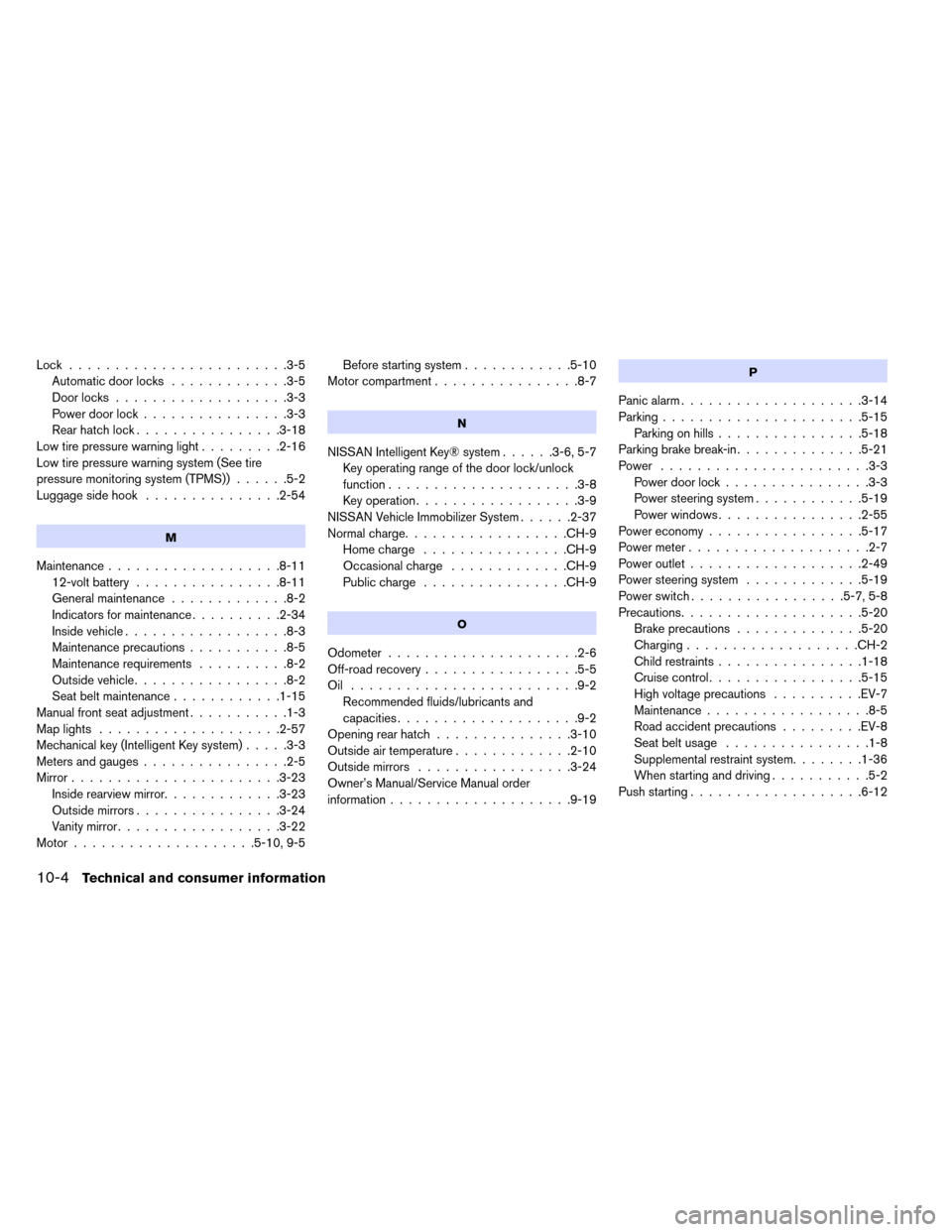
Lock........................3-5
Automatic door locks .............3-5
Door locks ...................3-3
Power door lock ................3-3
Rearhatchlock................3-18
Low tire pressure warning light .........2-16
Low tire pressure warning system (See tire
pressure monitoring system (TPMS)) ......5-2
Luggage side hook ...............2-54
M
Maintenance...................8-11
12-volt battery ................8-11
Generalmaintenance .............8-2
Indicatorsformaintenance..........2-34
Inside vehicle ..................8-3
Maintenance precautions ...........8-5
Maintenance requirements ..........8-2
Outside vehicle .................8-2
Seatbeltmaintenance............1-15
Manual front seat adjustment ...........1-3
Maplights ....................2-57
Mechanical key (Intelligent Key system) .....3-3
Meters and gauges ................2-5
Mirror .......................3-23
Inside rearview mirror.............3-23
Outside mirrors ................3-24
Vanity mirror ..................3-22
Motor....................5-10,9-5 Before starting system
............5-10
Motor compartment ................8-7
N
NISSAN Intelligent Key® system ......3-6,5-7
Key operating range of the door lock/unlock
function.....................3-8
Key operation ..................3-9
NISSAN Vehicle Immobilizer System ......2-37
Normalcharge..................CH-9 Home charge ................CH-9
Occasional charge .............CH-9
Publiccharge ................CH-9
O
Odometer .....................2-6
Off-road recovery .................5-5
Oil .........................9-2 Recommended fluids/lubricants and
capacities ....................9-2
Opening rear hatch ...............3-10
Outside air temperature .............2-10
Outside mirrors .................3-24
Owner’s Manual/Service Manual order
information ....................9-19
P
Panic alarm....................3-14
Parking ......................5-15
Parking on hills ................5-18
Parking brake break-in ..............5-21
Power .......................3-3 Power door lock ................3-3
Power steering system ............5-19
Power windows ................2-55
Powereconomy.................5-17
Powermeter....................2-7
Power outlet ...................2-49
Power steering system .............5-19
Powerswitch.................5-7,5-8
Precautions ....................5-20
Brake precautions ..............5-20
Charging ...................CH-2
Child restraints ................1-18
Cruise control .................5-15
High voltage precautions ..........EV-7
Maintenance..................8-5
Road accident precautions .........EV-8
Seatbeltusage ................1-8
Supplemental restraint system........1-36
When starting and driving ...........5-2
Push starting ...................6-12
10-4Technical and consumer information
Page 402 of 412
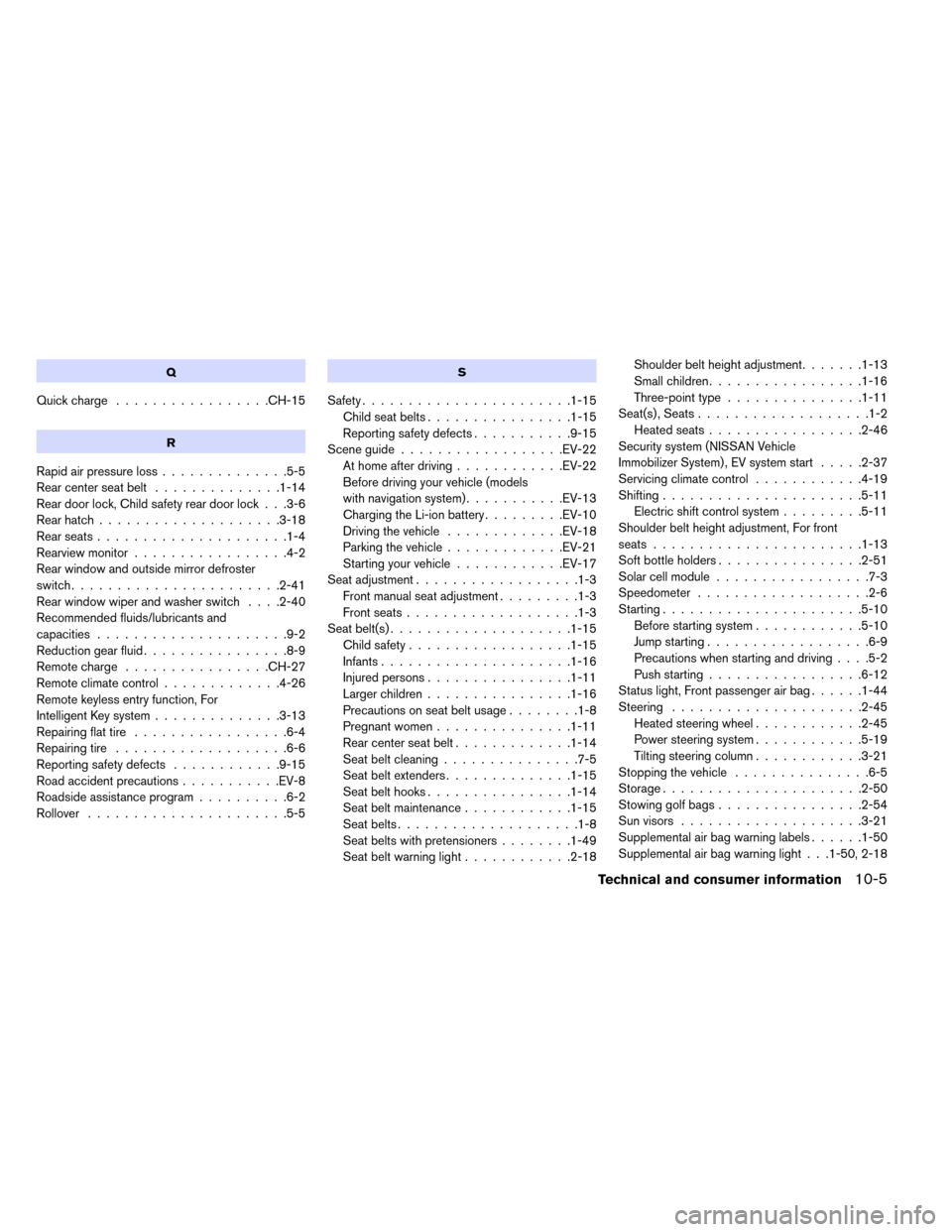
Q
Quickcharge .................CH-15
R
Rapidairpressureloss..............5-5
Rearcenterseatbelt ..............1-14
Rear door lock, Child safety rear door lock . . .3-6
Rear hatch....................3-18
Rearseats.....................1-4
Rearview monitor .................4-2
Rear window and outside mirror defroster
switch .......................2-41
Rear window wiper and washer switch ....2-40
Recommended fluids/lubricants and
capacities .....................9-2
Reductiongearfluid................8-9
Remotecharge ................CH-27
Remoteclimatecontrol.............4-26
Remote keyless entry function, For
Intelligent Key system ..............3-13
Repairing flat tire .................6-4
Repairing tire ...................6-6
Reporting safety defects ............9-15
Road accident precautions ...........EV-8
Roadside assistance program ..........6-2
Rollover ......................5-5
S
Safety.......................1-15 Childseatbelts................1-15
Reporting safety defects ...........9-15
Sceneguide..................EV-22 At home after driving ............EV-22
Before driving your vehicle (models
with navigation system) ...........EV-13
Charging the Li-ion battery .........EV-10
Driving the vehicle .............EV-18
Parking the vehicle .............EV-21
Starting your vehicle ............EV-17
Seat adjustment ..................1-3
Front manual seat adjustment .........1-3
Frontseats...................1-3
Seat belt(s) ....................1-15
Child safety ..................1-15
Infants.....................1-16
Injuredpersons................1-11
Largerchildren................1-16
Precautions on seat belt usage ........1-8
Pregnant women ...............1-11
Rear center seat belt .............1-14
Seatbeltcleaning...............7-5
Seatbeltextenders..............1-15
Seat belt hooks ................1-14
Seat belt maintenance ............1-15
Seatbelts....................1-8
Seat belts with pretensioners ........1-49
Seatbeltwarninglight............2-18 Shoulder belt height adjustment
.......1-13
Small children .................1-16
Three-pointtype...............1-11
Seat(s) , Seats ...................1-2
Heatedseats.................2-46
Security system (NISSAN Vehicle
Immobilizer System) , EV system start .....2-37
Servicing climate control ............4-19
Shifting ......................5-11
Electric shift control system .........5-11
Shoulder belt height adjustment, For front
seats .......................1-13
Soft bottle holders ................2-51
Solar cell module .................7-3
Speedometer ...................2-6
Starting ......................5-10
Before starting system ............5-10
Jump starting ..................6-9
Precautions when starting and driving ....5-2
Push starting .................6-12
Status light, Front passenger air bag ......1-44
Steering .....................2-45 Heated steering wheel ............2-45
Power steering system ............5-19
Tilting steering column ............3-21
Stopping the vehicle ...............6-5
Storage......................2-50
Stowing golf bags ................2-54
Sun visors ....................3-21
Supplemental air bag warning labels ......1-50
Supplemental air bag warning light . . .1-50, 2-18
Technical and consumer information10-5
Page 404 of 412
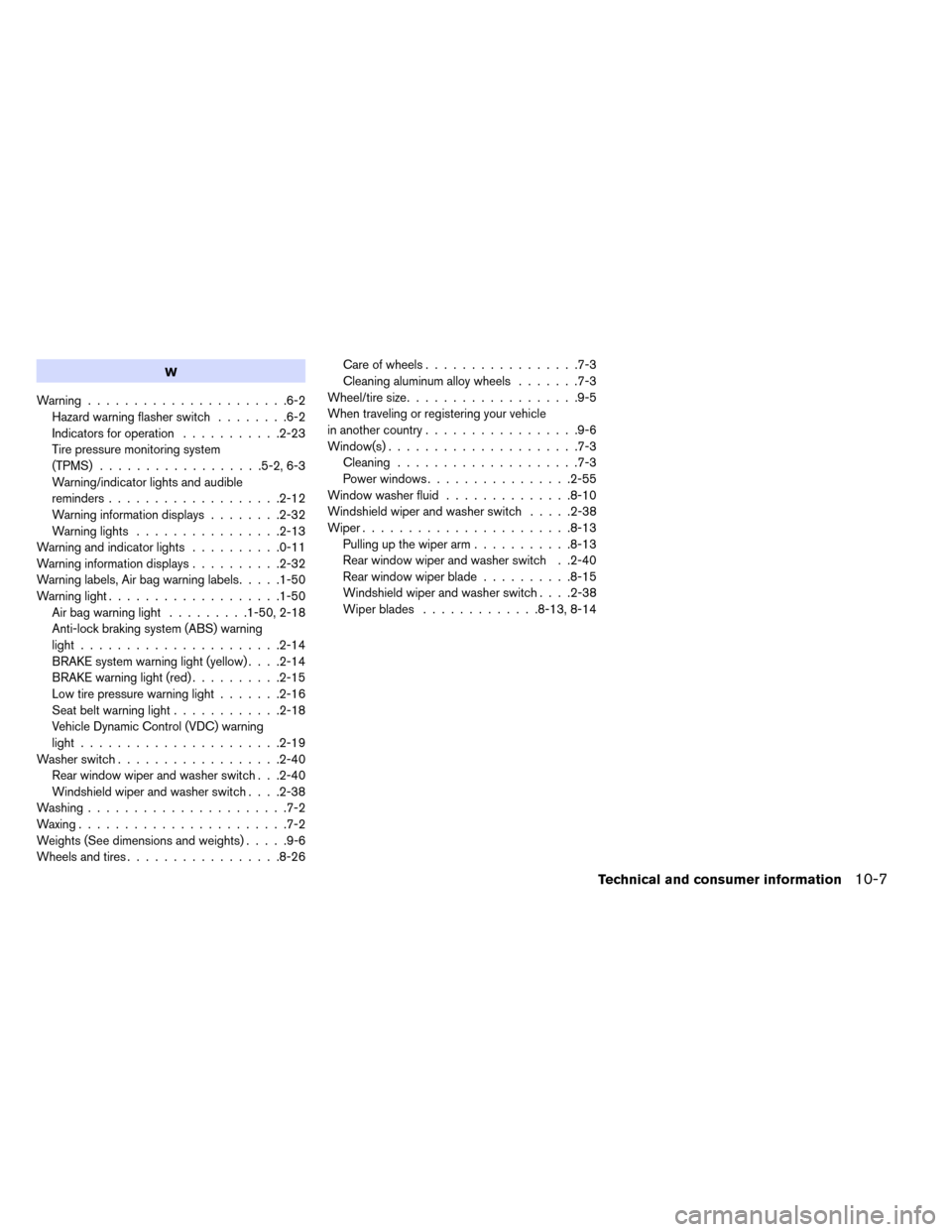
W
Warning......................6-2Hazard warning flasher switch ........6-2
Indicators for operation ...........2-23
Tire pressure monitoring system
(TPMS) ..................5-2,6-3
Warning/indicator lights and audible
reminders ...................2-12
Warning information displays ........2-32
Warninglights ................2-13
Warningandindicatorlights ..........0-11
Warninginformationdisplays..........2-32
Warninglabels,Airbagwarninglabels.....1-50
Warninglight...................1-50 Airbagwarninglight .........1-50,2-18
Anti-lock braking system (ABS) warning
light......................2-14
BRAKE system warning light (yellow) ....2-14
BRAKE warning light (red) ..........2-15
Low tire pressure warning light .......2-16
Seatbeltwarninglight............2-18
Vehicle Dynamic Control (VDC) warning
light......................2-19
Washer switch ..................2-40
Rear window wiper and washer switch . . .2-40
Windshield wiper and washer switch ....2-38
Washing ......................7-2
Waxing.......................7-2
Weights(Seedimensionsandweights).....9-6
Wheels and tires .................8-26 Careofwheels.................7-3
Cleaning aluminum alloy wheels
.......7-3
Wheel/tire size ...................9-5
When traveling or registering your vehicle
inanothercountry.................9-6
Window(s) .....................7-3
Cleaning ....................7-3
Powerwindows................2-55
Window washer fluid ..............8-10
Windshieldwiperandwasherswitch .....2-38
Wiper.......................8-13 Pulling up the wiper arm ...........8-13
Rear window wiper and washer switch . .2-40
Rear window wiper blade ..........8-15
Windshieldwiperandwasherswitch....2-38
Wiperblades .............8-13,8-14
Technical and consumer information10-7