battery NISSAN LEAF 2015 1.G Roadside Assistance Guide
[x] Cancel search | Manufacturer: NISSAN, Model Year: 2015, Model line: LEAF, Model: NISSAN LEAF 2015 1.GPages: 39, PDF Size: 1.16 MB
Page 18 of 39
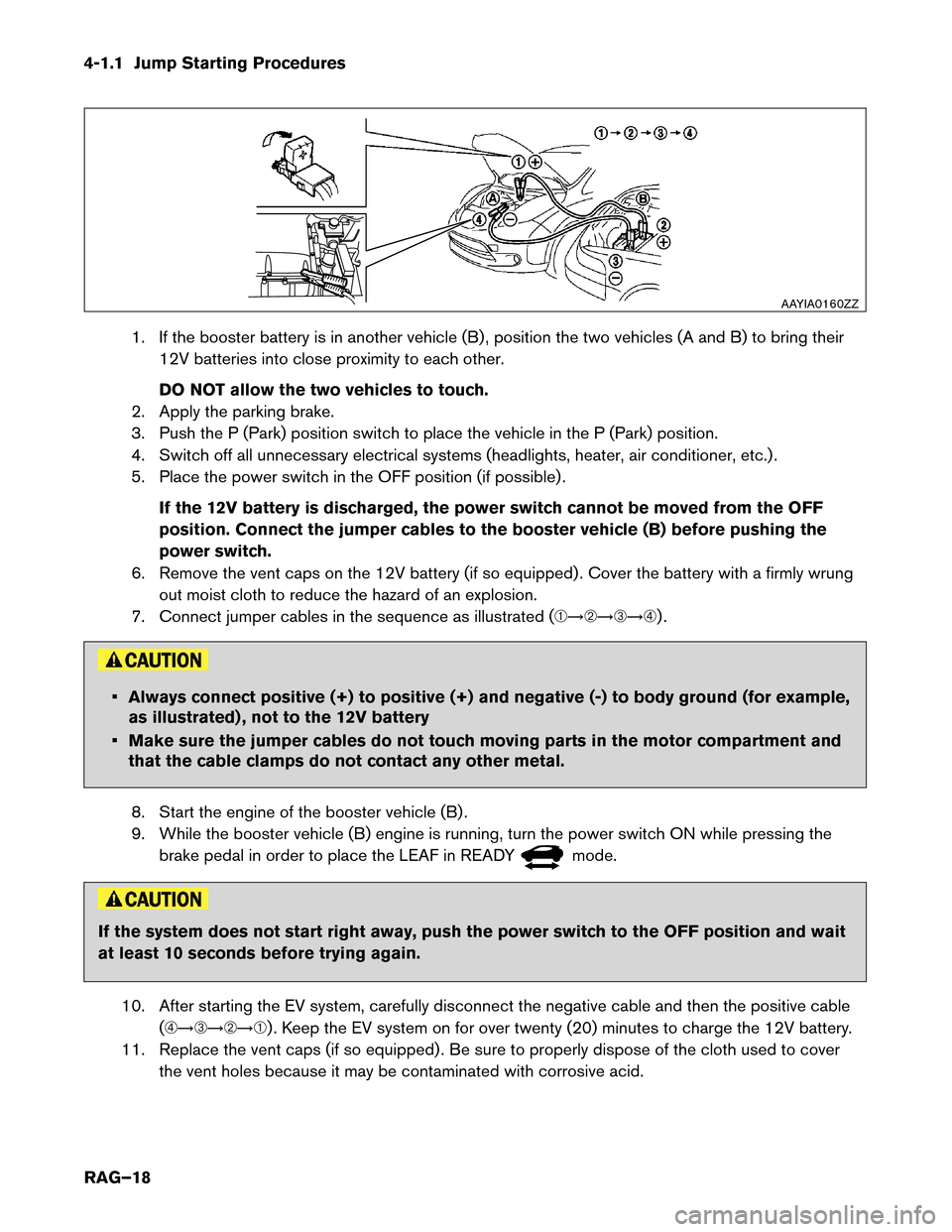
4-1.1 Jump Starting Procedures
1. If the booster battery is in another vehicle (B) , position the two vehicles (A and B) to bring their
12V batteries into close proximity to each other.
DO NOT allow the two vehicles to touch.
2. Apply the parking brake.
3. Push the P (Park) position switch to place the vehicle in the P (Park) position.
4. Switch off all unnecessary electrical systems (headlights, heater, air conditioner, etc.) .
5. Place the power switch in the OFF position (if possible) .
If the 12V battery is discharged, the power switch cannot be moved from the OFF
position. Connect the jumper cables to the booster vehicle (B) before pushing the
power switch.
6. Remove the vent caps on the 12V battery (if so equipped) . Cover the battery with a firmly wrung out moist cloth to reduce the hazard of an explosion.
7. Connect jumper cables in the sequence as illustrated () . • Always connect positive (+) to positive (+) and negative (-) to body ground (for example,
as
illustrated) , not to the 12V battery
• Make sure the jumper cables do not touch moving parts in the motor compartment and that the cable clamps do not contact any other metal.
8. Start the engine of the booster vehicle (B) .
9. While the booster vehicle (B) engine is running, turn the power switch ON while pressing the brake pedal in order to place the LEAF in READY mode.
If the system does not start right away, push the power switch to the OFF position and wait
at
least 10 seconds before trying again.
10. After starting the EV system, carefully disconnect the negative cable and then the positive cable () . Keep the EV system on for over twenty (20) minutes to charge the 12V battery.
11. Replace the vent caps (if so equipped) . Be sure to properly dispose of the cloth used to cover the vent holes because it may be contaminated with corrosive acid. AAYIA0160ZZ
RAG–18
Page 19 of 39
12. If necessary, connect the vehicle to a charging station or EVSE (Electric Vehicle Supply
Equipment) to charge the Li-ion battery. The vehicle cannot be driven unless the Li-ion battery is
charged.
NOTE:
If it is not possible to turn the LEAF system ON by following this procedure, contact a
NISSAN certified LEAF dealer immediately.
4-2 P (Park) Position Release Procedure
If you need to release the vehicle from the P (Park) position, proceed as follows. When power switch is
turned OFF or 12V battery is low, LEAF automatically shifts to P position.
NOTE: This procedure requires two (2) people.
1. To start the EV system with a booster battery, refer to 4-1 Jump Starting (RAG–17).
2.
Turn power switch ON by pushing the power switch 2 times without pressing brake pedal.
3. Confirm parking brake is applied.
4. Close all doors and press and hold the brake pedal.
5. Place the selector lever in the N (Neutral) position.
6. Remove the following 2 fuses:
• F/L 40A PBW MTR (under hood fuse and relay box)
• METER 1 10A (in the cabin fuse box)
RAG–19
Page 21 of 39
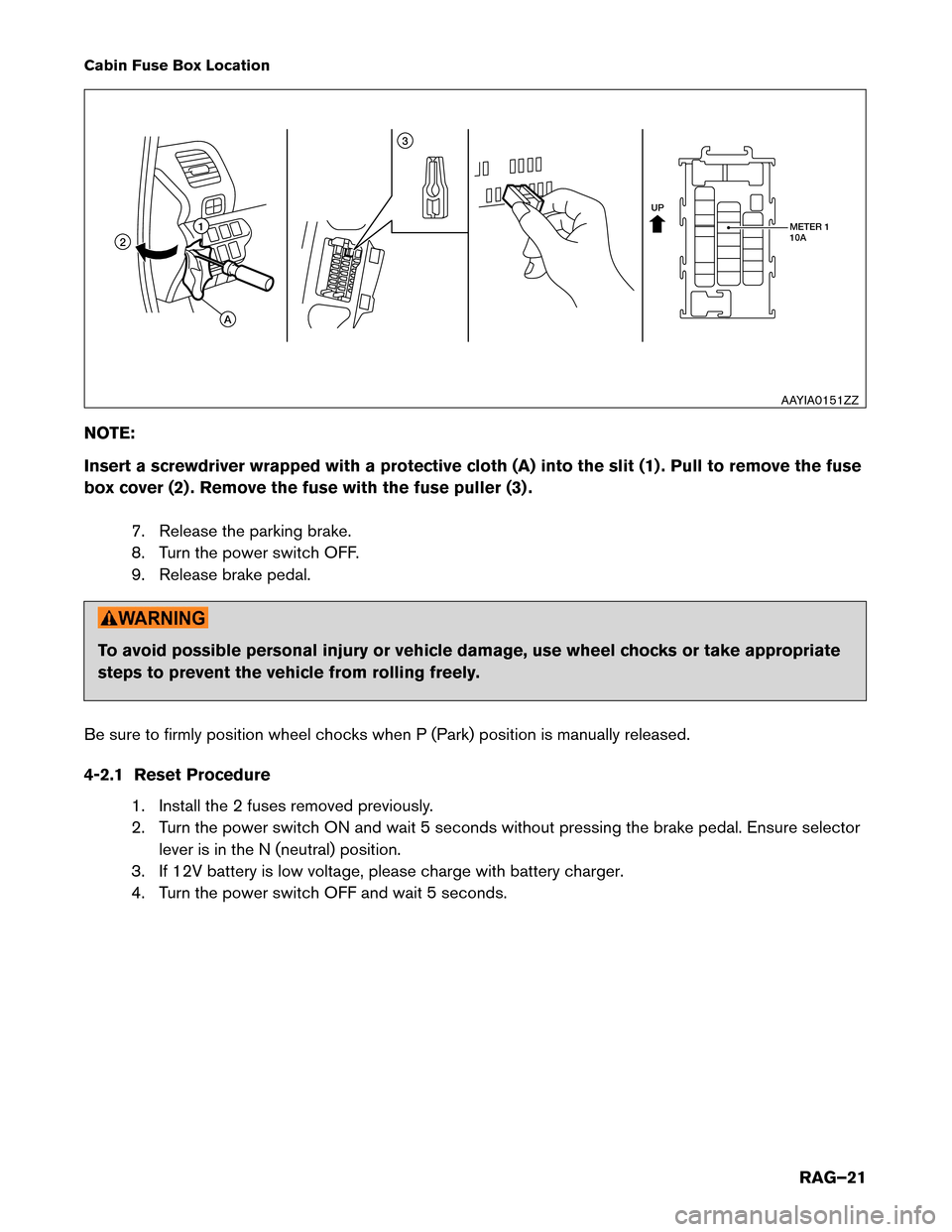
Cabin Fuse Box Location
NO
TE:
Insert a screwdriver wrapped with a protective cloth (A) into the slit (1) . Pull to remove the fuse
box cover (2) . Remove the fuse with the fuse puller (3) .
7. Release the parking brake.
8. Turn the power switch OFF.
9. Release brake pedal. To avoid possible personal injury or vehicle damage, use wheel chocks or take appropriate
steps
to prevent the vehicle from rolling freely.
Be sure to firmly position wheel chocks when P (Park) position is manually released.
4-2.1 Reset Procedure 1. Install the 2 fuses removed previously.
2. Turn the power switch ON and wait 5 seconds without pressing the brake pedal. Ensure selectorlever is in the N (neutral) position.
3. If 12V battery is low voltage, please charge with battery charger.
4. Turn the power switch OFF and wait 5 seconds. UP
METER 1
10A
11 3
2
A
AAYIA0151ZZ
RAG–21
Page 33 of 39
5. Storing the Vehicle
The service plug must be removed to shut down the high voltage system for storage.
Do
not store a vehicle inside a structure. Keep the vehicle away from other vehicles if the
li-ion battery is severely damaged. There is possibility of delayed fire from a severely
damaged li-ion battery.
RAG–33
Page 35 of 39
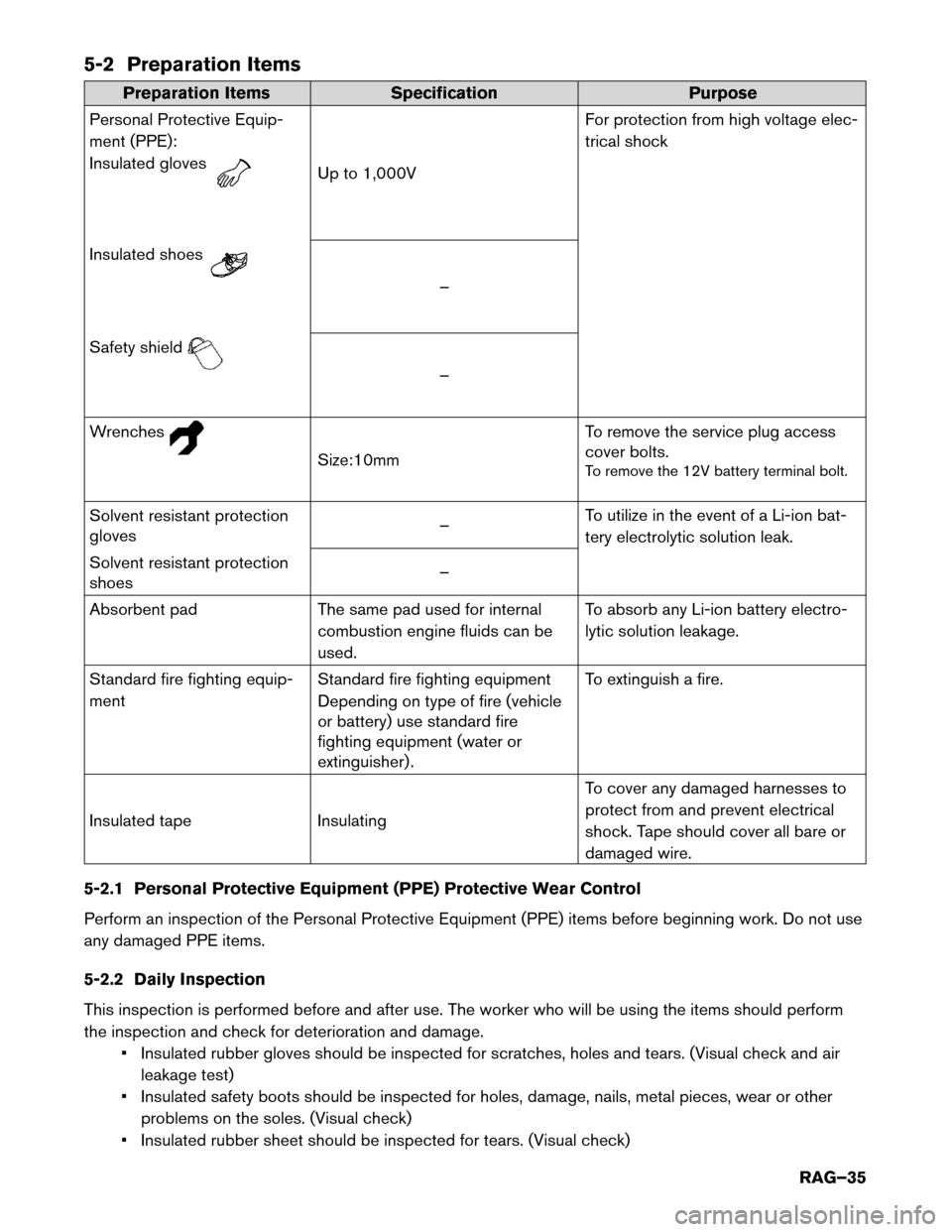
5-2 Preparation Items
Preparation Items
Specification Purpose
Personal Protective Equip-
ment (PPE):
Insulated gloves Up to 1,000V
For
protection from high voltage elec-
trical shock
Insulated shoes –
Safety
shield –
W
renches Size:10mm
T
o remove the service plug access
cover bolts.
To remove the 12V battery terminal bolt.
Solvent resistant protection
gloves –
To utilize in the event of a Li-ion bat-
tery electrolytic solution leak.
Solvent resistant protection
shoes –
Absorbent pad The same pad used for internal
combustion engine fluids can be
used. To absorb any Li-ion battery electro-
lytic solution leakage.
Standard fire fighting equip-
ment Standard fire fighting equipment
Depending on type of fire (vehicle
or battery) use standard fire
fighting equipment (water or
extinguisher) . To extinguish a fire.
Insulated tape Insulating To cover any damaged harnesses to
protect from and prevent electrical
shock. Tape should cover all bare or
damaged wire.
5-2.1 Personal Protective Equipment (PPE) Protective Wear Control
Perform an inspection of the Personal Protective Equipment (PPE) items before beginning work. Do not use
any damaged PPE items.
5-2.2 Daily Inspection
This inspection is performed before and after use. The worker who will be using the items should perform
the inspection and check for deterioration and damage. • Insulated rubber gloves should be inspected for scratches, holes and tears. (Visual check and airleakage test)
• Insulated safety boots should be inspected for holes, damage, nails, metal pieces, wear or other problems on the soles. (Visual check)
• Insulated rubber sheet should be inspected for tears. (Visual check)
RAG–35
Page 36 of 39
5-2.3 Insulated Tools
When
performing work at locations where high voltage is applied (such as terminals) , use insulated tools
meeting 1,000V/300A specifications.
5-3 Removing the Service Plug • Do not remove the service plug without always wearing appropriate Personal
Protective
Equipment (PPE) to help protect the responder from serious injury or death
by electrical shock.
• Immediately cover the service plug socket with insulated tape. The Li-ion battery
retains
high voltage power even when the service plug is removed. To avoid electric
shock, NEVER touch the terminals inside the socket. To avoid unintended reinstallation and risk of electrical shock and severe personal injury
or
death, the service plug should be securely stored away from the vehicle while the vehicle
is in storage.
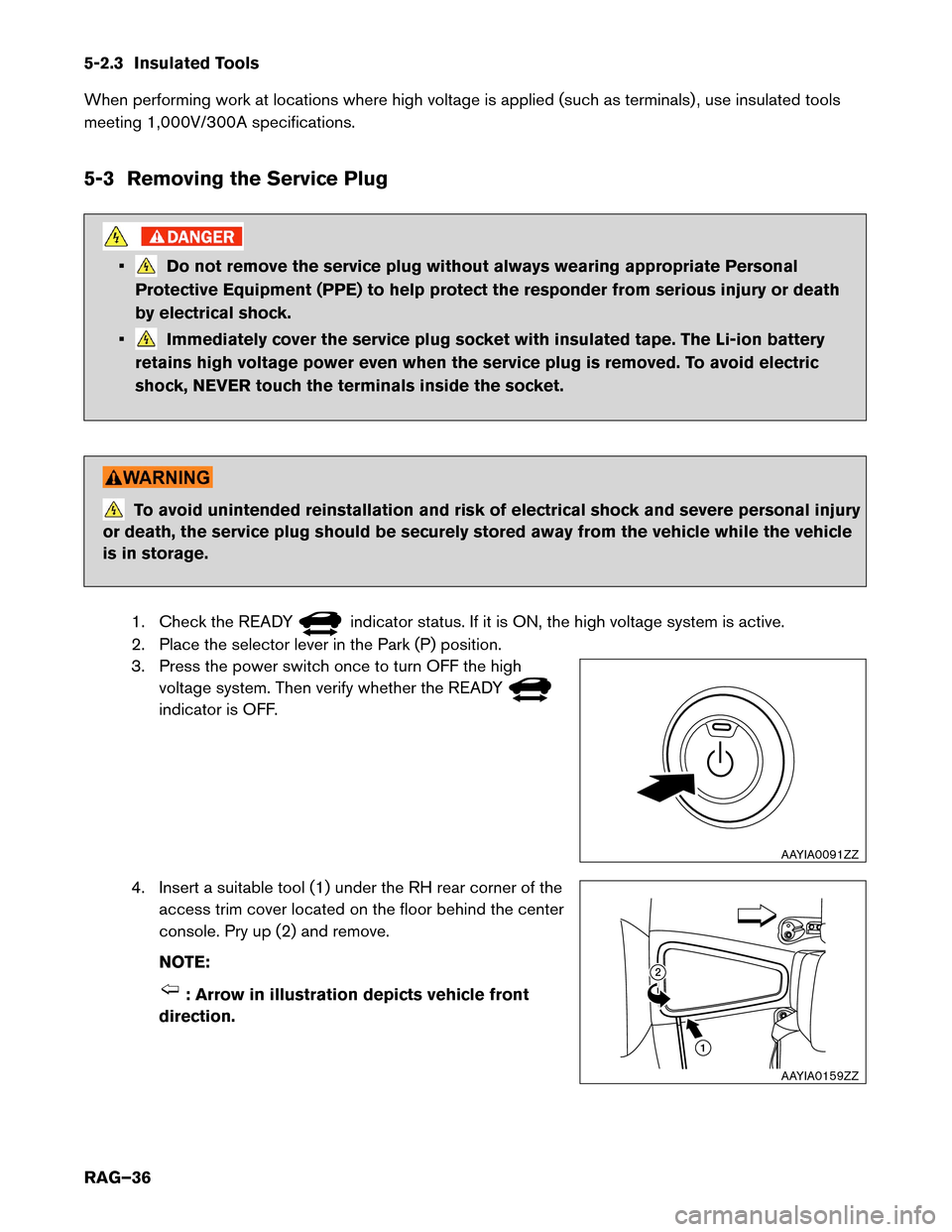
1. Check the READY indicator status. If it is ON, the high voltage system is active.
2.
Place the selector lever in the Park (P) position.
3. Press the power switch once to turn OFF the high voltage system. Then verify whether the READY indicator is OFF.
4.
Insert a suitable tool (1) under the RH rear corner of the
access trim cover located on the floor behind the center
console. Pry up (2) and remove.
NOTE: : Arrow in illustration depicts vehicle front
direction. AAYIA0091ZZ
12
AAYIA0159ZZ
RAG–36
Page 38 of 39
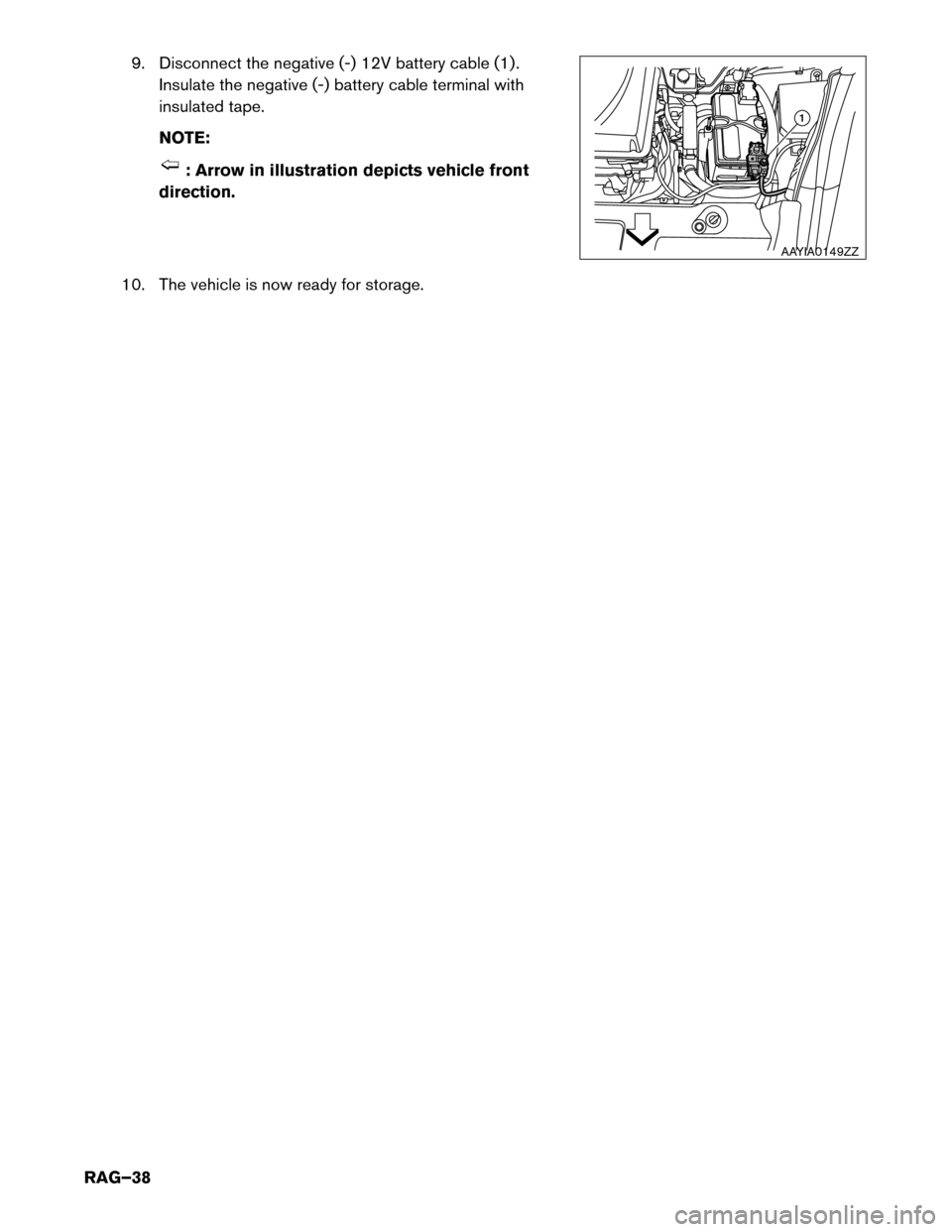
9. Disconnect the negative (-) 12V battery cable (1) .
Insulate the negative (-) battery cable terminal with
insulated tape.
NOTE: : Arrow in illustration depicts vehicle front
direction.
10.
The vehicle is now ready for storage. 1
AAYIA0149ZZ
RAG–38