maintenance NISSAN LEAF 2017 1.G Owner's Manual
[x] Cancel search | Manufacturer: NISSAN, Model Year: 2017, Model line: LEAF, Model: NISSAN LEAF 2017 1.GPages: 424, PDF Size: 4.51 MB
Page 307 of 424
WARNING
• Do not leave children or adults who would normally require the support of
others alone in your vehicle. Pets
should not be left alone either. They
could accidentally injure themselves or
others through inadvertent operation
of the vehicle. Also, on hot, sunny days,
temperatures in a closed vehicle could
quickly become high enough to cause
severe or possibly fatal injuries to
people or animals.
• Properly secure all cargo with ropes or straps to help prevent it from sliding or
shifting. Do not place cargo higher
than the seatbacks. In a sudden stop or
collision, unsecured cargo could cause
personal injury.
TIRE PRESSURE MONITORING
SYSTEM (TPMS)
Each tire, including the spare (if provided) ,
should be checked monthly when cold and in-
flated to the inflation pressure recommended by
the vehicle manufacturer on the vehicle placard
or tire inflation pressure label. (If your vehicle has
tires of a different size than the size indicated on
the vehicle placard or tire inflation pressure label, you should determine the proper tire inflation
pressure for those tires.)
As an added safety feature, your vehicle has been
equipped with a Tire Pressure Monitoring System
(TPMS) that illuminates a low tire pressure telltale
when one or more of your tires is significantly
under-inflated. Accordingly, when the low tire
pressure telltale illuminates, you should stop and
check your tires as soon as possible, and inflate
them to the proper pressure. Driving on a signifi-
cantly under-inflated tire causes the tire to over-
heat and can lead to tire failure. Under-inflation
also reduces power efficiency and tire tread life,
and may affect the vehicle’s handling and stop-
ping ability.
Please note that the TPMS is not a substitute for
proper tire maintenance, and it is the driver’s
responsibility to maintain correct tire pressure,
even if under-inflation has not reached the level to
trigger illumination of the TPMS low tire pressure
telltale.
Your vehicle has also been equipped with a
TPMS malfunction indicator to indicate when the
system is not operating properly. The TPMS mal-
function indicator is combined with the low tire
pressure telltale. When the system detects a
malfunction, the telltale will flash for approxi-
mately one minute and then remain continuously
illuminated. This sequence will continue upon
subsequent vehicle start-ups as long as the mal-
function exists. When the malfunction indicator is
illuminated, the system may not be able to detect
or signal low tire pressure as intended. TPMS
malfunctions may occur for a variety of reasons,
including the installation of replacement or alter-
nate tires or wheels on the vehicle that prevent
the TPMS from functioning properly. Always
check the TPMS malfunction telltale after replac-
ing one or more tires or wheels on your vehicle to
ensure that the replacement or alternate tires and
wheels allow the TPMS to continue to function
properly.
Additional information
• The TPMS will activate only when the vehicle is
driven at speeds above 16 mph (25 km/h) . Also,
this system may not detect a sudden drop in tire
pressure (for example, a flat tire while driving) .
• The low tire pressure warning light does not automatically turn off when the tire pressure is
adjusted. After the tire is inflated to the recom-
mended pressure, the vehicle must be driven at
speeds above 16 mph (25 km/h) to active the
TPMS and turn off the low tire pressure warning
PRECAUTIONS WHEN STARTING
AND DRIVING
5-2Starting and driving
Page 311 of 424
6. When it is safe to do so, gradually turn thesteering wheel until both tires return to the
road surface. When all tires are on the road
surface, steer the vehicle to stay in the appro-
priate driving lane.
•If you decide that it is not safe to return the
vehicle to the road surface based on vehicle,
road or traffic conditions, gradually slow the
vehicle to a stop in a safe place off the road.
RAPID AIR PRESSURE LOSS
Rapid air pressure loss or a “blow-out” can occur
if the tire is punctured or is damaged due to
hitting a curb or pothole. Rapid air pressure loss
can also be caused by driving on under-inflated
tires.
Rapid air pressure loss can affect the handling
and stability of the vehicle, especially at highway
speeds.
Help prevent rapid air pressure loss by maintain-
ing the correct air pressure and visually inspect-
ing the tires for wear and damage. For additional
information, refer to “Wheels and tires” in the
“Maintenance and do-it-yourself” section of this
manual. If a tire rapidly loses air pressure or “blows-out”
while driving, maintain control of the vehicle by
following the procedure below. Please note that
this procedure is only a general guide. The ve-
hicle must be driven as appropriate based on the
conditions of the vehicle, road and traffic.
WARNING
The following actions can increase the
chance of losing control of the vehicle if
there is a sudden loss of tire air pressure.
Losing control of the vehicle may cause a
collision and result in personal injury.
• The vehicle generally moves or pulls in the direction of the flat tire.
• Do not rapidly apply the brakes.
• Do not rapidly release the accelerator pedal.
• Do not rapidly turn the steering wheel.
1. Remain calm and do not overreact.
2. Maintain a firm grip on the steering wheel with both hands and try to hold a straight course.
3. When appropriate, slowly release the accel- erator pedal to gradually slow the vehicle.
4. Gradually steer the vehicle to a safe location off the road and away from traffic if possible. 5. Lightly apply the brake pedal to gradually stop
the vehicle.
6. Turn on the hazard warning flashers and con- tact a roadside emergency service to change
the tire. For additional information, refer to
“Flat tire” in the “In case of emergency” sec-
tion of this manual.
DRINKING ALCOHOL/DRUGS AND
DRIVING
WARNING
Never drive under the influence of alco-
hol or drugs. Alcohol in the bloodstream
reduces coordination, delays reaction
time and impairs judgement. Driving af-
ter drinking alcohol increases the likeli-
hood of being involved in an accident
injuring yourself and others. Additionally,
if you are injured in an accident, alcohol
can increase the severity of the injury.
NISSAN is committed to safe driving. However,
you must choose not to drive under the influence
of alcohol. Every year thousands of people are
injured or killed in alcohol-related accidents. Al-
though the local laws vary on what is considered
to be legally intoxicated, the fact is that alcohol
5-6Starting and driving
Page 315 of 424
The power switch cannot be placed in the LOCK
position until the vehicle is in the P (Park) posi-
tion.
CAUTION
Do not leave the vehicle with the power
switch in the ACC position for an ex-
tended period of time. This can discharge
the 12-volt battery.
NOTE:
If the power switch is pushed quickly or is
pushed twice quickly, the switch may not
function even if a chime sound is heard.
Push the switch again more slowly.
EMERGENCY EV SHUT OFF
To shut off the EV system in an emergency situ-
ation while driving, perform the following proce-
dure.
• Rapidly push the power switch three consecu- tive times in less than 1.5 seconds, or
• Push and hold the power switch for more than 2 seconds.
NISSAN INTELLIGENT KEY®
BATTERY DISCHARGE
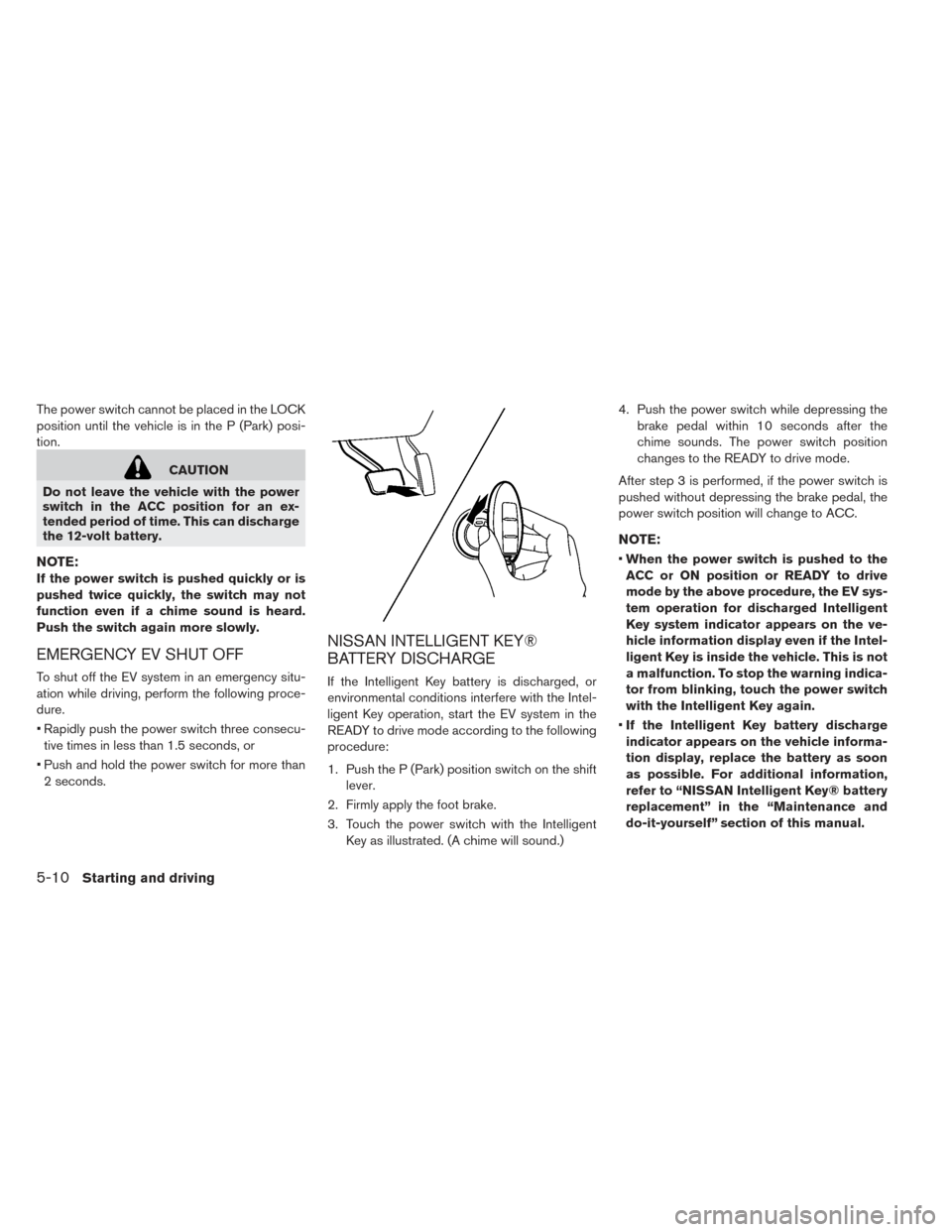
If the Intelligent Key battery is discharged, or
environmental conditions interfere with the Intel-
ligent Key operation, start the EV system in the
READY to drive mode according to the following
procedure:
1. Push the P (Park) position switch on the shift lever.
2. Firmly apply the foot brake.
3. Touch the power switch with the Intelligent Key as illustrated. (A chime will sound.) 4. Push the power switch while depressing the
brake pedal within 10 seconds after the
chime sounds. The power switch position
changes to the READY to drive mode.
After step 3 is performed, if the power switch is
pushed without depressing the brake pedal, the
power switch position will change to ACC.
NOTE:
• When the power switch is pushed to the
ACC or ON position or READY to drive
mode by the above procedure, the EV sys-
tem operation for discharged Intelligent
Key system indicator appears on the ve-
hicle information display even if the Intel-
ligent Key is inside the vehicle. This is not
a malfunction. To stop the warning indica-
tor from blinking, touch the power switch
with the Intelligent Key again.
• If the Intelligent Key battery discharge
indicator appears on the vehicle informa-
tion display, replace the battery as soon
as possible. For additional information,
refer to “NISSAN Intelligent Key® battery
replacement” in the “Maintenance and
do-it-yourself” section of this manual.
5-10Starting and driving
Page 323 of 424
• Push, then quickly release, the COAST/SETswitch. Each time you do this, the set speed will
decrease by about 1 mph or 1km/h.
To resume the preset speed, push and re-
lease the ACCEL/RES switch. The vehicle will
resume the last set cruising speed when the
vehicle speed is over 25 mph (40 km/h) . Vehicle range depends on a number of factors.
Actual vehicle range will vary depending upon:
• speed
• vehicle load
• electrical load from vehicle accessories
• traffic and road conditions
NISSAN recommends the following driving
habits to help maximize vehicle range:
Before driving:
• Follow recommended periodic maintenance.
• Keep tires inflated to correct pressure.
• Keep wheels in correct alignment.
• Pre-heat or pre-cool the interior cabin while the
vehicle is charging.
• Remove unnecessary cargo from the vehicle.
While driving:
• Drive in ECO mode – The ECO mode helps reduce power con-sumption by reducing acceleration when
compared to the same accelerator pedal
position in the D (Drive) position.
• Drive at a constant speed. Maintain cruising speeds with a constant accelerator position or
by using cruise control when appropriate. • Accelerate slowly and smoothly. Gently press
and release the accelerator pedal for accelera-
tion and deceleration.
• Drive at moderate speeds on the highway.
• Avoid frequent stopping and braking. Maintain a safe distance behind other vehicles.
• Turn off the air conditioner/heater when it is not necessary.
• Select a moderate temperature setting for heat- ing or cooling to help reduce power
consumption.
• Use the air conditioner/heater and close win- dows to reduce drag when cruising at highway
speed.
• Release the accelerator pedal to slow down and do not apply the brakes when traffic and
road conditions allow. – This vehicle is equipped with a regenerative brake system. The primary purpose of the
regenerative brake system is to provide
some power to recharge the Li-ion battery
and extend driving range. A secondary ben-
efit is “engine braking” that operates based
on Li-ion battery conditions. In the D (Drive)
INCREASING POWER ECONOMY
5-18Starting and driving
Page 332 of 424
FREEING A FROZEN DOOR LOCK
To prevent a door lock from freezing, apply deicer
through the key hole. If the lock becomes frozen,
heat the key before inserting it into the key hole or
use the remote keyless entry key fob.
ANTIFREEZE
In the winter when it is possible that the outside
temperature will drop below 32°F (0°C) , check
the antifreeze to ensure proper winter protection.
For additional information, refer to “Cooling sys-
tem” in the “Maintenance and do-it-yourself” sec-
tion of this manual.
12-VOLT BATTERY
If the 12-volt battery is not fully charged during
extremely cold weather conditions, the 12-volt
battery fluid may freeze and damage the 12-volt
battery. To maintain maximum efficiency, the 12-
volt battery should be checked regularly. For ad-
ditional information, refer to “12-volt battery” in
the “Maintenance and do-it-yourself” section of
this manual.
DRAINING OF COOLANT WATER
If the vehicle is to be left outside without anti-
freeze, drain the cooling system. Refill before
operating the vehicle. For additional information,
refer to “Cooling system” in the “Maintenance
and do-it-yourself” section of this manual.
TIRE EQUIPMENT
SUMMER tires have a tread designed to provide
superior performance on dry pavement. How-
ever, the performance of these tires will be sub-
stantially reduced in snowy and icy conditions. If
you operate your vehicle on snowy or icy roads,
NISSAN recommends the use of MUD & SNOW
or ALL SEASON tires on all four wheels. It is
recommended that you visit a NISSAN certified
LEAF dealer for the tire type, size, speed rating
and availability information.
For additional traction on icy roads, studded tires
may be used. However, some U.S. states and
Canadian provinces prohibit their use. Check
local, state and provincial laws before installing
studded tires.Skid and traction capabilities of studded
snow tires, on wet or dry surfaces, may be
poorer than that of non-studded snow tires.
Tire chains may be used. For additional informa-
tion, refer to “Tire chains” in the “Maintenance
and do-it-yourself” section of this manual.
SPECIAL WINTER EQUIPMENT
It is recommended that the following items be
carried in the vehicle during winter:
• A scraper and stiff-bristled brush to remove ice
and snow from the windows and wiper blades.
• A shovel to dig the vehicle out of snow-drifts.
• Extra windshield-washer fluid to refill the reser- voir tank.
Starting and driving5-27
Page 358 of 424
8 Maintenance and do-it yourself
Maintenance requirement................. .8-2
Scheduled maintenance ................ .8-2
General maintenance .................. .8-2
Where to go for service ................ .8-2
General maintenance .................... .8-2
Explanation of maintenance items ...........8-2
Maintenance precautions ................. .8-5
Motor compartment check locations ............8-7
Cooling system ....................... .8-8
Checking coolant level ................. .8-9
Changing coolant .................... .8-9
Reduction gear fluid .................... .8-10
Brake fluid ......................... .8-10
Windshield-washer fluid ................. .8-11
12-volt battery ....................... .8-12
Jump starting ...................... .8-13
Windshield wiper blades ................. .8-13
Cleaning ........................ .8-13
Replacing ........................ .8-14Rear window wiper blade
...............8-16
Brakes ........................... .8-16
Brake pad wear warning ................8-16
Fuses ............................ .8-17
Motor compartment .................. .8-17
Passenger compartment ................8-19
Nissan Intelligent Key® battery replacement ......8-20
Lights ............................ .8-22
Headlights ....................... .8-22
Exterior and interior lights ...............8-24
Wheels and tires ..................... .8-26
Tire pressure ...................... .8-26
Tire labeling ...................... .8-30
Types of tires ...................... .8-32
Tire chains .......................
.8-33
Changing
wheels and tires .............. .8-33
Emergency tire puncture repair kit ..........8-36
Page 359 of 424
Your new NISSAN has been designed to have
minimum maintenance requirements with long
service intervals to save you both time and
money. However, some day-to-day and regular
maintenance is essential to maintain your NISSA-
N’s fine mechanical condition, and its Electric
Vehicle (EV) system performance.
It is the owner’s responsibility to make sure that
the scheduled maintenance, and general mainte-
nance, is performed.
As the vehicle owner, you are the only one who
can ensure that your vehicle receives the proper
maintenance care. You are a vital link in the main-
tenance chain.
SCHEDULED MAINTENANCE
For your convenience, both required and optional
scheduled maintenance items are described and
listed in your “NISSAN Service and Maintenance
Guide”. You must refer to that guide to ensure
that necessary maintenance is performed on your
NISSAN at regular intervals.
GENERAL MAINTENANCE
General maintenance includes those items which
should be checked during normal day-to-day op-
eration. They are essential for proper vehicle op-eration. It is your responsibility to perform these
procedures regularly as prescribed.
Performing general maintenance checks requires
minimal mechanical skill and only a few general
automotive tools.
These checks or inspections can be done by
yourself, a qualified technician or, if you prefer, a
NISSAN certified LEAF dealer.
WHERE TO GO FOR SERVICE
If maintenance service is required or your vehicle
appears to malfunction, have the systems
checked and serviced. It is recommended that
you visit a NISSAN certified LEAF dealer for this
service.
NISSAN technicians are well-trained specialists
and are kept up-to-date with the latest service
information through technical bulletins, service
tips, and in-dealership information systems. They
are completely qualified to work on NISSAN ve-
hicles
before work begins.
You can be confident that a NISSAN certified
LEAF dealer’s service department performs the
best job to meet the maintenance requirements
on your vehicle — in a reliable and economical
way. During the normal day-to-day operation of the
vehicle, general maintenance should be per-
formed regularly as prescribed in this section. If
you detect any unusual sounds, vibrations or
smell, be sure to check for the cause or have a
NISSAN certified LEAF dealer do it promptly. In
addition, you should notify a NISSAN certified
LEAF dealer if you think that repairs are required.
When performing any checks or maintenance
work, refer to “Maintenance precautions” in this
section.
EXPLANATION OF MAINTENANCE
ITEMS
Additional information on the following
items with “*” is found in this section.
Outside vehicle
The maintenance items listed here should be
performed from time to time, unless otherwise
specified.
Doors and motor hood:
Check that all doors
and the motor hood operate properly. Also en-
sure that all latches lock securely. Lubricate
hinges, latches, latch pins, rollers and links if
necessary. Make sure that the secondary latch
MAINTENANCE REQUIREMENT GENERAL MAINTENANCE
8-2Maintenance and do-it yourself
Page 360 of 424
keeps the motor hood from opening when the
primary latch is released.
When driving in areas using road salt or other
corrosive materials, check lubrication frequently.
Lights*:Clean the headlights on a regular basis.
Make sure that the headlights, stop lights, tail
lights, turn signal lights and other lights are all
operating properly and installed securely. Also
check the aim of the headlights.
Road wheel nuts (lug nuts)*: When checking
the tires, make sure that no wheel nuts are miss-
ing, and check for any loose wheel nuts. Tighten
if necessary.
Tire rotation*: Tires should be rotated every
5,000 miles (8,000 km) .
Tires*: Check the pressure with a gauge often
and always prior to long distance trips. If neces-
sary, adjust the pressure in all tires to the pres-
sure specified. Check carefully for damage, cuts
or excessive wear.
Tire Pressure Monitoring System (TPMS)
transmitter components: Replace the TPMS
transmitter grommet seal, valve core and cap
when the tires are replaced due to wear or age. Wheel alignment and balance:
If the vehicle
pulls to either side while driving on a straight and
level road, or if you detect uneven or abnormal tire
wear, there may be a need for wheel alignment.
If the steering wheel or seat vibrates at normal
highway speeds, wheel balancing may be
needed.
For additional information regarding tires, refer to
“Important Tire Safety Information” (US) or “Tire
Safety Information” (Canada) in the Warranty In-
formation Booklet.
Windshield: Clean the windshield on a regular
basis. Check the windshield at least every six
months for cracks or other damage. Have a dam-
aged windshield repaired by a qualified repair
facility.
Wiper blades*: Check for cracks or wear if they
do not wipe properly.
Inside vehicle
The maintenance items listed here should be
checked on a regular basis, such as when per-
forming scheduled maintenance, cleaning the ve-
hicle, etc.
Accelerator pedal: Check the pedal for smooth
operation and make sure that the pedal does not catch or require uneven effort. Keep the floor mat
away from the pedal.
Brake pedal:
Check the pedal for smooth op-
eration. If the brake pedal suddenly goes down
further than normal, the pedal feels spongy or the
vehicle seems to take longer to stop, it is recom-
mended that you visit a NISSAN certified LEAF
dealer immediately. Keep the floor mat away from
the pedal.
Brakes: Check that the brakes do not pull the
vehicle to one side when applied.
Electric shift P (Park) position mechanism:
On a steep hill, check that the vehicle is held
securely while the vehicle is in the P (Park) posi-
tion without applying the brakes.
Parking brake: Check the parking brake opera-
tion regularly. The vehicle should be securely held
on a steep hill with only the parking brake applied.
If the parking brake cannot keep a vehicle posi-
tion, it is recommended that you visit a NISSAN
certified LEAF dealer for this service.
Seat: Check seat position controls such as the
seat adjusters, seatback recliners, etc. to ensure
that they operate smoothly and that all latches
lock securely in every position. Check that the
head restraints/headrests move up and down
Maintenance and do-it yourself8-3
Page 361 of 424
smoothly and that the locks (if so equipped) hold
securely in all latched positions.
Seat belts:Check that all parts of the seat belt
system (for example, buckles, anchors, adjusters
and retractors) operate properly and smoothly,
and are installed securely. Check the belt web-
bing for cuts, fraying, wear or damage.
Steering wheel: Check for changes in the
steering conditions, such as excessive free play,
hard steering or strange noises.
Warning lights and chimes: Make sure that all
warning lights and chimes are operating properly.
Windshield defroster: Check that the air emits
from the defroster outlets properly and in suffi-
cient quantity when operating the heater or air
conditioner.
Windshield wiper and washer*: Check that
the wipers and washers operate properly and
that the wipers do not streak.
Under hood and vehicle
The maintenance items listed here should be
checked periodically.
12-volt battery (for serviceable battery)*:
Check the fluid level in each cell. It should be
between the MAX and MIN lines. Vehicles oper- ated in high temperatures or under severe condi-
tions require frequent checks of the 12–volt bat-
tery fluid level.
NOTE:
Care should be taken to avoid situations
that can lead to potential battery discharge
and potential no-start conditions such as:
1.
Installation or extended use of elec-
tronic accessories that consume battery
power when the engine is not running
(Phone chargers, GPS, DVD players,
etc.)
2. Vehicle is not driven regularly and/or
only driven short distances.
In these cases, the battery may need to be
charged to maintain battery health.
Brake fluid level*: Make sure that the brake
fluid level is between the “MAX” and “MIN” lines
on the reservoir.
Coolant level*: Check the coolant level when
the motor compartment is cold.
Fluid leaks: Check under the vehicle for water
or other fluid leaks after the vehicle has been
parked for a while. Water dripping from the air
conditioner after use is normal. If you should notice any leaks, check for cause and have it
corrected immediately.
Radiator and hoses:
Check the front of the
radiator and clean off any dirt, insects, leaves,
etc., that may have accumulated. Make sure that
the hoses have no cracks, deformation, rot or
loose connections.
Underbody: The underbody is frequently ex-
posed to corrosive substances such as those
used on icy roads or to control dust. It is very
important to remove these substances, other-
wise rust will form on the floor pan and frame. At
the end of winter, the underbody should be thor-
oughly flushed with plain water, being careful to
clean those areas where mud and dirt may accu-
mulate. For additional information, refer to
“Cleaning exterior” in the “Appearance and care”
section of this manual.
Windshield-washer fluid*: Check that there is
an adequate amount of fluid in the reservoir.
8-4Maintenance and do-it yourself
Page 362 of 424
When performing any inspection or maintenance
work on your vehicle, always take care to prevent
serious accidental injury to yourself or damage to
the vehicle. The following are general precau-
tions that should be closely observed.
WARNING
• The EV system uses high voltage up to approximately DC 400 volt. The system
can be hot during and after starting
and when the vehicle is shut off. Be
careful of both the high voltage and
the high temperature. Obey the labels
that are attached to the vehicle.
• Never disassemble, remove or replace high-voltage parts and cables as well
as their connectors. High-voltage
cables are colored orange.
• Disassembling, removing or replacing those parts or cables can cause severe
burns or electric shock that may result
in serious injury or death. The vehicle
high-voltage system has no user ser-
viceable parts. Take your vehicle to the
NISSAN certified LEAF dealer for any
necessary maintenance. • Park the vehicle on a level surface,
apply the parking brake securely and
chock the wheels to prevent the ve-
hicle from moving. Push the P (Park)
position switch on the shift lever or
place the vehicle into the N (Neutral)
position.
• If you must work with the EV (Electric vehicle) system is turned on, keep
hands, clothing, hair and tools away
from moving fans and any other mov-
ing parts.
• Make sure that the power switch is in the OFF or LOCK position when per-
forming any part replacement or re-
pairs.
• It is advisable to secure or remove any loose clothing and remove any jewelry,
such as rings, watches, etc. before
working on your vehicle.
• Always wear eye protection whenever you work on your vehicle.
• Never get under the vehicle while it is supported only by a jack. If it is neces-
sary to work under the vehicle, support
it with safety stands.
• Keep smoking materials, flames and sparks away from the 12-volt battery.
CAUTION
• Do not work under the hood while the motor compartment is hot. Push the
power switch in the OFF position and
wait until it cools down.
• Avoid direct contact with used coolant. Improperly disposed coolant and/or
other vehicle fluids can damage the
environment. Always conform to local
regulations for the disposal of vehicle
fluids.
• Never connect or disconnect the bat- tery or any transistorized component
while the power switch is in the ON
position.
• Your vehicle is equipped with an auto- matic cooling fan. It may come on at
any time without warning, even if the
power switch is not in the ACC, ON or
READY to drive position. To avoid in-
jury, always disconnect the negative
12-volt battery cable before working
near the fan.
• Before performing any electrical main- tenance work on the vehicle such as
the battery, fuses or bulb replacement,
confirm the following:
– The charge connector is removedfrom the vehicle.
MAINTENANCE PRECAUTIONS
Maintenance and do-it yourself8-5