CD player NISSAN LEAF 2019 Owner´s Manual
[x] Cancel search | Manufacturer: NISSAN, Model Year: 2019, Model line: LEAF, Model: NISSAN LEAF 2019Pages: 610, PDF Size: 7.11 MB
Page 373 of 610
• Make sure that the area around the ve-hicle is clear.
• Check fluid levels such as coolant, brake fluid, and windshield-washer fluid as fre-
quently as possible.
• Check that all windows and lights are clean.
• Visually inspect tires for their appearance and condition. Also check tires for proper
inflation.
• Check that all doors are closed.
• Position the seat and adjust the head restraints/headrests.
• Adjust the inside and outside mirrors.
• Fasten seat belts and ask all passengers to do likewise.
•
Check the operation of the warning lights
when the power switch is pushed to the ON
position. For additional information, refer to
“Warning lights, indicator lights and audible
reminders” in the “Instruments and con-
trols” section of this manual.
1. Confirm the parking brake is applied.
2. Confirm that the vehicle is in the P (Park) position.
When the power switch is placed in the
ON position, the EV is designed not to
operate unless the shif t lever is in the P
(Park) or N (Neutral) position.
The Intelligent Key must be carried
with you when operating the power
switch.
3. Depress the brake pedal and push the power switch to place the EV system in
the READY to drive position.
To place the vehicle in the READY to drive
position immediately, push and release
the power switch while depressing the
brake pedal with the power switch in
any position. The READY to drive indica-
tor light
in the meter illuminates.
4. To stop the EV system, push the P (Park) position switch on the shif t lever, and
push the power switch to the OFF
position.
NOTE:
Care should be taken to avoid situa-
tions that can lead to potential battery
discharge and potential no-start con-
ditions such as:
1.Installation or extended use of elec-
tronic accessories that consume bat-
tery power when the EV system is not
running (phone chargers, GPS, DVD
players, etc.).
2. The vehicle is not driven regularly
and/or only driven short distances.
In these cases, the battery may need to
be charged to maintain battery health.
BEFORE STARTING THE EV SYSTEM STARTING THE EV SYSTEM
5-14Starting and driving
Page 544 of 610
NOTE:
Care should be taken to avoid situations
that can lead to potential battery dis-
charge and potential no-start conditions
such as:
1.Installation or extended use of elec-
tronic accessories that consume bat-
tery power when the EV system is not
running (Phone chargers, GPS, DVD
players, etc.)
2. Vehicle is not driven regularly and/or
only driven short distances.
In these cases, the battery may need to
be charged to maintain battery health.
Brake fluid level*: Make sure that the brake
fluid level is between the MAX and MIN lines
on the reservoir.
Coolant level*: Check the coolant level
when the high voltage parts are cold. Make
sure that the coolant level is between the
MAX and MIN lines on the reservoir. Fluid leaks:
Check under the vehicle for
water or other fluid leaks af ter the vehicle
has been parked for a while. Water dripping
from the air conditioner af ter use is normal.
If you should notice any leaks, check for
cause and have it corrected immediately.
Radiator and hoses: Check the front of the
radiator and clean off any dirt, insects,
leaves, etc., that may have accumulated.
Make sure that the hoses have no cracks,
deformation, rot or loose connections.
Underbody: The underbody is frequently
exposed to corrosive substances such as
those used on icy roads or to control dust. It
is very important to remove these sub-
stances, otherwise rust will form on the
floor pan and frame. At the end of winter,
the underbody should be thoroughly
flushed with plain water, being careful to
clean those areas where mud and dirt may
accumulate. For additional information, re-
fer to “Cleaning exterior” in the “Appearance
and care” section of this manual.
Windshield-washer fluid*: Check that
there is an adequate amount of fluid in the
reservoir. When performing any inspection or main-
tenance work on your vehicle, always take
care to prevent serious accidental injury to
yourself or damage to the vehicle. The fol-
lowing are general precautions that should
be closely observed.
WARNING
• The EV system uses high voltage up to approximately DC 400 volt. The
system can be hot during and af ter
starting and when the vehicle is shut
off. Be careful of both the high volt-
age and the high temperature. Obey
the labels that are attached to the
vehicle.
• Never disassemble, remove or re- place high-voltage parts and cables
as well as their connectors. High-
voltage cables are colored orange.
• Disassembling, removing or replac- ing those parts or cables can cause
severe burns or electric shock that
may result in serious injury or death.
The vehicle high-voltage system has
no user serviceable parts. It is rec-
ommended that you visit a NISSAN
certified LEAF dealer for any neces-
sary maintenance.
MAINTENANCE PRECAUTIONS
Maintenance and do-it yourself8-5
Page 552 of 610
NOTE:
Care should be taken to avoid situations
that can lead to potential battery dis-
charge and potential no-start conditions
such as:
1.Installation or extended use of elec-
tronic accessories that consume bat-
tery power when the EV system is not
running (Phone chargers, GPS, DVD
players, etc.)
2. Vehicle is not driven regularly and/or
only driven short distances.
In these cases, the battery may need to
be charged to maintain battery healthWARNING
• Do not expose the 12-volt battery to flames or electrical sparks. Hydro-
gen gas generated by the 12-volt
battery is explosive. Do not allow 12-
volt battery fluid to contact your
skin, eyes, fabrics or painted sur-
faces. Af ter touching a 12-volt bat-
tery or 12-volt battery cap, do not
touch or rub your eyes. Thoroughly
wash your hands. If the acid con-
tacts your eyes, skin or clothing, im-
mediately flush with water for at
least 15 minutes and seek medical
attention.
• Do not operate the vehicle if the fluid in the 12-volt battery is low. Low 12-
volt battery fluid can cause a higher
load on the 12-volt battery which
can generate heat, reduce battery
life, and in some cases lead to an
explosion. • When working on or near a 12-volt
battery, always wear suitable eye
protection and remove all jewelry.
• 12-volt battery posts, terminals and related accessories contain lead and
lead compounds. Wash hands af ter
handling.
• Keep the 12-volt battery out of the reach of children.
Maintenance and do-it yourself8-13
Page 605 of 610
Charging troubleshooting guide.....CH-57
Chassis control ................5-152
Checking ..................2-17, 8-9
Checking bulbs .................2-17
Checking coolant level .............8-9
Child restraints ...........1-21, 1-25, 1-39
Child safety ....................1-18
Child safety rear door lock ...........3-6
Child seat belts .................1-18
Circuit breaker, Fusible link ..........8-20
Cleaning ......................7-3
Cleaning aluminum alloy wheels .......7-3
Cleaning exterior and interior .......7-2,7-4
Climate control .................4-46
Climate control operation ...........4-31
Climate control service ............4-46
Climate control system ............4-31
Climate control system refrigerant and
lubricant recommendations .........4-46
Climate Ctrl. Timer ...............4-41
Clock .......................2-13
Clock setting (models without Navigation
System) .....................4-56
Cold tire pressures ...............9-23
Cold weather driving .............5-154
Console box ...................2-67
coolant ......................8-8
Coolant ....................8-9, 9-2
Cooling system .................8-8
Corrosion protection ..............7-7
Cruise control ..................5-54 Cup holders
...................2-68
D
Defroster switch, Rear window and outside
mirror defroster switch ............2-53
Dimensions and weights ............9-6
Display, vehicle information .........2-28
Door locks ..................3-4, 3-6
Doors .......................3-4
Driving ................5-4, 5-15, 5-154
Driving range ..................2-10
Driving the vehicle ..............EV-18
Driving vehicle ..................5-15
E
e-Pedal......................2-14
e-Pedal system .................5-22
ECO........................2-60
ECO drive report ................5-143
ECO mode ....................2-14
ECO Mode ...................5-142
ECO switch ...................2-60
Efficient use of your vehicle ........EV-23
Electric shif t control system .........5-15
Electronic parking brake ...........5-20
Emergency charge .....CH-11, CH-17, CH-25
Emergency EV (Electric Vehicle)
shut off ...................5-12, 6-3 Emergency shutoff system
.........EV-10
Emission control information label ......9-8
EV Characteristics ..............EV-11
EV system ....................EV-2
EV unique information ............EV-25
Event Data Recorder (EDR) ..........9-19
EVSE (Electric Vehicle Supply Equipment) ....
CH-11, CH-17, CH-25
Exterior appearance care ...........7-2
F
F.M.V.S.S./C.M.V.S.S. certification label .....9-8
Flashers (Refer to hazard warning flasher
switch) .......................6-2
Flat tire ......................6-3
Flat towing ....................9-13
Floor mat cleaning ...............7-5
Fluid ................8-8, 8-10, 8-11, 9-2
FM/AM/SAT Radio with Compact Disc (CD)
Player.......................4-55
Fog light bulb replacement .........8-26
Fog light switch .................2-59
Fog lights ....................8-26
For Intelligent Key system ...........3-6
Front passenger air bag and status light. . .1-52
Front-seat mounted side-impact
supplemental air bag system ........1-58
Fuses .......................8-18
Fusible links ...................8-20
10-2Index
Page 606 of 610
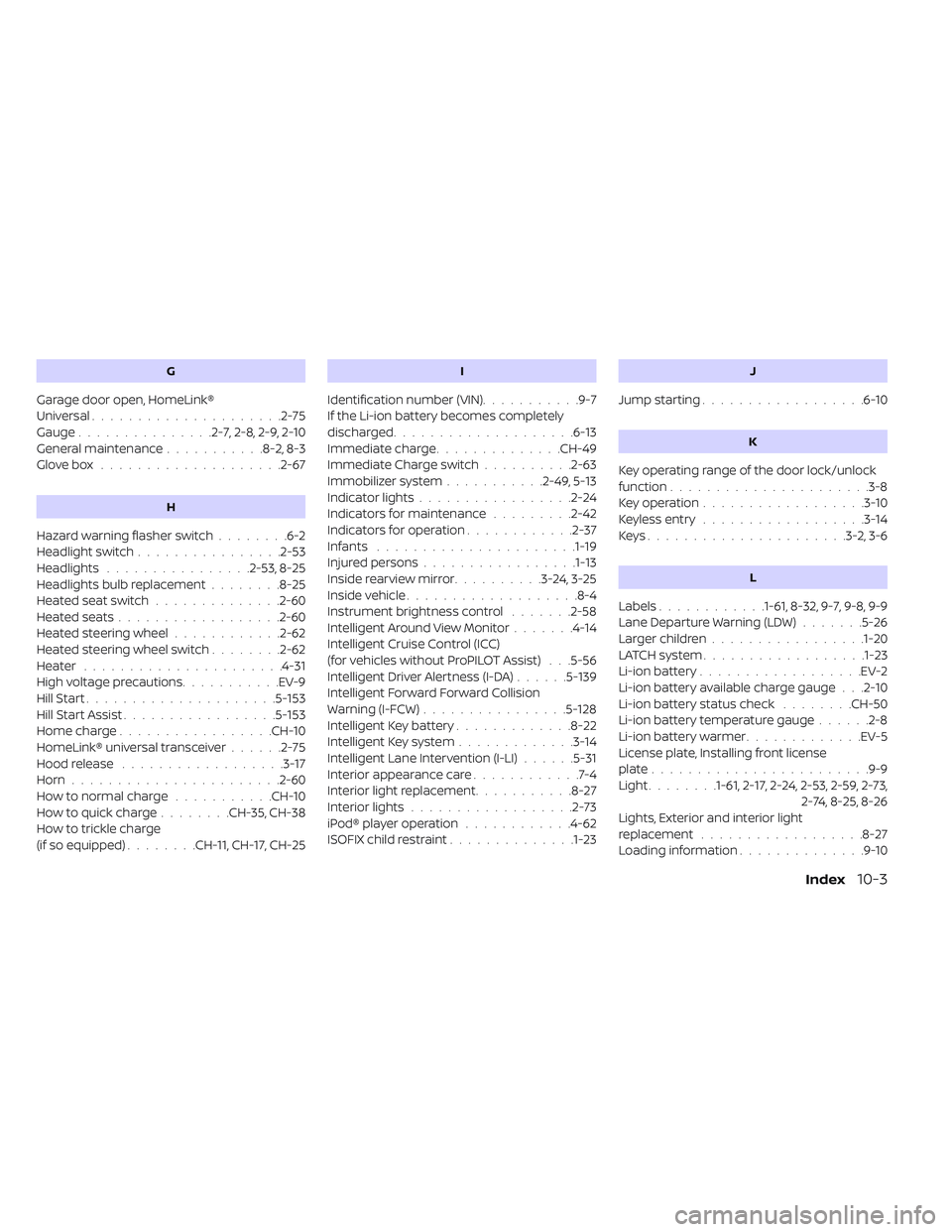
G
Garage door open, HomeLink®
Universal.....................2-75
Gauge ...............2-7, 2-8, 2-9, 2-10
General maintenance ...........8-2, 8-3
Glovebox ....................2-67
H
Hazard warning flasher switch ........6-2
Headlight switch ................2-53
Headlights ................2-53, 8-25
Headlights bulb replacement ........8-25
Heated seat switch ..............2-60
Heated seats ..................2-60
Heated steering wheel ............2-62
Heated steering wheel switch ........2-62
Heater ......................4-31
High voltage precautions ...........EV-9
HillStart.....................5-153
Hill Start Assist .................5-153
Home charge .................CH-10
HomeLink® universal transceiver ......2-75
Hood release ..................3-17
Horn .......................2-60
How to normal charge ...........CH-10
How to quick charge ........CH-35, CH-38
How to trickle charge
(if so equipped) ........CH-11, CH-17, CH-25
I
Identification number (VIN) ...........9-7
If the Li-ion battery becomes completely
discharged ....................6-13
Immediate charge ..............CH-49
Immediate Charge switch ..........2-63
Immobilizer system ...........2-49, 5-13
Indicator lights .................2-24
Indicators for maintenance .........2-42
Indicators for operation ............2-37
Infants ......................1-19
Injured persons .................1-13
Inside rearview mirror ..........3-24, 3-25
Inside vehicle ...................8-4
Instrument brightness control .......2-58
Intelligent Around View Monitor .......4-14
Intelligent Cruise Control (ICC)
(for vehicles without ProPILOT Assist) . . .5-56
Intelligent Driver Alertness (I-DA) ......5-139
Intelligent Forward Forward Collision
Warning (I-FCW) ................5-128
Intelligent Key battery .............8-22
Intelligent Key system .............3-14
Intelligent Lane Intervention (I-LI) ......5-31
Interior appearance care ............7-4
Interior light replacement ...........8-27
Interior lights ..................2-73
iPod® player operation ............4-62
ISOFIX child restraint ..............1-23
J
Jump starting..................6-10
K
Key operating range of the door lock/unlock
function......................3-8
Key operation ..................3-10
Keyless entry ..................3-14
Keys......................3-2, 3-6
L
Labels ............1-61, 8-32, 9-7, 9-8, 9-9
Lane Departure Warning (LDW) .......5-26
Larger children .................1-20
LATCH system ..................1-23
Li-ion battery ..................EV-2
Li-ion battery available charge gauge . . .2-10
Li-ion battery status check ........CH-50
Li-ion battery temperature gauge ......2-8
Li-ion battery warmer .............EV-5
License plate, Installing front license
plate ........................9-9
Light ........1-61, 2-17, 2-24, 2-53, 2-59, 2-73,
2-74, 8-25, 8-26
Lights, Exterior and interior light
replacement ..................8-27
Loading information ..............9-10
Index10-3