brake NISSAN LEAF 2020 Owner´s Manual
[x] Cancel search | Manufacturer: NISSAN, Model Year: 2020, Model line: LEAF, Model: NISSAN LEAF 2020Pages: 596, PDF Size: 4.33 MB
Page 520 of 596
8 Maintenance and do-it yourself
Maintenance requirement.......................8-2
Scheduled maintenance .....................8-2
General maintenance ........................8-2
Where to go for service .......................8-2
General maintenance ...........................8-2
Explanation of maintenance items ...........8-2
Maintenance precautions .......................8-5
Motor compartment check locations ...........8-7
Cooling system .................................8-8
Checking coolant level .......................8-9
Changing coolant ............................8-9
Reduction gear fluid ............................ 8-10
Brake fluid ...................................... 8-10
Windshield-washer fluid .........................8-11
12-volt battery .................................. 8-12
Jump starting ............................... 8-14
Windshield wiper blades ........................8-14
Cleaning .................................... 8-14
Replacing ................................... 8-14Rear window wiper blade
...................8-17
Brakes ......................................... 8-17
Brake pad wear warning ....................8-17
Fuses .......................................... 8-18
Motor compartment ........................ 8-18
Passenger compartment ...................8-21
Nissan Intelligent Key® battery replacement ....8-22
Lights .......................................... 8-24
Headlights .................................. 8-25
Fog lights (if so equipped) ...................8-25
Exterior and interior lights ...................8-26
Wheels and tires ............................... 8-28
Tire pressure ................................ 8-28
Tire labeling ................................. 8-33
Types of tires ................................ 8-35
Tire chains .................................. 8-36
Changing wheels and tires ..................8-37
Emergency tire puncture repair kit ..........8-39
Page 522 of 596
that the secondary latch keeps the motor
hood from opening when the primary latch
is released.
When driving in areas using road salt or
other corrosive materials, check lubrica-
tion frequently.
Lights*:Clean the headlights on a regular
basis. Make sure that the headlights, stop
lights, tail lights, turn signal lights and other
lights are all operating properly and in-
stalled securely. Also check the aim of the
headlights.
Road wheel nuts (lug nuts)*: When check-
ing the tires, make sure that no wheel nuts
are missing, and check for any loose wheel
nuts. Tighten if necessary.
Tire rotation*: Tires should be rotated ev-
ery 7,500 miles (12,000 km).
Tires*: Check the pressure with a gauge
of ten and always prior to long distance
trips. If necessary, adjust the pressure in all
tires to the pressure specified. Check care-
fully for damage, cuts or excessive wear.
Tire Pressure Monitoring System (TPMS)
transmitter components: Replace the
TPMS transmitter grommet seal, valve core
and cap when the tires are replaced due to
wear or age. Wheel alignment and balance:
If the ve-
hicle pulls to either side while driving on a
straight and level road, or if you detect un-
even or abnormal tire wear, there may be a
need for wheel alignment.
If the steering wheel or seat vibrates at
normal highway speeds, wheel balancing
may be needed.
For additional information regarding tires,
refer to “Important Tire Safety Information”
(US) or “Tire Safety Information” (Canada) in
the Warranty Information Booklet.
Windshield: Clean the windshield on a
regular basis. Check the windshield at least
every six months for cracks or other dam-
age. Have a damaged windshield repaired
by a qualified repair facility.
Wiper blades*: Check for cracks or wear if
they do not wipe properly.
Inside vehicle
The maintenance items listed here should
be checked on a regular basis, such as
when performing scheduled maintenance,
cleaning the vehicle, etc.
Accelerator pedal: Check the pedal for
smooth operation and make sure that the pedal does not catch or require uneven
effort. Keep the floor mat away from the
pedal.
Brake pedal:
Check the pedal for smooth
operation. If the brake pedal suddenly goes
down further than normal, the pedal feels
spongy or the vehicle seems to take longer
to stop, it is recommended that you visit a
NISSAN certified LEAF dealer immediately.
Keep the floor mat away from the pedal.
Brakes: Check that the brakes do not pull
the vehicle to one side when applied.
Electric shif t P (Park) position mecha-
nism: On a steep hill, check that the vehicle
is held securely while the vehicle is in the P
(Park) position without applying the brakes.
Parking brake: Check the parking brake
operation regularly. The vehicle should be
securely held on a steep hill with only the
parking brake applied. If the parking brake
cannot keep a vehicle position, it is recom-
mended that you visit a NISSAN certified
LEAF dealer for this service.
Seat: Check seat position controls such as
the seat adjusters, seatback recliners, etc.
to ensure that they operate smoothly and
that all latches lock securely in every posi-
tion. Check that the head restraints/
headrests move up and down smoothly
Maintenance and do-it yourself8-3
Page 523 of 596
and that the locks (if so equipped) hold
securely in all latched positions.
Seat belts:Check that all parts of the seat
belt system (for example, buckles, anchors,
adjusters and retractors) operate properly
and smoothly, and are installed securely.
Check the belt webbing for cuts, fraying,
wear or damage.
Steering wheel: Check for changes in the
steering conditions, such as excessive free
play, hard steering or strange noises.
Warning lights and chimes: Make sure
that all warning lights and chimes are op-
erating properly.
Windshield defroster: Check that the air
emits from the defroster outlets properly
and in sufficient quantity when operating
the heater or air conditioner.
Windshield wiper and washer*: Check
that the wipers and washers operate prop-
erly and that the wipers do not streak.
Under hood and vehicle
The maintenance items listed here should
be checked periodically.
12-volt battery (except for maintenance
free batteries)*: Check the fluid level in
each cell. The fluid should be at the bottom of the filler opening. Vehicles operated in
high temperatures or under severe condi-
tions require frequent checks of the 12–volt
battery fluid level.
NOTE:
Care should be taken to avoid situations
that can lead to potential battery dis-
charge and potential no-start conditions
such as:
1. Installation or extended use of elec-
tronic accessories that consume bat-
tery power when the EV system is not
running (Phone chargers, GPS, DVD
players, etc.)
2. Vehicle is not driven regularly and/or only driven short distances.
In these cases, the battery may need to
be charged to maintain battery health.
Brake fluid level*: Make sure that the brake
fluid level is between the MAX and MIN lines
on the reservoir.
Coolant level*: Check the coolant level
when the high voltage parts are cold. Make
sure that the coolant level is between the
MAX and MIN lines on the reservoir.
Fluid leaks: Check under the vehicle for
water or other fluid leaks af ter the vehicle
has been parked for a while. Water dripping from the air conditioner af ter use is normal.
If you should notice any leaks, check for
cause and have it corrected immediately.
Radiator and hoses:
Check the front of the
radiator and clean off any dirt, insects,
leaves, etc., that may have accumulated.
Make sure that the hoses have no cracks,
deformation, rot or loose connections.
Underbody: The underbody is frequently
exposed to corrosive substances such as
those used on icy roads or to control dust. It
is very important to remove these sub-
stances, otherwise rust will form on the
floor pan and frame. At the end of winter,
the underbody should be thoroughly
flushed with plain water, being careful to
clean those areas where mud and dirt may
accumulate. For additional information, re-
fer to “Cleaning exterior” in the “Appearance
and care” section of this manual.
Windshield-washer fluid*: Check that
there is an adequate amount of fluid in the
reservoir.
8-4Maintenance and do-it yourself
Page 524 of 596
When performing any inspection or main-
tenance work on your vehicle, always take
care to prevent serious accidental injury to
yourself or damage to the vehicle. The fol-
lowing are general precautions that should
be closely observed.
WARNING
• The EV system uses high voltage up
to approximately DC 400 volt. The
system can be hot during and af ter
starting and when the vehicle is shut
off. Be careful of both the high volt-
age and the high temperature. Obey
the labels that are attached to the
vehicle.
• Never disassemble, remove or re-
place high-voltage parts and cables
as well as their connectors. High-
voltage cables are colored orange.
• Disassembling, removing or replac-
ing those parts or cables can cause
severe burns or electric shock that
may result in serious injury or death.
The vehicle high-voltage system has
no user serviceable parts. It is recom-
mended that you visit a NISSAN cer-
tified LEAF dealer for any necessary
maintenance. •
Park the vehicle on a level surface,
apply the parking brake securely and
chock the wheels to prevent the ve-
hicle from moving. Push the P (Park)
position switch on the shif t lever or
place the vehicle into the N (Neutral)
position.
• If you must work with the EV (Electric
Vehicle) system is turned on, keep
hands, clothing, hair and tools away
from moving fans and any other
moving parts.
• Make sure that the power switch is in
the OFF or LOCK position when per-
forming any part replacement or
repairs.
• It is advisable to secure or remove
any loose clothing and remove any
jewelry, such as rings, watches, etc.
before working on your vehicle.
• Always wear eye protection when-
ever you work on your vehicle.
• Never get under the vehicle while it is
supported only by a jack. If it is nec-
essary to work under the vehicle,
support it with safety stands.
• Keep smoking materials, flames and
sparks away from the 12-volt battery.
CAUTION
• Do not work under the hood while
the motor compartment is hot. Push
the power switch in the OFF position
and wait until it cools down.
• Avoid direct contact with used cool-
ant. Improperly disposed coolant
and/or other vehicle fluids can dam-
age the environment. Always con-
form to local regulations for the dis-
posal of vehicle fluids.
• Never connect or disconnect the bat-
tery or any transistorized compo-
nent while the power switch is in the
ON position.
• Your vehicle is equipped with an au-
tomatic cooling fan. It may come on
at any time without warning, even if
the power switch is not in the ACC, ON
or READY to drive position. To avoid
injury, always disconnect the nega-
tive 12-volt battery cable before
working near the fan.
• Before performing any electrical
maintenance work on the vehicle
such as the battery, fuses or bulb re-
placement, confirm the following:
– The charge connector is removed
from the vehicle.
MAINTENANCE PRECAUTIONS
Maintenance and do-it yourself8-5
Page 526 of 596
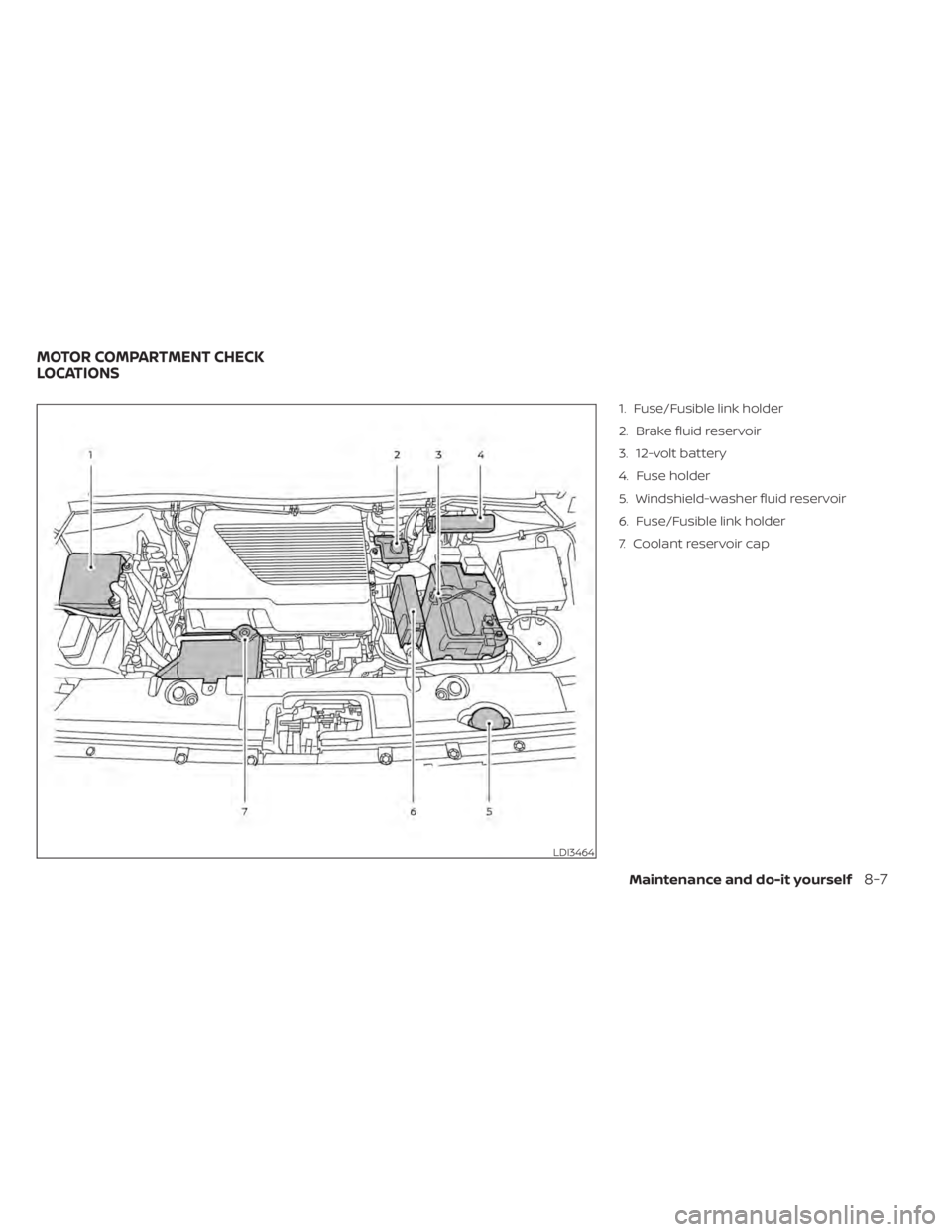
1. Fuse/Fusible link holder
2. Brake fluid reservoir
3. 12-volt battery
4. Fuse holder
5. Windshield-washer fluid reservoir
6. Fuse/Fusible link holder
7. Coolant reservoir cap
LDI3464
MOTOR COMPARTMENT CHECK
LOCATIONS
Maintenance and do-it yourself8-7
Page 529 of 596
When checking or replacement is required,
it is recommended that you visit a NISSAN
certified LEAF dealer for this service.
CAUTION
• Use only Genuine NISSAN Matic S ATF.
Do not mix with other fluids.
• Using reduction gear fluid other than
Genuine NISSAN Matic S ATF will
cause deterioration in driveability
and reduction gear durability, and
may damage the reduction gear,
which is not covered by the NISSAN
New Vehicle Limited Warranty. For additional brake fluid information, refer
to “Recommended fluids/lubricants and
capacities” in the “Technical and consumer
information” section of this manual.WARNING
• Use only new fluid from a sealed con-
tainer. Old, inferior or contaminated
fluid may damage the brake system.
The use of improper fluids can dam-
age the brake system, and affect the
vehicle’s stopping ability.
• Clean the filler cap before removing.
• Brake fluid is poisonous and should
be stored carefully in marked con-
tainers out of the reach of children.
CAUTION
Do not spill the fluid on any painted sur-
faces. This will damage the paint. If fluid
is spilled, immediately wash the sur-
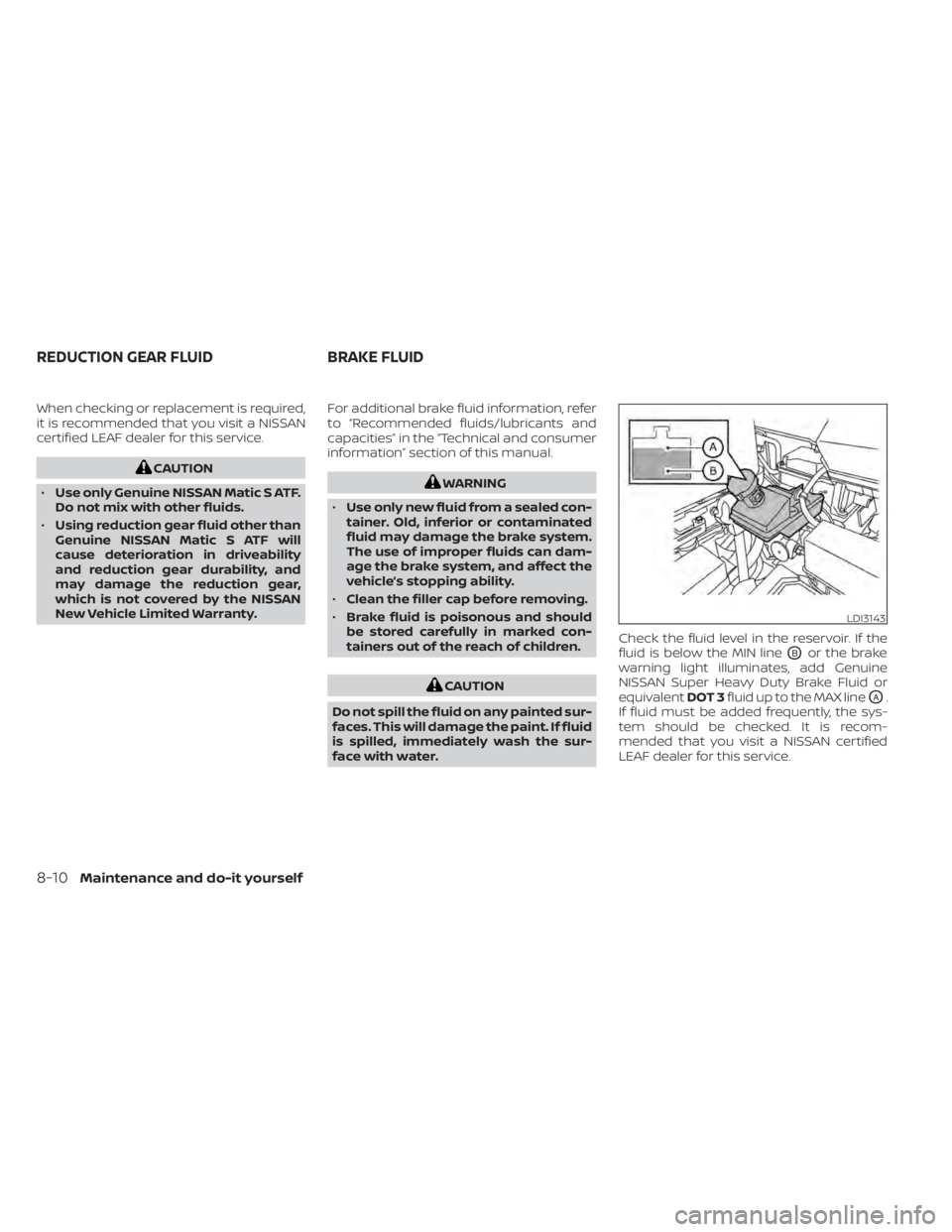
face with water. Check the fluid level in the reservoir. If the
fluid is below the MIN line
OBor the brake
warning light illuminates, add Genuine
NISSAN Super Heavy Duty Brake Fluid or
equivalent DOT 3fluid up to the MAX line
OA.
If fluid must be added frequently, the sys-
tem should be checked. It is recom-
mended that you visit a NISSAN certified
LEAF dealer for this service.
LDI3143
REDUCTION GEAR FLUID BRAKE FLUID
8-10Maintenance and do-it yourself
Page 536 of 596
REAR WINDOW WIPER BLADE
It is recommended that you visit a NISSAN
certified LEAF dealer if checking or replace-
ment is required.If the brakes do not operate properly, have
the brakes checked. It is recommended
that you visit a NISSAN certified LEAF dealer
for this service.
WARNING
Do not adjust the height of the brake
pedal. Doing so could alter the effec-
tiveness of the brakes, which could re-
sult in a serious accident and personal
injury. If adjustment is required, it is
recommended that you visit a NISSAN
certified LEAF dealer for this service.
BRAKE PAD WEAR WARNING
The disc brake pads have audible wear
warnings. When a brake pad requires re-
placement, it will make a high pitched
scraping sound when the vehicle is in mo-
tion. This scraping sound will first occur
only when the brake pedal is depressed.
Af ter more wear of the brake pad, the
sound will always be heard even if the
brake pedal is not depressed. Have the
brakes checked as soon as possible if the
wear warning sound is heard. Under some driving or climate conditions,
occasional brake squeak, squeal or other
noise may be heard. Occasional brake
noise during light to moderate stops is nor-
mal and does not affect the function or
performance of the brake system.
Proper brake inspection intervals should
be followed.
For additional information, re-
fer to the maintenance log section of your
NISSAN Service and Maintenance Guide.
BRAKES
Maintenance and do-it yourself8-17
Page 558 of 596
•If the wheels are changed for any
reason, always replace with wheels
which have the same off-set dimen-
sion. Wheels of a different off-set
could cause premature tire wear, de-
grade vehicle handling characteris-
tics, affect the VDC system and/or in-
terference with the brake discs. Such
interference can lead to decreased
braking efficiency and/or early brake
pad/shoe wear. For additional infor-
mation on wheel-off set dimensions,
refer to “Wheels and tires” in the
“Technical and consumer informa-
tion” section of this manual.
• When replacing a wheel without the
TPMS such as the spare tire, the TPMS
will not function when a wheel is re-
placed, the TPMS will not function
and the low tire pressure warning
light will flash for approximately 1
minute. The light will remain on af ter
1 minute. It is recommended that you
visit a NISSAN certified LEAF dealer
for this service.
• Replacing tires with those not origi-
nally specified by NISSAN could af-
fect the proper operation of the
TPMS. •
The TPMS sensor may be damaged if
it is not handled correctly. Be careful
when handling the TPMS sensor.
• When replacing the TPMS sensor, the
ID registration may be required. It is
recommended that you visit a
NISSAN certified LEAF dealer for ID
registration.
• Do not use a valve stem cap that is
not specified by NISSAN. The valve
stem cap may become stuck.
• Be sure that the valve stem caps are
correctly fitted. Otherwise the valve
may be clogged up with dirt and
cause a malfunction or loss of
pressure.
• Do not install a damaged or de-
formed wheel or tire even if it has
been repaired. Such wheels or tires
could have structural damage and
could fail without warning.
• The use of retread tire is not
recommended.
• For additional information regarding
tires, refer to “Important Tire Safety
Information” (US) or “Tire Safety In-
formation” (Canada) in the Warranty
Information Booklet.Wheel balance
Unbalanced wheels may affect vehicle
handling and tire life. Even with regular use,
wheels can get out of balance. Therefore,
they should be balanced as required.
Wheel balance service should be per-
formed with the wheels off the vehicle.
Spin balancing the wheels on the vehicle
could lead to mechanical damage.
For additional information regarding tires,
refer to “Important Tire Safety Information”
(US) or “Tire Safety Information” (Canada) in
the Warranty Information Booklet.
Care of wheels
For additional information on care of
wheels, refer to “Cleaning exterior” in the
“Appearance and care” section of this
manual.
EMERGENCY TIRE PUNCTURE
REPAIR KIT
The emergency tire puncture repair kit
(Emergency Tire Sealant) is supplied with
the vehicle instead of a spare tire. It can be
used to temporarily repair minor tire punc-
tures.
Maintenance and do-it yourself8-39
Page 561 of 596
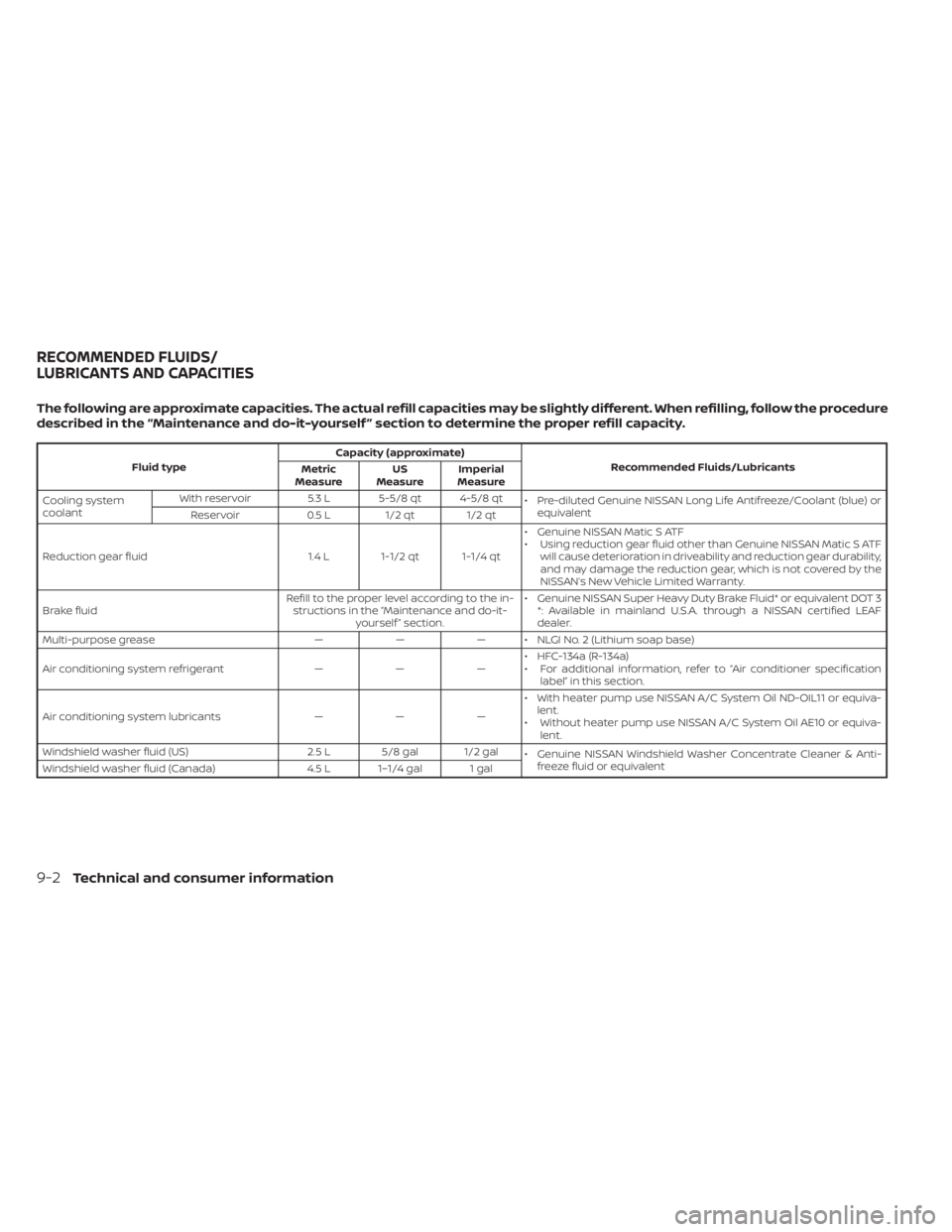
The following are approximate capacities. The actual refill capacities may be slightly different. When refilling, follow the procedure
described in the “Maintenance and do-it-yourself ” section to determine the proper refill capacity.
Fluid typeCapacity (approximate)
Recommended Fluids/Lubricants
Metric
Measure US
Measure Imperial
Measure
Cooling system
coolant With reservoir 5.3 L 5-5/8 qt 4-5/8 qt
• Pre-diluted Genuine NISSAN Long Life Antifreeze/Coolant (blue) or
equivalent
Reservoir 0.5 L 1/2 qt 1/2 qt
Reduction gear fluid 1.4 L 1-1/2 qt 1-1/4 qt • Genuine NISSAN Matic S ATF
• Using reduction gear fluid other than Genuine NISSAN Matic S ATF
will cause deterioration in driveability and reduction gear durability,
and may damage the reduction gear, which is not covered by the
NISSAN’s New Vehicle Limited Warranty.
Brake fluid Refill to the proper level according to the in-
structions in the “Maintenance and do-it- yourself ” section. • Genuine NISSAN Super Heavy Duty Brake Fluid* or equivalent DOT 3
*: Available in mainland U.S.A. through a NISSAN certified LEAF
dealer.
Multi-purpose grease — — — • NLGI No. 2 (Lithium soap base)
Air conditioning system refrigerant — — — • HFC-134a (R-134a)
• For additional information, refer to “Air conditioner specification
label” in this section.
Air conditioning system lubricants — — — • With heater pump use NISSAN A/C System Oil ND-OIL11 or equiva-
lent.
• Without heater pump use NISSAN A/C System Oil AE10 or equiva- lent.
Windshield washer fluid (US) 2.5 L 5/8 gal 1/2 gal • Genuine NISSAN Windshield Washer Concentrate Cleaner & Anti-
freeze fluid or equivalent
Windshield washer fluid (Canada) 4.5 L 1–1/4 gal 1 gal
RECOMMENDED FLUIDS/
LUBRICANTS AND CAPACITIES
9-2Technical and consumer information
Page 579 of 596
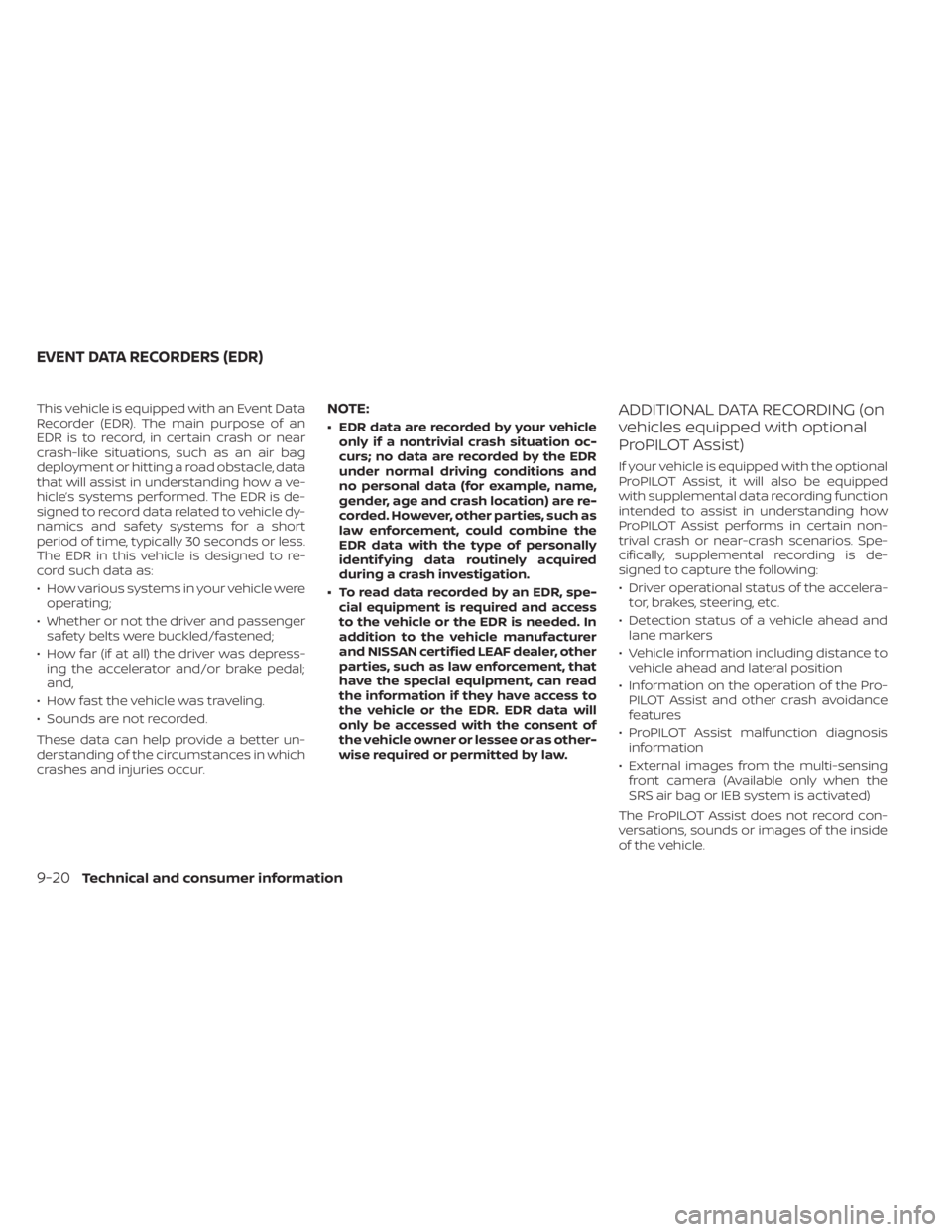
This vehicle is equipped with an Event Data
Recorder (EDR). The main purpose of an
EDR is to record, in certain crash or near
crash-like situations, such as an air bag
deployment or hitting a road obstacle, data
that will assist in understanding how a ve-
hicle’s systems performed. The EDR is de-
signed to record data related to vehicle dy-
namics and safety systems for a short
period of time, typically 30 seconds or less.
The EDR in this vehicle is designed to re-
cord such data as:
• How various systems in your vehicle wereoperating;
• Whether or not the driver and passenger safety belts were buckled/fastened;
• How far (if at all) the driver was depress- ing the accelerator and/or brake pedal;
and,
• How fast the vehicle was traveling.
• Sounds are not recorded.
These data can help provide a better un-
derstanding of the circumstances in which
crashes and injuries occur.NOTE:
• EDR data are recorded by your vehicle only if a nontrivial crash situation oc-
curs; no data are recorded by the EDR
under normal driving conditions and
no personal data (for example, name,
gender, age and crash location) are re-
corded. However, other parties, such as
law enforcement, could combine the
EDR data with the type of personally
identif ying data routinely acquired
during a crash investigation.
• To read data recorded by an EDR, spe- cial equipment is required and access
to the vehicle or the EDR is needed. In
addition to the vehicle manufacturer
and NISSAN certified LEAF dealer, other
parties, such as law enforcement, that
have the special equipment, can read
the information if they have access to
the vehicle or the EDR. EDR data will
only be accessed with the consent of
the vehicle owner or lessee or as other-
wise required or permitted by law.
ADDITIONAL DATA RECORDING (on
vehicles equipped with optional
ProPILOT Assist)
If your vehicle is equipped with the optional
ProPILOT Assist, it will also be equipped
with supplemental data recording function
intended to assist in understanding how
ProPILOT Assist performs in certain non-
trival crash or near-crash scenarios. Spe-
cifically, supplemental recording is de-
signed to capture the following:
• Driver operational status of the accelera-tor, brakes, steering, etc.
• Detection status of a vehicle ahead and lane markers
• Vehicle information including distance to vehicle ahead and lateral position
• Information on the operation of the Pro- PILOT Assist and other crash avoidance
features
• ProPILOT Assist malfunction diagnosis information
• External images from the multi-sensing front camera (Available only when the
SRS air bag or IEB system is activated)
The ProPILOT Assist does not record con-
versations, sounds or images of the inside
of the vehicle.
EVENT DATA RECORDERS (EDR)
9-20Technical and consumer information