display NISSAN LEAF 2020 Owner´s Manual
[x] Cancel search | Manufacturer: NISSAN, Model Year: 2020, Model line: LEAF, Model: NISSAN LEAF 2020Pages: 596, PDF Size: 4.33 MB
Page 84 of 596
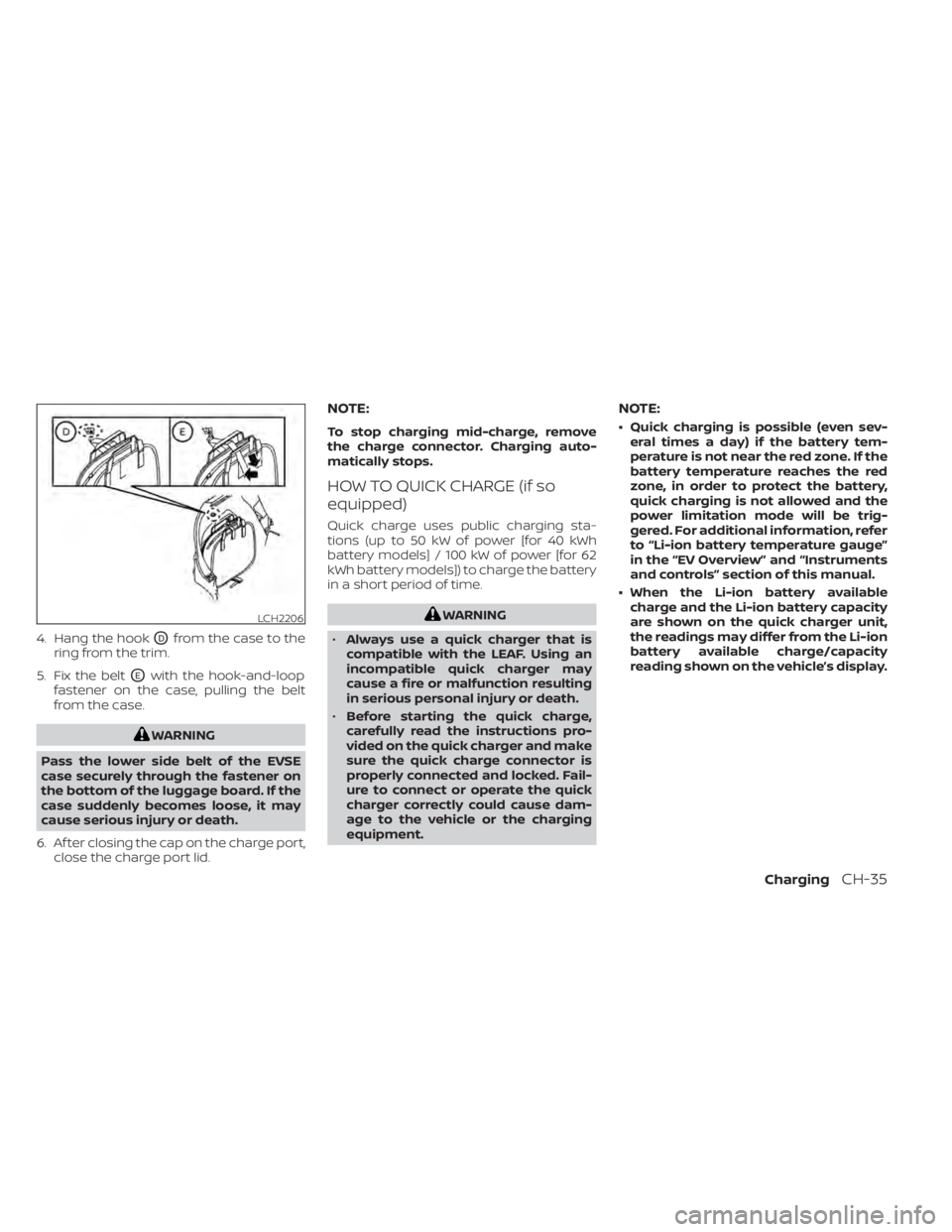
4. Hang the hookODfrom the case to the
ring from the trim.
5. Fix the belt
OEwith the hook-and-loop
fastener on the case, pulling the belt
from the case.
WARNING
Pass the lower side belt of the EVSE
case securely through the fastener on
the bottom of the luggage board. If the
case suddenly becomes loose, it may
cause serious injury or death.
6. Af ter closing the cap on the charge port, close the charge port lid.
NOTE:
To stop charging mid-charge, remove
the charge connector. Charging auto-
matically stops.
HOW TO QUICK CHARGE (if so
equipped)
Quick charge uses public charging sta-
tions (up to 50 kW of power [for 40 kWh
battery models] / 100 kW of power [for 62
kWh battery models]) to charge the battery
in a short period of time.
WARNING
• Always use a quick charger that is
compatible with the LEAF. Using an
incompatible quick charger may
cause a fire or malfunction resulting
in serious personal injury or death.
• Before starting the quick charge,
carefully read the instructions pro-
vided on the quick charger and make
sure the quick charge connector is
properly connected and locked. Fail-
ure to connect or operate the quick
charger correctly could cause dam-
age to the vehicle or the charging
equipment.
NOTE:
• Quick charging is possible (even sev- eral times a day) if the battery tem-
perature is not near the red zone. If the
battery temperature reaches the red
zone, in order to protect the battery,
quick charging is not allowed and the
power limitation mode will be trig-
gered. For additional information, refer
to “Li-ion battery temperature gauge”
in the “EV Overview” and “Instruments
and controls” section of this manual.
• When the Li-ion battery available charge and the Li-ion battery capacity
are shown on the quick charger unit,
the readings may differ from the Li-ion
battery available charge/capacity
reading shown on the vehicle’s display.
LCH2206
ChargingCH-35
Page 87 of 596
CAUTION
As the quick charge connector is
heavier in comparison to the other
charge connectors, allowing it to drop
could cause damage to the vehicle or
charge connector or personal injury.
When removing the connector, be sure
to pull it out straight and as carefully as
possible.
HOW TO CHARGE/DISCHARGE
USING QUICK CHARGE PORT (if so
equipped)
V2X (vehicle to everything) enables the EV
to supply electric power to a home or a
building, etc.
“V2X ” includes all of the following:
• Vehicle to home (V2H)
• Vehicle to building (V2B)
• Vehicle to grid (V2G)
• Vehicle to load (V2L)
• Vehicle to vehicle (V2V)
V2X charge/discharge uses a V2X device.
WARNING
• Always use a quick charger/V2X de-
vice that is compatible with the LEAF.
Using an incompatible quick
charger/V2X device may cause a fire
or malfunction resulting in serious
personal injury or death.
• Before starting the quick charge/V2X
charge, carefully read the instruc-
tions provided on the quick charger/
V2X device and make sure the quick
charge connector is properly con-
nected and locked. Failure to connect
or operate the quick charger cor-
rectly could cause damage to the ve-
hicle or the charging equipment.
NOTE:
• Charging/discharging using quick charge port is possible (even several
times a day) if the battery temperature
is not near the red zone. If the battery
temperature reaches the red zone, in
order to protect the battery, charging/
discharging is not allowed and the
power limitation mode will be trig-
gered. For additional information, refer
to “Li-ion battery temperature gauge”
in the “EV Overview” and “Instruments
and controls” section of this manual. • When the Li-ion battery available
charge/discharge and the Li-ion bat-
tery capacity are shown on the quick
charger unit or V2X device, the read-
ings may differ from the Li-ion battery
available charge/discharge/capacity
reading shown on the vehicle’s display.
CH-38Charging
Page 93 of 596
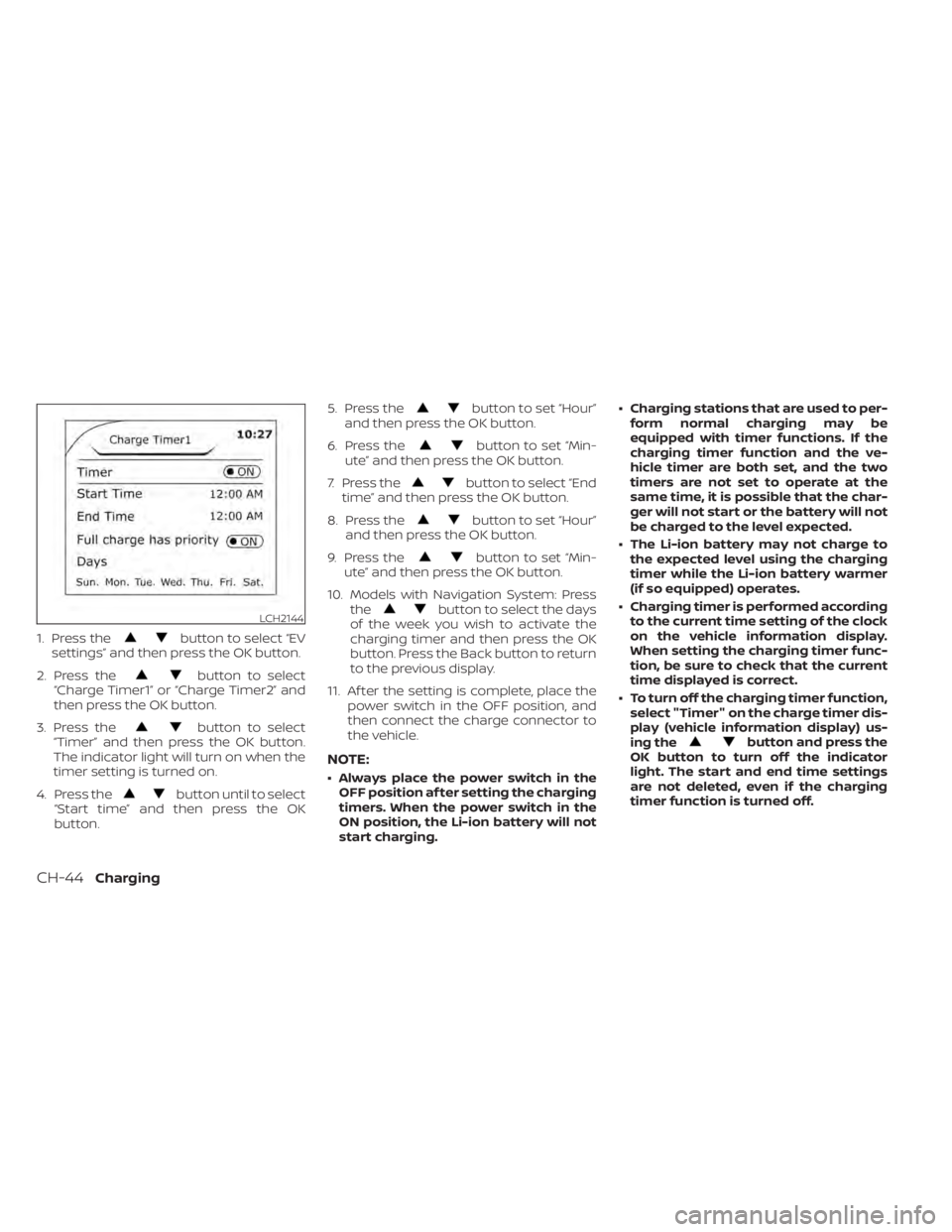
1. Press thebutton to select “EV
settings” and then press the OK button.
2. Press the
button to select
“Charge Timer1” or “Charge Timer2” and
then press the OK button.
3. Press the
button to select
“Timer” and then press the OK button.
The indicator light will turn on when the
timer setting is turned on.
4. Press the
button until to select
“Start time” and then press the OK
button. 5. Press the
button to set “Hour”
and then press the OK button.
6. Press the
button to set “Min-
ute” and then press the OK button.
7. Press the
button to select “End
time” and then press the OK button.
8. Press the
button to set “Hour”
and then press the OK button.
9. Press the
button to set “Min-
ute” and then press the OK button.
10. Models with Navigation System: Press the
button to select the days
of the week you wish to activate the
charging timer and then press the OK
button. Press the Back button to return
to the previous display.
11. Af ter the setting is complete, place the power switch in the OFF position, and
then connect the charge connector to
the vehicle.
NOTE:
• Always place the power switch in theOFF position af ter setting the charging
timers. When the power switch in the
ON position, the Li-ion battery will not
start charging. • Charging stations that are used to per-
form normal charging may be
equipped with timer functions. If the
charging timer function and the ve-
hicle timer are both set, and the two
timers are not set to operate at the
same time, it is possible that the char-
ger will not start or the battery will not
be charged to the level expected.
• The Li-ion battery may not charge to the expected level using the charging
timer while the Li-ion battery warmer
(if so equipped) operates.
• Charging timer is performed according to the current time setting of the clock
on the vehicle information display.
When setting the charging timer func-
tion, be sure to check that the current
time displayed is correct.
• To turn off the charging timer function, select "Timer" on the charge timer dis-
play (vehicle information display) us-
ing the
button and press the
OK button to turn off the indicator
light. The start and end time settings
are not deleted, even if the charging
timer function is turned off.
LCH2144
CH-44Charging
Page 95 of 596
Full charge has priority
If “Full charge has priority” is turned on, the
charge start timer will be advanced if the
fully charged condition of the Li-ion battery
cannot be achieved during the start time
to end time interval. If the fully charged
battery condition cannot be achieved, the
charge continues until the battery is fully
charged.
NOTE:
If “Full charge has priority ” is turned on, it
is possible that the battery is not
charged fully by the charge end time due
to the operating condition of Climate
Ctrl. Timer and the tolerance of charging
time, etc. In that case, the charging con-
tinues until the Li-ion battery is fully
charged.
TIMER DISPLAY
The timer display appears for approxi-
mately 30 seconds when the power switch
is placed in the OFF position.
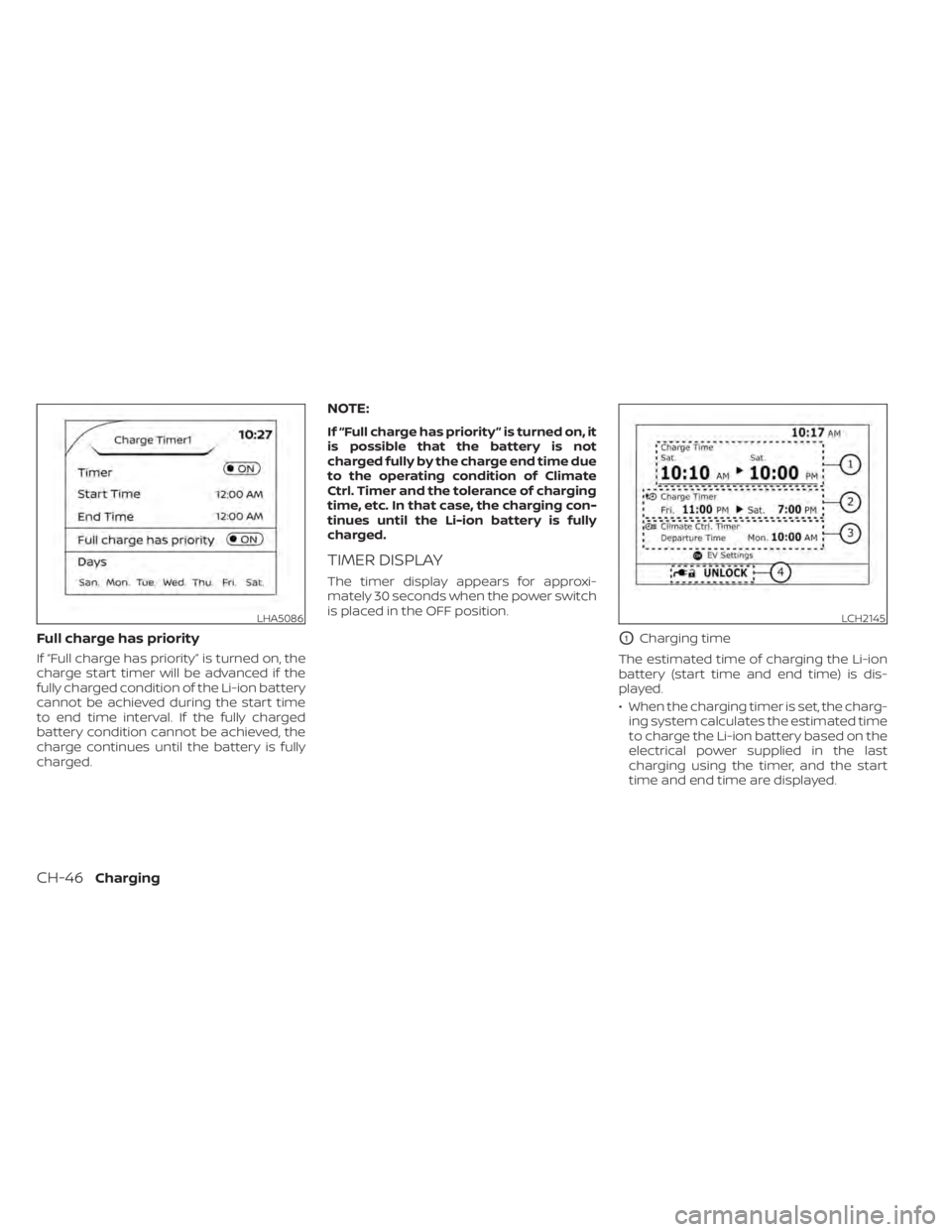
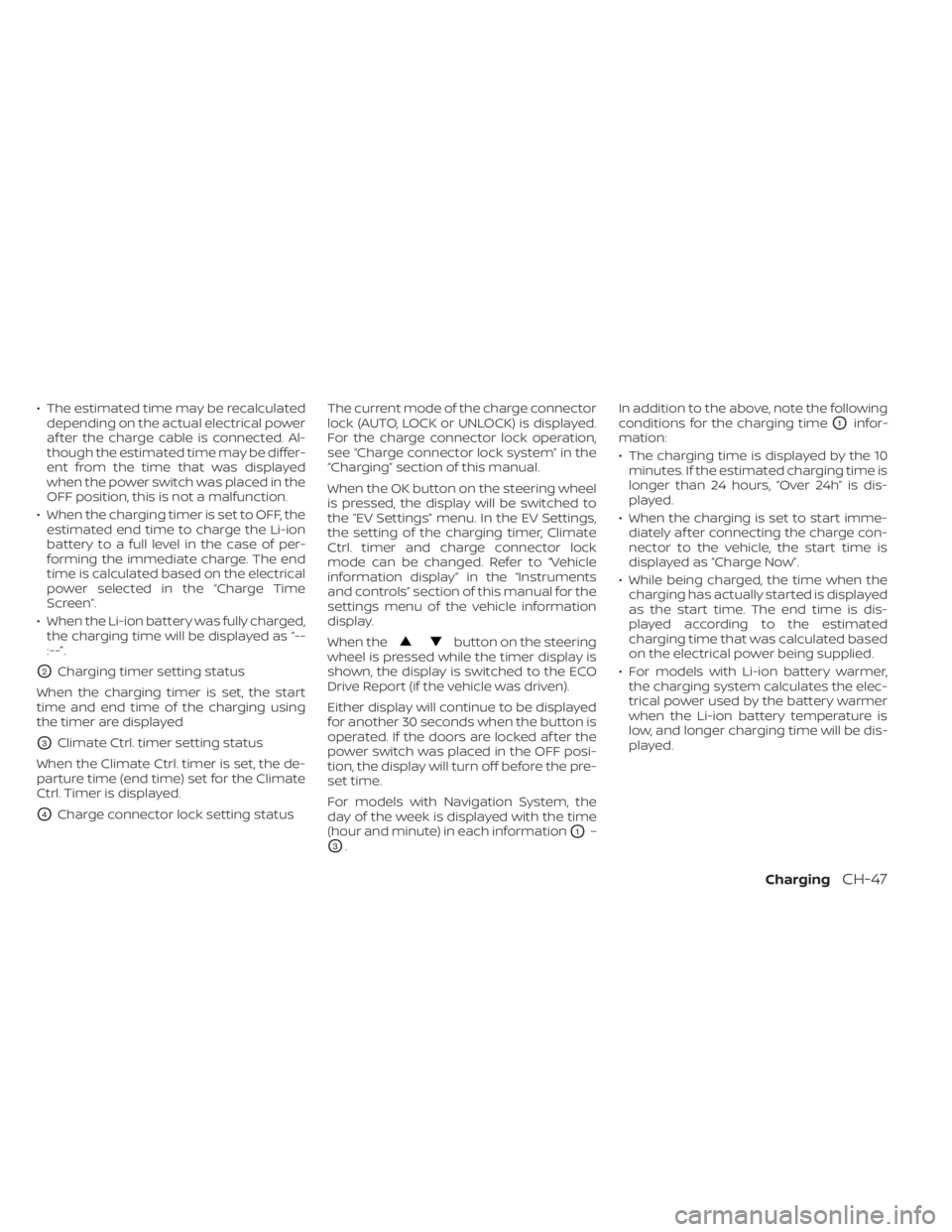
O1Charging time
The estimated time of charging the Li-ion
battery (start time and end time) is dis-
played.
• When the charging timer is set, the charg- ing system calculates the estimated time
to charge the Li-ion battery based on the
electrical power supplied in the last
charging using the timer, and the start
time and end time are displayed.
LHA5086LCH2145
CH-46Charging
Page 96 of 596
• The estimated time may be recalculateddepending on the actual electrical power
af ter the charge cable is connected. Al-
though the estimated time may be differ-
ent from the time that was displayed
when the power switch was placed in the
OFF position, this is not a malfunction.
• When the charging timer is set to OFF, the estimated end time to charge the Li-ion
battery to a full level in the case of per-
forming the immediate charge. The end
time is calculated based on the electrical
power selected in the “Charge Time
Screen”.
• When the Li-ion battery was fully charged, the charging time will be displayed as “--
:--”.
O2Charging timer setting status
When the charging timer is set, the start
time and end time of the charging using
the timer are displayed
O3Climate Ctrl. timer setting status
When the Climate Ctrl. timer is set, the de-
parture time (end time) set for the Climate
Ctrl. Timer is displayed.
O4Charge connector lock setting status The current mode of the charge connector
lock (AUTO, LOCK or UNLOCK) is displayed.
For the charge connector lock operation,
see “Charge connector lock system” in the
“Charging” section of this manual.
When the OK button on the steering wheel
is pressed, the display will be switched to
the “EV Settings” menu. In the EV Settings,
the setting of the charging timer, Climate
Ctrl. timer and charge connector lock
mode can be changed. Refer to “Vehicle
information display” in the “Instruments
and controls” section of this manual for the
settings menu of the vehicle information
display.
When the
button on the steering
wheel is pressed while the timer display is
shown, the display is switched to the ECO
Drive Report (if the vehicle was driven).
Either display will continue to be displayed
for another 30 seconds when the button is
operated. If the doors are locked af ter the
power switch was placed in the OFF posi-
tion, the display will turn off before the pre-
set time.
For models with Navigation System, the
day of the week is displayed with the time
(hour and minute) in each information
O1–
O3. In addition to the above, note the following
conditions for the charging time
O1infor-
mation:
• The charging time is displayed by the 10 minutes. If the estimated charging time is
longer than 24 hours, “Over 24h” is dis-
played.
• When the charging is set to start imme- diately af ter connecting the charge con-
nector to the vehicle, the start time is
displayed as “Charge Now”.
• While being charged, the time when the charging has actually started is displayed
as the start time. The end time is dis-
played according to the estimated
charging time that was calculated based
on the electrical power being supplied.
• For models with Li-ion battery warmer, the charging system calculates the elec-
trical power used by the battery warmer
when the Li-ion battery temperature is
low, and longer charging time will be dis-
played.
ChargingCH-47
Page 97 of 596
• When “Chg. Timer Only at HOME” is set toON (models with Navigation System) in
the EV Settings, the start time is displayed
only when the power switch is placed in
the OFF position at home. If the power
switch is placed in the OFF position other
than at home, the immediate charge
mode is selected and “Charge Now” will
appear as the start time.
• When “Full charge has priority” is set to ON in the EV Settings and the Li-ion battery
cannot be charged to a full level within
the hours between the scheduled start
time and end time of the charging timer,
the charging time shows the time that
exceeds the scheduled hours in the
charging timer.
• If you need to confirm the estimated charging time depending on the avail-
able electrical power (supplied to the
charger), see the Estimated Charge Time
display. Refer to “Meters and gauges” in
the “Instruments and controls” section of
this manual.NOTE:
• The displayed end time of charging is an estimation. The Li-ion battery may
not be charged to a full level by the
estimated end time.
• If the charging timer and the Climate Ctrl. timer are set to operate at the
same time, longer charging time will be
displayed or the Li-ion battery may not
be charged to a full level at the sched-
uled end time.
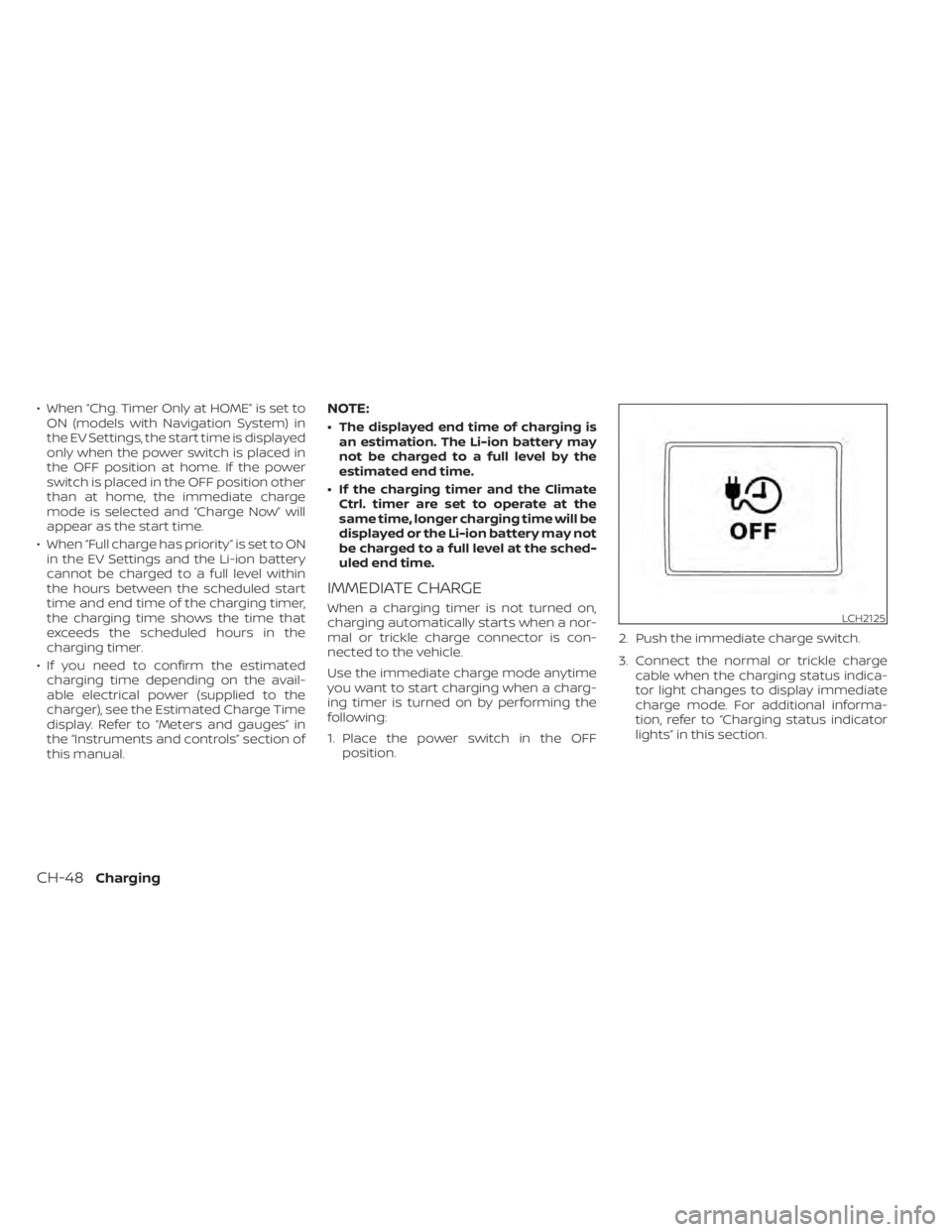
IMMEDIATE CHARGE
When a charging timer is not turned on,
charging automatically starts when a nor-
mal or trickle charge connector is con-
nected to the vehicle.
Use the immediate charge mode anytime
you want to start charging when a charg-
ing timer is turned on by performing the
following:
1. Place the power switch in the OFF position. 2. Push the immediate charge switch.
3. Connect the normal or trickle charge
cable when the charging status indica-
tor light changes to display immediate
charge mode. For additional informa-
tion, refer to “Charging status indicator
lights” in this section.LCH2125
CH-48Charging
Page 99 of 596
• NissanConnect® EV & Services, orNissanConnect® Services, information
system features are included through
a subscription service which requires
owner consent to activate. The sub-
scription must be active to use these
features.
• NissanConnect® EV & Services, or NissanConnect® Services, communica-
tions may be received at a verified
e-mail address or by SMS/text
messaging-enabled mobile phone.
• Standard text rates and/or data usage may apply depending on your carrier.
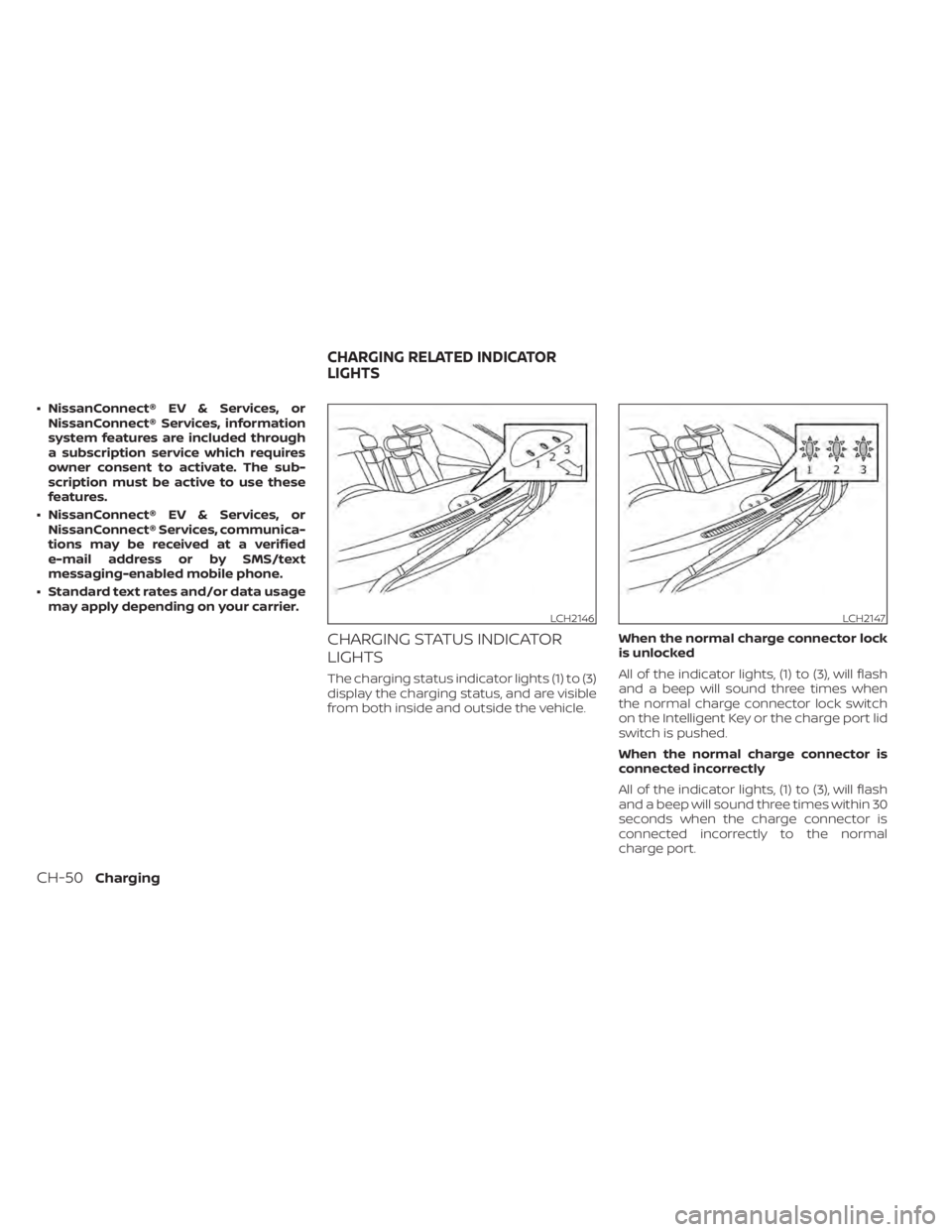
CHARGING STATUS INDICATOR
LIGHTS
The charging status indicator lights (1) to (3)
display the charging status, and are visible
from both inside and outside the vehicle. When the normal charge connector lock
is unlocked
All of the indicator lights, (1) to (3), will flash
and a beep will sound three times when
the normal charge connector lock switch
on the Intelligent Key or the charge port lid
switch is pushed.
When the normal charge connector is
connected incorrectly
All of the indicator lights, (1) to (3), will flash
and a beep will sound three times within 30
seconds when the charge connector is
connected incorrectly to the normal
charge port.
LCH2146LCH2147
CHARGING RELATED INDICATOR
LIGHTS
CH-50Charging
Page 100 of 596
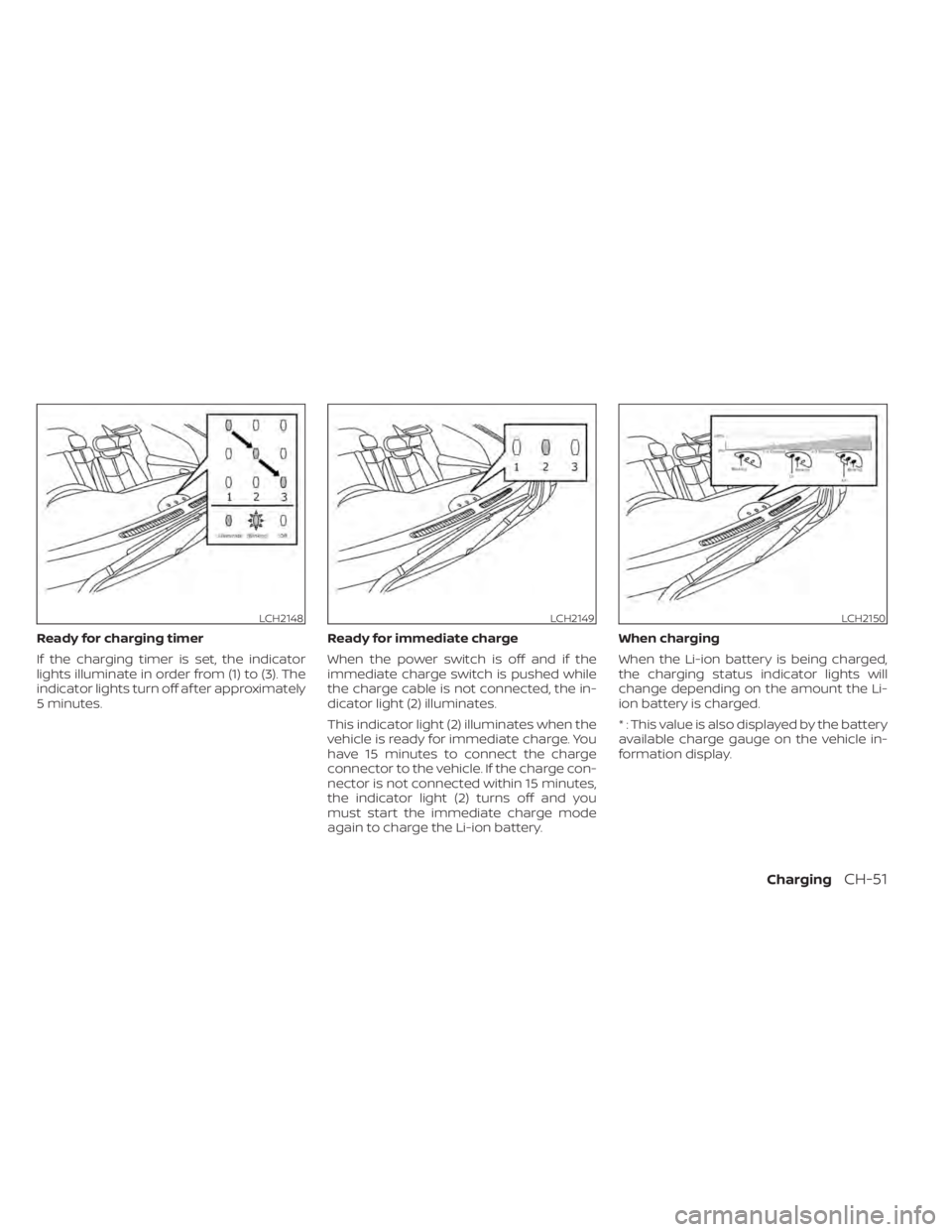
Ready for charging timer
If the charging timer is set, the indicator
lights illuminate in order from (1) to (3). The
indicator lights turn off af ter approximately
5 minutes.Ready for immediate charge
When the power switch is off and if the
immediate charge switch is pushed while
the charge cable is not connected, the in-
dicator light (2) illuminates.
This indicator light (2) illuminates when the
vehicle is ready for immediate charge. You
have 15 minutes to connect the charge
connector to the vehicle. If the charge con-
nector is not connected within 15 minutes,
the indicator light (2) turns off and you
must start the immediate charge mode
again to charge the Li-ion battery.When charging
When the Li-ion battery is being charged,
the charging status indicator lights will
change depending on the amount the Li-
ion battery is charged.
* : This value is also displayed by the battery
available charge gauge on the vehicle in-
formation display.
LCH2148LCH2149LCH2150
ChargingCH-51
Page 105 of 596
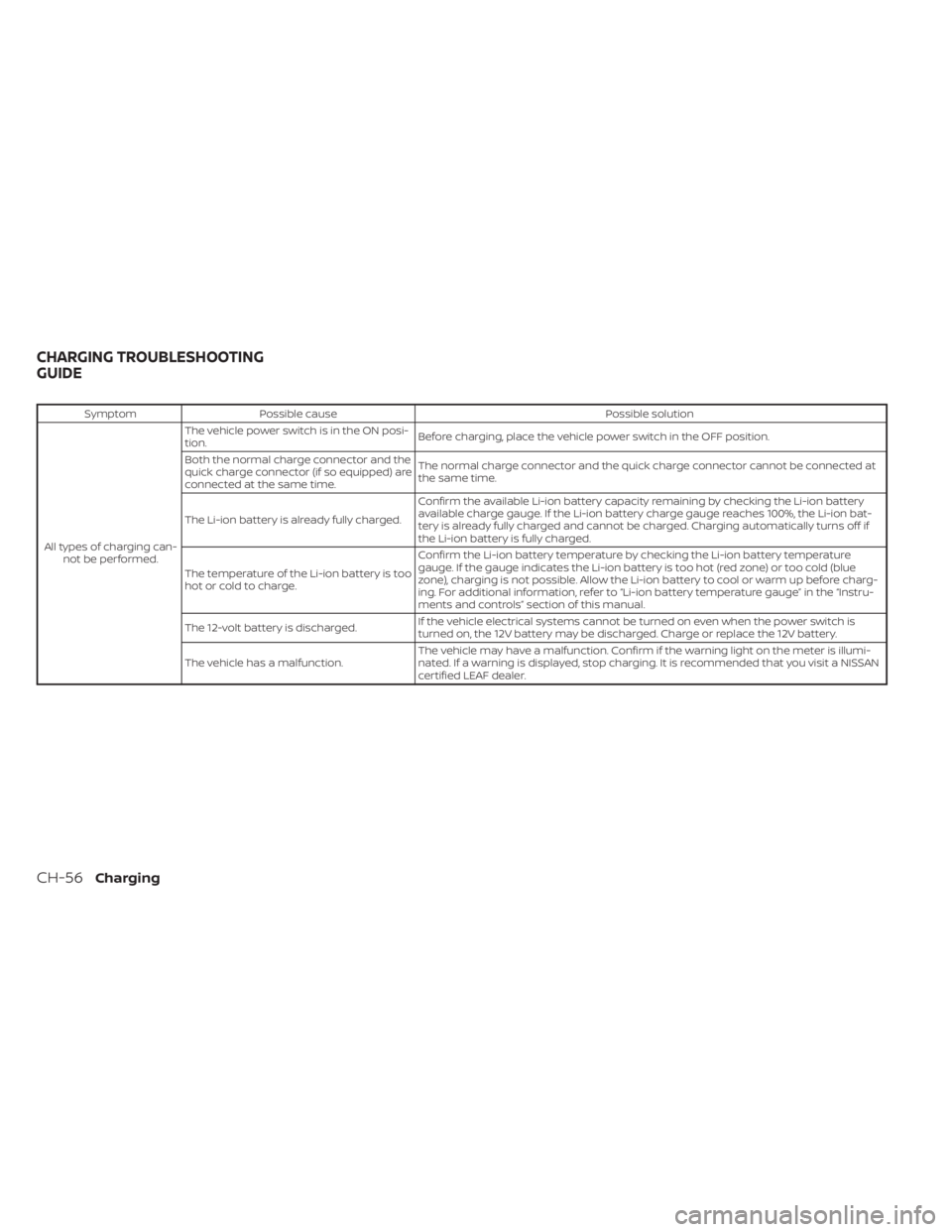
SymptomPossible cause Possible solution
All types of charging can- not be performed. The vehicle power switch is in the ON posi-
tion.
Before charging, place the vehicle power switch in the OFF position.
Both the normal charge connector and the
quick charge connector (if so equipped) are
connected at the same time. The normal charge connector and the quick charge connector cannot be connected at
the same time.
The Li-ion battery is already fully charged. Confirm the available Li-ion battery capacity remaining by checking the Li-ion battery
available charge gauge. If the Li-ion battery charge gauge reaches 100%, the Li-ion bat-
tery is already fully charged and cannot be charged. Charging automatically turns off if
the Li-ion battery is fully charged.
The temperature of the Li-ion battery is too
hot or cold to charge. Confirm the Li-ion battery temperature by checking the Li-ion battery temperature
gauge. If the gauge indicates the Li-ion battery is too hot (red zone) or too cold (blue
zone), charging is not possible. Allow the Li-ion battery to cool or warm up before charg-
ing. For additional information, refer to “Li-ion battery temperature gauge” in the “Instru-
ments and controls” section of this manual.
The 12-volt battery is discharged. If the vehicle electrical systems cannot be turned on even when the power switch is
turned on, the 12V battery may be discharged. Charge or replace the 12V battery.
The vehicle has a malfunction. The vehicle may have a malfunction. Confirm if the warning light on the meter is illumi-
nated. If a warning is displayed, stop charging. It is recommended that you visit a NISSAN
certified LEAF dealer.
CHARGING TROUBLESHOOTING
GUIDE
CH-56Charging
Page 106 of 596
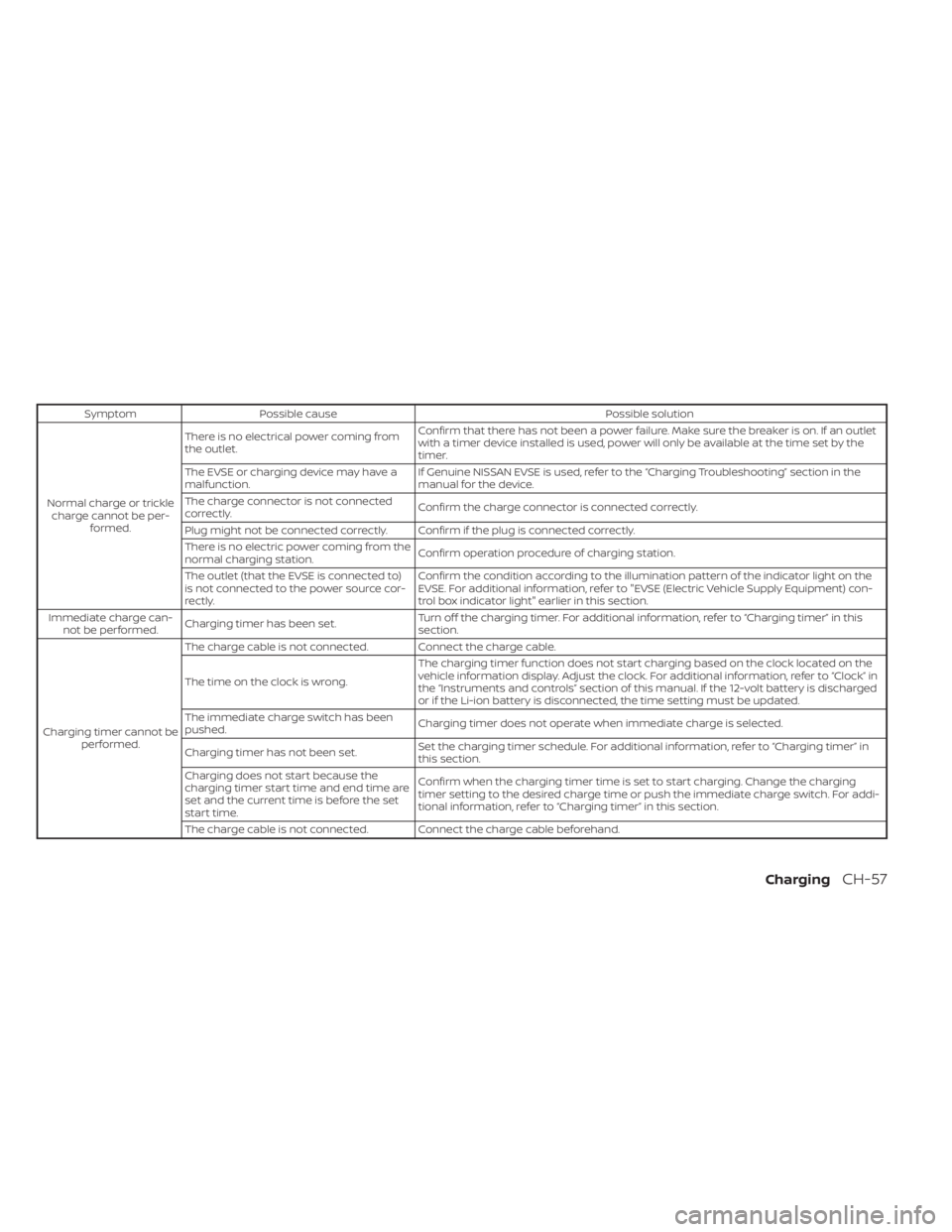
SymptomPossible cause Possible solution
Normal charge or trickle charge cannot be per- formed. There is no electrical power coming from
the outlet.
Confirm that there has not been a power failure. Make sure the breaker is on. If an outlet
with a timer device installed is used, power will only be available at the time set by the
timer.
The EVSE or charging device may have a
malfunction. If Genuine NISSAN EVSE is used, refer to the “Charging Troubleshooting” section in the
manual for the device.
The charge connector is not connected
correctly. Confirm the charge connector is connected correctly.
Plug might not be connected correctly. Confirm if the plug is connected correctly.
There is no electric power coming from the
normal charging station. Confirm operation procedure of charging station.
The outlet (that the EVSE is connected to)
is not connected to the power source cor-
rectly. Confirm the condition according to the illumination pattern of the indicator light on the
EVSE. For additional information, refer to "EVSE (Electric Vehicle Supply Equipment) con-
trol box indicator light" earlier in this section.
Immediate charge can- not be performed. Charging timer has been set. Turn off the charging timer. For additional information, refer to “Charging timer” in this
section.
Charging timer cannot be performed. The charge cable is not connected. Connect the charge cable.
The time on the clock is wrong.
The charging timer function does not start charging based on the clock located on the
vehicle information display. Adjust the clock. For additional information, refer to “Clock” in
the “Instruments and controls” section of this manual. If the 12-volt battery is discharged
or if the Li-ion battery is disconnected, the time setting must be updated.
The immediate charge switch has been
pushed. Charging timer does not operate when immediate charge is selected.
Charging timer has not been set. Set the charging timer schedule. For additional information, refer to “Charging timer” in
this section.
Charging does not start because the
charging timer start time and end time are
set and the current time is before the set
start time. Confirm when the charging timer time is set to start charging. Change the charging
timer setting to the desired charge time or push the immediate charge switch. For addi-
tional information, refer to “Charging timer” in this section.
The charge cable is not connected. Connect the charge cable beforehand.
ChargingCH-57