weight NISSAN LEAF 2020 Owner´s Manual
[x] Cancel search | Manufacturer: NISSAN, Model Year: 2020, Model line: LEAF, Model: NISSAN LEAF 2020Pages: 596, PDF Size: 4.33 MB
Page 560 of 596
9 Technical and consumer information
Recommended fluids/lubricants and
capacities.......................................9-2
Air conditioning system refrigerant and
lubricant recommendations .................9-2
Specifications ...................................9-4
Charging system .............................9-4
Motor ........................................9-4
Wheels and tires .............................9-5
Dimensions and weights .....................9-5
When traveling or registering in another
country .........................................9-6
Vehicle identification ............................9-7
Vehicle Identification Number (VIN)
plate .........................................9-7
Vehicle identification number
(chassis number) .............................9-7
Traction motor serial number ................9-8
F.M.V.S.S./C.M.V.S.S Certification label ..........9-8
Emission control information label ...........9-8
Tire and Loading Information label ...........9-9
Air conditioner specification label ............9-9
Installing front license plate .....................9-9
Vehicle loading information ....................9-10Terms
....................................... 9-10
Vehicle load capacity ......................... 9-11
Loading tips ................................. 9-13
Measurement of weights ....................9-13
Towing a trailer ................................. 9-14
Flat towing ..................................... 9-14
Uniform tire quality grading ....................9-14
Treadwear .................................. 9-14
Traction AA, A, B and C ....................... 9-15
Temperature A, B and C .....................9-15
Reporting safety defects .......................9-15
Telematics overview (models with Navigation
System) ........................................ 9-16
Telematic Control Unit Gen2K ..................9-18
Event Data Recorders (EDR) ....................9-20
Additional Data Recording (on vehicles
equipped with optional ProPILOT
Assist) ....................................... 9-20
Owner's Manual/Service Manual order
information .................................... 9-21
Charging information .......................... 9-22
Cold tire pressures ............................. 9-24
Page 565 of 596
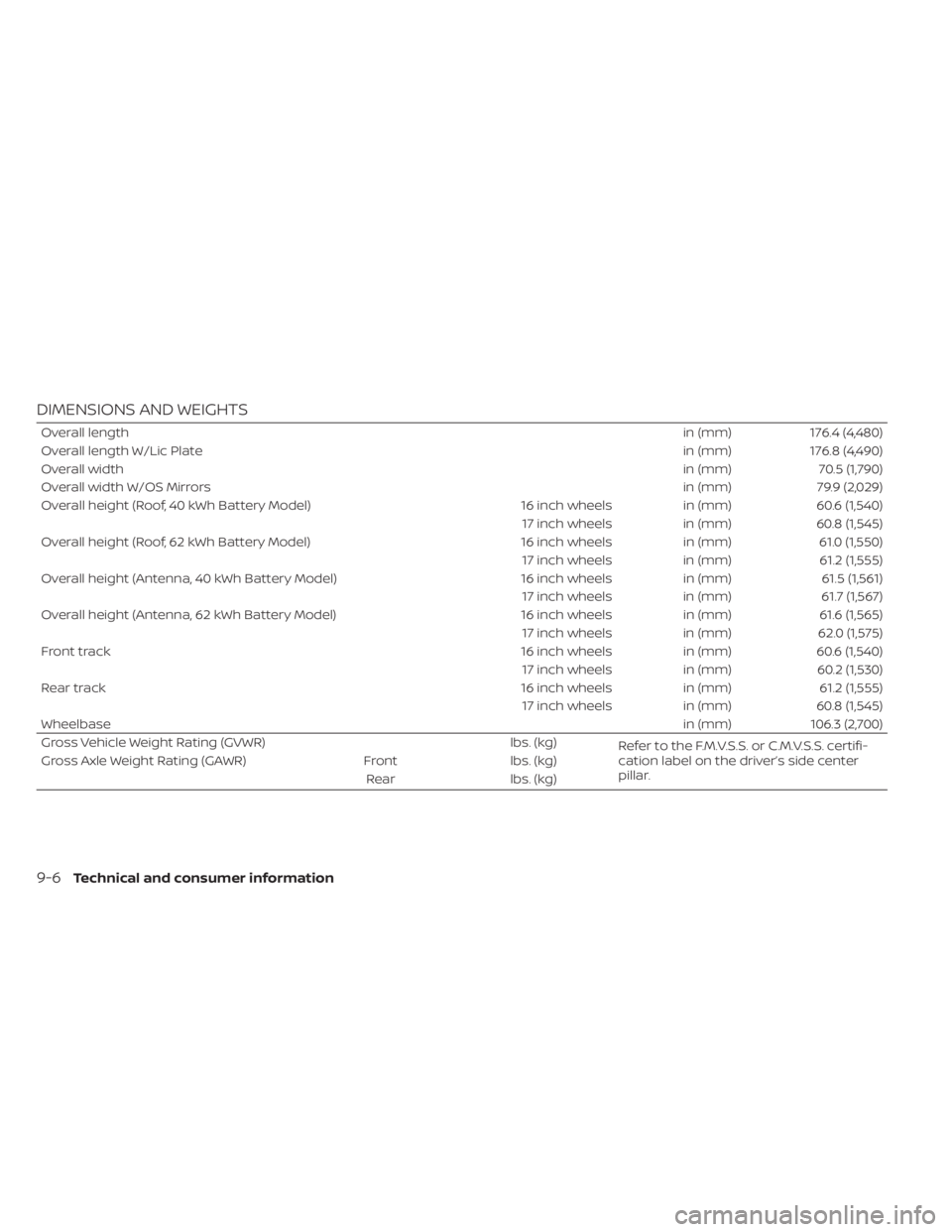
DIMENSIONS AND WEIGHTS
Overall lengthin (mm) 176.4 (4,480)
Overall length W/Lic Plate in (mm)176.8 (4,490)
Overall width in (mm)70.5 (1,790)
Overall width W/OS Mirrors in (mm)79.9 (2,029)
Overall height (Roof, 40 kWh Battery Model) 16 inch wheelsin (mm)60.6 (1,540)
17 inch wheels in (mm)60.8 (1,545)
Overall height (Roof, 62 kWh Battery Model) 16 inch wheelsin (mm)61.0 (1,550)
17 inch wheels in (mm)61.2 (1,555)
Overall height (Antenna, 40 kWh Battery Model) 16 inch wheelsin (mm)61.5 (1,561)
17 inch wheels in (mm)61.7 (1,567)
Overall height (Antenna, 62 kWh Battery Model) 16 inch wheelsin (mm)61.6 (1,565)
17 inch wheels in (mm)62.0 (1,575)
Front track 16 inch wheelsin (mm)60.6 (1,540)
17 inch wheels in (mm)60.2 (1,530)
Rear track 16 inch wheelsin (mm)61.2 (1,555)
17 inch wheels in (mm)60.8 (1,545)
Wheelbase in (mm)106.3 (2,700)
Gross Vehicle Weight Rating (GVWR) lbs. (kg)
Refer to the F.M.V.S.S. or C.M.V.S.S. certifi-
cation label on the driver’s side center
pillar.
Gross Axle Weight Rating (GAWR)
Frontlbs. (kg)
Rear lbs. (kg)
9-6Technical and consumer information
Page 567 of 596
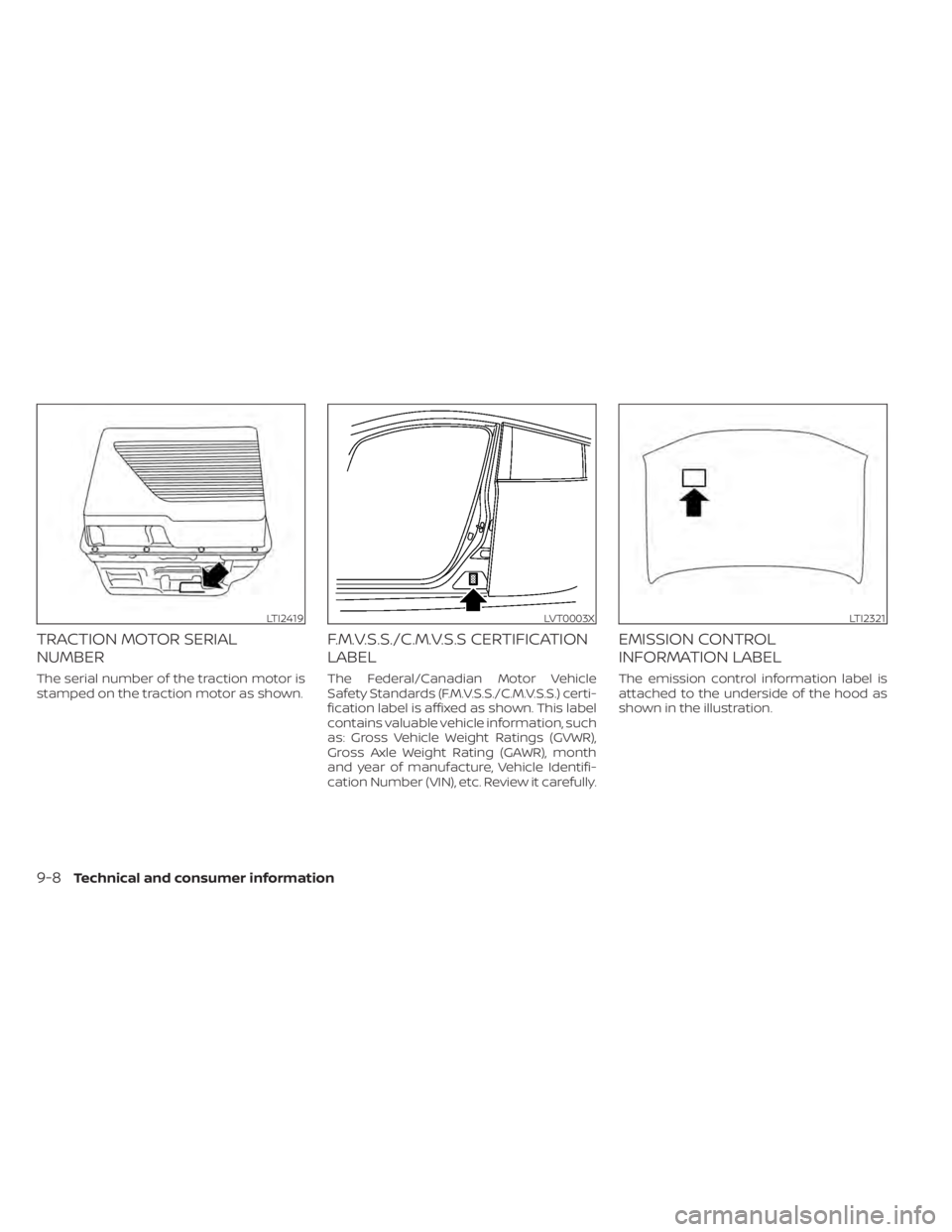
TRACTION MOTOR SERIAL
NUMBER
The serial number of the traction motor is
stamped on the traction motor as shown.
F.M.V.S.S./C.M.V.S.S CERTIFICATION
LABEL
The Federal/Canadian Motor Vehicle
Safety Standards (F.M.V.S.S./C.M.V.S.S.) certi-
fication label is affixed as shown. This label
contains valuable vehicle information, such
as: Gross Vehicle Weight Ratings (GVWR),
Gross Axle Weight Rating (GAWR), month
and year of manufacture, Vehicle Identifi-
cation Number (VIN), etc. Review it carefully.
EMISSION CONTROL
INFORMATION LABEL
The emission control information label is
attached to the underside of the hood as
shown in the illustration.
LTI2419LVT0003XLTI2321
9-8Technical and consumer information
Page 569 of 596
WARNING
•
It is extremely dangerous to
ride in the cargo area inside the
vehicle. In a collision, people
riding in these areas are more
likely to be seriously injured or
killed.
•Do not allow people to ride in
any area of your vehicle that is
not equipped with seats and
seat belts.
•Be sure everyone in your ve-
hicle is in a seat and using a
seat belt properly.
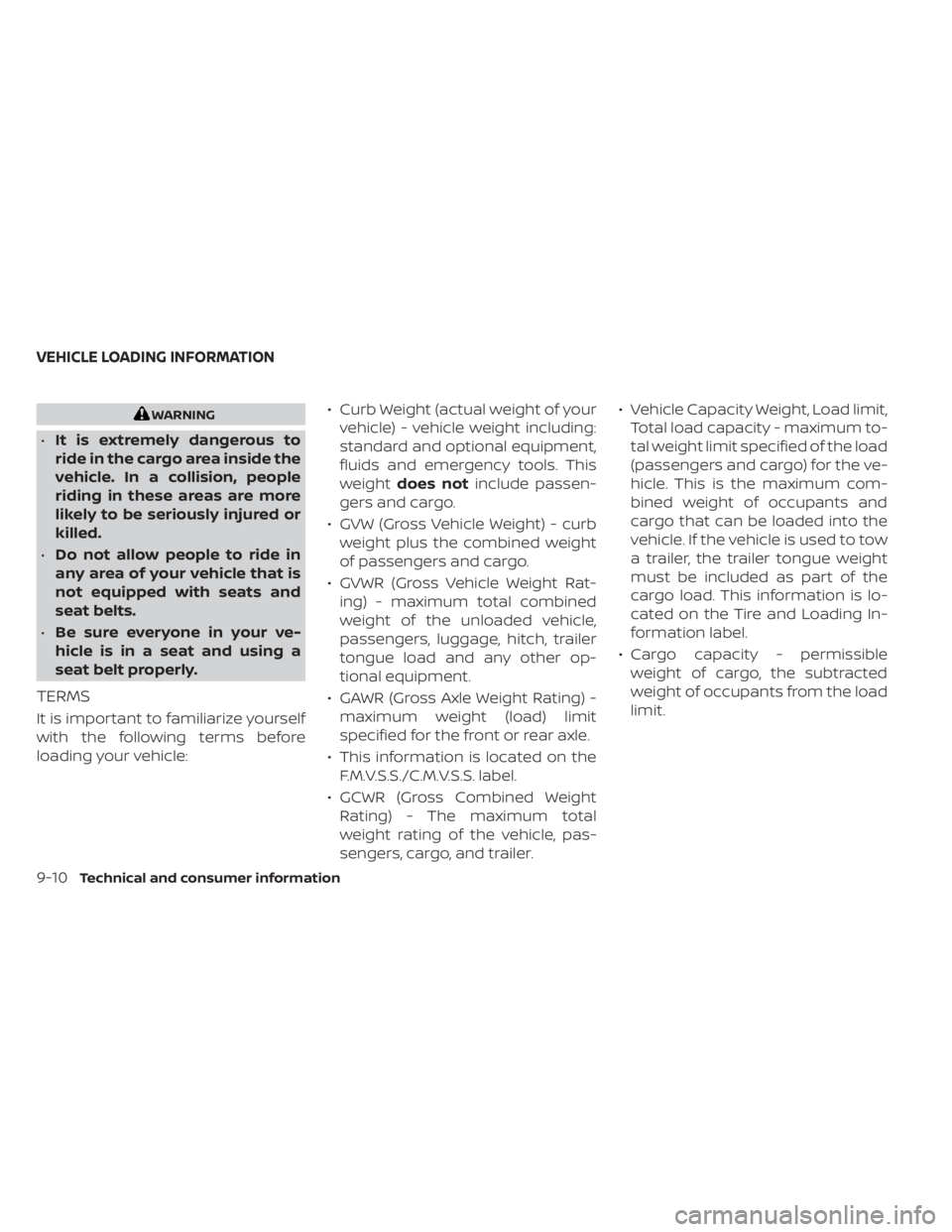
TERMS
It is important to familiarize yourself
with the following terms before
loading your vehicle: • Curb Weight (actual weight of your
vehicle) - vehicle weight including:
standard and optional equipment,
fluids and emergency tools. This
weight does not include passen-
gers and cargo.
• GVW (Gross Vehicle Weight) - curb weight plus the combined weight
of passengers and cargo.
• GVWR (Gross Vehicle Weight Rat- ing) - maximum total combined
weight of the unloaded vehicle,
passengers, luggage, hitch, trailer
tongue load and any other op-
tional equipment.
• GAWR (Gross Axle Weight Rating) - maximum weight (load) limit
specified for the front or rear axle.
• This information is located on the F.M.V.S.S./C.M.V.S.S. label.
• GCWR (Gross Combined Weight Rating) - The maximum total
weight rating of the vehicle, pas-
sengers, cargo, and trailer. • Vehicle Capacity Weight, Load limit,
Total load capacity - maximum to-
tal weight limit specified of the load
(passengers and cargo) for the ve-
hicle. This is the maximum com-
bined weight of occupants and
cargo that can be loaded into the
vehicle. If the vehicle is used to tow
a trailer, the trailer tongue weight
must be included as part of the
cargo load. This information is lo-
cated on the Tire and Loading In-
formation label.
• Cargo capacity - permissible weight of cargo, the subtracted
weight of occupants from the load
limit.
VEHICLE LOADING INFORMATION
9-10Technical and consumer information
Page 570 of 596
VEHICLE LOAD CAPACITY
Do not exceed the load limit of your
vehicle shown as “The combined
weight of occupants and cargo” on
the Tire and Loading Information la-
bel. Do not exceed the number of
occupants shown as “Seating Ca-
pacity” on the Tire and Loading Infor-
mation label.
To get “the combined weight of oc-
cupants and cargo”, add the weight
of all occupants, then add the total
luggage weight. Examples are
shown in the following illustration.
Technical and consumer information9-11
Page 571 of 596
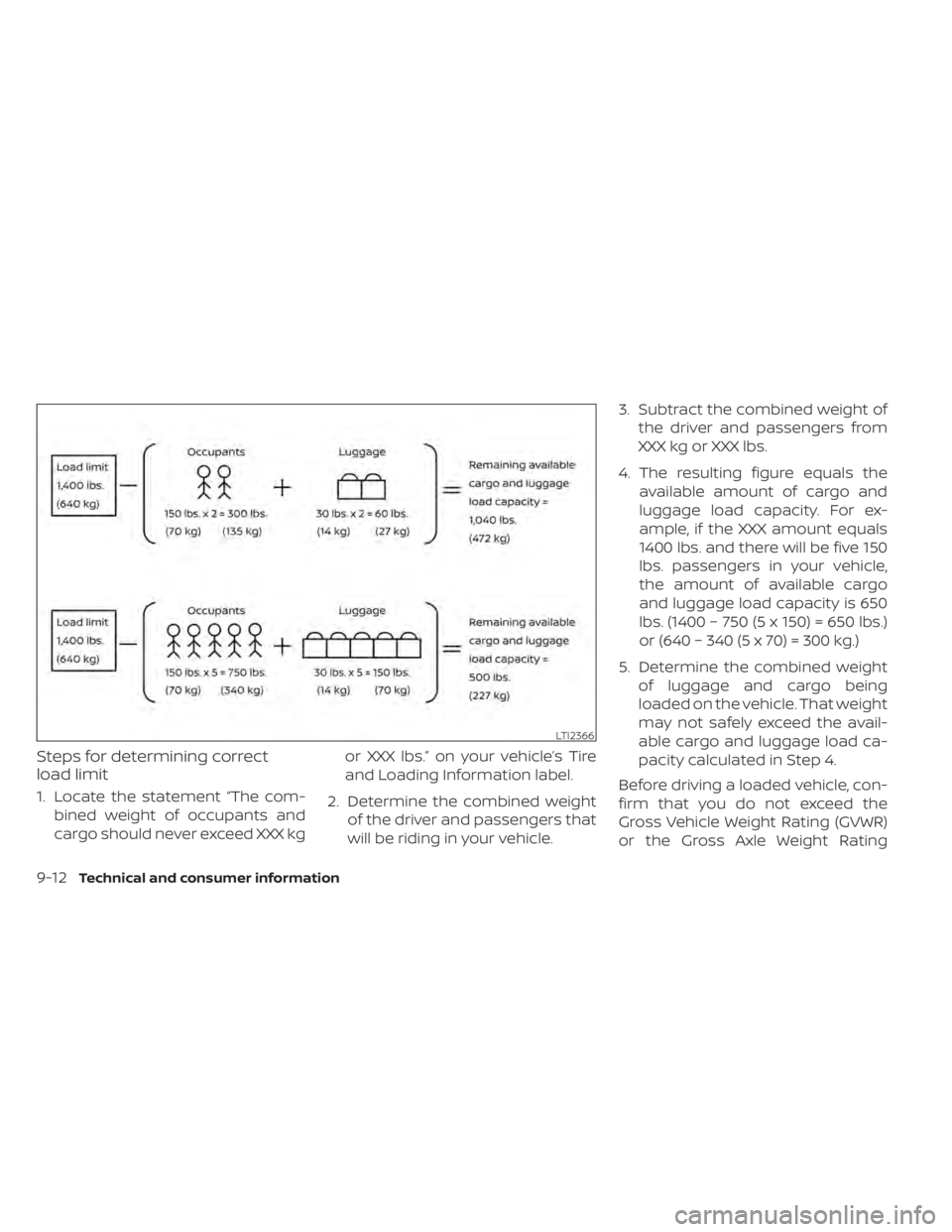
Steps for determining correct
load limit
1. Locate the statement “The com-bined weight of occupants and
cargo should never exceed XXX kg or XXX lbs.” on your vehicle’s Tire
and Loading Information label.
2. Determine the combined weight of the driver and passengers that
will be riding in your vehicle. 3. Subtract the combined weight of
the driver and passengers from
XXX kg or XXX lbs.
4. The resulting figure equals the available amount of cargo and
luggage load capacity. For ex-
ample, if the XXX amount equals
1400 lbs. and there will be five 150
lbs. passengers in your vehicle,
the amount of available cargo
and luggage load capacity is 650
lbs. (1400 − 750 (5 x 150) = 650 lbs.)
or (640 − 340 (5 x 70) = 300 kg.)
5. Determine the combined weight of luggage and cargo being
loaded on the vehicle. That weight
may not safely exceed the avail-
able cargo and luggage load ca-
pacity calculated in Step 4.
Before driving a loaded vehicle, con-
firm that you do not exceed the
Gross Vehicle Weight Rating (GVWR)
or the Gross Axle Weight Rating
LTI2366
9-12Technical and consumer information
Page 572 of 596
(GAWR) for your vehicle. For addi-
tional information, refer to “Measure-
ment of weights” in this section.
Also check tires for proper inflation
pressures. For additional informa-
tion, refer to “Tire and Loading Infor-
mation label” in this section.
LOADING TIPS
• The GVW must not exceed theGVWR or GAWR.
• Do not load the front and rear axle to the GAWR. Doing so will exceed
the GVWR.
WARNING
• Properly secure all cargo with
ropes or straps to help prevent
it from sliding or shif ting. Do
not place cargo higher than the
seatbacks. In a sudden stop or
collision, unsecured cargo
could cause personal injury. •
Do not load your vehicle any
heavier than the GVWR or the
maximum front and rear
GAWRs. If you do, parts of your
vehicle can break, tire damage
could occur, or it can change
the way your vehicle handles.
This could result in loss of con-
trol and cause personal injury.
• Overloading not only can
shorten the life of your vehicle
and the tire, but can cause un-
safe vehicle handling and lon-
ger braking distances. This
may cause a premature tire
failure, which could result in a
serious accident and personal
injury. Failures caused by over-
loading are not covered by the
vehicle’s warranty.
MEASUREMENT OF WEIGHTS
Secure loose items to prevent
weight shif ts that could affect the
balance of your vehicle. When the ve-
hicle is loaded, drive to a scale and
weigh the front and the rear wheels
separately to determine axle loads.
Individual axle loads should not ex-
ceed either of the Gross Axle Weight
Ratings (GAWR). The total of the axle
loads should not exceed the Gross
Vehicle Weight Rating (GVWR). These
ratings are given on the vehicle cer-
tification label. If weight ratings are
exceeded, move or remove items to
bring all weights below the ratings.
Technical and consumer information9-13
Page 585 of 596
Car phone or CB radio............4-44Ceiling light...................2-70Center console................2-63Charge port lid.................3-21Charge port lid switch............2-58ChargingCharge port lid...............3-21Charging related indicator light. . .CH-50Normal charge..............CH-9Precautions on charging........CH-2Quick charge..........CH-35, CH-38Specifications................9-4Trickle charge...............CH-11Charging information............9-22Charging methods.............CH-43Charging related indicator light.....CH-50Charging related remote function. . .CH-49Charging status indicator light.....CH-50Charging the Li-ion battery........EV-12Charging troubleshooting guide. . . .CH-56CheckingChecking bulbs...............2-15Checking coolant level...........8-9Child restraints.................1-21Booster seats................1-39LATCH (Lower Anchors and Tethers for
CHildren) System..............1-23Precautions on child restraints.....1-21Top tether strap..............1-25Child restraint with top tether strap. . . .1-25Child safety...................1-18Child safety rear door lock..........3-6Chimes, audible reminders.........2-24Circuit breaker, fusible link..........8-20
Cleaning exterior and interior......7-2,7-4ClimateClimate control system refrigerant and
lubricant recommendations
......4-43Climate controlClimate control service..........4-43Climate control systemAir conditioner...............4-28Climate control operation........4-28Heater....................4-28Climate Ctrl. Timer..............4-38Clock.......................2-13Cold tire pressures..............9-24Cold weather driving............5-169ConsoleCenter console...............2-63CoolantCapacities and recommended
fuel/lubricants
................9-2Changing coolant..............8-9Checking coolant level...........8-9Cooling system................ .8-8Corrosion protection..............7-7Cruise control.................5-66Cup holders................. .2-64
D
Defroster switch
Rear window and outside mirror defroster
switch
................... .2-48Dimensions and weights...........9-6Dimmer switch for instrument panel. . .2-54
Display
Information display............2-25Door locks................... .3-4Doors...................... .3-4Driving
Cold weather driving...........5-169Driving vehicle...............5-15Precautions when starting and
driving.................... .5-4Driving range..................2-9Driving the vehicle..............EV-18Driving vehicle.................5-15Dynamic driver assistance switch.....2-59
E
ECO
ECO switch................ .2-55Eco Drive Report...............5-154ECO mode...............2-13,5-152ECO switch.................. .2-55Efficient use of your vehicle........EV-22Electric shif t control system.........5-15Electronic parking brake...........5-20Emergency charge.............CH-11Emergency EV (Electric Vehicle) shut
off......................5-13,6-3Emergency shutoff system........EV-10Emission control information label.....9-8e-Pedal......................2-13e-Pedal system................5-22EV Characteristics..............EV-11Event Data recorders.............9-20
10-2Index
Page 590 of 596
Thef t (NISSAN Vehicle Immobilizer System),
traction motor start..........2-44, 5-14Tilt steering column..............3-23TireFlat tire................... .6-3Low tire pressure warning system. . .5-4Tire and Loading Information
label...................8-31, 9-9Tire chains.................8-36Tire dressing.................7-4Tire pressure................8-32Tire Pressure Monitoring System
(TPMS)................. .5-4, 6-3Tire rotation.................8-37Types of tires................8-35Uniform tire quality grading.......9-14Wheels and tires..............8-28Wheel/tire size................9-5Tire pressure
Low tire pressure warning light.....2-19Tonneau cover................ .2-65To p
Tether strap child restraints.......1-25Top tether strap child restraint.......1-25TowingFlat towing..................9-14Tow truck towing..............6-13Trailer towing................9-14Towing a trailer.................9-14TPMS, Tire Pressure Monitoring System. .5-4Traction motorTraction motor serial number......9-8
TransceiverHomeLink® Universal
Transceiver
.......2-71,2-73,2-74,2-75Transmitter, With Intelligent Key system
(Refer to Intelligent Key system)......3-14Trickle charge................CH-11Turn signal switch...............2-54Type of charge and how to charge the Li-ion
battery.................... .CH-5
U
Underbody cleaning..............7-3Uniform tire quality grading.........9-14Unplugged status.............CH-49USB/iPod® Charging Ports.........4-43
V
Vanity mirror..................3-25Vehicle
Dimensions and weights.........9-6Loading information............9-10Security system..............2-43Vehicle Dynamic Control (VDC)
system.....................5-160Vehicle identification number (VIN)
plate........................9-7Vehicle immobilizer system.....2-44, 5-14Vehicle information display.....2-25,2-26Vehicle security system (NISSAN Vehicle
Immobilizer System), engine
start
................... .2-44, 5-14
Vents.......................4-27Visors......................3-24
W
Warning
Air bag warning light........1-62, 2-21Hazard warning flasher switch......6-2Indicators for operation.........2-33Low tire pressure warning light.....2-19Supplemental air bag warning
light.................. .1-62, 2-21Tire Pressure Monitoring System
(TPMS)..................5-4, 6-3Warning/indicator lights and audible
reminders..................2-14Warning lights................2-15Warning/indicator lights and audible
reminders....................2-14Audible reminders.............2-14Indicator lights...............2-14Warning lights................2-14Warning light
Anti-lock braking system (ABS) warning
light
......................2-16BRAKE warning light (red).........2-17BRAKE warning light (yellow).......2-17Seat belt warning light..........2-21Warning lights.................2-14Washer switchRear window wiper and washer
switches
.................. .2-47Wiper and washer switch........2-46
Index10-7
Page 591 of 596
Washing......................7-2Waxing......................7-3Weights (See dimensions and weights). .9-6Wheels and tires................8-28Care of wheels................7-3Cleaning aluminum alloy wheels.....7-4Wheel/tire size..................9-5When traveling or registering in another
country......................9-7Window(s)
Cleaning....................7-3WindowsPower windows..............2-66Windshield-washer fluid...........8-11Windshield wiper blades.......8-14,8-16WiperPulling up the wiper arm.........8-15Rear window wiper and washer
switches.................. .2-47Rear window wiper blade.........8-17Wiper and washer switch........2-46Wiper blades.............8-14,8-16Wiper and washer switch..........2-46
10-8Index