charge NISSAN LEAF 2022 Owner´s Manual
[x] Cancel search | Manufacturer: NISSAN, Model Year: 2022, Model line: LEAF, Model: NISSAN LEAF 2022Pages: 618, PDF Size: 4.3 MB
Page 500 of 618
•Allow more stopping distance under
these conditions. Braking should be
started sooner than on dry
pavement.
• Allow greater following distances on
slippery roads.
• Watch for slippery spots (glare ice).
These may appear on an otherwise
clear road in shaded areas. If a patch
of ice is seen ahead, brake before
reaching it. Try not to brake while on
the ice, and avoid any sudden steer-
ing maneuvers.
• Do not use cruise control on slippery
roads.
FREEING A FROZEN CHARGE PORT
LID
When the charge port is frozen, melt the ice
using a hair dryer.
PARKING BRAKE
CAUTION
• When parking in an area where the
outside temperature is below 32°F
(0°C), the parking brake, if applied,
may freeze in place and may be diffi-
cult to release.
• For safe parking, it is recommended
that you place the shif t lever in the P
(Park) position and securely block
the wheels.
Starting and driving5-175
Page 502 of 618
6 In case of emergency
Hazard warning flasher switch..................6-2
Roadside assistance program ...................6-2
Emergency EV (Electric Vehicle) shut off .........6-3
Flat tire ..........................................6-3
Tire Pressure Monitoring System
(TPMS) .......................................6-3
Repairing flat tire .............................6-4
Jump starting .................................. 6-10If the Li-ion battery becomes completely
discharged
..................................... 6-12
Push starting ................................... 6-13
Towing your vehicle ............................ 6-13
Towing recommended by NISSAN ...........6-14
Vehicle recovery (freeing a stuck
vehicle) ...................................... 6-15
Page 511 of 618
•NISSAN recommends using only
Genuine NISSAN Emergency Tire
Sealant provided with your vehicle.
Other tire sealants may damage the
valve stem seal which can cause the
tire to lose air pressure. To start your EV system with a booster bat-
tery, the instructions and precautions be-
low must be followed.
Jump starting provides power to the 12-
volt system to allow the electrical systems
to operate. The electrical systems must be
operating to allow the Li-ion battery to be
charged. Jump starting does not charge
the Li-ion battery. The Li-ion battery must
be charged before the vehicle can be
driven.
WARNING
• If done incorrectly, jump starting can
lead to a 12-volt battery explosion,
resulting in severe injury or death. It
could also damage your vehicle.
• Explosive hydrogen gas is always
present in the vicinity of the 12-volt
battery. Keep all sparks and flames
away from the 12-volt battery.
• Do not allow battery fluid to come
into contact with eyes, skin, clothing
or painted surfaces. Battery fluid is a
corrosive sulfuric acid solution that
can cause severe burns. If the fluid
comes into contact with anything,
immediately flush the contacted
area with water. •
Keep the 12-volt battery out of the
reach of children.
• The booster battery must be rated at
12 volt. Use of an improperly rated
battery can damage your vehicle.
• Whenever working on or near a 12-
volt battery, always wear suitable
eye protectors (for example, goggles
or industrial safety spectacles) and
remove rings, metal bands, or any
other jewelry. Do not lean over the
12-volt battery when jump starting.
• Do not attempt to jump start a frozen
battery. It could explode and cause
serious injury.
• Your vehicle has an automatic cool-
ing fan. It could come on at any time.
Keep hands and other objects away
from it.
• Always follow the instructions below.
Failure to do so could result in dam-
age to the DC/DC converter and
cause personal injury.
• Do not attempt to perform a jump
start on the 12-volt battery at the
same time that the Li-ion battery is
being charged. Doing so may dam-
age the vehicle or charging equip-
ment and could cause an injury.
JUMP STARTING
6-10In case of emergency
Page 512 of 618
CAUTION
LEAF cannot be used as a booster ve-
hicle because it cannot supply enough
power to start a gasoline engine. How-
ever, a gasoline engine vehicle can be
used to jump start LEAF's 12-volt
battery.
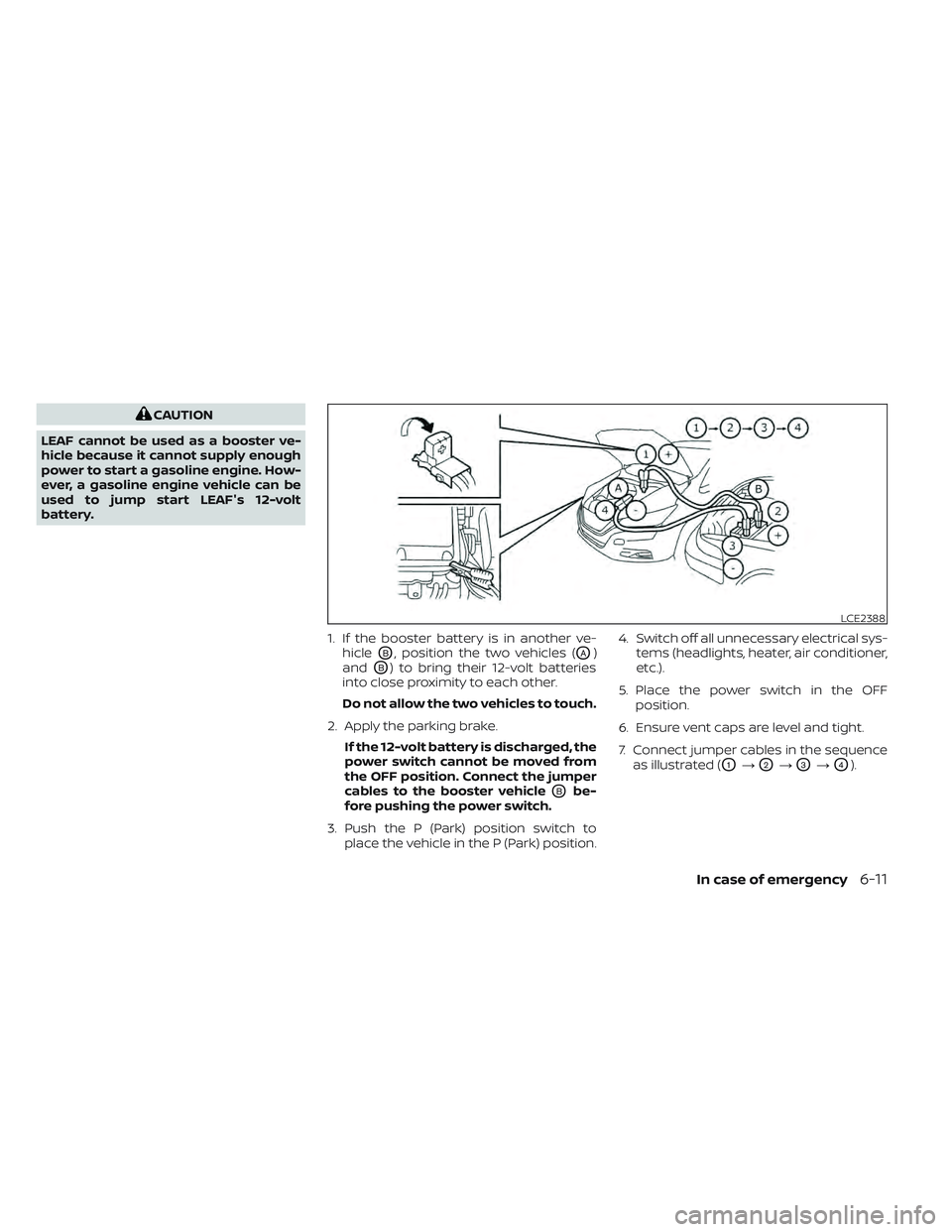
1. If the booster battery is in another ve-hicle
OB, position the two vehicles (OA)
and
OB) to bring their 12-volt batteries
into close proximity to each other.
Do not allow the two vehicles to touch.
2. Apply the parking brake. If the 12-volt battery is discharged, the
power switch cannot be moved from
the OFF position. Connect the jumper
cables to the booster vehicle
OBbe-
fore pushing the power switch.
3. Push the P (Park) position switch to place the vehicle in the P (Park) position. 4. Switch off all unnecessary electrical sys-
tems (headlights, heater, air conditioner,
etc.).
5. Place the power switch in the OFF position.
6. Ensure vent caps are level and tight.
7. Connect jumper cables in the sequence as illustrated (
O1→O2→O3→O4).
LCE2388
In case of emergency6-11
Page 513 of 618
CAUTION
• Always connect positive (+) to posi-
tive (+) and negative (−) to body
ground (for example, as illustrated),
not to the 12-volt battery.
• Make sure the jumper cables do not
touch moving parts in the motor
compartment and that the cable
clamps do not contact any other
metal.
8. Start the engine of the booster vehicle
OB.
9. While the booster vehicle
OBengine is
running, place the EV system in the
READY to drive position.
CAUTION
If the system does not start right away,
push the power switch to the OFF posi-
tion and wait 10 seconds before trying
again.
10. Af ter starting your EV system, carefully disconnect the negative cable and
then the positive cable (
O4→O3→O2
→O1) and keep in the READY to drive
position over 20 minutes to charge the
12-volt battery. 11. If necessary, connect the vehicle to a
charging station or EVSE (Electric Ve-
hicle Supply Equipment) to charge the
Li-ion battery. Be sure to read the
“Charging” section and follow the proce-
dures and guidelines described. The ve-
hicle cannot be driven until the Li-ion
battery is charged.
12. Af ter jump starting your vehicle it is rec- ommended you visit a NISSAN certified
LEAF dealer to have the 12V battery
tested.
NOTE:
If it is not possible to turn the system ON
by following this procedure, it is recom-
mended that you visit a NISSAN certified
LEAF dealer immediately. If the power limitation indicator light
illuminates, the traction motor output is
limited resulting in reduced vehicle speed.
Stop the vehicle in a safe location before
the Li-ion battery becomes completely dis-
charged and no power is available to drive
the vehicle. Contact Roadside assistance;
refer to a NISSAN Warranty Information
Booklet.
If possible, place the power switch in the
OFF position while waiting for assistance to
prevent discharging the 12-volt battery.
NOTE:
If the Li-ion battery becomes completely
discharged:
• The vehicle is automatically placed in
the ON position and it will not be pos-
sible to switch to the READY to drive
position.
• The vehicle is automatically switched to the N (Neutral) position and it will not
be possible to drive the vehicle.
IF THE LI-ION BATTERY BECOMES
COMPLETELY DISCHARGED
6-12In case of emergency
Page 514 of 618
WARNING
If the vehicle is in the N (Neutral) posi-
tion and the Li-ion battery and the 12-
volt battery become completely dis-
charged, the vehicle cannot be placed
in the P (Park) position. If this occurs,
place suitable blocks at both the front
and back of a wheel to prevent the ve-
hicle from moving. Failure to block a
wheel may allow the vehicle to move
unexpectedly which may result in seri-
ous personal injury or death.
To place the vehicle in the READY to drive
position so the vehicle can be driven,
charge the Li-ion battery until the driving
range on the instrument panel changes
from “---” to a numeric distance.
NOTE:
• Some vibration may occur when the vehicle is stopped in case the Li-ion
battery becomes completely dis-
charged. This is not the malfunction of
the system.
• If the Li-ion battery is completely dis- charged, it is required to charge until
the low battery charge warning light
turns off (white) from on (yellow). Do not attempt to start the system by
pushing the vehicle.
CAUTION
An EV cannot be push-started or tow-
started. Attempting to do so may cause
traction motor damage. When towing your vehicle, all State (Provin-
cial in Canada) and local regulations for
towing must be followed.
Incorrect towing equipment could dam-
age your vehicle. Towing instructions are
available from a NISSAN certified LEAF
dealer. Local service operators are familiar
with the applicable laws and procedures
for towing. To assure proper towing and to
prevent accidental damage to your vehicle,
NISSAN recommends that you have a ser-
vice operator tow your vehicle. It is advis-
able to have the service operator carefully
read the following precautions.
WARNING
• Never ride in a vehicle that is being
towed.
• Never get under your vehicle af ter it
has been lif ted by a tow truck.
PUSH STARTING TOWING YOUR VEHICLE
In case of emergency6-13
Page 527 of 618
When performing any inspection or main-
tenance work on your vehicle, always take
care to prevent serious accidental injury to
yourself or damage to the vehicle. The fol-
lowing are general precautions that should
be closely observed.
WARNING
• The EV system uses high voltage up
to approximately DC 400 volt. The
system can be hot during and af ter
starting and when the vehicle is shut
off. Be careful of both the high volt-
age and the high temperature. Obey
the labels that are attached to the
vehicle.
• Never disassemble, remove or re-
place high-voltage parts and cables
as well as their connectors. High-
voltage cables are colored orange.
• Disassembling, removing or replac-
ing those parts or cables can cause
severe burns or electric shock that
may result in serious injury or death.
The vehicle high-voltage system has
no user serviceable parts. It is recom-
mended that you visit a NISSAN cer-
tified LEAF dealer for any necessary
maintenance. •
Park the vehicle on a level surface,
apply the parking brake securely and
chock the wheels to prevent the ve-
hicle from moving. Push the P (Park)
position switch on the shif t lever or
place the vehicle into the N (Neutral)
position.
• If you must work with the EV (Electric
Vehicle) system is turned on, keep
hands, clothing, hair and tools away
from moving fans and any other
moving parts.
• Make sure that the power switch is in
the OFF or LOCK position when per-
forming any part replacement or
repairs.
• It is advisable to secure or remove
any loose clothing and remove any
jewelry, such as rings, watches, etc.
before working on your vehicle.
• Always wear eye protection when-
ever you work on your vehicle.
• Never get under the vehicle while it is
supported only by a jack. If it is nec-
essary to work under the vehicle,
support it with safety stands.
• Keep smoking materials, flames and
sparks away from the 12-volt battery.
CAUTION
• Do not work under the hood while
the motor compartment is hot. Push
the power switch in the OFF position
and wait until it cools down.
• Avoid direct contact with used cool-
ant. Improperly disposed coolant
and/or other vehicle fluids can dam-
age the environment. Always con-
form to local regulations for the dis-
posal of vehicle fluids.
• Never connect or disconnect the bat-
tery or any transistorized compo-
nent while the power switch is in the
ON position.
• Your vehicle is equipped with an au-
tomatic cooling fan. It may come on
at any time without warning, even if
the power switch is not in the ACC, ON
or READY to drive position. To avoid
injury, always disconnect the nega-
tive 12-volt battery cable before
working near the fan.
• Before performing any electrical
maintenance work on the vehicle
such as the battery, fuses or bulb re-
placement, confirm the following:
– The charge connector is removed
from the vehicle.
MAINTENANCE PRECAUTIONS
8-2Do-it yourself
Page 528 of 618
–The Climate Ctrl. Timer is not ac-
tive or operating. For additional
information, see “Climate Ctrl.
Timer” (P. 4-38).
– The 12-volt battery is not being
charged by the Li-ion battery and
that all charging status indicator
lights are off. For additional infor-
mation, see “Charging the 12-volt
battery ” (P. EV-5) and “Charging
status indicator lights” (P. CH-49).
• The power switch is in the OFF posi-
tion. Place the power switch in the ON
position and then in the OFF position
to prevent the 12-volt battery auto-
matically being charged by the Li-ion
battery. For additional information,
see “Charging the 12-volt battery ”
(P. EV-5).
NOTE:
If the battery is completely drained the
transmission will not manually shif t to
other positions. The “Do-it-yourself ” section gives instruc-
tions regarding only those items that are
relatively easy for an owner to perform.
A Genuine NISSAN Service Manual is also
available. For additional information, see
“Owner’s manual/service manual order in-
formation” (P. 10-22).
You should be aware that incomplete or
improper servicing may result in operating
difficulties and could affect your warranty
coverage.
If in doubt about any servicing,
it is recommended that you visit a
NISSAN certified LEAF dealer.
Do-it yourself8-3
Page 535 of 618
• Keep the 12-volt battery surface cleanand dry. Clean the 12-volt battery with a
solution of baking soda and water.
• Make certain the terminal connections are clean and securely tightened.
NOTE:
Care should be taken to avoid situations
that can lead to potential battery dis-
charge and potential no-start conditions
such as:
1. Installation or extended use of elec- tronic accessories that consume bat-
tery power when the EV system is not
running (Phone chargers, GPS, DVD
players, etc.)
2. Vehicle is not driven regularly and/or only driven short distances.
In these cases, the battery may need to
be charged to maintain battery health
WARNING
• Do not expose the 12-volt battery to
flames or electrical sparks. Hydrogen
gas generated by the 12-volt battery
is explosive. Do not allow 12-volt bat-
tery fluid to contact your skin, eyes,
fabrics or painted surfaces. Af ter
touching a 12-volt battery or 12-volt
battery cap, do not touch or rub your
eyes. Thoroughly wash your hands. If
the acid contacts your eyes, skin or
clothing, immediately flush with wa-
ter for at least 15 minutes and seek
medical attention.
• Do not operate the vehicle if the fluid
in the 12-volt battery is low. Low 12-
volt battery fluid can cause a higher
load on the 12-volt battery which can
generate heat, reduce battery life,
and in some cases lead to an
explosion. •
When working on or near a 12-volt
battery, always wear suitable eye
protection and remove all jewelry.
• 12-volt battery posts, terminals and
related accessories contain lead and
lead compounds. Wash hands af ter
handling.
• Keep the 12-volt battery out of the
reach of children.
8-10Do-it yourself
Page 536 of 618
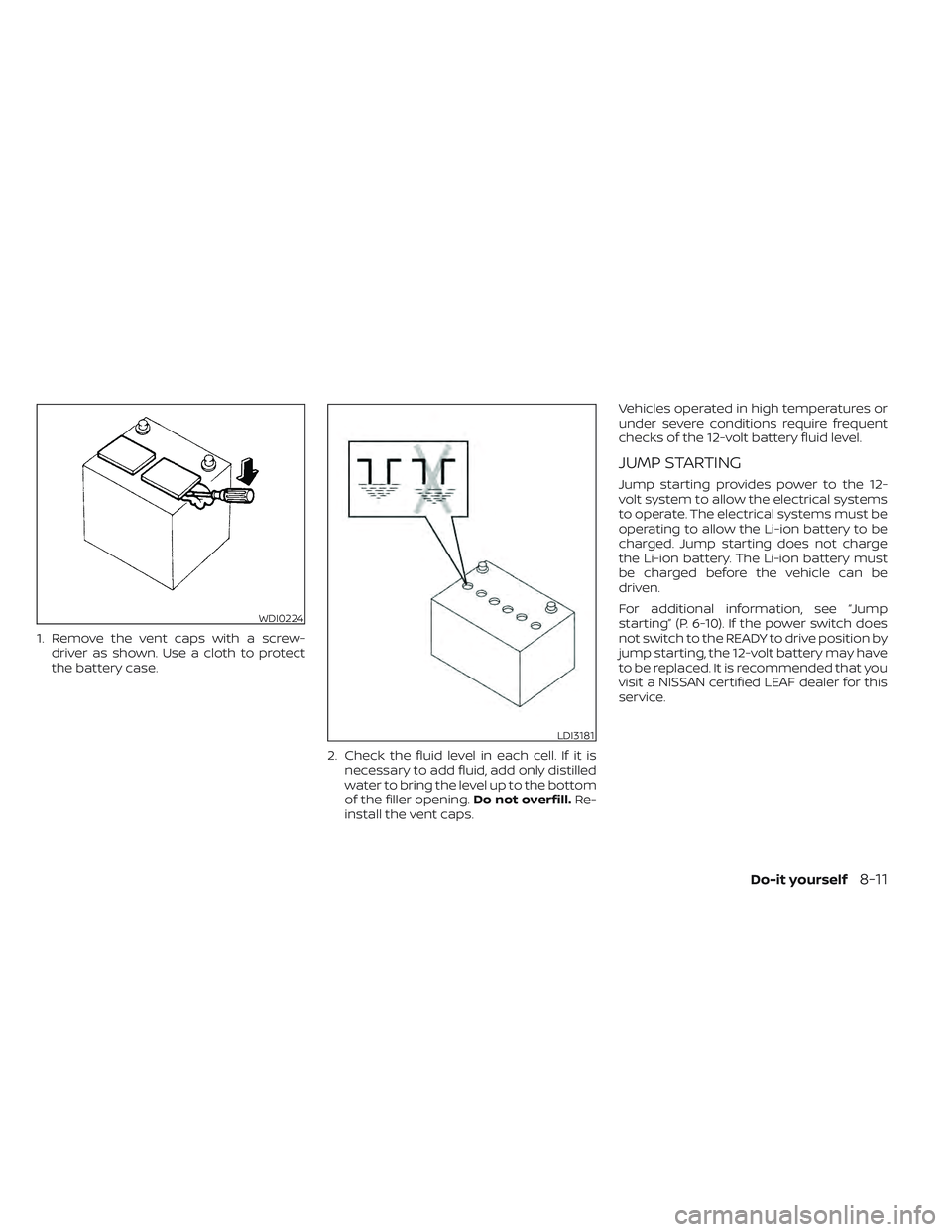
1. Remove the vent caps with a screw-driver as shown. Use a cloth to protect
the battery case.
2. Check the fluid level in each cell. If it isnecessary to add fluid, add only distilled
water to bring the level up to the bottom
of the filler opening. Do not overfill.Re-
install the vent caps. Vehicles operated in high temperatures or
under severe conditions require frequent
checks of the 12-volt battery fluid level.
JUMP STARTING
Jump starting provides power to the 12-
volt system to allow the electrical systems
to operate. The electrical systems must be
operating to allow the Li-ion battery to be
charged. Jump starting does not charge
the Li-ion battery. The Li-ion battery must
be charged before the vehicle can be
driven.
For additional information, see “Jump
starting” (P. 6-10). If the power switch does
not switch to the READY to drive position by
jump starting, the 12-volt battery may have
to be replaced. It is recommended that you
visit a NISSAN certified LEAF dealer for this
service.
WDI0224
LDI3181
Do-it yourself8-11