tire size NISSAN LEAF 2023 User Guide
[x] Cancel search | Manufacturer: NISSAN, Model Year: 2023, Model line: LEAF, Model: NISSAN LEAF 2023Pages: 612, PDF Size: 7.42 MB
Page 551 of 612
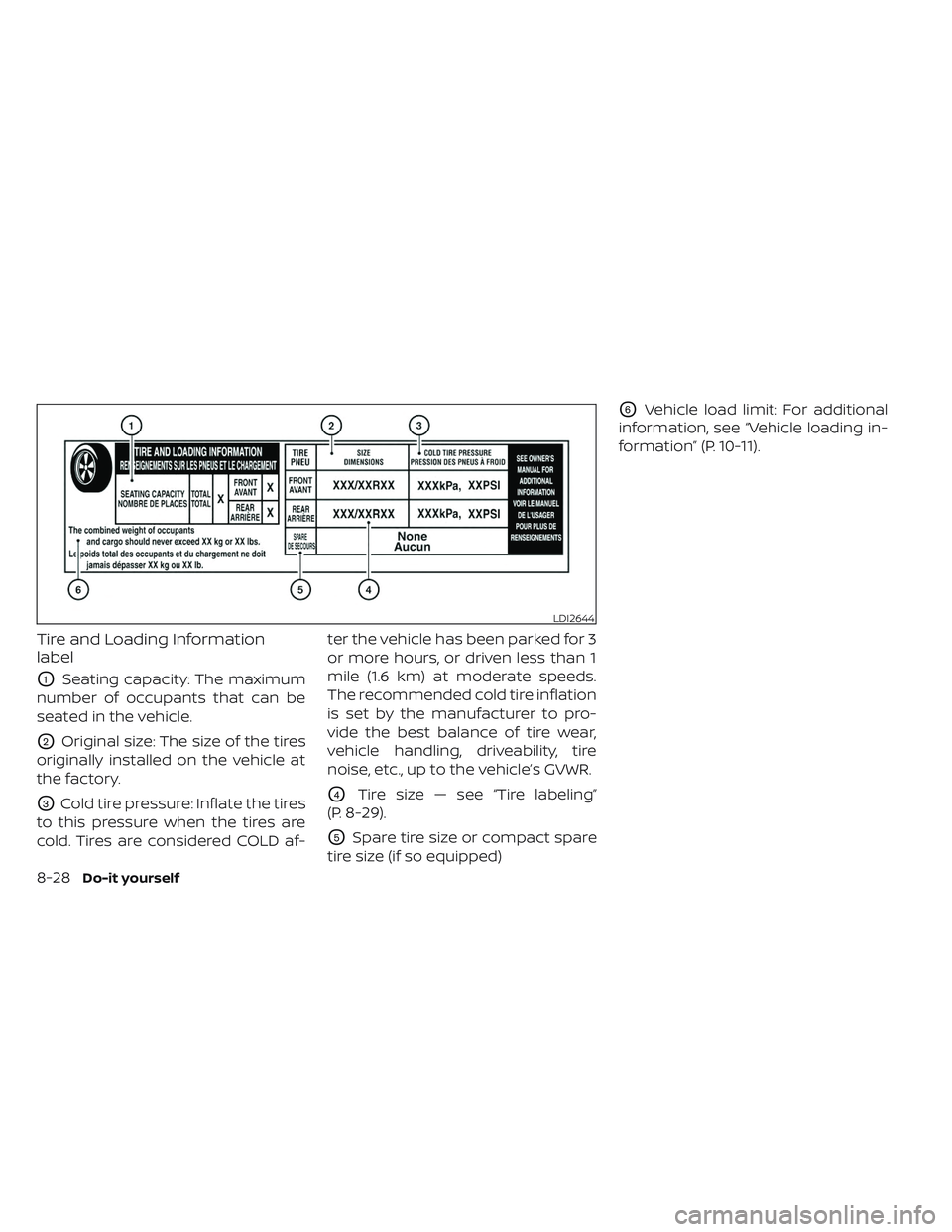
Tire and Loading Information
label
O1Seating capacity: The maximum
number of occupants that can be
seated in the vehicle.
O2Original size: The size of the tires
originally installed on the vehicle at
the factory.
O3Cold tire pressure: Inflate the tires
to this pressure when the tires are
cold. Tires are considered COLD af- ter the vehicle has been parked for 3
or more hours, or driven less than 1
mile (1.6 km) at moderate speeds.
The recommended cold tire inflation
is set by the manufacturer to pro-
vide the best balance of tire wear,
vehicle handling, driveability, tire
noise, etc., up to the vehicle’s GVWR.O4Tire size — see “Tire labeling”
(P. 8-29).
O5Spare tire size or compact spare
tire size (if so equipped)
O6Vehicle load limit: For additional
information, see “Vehicle loading in-
formation” (P. 10-11).
LDI2644
8-28Do-it yourself
Page 552 of 612
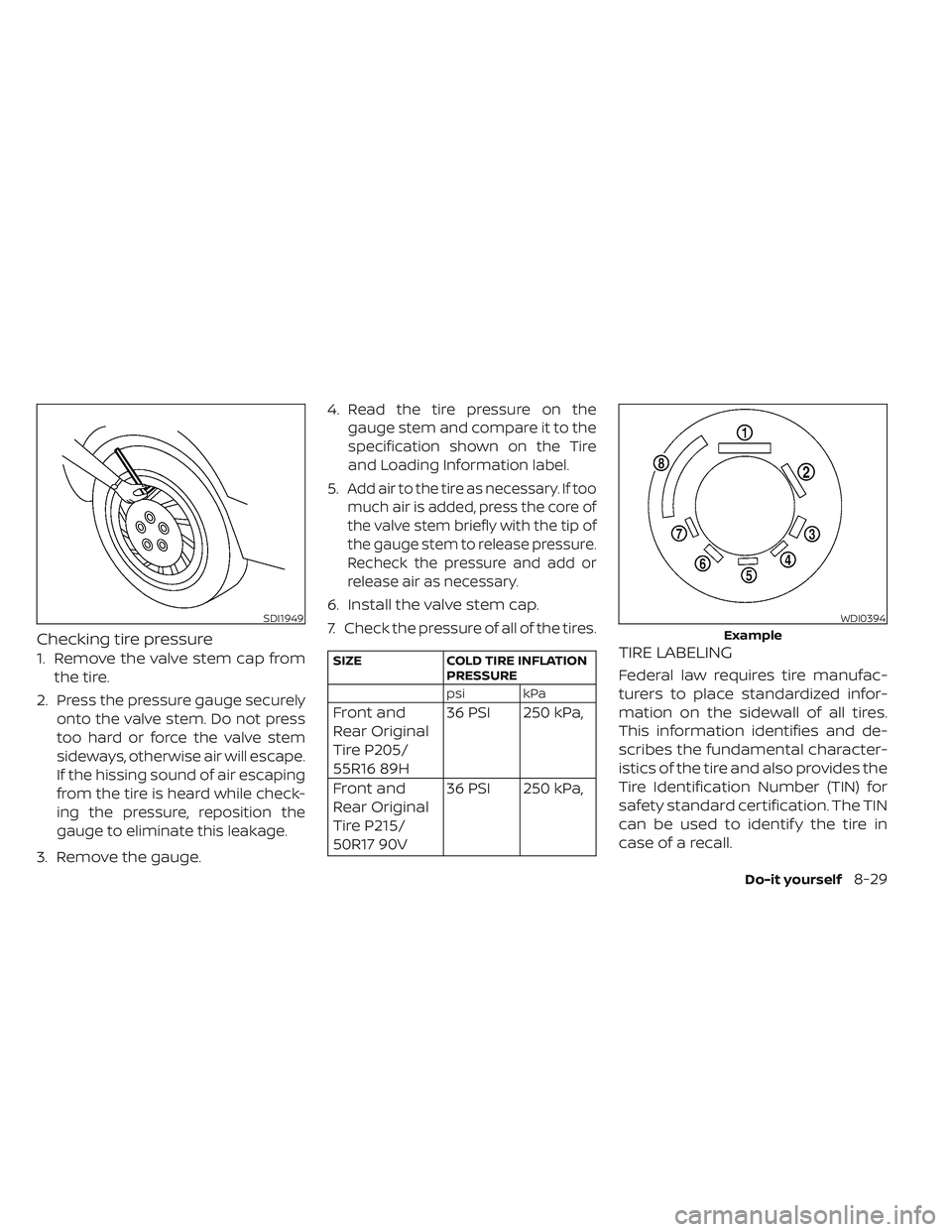
Checking tire pressure
1. Remove the valve stem cap fromthe tire.
2.
Press the pressure gauge securely
onto the valve stem. Do not press
too hard or force the valve stem
sideways, otherwise air will escape.
If the hissing sound of air escaping
from the tire is heard while check-
ing the pressure, reposition the
gauge to eliminate this leakage.
3. Remove the gauge. 4.
Read the tire pressure on the
gauge stem and compare it to the
specification shown on the Tire
and Loading Information label.
5.Add air to the tire as necessary. If too
much air is added, press the core of
the valve stem briefly with the tip of
the gauge stem to release pressure.
Recheck the pressure and add or
release air as necessary.
6. Install the valve stem cap.
7.
Check the pressure of all of the tires.
SIZE COLD TIRE INFLATION
PRESSURE
psi kPa
Front and
Rear Original
Tire P205/
55R16 89H 36 PSI 250 kPa,
Front and
Rear Original
Tire P215/
50R17 90V 36 PSI 250 kPa,
TIRE LABELING
Federal law requires tire manufac-
turers to place standardized infor-
mation on the sidewall of all tires.
This information identifies and de-
scribes the fundamental character-
istics of the tire and also provides the
Tire Identification Number (TIN) for
safety standard certification. The TIN
can be used to identif y the tire in
case of a recall.
SDI1949WDI0394
Example
Do-it yourself8-29
Page 553 of 612
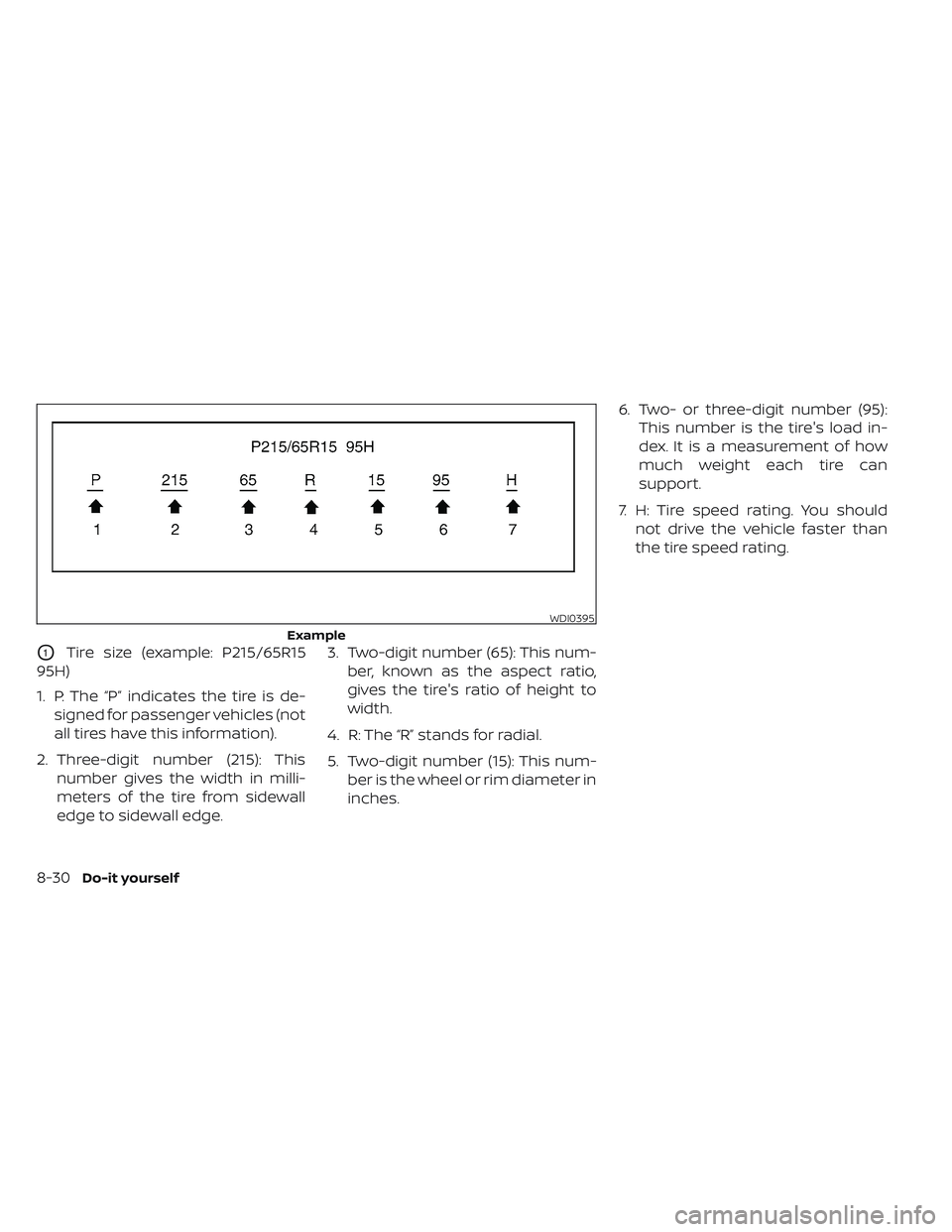
O1Tire size (example: P215/65R15
95H)
1. P: The “P” indicates the tire is de- signed for passenger vehicles (not
all tires have this information).
2. Three-digit number (215): This number gives the width in milli-
meters of the tire from sidewall
edge to sidewall edge. 3. Two-digit number (65): This num-
ber, known as the aspect ratio,
gives the tire's ratio of height to
width.
4. R: The “R” stands for radial.
5. Two-digit number (15): This num- ber is the wheel or rim diameter in
inches. 6. Two- or three-digit number (95):
This number is the tire's load in-
dex. It is a measurement of how
much weight each tire can
support.
7. H: Tire speed rating. You should not drive the vehicle faster than
the tire speed rating.
WDI0395
Example
8-30Do-it yourself
Page 554 of 612
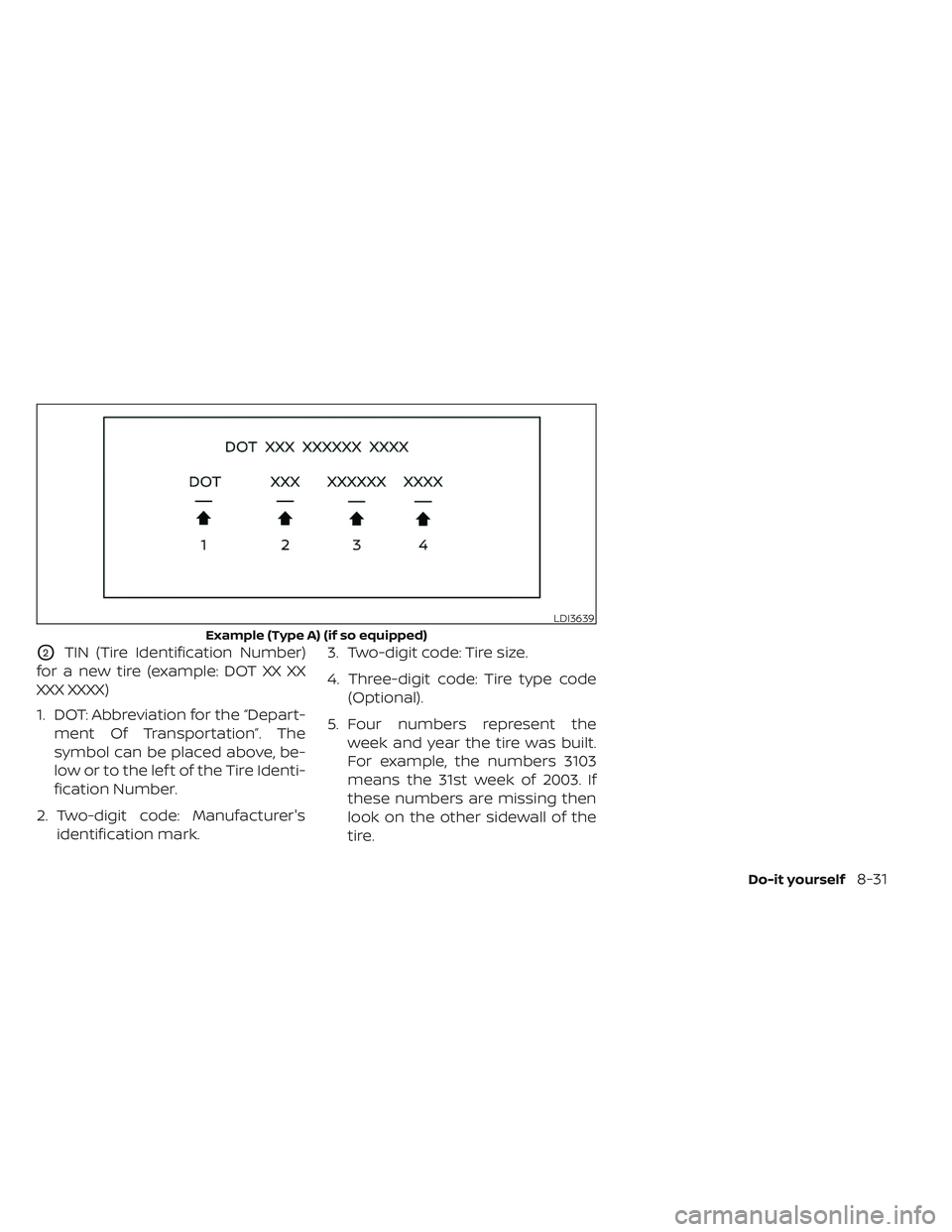
O2TIN (Tire Identification Number)
for a new tire (example: DOT XX XX
XXX XXXX)
1. DOT: Abbreviation for the “Depart- ment Of Transportation”. The
symbol can be placed above, be-
low or to the lef t of the Tire Identi-
fication Number.
2. Two-digit code: Manufacturer's identification mark. 3. Two-digit code: Tire size.
4. Three-digit code: Tire type code
(Optional).
5. Four numbers represent the week and year the tire was built.
For example, the numbers 3103
means the 31st week of 2003. If
these numbers are missing then
look on the other sidewall of the
tire.
LDI3639
Example (Type A) (if so equipped)
Do-it yourself8-31
Page 556 of 612
O6Term of “tubeless” or “tube type”
Indicates whether the tire requires
an inner tube (“tube type”) or not
(“tubeless”).
O7The word “radial”
The word “radial” is shown if the tire
has radial structure.
O8Manufacturer or brand name
Manufacturer or brand name is
shown.
Other Tire-related Terminology
In addition to the many terms that
are defined throughout this section,
Intended Outboard Sidewall is (1) the
sidewall that contains a whitewall,
bears white lettering or bears
manufacturer, brand, and/or model
name molding that is higher or
deeper than the same molding on
the other sidewall of the tire, or (2)
the outward facing sidewall of an
asymmetrical tire that has a particu- lar side that must always face out-
ward when mounted on a vehicle.
TYPES OF TIRES
WARNING
• When changing or replacing tires, be
sure all four tires are of the same type
(Example: Summer, All Season or
Snow) and construction. A NISSAN
certified LEAF dealer may be able to
help you with information about tire
type, size, speed rating and
availability.
• Always use tires of the same type,
size, brand, construction and tread
pattern on all four wheels. Failure to
do so may result in a circumference
difference between tires on the front
and rear axles which can cause the
VDC system to malfunction resulting
in personal injury or death, excessive
tie wear and may damage the trans-
mission and differential gears.
• Replacement tires may have a lower
speed rating than the factory
equipped tires, and may not match
the potential maximum vehicle
speed. Never exceed the maximum
speed rating of the tire. •
Replacing tires with those not origi-
nally specified by NISSAN could af-
fect the proper operation of the
TPMS.
• For additional information regarding
tires, refer to “Important Tire Safety
Information” (US) or “Tire Safety In-
formation” (Canada) in the Warranty
Information Booklet.
All season tires
NISSAN specifies all season tires on some
models to provide good performance all
year, including snowy and icy road condi-
tions. All Season tires are identified by ALL
SEASON and/or M&S (Mud and Snow) on
the tire sidewall. Snow tires have better
snow traction than All Season tires and
may be more appropriate in some areas.
Summer tires
NISSAN specifies summer tires on some
models to provide superior performance
on dry roads. Summer tire performance is
substantially reduced in snow and ice.
Summer tires do not have the tire traction
rating M&S on the tire sidewall.
Do-it yourself8-33
Page 557 of 612
If you plan to operate your vehicle in snowy
or icy conditions, NISSAN recommends the
use of SNOW tires or ALL SEASON tires on all
four wheels.
Snow tires
If snow tires are needed, it is necessary to
select tires equivalent in size and load rat-
ing to the original equipment tires. If you do
not, it can adversely affect the safety and
handling of your vehicle.
Generally, snow tires will have lower speed
ratings than factory equipped tires and
may not match the potential maximum
vehicle speed. Never exceed the maximum
speed rating of the tire.
If you install snow tires, they must be the
same size, brand, construction and tread
pattern on all four wheels.
For additional traction on icy roads, stud-
ded tires may be used. However, some U.S.
states and Canadian provinces prohibit
their use. Check local, state and provincial
laws before installing studded tires. Skid
and traction capabilities of studded snow
tires, on wet or dry surfaces, may be poorer
than that of non-studded snow tires.
TIRE CHAINS
Use of tire chains may be prohibited ac-
cording to location. Check the local laws
before installing tire chains. When installing
tire chains, make sure they are the proper
size for the tires on your vehicle and are
installed according to the chain manufac-
turer’s suggestions.
Use only SAE Class S chains.Class “S”
chains are used on vehicles with restricted
tire to vehicle clearance. Vehicles that can
use Class “S” chains are designed to meet
the SAE standard minimum clearances be-
tween the tire and the closest vehicle sus-
pension or body component required to
accommodate the use of a winter traction
device (tire chains or cables). The minimum
clearances are determined using the fac-
tory equipped tire size. Other types may
damage your vehicle. Use chain tensioners when recommended
by the tire chain manufacturer to ensure a
tight fit. Loose end links of the tire chain
must be secured or removed to prevent
the possibility of whipping action damage
to the fenders or underbody. If possible,
avoid fully loading your vehicle when using
tire chains. In addition, drive at a reduced
speed. Otherwise, your vehicle may be
damaged and/or vehicle handling and
performance may be adversely affected.
Tire chains must be installed only on the
front wheels and not on the rear wheels.
Do not use tire chains on dry roads. Driving
with tire chains in such conditions can
cause damage to the various mechanisms
of the vehicle due to some overstress.
8-34Do-it yourself
Page 559 of 612
WARNING
•Tires should be periodically in-
spected for wear, cracking,
bulging or objects caught in
the tread. If excessive wear,
cracks, bulging or deep cuts
are found, the tire(s) should be
replaced.
• The original tires have built-in
tread wear indicators. When
wear indicators are visible, the
tire(s) should be replaced.
• Tires degrade with age and
use. Have tires, over 6 years old
checked by a qualified techni-
cian, because some tire dam-
age may not be obvious. Re-
place the tires as necessary to
prevent tire failure and pos-
sible personal injury. •
For additional information re-
garding tires, refer to “Impor-
tant Tire Safety Information”
(US) or “Tire Safety Informa-
tion” (Canada) in the Warranty
Information Booklet.
Replacing wheels and tires
When replacing a tire, use the same size,
tread design, speed rating and load carry-
ing capacity as originally equipped. For ad-
ditional information, see “Wheels and tires”
(P. 10-5) for recommended types and sizes
of tires and wheels.
WARNING
• The use of tires other than those rec-
ommended or the mixed use of tires
of different brands, construction
(bias, bias-belted or radial), or tread
patterns can adversely affect the
ride, braking, handling, Vehicle Dy-
namic Control (VDC) system, ground
clearance, body-to-tire clearance,
tire chain clearance, speedometer
calibration, headlight aim and bum-
per height. Some of these effects
may lead to accidents and could re-
sult in serious personal injury.
• If your vehicle was originally
equipped with four tires that were
the same size and you are only re-
placing two of the four tires, install
the new tires on the rear axle. Placing
new tires on the front axle may cause
loss of vehicle control in some driving
conditions and cause an accident
and personal injury.
8-36Do-it yourself
Page 582 of 612
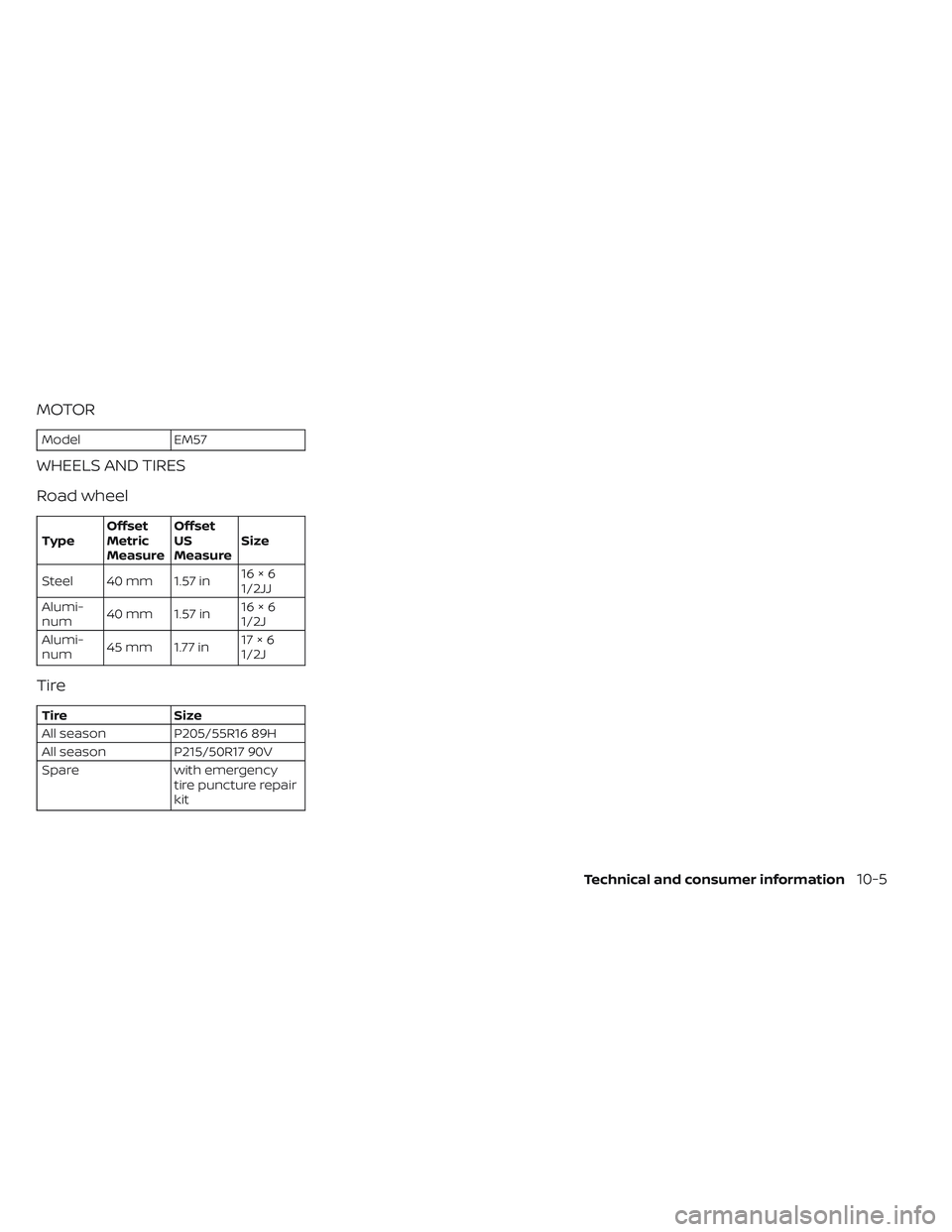
MOTOR
ModelEM57
WHEELS AND TIRES
Road wheel
TypeOffset
Metric
Measure Offset
US
Measure
Size
Steel 40 mm 1.57 in 16×6
1/2JJ
Alumi-
num 40 mm 1.57 in 16×6
1/2J
Alumi-
num 45 mm 1.77 in 17×6
1/2J
Tire
Tire
Size
All season P205/55R16 89H
All season P215/50R17 90V
Spare with emergency
tire puncture repair
kit
Technical and consumer information10-5
Page 610 of 612
T
Telematic Control Unit Gen2K.......10-19Telematics overview.............10-17TemperatureLi-ion battery temperature gauge. . . .2-7Thef t (NISSAN Vehicle Immobilizer System),
traction motor start..........2-46, 5-13TireFlat tire................... .6-3Low tire pressure warning system. . .5-4Tire and Loading Information
label..................8-28, 10-9Tire chains.................8-34Tire dressing.................7-4Tire pressure................8-29Tire Pressure Monitoring System
(TPMS)................. .5-4, 6-3Tire rotation.................8-35Types of tires................8-33Uniform tire quality grading.......10-15Wheel/tire size...............10-5Wheels and tires..............8-25Tire pressure
Low tire pressure warning light.....2-21Tonneau cover................ .2-68To p
Tether strap child restraints.......1-27Top tether strap child restraint.......1-27TowingFlat towing................ .10-15Tow truck towing..............6-13Trailer towing...............10-14Towing a trailer................10-14
TPMS, Tire Pressure Monitoring System. .5-4Traction motor
Traction motor serial number......10-8Trickle charge................CH-11Turn signal switch...............2-56Type of charge and how to charge the
Li-ion battery................ .CH-5
U
Underbody cleaning..............7-3Uniform tire quality grading........10-15Unplugged status.............CH-48USB/iPod® Charging Ports.........2-64
V
Vanity mirror..................3-24Vehicle
Dimensions and weights.........10-6Loading information...........10-11Security system..............2-44Vehicle Dynamic Control (VDC)
system.....................5-164Vehicle identification number (VIN)
plate...................... .10-7Vehicle immobilizer system.........5-13Vehicle information display......2-26,2-27Vehicle security system (NISSAN Vehicle
Immobilizer System), traction motor
start
.......................5-13Vents......................4-28Visors......................3-23
W
Warning
Air bag warning light........1-66, 2-18Hazard warning flasher switch......6-2Indicators for operation.........2-36Low tire pressure warning light.....2-21Seat belt warning light...........1-14Supplemental air bag warning
light.................. .1-66, 2-18Tire Pressure Monitoring System
(TPMS)..................5-4, 6-3Warning lights............2-16,2-19Warning/indicator lights and audible
reminders..................2-14Warning light
Anti-lock braking system (ABS) warning
light
......................2-19BRAKE warning light (red).........2-17BRAKE warning light (yellow).......2-20Seat belt warning light..........2-18Warning lights.................2-14Warning/indicator lights and audible
reminders....................2-14Audible reminders.............2-14Indicator lights...............2-14Warning lights................2-14Washer switchRear window wiper and washer
switches
.................. .2-48Wiper and washer switch........2-47Washing......................7-2Waxing......................7-3Weights (See dimensions and weights). .10-6
11-7
Page 611 of 612
Wheel/tire size.................10-5Wheels and tires................8-25Care of wheels................7-3Cleaning aluminum alloy wheels.....7-4When traveling or registering in another
country..................... .10-7Window(s)
Cleaning....................7-3WindowsPowerrearwindows............2-71Power windows..............2-69Rear power windows...........2-71Windshield wiper blades........8-12,8-13Windshield-washer fluid............8-8WiperPulling up the wiper arm.........8-12Rear window wiper and washer
switches.................. .2-48Rear window wiper blade........8-14Wiper and washer switch........2-47Wiper blades.............8-12,8-13Wiper and washer switch..........2-47
11-8