hatch NISSAN LEAF 2023 Owner's Manual
[x] Cancel search | Manufacturer: NISSAN, Model Year: 2023, Model line: LEAF, Model: NISSAN LEAF 2023Pages: 612, PDF Size: 7.42 MB
Page 271 of 612
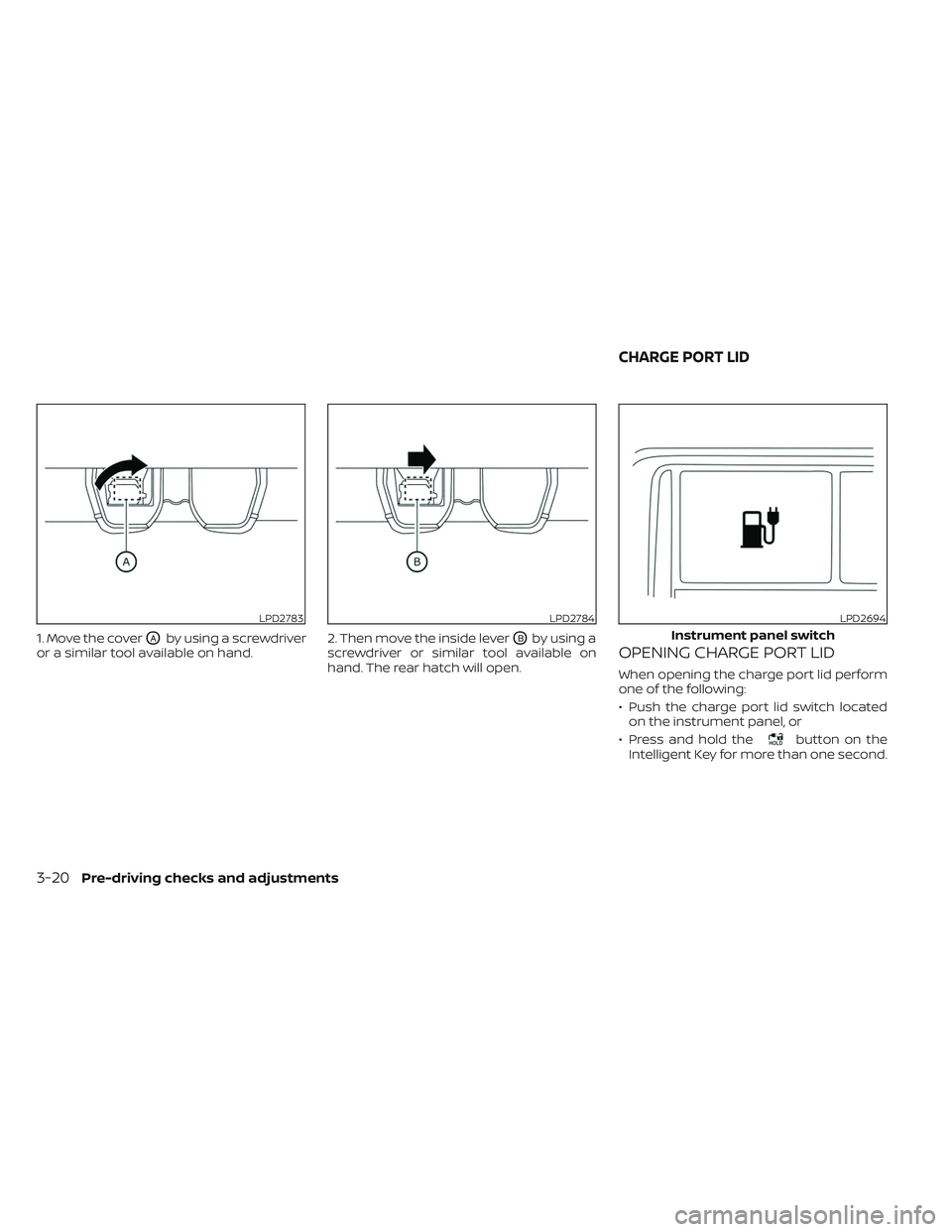
1. Move the coverOAby using a screwdriver
or a similar tool available on hand. 2. Then move the inside leverOBby using a
screwdriver or similar tool available on
hand. The rear hatch will open.OPENING CHARGE PORT LID
When opening the charge port lid perform
one of the following:
• Push the charge port lid switch located on the instrument panel, or
• Press and hold the
button on the
Intelligent Key for more than one second.
LPD2783LPD2784LPD2694
Instrument panel switch
CHARGE PORT LID
3-20Pre-driving checks and adjustments
Page 286 of 612
NOTE:Do not adjust any of the display set-
tings of the RearView Monitor while
the vehicle is moving. Make sure the
parking brake is firmly applied.
HOW TO TURN ON AND OFF
PREDICTED COURSE LINES
To toggle ON and OFF the predicted course
lines while in the P (Park) position:
1. Touch the “Settings” key.
2. Touch the “Camera” key.
3. Touch the “Predicted Course Lines” keyto turn the feature ON or OFF.
Pressing the CAMERA button while the shif t
lever is in the R (Reverse) position can also
turn on and off the predicted course lines.
REARVIEW MONITOR SYSTEM
LIMITATIONS
WARNING
Listed below are the system limitations
for RearView Monitor. Failure to oper-
ate the vehicle in accordance with
these system limitations could result in
serious injury or death. •
The system cannot completely elimi-
nate blind spots and may not show
every object.
• Underneath the bumper and the cor-
ner areas of the bumper cannot be
viewed on the RearView Monitor be-
cause of its monitoring range limita-
tion. The system will not show small
objects below the bumper, and may
not show objects close to the bum-
per or on the ground.
• Objects viewed in the RearView
Monitor differ from actual distance
because a wide-angle lens is used.
• Objects in the RearView Monitor will
appear visually opposite compared
to when viewed in the rearview and
outside mirrors.
• Use the displayed lines as a refer-
ence. The lines are highly affected by
the number of occupants, fuel level,
vehicle position, road conditions and
road grade.
• Make sure that the rear hatch is se-
curely closed when backing up.
• Do not put anything on the rearview
camera. The rearview camera is in-
stalled above the license plate. •
When washing the vehicle with high
pressure water, be sure not to spray it
around the camera. Otherwise, water
may enter the camera unit causing
water condensation on the lens, a
malfunction, fire or an electric shock.
• Do not strike the camera. It is a preci-
sion instrument. Otherwise, it may
malfunction or cause damage result-
ing in a fire or an electric shock.
The following are operating limitations and
do not represent a system malfunction:
• When the temperature is extremely high or low, the screen may not clearly display
objects.
• When strong light directly shines on the camera, objects may not be displayed
clearly.
• Vertical lines may be seen in objects on the screen. This is due to strong reflected
light from the bumper.
• The screen may flicker under fluorescent light.
• The colors of objects on the RearView Monitor may differ somewhat from the
actual color of objects.
• Objects on the monitor may not be clear in a dark environment.
Monitor, climate, audio, phone and voice recognition systems4-9
Page 297 of 612
INTELLIGENT AROUND VIEW®
MONITOR SYSTEM LIMITATIONS
WARNING
Listed below are the system limitations
for Intelligent Around View® Monitor.
Failure to operate the vehicle in accor-
dance with these system limitations
could result in serious injury or death.
• Do not use the Intelligent Around
View® Monitor with the outside mir-
rors in the stored position, and make
sure that the rear hatch is securely
closed when operating the vehicle
using the Intelligent Around View®
Monitor.
• The apparent distance between ob-
jects viewed on the Intelligent
Around View® Monitor differs from
the actual distance.
• The cameras are installed on the
front grille, the outside mirrors and
above the rear license plate. Do not
put anything on the vehicle that cov-
ers the cameras.
• When washing the vehicle with high
pressure water, be sure not to spray it
around the cameras. Otherwise, wa-
ter may enter the camera unit caus-
ing water condensation on the lens, a
malfunction, fire or an electric shock. •
Do not strike the cameras. They are
precision instruments. Doing so
could cause a malfunction or cause
damage resulting in a fire or an elec-
tric shock.
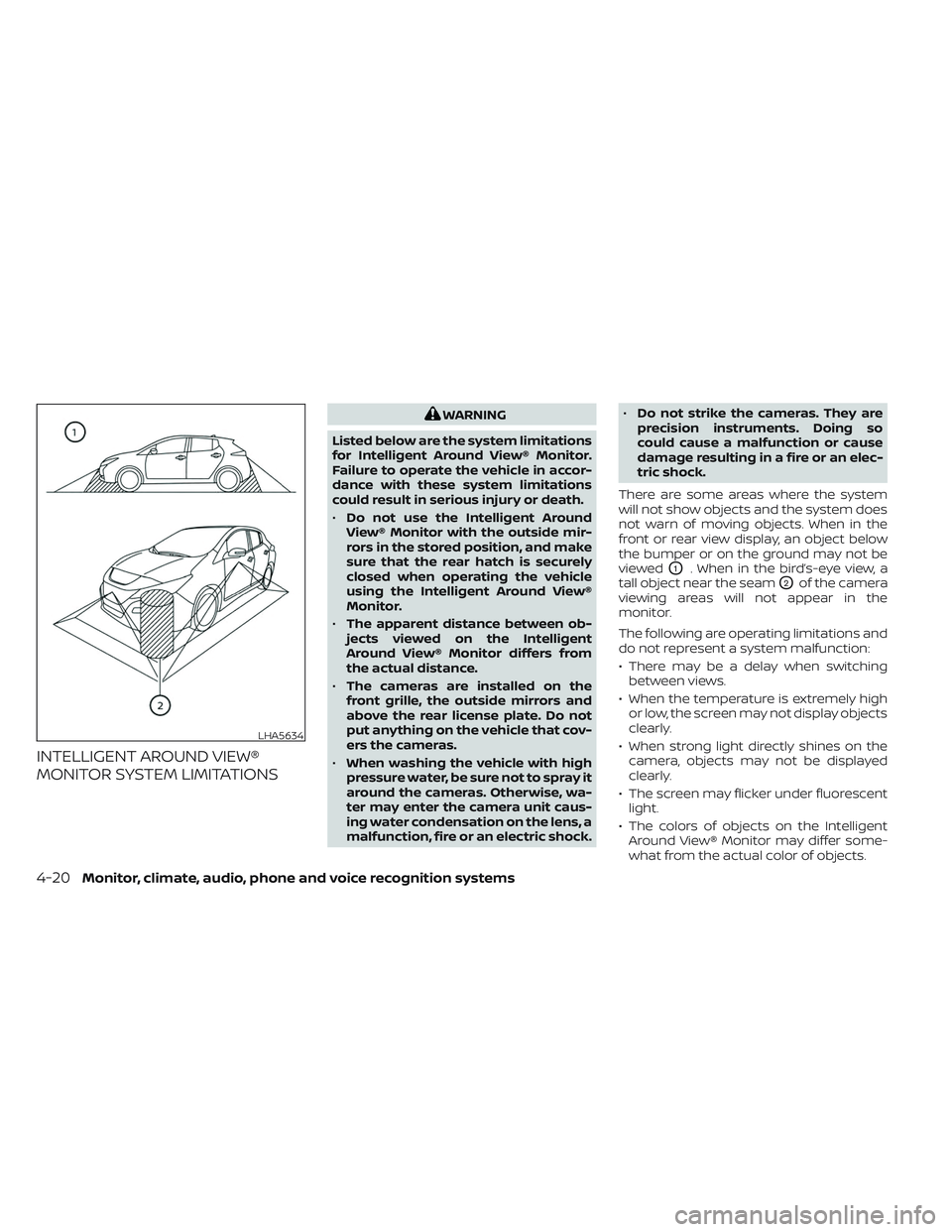
There are some areas where the system
will not show objects and the system does
not warn of moving objects. When in the
front or rear view display, an object below
the bumper or on the ground may not be
viewed
O1. When in the bird’s-eye view, a
tall object near the seam
O2of the camera
viewing areas will not appear in the
monitor.
The following are operating limitations and
do not represent a system malfunction:
• There may be a delay when switching between views.
• When the temperature is extremely high or low, the screen may not display objects
clearly.
• When strong light directly shines on the camera, objects may not be displayed
clearly.
• The screen may flicker under fluorescent light.
• The colors of objects on the Intelligent Around View® Monitor may differ some-
what from the actual color of objects.
LHA5634
4-20Monitor, climate, audio, phone and voice recognition systems
Page 302 of 612
• When the shif t lever is in the D (Drive)position and the vehicle speed is below
approximately 5 mph (8 km/h), the MOD
system detects moving objects in the
front view.
• When the shif t lever is in the R (Reverse) position and the vehicle speed is below
approximately 5 mph (8 km/h), the MOD
system detects moving objects in the
rear view. The MOD system will not oper-
ate if the rear hatch is open. The MOD system does not detect moving
objects in the front-side view. The MOD
icon is not displayed on the screen when in
this view.
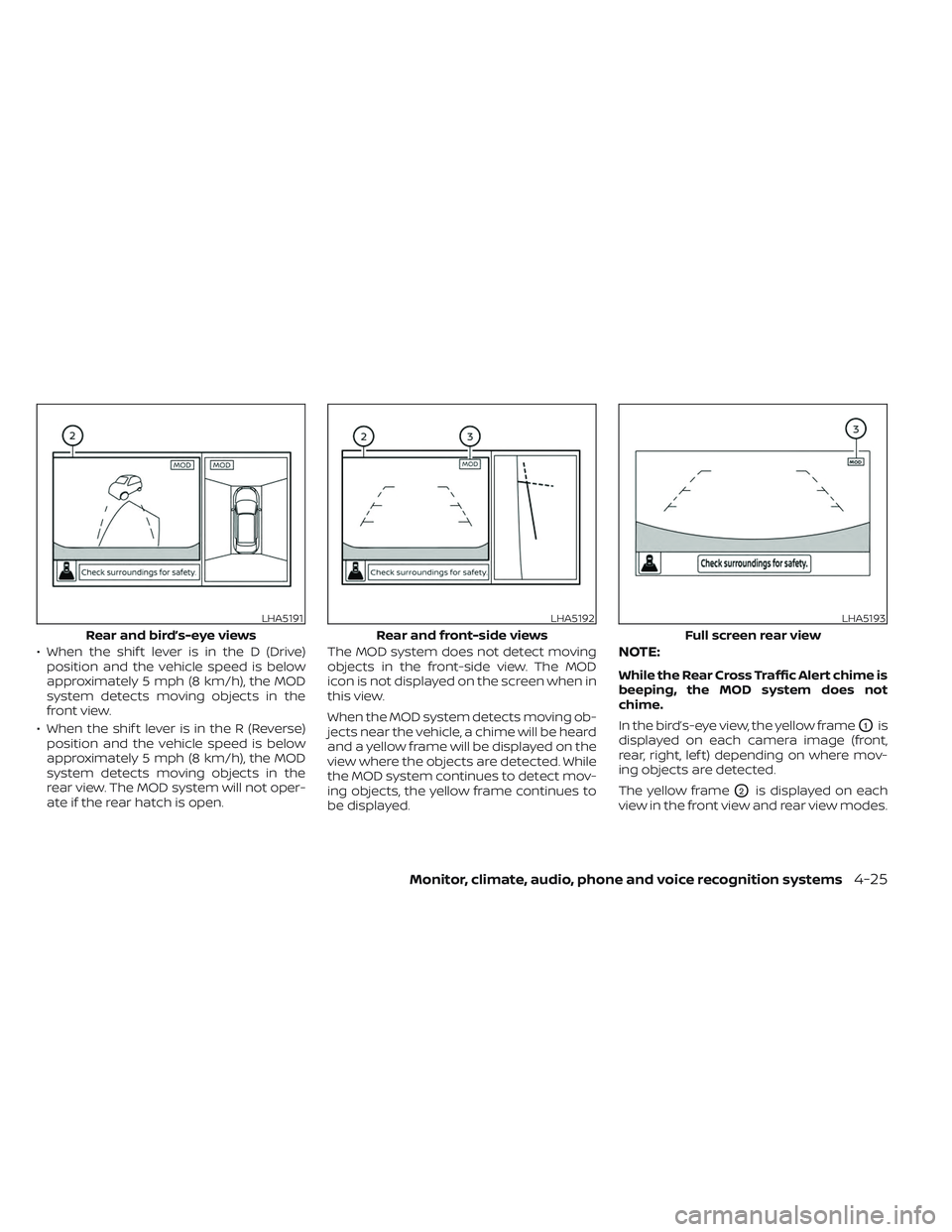
When the MOD system detects moving ob-
jects near the vehicle, a chime will be heard
and a yellow frame will be displayed on the
view where the objects are detected. While
the MOD system continues to detect mov-
ing objects, the yellow frame continues to
be displayed.NOTE:
While the Rear Cross Traffic Alert chime is
beeping, the MOD system does not
chime.
In the bird’s-eye view, the yellow frame
O1is
displayed on each camera image (front,
rear, right, lef t) depending on where mov-
ing objects are detected.
The yellow frame
O2is displayed on each
view in the front view and rear view modes.
LHA5191
Rear and bird’s-eye views
LHA5192
Rear and front-side views
LHA5193
Full screen rear view
Monitor, climate, audio, phone and voice recognition systems4-25
Page 518 of 612
Rinse the vehicle thoroughly with plenty of
clean water.
Inside flanges, seams and folds on the
doors, hatches and hood are particularly
vulnerable to the effects of road salt. There-
fore, these areas must be regularly
cleaned. Make sure that the drain holes in
the lower edge of the door are open. Spray
water under the body and in the wheel
wells to loosen the dirt and wash away
road salt.
Avoid leaving water spots on the paint sur-
face by using a damp chamois to dry the
vehicle.
WAXING
Regular waxing protects the paint surface
and helps retain new vehicle appearance.
Polishing is recommended to remove
built-up wax residue and to avoid a weath-
ered appearance before reapplying wax.
A NISSAN certified LEAF dealer can assist
you in choosing the proper product.
• Wax your vehicle only af ter a thoroughwashing. Follow the instructions supplied
with the wax.
• Do not use a wax containing any abra- sives, cutting compounds or cleaners
that may damage the vehicle finish. Machine compound or aggressive polish-
ing on a base coat/clear coat paint finish
may dull the finish or leave swirl marks.
REMOVING SPOTS
Remove tar and oil spots, industrial dust,
insects, and tree sap as quickly as possible
from the paint surface to avoid lasting
damage or staining. Special cleaning prod-
ucts are available at a NISSAN certified
LEAF dealer or any automotive accessory
stores.
UNDERBODY
In areas where road salt is used in winter,
the underbody must be cleaned regularly.
This will prevent dirt and salt from building
up and causing the acceleration of corro-
sion on the underbody and suspension.
Before the winter period and again in the
spring, the underseal must be checked
and, if necessary, re-treated.
GLASS
Use glass cleaner to remove smoke and
dust film from the glass surfaces. It is nor-
mal for glass to become coated with a film
af ter the vehicle is parked in the hot sun.
Glass cleaner and a sof t cloth will easily
remove this film.
CAUTION
When cleaning the inside of the win-
dows, do not use sharp-edged tools,
abrasive cleaners or chlorine-based
disinfectant cleaners. They could dam-
age the electrical conductors, radio an-
tenna elements or rear window de-
froster elements.
WHEELS
Wash the wheels when washing the vehicle
to maintain their appearance.
• Clean the inner side of the wheels when the wheel is changed or the underside of
the vehicle is washed.
• Inspect wheel rims regularly for dents or corrosion. Such damage may cause loss
of pressure or poor seal at the tire bead.
• NISSAN recommends that the road wheels be waxed to protect against road
salt in areas where it is used during
winter.
CAUTION
Do not use abrasive cleaners when
washing the wheels.
Appearance and care7-3
Page 564 of 612
Outside the vehicle
The maintenance items listed here should
be performed from time to time, unless
otherwise specified.
Doors and motor hood:
Check that the
doors and motor hood operate properly.
Also ensure that all latches lock securely. Lu-
bricate hinges, latches, latch pins, rollers and
links if necessary. Make sure that the sec-
ondary latch keeps the motor hood from
opening when the primary latch is released.
When driving in areas using road salt or
other corrosive materials, check lubrica-
tion frequently.
Check that the gas stays or struts properly
and securely hold the hood, trunk, or rear
hatch fully open. If the hood, trunk, or rear
hatch is not held open, have the gas stays
or struts replaced.
Lights*: Clean the headlights on a regular
basis. Make sure that the headlights, stop
lights, tail lights, turn signal lights, and other
lights are all operating properly and in-
stalled securely. Also check headlight aim.
Road wheel nuts (lug nuts)*: When check-
ing the tires, make sure no wheel nuts are
missing, and check for any loose wheel
nuts. Tighten if necessary. Tire rotation*:
Rotate tires at the specified
interval shown in the maintenance
schedule.
Tires*: Check the pressure with a gauge
of ten and always prior to long distance
trips. If necessary, adjust the pressure in all
tires, to the pressure specified. Check care-
fully for damage, cuts or excessive wear.
Tire Pressure Monitoring System (TPMS)
tire pressure sensor: It is recommended
that you replace the TPMS tire pressure
sensor assembly when the tires are re-
placed due to wear or age.
Wheel alignment and balance: If the ve-
hicle pulls to either side while driving on a
straight and level road, or if you detect un-
even or abnormal tire wear, there may be a
need for wheel alignment.
If the steering wheel or seat vibrates at
normal highway speeds, wheel balancing
may be needed.
For additional information regarding tires,
refer to “Important Tire Safety Information”
(US) or “Tire Safety Information” (Canada) in
the Warranty Information Booklet.
Windshield: Clean the windshield on a
regular basis. Check the windshield at least
every six months for cracks or other dam- age. Have a damaged windshield repaired
by a qualified repair facility. It is recom-
mended that you have a damaged wind-
shield repaired by a NISSAN certified LEAF
dealer, or a NISSAN Certified Collision Cen-
ter. To locate a collision center in your area,
refer to http://collision.nissanusa.com.
Windshield wiper blades*:
Check for
cracks or wear if they do not wipe properly.
Inside the vehicle
The maintenance items listed here should
be checked on a regular basis, such as
when performing scheduled maintenance,
cleaning the vehicle, etc.
Accelerator pedal: Check the pedal for
smooth operation and make sure the
pedal does not catch or require uneven
effort. Keep the floor mat away from the
pedal.
Brake pedal: Check the pedal for smooth
operation. If the brake pedal suddenly goes
down further than normal, the pedal feels
spongy or the vehicle seems to take longer
to stop, it is recommended that you visit a
NISSAN certified LEAF dealer immediately.
Keep the floor mat away from the pedal.
Brakes: Check that the brakes do not pull
the vehicle to one side when applied.
Maintenance and schedules9-3
Page 568 of 612
EV MAINTENANCE SCHEDULES
(EM57 electric motor)
The following shows the maintenance
schedule.
Choose the maintenance schedule
needed based on your vehicle driving
conditions.
Af ter 120,000 miles (192,000 km)/96
months, continue maintenance at the
same mileage/time interval.
7,500 miles/(12,000 km)/6 months
Perform at number of miles, kilometers or
months, whichever comes first.
Standard maintenance:
Inspections:
• Horn, lights, signals, wipers, rear hatch/hood lif t supports
• Battery terminals and cables, battery test
• Tire pressure, treadwear and depth
• Suspension components (shocks, sub- frame, tie rods)
Essential:
• Tire rotation
Severe use maintenance:
Inspections:
• Axle & suspension parts
• Brake pads & rotors
• Drive shaf t boots
• Front suspension ball joints
• Steering gear and linkage
• Steering linkage ball joints
15,000 miles/(24,000 km)/
12 months
Perform at number of miles, kilometers or
months, whichever comes first.
Standard maintenance:
Inspections:
• Brake lines & cables
• Brake pads & rotors
• Charging port
• Drive shaf t boots
• Reduction gear oil
• Horn, lights, signals, wipers, rear hatch/ hood lif t supports
• Battery terminals and cables, battery test
• Tire pressure, treadwear and depth
• Suspension components (shocks, sub- frame, tie rods)
Essential:
• Replace in-cabin microfilter
• Tire rotation
Maintenance and schedules9-7
Page 569 of 612
Severe use maintenance:
Inspections:
• Axle & suspension parts
• Front suspension ball joints
• Steering gear and linkage
• Steering linkage ball joints
Essential:
• Replace brake fluid22,500 miles/(36,000 km)/
18 months
Perform at number of miles, kilometers or
months, whichever comes first.
Standard maintenance:
Inspections:
• Inspect Intelligent Key battery (1)
• Horn, lights, signals, wipers, rear hatch/hood lif t supports
• Battery terminals and cables, battery test
• Tire pressure, treadwear and depth
• Suspension components (shocks, sub- frame, tie rods)
Essential:
• Tire rotation
Severe use maintenance:
Inspections:
• Axle & suspension parts
• Brake pads & rotors
• Drive shaf t boots
• Front suspension ball joints
• Steering gear and linkage
• Steering linkage ball joints
(1) Performed based on the number of ser-
vice months only.
30,000 miles/(48,000 km)/
24 months
Perform at number of miles, kilometers or
months, whichever comes first.
Standard maintenance:
Inspections:
• Axle & suspension parts
• Brake lines & cables
• Brake pads & rotors
• Charging port
• Charging port sealing cap
• Drive shaf t boots
• Front suspension ball joints
• Reduction gear oil
• Steering gear and linkage
• Steering linkage ball joints
• Horn, lights, signals, wipers, rear hatch/ hood lif t supports
• Battery terminals and cables, battery test
• Tire pressure, treadwear and depth
• Suspension components (shocks, sub- frame, tie rods)
9-8Maintenance and schedules
Page 570 of 612
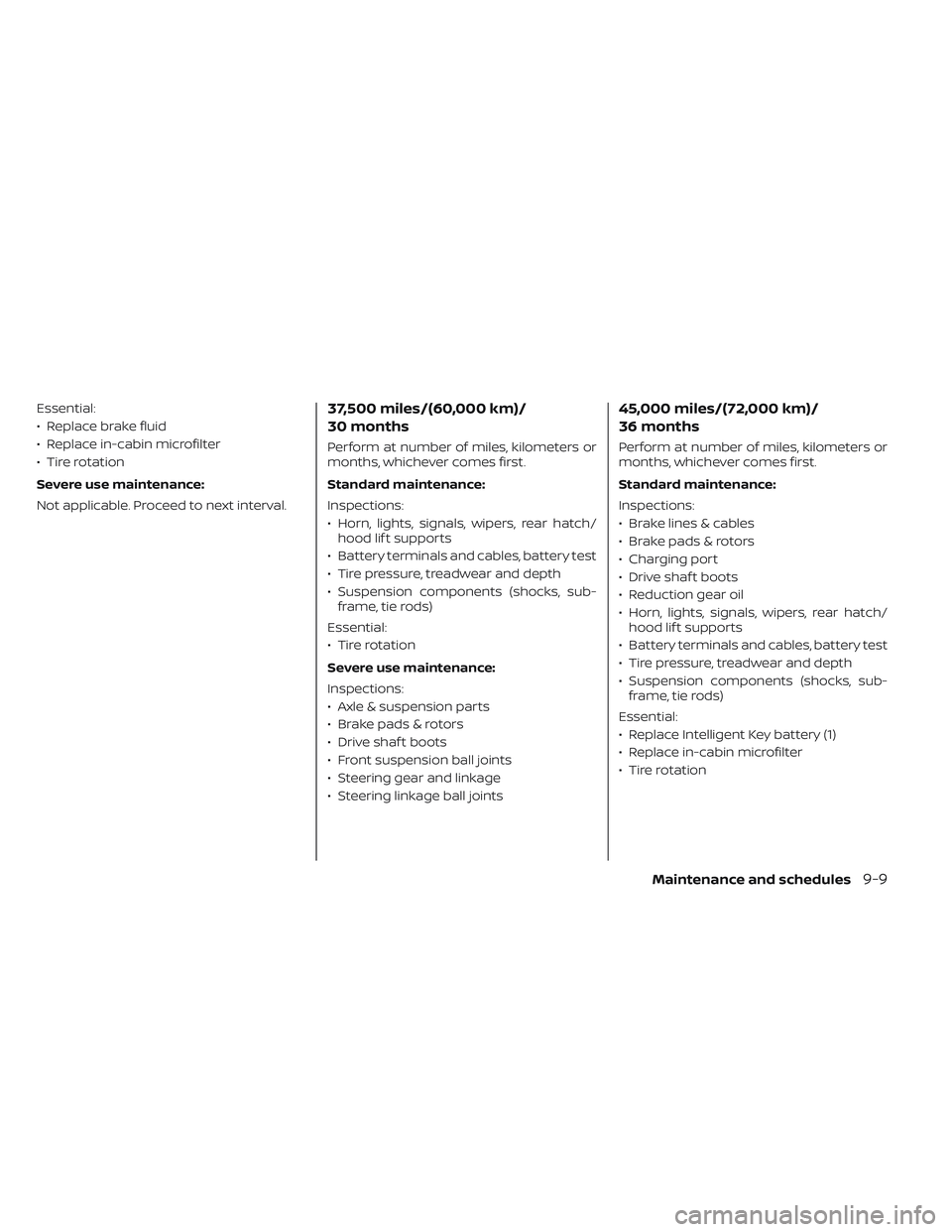
Essential:
• Replace brake fluid
• Replace in-cabin microfilter
• Tire rotation
Severe use maintenance:
Not applicable. Proceed to next interval.37,500 miles/(60,000 km)/
30 months
Perform at number of miles, kilometers or
months, whichever comes first.
Standard maintenance:
Inspections:
• Horn, lights, signals, wipers, rear hatch/hood lif t supports
• Battery terminals and cables, battery test
• Tire pressure, treadwear and depth
• Suspension components (shocks, sub- frame, tie rods)
Essential:
• Tire rotation
Severe use maintenance:
Inspections:
• Axle & suspension parts
• Brake pads & rotors
• Drive shaf t boots
• Front suspension ball joints
• Steering gear and linkage
• Steering linkage ball joints
45,000 miles/(72,000 km)/
36 months
Perform at number of miles, kilometers or
months, whichever comes first.
Standard maintenance:
Inspections:
• Brake lines & cables
• Brake pads & rotors
• Charging port
• Drive shaf t boots
• Reduction gear oil
• Horn, lights, signals, wipers, rear hatch/ hood lif t supports
• Battery terminals and cables, battery test
• Tire pressure, treadwear and depth
• Suspension components (shocks, sub- frame, tie rods)
Essential:
• Replace Intelligent Key battery (1)
• Replace in-cabin microfilter
• Tire rotation
Maintenance and schedules9-9
Page 571 of 612
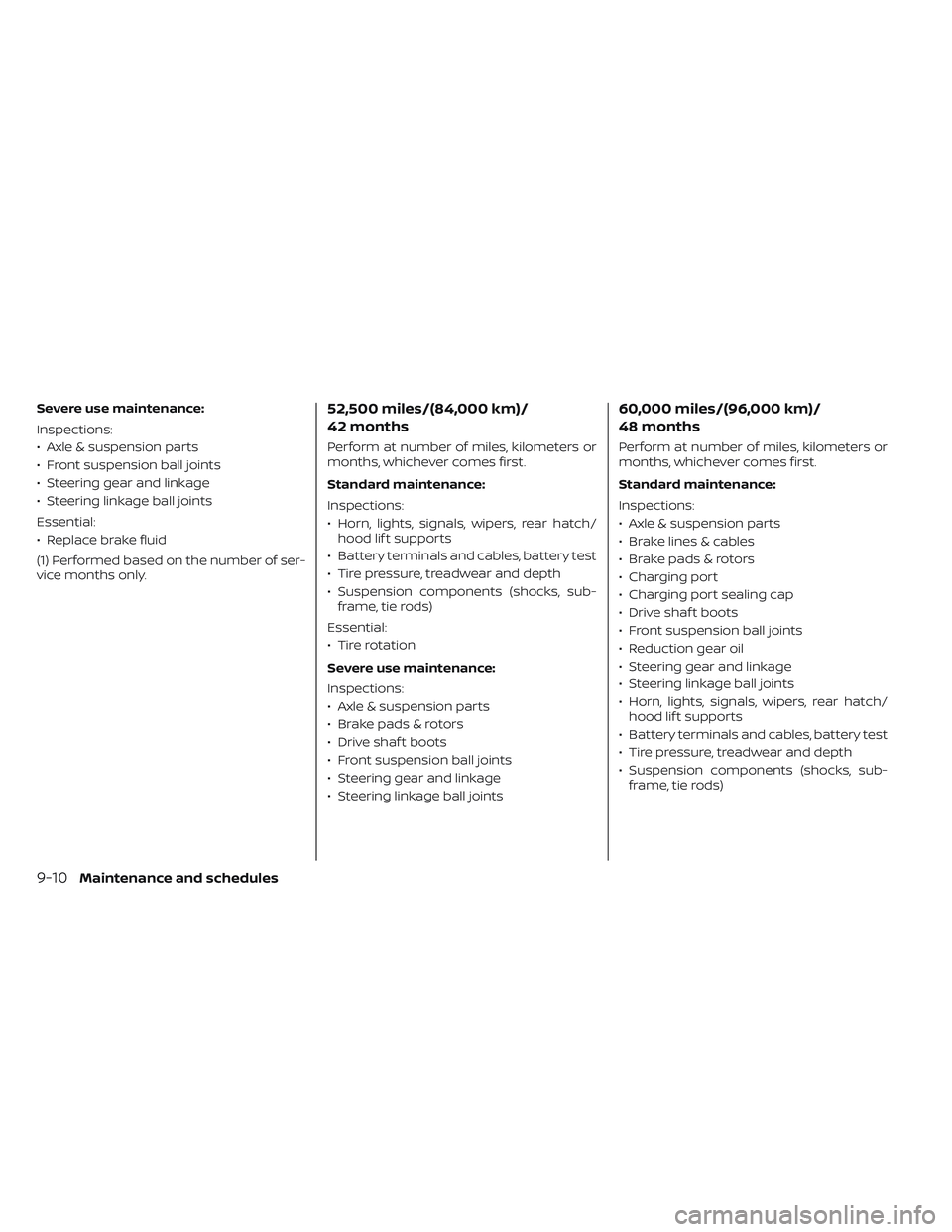
Severe use maintenance:
Inspections:
• Axle & suspension parts
• Front suspension ball joints
• Steering gear and linkage
• Steering linkage ball joints
Essential:
• Replace brake fluid
(1) Performed based on the number of ser-
vice months only.52,500 miles/(84,000 km)/
42 months
Perform at number of miles, kilometers or
months, whichever comes first.
Standard maintenance:
Inspections:
• Horn, lights, signals, wipers, rear hatch/hood lif t supports
• Battery terminals and cables, battery test
• Tire pressure, treadwear and depth
• Suspension components (shocks, sub- frame, tie rods)
Essential:
• Tire rotation
Severe use maintenance:
Inspections:
• Axle & suspension parts
• Brake pads & rotors
• Drive shaf t boots
• Front suspension ball joints
• Steering gear and linkage
• Steering linkage ball joints
60,000 miles/(96,000 km)/
48 months
Perform at number of miles, kilometers or
months, whichever comes first.
Standard maintenance:
Inspections:
• Axle & suspension parts
• Brake lines & cables
• Brake pads & rotors
• Charging port
• Charging port sealing cap
• Drive shaf t boots
• Front suspension ball joints
• Reduction gear oil
• Steering gear and linkage
• Steering linkage ball joints
• Horn, lights, signals, wipers, rear hatch/ hood lif t supports
• Battery terminals and cables, battery test
• Tire pressure, treadwear and depth
• Suspension components (shocks, sub- frame, tie rods)
9-10Maintenance and schedules