turn signal NISSAN MAXIMA 2018 Owner´s Manual
[x] Cancel search | Manufacturer: NISSAN, Model Year: 2018, Model line: MAXIMA, Model: NISSAN MAXIMA 2018Pages: 428, PDF Size: 4.85 MB
Page 253 of 428
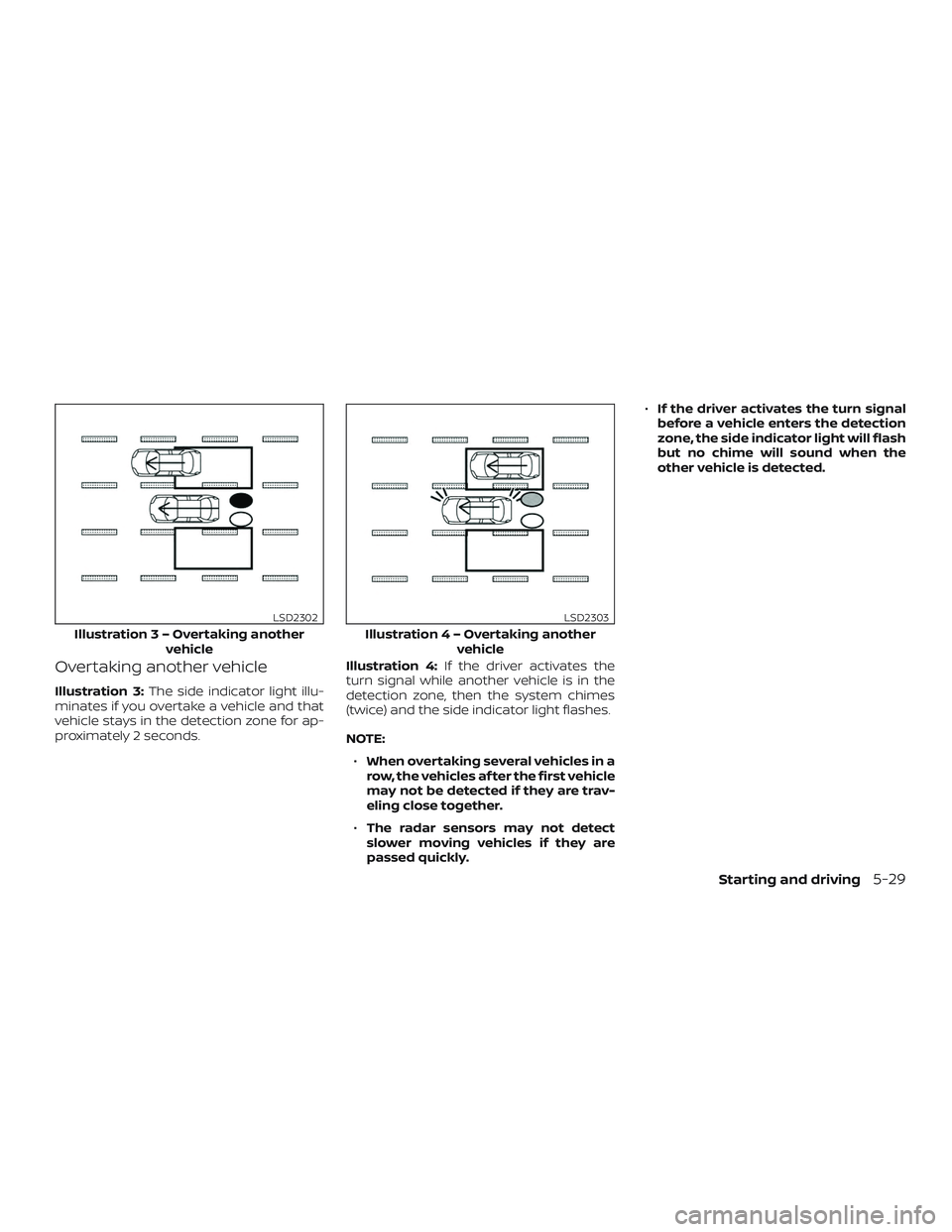
Overtaking another vehicle
Illustration 3:The side indicator light illu-
minates if you overtake a vehicle and that
vehicle stays in the detection zone for ap-
proximately 2 seconds. Illustration 4:
If the driver activates the
turn signal while another vehicle is in the
detection zone, then the system chimes
(twice) and the side indicator light flashes.
NOTE:
∙ When overtaking several vehicles in a
row, the vehicles af ter the first vehicle
may not be detected if they are trav-
eling close together.
∙ The radar sensors may not detect
slower moving vehicles if they are
passed quickly. ∙
If the driver activates the turn signal
before a vehicle enters the detection
zone, the side indicator light will flash
but no chime will sound when the
other vehicle is detected.
Illustratio n3–Over taking another
vehicle
LSD2302
Illustratio n4–Over taking another
vehicle
LSD2303
Starting and driving5-29
Page 254 of 428
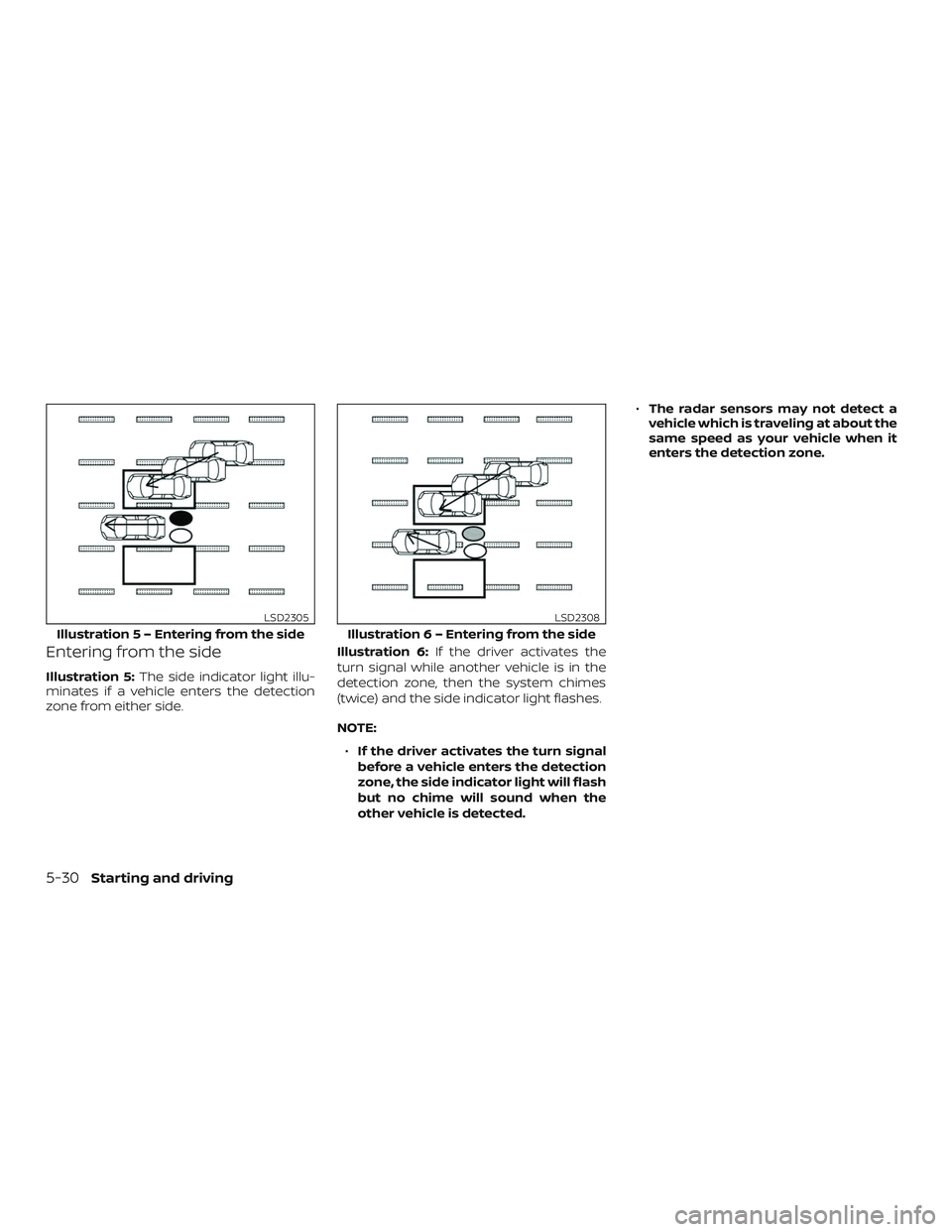
Entering from the side
Illustration 5:The side indicator light illu-
minates if a vehicle enters the detection
zone from either side. Illustration 6:
If the driver activates the
turn signal while another vehicle is in the
detection zone, then the system chimes
(twice) and the side indicator light flashes.
NOTE:
∙ If the driver activates the turn signal
before a vehicle enters the detection
zone, the side indicator light will flash
but no chime will sound when the
other vehicle is detected. ∙
The radar sensors may not detect a
vehicle which is traveling at about the
same speed as your vehicle when it
enters the detection zone.
Illustratio n 5 – Entering from the side
LSD2305
Illustration 6 – Entering from the side
LSD2308
5-30Starting and driving
Page 322 of 428
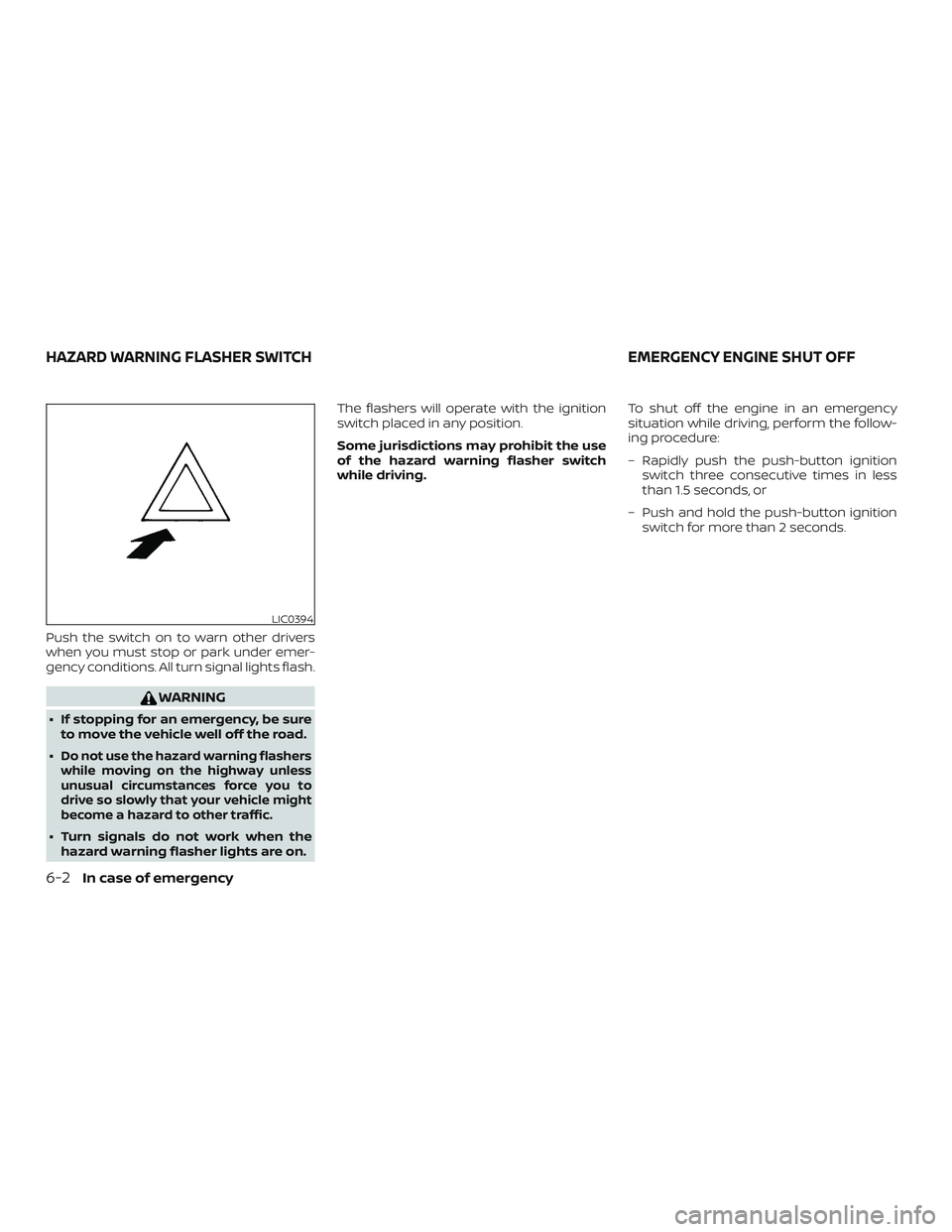
Push the switch on to warn other drivers
when you must stop or park under emer-
gency conditions. All turn signal lights flash.
WARNING
∙ If stopping for an emergency, be sureto move the vehicle well off the road.
∙
Do not use the hazard warning flashers
while moving on the highway unless
unusual circumstances force you to
drive so slowly that your vehicle might
become a hazard to other traffic.
∙ Turn signals do not work when the hazard warning flasher lights are on. The flashers will operate with the ignition
switch placed in any position.
Some jurisdictions may prohibit the use
of the hazard warning flasher switch
while driving.
To shut off the engine in an emergency
situation while driving, perform the follow-
ing procedure:
– Rapidly push the push-button ignition
switch three consecutive times in less
than 1.5 seconds, or
– Push and hold the push-button ignition switch for more than 2 seconds.
LIC0394
HAZARD WARNING FLASHER SWITCH EMERGENCY ENGINE SHUT OFF
6-2In case of emergency
Page 324 of 428
4. Turn off the engine.
5. Raise the hood to warn other trafficand to signal professional road assis-
tance personnel that you need assis-
tance.
6. Have all passengers get out of the ve- hicle and stand in a safe place, away
from traffic and clear of the vehicle.
WARNING
∙ Make sure the parking brake is se-curely applied and the Continuously
Variable Transmission (CVT) is shif ted
into P (Park).
∙ Never change tires when the vehicle is on a slope, ice or slippery areas. This is
hazardous.
∙ Never change tires if oncoming traffic is close to your vehicle. Wait for pro-
fessional road assistance.
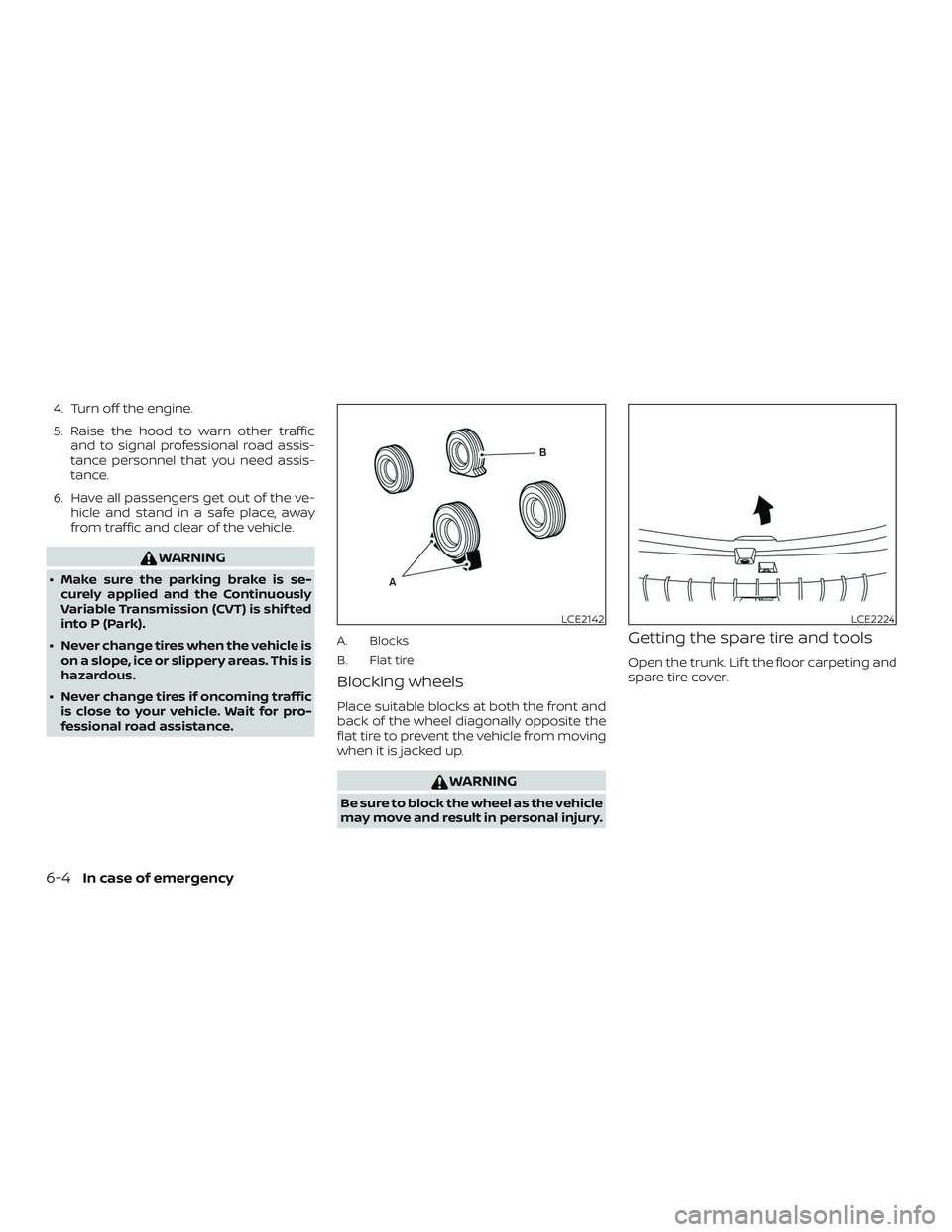
A. Blocks
B. Flat tire
Blocking wheels
Place suitable blocks at both the front and
back of the wheel diagonally opposite the
flat tire to prevent the vehicle from moving
when it is jacked up.
WARNING
Be sure to block the wheel as the vehicle
may move and result in personal injury.
Getting the spare tire and tools
Open the trunk. Lif t the floor carpeting and
spare tire cover.
LCE2142LCE2224
6-4In case of emergency
Page 343 of 428
8 Do-it-yourself
Maintenance precautions.......................8-2
Engine compartment check locations ...........8-3
Engine cooling system ..........................8-4
Checking engine coolant level ................8-5
Changing engine coolant .....................8-5
Engine oil ........................................8-6
Checking engine oil level .....................8-6
Changing engine oil ..........................8-7
Changing engine oil filter .....................8-8
Continuously Variable Transmission (CVT)
fluid .............................................8-9
Power Steering Fluid (PSF) ......................8-10
Brake fluid ...................................... 8-10
Windshield-washer fluid .........................8-11
Windshield-washer fluid reservoir .............8-11
Battery......................................... 8-12
Jump starting ............................... 8-14
Drive belt ....................................... 8-14
Spark plugs .................................... 8-15
Replacing spark plugs ....................... 8-15
Air cleaner ...................................... 8-15
In-cabin microfilter .......................... 8-16Windshield wiper blades
........................8-16
Cleaning .................................... 8-16
Replacing ................................... 8-16
Brakes.......................................... 8-17
Fuses ........................................... 8-18
Engine compartment .......................8-18
Passenger compartment ....................8-19
Battery replacement ........................... 8-20
NISSAN Intelligent Key® ......................8-21
Lights .......................................... 8-22
Headlights ................................... 8-22
Front park/turn signal/side marker
light ......................................... 8-23
Fog lights .................................... 8-23
Exterior and interior lights ...................8-24
Wheels and tires ................................ 8-26
Tire pressure ................................ 8-26
Tire labeling ................................. 8-30
T
ypes of tires ................................ 8-33
Tire chains .................................. 8-34
Changing wheels and tires ..................8-34
Page 365 of 428
∙ Do not leave the headlight assemblyopen without a bulb installed for a
long period of time. Dust, moisture,
smoke, etc. entering the headlight
body may affect bulb performance.
Remove the bulb from the headlight
assembly just before a replacement
bulb is installed.
∙ Only touch the base when handling the bulb. Never touch the glass enve-
lope. Touching the glass could signifi-
cantly affect bulb life and/or head-
light performance.
∙ High pressure halogen gas is sealed inside the halogen bulb. The bulb may
break if the glass envelope is
scratched or the bulb is dropped.
∙ Use the same number and wattage as shown in the chart.
Fog may temporarily form inside the lens
of the exterior lights in the rain or in a car
wash. A temperature difference between
the inside and the outside of the lens
causes the fog. This is not a malfunction. If
large drops of water collect inside the lens,
it is recommended that you visit a NISSAN
dealer for this service.Replacing the LED headlight bulb
(if so equipped)
If LED headlight bulb replacement is re-
quired, it is recommended that you visit a
NISSAN dealer for this service.
FRONT PARK/TURN SIGNAL/SIDE
MARKER LIGHT
If park, turn signal or side marker light bulb
replacement is required. It is recom-
mended that you visit a NISSAN dealer for
this service.
FOG LIGHTS
For additional information on fog light bulb
replacement, refer to the instructions out-
lined in this section.
Replacing the fog light bulb
If fog light bulb replacement is required, it is
recommended that you visit a NISSAN
dealer for this service.
CAUTION
∙ High pressure halogen gas is sealed inside the halogen bulb. The bulb may
break if the glass envelope is
scratched or the bulb is dropped.
∙ When handling the bulb, do not touch the glass envelope.
∙ Use the same number and wattage as originally installed as shown in the
chart.
∙ Do not leave the bulb out of the fog light for a long period of time as dust,
moisture and smoke may enter the
fog light body and affect the perfor-
mance of the fog light.
Do-it-yourself8-23
Page 366 of 428
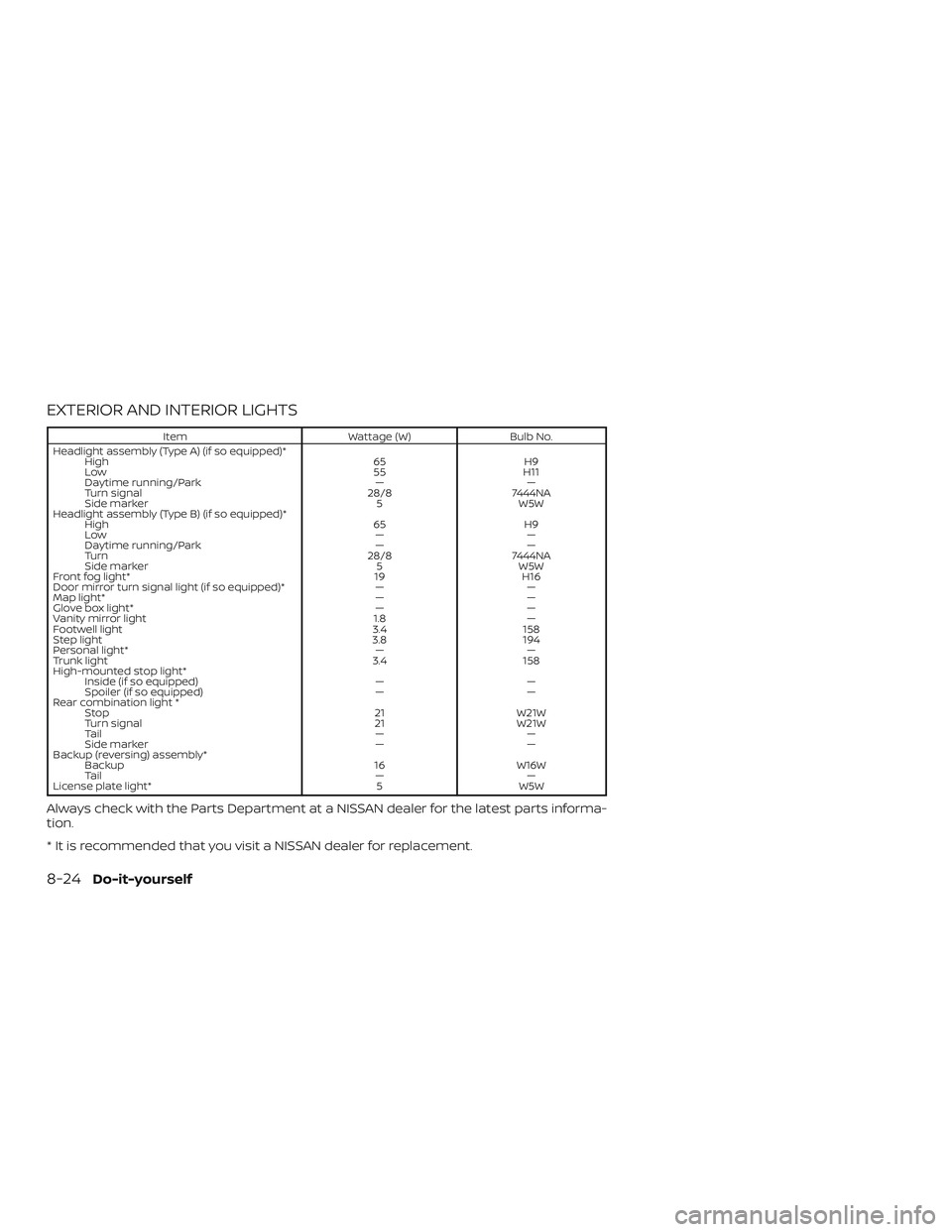
EXTERIOR AND INTERIOR LIGHTS
ItemWattage (W)Bulb No.
Headlight assembly (Type A) (if so equipped)* High 65H9
Low 55H11
Daytime running/Park ——
Turn signal 28/87444NA
Side marker 5W5W
Headlight assembly (Type B) (if so equipped)* High 65H9
Low ——
Daytime running/Park ——
Turn 28/87444NA
Side marker 5W5W
Front fog light* 19H16
Door mirror turn signal light (if so equipped)* ——
Map light* ——
Glove box light* ——
Vanity mirror light 1.8—
Footwell light 3.4158
Step light 3.8194
Personal light* ——
Trunk light 3.4158
High-mounted stop light* Inside (if so equipped) ——
Spoiler (if so equipped) ——
Rear combination light * Stop 21W21W
Turn signal 21W21W
Ta i l ——
Side marker ——
Backup (reversing) assembly* Backup 16W16W
Ta i l ——
License plate light* 5W5W
Always check with the Parts Department at a NISSAN dealer for the latest parts informa-
tion.
* It is recommended that you visit a NISSAN dealer for replacement.
8-24Do-it-yourself
Page 367 of 428
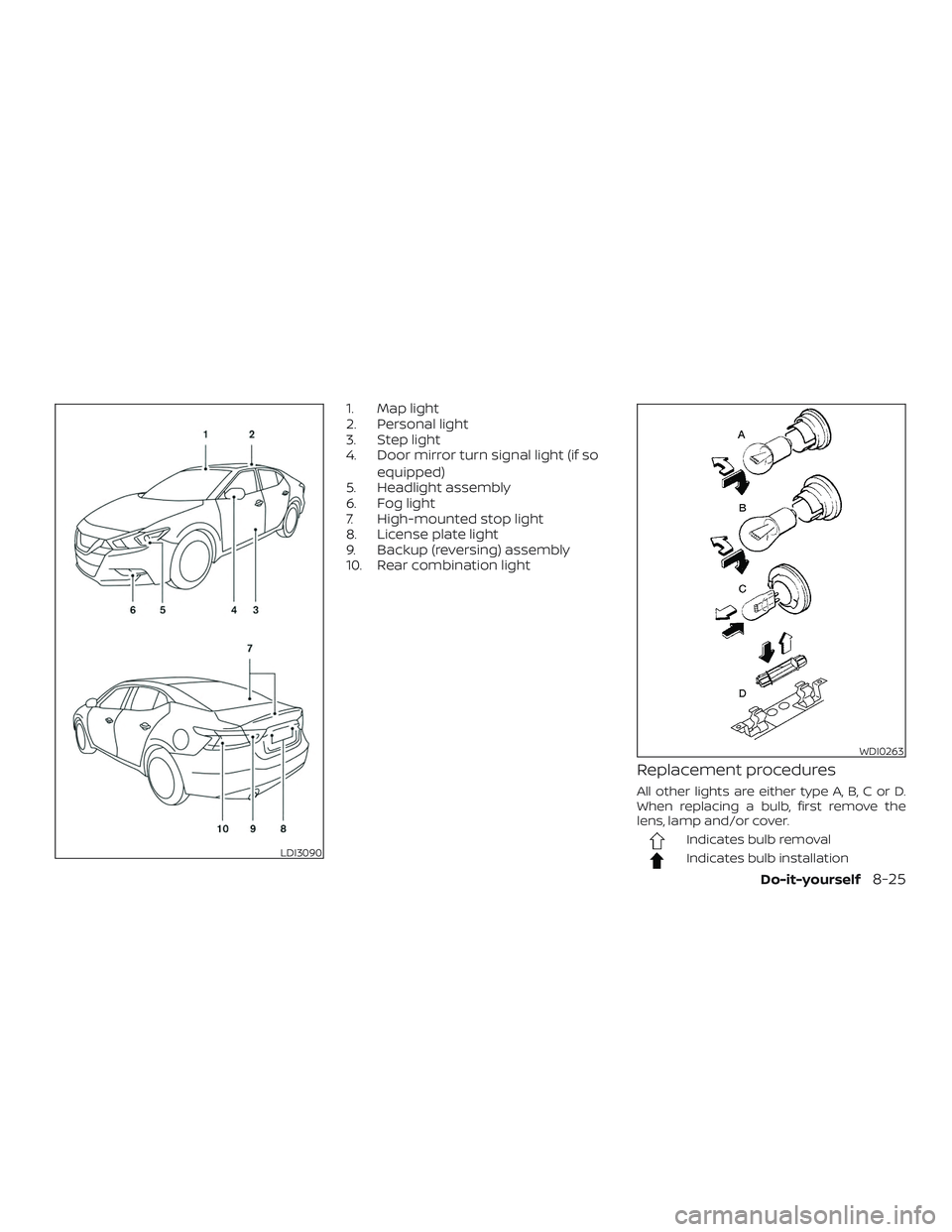
1. Map light
2. Personal light
3. Step light
4. Door mirror turn signal light (if soequipped)
5. Headlight assembly
6. Fog light
7. High-mounted stop light
8. License plate light
9. Backup (reversing) assembly
10. Rear combination light
Replacement procedures
All other lights are either type A, B, C or D.
When replacing a bulb, first remove the
lens, lamp and/or cover.
Indicates bulb removal
Indicates bulb installationLDI3090
WDI0263
Do-it-yourself8-25
Page 383 of 428

secondary latch keeps the hood from
opening when the primary latch is re-
leased.
When driving in areas using road salt or
other corrosive materials, check lubrica-
tion frequently.
Lights*:Clean the headlights on a regular
basis. Make sure that the headlights, stop
lights, tail lights, turn signal lights, and other
lights are all operating properly and in-
stalled securely. Also check headlight aim.
Road wheel nuts (lug nuts)*: When check-
ing the tires, make sure no wheel nuts are
missing, and check for any loose wheel
nuts. Tighten if necessary.
Tire rotation*: Tires should be rotated ev-
ery 5,000 miles (8,000 km).
Tires*: Check the pressure with a gauge
of ten and always prior to long distance
trips. If necessary, adjust the pressure in all
tires, including the spare, to the pressure
specified. Check carefully for damage, cuts
or excessive wear.
Tire Pressure Monitoring System (TPMS)
transmitter components: Replace the
TPMS transmitter grommet seal, valve core
and cap when the tires are replaced due to
wear or age. Wheel alignment and balance:
If the ve-
hicle should pull to either side while driving
on a straight and level road, or if you detect
uneven or abnormal tire wear, there may
be a need for wheel alignment. If the steer-
ing wheel or seat vibrates at normal high-
way speeds, wheel balancing may be
needed.
For additional information regarding tires,
refer to “Important Tire Safety Information”
(US) or “Tire Safety Information” (Canada) in
the Warranty Information Booklet.
Windshield: Clean the windshield on a
regular basis. Check the windshield at least
every six months for cracks or other dam-
age. Have a damaged windshield repaired
by a qualified repair facility.
Windshield wiper blades*: Check for
cracks or wear if they do not wipe properly.
Inside the vehicle
The maintenance items listed here should
be checked on a regular basis, such as
when performing scheduled maintenance,
cleaning the vehicle, etc. Accelerator pedal:
Check the pedal for
smooth operation and make sure the
pedal does not catch or require uneven
effort. Keep the floor mat away from the
pedal.
Brake pedal: Check the pedal for smooth
operation. If the brake pedal suddenly goes
down further than normal, the pedal feels
spongy or the vehicle seems to take longer
to stop, have your vehicle checked imme-
diately. It is recommended that you visit a
NISSAN dealer for this service. Keep the
floor mat away from the pedal.
Brakes: Check that the brakes do not pull
the vehicle to one side when applied.
Continuously Variable Transmission
(CVT) P (Park) position mechanism: On a
fairly steep hill check that the vehicle is held
securely with the shif t lever in the P (Park)
position without applying any brakes.
Parking brake: Check the parking brake
operation regularly. The vehicle should be
securely held on a fairly steep hill with only
the parking brake applied. If the parking
brake needs adjustment, it is recom-
mended that you visit a NISSAN dealer for
this service.
Maintenance and schedules9-3
Page 419 of 428
Foglightswitch................2-49
Foldingrearseat.................1-5
Front air bag system
(See supplemental restraint system) . . .1-49
Front and rear sonar system........5-89
Front-door pocket ..............2-56
Front power seat adjustment .........1-3
Frontseats................... .1-2
Fuel Capacities and recommended
fuel/lubricants...............10-2
Fuel economy ...............5-80
Fuel-filler cap ................3-23
Fuel-filler lid .................3-23
Fuel gauge ..................2-7
Fueloctanerating.............10-5
Fuel recommendation .......10-2,10-3
Loose fuel cap warning .........2-32
Fuelefficientdrivingtips...........5-79
Fuel-filler door .................3-23
Fuel gauge ....................2-7
Fuses .......................8-18
Fusiblelinks...................8-19
G
Garage door opener, HomeLink® Universal
Transceiver . . .2-68, 2-69, 2-70, 2-71, 2-71, 2-72
Gascap.....................3-23
Gauge Engine coolant temperature gauge . .2-6
Fuel gauge ..................2-7
Odometer ..................2-5
Speedometer ..............2-4,2-5
Tachometer .................2-6 Trip odometer
.............2-4,2-5
General maintenance .............9-2
Glovebox....................2-57
Gloveboxlock.................2-57
H
Hazard warning flasher switch ........6-2
Headlight and turn signal switch ......2-45
Headlightcontrolswitch...........2-45
Headlights ...................8-22
Headrestraints................. .1-7
Heatedseats..................2-51
Heated seat switches .............2-51
Heated steering wheel switch .......2-52
Heater Heater and air conditioner (automatic)
(if so equipped) ..............4-28
Heater and air conditioner controls . .4-29
Heater operation .............4-30
Heater and air conditioner (automatic) . .4-28
HomeLink® Universal
Transceiver . . .2-68, 2-69, 2-70, 2-71, 2-71, 2-72
Hood ...................... .3-21
Horn.......................2-50
I
Ignition Switch Push-button ignition switch .......5-10
Immobilizer system ...........2-41,5-14
Important vehicle information label . . . .10-11
In-cabinmicrofilter..............8-16
Increasing fuel economy ..........5-80Indicator
NISSAN Intelligent Key® battery discharge
indicator...................5-13
Indicator lights and audible reminders
(See warning/indicator lights and audible
reminders) .................2-8,2-14
Informationdisplay..............2-17
Inside automatic anti-glare mirror .....3-28
Instrument brightness control .......2-48
Instrument panel .............0-6,2-2
Instrument panel dimmer switch .....2-48
Integrated Dynamics-control Module. . .5-88
Intelligent Around View Monitor .......4-11
Intelligent Cruise Control (ICC) .......5-43
Intelligent Drive Alertness (I-DA) ......5-75
Intelligent Engine Brake (I-EB) ........5-88
Intelligent Forward Collision Warning
(I-FCW)......................5-65
Intelligent
Key system
Key operating range ............3-8
Key operation ................3-9
Mechanical key ...............3-3
Remote keyless entry operation ....3-13
Troubleshooting guide ..........3-16
Warning signals ..............3-16
Intelligent Trace Control (I-TC) ........5-88
Interiorlight...................2-66
Interiortrunklidrelease...........3-22
ISOFIX child restraints .............1-24
J
Jumpstarting...............6-8,8-14
11-3