weight NISSAN MAXIMA 2020 Owner´s Manual
[x] Cancel search | Manufacturer: NISSAN, Model Year: 2020, Model line: MAXIMA, Model: NISSAN MAXIMA 2020Pages: 500, PDF Size: 6.37 MB
Page 471 of 500
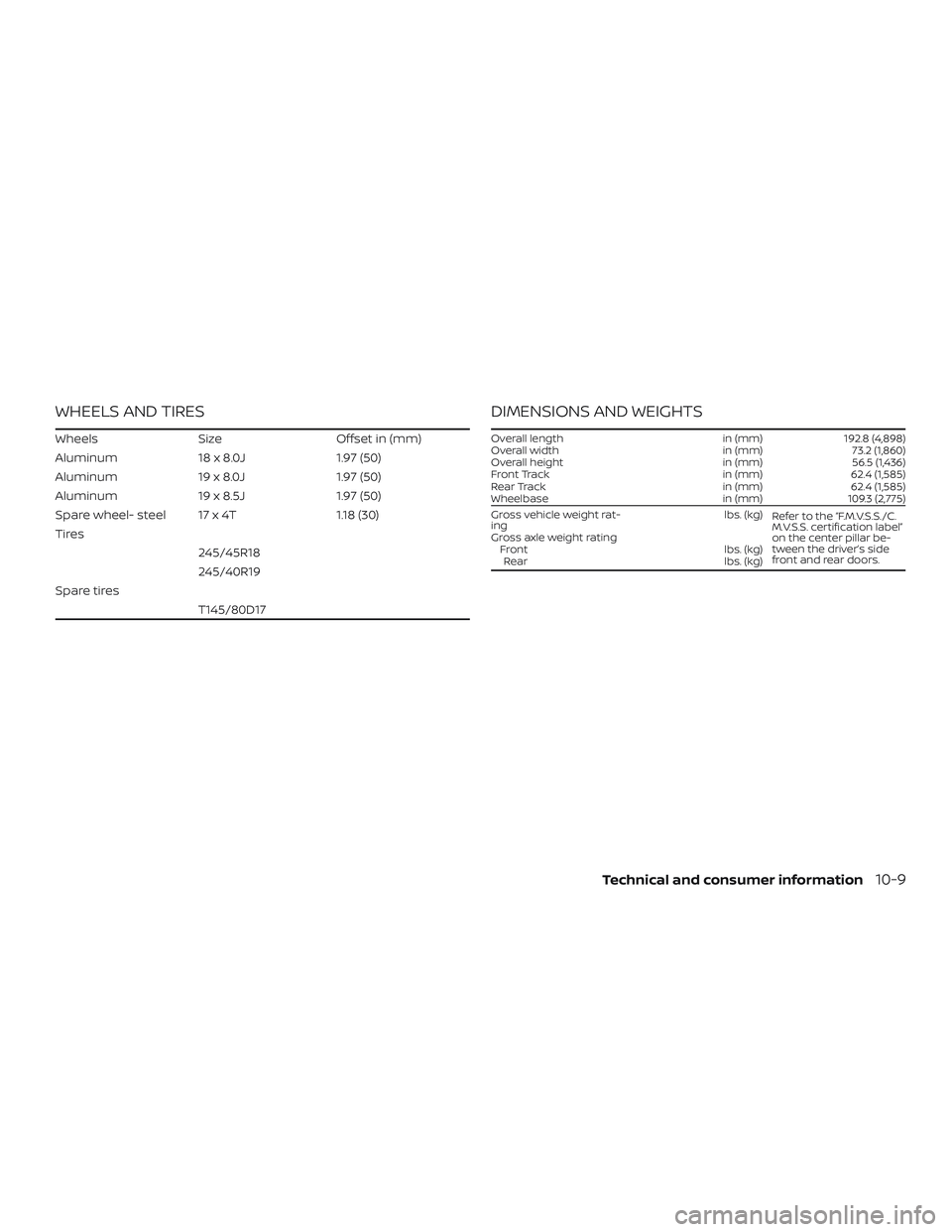
WHEELS AND TIRES
WheelsSizeOffset in (mm)
Aluminum 18 x 8.0J1.97 (50)
Aluminum 19 x 8.0J1.97 (50)
Aluminum 19 x 8.5J1.97 (50)
Spare wheel- steel 17 x 4T 1.18 (30)
Tires 245/45R18
245/40R19
Spare tires T145/80D17
DIMENSIONS AND WEIGHTS
Overall length in (mm)192.8 (4,898)
Overall width in (mm)73.2 (1,860)
Overall height in (mm)56.5 (1,436)
Front Track in (mm)62.4 (1,585)
Rear Track in (mm)62.4 (1,585)
Wheelbase in (mm)109.3 (2,775)
Gross vehicle weight rat-
ing lbs. (kg)
Refer to the “F.M.V.S.S./C.
M.V.S.S. certification label”
on the center pillar be-
tween the driver’s side
front and rear doors.
Gross axle weight rating
Front lbs. (kg)
Rear lbs. (kg)
Technical and consumer information10-9
Page 475 of 500
WARNING
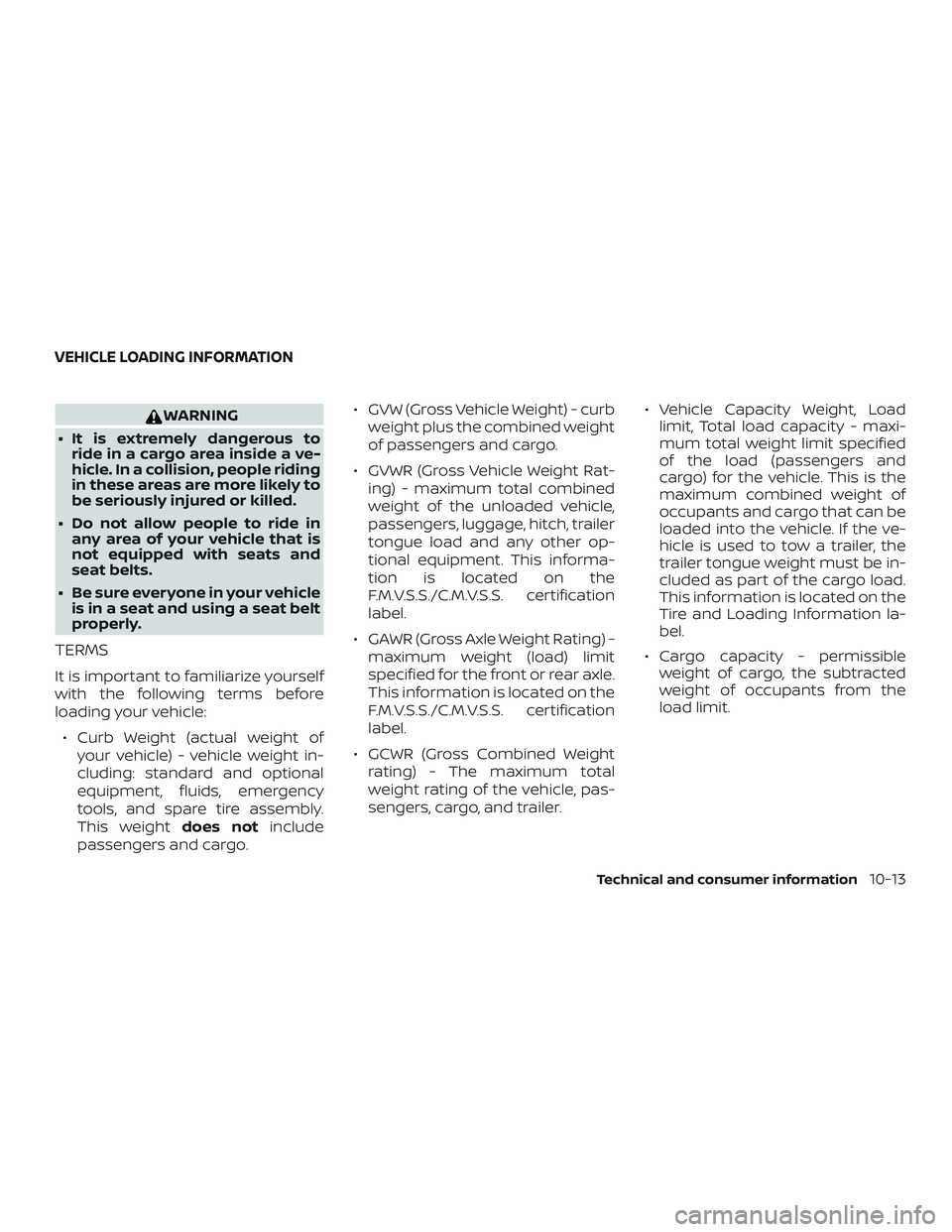
∙ It is extremely dangerous to ride in a cargo area inside a ve-
hicle. In a collision, people riding
in these areas are more likely to
be seriously injured or killed.
∙ Do not allow people to ride in any area of your vehicle that is
not equipped with seats and
seat belts.
∙ Be sure everyone in your vehicle is in a seat and using a seat belt
properly.
TERMS
It is important to familiarize yourself
with the following terms before
loading your vehicle:
∙ Curb Weight (actual weight of your vehicle) - vehicle weight in-
cluding: standard and optional
equipment, fluids, emergency
tools, and spare tire assembly.
This weight does notinclude
passengers and cargo. ∙ GVW (Gross Vehicle Weight) - curb
weight plus the combined weight
of passengers and cargo.
∙ GVWR (Gross Vehicle Weight Rat- ing) - maximum total combined
weight of the unloaded vehicle,
passengers, luggage, hitch, trailer
tongue load and any other op-
tional equipment. This informa-
tion is located on the
F.M.V.S.S./C.M.V.S.S. certification
label.
∙ GAWR (Gross Axle Weight Rating) - maximum weight (load) limit
specified for the front or rear axle.
This information is located on the
F.M.V.S.S./C.M.V.S.S. certification
label.
∙ GCWR (Gross Combined Weight rating) - The maximum total
weight rating of the vehicle, pas-
sengers, cargo, and trailer. ∙ Vehicle Capacity Weight, Load
limit, Total load capacity - maxi-
mum total weight limit specified
of the load (passengers and
cargo) for the vehicle. This is the
maximum combined weight of
occupants and cargo that can be
loaded into the vehicle. If the ve-
hicle is used to tow a trailer, the
trailer tongue weight must be in-
cluded as part of the cargo load.
This information is located on the
Tire and Loading Information la-
bel.
∙ Cargo capacity - permissible weight of cargo, the subtracted
weight of occupants from the
load limit.
VEHICLE LOADING INFORMATION
Technical and consumer information10-13
Page 476 of 500
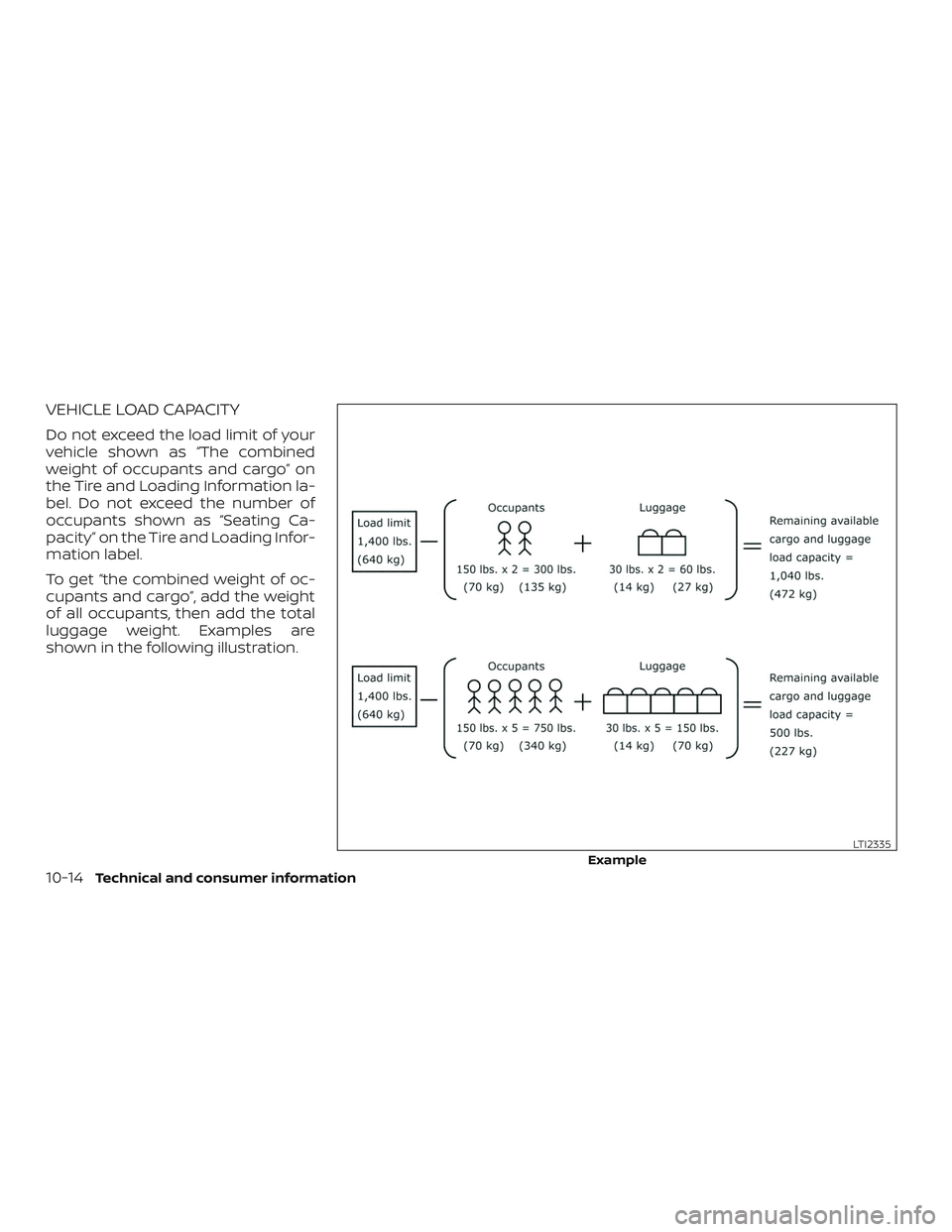
VEHICLE LOAD CAPACITY
Do not exceed the load limit of your
vehicle shown as “The combined
weight of occupants and cargo” on
the Tire and Loading Information la-
bel. Do not exceed the number of
occupants shown as “Seating Ca-
pacity” on the Tire and Loading Infor-
mation label.
To get “the combined weight of oc-
cupants and cargo”, add the weight
of all occupants, then add the total
luggage weight. Examples are
shown in the following illustration.
Example
LTI2335
10-14Technical and consumer information
Page 477 of 500
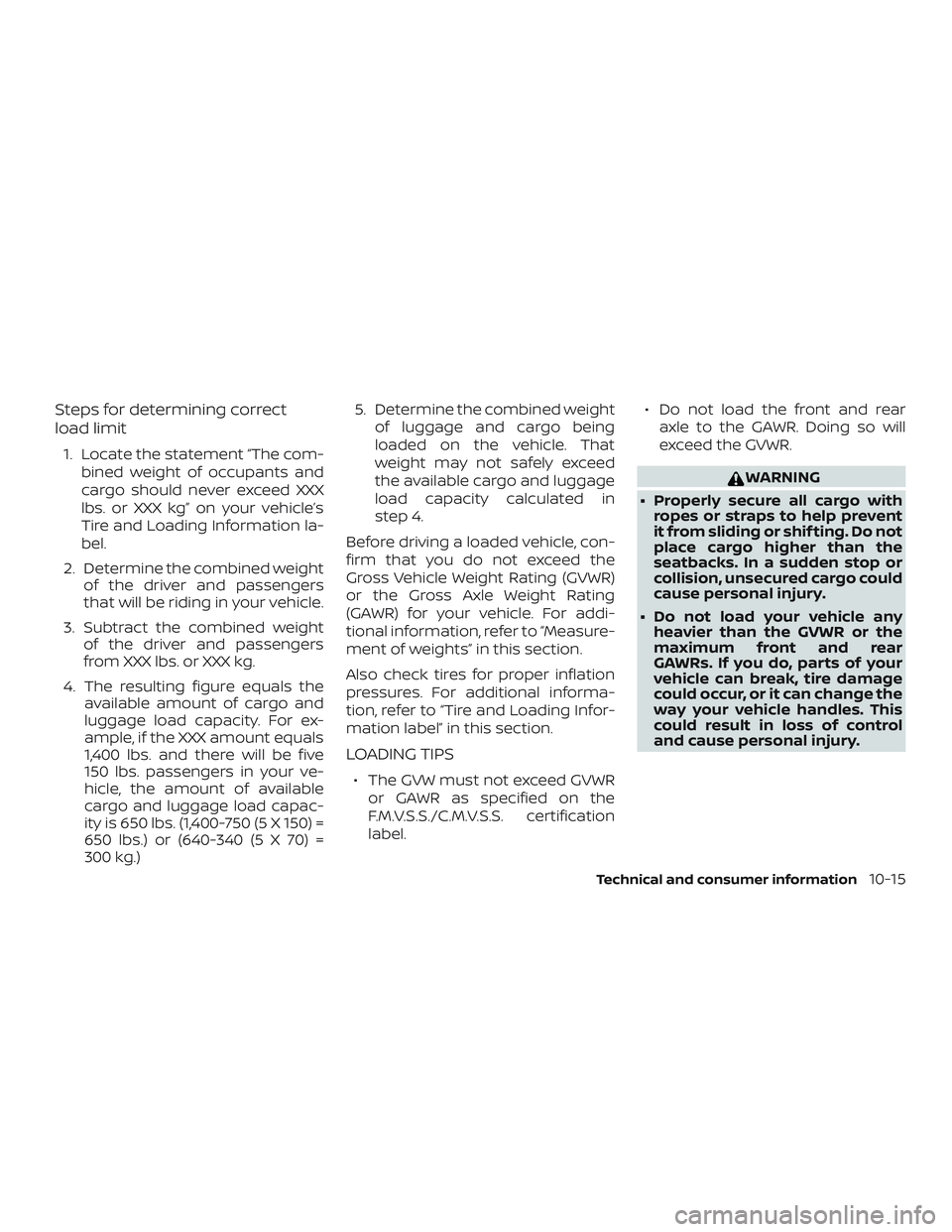
Steps for determining correct
load limit
1. Locate the statement “The com-bined weight of occupants and
cargo should never exceed XXX
lbs. or XXX kg” on your vehicle’s
Tire and Loading Information la-
bel.
2. Determine the combined weight of the driver and passengers
that will be riding in your vehicle.
3. Subtract the combined weight of the driver and passengers
from XXX lbs. or XXX kg.
4. The resulting figure equals the available amount of cargo and
luggage load capacity. For ex-
ample, if the XXX amount equals
1,400 lbs. and there will be five
150 lbs. passengers in your ve-
hicle, the amount of available
cargo and luggage load capac-
ity is 650 lbs. (1,400-750 (5 X 150) =
650 lbs.) or (640-340 (5 X 70) =
300 kg.) 5. Determine the combined weight
of luggage and cargo being
loaded on the vehicle. That
weight may not safely exceed
the available cargo and luggage
load capacity calculated in
step 4.
Before driving a loaded vehicle, con-
firm that you do not exceed the
Gross Vehicle Weight Rating (GVWR)
or the Gross Axle Weight Rating
(GAWR) for your vehicle. For addi-
tional information, refer to “Measure-
ment of weights” in this section.
Also check tires for proper inflation
pressures. For additional informa-
tion, refer to “Tire and Loading Infor-
mation label” in this section.
LOADING TIPS
∙ The GVW must not exceed GVWR or GAWR as specified on the
F.M.V.S.S./C.M.V.S.S. certification
label. ∙ Do not load the front and rear
axle to the GAWR. Doing so will
exceed the GVWR.
WARNING
∙ Properly secure all cargo with ropes or straps to help prevent
it from sliding or shif ting. Do not
place cargo higher than the
seatbacks. In a sudden stop or
collision, unsecured cargo could
cause personal injury.
∙ Do not load your vehicle any heavier than the GVWR or the
maximum front and rear
GAWRs. If you do, parts of your
vehicle can break, tire damage
could occur, or it can change the
way your vehicle handles. This
could result in loss of control
and cause personal injury.
Technical and consumer information10-15
Page 478 of 500
∙ Overloading not only canshorten the life of your vehicle
and the tire, but can also cause
unsafe vehicle handling and
longer braking distances. This
may cause a premature tire fail-
ure which could result in a seri-
ous accident and personal in-
jury. Failures caused by
overloading are not covered by
the vehicle’s warranty.MEASUREMENT OF WEIGHTS
Secure loose items to prevent
weight shif ts that could affect the
balance of your vehicle. When the ve-
hicle is loaded, drive to a scale and
weigh the front and the rear wheels
separately to determine axle loads.
Individual axle loads should not ex-
ceed either of the Gross Axle Weight
Ratings (GAWR). The total of the axle
loads should not exceed the Gross
Vehicle Weight Rating (GVWR). These
ratings are given on the vehicle cer-
tification label. If weight ratings are
exceeded, move or remove items to
bring all weights below the ratings.
Do not tow a trailer with your vehicle.
FLAT TOWING
Towing your vehicle with all four wheels on
the ground is sometimes called flat towing.
This method is sometimes used when
towing a vehicle behind a recreational ve-
hicle, such as a motor home.
CAUTION
∙ Failure to follow these guidelines can
result in severe transmission damage.
∙ Whenever flat towing your vehicle, al- ways tow forward, never backward.
∙
Never tow your front wheel drive ve-
hicle with the front tires on the ground.
Doing so may cause serious and expen-
sive damage to the powertrain.
∙ DO NOT tow any continuously variable transmission vehicle with all four
wheels on the ground (flat towing).
Doing so WILL DAMAGE internal trans-
mission parts due to lack of transmis-
sion lubrication.
∙ For emergency towing procedures re- fer to “Towing recommended by
NISSAN” in the “In case of emergency ”
section of this manual.
TOWING A TRAILER
10-16Technical and consumer information
Page 486 of 500
Chimes, audible reminders.........2-16
Cleaningexteriorandinterior......7-2,7-5
Climatecontrolseatswitch.........2-55
C.M.V.S.S. certification label .........10-11
Coldweatherdriving ............5-130
Console box ..................2-66
Console light ..................2-75
Continuously Variable Transmission
(CVT) .......................5-16
Continuously Variable Transmission (CVT)
fluid......................8-10
Driving with Continuously Variable
Transmission (CVT) ............5-16
Transmission shif t selector lock
release....................5-20
Control panel and vehicle information
displayinteraction...............2-36
Controls Heater and air conditioner controls . .4-30
Coolant Capacities and recommended
fuel/lubricants...............10-2
Changing engine coolant .........8-5
Checking engine coolant level ......8-5
Engine coolant temperature gauge . .2-6
Corrosionprotection..............7-9
Cruisecontrol .................5-57
Cupholders...................2-67
D
Daytime Running Light System .......2-53
Defroster switch Rear window and outside mirror
defrosterswitch..............2-48 Dimensions and weights
...........10-9
Dimmer switch for instrument panel . . .2-53
Display......................2-17
Door locks ....................3-4
Drivebelt ....................8-15
Drive Mode Selector ..............5-23
Drive positioner,
Automatic..........3-31,3-32,3-33,3-34
Drive Sport Mode Selector ..........5-23
Driving Cold weather driving ..........5-130
Driving with Continuously Variable
Transmission (CVT) ............5-16
Precautions when starting and
driving.....................5-4
Drivingthevehicle...............5-16
Dynamic driver assistance switch .....2-59
E
E-call (SOS) Button ..............2-62
Economy - fuel ................5 -117
Emergency engine shutoff .......5-13,6-2
Emission control information label . . . .10-11
Emission control system warranty . . . .10-18
Engine Before starting the engine ........5-14
Capacities and recommended
fuel/lubricants...............10-2
Changing engine coolant .........8-5
Changing engine oil ............8-6
Changing engine oil filter .........8-6
Checking engine coolant level ......8-5
Checking engine oil level .........8-6Engine compartment check
locations...................8-3
Engine coolant temperature gauge . .2-6
Engine cooling system
..........8-4
Engine oil ...................8-6
Engine oil and oil filter
recommendation ..........10-2,10-6
Engine oil pressure warning light . . . .2-10
Engine oil viscosity .............10-7
Engine serial number ...........10-11
Engine specifications ...........10-8
Starting the engine ............5-15
Engine Block Heater .............5-131
Engine coolant temperature gauge ....2-6
EventDatarecorders............10-20
Exhaust gas (Carbon monoxide) .......5-4
Explanation of maintenance items .....9-2
Explanation of scheduled maintenance
items .......................9-5
Extended storage switch ..........2-63
Eyeglasscase................ .2-66
F
Flashers
(Seehazardwarningflasherswitch)....6-2
Flattire....................6-3,6-4
F
loormatpositioningaid...........7-8
Fluid Brakefluid..................8-11
Capacities and recommended
fuel/lubricants...............10-2
Continuously Variable Transmission
(CVT) fluid ..................8-10
Engine coolant ...............8-4
11-2
Page 491 of 500
Tire pressureLow tire pressure warning light .....2-10
Tire Pressure Monitoring System (TPMS) . .5-5
Towing 4-wheel drive models ...........6-13
Flattowing.................10-16
Trailertowing...............10-16
Towingatrailer................10-16
Towingyourvehicle..............6-12
Traffic Sign Recognition (TSR) ........5-23
Transceiver HomeLink® Universal
Transceiver ....2-76,2-77,2-79,2-79,2-80
Transmission Continuously Variable Transmission
(CVT) fluid ..................8-10
Driving with Continuously Variable
Transmission (CVT) ............5-16
Travel (See registering a vehicle in another
country) .....................10-10
Trip odometer ...............2-4,2-5
Trunk access through the rear
seat.................... .1-5, 3-22
Trunk lid lock opener lever ..........3-22
Trunklight....................2-76
Turn signal switch ...............2-53
U
Uniform tire quality grading .........10-17
USB/iPod® Charging Ports ..........4-33 V
Vanitymirror..................3-28
Vehicle dimensions and weights ......10-9
Vehicle Dynamic Control (VDC) OFF
switch......................2-60
Vehicle Dynamic Control (VDC)
system .....................5-122
Vehicle identification .............10-10
Vehicle identification number (VIN) . . . .10-10
Vehicle identification number (VIN)
(Chassis number) ...............10-10
Vehicle identification number (VIN)
plate.......................10-10
Vehicle immobilizer system ......2-44,5-14
VehicleInformationDisplay.........2-17
Vehicle loading information ........10-13
Vehiclerecovery................6-13
Vehicle security system ...........2-42
Vehicle security system (NISSAN Vehicle
Immobilizer System), engine start . .2-44, 5-14
Vents.......................4-27
Visors.......................3-27
W
Warning Airbagwarninglight........1-64, 2-13
Anti-lock brake warning light .......2-8
Battery charge warning light ......2-10
Brakewarninglight.............2-9
Engine oil pressure warning light ....2-10
Hazard warning flasher switch ......6-2Loose fuel cap warning
.........2-34
Lowfuelwarninglight.......2-12,2-30
Lowtirepressurewarninglight.....2-10
Low windshield-washer fluid warning
light......................2-30
Seatbeltwarninglight.......1-14, 2-13
Supplemental air bag warning
light...................1-64, 2-13
TPMS......................2-4
Vehicle security system .........2-42
Warning/indicator lights and audible
reminders ...............2-8,2-13
Warning labels (for SRS) .........1-64
Warning/indicator lights and audible
reminders .................2-8,2-13
Audible reminders ..........2-8, 2-13
Indicatorlights ............2-8,2-13
Warninglights.............2-8,2-13
Warninglights...............2-8, 2-13
Weights (See dimensions and weights) . .10-9
Wheels and tires ................8-26
Wheel/tire size .................10-9
When traveling or registering in another
country .....................10-10
Windows ....................2-68 Locking passengers' windows .....2-70
Powerrearwindows...........2-69
Powerwindows............. .2-68
Rearpowerwindows...........2-69
Windshield-washer fluid ...........8-12
Windshield wiper blades ...........8-17
Wiper Wiper
blades ................8-17
Wiper and washer switch ..........2-45
11-7