tow NISSAN MURANO PLATINUM 2018 Owner's Manual
[x] Cancel search | Manufacturer: NISSAN, Model Year: 2018, Model line: MURANO PLATINUM, Model: NISSAN MURANO PLATINUM 2018Pages: 460, PDF Size: 4.89 MB
Page 433 of 460
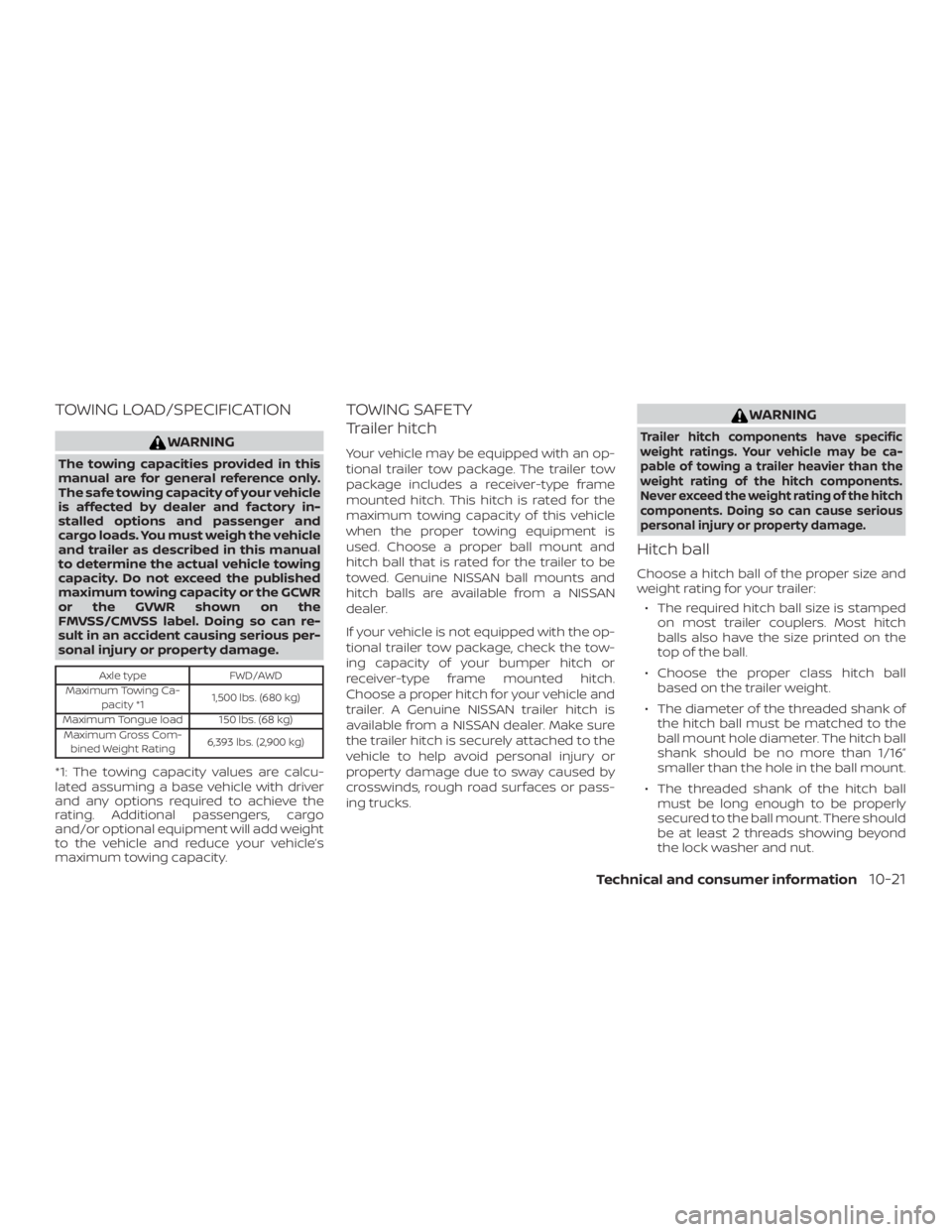
TOWING LOAD/SPECIFICATION
Page 434 of 460
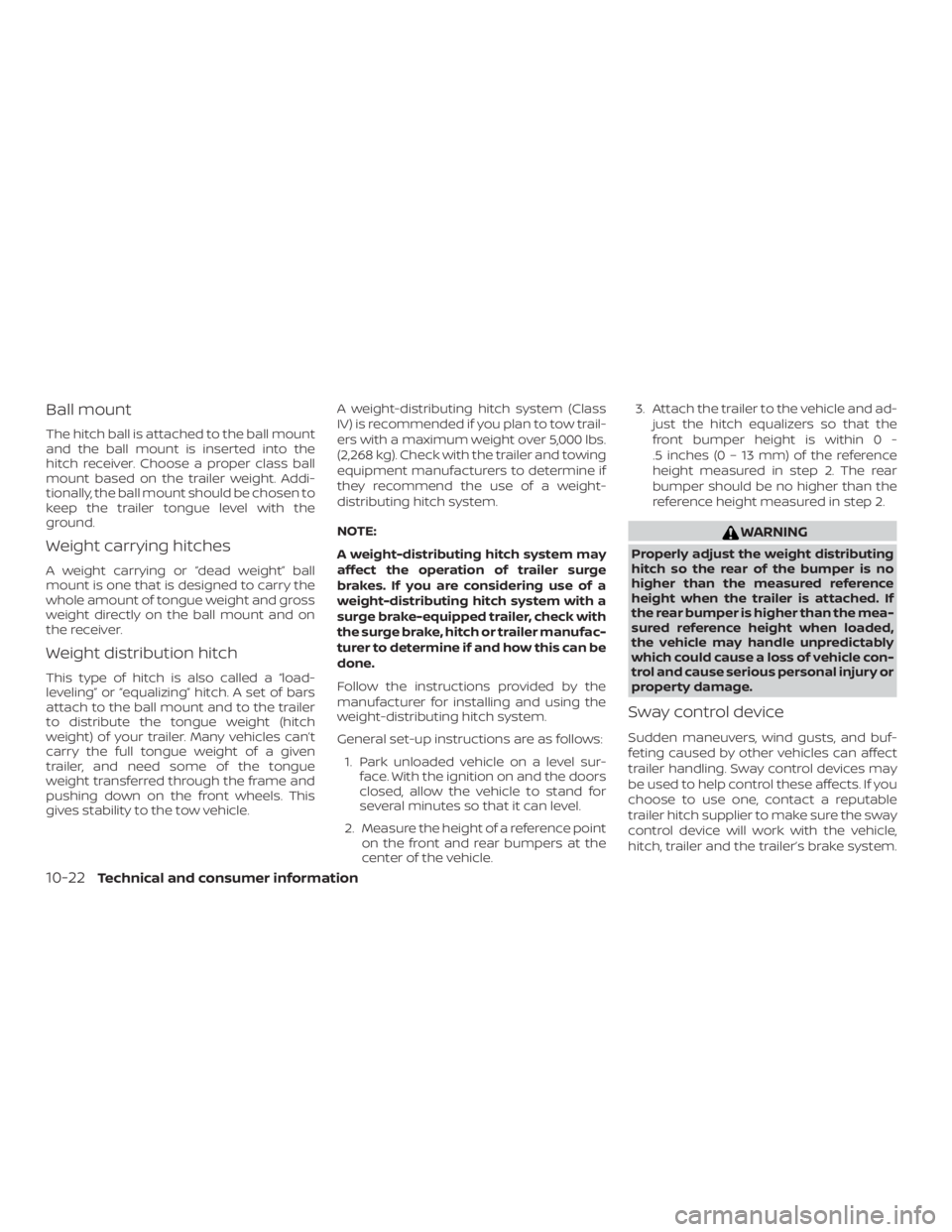
Ball mount
The hitch ball is attached to the ball mount
and the ball mount is inserted into the
hitch receiver. Choose a proper class ball
mount based on the trailer weight. Addi-
tionally, the ball mount should be chosen to
keep the trailer tongue level with the
ground.
Weight carrying hitches
A weight carrying or “dead weight” ball
mount is one that is designed to carry the
whole amount of tongue weight and gross
weight directly on the ball mount and on
the receiver.
Weight distribution hitch
This type of hitch is also called a “load-
leveling” or “equalizing” hitch. A set of bars
attach to the ball mount and to the trailer
to distribute the tongue weight (hitch
weight) of your trailer. Many vehicles can’t
carry the full tongue weight of a given
trailer, and need some of the tongue
weight transferred through the frame and
pushing down on the front wheels. This
gives stability to the tow vehicle.A weight-distributing hitch system (Class
IV) is recommended if you plan to tow trail-
ers with a maximum weight over 5,000 lbs.
(2,268 kg). Check with the trailer and towing
equipment manufacturers to determine if
they recommend the use of a weight-
distributing hitch system.
NOTE:
A weight-distributing hitch system may
affect the operation of trailer surge
brakes. If you are considering use of a
weight-distributing hitch system with a
surge brake-equipped trailer, check with
the surge brake, hitch or trailer manufac-
turer to determine if and how this can be
done.
Follow the instructions provided by the
manufacturer for installing and using the
weight-distributing hitch system.
General set-up instructions are as follows:
1. Park unloaded vehicle on a level sur- face. With the ignition on and the doors
closed, allow the vehicle to stand for
several minutes so that it can level.
2. Measure the height of a reference point on the front and rear bumpers at the
center of the vehicle. 3. Attach the trailer to the vehicle and ad-
just the hitch equalizers so that the
front bumper height is within 0 -
.5 inches (0 – 13 mm) of the reference
height measured in step 2. The rear
bumper should be no higher than the
reference height measured in step 2.
Page 435 of 460
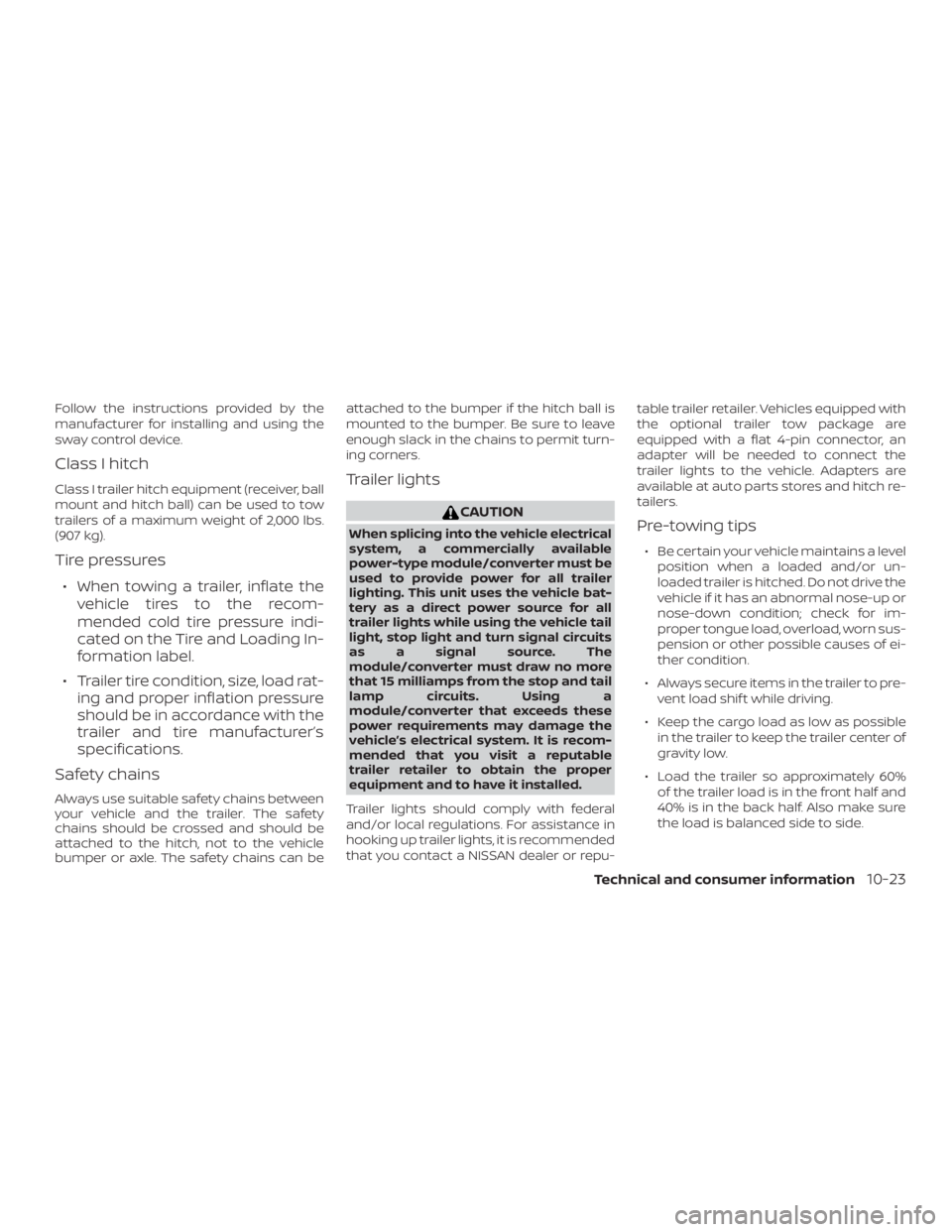
Follow the instructions provided by the
manufacturer for installing and using the
sway control device.
Class I hitch
Class I trailer hitch equipment (receiver, ball
mount and hitch ball) can be used to tow
trailers of a maximum weight of 2,000 lbs.
(907 kg).
Tire pressures
∙ When towing a trailer, inflate thevehicle tires to the recom-
mended cold tire pressure indi-
cated on the Tire and Loading In-
formation label.
∙ Trailer tire condition, size, load rat- ing and proper inflation pressure
should be in accordance with the
trailer and tire manufacturer’s
specifications.
Safety chains
Always use suitable safety chains between
your vehicle and the trailer. The safety
chains should be crossed and should be
attached to the hitch, not to the vehicle
bumper or axle. The safety chains can be attached to the bumper if the hitch ball is
mounted to the bumper. Be sure to leave
enough slack in the chains to permit turn-
ing corners.
Trailer lights
Page 436 of 460
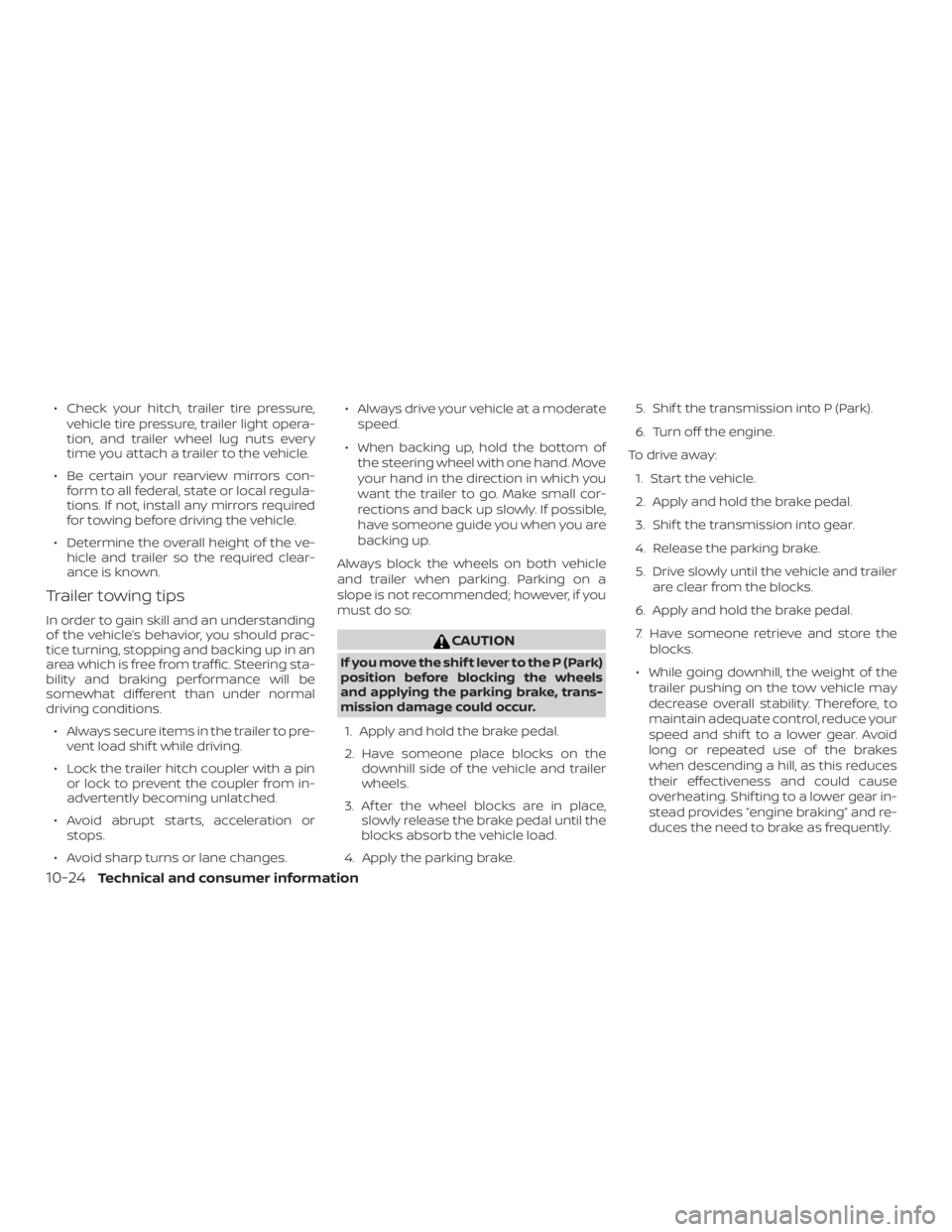
∙ Check your hitch, trailer tire pressure,vehicle tire pressure, trailer light opera-
tion, and trailer wheel lug nuts every
time you attach a trailer to the vehicle.
∙ Be certain your rearview mirrors con- form to all federal, state or local regula-
tions. If not, install any mirrors required
for towing before driving the vehicle.
∙ Determine the overall height of the ve- hicle and trailer so the required clear-
ance is known.
Trailer towing tips
In order to gain skill and an understanding
of the vehicle’s behavior, you should prac-
tice turning, stopping and backing up in an
area which is free from traffic. Steering sta-
bility and braking performance will be
somewhat different than under normal
driving conditions.
∙ Always secure items in the trailer to pre- vent load shif t while driving.
∙ Lock the trailer hitch coupler with a pin or lock to prevent the coupler from in-
advertently becoming unlatched.
∙ Avoid abrupt starts, acceleration or stops.
∙ Avoid sharp turns or lane changes. ∙ Always drive your vehicle at a moderate
speed.
∙ When backing up, hold the bottom of the steering wheel with one hand. Move
your hand in the direction in which you
want the trailer to go. Make small cor-
rections and back up slowly. If possible,
have someone guide you when you are
backing up.
Always block the wheels on both vehicle
and trailer when parking. Parking on a
slope is not recommended; however, if you
must do so:
Page 438 of 460
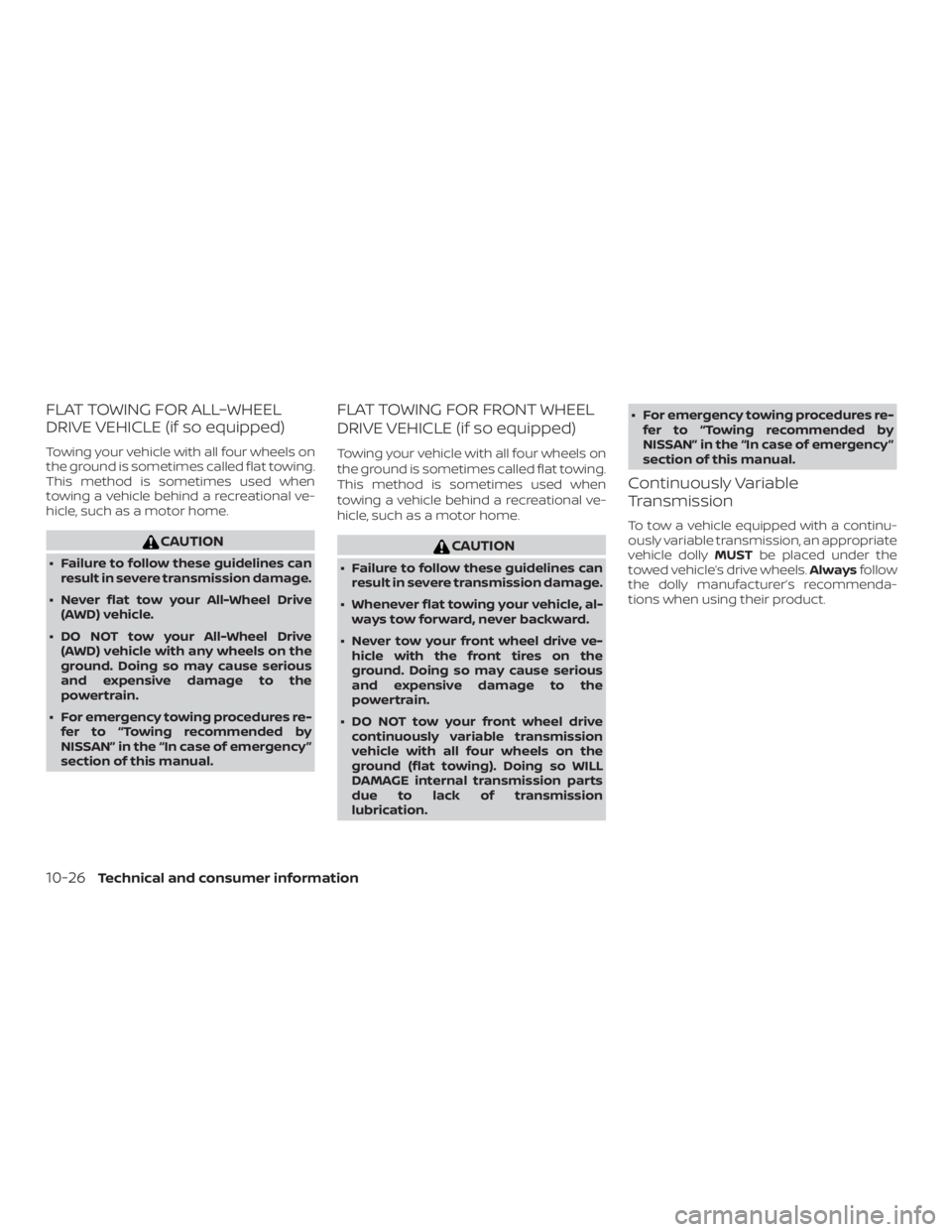
FLAT TOWING FOR ALL–WHEEL
DRIVE VEHICLE (if so equipped)
Towing your vehicle with all four wheels on
the ground is sometimes called flat towing.
This method is sometimes used when
towing a vehicle behind a recreational ve-
hicle, such as a motor home.
Page 450 of 460
SeatsAdjustment ..................1-2
Armrests .................. .1-6
Automatic drive positioner .3-39, 3-40, 3-41
Frontseats..................1-2
Heatedseats................2-43
Manual front seat adjustment ......1-3
Rearseat.................. .1-6
Security indicator light ............2-15
Security system (NISSAN Vehicle Immobilizer
System), engine start ..........2-32,5-16
Security systems Vehicle security system ..........2-31
Self-adjustingbrakes.............8-20
Service manual order form .........10-31
Servicing air conditioner ...........4-32
Shoulder belt height adjustment ......1-23
Spark plug replacement ...........8-16
Spark plugs ...................8-16
Specifications .................10-8
Speedometer ................2-4,2-5
Speedometer and odometer ........2-4
Spotlights(Seemaplight)..........2-62
SRS warning label ...............1-68
Standard maintenance ............9-8
Starting Before starting the engine ........5-17
Jumpstarting............6-10,8-15
Precautions when starting and
driving ..................5-4,5-11
Push starting ................6-12
Starting the engine ............5-17
Starting the engine ..............5-17
Startupdisplay.................2-18
Steering Heated steering wheel ..........2-45 Powersteeringfluid............8-10
Powersteeringsystem .........5-86
Steering wheel .................3-33
Stoplight....................8-27
Storage.....................2-49
Storagetray...................2-51
Sunglasses case ................2-52
Sunglasses holder ..............2-52
Sunroof .....................2-59
Sunroof (see Moonroof ) ...........2-59
Sunvisors....................3-35
Supplemental air bag warning labels . . .1-68
Supplemental air bag warning
light.................... .1-69, 2-13
Supplemental front impact air bag
system ..................... .1-56
Supplemental restraint system Information and warning labels . . . .1-68
Precautions on supplemental restraint
system ................... .1-49
Supplemental restraint system
(Supplemental air bag system) .......1-49
Switch Autolightswitch..............2-37
Automatic power window switch . . .2-58
Cruise control main/set switches . . .2-16
Foglightswitch ..............2-41
Hazard warning flasher switch ......6-2
Headlight and turn signal switch ....2-37
Headlightcontrolswitch.........2-37
Instrument brightness control .....2-40
Power door lock switch ..........3-6
Rear window and outside mirror
defrosterswitch..............2-36
Rear window wiper and washer
switches ...................2-35 Turn signal switch
.............2-40
T
Tachometer ...................2-6
Temperature gauge Engine coolant temperature gauge . .2-6
Thef t (NISSAN Vehicle Immobilizer System),
engine start ...............
2-32,5-16
Three-waycatalyst...............5-5
Tire Flattire....................6-3
Spare tire ...............6-5,8-40
Tire and Loading Information label . .10-12
Tire chains .................8-36
Tire pressure ................8-29
Tirerotation.................8-37
Types of tires ................8-35
Uniform tire quality grading ......10-27
Wheels and tires ...........8-29,10-9
Wheel/tire size ...............10-9
Tire pressure Low tire pressure warning light .....2-10
Tire Pressure Monitoring System (TPMS) . .5-5
Toptetherstrapchildrestraint.......1-32
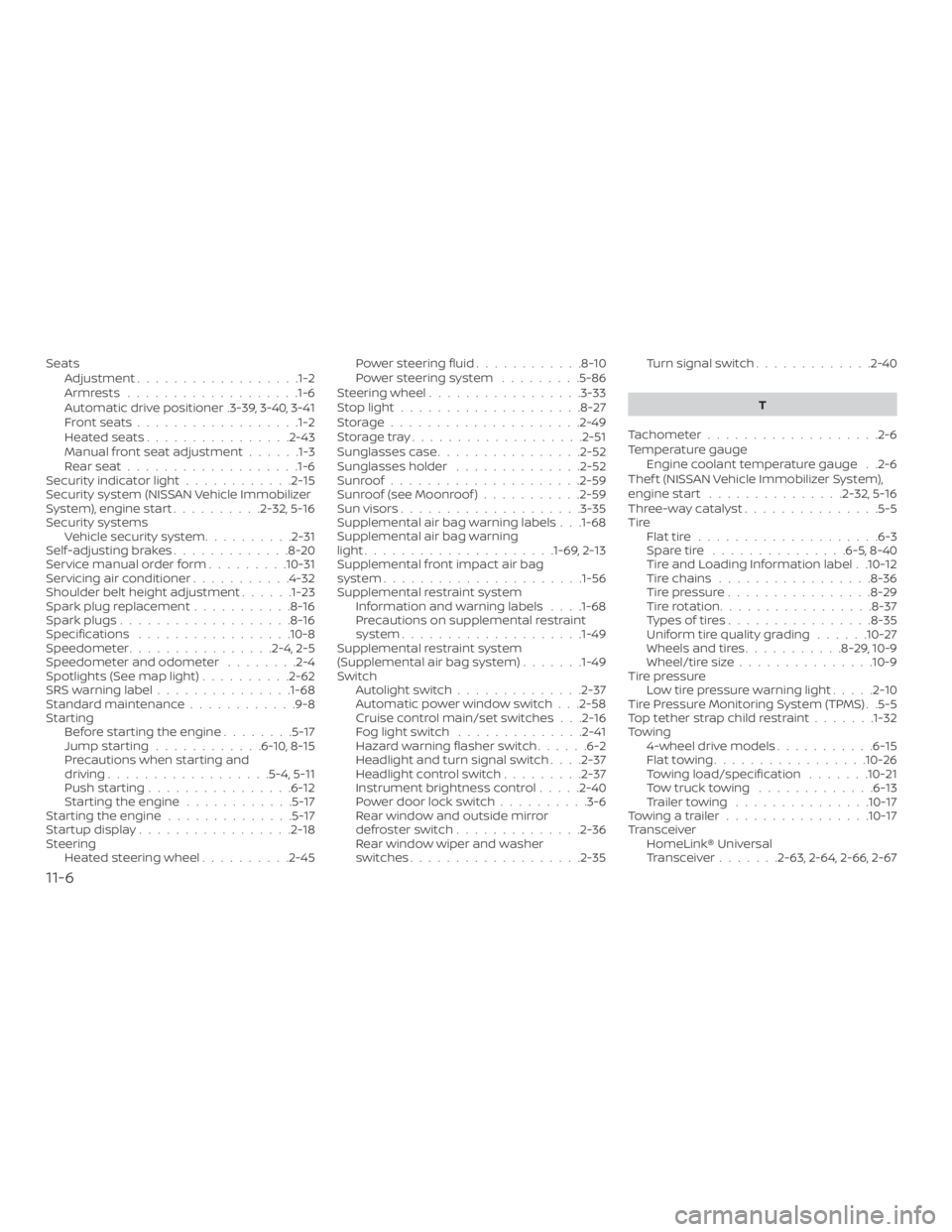
Towing 4-wheel drive models ...........6-15
Flattowing.................10-26
Towing load/specification .......10-21
Towtrucktowing .............6-13
Trailertowing ...............10-17
Towingatrailer................10-17
Transceiver HomeLink® Universal
Transceiver .......2-63,2-64,2-66,2-67
11-6