service NISSAN NAVARA 2005 Repair Owners Manual
[x] Cancel search | Manufacturer: NISSAN, Model Year: 2005, Model line: NAVARA, Model: NISSAN NAVARA 2005Pages: 3171, PDF Size: 49.59 MB
Page 825 of 3171
![NISSAN NAVARA 2005 Repair Owners Manual PRECAUTIONS
BRC-3
[ABS]
C
D
E
G
H
I
J
K
L
MA
B
BRC
[ABS]PRECAUTIONSPFP:00001
Precautions for Supplemental Restraint System (SRS) “AIR BAG” and “SEAT
BELT PRE-TENSIONER”
EFS006DM
The Supplement](/img/5/57362/w960_57362-824.png "NISSAN NAVARA 2005 Repair Owners Manual PRECAUTIONS
BRC-3
[ABS]
C
D
E
G
H
I
J
K
L
MA
B
BRC
[ABS]PRECAUTIONSPFP:00001
Precautions for Supplemental Restraint System (SRS) “AIR BAG” and “SEAT
BELT PRE-TENSIONER”
EFS006DM
The Supplement")
PRECAUTIONS
BRC-3
[ABS]
C
D
E
G
H
I
J
K
L
MA
B
BRC
[ABS]PRECAUTIONSPFP:00001
Precautions for Supplemental Restraint System (SRS) “AIR BAG” and “SEAT
BELT PRE-TENSIONER”
EFS006DM
The Supplemental Restraint System such as “AIR BAG” and “SEAT BELT PRE-TENSIONER”, used along
with a front seat belt, helps to reduce the risk or severity of injury to the driver and front passenger for certain
types of collision. Information necessary to service the system safely is included in the SRS and SB section of
this Service Manual.
WARNING:
lTo avoid rendering the SRS inoperative, which could increase the risk of personal injury or death
in the event of a collision which would result in air bag inflation, all maintenance must be per-
formed by an authorized NISSAN/INFINITI dealer.
lImproper maintenance, including incorrect removal and installation of the SRS, can lead to per-
sonal injury caused by unintentional activation of the system. For removal of Spiral Cable and Air
Bag Module, see the SRS section.
lDo not use electrical test equipment on any circuit related to the SRS unless instructed to in this
Service Manual. SRS wiring harnesses can be identified by yellow and/or orange harnesses or
harness connectors.
Precautions for Brake SystemEFS005TG
lRecommended fluid is brake fluid “DOT 3” or “DOT 4”.
lNever reuse drained brake fluid.
lBe careful not to splash brake fluid on painted areas.If brake fluid is splashed, wipe it off and flush area
with water immediately.
lNever use mineral oils such as gasoline or kerosene. They will ruin rubber parts of the hydraulic system.
lUse flare nut wrench when removing flare nuts, and use a flare
nut torque wrench when tighten flare nuts.
lBrake system is an important safety part.If a brake fluid leak is
detected, always disassemble the affected part.If a malfunction
is detected, replace part with new one.
lBefore working, turn ignition switch OFF and disconnect con-
nector of ABS actuator and electric unit (control unit) or the bat-
tery cables.
lWhen installing brake tube and hose, be sure to torque.
WARNING:
Clean brake pads and shoes with a waster cloth, then wipe with
a dust collector.
Precautions for Brake ControlEFS005TH
lJust after starting vehicle after ignition switch ON, brake pedal may vibrate or motor operating noise may
be heard from engine room. This is a normal status of operation check.
lStopping distance may be longer than that of vehicles without ABS when vehicle drives on rough, gravel,
or snow-covered (fresh, deep snow) roads.
lWhen an error is indicated by ABS or another warning lamp, collect all necessary information from cus-
tomer (what symptoms are present under what conditions) and check for simple causes before starting
diagnostic servicing. Besides electrical system inspection, check brake booster operation, brake fluid
level, and fluid leaks.
lIf tyre size and type are used in an improper combination, or brake pads are not Genuine NISSAN parts,
stopping distance or steering stability may deteriorate.
lIf there is a radio, antenna, or antenna lead-in wire (including wiring) near control module, ABS function
may have a malfunction or error.
lIf aftermarket parts (car stereo, CD player, etc.) have been installed, check for incidents such as harness
pinches, open circuits, and improper wiring.
SBR820BA
Page 826 of 3171
![NISSAN NAVARA 2005 Repair Owners Manual BRC-4
[ABS]
PREPARATION
PREPARATION
PFP:00002
Special Service Tools (SST)EFS005TI
Tool number
Tool nameDescription
GG94310000
Flare nut torque wrench
a:10 mm (0.39 in)Installing brake tube and hose
ST](/img/5/57362/w960_57362-825.png "NISSAN NAVARA 2005 Repair Owners Manual BRC-4
[ABS]
PREPARATION
PREPARATION
PFP:00002
Special Service Tools (SST)EFS005TI
Tool number
Tool nameDescription
GG94310000
Flare nut torque wrench
a:10 mm (0.39 in)Installing brake tube and hose
ST")
BRC-4
[ABS]
PREPARATION
PREPARATION
PFP:00002
Special Service Tools (SST)EFS005TI
Tool number
Tool nameDescription
GG94310000
Flare nut torque wrench
a:10 mm (0.39 in)Installing brake tube and hose
ST30720000
Drift
a: 77 mm (0.03 in) dia.
b: 55 mm (2.17 in) dia.
Installation rear sensor rotor ST27863000
Drift
a: 75 mm (2.95 in) dia.
b: 62 mm (2.44 in) dia.
KV40104710
Drift
a: 76 mm (2.99 in) dia.
b: 68.5 mm (2.697 in) dia.
NT406
ZZA0701D
ZZA0832D
ZZA0832D
Page 855 of 3171
![NISSAN NAVARA 2005 Repair Owners Manual TROUBLE DIAGNOSIS
BRC-33
[ABS]
C
D
E
G
H
I
J
K
L
MA
B
BRC
Inspection 8 Warning lamp systemEFS005U7
INSPECTION PROCEDURE
1.CHECK SELF-DIAGNOSTIC RESULTS
Perform self-diagnosis of ABS actuator and elect](/img/5/57362/w960_57362-854.png "NISSAN NAVARA 2005 Repair Owners Manual TROUBLE DIAGNOSIS
BRC-33
[ABS]
C
D
E
G
H
I
J
K
L
MA
B
BRC
Inspection 8 Warning lamp systemEFS005U7
INSPECTION PROCEDURE
1.CHECK SELF-DIAGNOSTIC RESULTS
Perform self-diagnosis of ABS actuator and elect")
TROUBLE DIAGNOSIS
BRC-33
[ABS]
C
D
E
G
H
I
J
K
L
MA
B
BRC
Inspection 8 Warning lamp systemEFS005U7
INSPECTION PROCEDURE
1.CHECK SELF-DIAGNOSTIC RESULTS
Perform self-diagnosis of ABS actuator and electric unit (control unit). Refer toBRC-18, "
Self-Diagnosis".
OK or NG
OK >> GO TO 2.
NG >> Check items displayed by self-diagnosis. Refer toBRC-18, "
Display Item List".
2.CHECK COMBINATION METER
Check if the indication and operation of combination meter are normal. Refer toDI-13, "
Self-Diagnosis Mode
of Combination Meter".
OK or NG
OK >> INSPECTION END
NG >> Repair or replace combination meter. Refer toDI-27, "
Removal and Installation of Combination
Meter".
Symptom 1: Excessive ABS Function Operation FrequencyEFS005U8
1.CHECK START
Check longitudinal brake force distribution using a brake tester. Refer toBR-35, "
SERVICE DATA AND SPEC-
IFICATIONS (SDS)".
OK or NG
OK >> GO TO 2.
NG >> Check the following system. If any malfunction is found, repair or replace malfunctioning parts.
lBrake booster. Refer toBR-19, "BRAKE BOOSTER".
lHydraulic line. Refer toBR-12, "BRAKE TUBE AND HOSE".
lFront brake caliper. Refer toBR-24, "FRONT DISC BRAKE".
lRear wheel cylinder. Refer toBR-30, "REAR DRUM BRAKE".
2.CHECK FRONT AND REAR AXLE
Make sure that there is no excessive play in the front and rear axles. Refer to Front:FAX-5, "
WHEEL BEAR-
ING INSPECTION",Rear:RAX-6, "Rear Axle Bearing".
OK or NG
OK >> GO TO 3.
NG >> Repair.
3.CHECK WHEEL SENSOR AND SENSOR ROTOR
Check wheel sensor and sensor rotor for the following.
lWheel sensor installation for damage
lWheel sensor rotor installation for damage
lWheel sensor connector connection
lWheel sensor harness inspection
OK or NG
OK >> GO TO 4.
NG >>
lReplace wheel sensor or sensor rotor.
lRepair harness.
Page 865 of 3171

CL-1
CLUTCH
C TRANSMISSION/TRANSAXLE
CONTENTS
D
E
F
G
H
I
J
K
L
M
SECTIONCL
A
B
CL
CLUTCH
PRECAUTIONS .......................................................... 2
Service Notice or Precautions .................................. 2
PREPARATION ........................................................... 3
Special Service Tools ............................................... 3
Commercial Service Tools ........................................ 3
NOISE, VIBRATION AND HARSHNESS (NVH)
TROUBLESHOOTING ................................................ 5
NVH Troubleshooting Chart ..................................... 5
CLUTCH PEDAL ........................................................ 6
On-Vehicle Inspection and Adjustment .................... 6
Removal and Installation .......................................... 7
COMPONENTS .................................................... 7
REMOVAL ............................................................. 7
INSPECTION AFTER REMOVAL ......................... 7
INSTALLATION ..................................................... 7
CLUTCH FLUID .......................................................... 8
Air Bleeding Procedure ............................................ 8
CLUTCH MASTER CYLINDER .................................. 9
Components ............................................................. 9
Removal and Installation .......................................... 9
REMOVAL ............................................................. 9
INSTALLATION ..................................................... 9
Disassembly and Assembly ................................... 10
DISASSEMBLY ................................................... 10
INSPECTION AFTER DISASSEMBLY ............... 10
ASSEMBLY ......................................................... 10
OPERATING CYLINDER ...........................................11
Components ............................................................ 11
Removal and Installation ......................................... 11REMOVAL ........................................................... 11
INSTALLATION ................................................... 12
Disassembly and Assembly .................................... 12
DISASSEMBLY ................................................... 12
INSPECTION AFTER DISASSEMBLY ................ 12
ASSEMBLY ......................................................... 12
CLUTCH PIPING ....................................................... 13
Removal and Installation ........................................ 13
CLUTCH RELEASE MECHANISM ........................... 14
Removal and Installation ........................................ 14
COMPONENTS ................................................... 14
REMOVAL ........................................................... 14
INSPECTION AFTER REMOVAL ....................... 15
INSTALLATION ................................................... 15
CLUTCH DISC, CLUTCH COVER AND FLYWHEEL... 17
Removal and Installation ........................................ 17
COMPONENTS ................................................... 17
REMOVAL ........................................................... 17
INSPECTION AND ADJUSTMENT AFTER
REMOVAL ........................................................... 17
INSTALLATION ................................................... 18
SERVICE DATA AND SPECIFICATIONS (SDS) ...... 20
Clutch Control System ............................................ 20
Clutch Master Cylinder ........................................... 20
Clutch Operating Cylinder ...................................... 20
Clutch Disc ............................................................. 20
Clutch Cover ........................................................... 20
Clutch Pedal ........................................................... 20
Page 866 of 3171
CL-2
PRECAUTIONS
PRECAUTIONS
PFP:00001
ServiceNoticeorPrecautionsECS00ICC
lRecommended clutch fluid is brake fluid “DOT 3” or “DOT 4”. Refer toMA-14, "RECOMMENDED FLUIDS
AND LUBRICANTS".
lDo not reuse drained clutch fluid.
lBe careful not to splash clutch fluid on painted areas.
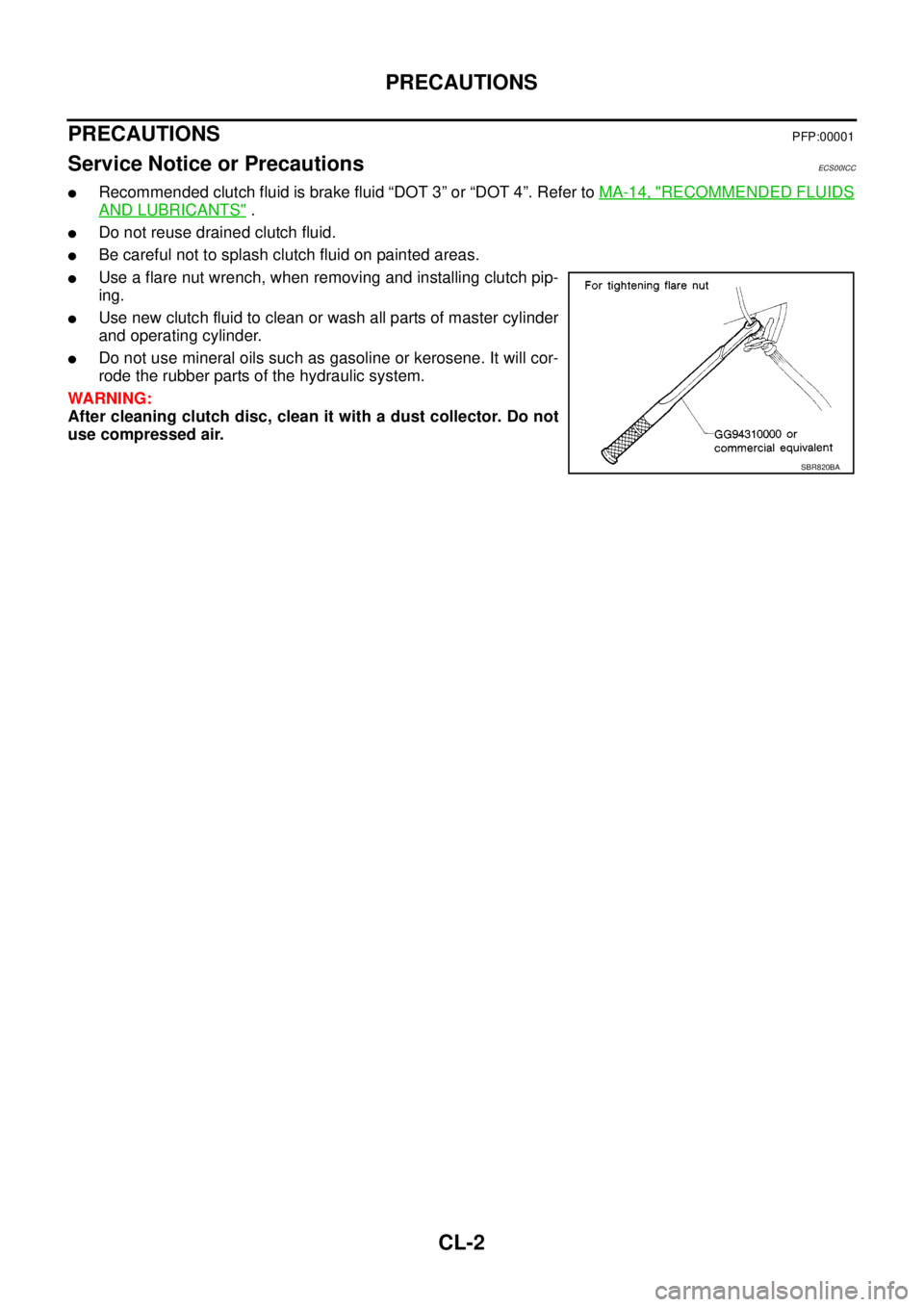
lUse a flare nut wrench, when removing and installing clutch pip-
ing.
lUse new clutch fluid to clean or wash all parts of master cylinder
and operating cylinder.
lDo not use mineral oils such as gasoline or kerosene. It will cor-
rode the rubber parts of the hydraulic system.
WARNING:
After cleaning clutch disc, clean it with a dust collector. Do not
use compressed air.
SBR820BA
Page 867 of 3171
PREPARATION
CL-3
D
E
F
G
H
I
J
K
L
MA
B
CL
PREPARATIONPFP:00002
Special Service ToolsECS00ICD
Commercial Service ToolsECS00ICE
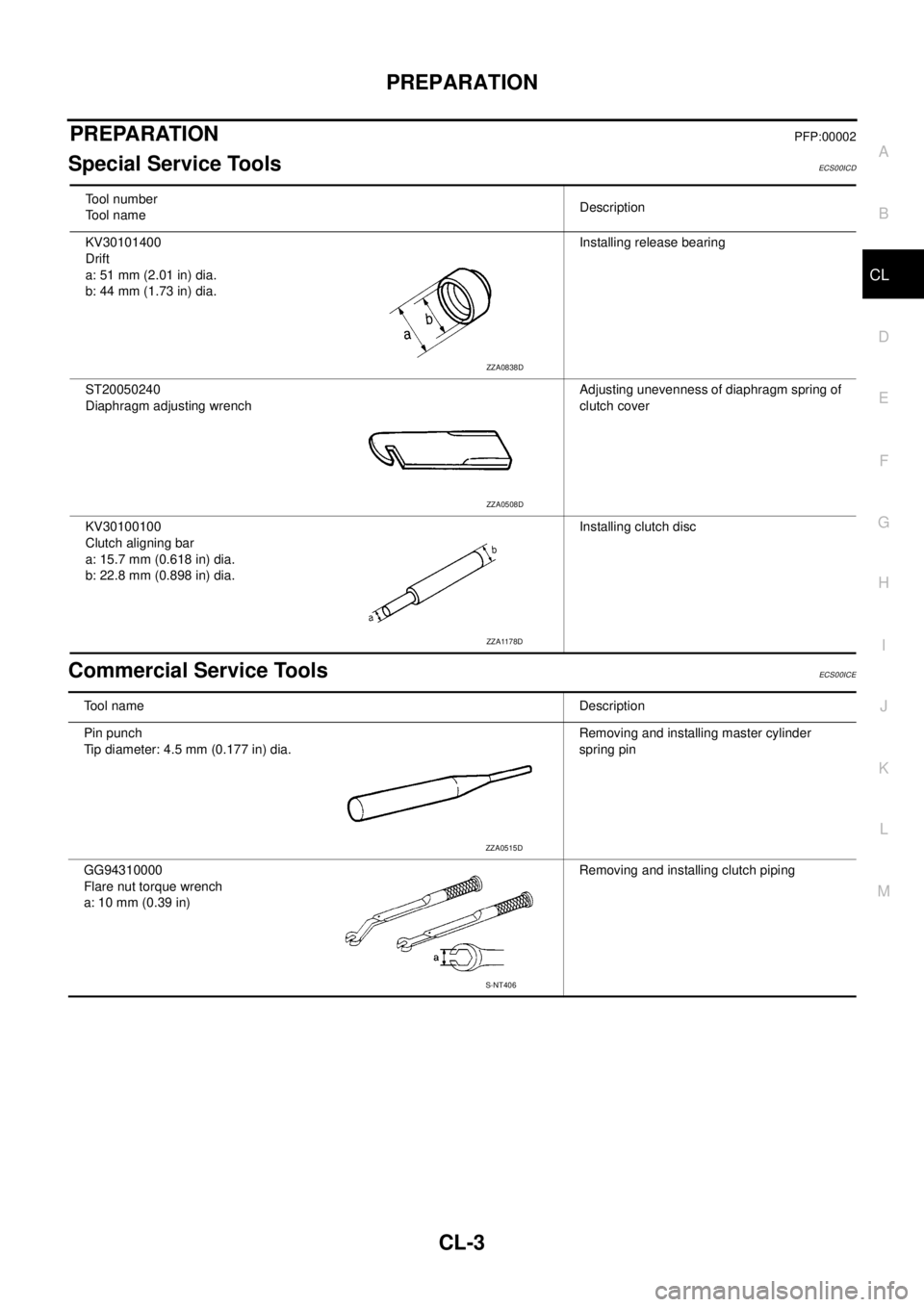
Tool number
Tool nameDescription
KV30101400
Drift
a: 51 mm (2.01 in) dia.
b: 44 mm (1.73 in) dia.Installing release bearing
ST20050240
Diaphragm adjusting wrenchAdjusting unevenness of diaphragm spring of
clutch cover
KV30100100
Clutch aligning bar
a: 15.7 mm (0.618 in) dia.
b: 22.8 mm (0.898 in) dia.Installing clutch disc
ZZA0838D
ZZA0508D
ZZA1178D
Tool nameDescription
Pin punch
Tip diameter: 4.5 mm (0.177 in) dia.Removing and installing master cylinder
spring pin
GG94310000
Flare nut torque wrench
a: 10 mm (0.39 in)Removing and installing clutch piping
ZZA0515D
S-NT406
Page 884 of 3171

CL-20
SERVICE DATA AND SPECIFICATIONS (SDS)
SERVICE DATA AND SPECIFICATIONS (SDS)
PFP:00030
Clutch Control SystemECS00ICS
Clutch Master CylinderECS00ICT
Clutch Operating CylinderECS00ICU
Clutch DiscECS00ICV
Clutch CoverECS00ICW
Clutch PedalECS00ICX
Type of clutch controlHydraulic
Inner diameter15.87 mm (5/8 in)
Inner diameter19.05 mm (3/4 in)
Facing size (outer dia. x inner dia. x thickness) 240 mm´160 mm´3.15 mm (9.45 in´6.30 in´0.1240 in)
Wear limit of facing surface to rivet head 0.3 mm (0.012 in)
Runout limit/diameter of the area to be measured 1.0 mm (0.039 in) / 230 mm (9.06 in) dia.
Maximum spline backlash (at outer edge of disc) 1.0 mm (0.039 in)
Set-load9,810 N (1,000 kg, 2,205 lb)
Diaphragm spring lever height 39.0 - 41.0 mm (1.535 - 1.614 in)
Uneven limit diaphragm spring toe height 0.7 mm (0.028 in) or less
Clearance²C²between pedal stopper rubber and clutch interlock
switch threaded while clutch pedal is fully depressed0.1 - 1.0 mm (0.004 - 0.039 in)
Page 885 of 3171

CO-1
ENGINE COOLING SYSTEM
B ENGINE
CONTENTS
C
D
E
F
G
H
I
J
K
L
M
SECTIONCO
A
CO
ENGINE COOLING SYSTEM
PRECAUTIONS .......................................................... 2
Precautions For Liquid Gasket ................................. 2
LIQUID GASKET APPLICATION PROCEDURE..... 2
PREPARATION ........................................................... 3
Special Service Tools ............................................... 3
Commercial Service Tools ........................................ 3
OVERHEATING CAUSE ANALYSIS .......................... 4
Troubleshooting Chart .............................................. 4
COOLING SYSTEM .................................................... 6
Cooling Circuit .......................................................... 6
ENGINE COOLANT .................................................... 7
Inspection ................................................................. 7
LEVEL CHECK ..................................................... 7
CHECKING RADIATOR SYSTEM FOR LEAKS..... 7
Changing Engine Coolant ........................................ 7
DRAINING ENGINE COOLANT ........................... 8
REFILLING ENGINE COOLANT .......................... 8
FLUSHING COOLING SYSTEM ........................... 9
RADIATOR .................................................................11
Components ............................................................ 11
Removal and Installation ......................................... 11
REMOVAL ............................................................ 11
INSPECTION AFTER REMOVAL ....................... 13
INSTALLATION ................................................... 14
INSPECTION AFTER INSTALLATION ............... 14
RADIATOR (ALUMINUM TYPE) .............................. 15
Components ........................................................... 15
Disassembly and Assembly ................................... 15
PREPARATION ................................................... 15
DISASSEMBLY ................................................... 15
ASSEMBLY ......................................................... 16
INSPECTION ...................................................... 18COOLING FAN .......................................................... 19
Components (Crankshaft Driven Type) .................. 19
Removal and Installation ........................................ 19
REMOVAL ........................................................... 19
INSPECTION AFTER REMOVAL ....................... 19
INSTALLATION ................................................... 19
Removal and Installation (Motor Driven Type) (Mod-
els with A/C) ........................................................... 19
REMOVAL ........................................................... 19
INSTALLATION ................................................... 20
WATER PUMP .......................................................... 21
Components ........................................................... 21
Removal and Installation ........................................ 21
REMOVAL ........................................................... 21
INSPECTION AFTER REMOVAL ....................... 22
INSTALLATION ................................................... 22
INSPECTION AFTER INSTALLATION ................ 22
THERMOSTAT AND WATER PIPING ...................... 23
Components ........................................................... 23
Removal and Installation ........................................ 24
REMOVAL ........................................................... 24
INSPECTION AFTER REMOVAL ....................... 24
INSTALLATION ................................................... 24
INSPECTION AFTER INSTALLATION ................ 25
SERVICE DATA AND SPECIFICATIONS (SDS) ...... 26
Standard and Limit .................................................. 26
ENGINE COOLANT CAPACITY .......................... 26
THERMOSTAT .................................................... 26
RESERVOIR TANK ............................................. 26
Page 887 of 3171
PREPARATION
CO-3
C
D
E
F
G
H
I
J
K
L
MA
CO
PREPARATIONPFP:00002
Special Service ToolsEBS01E6K
Commercial Service ToolsEBS01E6L
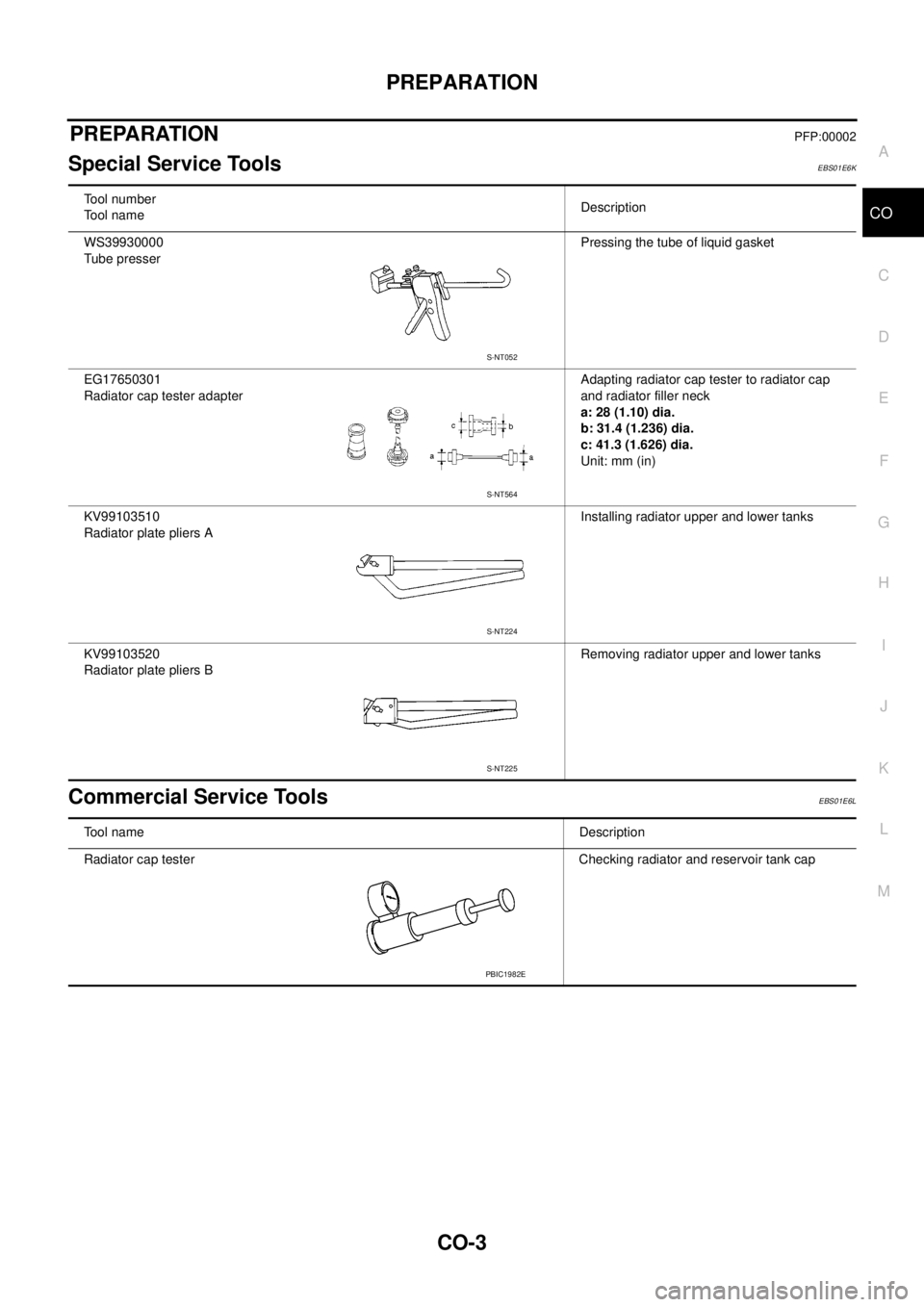
Tool number
Tool nameDescription
WS39930000
Tube presserPressing the tube of liquid gasket
EG17650301
Radiator cap tester adapterAdapting radiator cap tester to radiator cap
and radiator filler neck
a: 28 (1.10) dia.
b: 31.4 (1.236) dia.
c: 41.3 (1.626) dia.
Unit: mm (in)
KV99103510
Radiator plate pliers AInstalling radiator upper and lower tanks
KV99103520
Radiator plate pliers BRemoving radiator upper and lower tanks
S-NT052
S-NT564
S-NT224
S-NT225
Tool nameDescription
Radiator cap tester Checking radiator and reservoir tank cap
PBIC1982E
Page 891 of 3171
ENGINE COOLANT
CO-7
C
D
E
F
G
H
I
J
K
L
MA
CO
ENGINE COOLANTPFP:KQ100
InspectionEBS01E6P
LEVEL CHECK
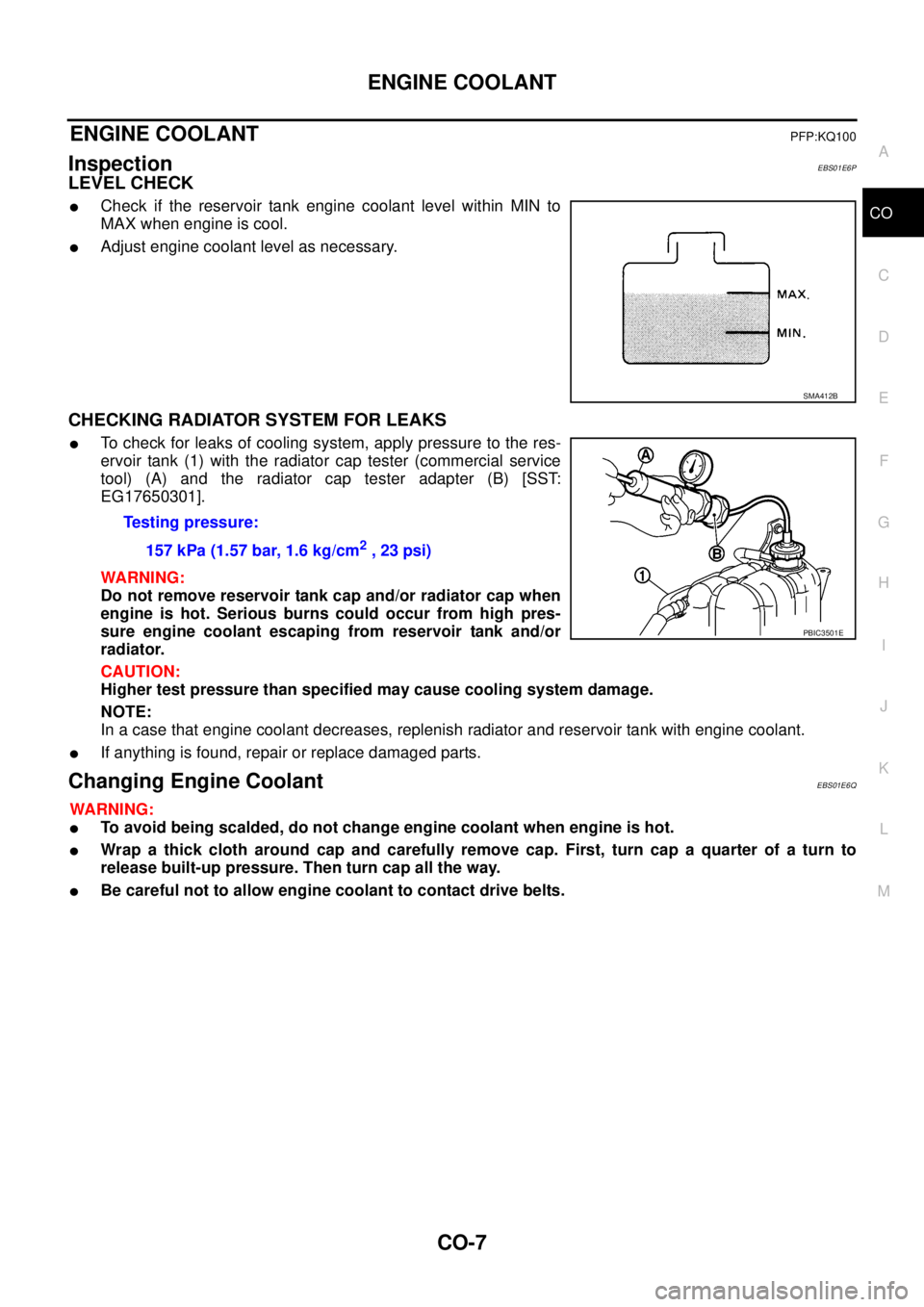
lCheck if the reservoir tank engine coolant level within MIN to
MAX when engine is cool.
lAdjust engine coolant level as necessary.
CHECKING RADIATOR SYSTEM FOR LEAKS
lTo check for leaks of cooling system, apply pressure to the res-
ervoir tank (1) with the radiator cap tester (commercial service
tool) (A) and the radiator cap tester adapter (B) [SST:
EG17650301].
WARNING:
Do not remove reservoir tank cap and/or radiator cap when
engine is hot. Serious burns could occur from high pres-
sure engine coolant escaping from reservoir tank and/or
radiator.
CAUTION:
Higher test pressure than specified may cause cooling system damage.
NOTE:
In a case that engine coolant decreases, replenish radiator and reservoir tank with engine coolant.
lIf anything is found, repair or replace damaged parts.
Changing Engine CoolantEBS01E6Q
WARNING:
lTo avoid being scalded, do not change engine coolant when engine is hot.
lWrap a thick cloth around cap and carefully remove cap. First, turn cap a quarter of a turn to
release built-up pressure. Then turn cap all the way.
lBe careful not to allow engine coolant to contact drive belts.
SMA412B
Testing pressure:
157 kPa (1.57 bar, 1.6 kg/cm
2,23psi)
PBIC3501E