sensor NISSAN NAVARA 2005 Repair Workshop Manual
[x] Cancel search | Manufacturer: NISSAN, Model Year: 2005, Model line: NAVARA, Model: NISSAN NAVARA 2005Pages: 3171, PDF Size: 49.59 MB
Page 855 of 3171
![NISSAN NAVARA 2005 Repair Workshop Manual TROUBLE DIAGNOSIS
BRC-33
[ABS]
C
D
E
G
H
I
J
K
L
MA
B
BRC
Inspection 8 Warning lamp systemEFS005U7
INSPECTION PROCEDURE
1.CHECK SELF-DIAGNOSTIC RESULTS
Perform self-diagnosis of ABS actuator and elect](/img/5/57362/w960_57362-854.png "NISSAN NAVARA 2005 Repair Workshop Manual TROUBLE DIAGNOSIS
BRC-33
[ABS]
C
D
E
G
H
I
J
K
L
MA
B
BRC
Inspection 8 Warning lamp systemEFS005U7
INSPECTION PROCEDURE
1.CHECK SELF-DIAGNOSTIC RESULTS
Perform self-diagnosis of ABS actuator and elect")
TROUBLE DIAGNOSIS
BRC-33
[ABS]
C
D
E
G
H
I
J
K
L
MA
B
BRC
Inspection 8 Warning lamp systemEFS005U7
INSPECTION PROCEDURE
1.CHECK SELF-DIAGNOSTIC RESULTS
Perform self-diagnosis of ABS actuator and electric unit (control unit). Refer toBRC-18, "
Self-Diagnosis".
OK or NG
OK >> GO TO 2.
NG >> Check items displayed by self-diagnosis. Refer toBRC-18, "
Display Item List".
2.CHECK COMBINATION METER
Check if the indication and operation of combination meter are normal. Refer toDI-13, "
Self-Diagnosis Mode
of Combination Meter".
OK or NG
OK >> INSPECTION END
NG >> Repair or replace combination meter. Refer toDI-27, "
Removal and Installation of Combination
Meter".
Symptom 1: Excessive ABS Function Operation FrequencyEFS005U8
1.CHECK START
Check longitudinal brake force distribution using a brake tester. Refer toBR-35, "
SERVICE DATA AND SPEC-
IFICATIONS (SDS)".
OK or NG
OK >> GO TO 2.
NG >> Check the following system. If any malfunction is found, repair or replace malfunctioning parts.
lBrake booster. Refer toBR-19, "BRAKE BOOSTER".
lHydraulic line. Refer toBR-12, "BRAKE TUBE AND HOSE".
lFront brake caliper. Refer toBR-24, "FRONT DISC BRAKE".
lRear wheel cylinder. Refer toBR-30, "REAR DRUM BRAKE".
2.CHECK FRONT AND REAR AXLE
Make sure that there is no excessive play in the front and rear axles. Refer to Front:FAX-5, "
WHEEL BEAR-
ING INSPECTION",Rear:RAX-6, "Rear Axle Bearing".
OK or NG
OK >> GO TO 3.
NG >> Repair.
3.CHECK WHEEL SENSOR AND SENSOR ROTOR
Check wheel sensor and sensor rotor for the following.
lWheel sensor installation for damage
lWheel sensor rotor installation for damage
lWheel sensor connector connection
lWheel sensor harness inspection
OK or NG
OK >> GO TO 4.
NG >>
lReplace wheel sensor or sensor rotor.
lRepair harness.
Page 856 of 3171
![NISSAN NAVARA 2005 Repair Workshop Manual BRC-34
[ABS]
TROUBLE DIAGNOSIS
4.CHECK ABS WARNING LAMP DISPLAY
Make sure that the ABS warning lamp is turned off after the ignition switch is turned ON or when driving.
OK or NG
OK >> Normal
NG >> Pe](/img/5/57362/w960_57362-855.png "NISSAN NAVARA 2005 Repair Workshop Manual BRC-34
[ABS]
TROUBLE DIAGNOSIS
4.CHECK ABS WARNING LAMP DISPLAY
Make sure that the ABS warning lamp is turned off after the ignition switch is turned ON or when driving.
OK or NG
OK >> Normal
NG >> Pe")
BRC-34
[ABS]
TROUBLE DIAGNOSIS
4.CHECK ABS WARNING LAMP DISPLAY
Make sure that the ABS warning lamp is turned off after the ignition switch is turned ON or when driving.
OK or NG
OK >> Normal
NG >> Perform self-diagnosis. Refer toBRC-18, "
Self-Diagnosis".
Symptom 2: Unexpected Pedal ReactionEFS005U9
1.CHECK BRAKE PEDAL STROKE
Check brake pedal stroke. Refer toBR-6, "
Inspection and Adjustment".
Is the stroke too big?
YES >>lBleed air from brake piping. Refer toBR-11, "Bleeding Brake System".
lCheck brake pedal, brake booster, and master cylinder for mount play, looseness, brake sys-
tem fluid leakage, etc. Repair if necessary. Refer to Brake pedal:BR-8, "
COMPONENTS",
brake booster and master cylinder:BR-20, "
COMPONENTS".
NO >> GO TO 2.
2.CHECK FUNCTION
Disconnect ABS actuator and electric unit (control unit) connector to deactivate ABS. Check if braking force is
normal in this condition. Connect connector after inspection.
OK or NG
OK >> GO TO procedure 3 “CHECK WHEEL SENSOR AND SENSOR ROTOR” of symptom 1. Refer to
BRC-33, "
Symptom 1: Excessive ABS Function Operation Frequency".
NG >> Check the following system. If any malfunction is found, repair or replace malfunctioning parts.
lBrake booster. Refer toBR-19, "BRAKE BOOSTER".
lHydraulic line. Refer toBR-12, "BRAKE TUBE AND HOSE".
lFront brake caliper. Refer toBR-24, "FRONT DISC BRAKE".
lRear wheel cylinder. Refer toBR-30, "REAR DRUM BRAKE".
Symptom 3: The Stopping Distance Is LongEFS005UA
CAUTION:
The stopping distance on slippery road surfaces might be longer with the ABS operating than when
the ABS is not operating.
1.CHECK FUNCTION
Turn ignition switch OFF. Disconnect ABS actuator and electric unit (control unit) connector to deactivate ABS.
In this condition, check stopping distance. After inspection, connect connector.
OK or NG
OK >> GO TO procedure 3 “CHECK WHEEL SENSOR AND SENSOR ROTOR” of symptom 1. Refer to
BRC-33, "
Symptom 1: Excessive ABS Function Operation Frequency".
NG >>
lBleed air from the brake piping. Refer toBR-11, "Bleeding Brake System".
lCheck the following system. If any malfunction is found, repair or replace malfunctioning parts.
–Brake booster. Refer toBR-19, "BRAKE BOOSTER".
–Hydraulic line. Refer toBR-12, "BRAKE TUBE AND HOSE".
–Front brake caliper. Refer toBR-24, "FRONT DISC BRAKE".
–Rear wheel cylinder. Refer toBR-30, "REAR DRUM BRAKE".
Page 857 of 3171
![NISSAN NAVARA 2005 Repair Workshop Manual TROUBLE DIAGNOSIS
BRC-35
[ABS]
C
D
E
G
H
I
J
K
L
MA
B
BRC
Symptom 4: ABS Function Does Not OperateEFS005UB
CAUTION:
ABS does not operate when speed is 10 km/h (6 MPH) or lower.
1.CHECK ABS WARNING LAM](/img/5/57362/w960_57362-856.png "NISSAN NAVARA 2005 Repair Workshop Manual TROUBLE DIAGNOSIS
BRC-35
[ABS]
C
D
E
G
H
I
J
K
L
MA
B
BRC
Symptom 4: ABS Function Does Not OperateEFS005UB
CAUTION:
ABS does not operate when speed is 10 km/h (6 MPH) or lower.
1.CHECK ABS WARNING LAM")
TROUBLE DIAGNOSIS
BRC-35
[ABS]
C
D
E
G
H
I
J
K
L
MA
B
BRC
Symptom 4: ABS Function Does Not OperateEFS005UB
CAUTION:
ABS does not operate when speed is 10 km/h (6 MPH) or lower.
1.CHECK ABS WARNING LAMP DISPLAY
Make sure that the ABS warning lamp is turned off after the ignition switch is turned ON or when driving.
OK or NG
OK >> GO TO procedure 3 “CHECK WHEEL SENSOR AND SENSOR ROTOR” of symptom1. Refer to
BRC-33, "
Symptom 1: Excessive ABS Function Operation Frequency".
NG >> Perform self-diagnosis. Refer toBRC-18, "
Self-Diagnosis".
Symptom 5: Pedal Vibration or ABS Operation Sound OccursEFS005UC
CAUTION:
Under the following conditions, ABS is activated and vibration is felt when brake pedal is lightly
depressed (just place a foot on it). However, this is normal.
lWhen shifting gears
lWhen driving on slippery road
lDuring cornering at high speed
lWhen passing over bumps or grooves [at approximately 50 mm (1.97 in) or more]
lWhen pulling away just after starting engine [at approximately 10 km/h (6 MPH) or more]
1.SYMPTOM CHECK 1
Check if there is pedal vibration or operation noise when the engine is started.
Do symptoms occur?
YES >> GO TO 2.
NO >> Perform self-diagnosis. Refer toBRC-18, "
Self-Diagnosis".
2.SYMPTOM CHECK 2
Check symptoms when electrical component (headlamps, etc.) switches are operated.
Do symptoms occur?
YES >> Check if there is a radio, antenna, antenna lead wire, or wiring close to the control unit. If there is,
move it farther away.
NO >> GO TO procedure 3²CHECK WHEEL SENSOR AND SENSOR ROTOR²of symptom 1. Refer to
BRC-33, "
Symptom 1: Excessive ABS Function Operation Frequency".
Symptom 6: ABS Warning Lamp Indication Is Not NormalEFS005UD
NOTE:
Lighting condition of ABS warning lamp refer toBRC-24, "
BASIC INSPECTION 3 ABS WARNING LAMP AND
BRAKE WARNING LAMP INSPECTION".
1.CHECK COMBINATION METER INDICATION
Check the combination meter indication and operation. Refer toDI-13, "
Self-Diagnosis Mode of Combination
Meter".
OK or NG
OK >> GO TO 2.
NG >> Combination meter is malfunctioning. Check combination meter. Refer toDI-4, "
COMBINATION
METERS".
Page 859 of 3171
![NISSAN NAVARA 2005 Repair Workshop Manual WHEEL SENSORS
BRC-37
[ABS]
C
D
E
G
H
I
J
K
L
MA
B
BRC
WHEEL SENSORSPFP:47910
Removal and InstallationEFS005UE
1. Front wheel sensor (LH) 2. Front wheel sensor connector (LH) 3. Rear wheel sensor (LH)](/img/5/57362/w960_57362-858.png "NISSAN NAVARA 2005 Repair Workshop Manual WHEEL SENSORS
BRC-37
[ABS]
C
D
E
G
H
I
J
K
L
MA
B
BRC
WHEEL SENSORSPFP:47910
Removal and InstallationEFS005UE
1. Front wheel sensor (LH) 2. Front wheel sensor connector (LH) 3. Rear wheel sensor (LH)")
WHEEL SENSORS
BRC-37
[ABS]
C
D
E
G
H
I
J
K
L
MA
B
BRC
WHEEL SENSORSPFP:47910
Removal and InstallationEFS005UE
1. Front wheel sensor (LH) 2. Front wheel sensor connector (LH) 3. Rear wheel sensor (LH)
4. Rear wheel sensor (RH) 5. Clip 6. Rear wheel sensor connector
A. Front B. Rear :Front
SFIA3228E
Page 860 of 3171
![NISSAN NAVARA 2005 Repair Workshop Manual BRC-38
[ABS]
WHEEL SENSORS
REMOVAL
Pay attention to the following when removing wheel sensor.
CAUTION:
lAs much as possible, avoid rotating wheel sensor when removing it. Pull wheel sensors out with-](/img/5/57362/w960_57362-859.png "NISSAN NAVARA 2005 Repair Workshop Manual BRC-38
[ABS]
WHEEL SENSORS
REMOVAL
Pay attention to the following when removing wheel sensor.
CAUTION:
lAs much as possible, avoid rotating wheel sensor when removing it. Pull wheel sensors out with-")
BRC-38
[ABS]
WHEEL SENSORS
REMOVAL
Pay attention to the following when removing wheel sensor.
CAUTION:
lAs much as possible, avoid rotating wheel sensor when removing it. Pull wheel sensors out with-
out pulling on sensor harness.
lTake care to avoid damaging wheel sensor edges or rotor teeth. Remove wheel sensor first before
removing front or rear wheel hub. This is to avoid damage to wheel sensor wiring and loss of sen-
sor function.
INSTALLATION
Pay attention to the following when installing wheel sensor. Tighten installation bolts and nuts to the specified
torques.
lWhen installing, make sure there is no foreign material such as iron chips on and in the mounting hole of
the wheel sensor. Make sure no foreign material has been caught in the sensor rotor. Remove any foreign
material and clean the mount.
lWhen installing wheel sensor, be sure to press rubber grommets in until they lock at locations shown
above in figure. When installed, harness must not be twisted.
Page 861 of 3171
![NISSAN NAVARA 2005 Repair Workshop Manual SENSOR ROTOR
BRC-39
[ABS]
C
D
E
G
H
I
J
K
L
MA
B
BRC
SENSOR ROTORPFP:47970
Removal and InstallationEFS005UF
FRONT
The sensor rotors are built into the wheel hubs and are not removable. If damaged, rep](/img/5/57362/w960_57362-860.png "NISSAN NAVARA 2005 Repair Workshop Manual SENSOR ROTOR
BRC-39
[ABS]
C
D
E
G
H
I
J
K
L
MA
B
BRC
SENSOR ROTORPFP:47970
Removal and InstallationEFS005UF
FRONT
The sensor rotors are built into the wheel hubs and are not removable. If damaged, rep")
SENSOR ROTOR
BRC-39
[ABS]
C
D
E
G
H
I
J
K
L
MA
B
BRC
SENSOR ROTORPFP:47970
Removal and InstallationEFS005UF
FRONT
The sensor rotors are built into the wheel hubs and are not removable. If damaged, replace wheel hub and
bearing assembly. Refer toFAX-5, "
Removal and Installation".
REAR
Removal
1. Remove axle shaft assembly. Refer toRAX-7, "Removal and Installation".
NOTE:
It is necessary to assemble the rear axle to replace the sensor rotor.
2. Pull the sensor rotor of off the axle shaft using Tool and a press.
Installation
1. Install new sensor rotor on axle shaft using a suitable length
steel tube and a press. Make sure sensor rotor is fully seated.
CAUTION:
Do not reuse the old sensor rotor.
2. Install axle shaft assembly. Refer toRAX-7, "
Removal and
Installation".
CAUTION:
Do not reuse the axle oil seal. The axle oil seal must be
replaced every time the axle shaft assembly is removed
from the axle shaft housing.
WFIA0341E
Page 907 of 3171
THERMOSTAT AND WATER PIPING
CO-23
C
D
E
F
G
H
I
J
K
L
MA
CO
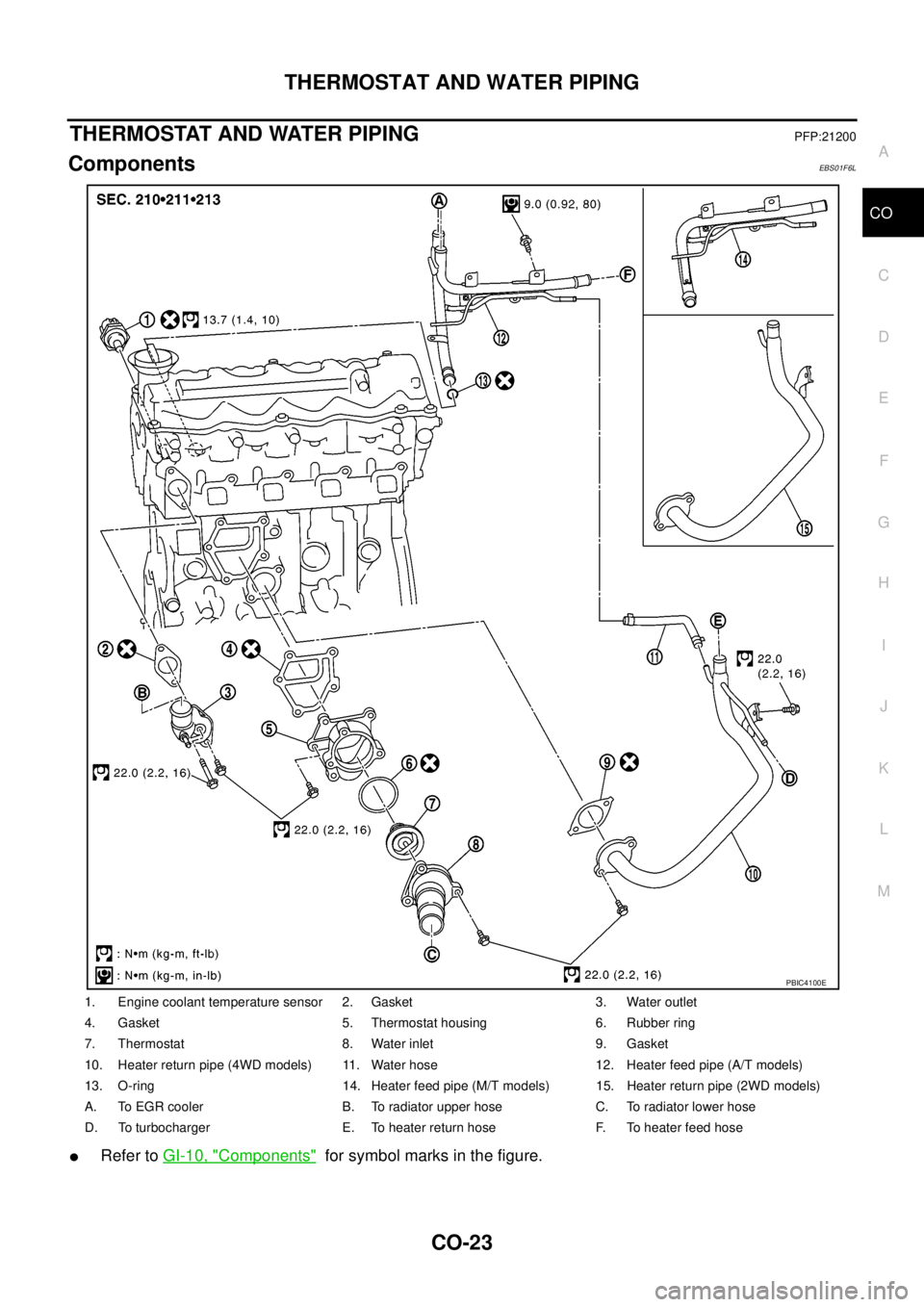
THERMOSTAT AND WATER PIPINGPFP:21200
ComponentsEBS01F6L
lRefer toGI-10, "Components"for symbol marks in the figure.
1. Engine coolant temperature sensor 2. Gasket 3. Water outlet
4. Gasket 5. Thermostat housing 6. Rubber ring
7. Thermostat 8. Water inlet 9. Gasket
10. Heater return pipe (4WD models) 11. Water hose 12. Heater feed pipe (A/T models)
13. O-ring 14. Heater feed pipe (M/T models) 15. Heater return pipe (2WD models)
A. To EGR cooler B. To radiator upper hose C. To radiator lower hose
D. To turbocharger E. To heater return hose F. To heater feed hose
PBIC4100E
Page 911 of 3171

DI-1
DRIVER INFORMATION SYSTEM
K ELECTRICAL
CONTENTS
C
D
E
F
G
H
I
J
L
M
SECTIONDI
A
B
DI
DRIVER INFORMATION SYSTEM
PRECAUTION ............................................................ 3
Precautions for Supplemental Restraint System
(SRS)“AIRBAG”and“SEATBELTPRE-TEN-
SIONER” .................................................................. 3
Wiring Diagrams and Trouble Diagnosis .................. 3
COMBINATION METERS ........................................... 4
System Description .................................................. 4
UNIFIED METER CONTROL UNIT ...................... 4
POWER SUPPLY AND GROUND CIRCUIT ........ 4
SPEEDOMETER ................................................... 4
TACHOMETER ..................................................... 4
WATER TEMPERATURE GAUGE ........................ 4
FUEL GAUGE ....................................................... 5
ODO/TRIP METER ............................................... 5
TRIP COMPUTER ................................................ 5
ENGINE OIL MAINTENANCE INFORMATION..... 6
METER ILLUMINATION CONTROL ..................... 6
CLOCK .................................................................. 6
AMBIENT AIR TEMPERATURE INDICATION ...... 6
Component Parts and Harness Connector Location..... 7
Arrangement of Combination Meter ......................... 8
Internal Circuit .......................................................... 9
Wiring Diagram — METER — ................................ 10
Terminals and Reference Value for Combination
Meter ...................................................................... 12
Self-Diagnosis Mode of Combination Meter ........... 13
FUNCTION .......................................................... 13
OPERATION PROCEDURE ............................... 13
TEST ITEM ......................................................... 13
CONSULT-II Function (METER) ............................. 15
CONSULT-II BASIC OPERATION ....................... 15
SELF-DIAG RESULTS ........................................ 16
DATA MONITOR ................................................. 17
Trouble Diagnosis .................................................. 18
HOW TO PERFORM TROUBLE DIAGNOSIS ... 18
PRELIMINARY CHECK ...................................... 19
Symptom Chart ...................................................... 19
Power Supply and Ground Circuit Inspection ........ 19
Vehicle Speed Signal Inspection ............................ 20
Engine Speed Signal Inspection ............................ 21Engine Coolant Temperature Signal Inspection ..... 21
Fuel Level Sensor Signal Inspection ...................... 22
Ambient Sensor Signal Inspection .......................... 24
Fuel Gauge Fluctuates, Indicates Wrong Value, or
Varies ...................................................................... 25
Fuel Gauge Does Not Move to Full position ........... 25
DTC [U1000] CAN Communication Circuit ............. 26
DTC [B2205] Vehicle Speed Circuit ........................ 26
Electrical Components Inspection .......................... 27
FUEL LEVEL SENSOR UNIT CHECK ................ 27
AMBIENT SENSOR CHECK ............................... 27
Removal and Installation of Combination Meter ..... 27
WARNING LAMPS .................................................... 28
System Description ................................................. 28
OIL PRESSURE WARNING LAMP ..................... 28
Component Parts and Harness Connector Location... 28
Schematic ............................................................... 29
Wiring Diagram — WARN — .................................. 30
A/T MODELS ....................................................... 30
M/T MODELS ...................................................... 37
Oil Pressure Warning Lamp Stays Off (Ignition
Switch ON) ............................................................. 44
Oil Pressure Warning Lamp Does Not Turn Off (Oil
Pressure Is Normal) ................................................ 45
Oil Pressure Warning Lamp Keeps Blinking (Oil
Level Is Normal) ..................................................... 46
Component Inspection ............................................ 47
OIL PRESSURE SWITCH ................................... 47
OIL LEVEL SENSOR .......................................... 47
A/T INDICATOR ........................................................ 48
System Description ................................................. 48
Wiring Diagram — AT/IND — ................................. 49
A/T Indicator Does Not Illuminate ........................... 50
WARNING CHIME ..................................................... 51
System Description ................................................. 51
POWER SUPPLY AND GROUND CIRCUIT ....... 51
LIGHT WARNING CHIME ................................... 51
KEY REMINDER WARNING CHIME .................. 51
LOW-FUEL WARNING CHIME ........................... 51
SEAT BELT WARNING CHIME ........................... 52
Page 914 of 3171

DI-4
COMBINATION METERS
COMBINATION METERS
PFP:24814
System DescriptionEKS00L8E
UNIFIED METER CONTROL UNIT
lSpeedometer, odo/trip meter, tachometer, fuel gauge and water temperature gauge are controlled by the
unified meter control unit, which is built into the combination meter.
lWarning lamp and indicator lamp are controlled by signals drawn from each unit with CAN communication
and components connected directly to the combination meter.
lOdo/trip meter display is included in the combination meter, which displays odometer, trip-meter, vehicle
information (trip computer, engine oil maintenance information)
*and A/T position*.
*: Vehicles with each system only.
lClock display is included in the combination meter, which displays current time, ambient air temperature*
and 4WD indicator*.
*: Vehicles with each system only.
lUnified meter control unit corresponds a CONSULT-II function (self-diagnosis results and data monitor).
lThe following items can be checked during self-diagnosis mode.
–Sweep of gauges pointer
–Present gauge values
–Odo/trip meter display and clock display segments
–Condition of warning lamps/indicator lamps controlled by unified meter control unit
–Battery voltage
–Driver's seat belt buckle switch status
–CPU status of unified meter control unit
POWER SUPPLY AND GROUND CIRCUIT
Power is supplied at all times
lthrough 10A fuse [No.19, located in the fuse block (J/B)]
lto combination meter terminal 3.
With the ignition switch in the ON or START position, power is supplied
lthrough 10A fuse [No.14, located in the fuse block (J/B)]
lto combination meter terminal 16.
Ground is supplied
lto combination meter terminals 13 and 23
lthrough grounds M21, M80 and M83.
SPEEDOMETER
The speedometer indicates the vehicle speed.
lABS actuator and electric unit (control unit) converses a pulse signal from wheel sensor to vehicle speed
signal, and transmits vehicle speed signal to combination meter with CAN communication.
lCombination meter converses the vehicle speed signal to angle signal, and commands to speedometer.
TACHOMETER
The tachometer indicates engine speed in revolutions per minute (rpm).
lECM converses a signal from crank position sensor to engine speed signal, and transmits to combination
meter with CAN communication.
lCombination meter converses the engine speed signal to angle signal, and commands to tachometer.
WATER TEMPERATURE GAUGE
The water temperature gauge indicates the engine coolant temperature.
lECM converses a signal from water temperature sensor to engine coolant temperature signal, and trans-
mits to combination meter with CAN communication.
lCombination meter converses the engine coolant temperature signal to angle signal, and commands to
water temperature gauge.
Page 915 of 3171
COMBINATION METERS
DI-5
C
D
E
F
G
H
I
J
L
MA
B
DI
FUEL GAUGE
The fuel gauge indicates the approximate fuel level in the fuel tank.
Combination meter reads a resistor signal from fuel level sensor unit.
Signal is supplied
lto combination meter terminal 9
lthrough fuel level sensor unit terminal 1 and 2
lfrom combination meter terminal 4.
ODO/TRIP METER
lABS actuator and electric unit (control unit) converses a pulse signal from wheel sensor to vehicle speed
signal, and transmits vehicle speed signal to combination meter with CAN communication.
lCombination meter uses the vehicle speed signal to calculate the mileage, and it displays.
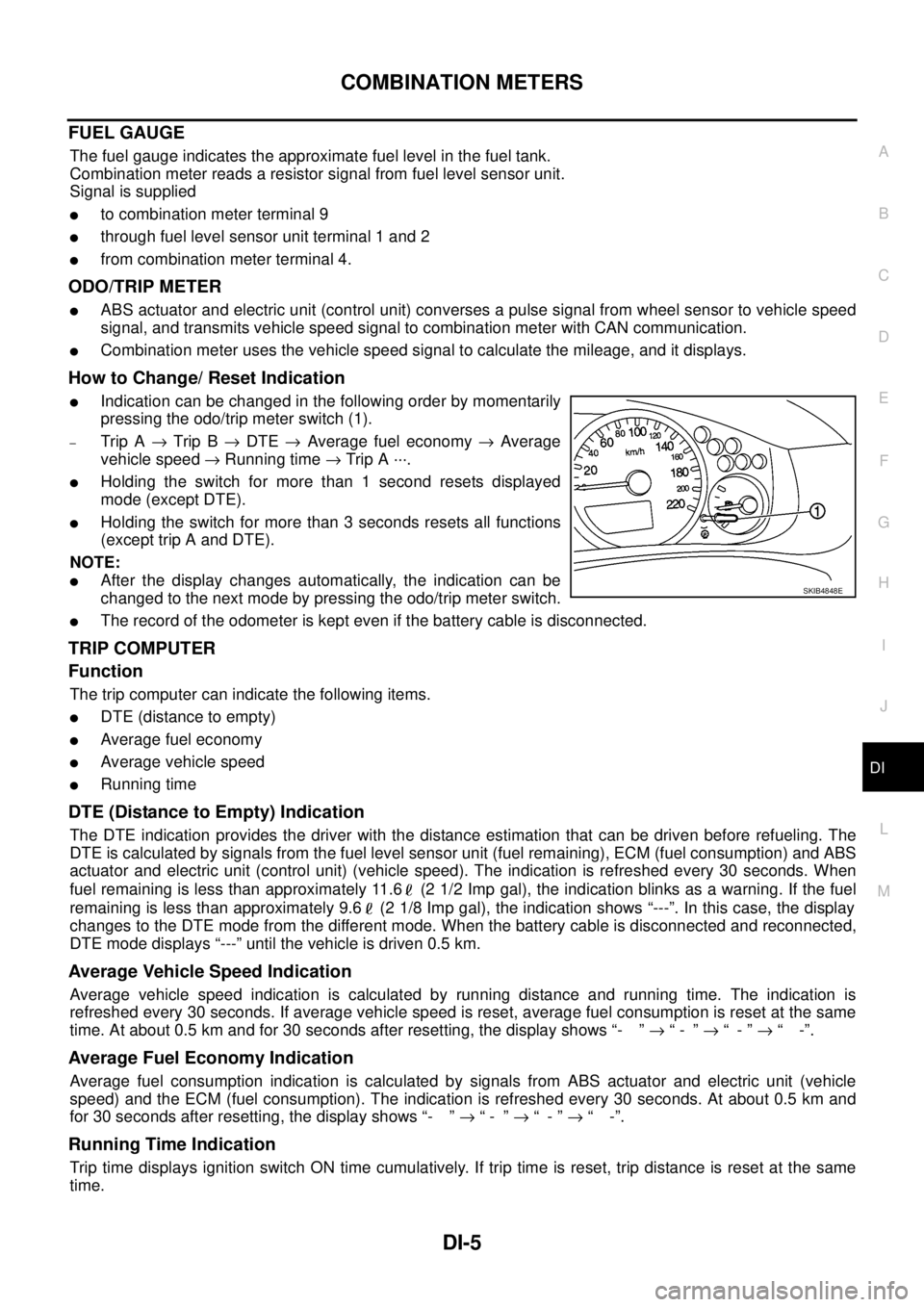
How to Change/ Reset Indication
lIndication can be changed in the following order by momentarily
pressing the odo/trip meter switch (1).
–Trip A®Trip B®DTE®Average fuel economy®Average
vehicle speed®Running time®Trip A ···.
lHolding the switch for more than 1 second resets displayed
mode (except DTE).
lHolding the switch for more than 3 seconds resets all functions
(except trip A and DTE).
NOTE:
lAfter the display changes automatically, the indication can be
changed to the next mode by pressing the odo/trip meter switch.
lThe record of the odometer is kept even if the battery cable is disconnected.
TRIP COMPUTER
Function
The trip computer can indicate the following items.
lDTE (distance to empty)
lAverage fuel economy
lAverage vehicle speed
lRunning time
DTE (Distance to Empty) Indication
The DTE indication provides the driver with the distance estimation that can be driven before refueling. The
DTE is calculated by signals from the fuel level sensor unit (fuel remaining), ECM (fuel consumption) and ABS
actuator and electric unit (control unit) (vehicle speed). The indication is refreshed every 30 seconds. When
fuel remaining is less than approximately 11.6 (2 1/2 Imp gal), the indication blinks as a warning. If the fuel
remaining is less than approximately 9.6 (2 1/8 Imp gal), the indication shows “---”. In this case, the display
changes to the DTE mode from the different mode. When the battery cable is disconnected and reconnected,
DTE mode displays “---” until the vehicle is driven 0.5 km.
Average Vehicle Speed Indication
Average vehicle speed indication is calculated by running distance and running time. The indication is
refreshed every 30 seconds. If average vehicle speed is reset, average fuel consumption is reset at the same
time. At about 0.5 km and for 30 seconds after resetting, the display shows “- ”®“- ”®“-”®“ -”.
Average Fuel Economy Indication
Average fuel consumption indication is calculated by signals from ABS actuator and electric unit (vehicle
speed) and the ECM (fuel consumption). The indication is refreshed every 30 seconds. At about 0.5 km and
for 30 seconds after resetting, the display shows “- ”®“- ”®“-”®“ -”.
Running Time Indication
Trip time displays ignition switch ON time cumulatively. If trip time is reset, trip distance is reset at the same
time.
SKIB4848E