checking oil NISSAN NAVARA 2005 Repair Manual PDF
[x] Cancel search | Manufacturer: NISSAN, Model Year: 2005, Model line: NAVARA, Model: NISSAN NAVARA 2005Pages: 3171, PDF Size: 49.59 MB
Page 2635 of 3171
PS-8
STEERING WHEEL
STEERING WHEEL
PFP:48430
On-Vehicle Inspection and ServiceEGS001LG
CHECKING CONDITION OF INSTALLATION
lCheck installation conditions of steering gear assembly, front suspension assembly, axle and steering col-
umn assembly.
lCheck if movement exists when steering wheel is moved up and down, to the left and right and to the axial
direction.
lCheck steering gear assembly mounting bolts and nuts for looseness. Refer toPS-14, "COMPONENT".
CHECKING STEERING WHEEL PLAY
lTurn steering wheel so that front wheels come to the straight-ahead position. Start engine and lightly turn
steering wheel to the left and right until front wheels start to move. Measure steering wheel movement on
the outer circumference.
lWhen the measurement value is outside the standard value, check backlash for each joint of steering col-
umn assembly and installation condition of steering gear assembly.
CHECKING NEUTRAL POSITION STEERING WHEEL
lMake sure that steering gear assembly, steering column assembly and steering wheel are installed in the
correct position.
lPerform neutral position inspection after wheel alignment. Refer toFSU-7, "Front Wheel Alignment".
lSet vehicle to the straight-ahead position and confirm steering wheel is in the neutral position.
lLoosen outer socket lock nut and turn inner socket to left and right equally to make fine adjustment if
steering wheel is not in the neutral position.
CHECKING STEERING WHEEL TURNING FORCE
1. Park vehicle on a level and dry surface, set parking brake.
2. Start engine.
3. Bring power steering fluid up to adequate operating temperature. [Make sure temperature of fluid is
approximately 50 to 80°C(122to176°F).]
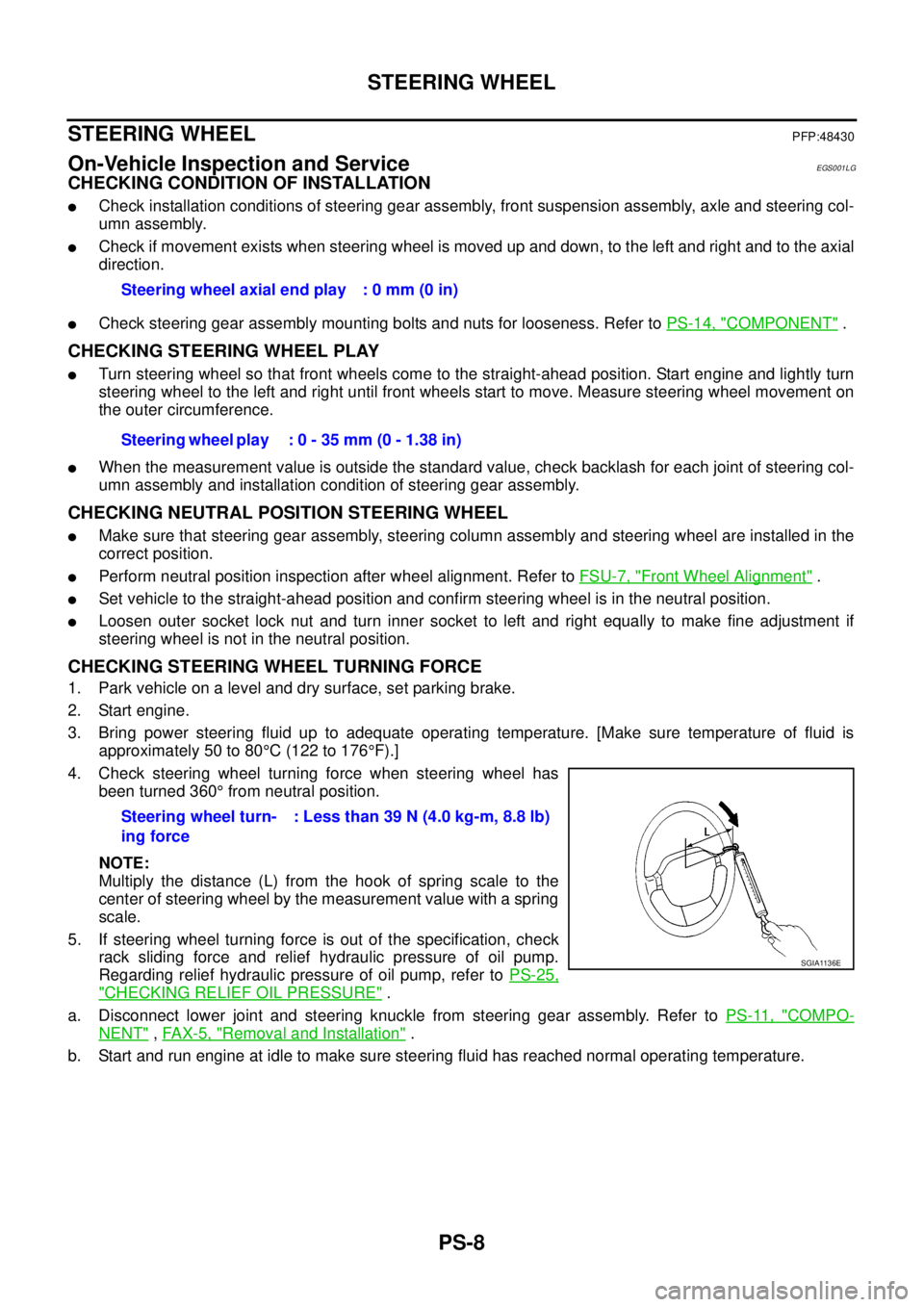
4. Check steering wheel turning force when steering wheel has
been turned 360°from neutral position.
NOTE:
Multiply the distance (L) from the hook of spring scale to the
center of steering wheel by the measurement value with a spring
scale.
5. If steering wheel turning force is out of the specification, check
rack sliding force and relief hydraulic pressure of oil pump.
Regarding relief hydraulic pressure of oil pump, refer toPS-25,
"CHECKING RELIEF OIL PRESSURE".
a. Disconnect lower joint and steering knuckle from steering gear assembly. Refer toPS-11, "
COMPO-
NENT",FAX-5, "Removal and Installation".
b. Start and run engine at idle to make sure steering fluid has reached normal operating temperature.Steering wheel axial end play : 0 mm (0 in)
Steering wheel play : 0 - 35 mm (0 - 1.38 in)
Steering wheel turn-
ing force: Less than 39 N (4.0 kg-m, 8.8 lb)
SGIA1136E
Page 2652 of 3171
POWER STEERING OIL PUMP
PS-25
C
D
E
F
H
I
J
K
L
MA
B
PS
POWER STEERING OIL PUMPPFP:49110
On-Vehicle Inspection and ServiceEGS001LL
CHECKING RELIEF OIL PRESSURE
CAUTION:
Make sure that belt tension is normal before starting the following procedure.
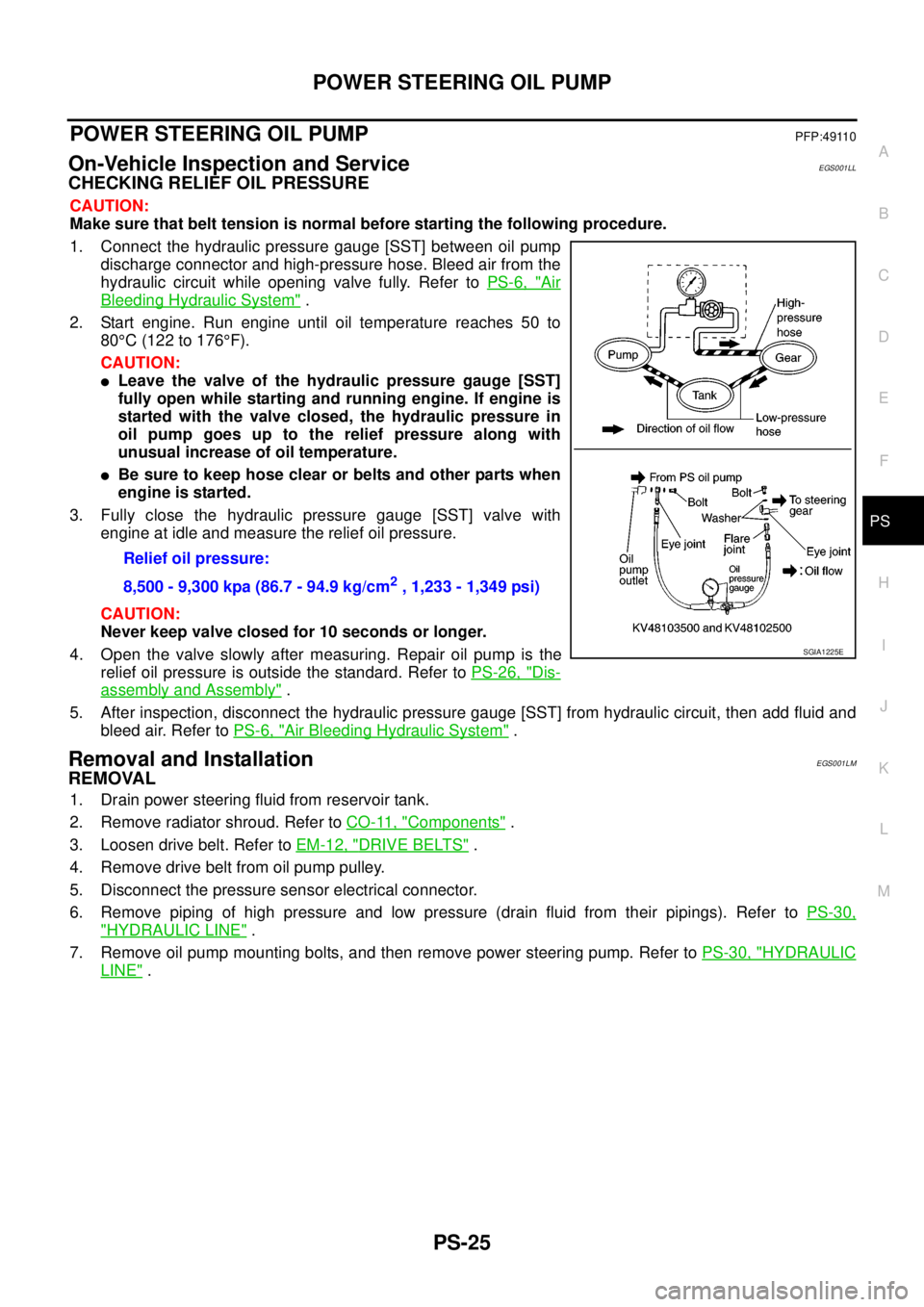
1. Connect the hydraulic pressure gauge [SST] between oil pump
discharge connector and high-pressure hose. Bleed air from the
hydraulic circuit while opening valve fully. Refer toPS-6, "
Air
Bleeding Hydraulic System".
2. Start engine. Run engine until oil temperature reaches 50 to
80°C(122to176°F).
CAUTION:
lLeave the valve of the hydraulic pressure gauge [SST]
fully open while starting and running engine. If engine is
started with the valve closed, the hydraulic pressure in
oil pump goes up to the relief pressure along with
unusual increase of oil temperature.
lBe sure to keep hose clear or belts and other parts when
engineisstarted.
3. Fully close the hydraulic pressure gauge [SST] valve with
engine at idle and measure the relief oil pressure.
CAUTION:
Never keep valve closed for 10 seconds or longer.
4. Open the valve slowly after measuring. Repair oil pump is the
relief oil pressure is outside the standard. Refer toPS-26, "
Dis-
assembly and Assembly".
5. After inspection, disconnect the hydraulic pressure gauge [SST] from hydraulic circuit, then add fluid and
bleed air. Refer toPS-6, "
Air Bleeding Hydraulic System".
Removal and InstallationEGS001LM
REMOVAL
1. Drain power steering fluid from reservoir tank.
2. Remove radiator shroud. Refer toCO-11, "
Components".
3. Loosen drive belt. Refer toEM-12, "
DRIVE BELTS".
4. Remove drive belt from oil pump pulley.
5. Disconnect the pressure sensor electrical connector.
6. Remove piping of high pressure and low pressure (drain fluid from their pipings). Refer toPS-30,
"HYDRAULIC LINE".
7. Remove oil pump mounting bolts, and then remove power steering pump. Refer toPS-30, "
HYDRAULIC
LINE". Relief oil pressure:
8,500 - 9,300 kpa (86.7 - 94.9 kg/cm
2, 1,233 - 1,349 psi)
SGIA1225E
Page 2704 of 3171
RFD-1
REAR FINAL DRIVE
D DRIVELINE/AXLE
CONTENTS
C
E
F
G
H
I
J
K
L
M
SECTIONRFD
A
B
RFD
REAR FINAL DRIVE
WITH LIMITED SLIP DIFFERENTIAL
PRECAUTIONS .......................................................... 3
Limited Slip Differential (LSD) Performance Judge-
ment ......................................................................... 3
METHOD FOR TROUBLESHOOTING ................. 3
Service Notice or Precautions .................................. 3
PREPARATION ........................................................... 4
Special Service Tools ............................................... 4
Commercial Service Tools ........................................ 5
NOISE, VIBRATION, AND HARSHNESS (NVH)
TROUBLESHOOTING ................................................ 7
NVH Troubleshooting Chart ..................................... 7
DESCRIPTION ............................................................ 8
Cross-Sectional View ............................................... 8
DIFFERENTIAL GEAR OIL ........................................ 9
Changing Differential Gear Oil ................................. 9
DRAINING ............................................................. 9
FILLING ................................................................. 9
Checking Differential Gear Oil .................................. 9
OIL LEAKAGE AND OIL LEVEL ........................... 9
FRONT OIL SEAL .................................................... 10
Removal and Installation ........................................ 10
REMOVAL ........................................................... 10
INSTALLATION .................................................... 11
CARRIER COVER .................................................... 13
Removal and Installation ........................................ 13
REMOVAL ........................................................... 13
INSTALLATION ................................................... 13
REAR FINAL DRIVE ASSEMBLY ............................ 14
Removal and Installation ........................................ 14
REMOVAL ........................................................... 14
INSTALLATION ................................................... 14
Disassembly and Assembly ................................... 15
COMPONENTS .................................................. 15
ASSEMBLY INSPECTION AND ADJUSTMENT... 16
DISASSEMBLY ................................................... 19
INSPECTION AFTER DISASSEMBLY ............... 22
SELECTION ADJUSTING WASHERS ............... 23
ASSEMBLY ......................................................... 24SERVICE DATA AND SPECIFICATIONS (SDS) ...... 31
General Specifications ............................................ 31
Inspection and Adjustment ..................................... 31
PRELOAD TORQUE ........................................... 31
BACKLASH ......................................................... 31
COMPANION FLANGE RUNOUT ....................... 31
SELECTIVE PARTS ............................................ 32
WITH ELECTRONIC LOCKING DIFFEREN-
TIAL
PRECAUTIONS ........................................................ 33
Precautions for Supplemental Restraint System
(SRS)“AIRBAG”and“SEATBELTPRE-TEN-
SIONER” ................................................................. 33
Precautions for Differential Case Assembly and Dif-
ferential Lock Control Unit Replacement ................ 33
CHECK DIFF LOCK INDICATOR LAMP ............. 33
METHOD FOR ADJUSTMENT ........................... 34
Precautions ............................................................. 34
Service Notice or Precaution .................................. 35
Wiring Diagrams and Trouble Diagnosis ................ 35
PREPARATION ......................................................... 36
Special Service Tools ............................................. 36
Commercial Service Tools ...................................... 37
NOISE, VIBRATION AND HARSHNESS (NVH)
TROUBLESHOOTING .............................................. 39
NVH Troubleshooting Chart ................................... 39
DIFFERENTIAL GEAR OIL ...................................... 40
Changing Differential Gear Oil ................................ 40
DRAINING ........................................................... 40
FILLING ............................................................... 40
Checking Differential Gear Oil ................................ 40
OIL LEAKAGE AND OIL LEVEL ......................... 40
DIFFERENTIAL LOCK SYSTEM .............................. 41
Cross-sectional View .............................................. 41
Differential Lock Operation ..................................... 42
System Description ................................................. 42
DIFFERENTIAL LOCK SOLENOID .................... 42
DIFFERENTIAL LOCK POSITION SWITCH ....... 42
Page 2706 of 3171
![NISSAN NAVARA 2005 Repair Manual PDF PRECAUTIONS
RFD-3
[WITH LIMITED SLIP DIFFERENTIAL]
C
E
F
G
H
I
J
K
L
MA
B
RFD
[WITH LIMITED SLIP DIFFERENTIAL]PRECAUTIONSPFP:00001
Limited Slip Differential (LSD) Performance JudgementEDS003IG
lInspec](/img/5/57362/w960_57362-2705.png "NISSAN NAVARA 2005 Repair Manual PDF PRECAUTIONS
RFD-3
[WITH LIMITED SLIP DIFFERENTIAL]
C
E
F
G
H
I
J
K
L
MA
B
RFD
[WITH LIMITED SLIP DIFFERENTIAL]PRECAUTIONSPFP:00001
Limited Slip Differential (LSD) Performance JudgementEDS003IG
lInspec")
PRECAUTIONS
RFD-3
[WITH LIMITED SLIP DIFFERENTIAL]
C
E
F
G
H
I
J
K
L
MA
B
RFD
[WITH LIMITED SLIP DIFFERENTIAL]PRECAUTIONSPFP:00001
Limited Slip Differential (LSD) Performance JudgementEDS003IG
lInspection is required when detecting any noise or malfunction while driving or turning. Improper condition
of oil or differential case assembly is suspected. Refer toRFD-3, "
METHOD FOR TROUBLESHOOTING"
.
METHOD FOR TROUBLESHOOTING
1. Check differential gear oil level and differential gear oil leakage. Refer toRFD-9, "Checking Differential
Gear Oil".
2. Changing differential gear oil. Refer toRFD-9, "
Changing Differential Gear Oil".
3. Start engine. Drive for 10 min.
4. Again changing differential gear oil. Refer toRFD-9, "
Changing Differential Gear Oil".
5. Start engine. Drive for 10 min. Check if any noise or improper oil condition is detected.
lIf OK, check differential gear oil level and differential gear oil leakage. Refer toRFD-9, "Checking Differ-
ential Gear Oil".
lIf NG, replace differential case assembly after checking each part of final drive. Refer toRFD-15, "Dis-
assembly and Assembly".
Service Notice or PrecautionsEDS0038Z
lCheck for the correct installation status prior to removal or disassembly. If matching marks are required,
be certain they do not interfere with the function of the parts when applied.
lOverhaul should be done in a clean work area, it is preferable to work in dust proof area.
lBefore disassembly completely remove sand and mud from the exterior of the unit, preventing them from
entering into the unit during disassembly or assembly.
lCheck appearance of the disassembled parts for damage, deformation, and unusual wear. Replace them
with new ones if necessary.
lGaskets, seals and O-rings should be replaced any time the unit is disassembled.
lIn principle, tighten bolts or nuts gradually in several steps working diagonally from inside to outside. If
tightening sequence is specified, observe it.
lClean and flush the parts sufficiently and blow-dry them.
lBe careful not to damage sliding surfaces and mating surfaces.
lWhen applying sealant, remove the old sealant from the mounting surface; then remove any moisture, oil,
and foreign materials from the application and mounting surfaces.
lAlways use shop paper for cleaning the inside of components.
lAvoid using cotton gloves or shop rags to prevent entering of lint.
lDuring assembly, observe the specified tightening torque, and apply new differential gear oil, petroleum
jelly, or multi-purpose grease as specified.
Page 2710 of 3171
![NISSAN NAVARA 2005 Repair Manual PDF NOISE, VIBRATION, AND HARSHNESS (NVH) TROUBLESHOOTING
RFD-7
[WITH LIMITED SLIP DIFFERENTIAL]
C
E
F
G
H
I
J
K
L
MA
B
RFD
NOISE, VIBRATION, AND HARSHNESS (NVH) TROUBLESHOOTINGPFP:00003
NVH Troubleshooti](/img/5/57362/w960_57362-2709.png "NISSAN NAVARA 2005 Repair Manual PDF NOISE, VIBRATION, AND HARSHNESS (NVH) TROUBLESHOOTING
RFD-7
[WITH LIMITED SLIP DIFFERENTIAL]
C
E
F
G
H
I
J
K
L
MA
B
RFD
NOISE, VIBRATION, AND HARSHNESS (NVH) TROUBLESHOOTINGPFP:00003
NVH Troubleshooti")
NOISE, VIBRATION, AND HARSHNESS (NVH) TROUBLESHOOTING
RFD-7
[WITH LIMITED SLIP DIFFERENTIAL]
C
E
F
G
H
I
J
K
L
MA
B
RFD
NOISE, VIBRATION, AND HARSHNESS (NVH) TROUBLESHOOTINGPFP:00003
NVH Troubleshooting ChartEDS00392
Use the chart below to help you find the cause of the symptom. If necessary, repair or replace these parts.
´: ApplicableReference page
RFD-22, "
INSPECTION AFTER DISASSEMBLY
"
RFD-16, "
Tooth Contact
"
RFD-22, "
INSPECTION AFTER DISASSEMBLY
"
RFD-17, "
Backlash
"
RFD-18, "
Companion Flange Runout
"
RFD-9, "
Checking Differential Gear Oil
"
PR-2, "
NVH Troubleshooting Chart
"
RAX-5, "
NVH Troubleshooting Chart
",RSU-3, "
NVH Troubleshooting Chart
"
WT-2, "
NVH Troubleshooting Chart
"
RAX-5, "
NVH Troubleshooting Chart
"
BR-5, "
NVH Troubleshooting Chart
"
PS-5, "
NVH Troubleshooting Chart
"
Possible cause and SUSPECTED PARTS
Gear tooth rough
Gear contact improper
Tooth surfaces worn
Backlash incorrect
Companion flange excessive runout
Gear oil improper
PROPELLER SHAFT
AXLE AND SUSPENSION
TIRES
ROAD WHEEL
AXLE SHAFT
BRAKES
STEERING
Symptom Noise´´´´´´´´´´´´´
Page 2712 of 3171
![NISSAN NAVARA 2005 Repair Manual PDF DIFFERENTIAL GEAR OIL
RFD-9
[WITH LIMITED SLIP DIFFERENTIAL]
C
E
F
G
H
I
J
K
L
MA
B
RFD
DIFFERENTIAL GEAR OILPFP:KLD30
Changing Differential Gear OilEDS00394
DRAINING
1. Stop engine.
2. Remove drain p](/img/5/57362/w960_57362-2711.png "NISSAN NAVARA 2005 Repair Manual PDF DIFFERENTIAL GEAR OIL
RFD-9
[WITH LIMITED SLIP DIFFERENTIAL]
C
E
F
G
H
I
J
K
L
MA
B
RFD
DIFFERENTIAL GEAR OILPFP:KLD30
Changing Differential Gear OilEDS00394
DRAINING
1. Stop engine.
2. Remove drain p")
DIFFERENTIAL GEAR OIL
RFD-9
[WITH LIMITED SLIP DIFFERENTIAL]
C
E
F
G
H
I
J
K
L
MA
B
RFD
DIFFERENTIAL GEAR OILPFP:KLD30
Changing Differential Gear OilEDS00394
DRAINING
1. Stop engine.
2. Remove drain plug and drain gear oil.
3. Apply sealant to drain plug. Install drain plug to final drive
assembly and tighten to the specified torque. Refer toRFD-15,
"COMPONENTS".
FILLING
1. Remove filler plug. Fill with new gear oil until oil level reaches
the specified limit near filler plug hole.
2. After refilling oil, check oil level. Apply sealant to filler plug.
Install filler plug to final drive assembly and tighten to the speci-
fied torque. Refer toRFD-15, "
COMPONENTS".
Checking Differential Gear OilEDS00395
OIL LEAKAGE AND OIL LEVEL
1. Make sure that gear oil is not leaking from final drive assembly or around it.
2. Check oil level from filler plug hole as shown.
CAUTION:
Do not start engine while checking oil level.
3. Apply sealant to filler plug. Install filler plug to final drive assem-
bly and tighten to the specified torque. Refer toRFD-15, "
COM-
PONENTS".
PDIA1038E
OilgradeandViscosity:
Refer toMA-14, "
Fluids and Lubricants".
Oil capacity:
Approx. 2.01 (3-1/2pt)
PDIA1039E
PDIA1039E
Page 2715 of 3171
![NISSAN NAVARA 2005 Repair Manual PDF RFD-12
[WITH LIMITED SLIP DIFFERENTIAL]
FRONT OIL SEAL
4. Rotate the drive pinion using Tool. Rotating torque should be
equaltothereadingrecordedinstep4aboveduringremoval
plus an additional 0.56 N·m](/img/5/57362/w960_57362-2714.png "NISSAN NAVARA 2005 Repair Manual PDF RFD-12
[WITH LIMITED SLIP DIFFERENTIAL]
FRONT OIL SEAL
4. Rotate the drive pinion using Tool. Rotating torque should be
equaltothereadingrecordedinstep4aboveduringremoval
plus an additional 0.56 N·m")
RFD-12
[WITH LIMITED SLIP DIFFERENTIAL]
FRONT OIL SEAL
4. Rotate the drive pinion using Tool. Rotating torque should be
equaltothereadingrecordedinstep4aboveduringremoval
plus an additional 0.56 N·m (5 in-lb).
5. If the rotating torque is low, continue to tighten the drive pinion
lock nut in 6.8 N·m (5 ft-lb) increments without overtightening.
Refer toRFD-15, "
COMPONENTS". Tighten until proper rotat-
ing torque is achieved.
CAUTION:
lDo not loosen the drive pinion lock nut to decrease drive
pinion rear bearing rotating torque.
lDo not exceed specified rotating preload torque. If preload torque or rotating torque is exceeded
a new collapsible spacer must be installed.
lDo not exceed maximum tightening torque. If maximum tightening torque is reached prior to
reaching the required rotating torque, the collapsible spacer may have been damaged. Replace
the collapsible spacer.
6. Check the gear oil level. Refer toRFD-9, "
Checking Differential Gear Oil".
7. Install the remaining components in the reverse order of removal.Tool number : ST3127S000
PDIA0309E
Page 2716 of 3171
![NISSAN NAVARA 2005 Repair Manual PDF CARRIER COVER
RFD-13
[WITH LIMITED SLIP DIFFERENTIAL]
C
E
F
G
H
I
J
K
L
MA
B
RFD
CARRIER COVERPFP:38351
Removal and InstallationEDS00397
REMOVAL
1. Remove the drain plug and drain the gear oil. Refer](/img/5/57362/w960_57362-2715.png "NISSAN NAVARA 2005 Repair Manual PDF CARRIER COVER
RFD-13
[WITH LIMITED SLIP DIFFERENTIAL]
C
E
F
G
H
I
J
K
L
MA
B
RFD
CARRIER COVERPFP:38351
Removal and InstallationEDS00397
REMOVAL
1. Remove the drain plug and drain the gear oil. Refer")
CARRIER COVER
RFD-13
[WITH LIMITED SLIP DIFFERENTIAL]
C
E
F
G
H
I
J
K
L
MA
B
RFD
CARRIER COVERPFP:38351
Removal and InstallationEDS00397
REMOVAL
1. Remove the drain plug and drain the gear oil. Refer toRFD-9, "DRAINING".
2. Disconnect the rear cable (LH) from the carrier cover. Refer toPB-3, "
Components".
3. Remove bracket from the axle housing.
4. Remove the carrier cover bolts. Then separate carrier cover
from the axle housing using Tool.
CAUTION:
lBe careful not to damage the mating surface.
lDo not insert flat-bladed screwdriver, this will damage the
mating surface.
INSTALLATION
1. Apply sealant to mating surface of carrier cover. Refer toRFD-
15, "COMPONENTS".
CAUTION:
Remove old sealant adhering to mounting surfaces. Also
remove any moisture, oil, or foreign material adhering to
application and mounting surfaces.
2. Install carrier cover and bracket on axle housing. Then tighten
carrier cover bolts to the specified torque. Refer toRFD-15,
"COMPONENTS".
3. Connect the rear cable (LH) to the carrier cover and tighten to
the specified torque. Refer toPB-3, "
Components".
4. Fill with new gear oil until oil level reaches the specified limit
near filler plug hole. Refer toRFD-9, "
Checking Differential Gear
Oil".
PDIA1066E
Tool number : KV10111100
PDIA1041E
PDIA1042E
PDIA1066E
Page 2717 of 3171
![NISSAN NAVARA 2005 Repair Manual PDF RFD-14
[WITH LIMITED SLIP DIFFERENTIAL]
REAR FINAL DRIVE ASSEMBLY
REAR FINAL DRIVE ASSEMBLY
PFP:38300
Removal and InstallationEDS00398
REMOVAL
1. Remove the rear propeller shaft. Refer toPR-8, "Remova](/img/5/57362/w960_57362-2716.png "NISSAN NAVARA 2005 Repair Manual PDF RFD-14
[WITH LIMITED SLIP DIFFERENTIAL]
REAR FINAL DRIVE ASSEMBLY
REAR FINAL DRIVE ASSEMBLY
PFP:38300
Removal and InstallationEDS00398
REMOVAL
1. Remove the rear propeller shaft. Refer toPR-8, \"Remova")
RFD-14
[WITH LIMITED SLIP DIFFERENTIAL]
REAR FINAL DRIVE ASSEMBLY
REAR FINAL DRIVE ASSEMBLY
PFP:38300
Removal and InstallationEDS00398
REMOVAL
1. Remove the rear propeller shaft. Refer toPR-8, "Removal and Installation".
lPlug rear end of transmission or transfer.
2. Remove the axle shafts and back plate and torque members. Refer toRAX-7, "
Removal and Installation".
3. Disconnect the following components from the rear final drive.
lABS sensor wire harness
lRear cable (LH) and rear cable (RH)
lBrake hoses and brake tube
CAUTION:
Position the wire harness, cable and hoses away from the final drive assembly. Failure to do so
may result in components being damaged during rear axle assembly removal.
4. Support the rear final drive using a suitable jack.
5. Remove rear shock absorber lower bolts. Refer toRSU-6, "
Removal and Installation".
6. Remove leaf spring U-bolt nuts. Refer toRSU-7, "
Removal and Installation".
WARNING:
Support the rear final drive assembly using suitable jack before removing leaf spring U-bolt nuts.
7. Remove rear final drive assembly using suitable jack.
INSTALLATION
Installation is the reverse order of removal.
lWhen oil leaks while removing rear final drive assembly, check oil level after the installation. Refer to
RFD-9, "
Checking Differential Gear Oil".
lRefill brake fluid and bleed the air from the brake system. Refer toBR-11, "Bleeding Brake System".
Page 2719 of 3171
![NISSAN NAVARA 2005 Repair Manual PDF RFD-16
[WITH LIMITED SLIP DIFFERENTIAL]
REAR FINAL DRIVE ASSEMBLY
ASSEMBLY INSPECTION AND ADJUSTMENT
lBefore inspection and adjustment, drain gear oil.
Total Preload Torque
1. Rotate drive pinion back](/img/5/57362/w960_57362-2718.png "NISSAN NAVARA 2005 Repair Manual PDF RFD-16
[WITH LIMITED SLIP DIFFERENTIAL]
REAR FINAL DRIVE ASSEMBLY
ASSEMBLY INSPECTION AND ADJUSTMENT
lBefore inspection and adjustment, drain gear oil.
Total Preload Torque
1. Rotate drive pinion back")
RFD-16
[WITH LIMITED SLIP DIFFERENTIAL]
REAR FINAL DRIVE ASSEMBLY
ASSEMBLY INSPECTION AND ADJUSTMENT
lBefore inspection and adjustment, drain gear oil.
Total Preload Torque
1. Rotate drive pinion back and forth 2 to 3 times to check for unusual noise and rotation malfunction.
2. Rotate drive pinion at least 20 times to check for smooth operation of the bearing.
3. Turn drive pinion in both directions several times to set bearing
rollers.
4. Measure total preload with preload gauge.
NOTE:
Total preload torque = Pinion bearing preload torque + Side bearing preload torque
lIf measured value is out of the specification, disassemble it to check and adjust each part. Adjust pinion
bearing preload and side bearing preload.
Adjust pinion bearing preload first, then adjust side bearing preload.
Tooth Contact
Checking gear tooth contact pattern is necessary to verify correct relationship between drive gear and drive
pinion. Gears which are not positioned in proper arrangement may be noisy and/or have a short life. Check
gear tooth contact pattern to obtain the best contact for low noise and long life.
1. Remove carrier cover. Refer toRFD-13, "
Removal and Installation".
2. Thoroughly clean drive gear and drive pinion teeth.
3. Apply red lead to drive gear.
CAUTION:
Apply red lead to both the faces of 3 to 4 gears at 4 loca-
tions evenly spaced on drive gear.Tool number : ST3127S000
To ta l p r e l o a d
Gear ratio 3.357 Type:
2.38 - 4.46 N·m (0.25 - 0.45 kg-m, 21- 39 in-lb)
Gear ratio 3.538 Type:
2.34 - 4.34 N·m (0.24 - 0.44 kg-m, 21- 38 in-lb)
Gear ratio 3.692 Type:
2.32 - 4.34 N·m (0.24 - 0.44 kg-m, 21 - 38 in-lb)
When the preload torque is greater than specification
On pinion bearings: Replace collapsible spacer.
On side bearings: Loosen side bearing adjuster.
When the preload torque is less than specification
On pinion bearings: Tighten drive pinion lock nut.
On side bearings: Tighten side bearing adjuster.
PDIA0309E
PDIA0321E