din NISSAN NOTE 2007 Owners Manual
[x] Cancel search | Manufacturer: NISSAN, Model Year: 2007, Model line: NOTE, Model: NISSAN NOTE 2007Pages: 235, PDF Size: 2.29 MB
Page 2 of 235
Foreword
Welcome to the growing family of new NISSAN owners. This vehicle has been delivered to you with confidence. It has been produced using the latest techniques
and strict quality control.
This manual was prepared to help you understand the operation and maintenance of your vehicle so that you may enjoy many kilometres (miles) of driving pleasure.
Please read through this manual before operating your vehicle.
A separate Warranty Information & Maintenance Booklet explains in detail the warranty coverage that applies to your vehicle.
Your NISSAN dealer knows your vehicle best. When you require any service or have any questions, your NISSAN dealer will be glad to assist you with the extensive
resources available for you.
IMPORTANT SAFETY INFORMATION
REMINDERS FOR SAFETY!
Follow these important driving rules to help ensure a safe and complete trip for
you and your passengers!
•NEVER drive under the influence of alcohol or drugs.
•ALWAYS observe posted speed limits and never drive too fast for condi-
tions.
•ALWAYS use your seat belts and appropriate child restraint systems.
Preteen children should be seated in the rear seat.
•ALWAYS provide information about the proper use of vehicle safety fea-
tures to all occupants of the vehicle.
•ALWAYS review this Owner’s Manual for important safety information.
WHEN READING THE MANUAL
This manual includes information for all options available on this model. There-
fore, you may find some information that does not apply to your vehicle.
All information, specifications and illustrations in this manual are those in effect
at the time of printing. NISSAN reserves the right to change specifications or
designs at any time without notice and without obligation.
MODIFICATION OF YOUR VEHICLE
This vehicle should not be modified. Modifications could affect its performance,
safety or durability, and may even violate governmental regulations. In addition,
damage or performance problems resulting from modifications may not be cov-
ered under NISSAN warranties.
READ FIRST — THEN DRIVE SAFELY
Before driving your vehicle, read this Owner’s Manual carefully. This will ensure
familiarity with controls and maintenance requirements, assisting you in the safe
operation of your vehicle.
Throughout this manual the following symbols and words are used:
WARNING
Indicates the presence of a hazard that could cause death or serious per-
sonal injury. To avoid or reduce the risk, the procedures described must be
followed precisely.
CAUTION
Indicates the presence of a hazard that could cause minor or moderate per-
sonal injury, or damage to your vehicle. To avoid or reduce the risk, the pro-
cedures described must be followed carefully.
NOTE
Indicates additional helpful information.
Page 20 of 235
FRONT SEATS
Manual seat adjustment
WARNING
•Do not adjust the driver’s seat while driving.
The seat may move suddenly and could cause
loss of control of the vehicle.
•After adjustment, gently rock in the seat to
make sure it is securely locked.
•The seatback should not be reclined any more
than needed for comfort. Seat belts are most
effective when the passenger sits well back
and upright in the seat. If the seatback is re-
clined, the risk of sliding under the lap belt
and being injured is increased.
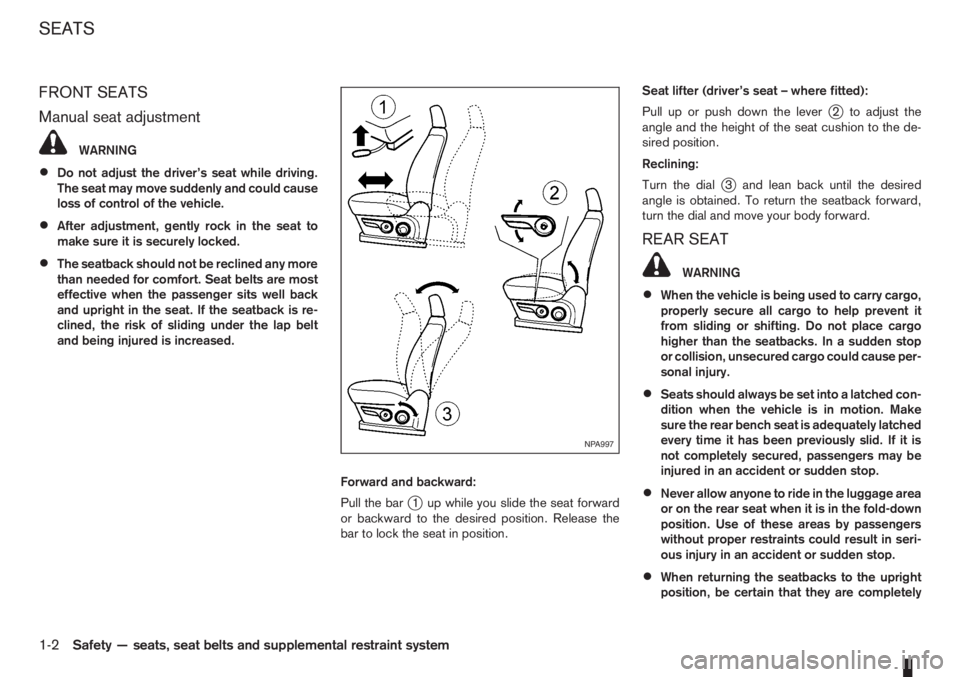
Forward and backward:
Pull the bar
j1 up while you slide the seat forward
or backward to the desired position. Release the
bar to lock the seat in position.Seat lifter (driver’s seat – where fitted):
Pull up or push down the lever
j2 to adjust the
angle and the height of the seat cushion to the de-
sired position.
Reclining:
Turn the dial
j3 and lean back until the desired
angle is obtained. To return the seatback forward,
turn the dial and move your body forward.
REAR SEAT
WARNING
•When the vehicle is being used to carry cargo,
properly secure all cargo to help prevent it
from sliding or shifting. Do not place cargo
higher than the seatbacks. In a sudden stop
or collision, unsecured cargo could cause per-
sonal injury.
•Seats should always be set into a latched con-
dition when the vehicle is in motion. Make
sure the rear bench seat is adequately latched
every time it has been previously slid. If it is
not completely secured, passengers may be
injured in an accident or sudden stop.
•Never allow anyone to ride in the luggage area
or on the rear seat when it is in the fold-down
position. Use of these areas by passengers
without proper restraints could result in seri-
ous injury in an accident or sudden stop.
•When returning the seatbacks to the upright
position, be certain that they are completely
NPA997
SEATS
1-2Safety — seats, seat belts and supplemental restraint system
Page 21 of 235
secured in the latched position. If they are not
completely secured, passengers may be in-
jured in an accident or sudden stop.
•Closely supervise children when they are
around the vehicle to prevent them from play-
ing and being locked in the luggage compart-
ment where they could be seriously injured.
Keep the vehicle locked with the rear seat-
back securely latched when not in use, and
prevent children from having access to the
vehicle’s keys.
•Head restraints should be adjusted properly
as they may provide significant protection
against whiplash injury. Always adjust them
properly when returning the seatbacks to the
upright position.
NOTE
The lowest head restraint position is a stowage
position to assist seat folding and rear vision.
The lowest position intended for use is with the
head restraint raised to its first notch position. It
should be further adjusted to suit the passenger
if necessary.
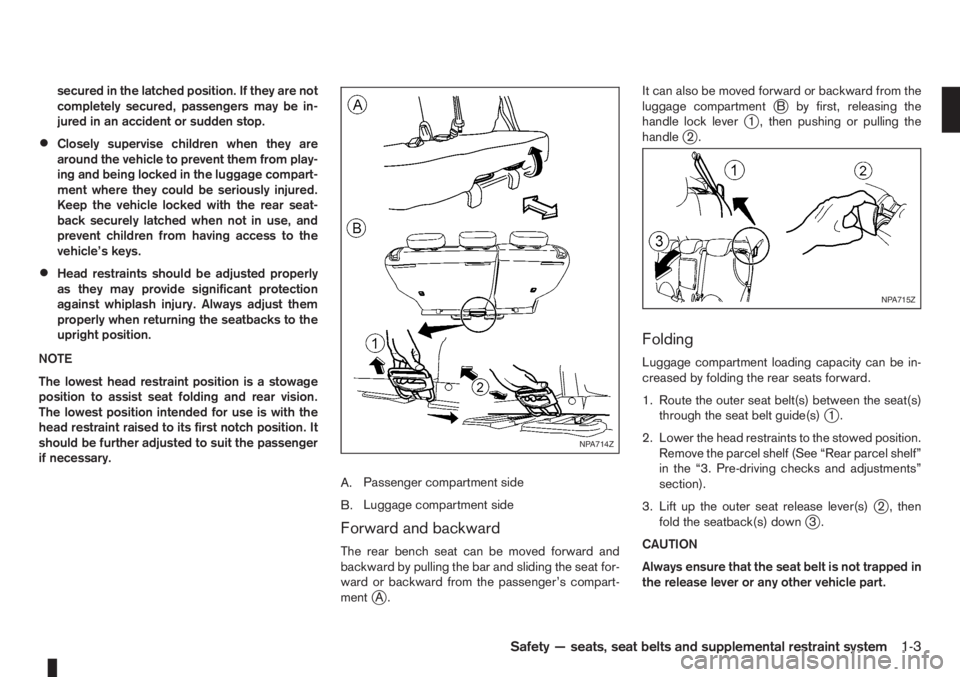
A.Passenger compartment side
B.Luggage compartment side
Forward and backward
The rear bench seat can be moved forward and
backward by pulling the bar and sliding the seat for-
ward or backward from the passenger’s compart-
ment
jA.It can also be moved forward or backward from the
luggage compartment
jB by first, releasing the
handle lock leverj1 , then pushing or pulling the
handlej2.
Folding
Luggage compartment loading capacity can be in-
creased by folding the rear seats forward.
1. Route the outer seat belt(s) between the seat(s)
through the seat belt guide(s)
j1.
2. Lower the head restraints to the stowed position.
Remove the parcel shelf (See “Rear parcel shelf”
in the “3. Pre-driving checks and adjustments”
section).
3. Lift up the outer seat release lever(s)
j2 , then
fold the seatback(s) downj3.
CAUTION
Always ensure that the seat belt is not trapped in
the release lever or any other vehicle part.
NPA714Z
NPA715Z
Safety — seats, seat belts and supplemental restraint system1-3
Page 22 of 235
Armrests (where fitted)
Driver and front passenger seat armrests:
WARNING
Do not adjust the driver’s seat armrest while driv-
ing so that full attention may be given to the ve-
hicle handling.
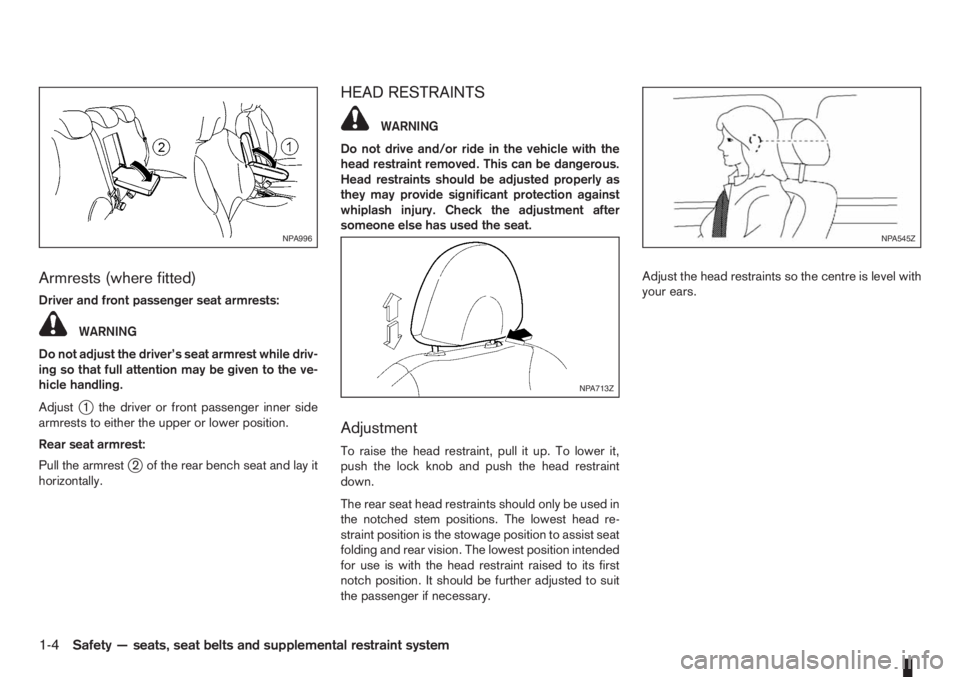
Adjust
j1 the driver or front passenger inner side
armrests to either the upper or lower position.
Rear seat armrest:
Pull the armrest
j2 of the rear bench seat and lay it
horizontally.
HEAD RESTRAINTS
WARNING
Do not drive and/or ride in the vehicle with the
head restraint removed. This can be dangerous.
Head restraints should be adjusted properly as
they may provide significant protection against
whiplash injury. Check the adjustment after
someone else has used the seat.
Adjustment
To raise the head restraint, pull it up. To lower it,
push the lock knob and push the head restraint
down.
The rear seat head restraints should only be used in
the notched stem positions. The lowest head re-
straint position is the stowage position to assist seat
folding and rear vision. The lowest position intended
for use is with the head restraint raised to its first
notch position. It should be further adjusted to suit
the passenger if necessary.Adjust the head restraints so the centre is level with
your ears.
NPA996
NPA713Z
NPA545Z
1-4Safety — seats, seat belts and supplemental restraint system
Page 24 of 235
NOTE
The front passenger seat belt warning will not
light up if the seat is unoccupied.
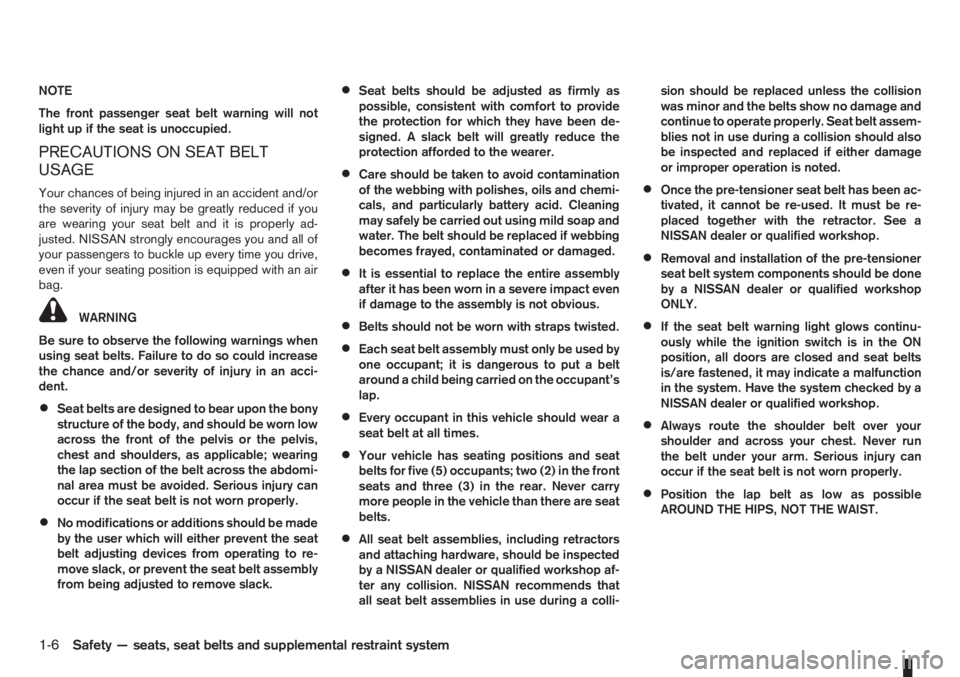
PRECAUTIONS ON SEAT BELT
USAGE
Your chances of being injured in an accident and/or
the severity of injury may be greatly reduced if you
are wearing your seat belt and it is properly ad-
justed. NISSAN strongly encourages you and all of
your passengers to buckle up every time you drive,
even if your seating position is equipped with an air
bag.
WARNING
Be sure to observe the following warnings when
using seat belts. Failure to do so could increase
the chance and/or severity of injury in an acci-
dent.
•Seat belts are designed to bear upon the bony
structure of the body, and should be worn low
across the front of the pelvis or the pelvis,
chest and shoulders, as applicable; wearing
the lap section of the belt across the abdomi-
nal area must be avoided. Serious injury can
occur if the seat belt is not worn properly.
•No modifications or additions should be made
by the user which will either prevent the seat
belt adjusting devices from operating to re-
move slack, or prevent the seat belt assembly
from being adjusted to remove slack.
•Seat belts should be adjusted as firmly as
possible, consistent with comfort to provide
the protection for which they have been de-
signed. A slack belt will greatly reduce the
protection afforded to the wearer.
•Care should be taken to avoid contamination
of the webbing with polishes, oils and chemi-
cals, and particularly battery acid. Cleaning
may safely be carried out using mild soap and
water. The belt should be replaced if webbing
becomes frayed, contaminated or damaged.
•It is essential to replace the entire assembly
after it has been worn in a severe impact even
if damage to the assembly is not obvious.
•Belts should not be worn with straps twisted.
•Each seat belt assembly must only be used by
one occupant; it is dangerous to put a belt
around a child being carried on the occupant’s
lap.
•Every occupant in this vehicle should wear a
seat belt at all times.
•Your vehicle has seating positions and seat
belts for five (5) occupants; two (2) in the front
seats and three (3) in the rear. Never carry
more people in the vehicle than there are seat
belts.
•All seat belt assemblies, including retractors
and attaching hardware, should be inspected
by a NISSAN dealer or qualified workshop af-
ter any collision. NISSAN recommends that
all seat belt assemblies in use during a colli-sion should be replaced unless the collision
was minor and the belts show no damage and
continue to operate properly. Seat belt assem-
blies not in use during a collision should also
be inspected and replaced if either damage
or improper operation is noted.
•Once the pre-tensioner seat belt has been ac-
tivated, it cannot be re-used. It must be re-
placed together with the retractor. See a
NISSAN dealer or qualified workshop.
•Removal and installation of the pre-tensioner
seat belt system components should be done
by a NISSAN dealer or qualified workshop
ONLY.
•If the seat belt warning light glows continu-
ously while the ignition switch is in the ON
position, all doors are closed and seat belts
is/are fastened, it may indicate a malfunction
in the system. Have the system checked by a
NISSAN dealer or qualified workshop.
•Always route the shoulder belt over your
shoulder and across your chest. Never run
the belt under your arm. Serious injury can
occur if the seat belt is not worn properly.
•Position the lap belt as low as possible
AROUND THE HIPS, NOT THE WAIST.
1-6Safety — seats, seat belts and supplemental restraint system
Page 25 of 235
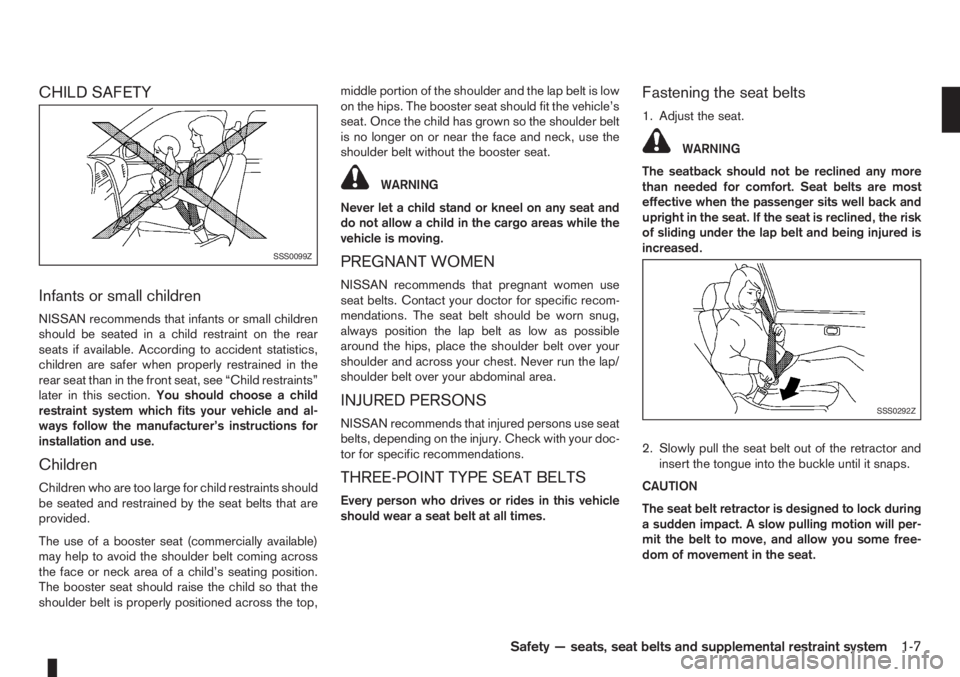
CHILD SAFETY
Infants or small children
NISSAN recommends that infants or small children
should be seated in a child restraint on the rear
seats if available. According to accident statistics,
children are safer when properly restrained in the
rear seat than in the front seat, see “Child restraints”
later in this section.You should choose a child
restraint system which fits your vehicle and al-
ways follow the manufacturer’s instructions for
installation and use.
Children
Children who are too large for child restraints should
be seated and restrained by the seat belts that are
provided.
The use of a booster seat (commercially available)
may help to avoid the shoulder belt coming across
the face or neck area of a child’s seating position.
The booster seat should raise the child so that the
shoulder belt is properly positioned across the top,middle portion of the shoulder and the lap belt is low
on the hips. The booster seat should fit the vehicle’s
seat. Once the child has grown so the shoulder belt
is no longer on or near the face and neck, use the
shoulder belt without the booster seat.
WARNING
Never let a child stand or kneel on any seat and
do not allow a child in the cargo areas while the
vehicle is moving.
PREGNANT WOMEN
NISSAN recommends that pregnant women use
seat belts. Contact your doctor for specific recom-
mendations. The seat belt should be worn snug,
always position the lap belt as low as possible
around the hips, place the shoulder belt over your
shoulder and across your chest. Never run the lap/
shoulder belt over your abdominal area.
INJURED PERSONS
NISSAN recommends that injured persons use seat
belts, depending on the injury. Check with your doc-
tor for specific recommendations.
THREE-POINT TYPE SEAT BELTS
Every person who drives or rides in this vehicle
should wear a seat belt at all times.
Fastening the seat belts
1. Adjust the seat.
WARNING
The seatback should not be reclined any more
than needed for comfort. Seat belts are most
effective when the passenger sits well back and
upright in the seat. If the seat is reclined, the risk
of sliding under the lap belt and being injured is
increased.
2. Slowly pull the seat belt out of the retractor and
insert the tongue into the buckle until it snaps.
CAUTION
The seat belt retractor is designed to lock during
a sudden impact. A slow pulling motion will per-
mit the belt to move, and allow you some free-
dom of movement in the seat.
SSS0099Z
SSS0292Z
Safety — seats, seat belts and supplemental restraint system1-7
Page 28 of 235
•The air bag warning light remains on after ap-
proximately 7 seconds.
•The air bag warning light flashes intermittently.
•The air bag warning light does not come on at
all.
Unless checked and repaired, the Supplemental Re-
straint System (SRS) and/or pre-tensioner seat belt
may not function properly. It must be checked and
repaired.
When selling your vehicle, we request that you in-
form the buyer about the pre-tensioner seat belt sys-
tem and guide the buyer to the appropriate sections
in this Owner’s Manual.This Supplemental Restraint System (SRS) section
contains important information concerning the driver
and front passenger air bags, side air bags, curtain
air bags and pre-tensioner seat belt system.
Front air bag system:this system can help cushion
the impact force to the face and chest of the driver
and front passenger in certain frontal collisions.
NOTE
It is possible to disable the front passenger air
bag. See “Front passenger air bag indicator light”
later in this section for further details.
Side air bag system:this system can help cushion
the impact force to the chest area of the driver and
front passenger in certain side impact collisions.
The side air bag is designed to inflate on the side
where the vehicle is impacted.
Curtain air bag system (where fitted):this system
can help cushion the impact force to the head of
occupants in the front and rear outer seating posi-
tion. Curtain air bags are designed to inflate on the
side where the vehicle is impacted.
SRS is designed tosupplementthe crash protec-
tion provided by the driver and front passenger seat
belts and isnot designed to substitutethem. Seat
belts should always be correctly worn and the driver
and front passenger seated a suitable distance away
from the steering wheel, instrument panel and front
door finishers. For additional information, see “Seat
belts” earlier in this section.
After turning the ignition switch to the ON or
START position, the air bag warning light illumi-nates. The air bag warning light will turn off after
approximately 7 seconds if the system is opera-
tional. See “Warning/indicator lights and audible
reminders” in the “2. Instruments and controls”
sectionfor further details.
The air bag will operate only when the ignition
switch is in the ON or START position.
WARNING
Driver and front passenger air bags.
•The air bags ordinarily will not inflate in the
event of a side impact, rear impact, roll over,
or lower severity frontal collision. Always wear
your seat belts to help reduce the risk or se-
verity of injury in various kinds of accidents.
•The seat belts and the air bags are most ef-
fective when you are sitting back and upright
in the seat. Air bags inflate with great force. If
you are unrestrained, leaning forward, sitting
sideways or out of position in any way, you
are at greater risk of injury or death in a crash
and may also receive serious or fatal injuries
from the air bag if you are up against it when
it inflates.
SUPPLEMENTAL RESTRAINT
SYSTEM (air bag system)
1-10Safety — seats, seat belts and supplemental restraint system
Page 29 of 235
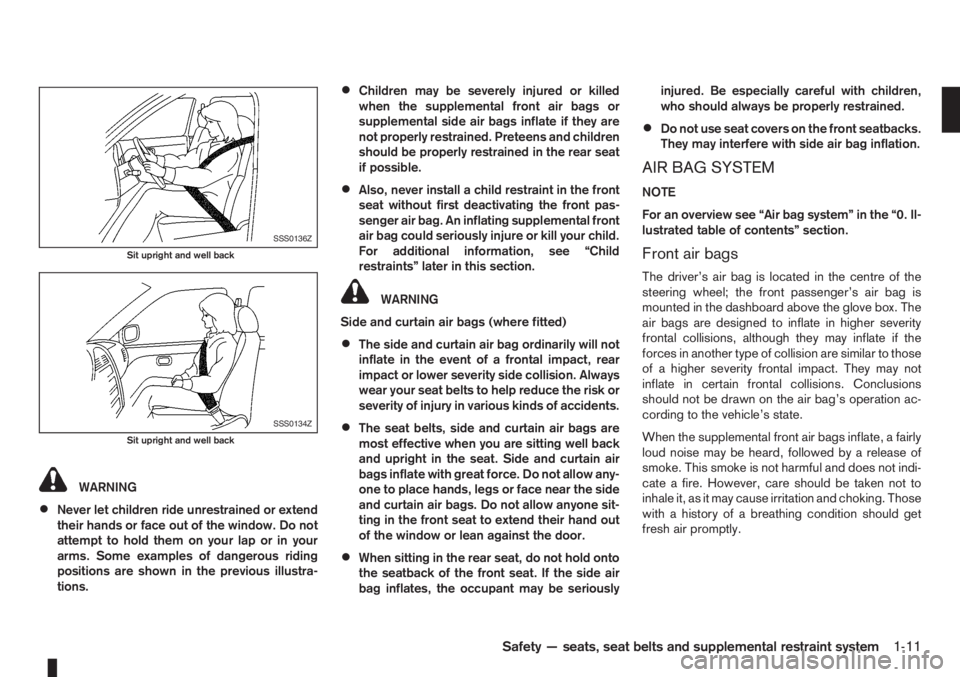
WARNING
•Never let children ride unrestrained or extend
their hands or face out of the window. Do not
attempt to hold them on your lap or in your
arms. Some examples of dangerous riding
positions are shown in the previous illustra-
tions.
•Children may be severely injured or killed
when the supplemental front air bags or
supplemental side air bags inflate if they are
not properly restrained. Preteens and children
should be properly restrained in the rear seat
if possible.
•Also, never install a child restraint in the front
seat without first deactivating the front pas-
senger air bag. An inflating supplemental front
air bag could seriously injure or kill your child.
For additional information, see “Child
restraints” later in this section.
WARNING
Side and curtain air bags (where fitted)
•The side and curtain air bag ordinarily will not
inflate in the event of a frontal impact, rear
impact or lower severity side collision. Always
wear your seat belts to help reduce the risk or
severity of injury in various kinds of accidents.
•The seat belts, side and curtain air bags are
most effective when you are sitting well back
and upright in the seat. Side and curtain air
bags inflate with great force. Do not allow any-
one to place hands, legs or face near the side
and curtain air bags. Do not allow anyone sit-
ting in the front seat to extend their hand out
of the window or lean against the door.
•When sitting in the rear seat, do not hold onto
the seatback of the front seat. If the side air
bag inflates, the occupant may be seriouslyinjured. Be especially careful with children,
who should always be properly restrained.
•Do not use seat covers on the front seatbacks.
They may interfere with side air bag inflation.
AIR BAG SYSTEM
NOTE
For an overview see “Air bag system” in the “0. Il-
lustrated table of contents” section.
Front air bags
The driver’s air bag is located in the centre of the
steering wheel; the front passenger’s air bag is
mounted in the dashboard above the glove box. The
air bags are designed to inflate in higher severity
frontal collisions, although they may inflate if the
forces in another type of collision are similar to those
of a higher severity frontal impact. They may not
inflate in certain frontal collisions. Conclusions
should not be drawn on the air bag’s operation ac-
cording to the vehicle’s state.
When the supplemental front air bags inflate, a fairly
loud noise may be heard, followed by a release of
smoke. This smoke is not harmful and does not indi-
cate a fire. However, care should be taken not to
inhale it, as it may cause irritation and choking. Those
with a history of a breathing condition should get
fresh air promptly.
SSS0136Z
Sit upright and well back
SSS0134Z
Sit upright and well back
Safety — seats, seat belts and supplemental restraint system1-11
Page 31 of 235
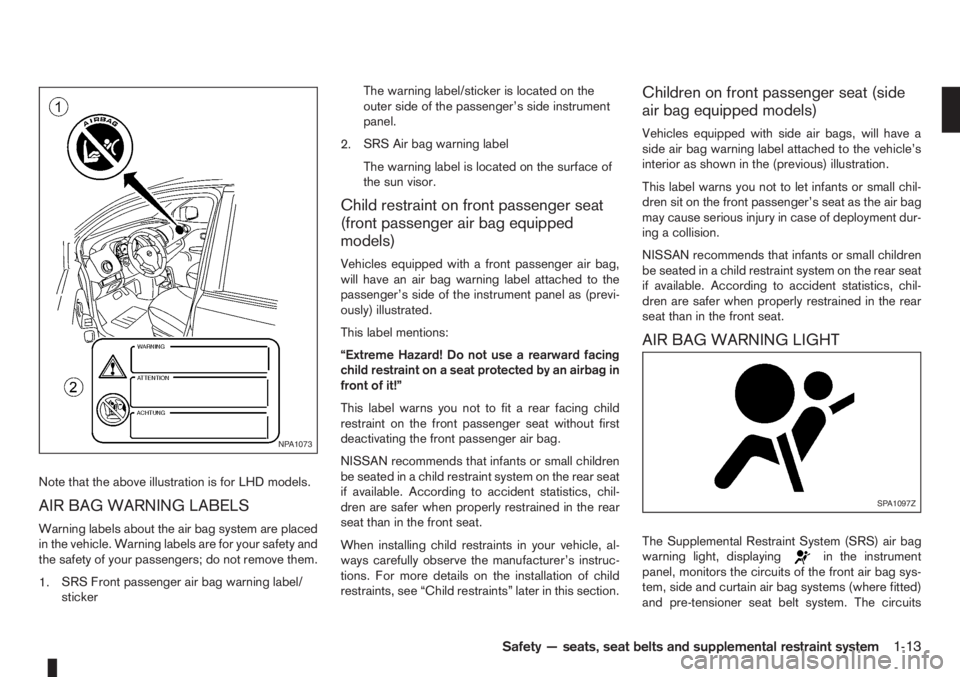
Note that the above illustration is for LHD models.
AIR BAG WARNING LABELS
Warning labels about the air bag system are placed
in the vehicle. Warning labels are for your safety and
the safety of your passengers; do not remove them.
1.SRS Front passenger air bag warning label/
stickerThe warning label/sticker is located on the
outer side of the passenger’s side instrument
panel.
2.SRS Air bag warning label
The warning label is located on the surface of
the sun visor.
Child restraint on front passenger seat
(front passenger air bag equipped
models)
Vehicles equipped with a front passenger air bag,
will have an air bag warning label attached to the
passenger’s side of the instrument panel as (previ-
ously) illustrated.
This label mentions:
“Extreme Hazard! Do not use a rearward facing
child restraint on a seat protected by an airbag in
front of it!”
This label warns you not to fit a rear facing child
restraint on the front passenger seat without first
deactivating the front passenger air bag.
NISSAN recommends that infants or small children
be seated in a child restraint system on the rear seat
if available. According to accident statistics, chil-
dren are safer when properly restrained in the rear
seat than in the front seat.
When installing child restraints in your vehicle, al-
ways carefully observe the manufacturer’s instruc-
tions. For more details on the installation of child
restraints, see “Child restraints” later in this section.
Children on front passenger seat (side
air bag equipped models)
Vehicles equipped with side air bags, will have a
side air bag warning label attached to the vehicle’s
interior as shown in the (previous) illustration.
This label warns you not to let infants or small chil-
dren sit on the front passenger’s seat as the air bag
may cause serious injury in case of deployment dur-
ing a collision.
NISSAN recommends that infants or small children
be seated in a child restraint system on the rear seat
if available. According to accident statistics, chil-
dren are safer when properly restrained in the rear
seat than in the front seat.
AIR BAG WARNING LIGHT
The Supplemental Restraint System (SRS) air bag
warning light, displayingin the instrument
panel, monitors the circuits of the front air bag sys-
tem, side and curtain air bag systems (where fitted)
and pre-tensioner seat belt system. The circuits
NPA1073
SPA1097Z
Safety — seats, seat belts and supplemental restraint system1-13
Page 34 of 235
3. Turn the ignition switch to the ON position and
make sure the front passenger air bag indicator
light
illuminates for a few seconds and then
turns off.
WARNING
If any of the following conditions occur after the
ignition switch has been turned to the ON posi-
tion, the front passenger air bag system needs
servicing and your vehicle must be taken to the
nearest NISSAN dealer or qualified workshop.
•The front passenger air bag indicator light
comes on and remains illuminated after ap-
proximately 7 seconds while the front pas-
senger air bag switch is ON.
•The front passenger air bag indicator light
does not come on at all while the front pas-
senger air bag switch is ON.
Unless checked and repaired, the front passenger
air bag system may not function properly.
PRECAUTIONS ON CHILD
RESTRAINT USAGE
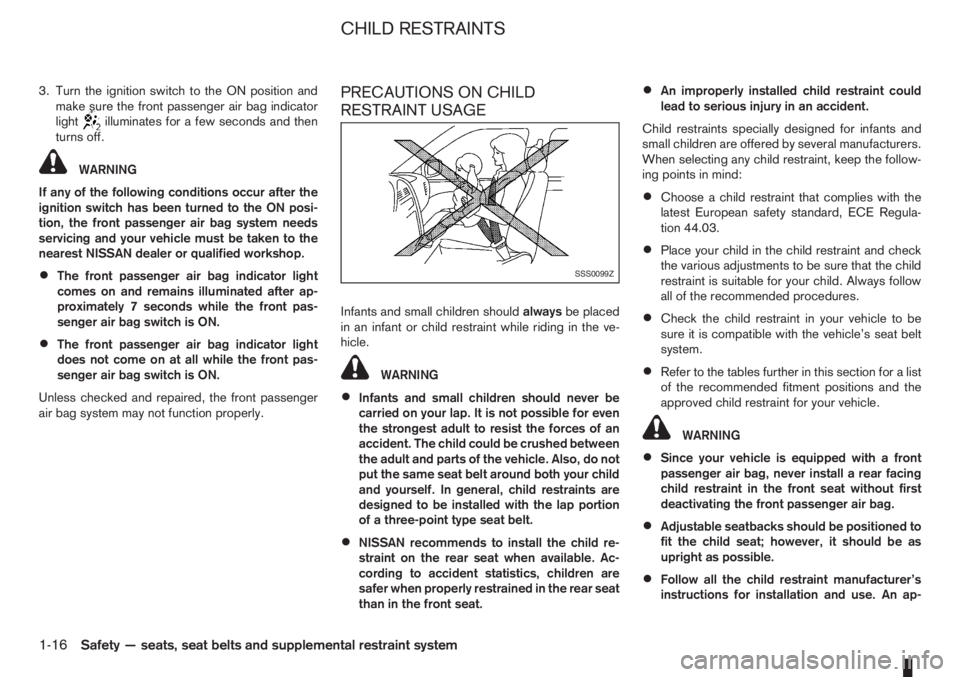
Infants and small children shouldalwaysbe placed
in an infant or child restraint while riding in the ve-
hicle.
WARNING
•Infants and small children should never be
carried on your lap. It is not possible for even
the strongest adult to resist the forces of an
accident. The child could be crushed between
the adult and parts of the vehicle. Also, do not
put the same seat belt around both your child
and yourself. In general, child restraints are
designed to be installed with the lap portion
of a three-point type seat belt.
•NISSAN recommends to install the child re-
straint on the rear seat when available. Ac-
cording to accident statistics, children are
safer when properly restrained in the rear seat
than in the front seat.
•An improperly installed child restraint could
lead to serious injury in an accident.
Child restraints specially designed for infants and
small children are offered by several manufacturers.
When selecting any child restraint, keep the follow-
ing points in mind:
•Choose a child restraint that complies with the
latest European safety standard, ECE Regula-
tion 44.03.
•Place your child in the child restraint and check
the various adjustments to be sure that the child
restraint is suitable for your child. Always follow
all of the recommended procedures.
•Check the child restraint in your vehicle to be
sure it is compatible with the vehicle’s seat belt
system.
•Refer to the tables further in this section for a list
of the recommended fitment positions and the
approved child restraint for your vehicle.
WARNING
•Since your vehicle is equipped with a front
passenger air bag, never install a rear facing
child restraint in the front seat without first
deactivating the front passenger air bag.
•Adjustable seatbacks should be positioned to
fit the child seat; however, it should be as
upright as possible.
•Follow all the child restraint manufacturer’s
instructions for installation and use. An ap-
SSS0099Z
CHILD RESTRAINTS
1-16Safety — seats, seat belts and supplemental restraint system