change wheel NISSAN NOTE 2016 Service User Guide
[x] Cancel search | Manufacturer: NISSAN, Model Year: 2016, Model line: NOTE, Model: NISSAN NOTE 2016Pages: 3641, PDF Size: 28.72 MB
Page 587 of 3641
![NISSAN NOTE 2016 Service User Guide NORMAL OPERATING CONDITIONBRC-139
< SYMPTOM DIAGNOSIS > [VDC/TCS/ABS]
C
D
E
G H
I
J
K L
M A
B
BRC
N
O P
NORMAL OPERATING CONDITION
DescriptionINFOID:0000000012430924
Symptom Result
Slight vibrations a](/img/5/57363/w960_57363-586.png "NISSAN NOTE 2016 Service User Guide NORMAL OPERATING CONDITIONBRC-139
< SYMPTOM DIAGNOSIS > [VDC/TCS/ABS]
C
D
E
G H
I
J
K L
M A
B
BRC
N
O P
NORMAL OPERATING CONDITION
DescriptionINFOID:0000000012430924
Symptom Result
Slight vibrations a")
NORMAL OPERATING CONDITIONBRC-139
< SYMPTOM DIAGNOSIS > [VDC/TCS/ABS]
C
D
E
G H
I
J
K L
M A
B
BRC
N
O P
NORMAL OPERATING CONDITION
DescriptionINFOID:0000000012430924
Symptom Result
Slight vibrations are felt on the brake pedal and operation noises occur when VDC, TCS or ABS is activated. This is a normal condi-
tion due to the VDC,
TCS or ABS activation.
Stopping distance is longer than that of vehicles without ABS when the vehicle drives on rough, gravel, or
snow-covered (fresh, deep snow) roads.
The brake pedal moves and generates noises when TCS or VDC is activated due to rapid acceleration or
sharp turn.
The brake pedal vibrates and motor operation noises occur from the engine room after the engine starts and
just after the vehicle starts.
This is normal, and it is
caused by the ABS op-
eration check.
Depending on the road conditions, the driver may experience a sluggish feel in the brake pedal. This is normal, because
TCS places the highest
priority on the optimum
traction (stability).
TCS may activate momentarily if wheel speed changes when driving where road friction coefficient varies,
when downshifting, or when fully depressing accelerator pedal.
The ABS warning lamp and SLIP
indicator lamp may turn ON when the vehicle is subject to strong shaking
or large vibration, such as when the vehicle is rotating on a turntable or located on a ship while the engine
is running. In this case, restart the
engine on a normal
road. If the normal con-
dition is restored, there
is no malfunction. At
that time, erase the self-
diagnostic result memo-
ry.
VDC may not operate normally or th
e ABS warning lamp, and SLIP indicato r lamp may illuminate when driv-
ing on a road that is extremely slanted (e.g., bank in a circuit course).
A malfunction may occur in the yaw rate/side/decel G sensor system when the vehicle turns sharply, such
as during a spin turn, axle turn, or drift driving, while the VDC function is OFF (VDC OFF indicator lamp illu-
minated).
The vehicle speed will not increase even though the accelerator pedal is depressed, when inspecting the
speedometer on a 2-wheel chassis dynamometer. Normal (Deactivate the
VDC/TCS function be-
fore performing an in-
spection on a chassis
dynamometer.)
SLIP indicator lamp may simultaneously turn ON when low tire pressure warning lamp turns ON. This is not a VDC sys-
tem error but results
from characteristic
change of tire.
Revision: August 2015
2016 Versa Note
cardiagn.com
Page 1174 of 3641
![NISSAN NOTE 2016 Service User Guide OPERATIONEC-47
< SYSTEM DESCRIPTION > [HR16DE]
C
D
E
F
G H
I
J
K L
M A
EC
NP
O
OPERATION
AUTOMATIC SPEED CONTROL DEVICE (ASCD)
AUTOMATIC SPEED CONTROL DEVICE (
ASCD) : Switch Name and Function
INFOID:](/img/5/57363/w960_57363-1173.png "NISSAN NOTE 2016 Service User Guide OPERATIONEC-47
< SYSTEM DESCRIPTION > [HR16DE]
C
D
E
F
G H
I
J
K L
M A
EC
NP
O
OPERATION
AUTOMATIC SPEED CONTROL DEVICE (ASCD)
AUTOMATIC SPEED CONTROL DEVICE (
ASCD) : Switch Name and Function
INFOID:")
OPERATIONEC-47
< SYSTEM DESCRIPTION > [HR16DE]
C
D
E
F
G H
I
J
K L
M A
EC
NP
O
OPERATION
AUTOMATIC SPEED CONTROL DEVICE (ASCD)
AUTOMATIC SPEED CONTROL DEVICE (
ASCD) : Switch Name and Function
INFOID:0000000012431330
SWITCHES AND INDICATORS
SET SPEED RANGE
ASCD system can be set the following vehicle speed.
SWITCH OPERATION
SET OPERATION
Press MAIN switch. (The CRUISE indicator in combination meter illuminates.)
When vehicle speed reaches a desired speed between approximately 38 km/h (24 MPH) and 144 km/h (90
MPH), press COAST/SET switch.
ACCELERATE OPERATION
If the ACCEL/RES switch is press ed during the cruise control driving, increase the vehicle speed until the
switch is released or vehicle speed reaches maximum speed controlled by the system.
And then ASCD will keep the new set speed.
CANCEL OPERATION
When any of following conditions exis t, cruise operation will be canceled.
• CANCEL switch is pressed
• More than 2 switches at ASCD steer ing switch are pressed at the same time (Set speed will be cleared)
• Brake pedal is depressed
• Clutch pedal is depressed or gear position is changed to neutral position. (M/T models)
• Selector lever is changed to N, P or R position (CVT models)
• Vehicle speed decreased to 13 km/h (8 MPH) lower than the set speed
CRUISE indicator SET indicator CANCEL switch
ACCEL/RES switch COAST/SET switch ASCD MAIN switch
On the combination meter
(Information display) On the steering wheel
JPBIA5485ZZ
Minimum speed (Approx.)
Maximum speed (Approx.)
38 km/h (24 MPH) 144 km/h (90 MPH)
ItemFunction
CANCEL switch Cancels the cruise control driving.
ACCEL/RES switch
(ACCELERATE/RESUME) • Resumes the set speed.
• Increases speed incrementally during cruise control driving.
COAST/SET switch • Sets desired cruise speed.
• Decreases speed incrementally during cruise control driving.
ASCD MAIN switch Master switch to activate the ASCD system.
Revision: August 2015 2016 Versa Note
cardiagn.com
Page 1418 of 3641
![NISSAN NOTE 2016 Service User Guide P0441 EVAP CONTROL SYSTEMEC-291
< DTC/CIRCUIT DIAGNOSIS > [HR16DE]
C
D
E
F
G H
I
J
K L
M A
EC
NP
O
2.PERFORM DTC CONFIRMATION PROCEDURE-I
WITH CONSULT
TESTING CONDITION:
Always perform test at a tempe](/img/5/57363/w960_57363-1417.png "NISSAN NOTE 2016 Service User Guide P0441 EVAP CONTROL SYSTEMEC-291
< DTC/CIRCUIT DIAGNOSIS > [HR16DE]
C
D
E
F
G H
I
J
K L
M A
EC
NP
O
2.PERFORM DTC CONFIRMATION PROCEDURE-I
WITH CONSULT
TESTING CONDITION:
Always perform test at a tempe")
P0441 EVAP CONTROL SYSTEMEC-291
< DTC/CIRCUIT DIAGNOSIS > [HR16DE]
C
D
E
F
G H
I
J
K L
M A
EC
NP
O
2.PERFORM DTC CONFIRMATION PROCEDURE-I
WITH CONSULT
TESTING CONDITION:
Always perform test at a temperature of 5 °C (41° F) or more.
1. Start engine and warm it up to normal operating temperature.
2. Turn ignition switch OFF and wait at least 10 seconds.
3. Turn ignition switch ON.
4. Turn ignition switch OFF and wait at least 10 seconds.
5. Start engine and let it idle for at least 70 seconds.
6. Select “PURG FLOW P0441” of “EVAPORATIVE SYSTEM” in “DTC WORK SUPPORT” mode of
“ENGINE” using CONSULT.
7. Touch “START”.
Is
“COMPLETED” displayed on CONSULT screen?
YES >> GO TO 4.
NO >> GO TO 3.
3.PERFORM DTC CONFIRMATION PROCEDURE-II
When the following conditions are met, “TESTING” will be displayed on the CONSULT screen. Maintain the
conditions continuously until “TESTING” changes to “COMPLETED”. (It will take at least 35 seconds.)
CAUTION:
Always drive vehicle at a safe speed.
NOTE:
If “TESTING” does not change for a long time, retry from step 2.
Is
“COMPLETED” displayed on CONSULT screen?
YES >> GO TO 4.
NO >> Perform DTC CONFIRMATION PROCEDURE again. GO TO 2.
4.PERFORM DTC CONFIRMATION PROCEDURE-III
Touch “SELF-DIAG RESULTS”.
Which is displayed on CONSULT screen?
OK >> INSPECTION END
NG >> Proceed to EC-292, "
Diagnosis Procedure".
5.PERFORM COMPONENT FUNCTION CHECK
WITH GST
Perform component function check. Refer to EC-291, "
Component Function Check".
NOTE:
Use component function check to check the overall m onitoring function of the EVAP control system purge flow
monitoring. During this check, a 1s t trip DTC might not be confirmed.
Is the inspection result normal?
YES >> INSPECTION END
NO >> Proceed to EC-292, "
Diagnosis Procedure".
Component Function CheckINFOID:0000000012431491
1.PERFORM COMPONENT FUNCTION CHECK
1. Lift up drive wheels.
2. Start engine (VDC switch OFF) and warm it up to normal operating temperature.
3. Turn ignition switch OFF and wait at least 10 seconds.
Selector lever Suitable position
VHCL SPEED SE 32 - 120 km/h (20 - 75 MPH)
ENG SPEED 500 - 3,800 rpm
B/FUEL SCHDL 1.0 - 10 msec
COOLAN TEMP/S More than 0°C (32 °F)
Revision: August 2015 2016 Versa Note
cardiagn.com
Page 1916 of 3641
GI-28
< PRECAUTION >
LIFTING POINT
LIFTING POINT
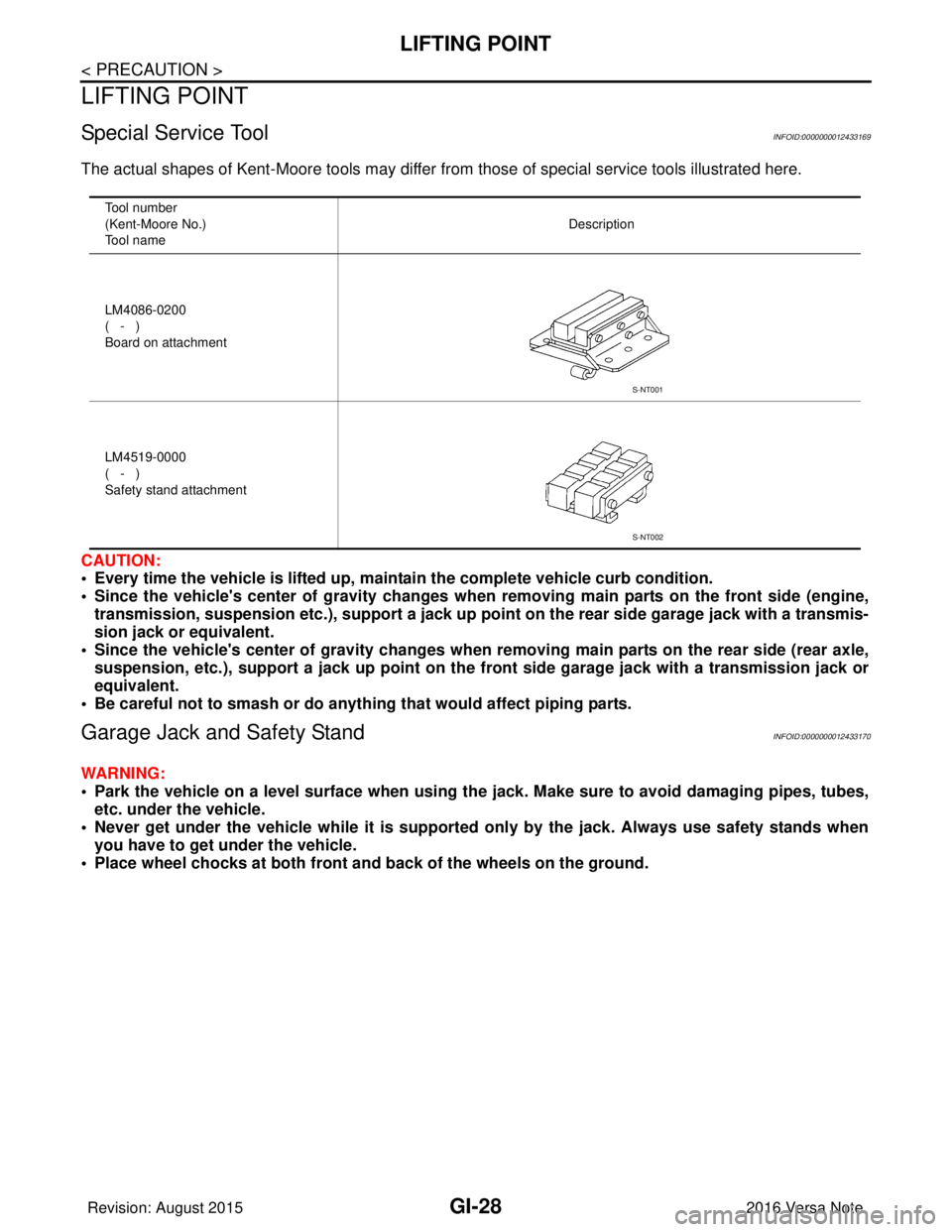
Special Service ToolINFOID:0000000012433169
The actual shapes of Kent-Moore tools may differ from those of special service tools illustrated here.
CAUTION:
• Every time the vehicle is lifted up, main tain the complete vehicle curb condition.
• Since the vehicle's center of gravity changes when removing main parts on the front side (engine, transmission, suspension etc.), supp ort a jack up point on the rear side garage jack with a transmis-
sion jack or equivalent.
• Since the vehicle's center of gravity changes when removing main parts on the rear side (rear axle,
suspension, etc.), support a jack up point on the front side garage jack with a transmission jack or
equivalent.
• Be careful not to smash or do anything that would affect piping parts.
Garage Jack and Safety StandINFOID:0000000012433170
WARNING:
• Park the vehicle on a level surface when using the jack. Make sure to avoid damaging pipes, tubes,
etc. under the vehicle.
• Never get under the vehicle while it is supported only by the jack. Always use safety stands when
you have to get under the vehicle.
• Place wheel chocks at both front an d back of the wheels on the ground.
Tool number
(Kent-Moore No.)
Tool name Description
LM4086-0200
( - )
Board on attachment
LM4519-0000
( - )
Safety stand attachment
S-NT001
S-NT002
Revision: August 2015 2016 Versa Note
cardiagn.com
Page 2320 of 3641
GENERAL MAINTENANCEMA-5
< PERIODIC MAINTENANCE >
C
DE
F
G H
I
J
K L
M B
MA
N
O A
PERIODIC MAINTENANCE
GENERAL MAINTENANCE
Explanation of Gene
ral MaintenanceINFOID:0000000012432243
General maintenance includes those items which shoul d be checked during the normal day-to-day operation
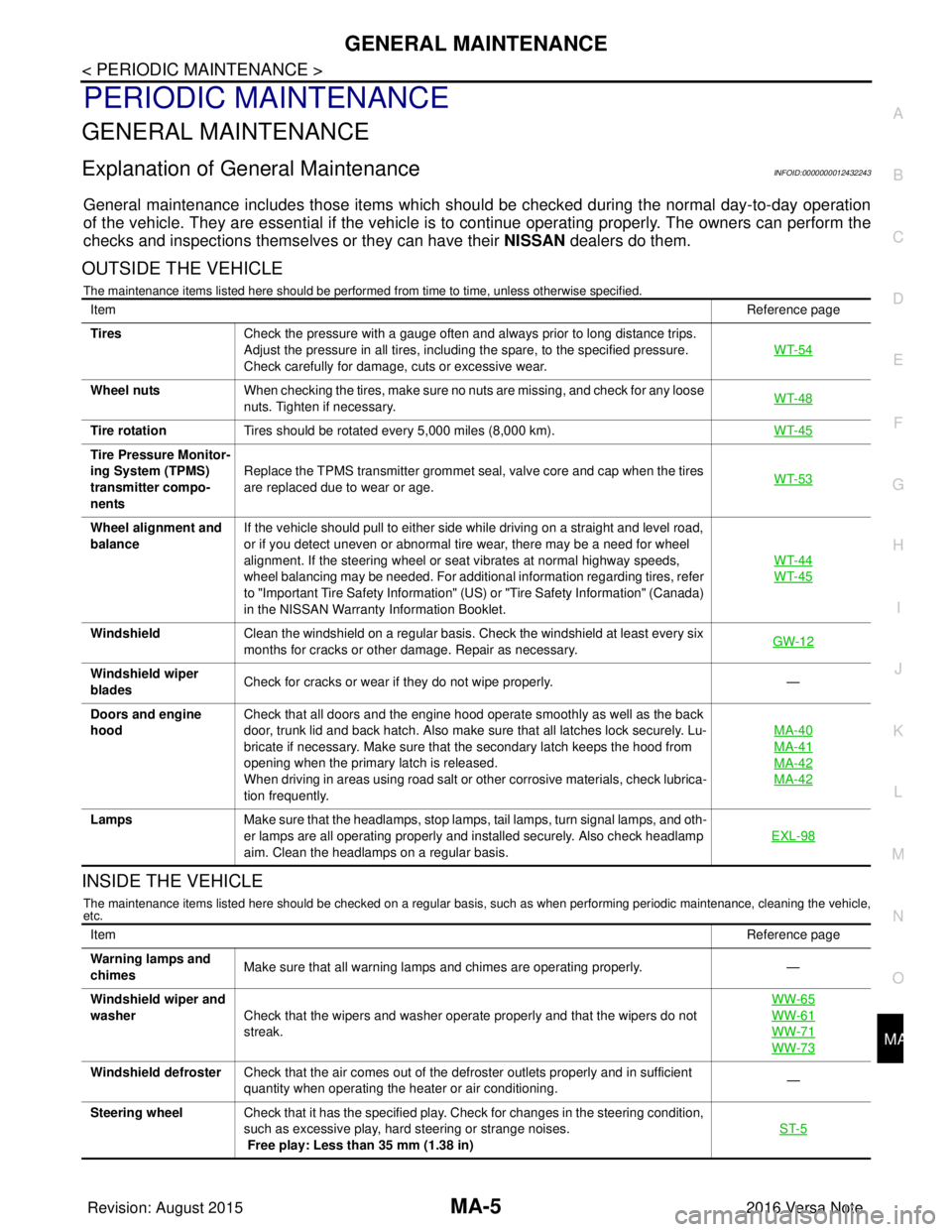
of the vehicle. They are essential if the vehicle is to continue operati ng properly. The owners can perform the
checks and inspections themselves or they can have their NISSAN dealers do them.
OUTSIDE THE VEHICLE
The maintenance items listed here should be performed from time to time, unless otherwise specified.
INSIDE THE VEHICLE
The maintenance items listed here should be checked on a regular basis, such as when performing periodic maintenance, cleaning the vehicle,
etc.
Item Reference page
Tires Check the pressure with a gauge often and always prior to long distance trips.
Adjust the pressure in all tires, including the spare, to the specified pressure.
Check carefully for damage, cuts or excessive wear. WT-54
Wheel nuts
When checking the tires, make sure no nuts are missing, and check for any loose
nuts. Tighten if necessary. WT-48
Tire rotation
Tires should be rotated every 5,000 miles (8,000 km). WT-45
Tire Pressure Monitor-
ing System (TPMS)
transmitter compo-
nentsReplace the TPMS transmitter grommet seal, valve core and cap when the tires
are replaced due to wear or age.
WT-53
Wheel alignment and
balanceIf the vehicle should pull to either side while driving on a straight and level road,
or if you detect uneven or abnormal tire wear, there may be a need for wheel
alignment. If the steering wheel or seat vibrates at normal highway speeds,
wheel balancing may be needed. For additional information regarding tires, refer
to "Important Tire Safety Information" (US) or "Tire Safety Information" (Canada)
in the NISSAN Warranty
Information Booklet. WT-44
WT-45
Windshield
Clean the windshield on a regular basis. Check the windshield at least every six
months for cracks or other damage. Repair as necessary. GW-12
Windshield wiper
bladesCheck for cracks or wear if they do not wipe properly.
—
Doors and engine
hood Check that all doors and the engine hood operate smoothly as well as the back
door, trunk lid and back hatch. Also make sure that all latches lock securely. Lu-
bricate if necessary. Make sure that the secondary latch keeps the hood from
opening when the primary latch is released.
When driving in areas using road salt or other corrosive materials, check lubrica-
tion frequently. MA-40
MA-41
MA-42
MA-42
Lamps
Make sure that the headlamps, stop lamps, tail lamps, turn signal lamps, and oth-
er lamps are all operating properly and installed securely. Also check headlamp
aim. Clean the headlamps on a regular basis. EXL-98
Item
Reference page
Warning lamps and
chimes Make sure that all warning lamps and chimes are operating properly.
—
Windshield wiper and
washer Check that the wipers and washer operate properly and that the wipers do not
streak. WW-65
WW-61
WW-71
WW-73
Windshield defroster
Check that the air comes out of the defroster outlets properly and in sufficient
quantity when operating the heater or air conditioning. —
Steering wheel Check that it has the specified play. Check for changes in the steering condition,
such as excessive play, hard steering or strange noises.
Free play: Less than 35 mm (1.38 in) ST-5
Revision: August 2015
2016 Versa Note
cardiagn.com
Page 2792 of 3641
TRANSMITTERWT-49
< REMOVAL AND INSTALLATION >
C
DF
G H
I
J
K L
M A
B
WT
N
O P
TRANSMITTER
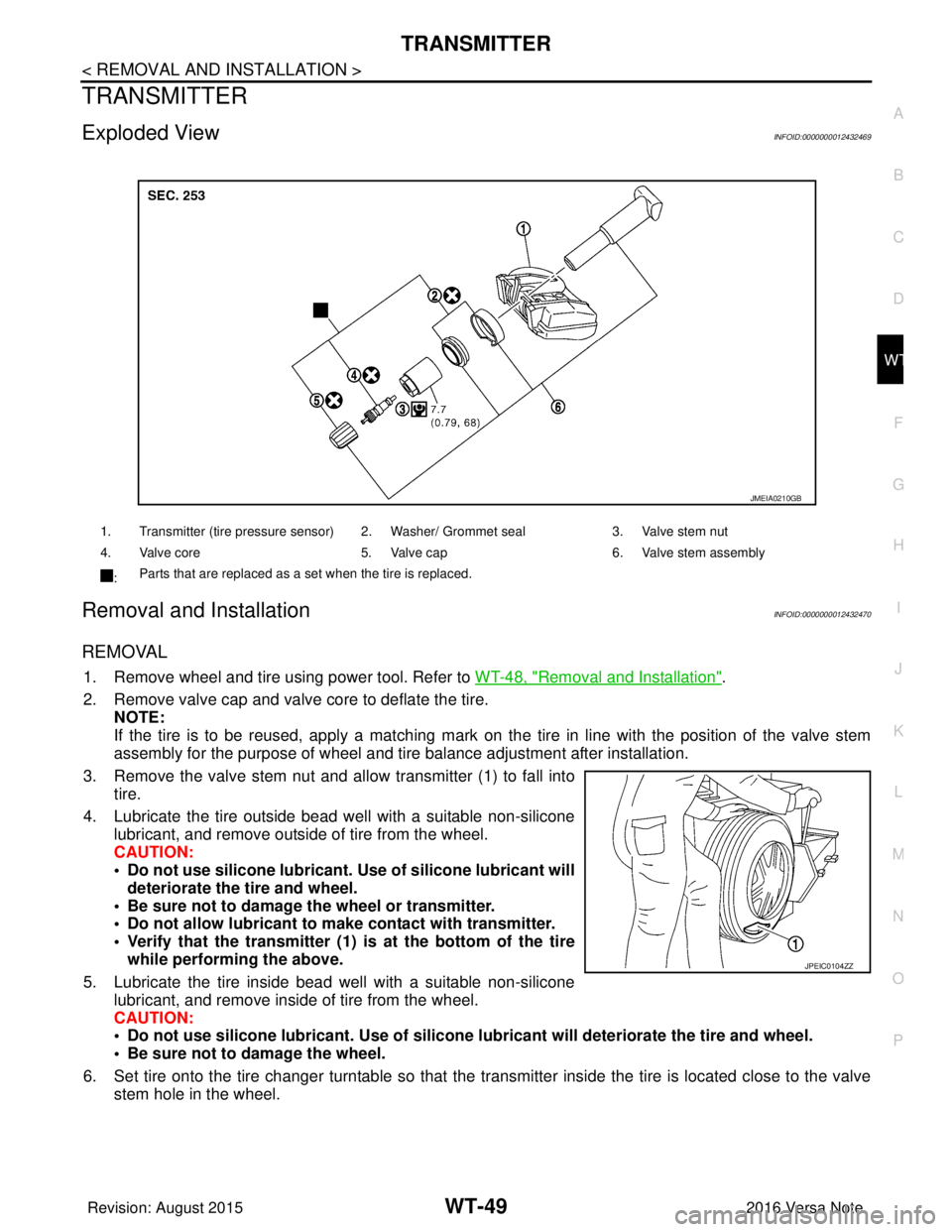
Exploded ViewINFOID:0000000012432469
Removal and InstallationINFOID:0000000012432470
REMOVAL
1. Remove wheel and tire using power tool. Refer to WT-48, "Removal and Installation".
2. Remove valve cap and valve core to deflate the tire. NOTE:
If the tire is to be reused, apply a matching mark on the tire in line with the position of the valve stem
assembly for the purpose of wheel and tire balance adjustment after installation.
3. Remove the valve stem nut and allow transmitter (1) to fall into tire.
4. Lubricate the tire outside bead well with a suitable non-silicone lubricant, and remove outside of tire from the wheel.
CAUTION:
• Do not use silicone lubricant. Use of silicone lubricant will
deteriorate the tire and wheel.
• Be sure not to damage the wheel or transmitter.
• Do not allow lubricant to make contact with transmitter.
• Verify that the transmitter (1) is at the bottom of the tire while performing the above.
5. Lubricate the tire inside bead well with a suitable non-silicone lubricant, and remove inside of tire from the wheel.
CAUTION:
• Do not use silicone lubricant. Use of silicone lubricant will deteriorate the tire and wheel.
• Be sure not to damage the wheel.
6. Set tire onto the tire changer turntable so that the transmitter inside the tire is located close to the valve stem hole in the wheel.
1. Transmitter (tire pressure sensor) 2. Washer/ Grommet seal 3. Valve stem nut
4. Valve core 5. Valve cap6. Valve stem assembly
: Parts that are replaced as a set when the tire is replaced.
JMEIA0210GB
JPEIC0104ZZ
Revision: August 2015
2016 Versa Note
cardiagn.com
Page 3193 of 3641
EPS CONTROL UNITSTC-9
< ECU DIAGNOSIS INFORMATION >
C
DE
F
H I
J
K L
M A
B
STC
N
O P
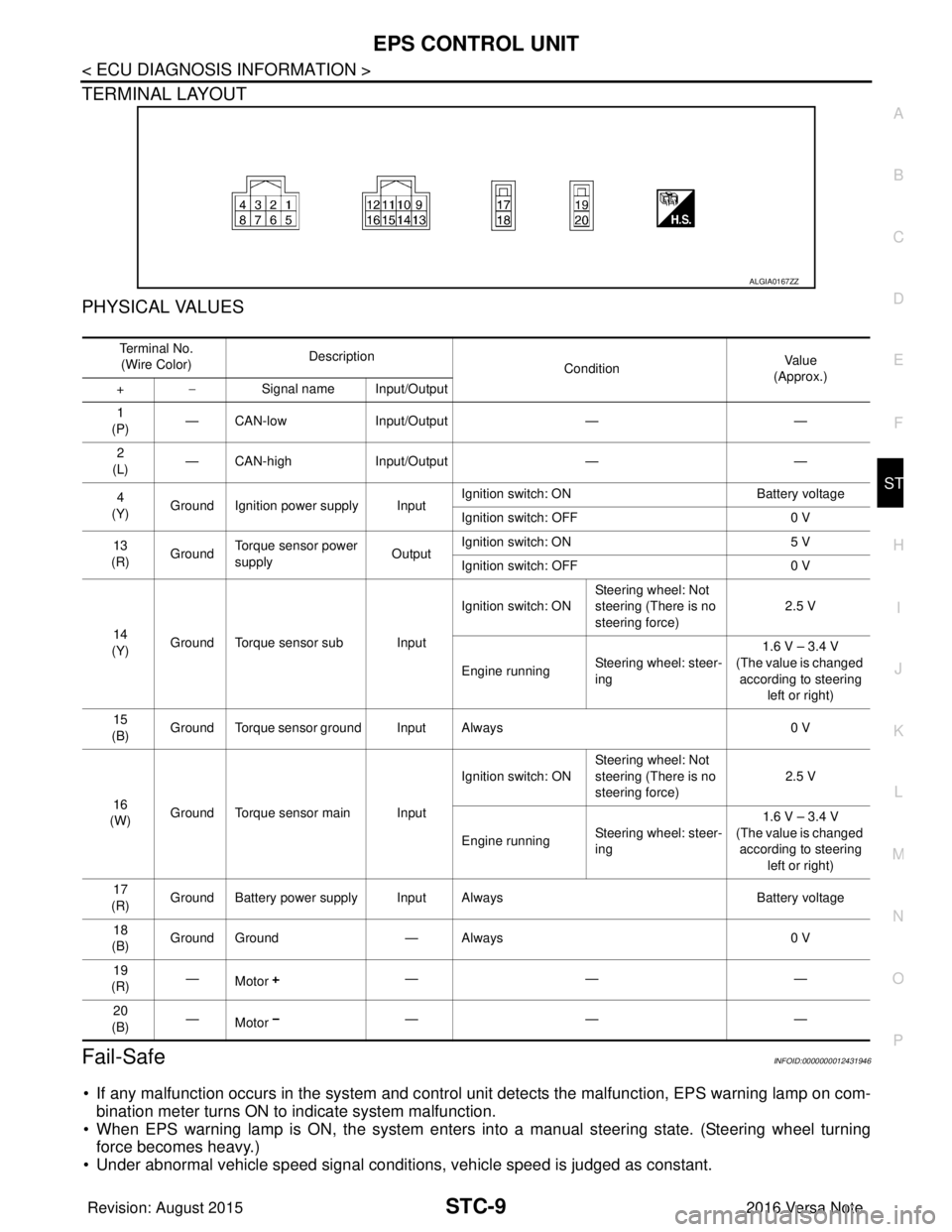
TERMINAL LAYOUT
PHYSICAL VALUES
Fail-SafeINFOID:0000000012431946
• If any malfunction occurs in the system and control uni t detects the malfunction, EPS warning lamp on com-
bination meter turns ON to indicate system malfunction.
• When EPS warning lamp is ON, the system enters into a manual steering state. (Steering wheel turning force becomes heavy.)
• Under abnormal vehicle speed signal conditions, vehicle speed is judged as constant.
ALGIA0167ZZ
Te r m i n a l N o .
(Wire Color) Description
ConditionVa l u e
(Approx.)
+ − Signal name Input/Output
1
(P) — CAN-low
Input/Output ——
2
(L) — CAN-high
Input/Output ——
4
(Y) Ground Ignition power supply Input Ignition switch: ON
Battery voltage
Ignition switch: OFF 0 V
13
(R) Ground Torque sensor power
supply
OutputIgnition switch: ON
5 V
Ignition switch: OFF 0 V
14
(Y) Ground Torque sensor sub Input Ignition switch: ON
Steering wheel: Not
steering (There is no
steering force) 2.5 V
Engine running Steering wheel: steer-
ing 1.6 V – 3.4 V
(The value is changed according to steering
left or right)
15
(B) Ground Torque sensor ground Input Always
0 V
16
(W) Ground Torque sensor main Input Ignition switch: ON
Steering wheel: Not
steering (There is no
steering force) 2.5 V
Engine running Steering wheel: steer-
ing 1.6 V – 3.4 V
(The value is changed according to steering left or right)
17
(R) Ground Battery power supply Input Always
Battery voltage
18
(B) Ground Ground
— Always 0 V
19
(R) —
Motor —— —
20
(B) —
Motor —— —
Revision: August 2015
2016 Versa Note
cardiagn.com
Page 3206 of 3641
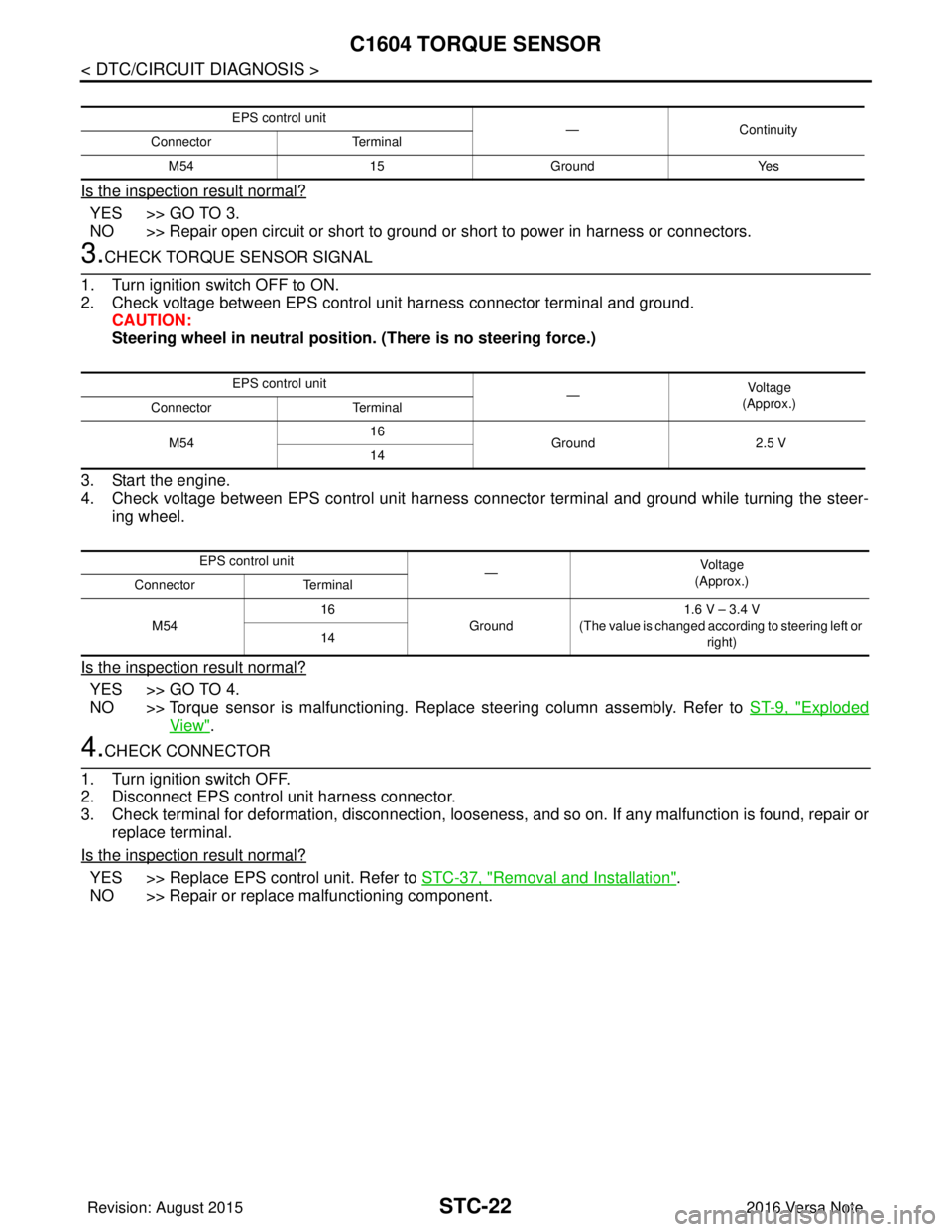
STC-22
< DTC/CIRCUIT DIAGNOSIS >
C1604 TORQUE SENSOR
Is the inspection result normal?
YES >> GO TO 3.
NO >> Repair open circuit or short to ground or short to power in harness or connectors.
3.CHECK TORQUE SENSOR SIGNAL
1. Turn ignition switch OFF to ON.
2. Check voltage between EPS control unit harness connector terminal and ground. CAUTION:
Steering wheel in neutral position. (There is no steering force.)
3. Start the engine.
4. Check voltage between EPS control unit harness connector terminal and ground while turning the steer- ing wheel.
Is the inspection result normal?
YES >> GO TO 4.
NO >> Torque sensor is malfunctioning. Repl ace steering column assembly. Refer to ST-9, "
Exploded
View".
4.CHECK CONNECTOR
1. Turn ignition switch OFF.
2. Disconnect EPS control unit harness connector.
3. Check terminal for deformation, disconnection, looseness, and so on. If any malfunction is found, repair or replace terminal.
Is the inspection result normal?
YES >> Replace EPS control unit. Refer to STC-37, "Removal and Installation".
NO >> Repair or replace malfunctioning component.
EPS control unit —Continuity
Connector Terminal
M54 15Ground Yes
EPS control unit
—Vo l ta g e
(Approx.)
Connector Terminal
M54 16
Ground 2.5 V
14
EPS control unit —Voltag e
(Approx.)
Connector Terminal
M54 16
Ground 1.6 V – 3.4 V
(The value is changed according to steering left or right)
14
Revision: August 2015
2016 Versa Note
cardiagn.com
Page 3321 of 3641
![NISSAN NOTE 2016 Service User Guide TM-80
< SYSTEM DESCRIPTION >[CVT: RE0F11A]
SYSTEM
CVT CONTROL SYSTEM : Protection Control
INFOID:0000000012431020
The TCM becomes the protection control status temporarily to protect the safety when](/img/5/57363/w960_57363-3320.png "NISSAN NOTE 2016 Service User Guide TM-80
< SYSTEM DESCRIPTION >[CVT: RE0F11A]
SYSTEM
CVT CONTROL SYSTEM : Protection Control
INFOID:0000000012431020
The TCM becomes the protection control status temporarily to protect the safety when")
TM-80
< SYSTEM DESCRIPTION >[CVT: RE0F11A]
SYSTEM
CVT CONTROL SYSTEM : Protection Control
INFOID:0000000012431020
The TCM becomes the protection control status temporarily to protect the safety when the safety of TCM and
transmission is lost. It automatically returns to the normal status if the safety is secured.
The TCM has the following protection control.
CONTROL FOR WHEEL SPIN
P0999•Start is slow
• Lock-up is not performed
Wire disconnection
• Vehicle speed is not increased
• Lock-up is not performed Voltage shorting
P099B Start is slow —
P099C •Start is slow
• Lock-up is not performed
Wire disconnection
• Vehicle speed is not increased
• Lock-up is not performed Voltage shorting
P1586 Idle neutral control is not performed —
P1588 Idle neutral control is not performed —
P2765 • Selector shock is large
•Start is slow
• Acceleration is slow
• Vehicle speed is not increased
• Lock-up is not performed
—
P2857 •Start is slow
• Lock-up is not performed —
P2858 • Vehicle speed is not increased
• Lock-up is not performed —
P2859 Vehicle speed is not increased —
P285A Start is slow —
U0073 • Selector shock is large
•Start is slow
• Acceleration is slow
• Lock-up is not performed —
U0100 • Selector shock is large
•Start is slow
• Acceleration is slow
• Lock-up is not performed —
U0140 Not changed from normal driving —
U0141 Not changed from normal driving —
U0155 Not changed from normal driving —
U0300 • Selector shock is large
•Start is slow
• Acceleration is slow
• Lock-up is not performed —
U1000 Not changed from normal driving —
U1114 Not changed from normal driving —
U1117 Not changed from normal driving —
DTC
Vehicle behavior Conditions of vehicle
ControlWhen a wheel spin is detected, the engine output and gear ratio are limited and the line pressure is increased.
At the 1GR, the clutch pressure is increased.
Revision: August 2015
2016 Versa Note
cardiagn.com
Page 3416 of 3641
![NISSAN NOTE 2016 Service User Guide P0846 TRANSMISSION FLUID PRESSURE SEN/SW BTM-175
< DTC/CIRCUIT DIAGNOSIS > [CVT: RE0F11A]
C
EF
G H
I
J
K L
M A
B
TM
N
O P
P0846 TRANSMISSION FLUI D PRESSURE SEN/SW B
DTC LogicINFOID:0000000012431111
D](/img/5/57363/w960_57363-3415.png "NISSAN NOTE 2016 Service User Guide P0846 TRANSMISSION FLUID PRESSURE SEN/SW BTM-175
< DTC/CIRCUIT DIAGNOSIS > [CVT: RE0F11A]
C
EF
G H
I
J
K L
M A
B
TM
N
O P
P0846 TRANSMISSION FLUI D PRESSURE SEN/SW B
DTC LogicINFOID:0000000012431111
D")
P0846 TRANSMISSION FLUID PRESSURE SEN/SW BTM-175
< DTC/CIRCUIT DIAGNOSIS > [CVT: RE0F11A]
C
EF
G H
I
J
K L
M A
B
TM
N
O P
P0846 TRANSMISSION FLUI D PRESSURE SEN/SW B
DTC LogicINFOID:0000000012431111
DTC DETECTION LOGIC
DTC CONFIRMATION PROCEDURE
CAUTION:
Be careful of the driving speed.
1.PREPARATION BEFORE WORK
If another "DTC CONFIRMATION PROCEDURE" occurs just before, turn ignition switch OFF and wait for at
least 10 seconds, then perform the next test.
>> GO TO 2.
2.CHECK DTC DETECTION
1. Start the engine.
2. Shift the selector lever to “D” position.
3. Drive the vehicle at a constant velocity of 40 km/h (25 MPH) at lease for 10 seconds.
CAUTION:
At the same time, the accelerator pedal angle must be maintained constant.
4. Stop the vehicle.
5. Check the first trip DTC.
Is
“P0846”detected?
YES >> Go to TM-175, "Diagnosis Procedure".
NO >> INSPECTION END
Diagnosis ProcedureINFOID:0000000012431112
1.CHECK TCM INPUT SIGNAL
1. Start the engine.
2. Check voltage between TCM connector terminal and ground.
DTC Trouble diagnosis name DTC detection conditionPossible causes
P0846 Transmission Fluid Pressure
Sensor/Switch B Circuit
Range/Performance The detection conditions continuously for 5
seconds or more under the following diagno-
sis conditions:
• Diagnosis conditions
- Selector lever:
“D” position
- The primary pulley speed experienced 306 rpm or more and the secondary pulley
speed experienced 230 rpm or more at
least once.
- Wheel spin is not being detected.
- The rate of change in pulley ratio: Between −0.09 and +0.09 inclusive
- Solenoid valve output current: 750 mA or more
- GND short diagnosis of the solenoid valve circuit is not satisfied.
- TCM power supply voltage: More than 11 V
• Detection conditions
- After the value of “Actual secondary pres-
sure − Target secondary pressure” exceeds
0.675 MPa:
• The rate of change in vehicle speed [km/h (MPH)]: Between −49 ( −30) and +49 (+30)
inclusive
• The rate of change in accelerator pedal an- gle: Between −1.3/8 and +1.3/8 inclusive • Secondary pressure sensor
• Control valve assembly
Revision: August 2015
2016 Versa Note
cardiagn.com