abs NISSAN NOTE 2016 Service Repair Manual
[x] Cancel search | Manufacturer: NISSAN, Model Year: 2016, Model line: NOTE, Model: NISSAN NOTE 2016Pages: 3641, PDF Size: 28.72 MB
Page 2586 of 3641
PWO-6
< REMOVAL AND INSTALLATION >
CONSOLE POWER SOCKET
REMOVAL AND INSTALLATION
CONSOLE POWER SOCKET
Removal and InstallationINFOID:0000000012432101
CONSOLE POWER SOCKET or CIGARETTE LIGHTER (IF EQUIPPED)
REMOVAL
NOTE:
If unable to use the tool because of power socket location or access to the harness connector, then further
removal of interior components may be required. Refer to IP-18, "
Removal and Installation".
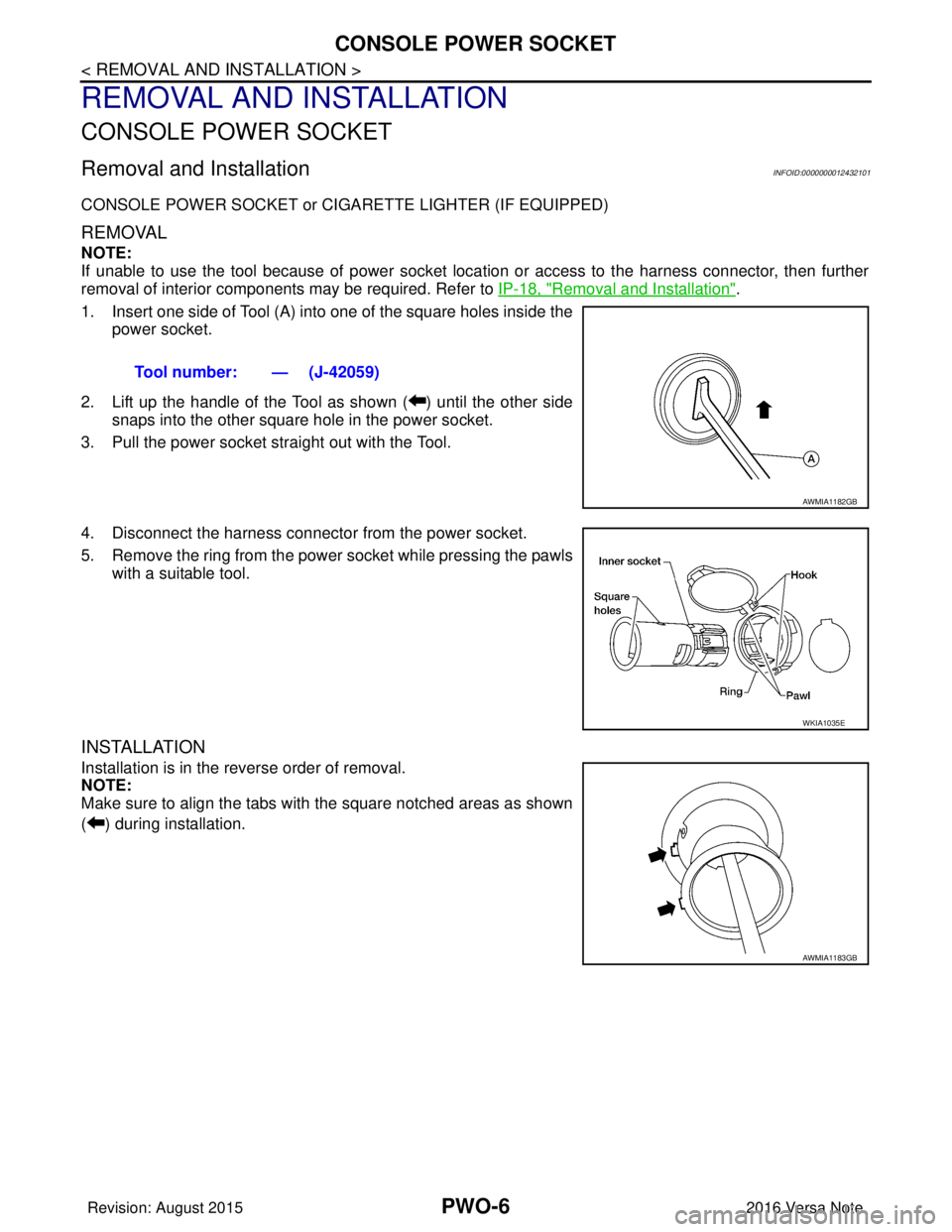
1. Insert one side of Tool (A) into one of the square holes inside the power socket.
2. Lift up the handle of the Tool as shown ( ) until the other side snaps into the other square hole in the power socket.
3. Pull the power socket straight out with the Tool.
4. Disconnect the harness connecto r from the power socket.
5. Remove the ring from the power socket while pressing the pawls with a suitable tool.
INSTALLATION
Installation is in the reverse order of removal.
NOTE:
Make sure to align the tabs with the square notched areas as shown
( ) during installation. Tool number: — (J-42059)
AWMIA1182GB
WKIA1035E
AWMIA1183GB
Revision: August 2015
2016 Versa Note
cardiagn.com
Page 2598 of 3641
![NISSAN NOTE 2016 Service Repair Manual PG
COMPONENT PARTSPG-11
< SYSTEM DESCRIPTION >
C
DE
F
G H
I
J
K L
B A
O P
N
[Example]
HARNESS CONNECTOR (LEVER LOCKING TYPE)
• Lever locking type harness connectors are used on certain control units](/img/5/57363/w960_57363-2597.png "NISSAN NOTE 2016 Service Repair Manual PG
COMPONENT PARTSPG-11
< SYSTEM DESCRIPTION >
C
DE
F
G H
I
J
K L
B A
O P
N
[Example]
HARNESS CONNECTOR (LEVER LOCKING TYPE)
• Lever locking type harness connectors are used on certain control units")
PG
COMPONENT PARTSPG-11
< SYSTEM DESCRIPTION >
C
DE
F
G H
I
J
K L
B A
O P
N
[Example]
HARNESS CONNECTOR (LEVER LOCKING TYPE)
• Lever locking type harness connectors are used on certain control units and control modules such as ECM,
ABS actuator and electric unit (control unit), etc.
• Lever locking type harness connectors are also us ed on super multiple junction (SMJ) connectors.
• Always confirm the lever is fully locked in place by mo ving the lever as far as it will go to ensure full connec-
tion.
CAUTION:
SEL769V
Revision: August 2015 2016 Versa Note
cardiagn.com
Page 2633 of 3641

PG-46
< WIRING DIAGRAM >
HARNESS
D3 E4 Y/2 : Crash zone sensorE1 E42 B/2: IPDM E/R (Intelligent power distribution
module engine room)
E4 E5 B/2 : Cooling fan motor (With CVT)E2 E43 B/6: IPDM E/R (Intelligent power distribution
module engine room)
E2 E8 W/24 : To F8 F2 E44 BR/8: IPDM E/R (Intelligent power distribution
module engine room)
E3 E9 BR/2 : Fusible link b o x ( B a t t e r y )E 1 E 4 5 B R / 1 2: IPDM E/R (Intelligent power distribution
module engine room)
E2 E10 GR/2 : Fusible link box (Battery) F2 E46 W/24: IPDM E/R (Intelligent power distribution
module engine room)
G 2 E 1 5 — : B o d y g r o u n d F 2 E 4 7 W / 1 6: IPDM E/R (Intelligent power distribution
module engine room)
F 2 E 1 6 B / 3 2 : E C M B 3 E 5 0 B R / 2 : W a s h e r f l u i d l e v e l s w i t c h
F4 E17 B/3 : Refrigerant pressure sensor E3 E51 B/2 : Front wheel sensor LH
C4 E18 BR/1 : Horn C4 E52 B/2 : Front wheel sensor RH
E 2 E 1 9 W / 6 : To F 3 3 G 4 E 5 3 B / 2 : F r o n t f o g l a m p L H
C 4 E 2 0 B / 1 : H o r n B 5 E 5 4 B / 2 : F r o n t f o g l a m p R H
A2 E24 — : Body ground E2 E55 GR/12 : To F55
G3 E25 B/3 : Front combination lamp LH G3 E62 L/4 : Cooling fan relay
A3 E26 B/3 : Front combination lamp RH C3 E63 GR/4 : Heated oxygen sensor 2
G2 E27 B/2 : Front combination lamp LH C4 E64 L/4 : Heated seat relay
A2 E28 B/2 : Front combinati on lamp RHG5 E69 B/2 : Ambient sensor
F4 E29 GR/3 : Front combination lamp LH E5 E70 BR/3 : Intelligent Key warning buzzer
B3 E30 GR/3 : Front combination lamp RH F5 E71 B/4 : Front camera
E3 E31 GR/4 : Cooling fan motor (With CVT) G3 E72 L/4 : Active grille shutter relay
E4 E32 W/2 : Cooling fan motor (With CVT) Front fog lamp sub harness
B2 E33 B/38 : ABS actuator and electric unit (Control
unit) E5 E302 B/4 : To E35
E5 E35 B/4 : To E302 F5 E303 B/4 : Active grille shutter
E1 E39 W/3 : Horn relay F5 E303 B/4 : Active grille shutter
Revision: August 2015 2016 Versa Note
cardiagn.com
Page 2653 of 3641
PG-66
< BASIC INSPECTION >
FUSE INSPECTION
• Turn the ignition switch OFF when operating the extended storage switch.
• Under normal conditions, keep the extended storage switch in ON state. Never operate the extended
storage switch except when necessary.
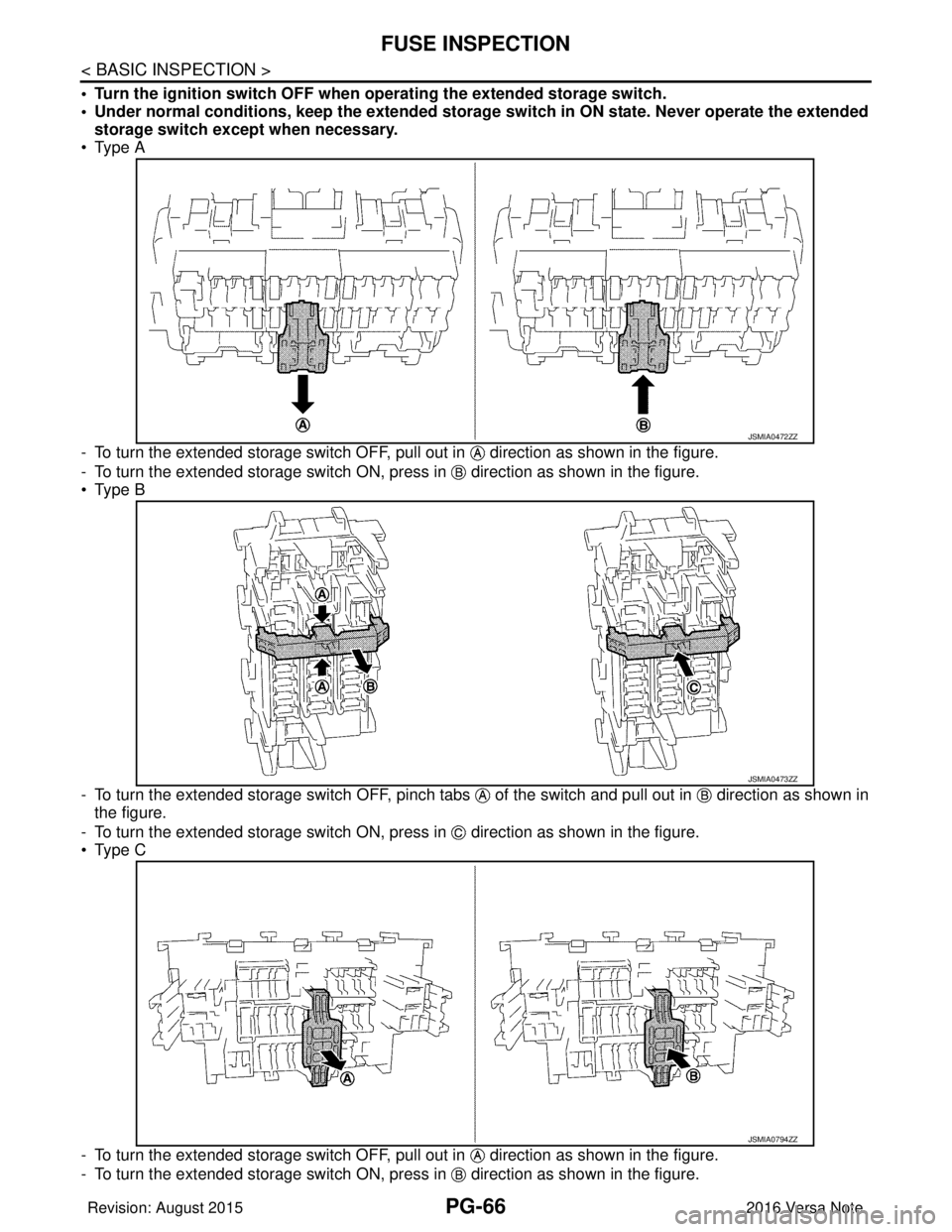
• Type A
- To turn the extended storage switch OFF, pull out in direction as shown in the figure.
- To turn the extended storage switch ON, press in direction as shown in the figure.
• Type B
- To turn the extended storage switch OFF, pinch tabs of the switch and pull out in direction as shown in
the figure.
- To turn the extended storage switch ON, press in direction as shown in the figure.
• Type C
- To turn the extended storage switch OFF, pull out in direction as shown in the figure.
- To turn the extended storage switch ON, press in direction as shown in the figure.
JSMIA0472ZZ
JSMIA0473ZZ
JSMIA0794ZZ
Revision: August 2015 2016 Versa Note
cardiagn.com
Page 2654 of 3641
PG
FUSE INSPECTIONPG-67
< BASIC INSPECTION >
C
DE
F
G H
I
J
K L
B A
O P
N
How To Remove Extended Storage Switch
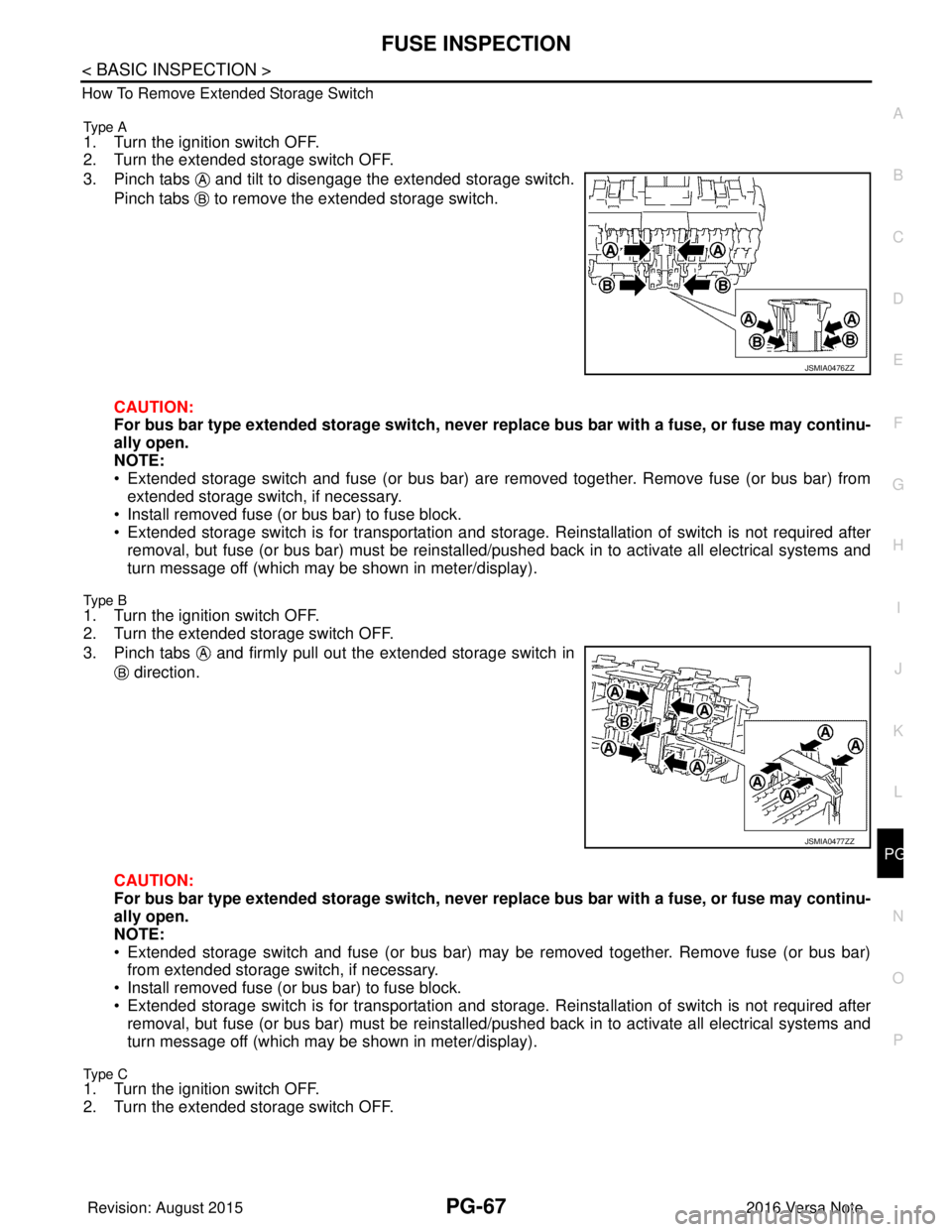
Type A
1. Turn the ignition switch OFF.
2. Turn the extended storage switch OFF.
3. Pinch tabs and tilt to disengage the extended storage switch.
Pinch tabs to remove the extended storage switch.
CAUTION:
For bus bar type extended storage switch, never replace bus bar with a fuse, or fuse may continu-
ally open.
NOTE:
• Extended storage switch and fuse (or bus bar) are removed together. Remove fuse (or bus bar) from extended storage switch, if necessary.
• Install removed fuse (or bus bar) to fuse block.
• Extended storage switch is for transportation and storage. Reinstallation of switch is not required after
removal, but fuse (or bus bar) must be reinstalled/ pushed back in to activate all electrical systems and
turn message off (which may be shown in meter/display).
Type B
1. Turn the ignition switch OFF.
2. Turn the extended storage switch OFF.
3. Pinch tabs and firmly pull out the extended storage switch in
direction.
CAUTION:
For bus bar type extended storage switch, never replace bus bar with a fuse, or fuse may continu-
ally open.
NOTE:
• Extended storage switch and fuse (or bus bar) may be removed together. Remove fuse (or bus bar) from extended storage switch, if necessary.
• Install removed fuse (or bus bar) to fuse block.
• Extended storage switch is for transportation and storage. Reinstallation of switch is not required after
removal, but fuse (or bus bar) must be reinstalled/ pushed back in to activate all electrical systems and
turn message off (which may be shown in meter/display).
Type C1. Turn the ignition switch OFF.
2. Turn the extended storage switch OFF.
JSMIA0476ZZ
JSMIA0477ZZ
Revision: August 2015 2016 Versa Note
cardiagn.com
Page 2655 of 3641
PG-68
< BASIC INSPECTION >
FUSE INSPECTION
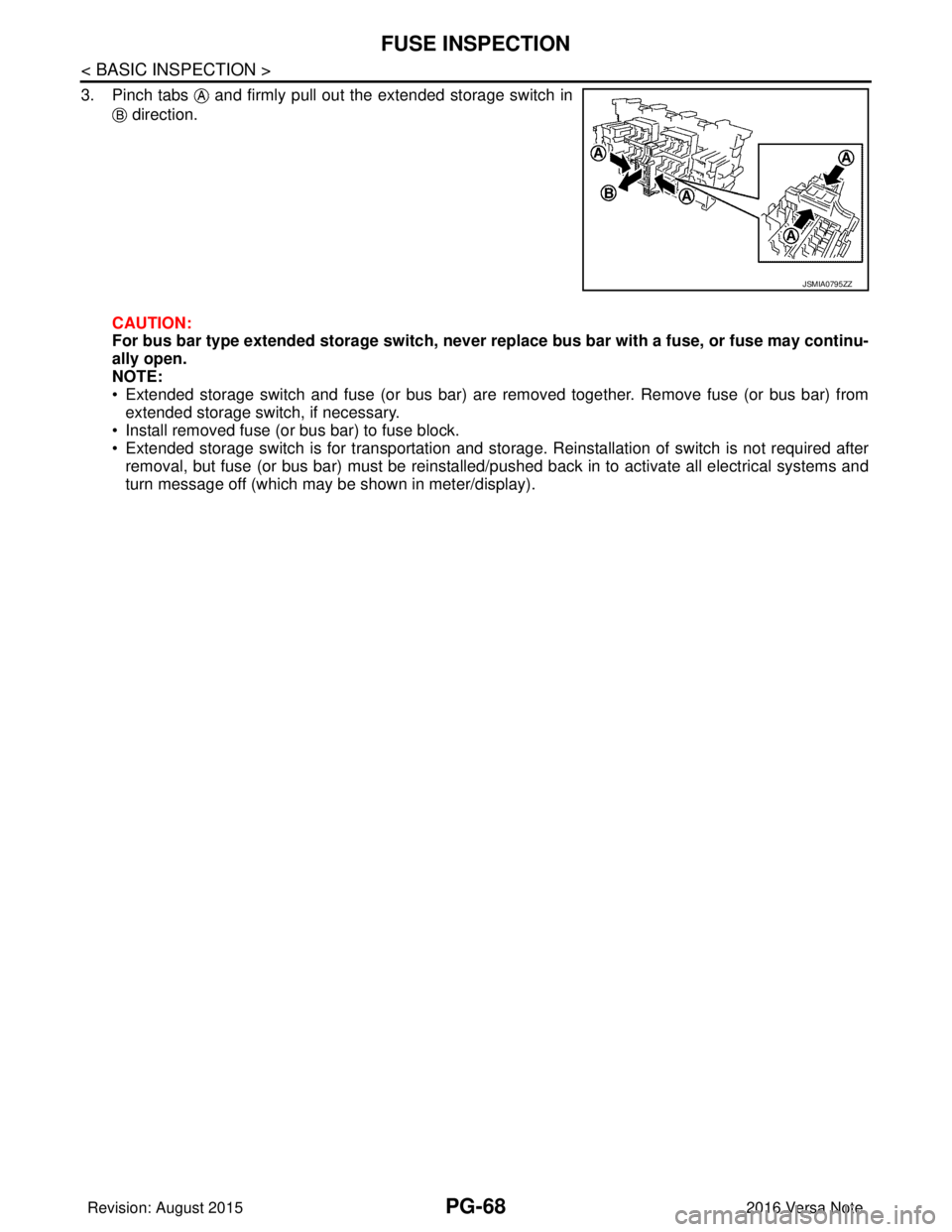
3. Pinch tabs and firmly pull out the extended storage switch in direction.
CAUTION:
For bus bar type extended storage switch, never replace bus bar with a fuse, or fuse may continu-
ally open.
NOTE:
• Extended storage switch and fuse (or bus bar) are removed together. Remove fuse (or bus bar) from extended storage switch, if necessary.
• Install removed fuse (or bus bar) to fuse block.
• Extended storage switch is for transportation and storage. Reinstallation of switch is not required after removal, but fuse (or bus bar) must be reinstalled/pushed back in to activate all electrical systems and
turn message off (which may be shown in meter/display).
JSMIA0795ZZ
Revision: August 2015 2016 Versa Note
cardiagn.com
Page 2729 of 3641

RSU-1
SUSPENSION
C
DF
G H
I
J
K L
M
SECTION RSU
A
B
RSU
N
O PCONTENTS
REAR SUSPENSION
PRECAUTION ....... ........................................2
PRECAUTIONS .............................................. .....2
Precaution for Supplemental Restraint System
(SRS) "AIR BAG" and "SEAT BELT PRE-TEN-
SIONER" ............................................................. ......
2
Precaution for Suspension ........................................2
PREPARATION ............................................3
PREPARATION .............................................. .....3
Special Service Tool ........................................... ......3
Commercial Service Tools ........................................3
SYMPTOM DIAGNOSIS ...............................4
NOISE, VIBRATION AND HARSHNESS
(NVH) TROUBLESHOOTING ........................ .....
4
NVH Troubleshooting Chart ................................ ......4
PERIODIC MAINTENANCE ..........................5
REAR SUSPENSION ASSEMBLY ................ .....5
Inspection ............................................................ ......5
WHEEL ALIGNMENT ..........................................6
Inspection ............................................................ ......6
REMOVAL AND INSTALLATION ................8
REAR SHOCK ABSORBER ..............................8
Exploded View ..................................................... .....8
Removal and Installation ..........................................8
Inspection .................................................................9
Disposal ...................................................................10
COIL SPRING ...................................................11
Exploded View .........................................................11
Removal and Installation .........................................11
Inspection ................................................................12
REAR SUSPENSION BEAM ............................13
Exploded View ..................................................... ....13
Removal and Installation .........................................13
Inspection ................................................................14
SERVICE DATA AND SPECIFICATIONS
(SDS) ............... .......................................... ...
15
SERVICE DATA AND SPECIFICATIONS
(SDS) .................................................................
15
Wheel Alignment (Unladen*1) ..................................15
Wheelarch Height (Unladen*) .............................. ....15
Revision: August 2015 2016 Versa Note
cardiagn.com
Page 2732 of 3641
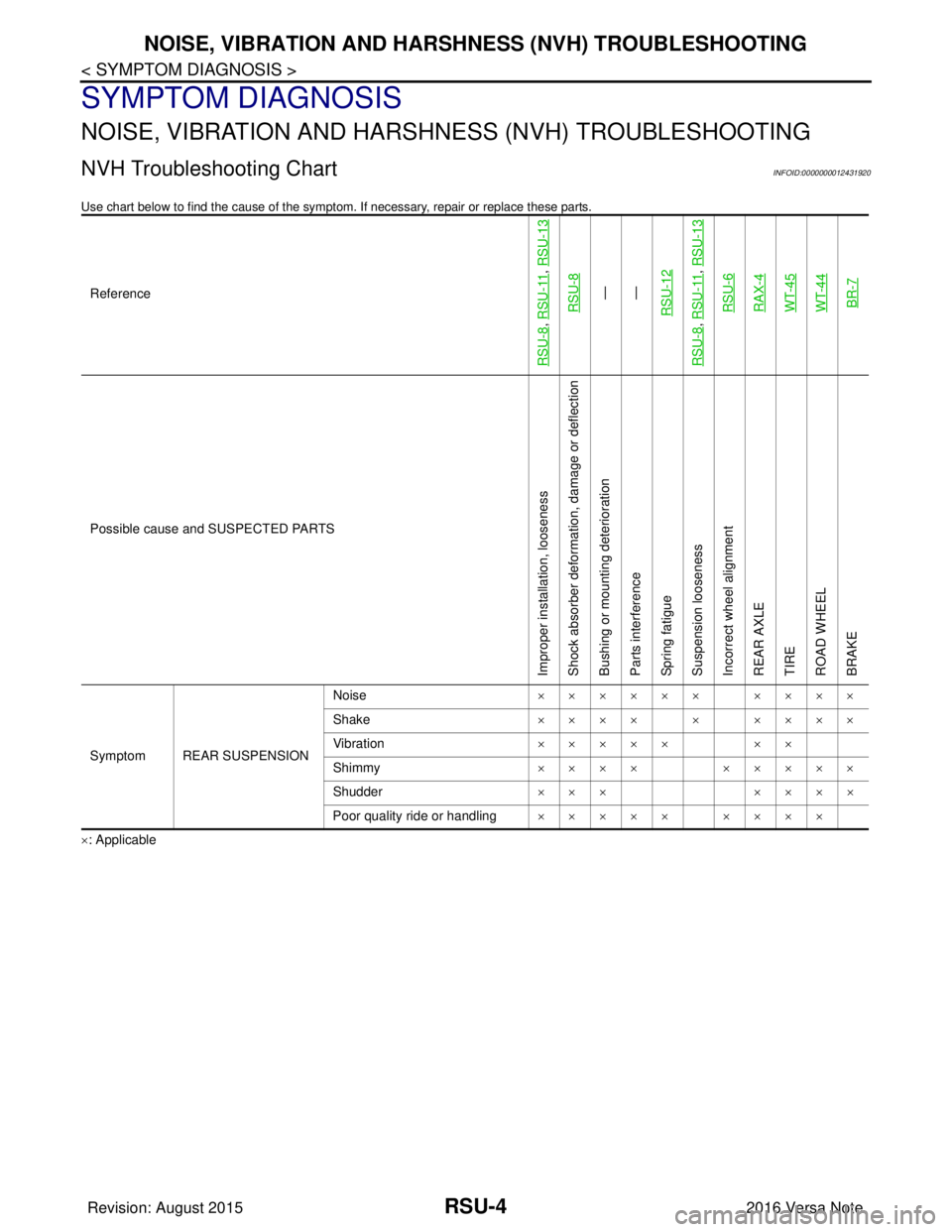
RSU-4
< SYMPTOM DIAGNOSIS >
NOISE, VIBRATION AND HARSHNESS (NVH) TROUBLESHOOTING
SYMPTOM DIAGNOSIS
NOISE, VIBRATION AND HARSHNESS (NVH) TROUBLESHOOTING
NVH Troubleshooting ChartINFOID:0000000012431920
Use chart below to find the cause of the symptom. If necessary, repair or replace these parts.
×: ApplicableReference
RSU-8
,
RSU-11
, RSU-13
RSU-8—
—
RSU-12
RSU-8
, RSU-11
, RSU-13
RSU-6RAX-4WT-45WT-44BR-7
Possible cause and SUSPECTED PARTS
Improper installation, looseness
Shock absorber deformation, damage or deflection
Bushing or mounting deterioration
Parts interference
Spring fatigue
Suspension looseness
Incorrect wheel alignment
REAR AXLE
TIRE
ROAD WHEEL
BRAKE
Symptom REAR SUSPENSION Noise
×××××× ××××
Shake ×××× × ××××
Vibration ××××× ××
Shimmy ×××× ×××××
Shudder ××× ××××
Poor quality ride or handling ××××× ××××
Revision: August 2015 2016 Versa Note
cardiagn.com
Page 2733 of 3641

REAR SUSPENSION ASSEMBLYRSU-5
< PERIODIC MAINTENANCE >
C
DF
G H
I
J
K L
M A
B
RSU
N
O P
PERIODIC MAINTENANCE
REAR SUSPENSION ASSEMBLY
InspectionINFOID:0000000012431921
COMPONENT PART
Check the mounting conditions (looseness, backlash) of each component. Verify the component conditions
(wear, damage) are normal.
SHOCK ABSORBER
Check the shock absorber for oil leaks or damage. Replace the components if necessary.
Revision: August 2015 2016 Versa Note
cardiagn.com
Page 2734 of 3641

RSU-6
< PERIODIC MAINTENANCE >
WHEEL ALIGNMENT
WHEEL ALIGNMENT
InspectionINFOID:0000000012431922
DESCRIPTION
Measure the wheel alignment under unladen conditions.
NOTE:
“Unladen conditions” means that fuel, engine coolant, and lubricants are full. Spare tire, jack, hand tools and
mats are in designated positions.
PRELIMINARY
Check the following:
1. Tires for improper air pressure and wear.
2. Road wheels for runout. Refer to WT-44, "
Inspection".
3. Wheel bearing axial end play. Refer to RAX-10, "
Wheel Bearing".
4. Shock absorber operation.
5. Each mounting part of suspension for looseness and deformation.
6. Rear suspension beam for cracks, deformation, and other damage.
7. Vehicle height (posture).
GENERAL INFORMATION AND RECOMMENDATIONS
1. A Four-Wheel Thrust Alignment should be performed. • This type of alignment is recommended for any NISSAN/INFINITI vehicle.
• The four-wheel “thrust” process helps ensure that the vehicle is properly aligned and the steering wheel
is centered.
• The alignment machine itself should be capabl e of accepting any NISSAN/INFINITI vehicle.
• The alignment machine should be checked to ensure that it is level.
2. Make sure the alignment machine is properly calibrated. • Your alignment machine should be regularly calibrated in order to give correct information.
• Check with the manufacturer of your specific al ignment machine for their recommended Service/Cali-
bration Schedule.
THE ALIGNMENT PROCESS
IMPORTANT: Use only the alignment specifications listed in this Service Manual. Refer to RSU-15, "Wheel
Alignment (Unladen*1)".
1. When displaying the alignment settings, many alignment machines use “indicators”: (Green/red, plus or minus, Go/No Go). Do NOT use these indicators.
• The alignment specifications programmed into your alignment machine that operate these indicators may not be correct.
• This may result in an ERROR.
2. Most camera-type alignment machines are equipped with both "Rolling Compensation" method and optional "Jacking Compensation" method to "com pensate" the alignment targets or head units.
"Rolling Compensation" is the preferred method.
• If using the "Rolling Compensation" method, after installing the alignment targets or head units, push or pull on the rear wheel to move the vehicle. Do not push or pull the vehicle body.
• If using the "Jacking Compensation" method, after in stalling the alignment targets or head units, raise
the vehicle and rotate the wheels 1/2 turn both ways.
NOTE:
Do not use the "rolling compensation" if you are using sensor-type alignment equipment.
• Follow all instructions for the alignment machine you're using for more information.
CAMBER INSPECTION
• Measure camber of both right and left wheels with a suitable alignment gauge.
• If it is out of the specificati on value, inspect and replace any damaged or worn rear suspension parts.
Camber : Refer to RSU-15, "
Wheel Alignment
(Unladen*1)".
Revision: August 2015
2016 Versa Note
cardiagn.com