ENGINE ELECTRONIC NISSAN NOTE 2016 Service Repair Manual
[x] Cancel search | Manufacturer: NISSAN, Model Year: 2016, Model line: NOTE, Model: NISSAN NOTE 2016Pages: 3641, PDF Size: 28.72 MB
Page 1146 of 3641
![NISSAN NOTE 2016 Service Repair Manual COMPONENT PARTSEC-19
< SYSTEM DESCRIPTION > [HR16DE]
C
D
E
F
G H
I
J
K L
M A
EC
NP
O
Air Fuel Ratio Sensor 1INFOID:0000000012431272
The air fuel ratio (A/F) sensor 1 is a planar one-cell limit current](/img/5/57363/w960_57363-1145.png "NISSAN NOTE 2016 Service Repair Manual COMPONENT PARTSEC-19
< SYSTEM DESCRIPTION > [HR16DE]
C
D
E
F
G H
I
J
K L
M A
EC
NP
O
Air Fuel Ratio Sensor 1INFOID:0000000012431272
The air fuel ratio (A/F) sensor 1 is a planar one-cell limit current")
COMPONENT PARTSEC-19
< SYSTEM DESCRIPTION > [HR16DE]
C
D
E
F
G H
I
J
K L
M A
EC
NP
O
Air Fuel Ratio Sensor 1INFOID:0000000012431272
The air fuel ratio (A/F) sensor 1 is a planar one-cell limit current sen-
sor. The sensor element of the A/F sensor 1 is composed an elec-
trode layer, which transports ions. It has a heater in the element.
The sensor is capable of precise m
easurement = 1, but also in the
lean and rich range. Together with its control electronics, the sensor
outputs a clear, continuous signal throughout a wide range.
The exhaust gas components diffuse through the diffusion layer at
the sensor cell. An electrode layer is applied voltage, and this current
relative oxygen density in lean. Also this current relative hydrocar-
bon density in rich.
Therefore, the A/F sensor 1 is able to indicate air fuel ratio by this
electrode layer of current. In addition, a heater is integrated in the
sensor to ensure the required operating temperature of about 800 °C
(1,472 °F).
Air Fuel Ratio Sensor 1 HeaterINFOID:0000000012431273
SYSTEM DESCRIPTION
The ECM performs ON/OFF duty control of the A/F sensor 1 heater corresponding to the engine operating
condition to keep the temperature of A/F s ensor 1 element within the specified range.
Camshaft Position SensorINFOID:0000000012431274
The camshaft position sensor senses the protrusion of camshaft to
identify a particular cylinder. The camshaft position sensor senses
the piston position.
When the crankshaft position sensor system becomes inoperative,
the camshaft position sensor provides various controls of engine
parts instead, utilizing timing of cylinder identification signals.
The sensor consists of a permanent magnet and Hall IC.
When engine is running, the high and low parts of the teeth cause
the gap with the sensor to change.
The changing gap causes the magnetic field near the sensor to
change.
Due to the changing magnetic fiel d, the voltage from the sensor
changes.
JMBIA0112GB
PBIB3354E
Sensor Input Signal to ECM ECM functionActuator
Camshaft position sensor (PHASE)
Crankshaft position sensor (POS) Engine speed
Air fuel ratio (A/F) sensor 1
heater controlAir fuel ratio (A/F) sensor 1
heater
Mass air flow sensor Amount of intake air
PBIA9209J
Revision: August 2015 2016 Versa Note
cardiagn.com
Page 1903 of 3641

ABBREVIATIONSGI-15
< HOW TO USE THIS MANUAL >
C
DE
F
G H
I
J
K L
M B
GI
N
O P
E
F
G
H
DLC Data link connector
DTC Diagnostic trouble code
ABBREVIATION DESCRIPTION
E/T Exhaust temperature
EBD Electric brake force distribution
EC Engine control
ECL Engine coolant level
ECM Engine control module
ECT Engine coolant temperature
ECV Electrical control valve
EEPROM Electrically erasable programmable read only memory EFT Engine fuel temperature
EGR Exhaust gas recirculation
EGRT Exhaust gas recirculation temperature EGT Exhaust gas temperature
EOP Engine oil pressure
EP Exhaust pressure
EPR Exhaust pressure regulator
EPS Electronically controlled power steering
ESP Electronic stability program system
EVAP canister Evaporative emission canister EVSE Electric vehicle supply equipment
EXC Exhaust control
ABBREVIATION DESCRIPTION
FC Fan control
FCW Forward collision warning
FIC Fuel injector control
FP Fuel pump
FR Front
FRP Fuel rail pressure
FRT Fuel rail temperature
FTP Fuel tank pressure
FTT Fuel tank temperature
ABBREVIATION DESCRIPTION
GND Ground
GPS Global positioning system
GST Generic scan tool
ABBREVIATION DESCRIPTION
HBMC Hydraulic body-motion control system HDD Hard disk drive
HO2S Heated oxygen sensor
ABBREVIATION
DESCRIPTION
Revision: August 2015 2016 Versa Note
cardiagn.com
Page 1912 of 3641
GI-24
< PRECAUTION >
PRECAUTIONS
General Precautions
INFOID:0000000012433162
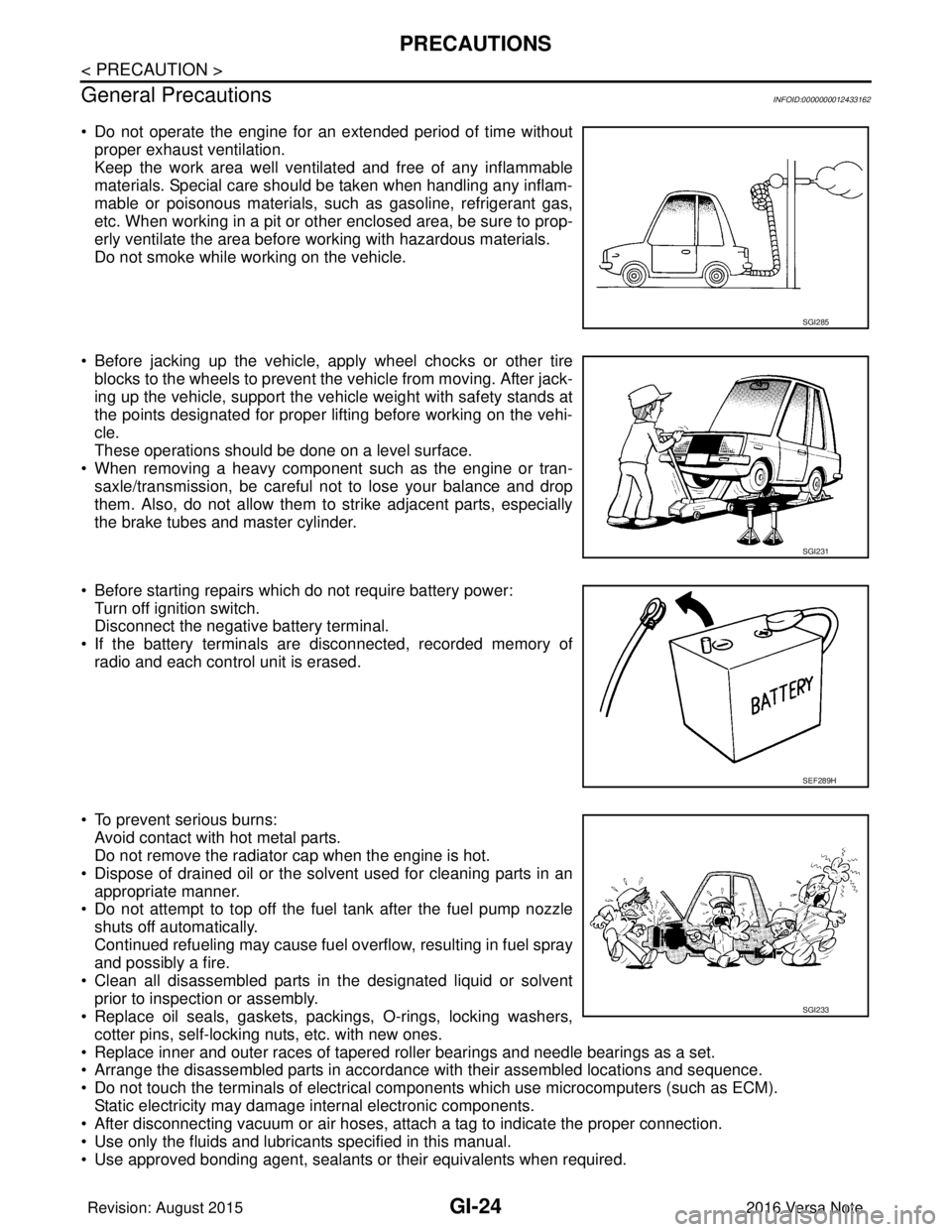
• Do not operate the engine for an extended period of time without proper exhaust ventilation.
Keep the work area well ventilated and free of any inflammable
materials. Special care should be taken when handling any inflam-
mable or poisonous materials, such as gasoline, refrigerant gas,
etc. When working in a pit or other enclosed area, be sure to prop-
erly ventilate the area before working with hazardous materials.
Do not smoke while working on the vehicle.
• Before jacking up the vehicle, apply wheel chocks or other tire blocks to the wheels to prevent the vehicle from moving. After jack-
ing up the vehicle, support the vehicle weight with safety stands at
the points designated for proper lifting before working on the vehi-
cle.
These operations should be done on a level surface.
• When removing a heavy component such as the engine or tran- saxle/transmission, be careful not to lose your balance and drop
them. Also, do not allow them to strike adjacent parts, especially
the brake tubes and master cylinder.
• Before starting repairs which do not require battery power: Turn off ignition switch.
Disconnect the negative battery terminal.
• If the battery terminals are disconnected, recorded memory of radio and each control unit is erased.
• To prevent serious burns: Avoid contact with hot metal parts.
Do not remove the radiator cap when the engine is hot.
• Dispose of drained oil or the solvent used for cleaning parts in an appropriate manner.
• Do not attempt to top off the fuel tank after the fuel pump nozzle
shuts off automatically.
Continued refueling may cause fuel overflow, resulting in fuel spray
and possibly a fire.
• Clean all disassembled parts in the designated liquid or solvent prior to inspection or assembly.
• Replace oil seals, gaskets, packings, O-rings, locking washers,
cotter pins, self-locking nuts, etc. with new ones.
• Replace inner and outer races of tapered roller bearings and needle bearings as a set.
• Arrange the disassembled parts in accordance with their assembled locations and sequence.
• Do not touch the terminals of electrical com ponents which use microcomputers (such as ECM).
Static electricity may damage internal electronic components.
• After disconnecting vacuum or air hoses, atta ch a tag to indicate the proper connection.
• Use only the fluids and lubricants specified in this manual.
• Use approved bonding agent, sealants or their equivalents when required.
SGI285
SGI231
SEF289H
SGI233
Revision: August 2015 2016 Versa Note
cardiagn.com
Page 1974 of 3641
![NISSAN NOTE 2016 Service Repair Manual HAC-6
< PRECAUTION >[MANUAL AIR CONDITIONING]
PRECAUTIONS
• The fluorescent leak detection dye is not a replacem
ent for an electronic leak detector. The fluores-
cent leak detection dye should be u](/img/5/57363/w960_57363-1973.png "NISSAN NOTE 2016 Service Repair Manual HAC-6
< PRECAUTION >[MANUAL AIR CONDITIONING]
PRECAUTIONS
• The fluorescent leak detection dye is not a replacem
ent for an electronic leak detector. The fluores-
cent leak detection dye should be u")
HAC-6
< PRECAUTION >[MANUAL AIR CONDITIONING]
PRECAUTIONS
• The fluorescent leak detection dye is not a replacem
ent for an electronic leak detector. The fluores-
cent leak detection dye should be u sed in conjunction with an electronic leak detector to pin-point
refrigerant leaks.
• Read and follow all manufacture’s operating inst ructions and precautions prior to performing the
work for the purpose of safet y and customer’s satisfaction.
• A compressor shaft seal should not necessarily be repaired becau se of dye seepage. The compres-
sor shaft seal should only be repaired after conf irming the leak with an electronic leak detector.
• Always remove any remaining dye from the leak area after repairs are completed to avoid a misdiag-
nosis during a future service.
• Do not allow dye to come into contact with painted body panels or interior components. Clean imme- diately with the approved dye cl eaner if dye is spilled. Fluorescent dye left on a surface for an
extended period of time cannot be removed.
• Do not spray the fluorescent dye cleaning agent on hot surfaces (engine exhaust manifold, etc.).
• Do not use more than one refrigerant dye bottle [1/4 ounce (7.4 cc)] per A/C system.
• Leak detection dyes for HFC-134a (R-134a) and CFC-12 (R-12) A/C systems are different. Do not use
HFC-134a (R-134a) leak detection dye in CFC-12 (R-12) A/C system, or CFC-12 (R-12) leak detection
dye in HFC-134a (R-134a) A/C system, or A/C system damage may result.
• The fluorescent properties of the dye remains fo r three or more years unless a compressor malfunc-
tion occurs.
NOTE: Identification
• Vehicles with factory installed fluorescent dye have a green label.
• Vehicles without factory installed fluorescent dye have a blue label.
Service EquipmentINFOID:0000000012430713
RECOVERY/RECYCLING RECHARGING EQUIPMENT
Be certain to follow the manufacturer’s instructions for machine operation and machine maintenance. Do not
introduce any refrigerant other than that specified into the machine.
ELECTRICAL LEAK DETECTOR
Be certain to follow the manufacturer’s instruct ions for tester operation and tester maintenance.
VACUUM PUMP
The oil contained inside the vacuum pump is not compatible with the
specified oil for HFC-134a (R-134a) A/C systems. The vent side of
the vacuum pump is exposed to atmospheric pressure. Vacuum
pump oil may migrate out of the pump into the service hose. This is
possible when the pump is switc hed OFF after evacuation (vacuum-
ing) and hose is connected to it.
To prevent this migration, use a manual valve placed near the hose-
to-pump connection, as per the following.
• Vacuum pumps usually have a manual isolator valve as part of the pump. Close this valve to isolat e the service hose from the pump.
• Use a hose equipped with a manual shut-off valve near the pump
end for pumps without an isolator. Close the valve to isolate the
hose from the pump.
• Disconnect the hose from the pump if the hose has an automatic
shut-off valve. As long as the hose is connected, the valve is open
and lubricating oil may migrate.
Some one-way valves open when vacuum is applied and close
under no vacuum condition. Such valves may restrict the pump’s
ability to pull a deep vacuum and are not recommended.
MANIFOLD GAUGE SET
RHA270DA
Revision: August 2015 2016 Versa Note
cardiagn.com
Page 2031 of 3641

HA-6
< PRECAUTION >
PRECAUTIONS
• The air conditioner warranty is void if the vehicle is within the warranty period. Please contact Nissan Cus-tomer Affairs for further assistance.
COMPRESSOR
CAUTION:
• Cap or plug all openings to prevent moisture and fo reign matter from entering.
• Store it in the same way as it is when moun ted on the car when the compressor is removed.
• Follow “Maintenance of Oil Level” exactly when replacing or repairing compressor. Refer to HA-22,
"Description".
• Keep friction surfaces between clut ch and pulley clean. Wipe it off by using a clean waste cloth
moistened with thinner if the su rface is contaminated with oil.
• Turn the compressor shaft by hand more than five turns in both directions after compressor service
operation. This distributes oil e qually inside the compressor. Let the engine idle and operate the
compressor for one hour after the compressor is installed.
• Apply voltage to the new one and check for norma l operation after replacing the compressor magnet
clutch.
LEAK DETECTION DYE
CAUTION:
• The A/C system contains a fluorescent leak detect ion dye used for locating refrigerant leaks. An
ultraviolet (UV) lamp is required to il luminate the dye when inspecting for leaks.
• Always wear fluorescence enhancing UV safety goggles to protect eyes and enhance the visibility of the fluorescent dye.
• The fluorescent dye leak detector is not a replacement for an electrical l eak detector (SST: J-41995).
The fluorescent dye leak detector sh ould be used in conjunction with an electrical leak detector
(SST: J-41995) to pin-point refrigerant leaks.
• Read and follow all manufacture’s operating inst ructions and precautions prior to performing the
work for the purpose of safet y and customer’s satisfaction.
• A compressor shaft seal should not necessarily be repaired becau se of dye seepage. The compres-
sor shaft seal should only be repaired after confi rming the leak with an electrical leak detector (SST:
J-41995).
• Always remove any remaining dye from the leak area after repairs are completed to avoid a misdiag-
nosis during a future service.
• Do not allow dye to come into contact with painted body panels or interior components. Clean imme- diately with the approved dye cl eaner if dye is spilled. Fluorescent dye left on a surface for an
extended period of time cannot be removed.
• Do not spray the fluorescent dye cleaning agent on hot surfaces (engine exhaust manifold, etc.).
• Do not use more than one refrigerant dye bottle [1/4 ounce (7.4 cc)] per A/C system.
• Leak detection dyes for HFC-134a (R-134a) and CFC-12 (R-12) A/C systems are different. Do not use
HFC-134a (R-134a) leak detection dye in CFC-12 (R- 12) A/C system or CFC-12 (R-12) leak detection
dye in HFC-134a (R-134a) A/C system or A/C system damage may result.
• The fluorescent properties of the dye remains fo r three or more years unless a compressor malfunc-
tion occurs.
NOTE: Identification
• Vehicles with factory installed fluorescent dye have a green label.
• Vehicles without factory installed fluorescent dye have a blue label.
Service EquipmentINFOID:0000000012431988
RECOVERY/RECYCLING RECHARGING EQUIPMENT
Be certain to follow the manufacturer’s instructions for machine operation and machine maintenance. Do not
introduce any refrigerant other than that specified into the machine.
ELECTRONIC LEAK DETECTOR
Be certain to follow the manufacturer’s instruct ions for tester operation and tester maintenance.
VACUUM PUMP
Revision: August 2015 2016 Versa Note
cardiagn.com
Page 2044 of 3641

REFRIGERANTHA-19
< PERIODIC MAINTENANCE >
C
DE
F
G H
J
K L
M A
B
HA
N
O P
4. Press UV lamp switch (5) and check A/C system for re frigerant leaks. (Where refrigerant leaks occur, flu-
orescent leak detection dye appears green in color.)
WARNING:
Do not look directly into UV lamp light source.
NOTE:
• For continuous operating time of UV lamp, fo llow the manufacturer’s operating instructions.
• Illuminate pipe joints from different angles using UV lamp to check for leaks.
• Use a mirror in areas that are di fficult to see to check for leaks.
• Refrigerant leaks from the evaporator can be detected by soaking a cotton swab or similar material with
drain hose water and illuminating it using the UV lamp.
• Dust, dirt, and packing material adhesives used for condenser, evaporator, and other components may fluoresce. Be careful not to misidentify leaks.
5. Repair or replace parts where refrigerant lea ks occur and wipe off fluorescent leak detection dye.
NOTE:
Completely wipe off fluorescent leak detection dye from gaps between parts, screw threads, and other
components using a cotton swab or similar material.
6. Use a UV lamp to check that no fluorescent leak detection dye remains after finishing work. WARNING:
Do not look directly into UV lamp light source.
NOTE:
• For continuous operating time of UV lamp, fo llow the manufacturer’s operating instructions.
• Dust, dirt, and packing material adhesives used for condenser, evaporator, and other components may
fluoresce. Be careful not to misidentify leaks.
CHECK REFRIGERANT LEAKS USING ELECTRONIC LEAK DETECTOR
WARNING:
Do not check for refrigerant leaks while the engine is running.
CAUTION:
Be careful of the following items so that in accurate checks or misidentifications are avoided.
• Do not allow refrigerant vapor, shop chemical vapors, cigarette smoke or other contaminates around the vehicle.
• Always check refrigerant leaks in a low air flow en vironment so that refrigerant may not disperse.
1. Stop the engine.
2. Connect recovery/recycling/recharging equipment or manifold gauge set to the A/C service valves.
3. Check that A/C refrigerant pressure is 345 kPa (3.52 kg/cm
2, 50 psi) or more when temperature is 16 °C
(61 °F) or more. When pressure is lower than the specified value, recycle refrigerant completely and
recharge refrigerant to the specified level.
NOTE:
Leaks may not be detected if A/C refriger ant pressure is 345 kPa (3.52 kg/cm
2, 50 psi) or less when tem-
perature is less than 16° C (61°F).
4. Clean the area where the refrigerant leak check is performed and check for refrigerant leaks along all sur- faces of pipe connections and A/C system co mponents using electronic leak detector probe.
CAUTION:
• Continue checking once leaks are found. Always co ntinue and complete checking along all pipe
connections and A/C system comp onents for additional leaks.
• When leaks are detected, clean leak ar ea using compressed air and re-check.
• When checking the evaporator for leaks, always clean inside of drain hose so that the probe sur-
face may not be exposed to water or dirt.
NOTE:
• Always check for leaks starting from the high-pressure side and continue to the low-pressure side.
• When checking the evaporator for leaks, operate blower motor for 15 minut\
es or more at the maximum speed while the engine is stopped. Insert electronic leak detector probe into drain hose and hold for 10
minutes or more.
• When disconnecting shut-off valve that is connected to A/C service valve, always evacuate remaining
refrigerant so that misidentification can be avoided.
5. Repair or replace parts where refrigerant leaks occur.
6. Start the engine and set A/C control in the following conditions. • A/C switch: ON
Revision: August 2015 2016 Versa Note
cardiagn.com
Page 2867 of 3641
![NISSAN NOTE 2016 Service Repair Manual SEC-10
< SYSTEM DESCRIPTION >[WITH INTELLIGENT KEY SYSTEM]
COMPONENT PARTS
When power supply position is turned ON, BCM starts
communication with ECM and performs the ID verifica-
tion between BCM an](/img/5/57363/w960_57363-2866.png "NISSAN NOTE 2016 Service Repair Manual SEC-10
< SYSTEM DESCRIPTION >[WITH INTELLIGENT KEY SYSTEM]
COMPONENT PARTS
When power supply position is turned ON, BCM starts
communication with ECM and performs the ID verifica-
tion between BCM an")
SEC-10
< SYSTEM DESCRIPTION >[WITH INTELLIGENT KEY SYSTEM]
COMPONENT PARTS
When power supply position is turned ON, BCM starts
communication with ECM and performs the ID verifica-
tion between BCM and ECM.
If the verification result is OK, the engine can start. If the verification result is invalid, the engine can not start.
IPDM E/RINFOID:0000000012430328
IPDM E/R has the starter relay and starter control relay inside. Starter relay and starter control relay are used
for the engine starting function. IPDM E/R controls these relays while communicating with BCM.
NATS Antenna Amp.INFOID:0000000012430329
The ID verification is performed between BCM and transponder in Intelligent Key via NATS antenna amp.
when Intelligent Key backside is contacted to push-button igni tion switch in case that Intelligent Key battery is
discharged. If the ID verification result is OK, the operation of starting engine is available.
Combination MeterINFOID:0000000012430330
Combination meter transmits the vehicle speed signal to BCM via CAN communication.
BCM also receives the vehicle speed signal from ABS ac tuator and electric unit (control unit) via CAN commu-
nication. BCM compares both signals to detect the vehicle speed.
Door SwitchINFOID:0000000012430331
Door switch detects door open/close conditi on and then transmits ON/OFF signal to BCM.
Outside Key AntennaINFOID:0000000012430332
Outside key antenna detects whether Intelligent Key is outside the vehicle and transmits the signal to BCM.
Three outside key antennas are installed in the front outside handle LH, front outside handle RH and rear
bumper.
Inside Key AntennaINFOID:0000000012430333
Inside key antenna detects whether Intelligent Key is inside the vehicle and transmits the signal to BCM.
Three inside key antennas are installed in the instrument center, console and trunk room.
Remote Keyless Entry ReceiverINFOID:0000000012430334
Remote keyless entry receiver receives each button oper ation signal and electronic key ID signal from Intelli-
gent Key and then transmits the signal to BCM.
Intelligent KeyINFOID:0000000012430335
Each Intelligent Key has an individual electronic ID and transmits the ID signal by request from BCM.
Carrying the Intelligent Key whose ID is registered in BC M, the driver can perform, remote start, door lock/
unlock operation, remote liftgate, panic alarm and push-button ignition switch operation.
Push-button Ignition SwitchINFOID:0000000012430336
Push-button ignition switch detects that push-button is pressed and then transmits the signal to BCM. BCM
changes the power supply position with the operation of push-button ignition switch. BCM maintains the power
supply position status while push-button is not operated.
Security Indicator LampINFOID:0000000012430337
Security indicator lamp is located on combination meter.
Security indicator lamp blinks when power supply positi on is any position other than ON to warn that NISSAN
VEHICLE IMMOBILIZER SYSTEM-NATS (NATS) is on board.
Starter RelayINFOID:0000000012430338
Engine starting system functions by controlling both starter relay and starter control relay.
Starter relay is controlled by BCM, and starter contro l relay is controlled by IPDM E/R on request from BCM.
IPDM E/R transmits starter relay and starter control relay status signal to BCM via CAN communication.
Revision: August 2015 2016 Versa Note
cardiagn.com
Page 2869 of 3641
![NISSAN NOTE 2016 Service Repair Manual SEC-12
< SYSTEM DESCRIPTION >[WITH INTELLIGENT KEY SYSTEM]
SYSTEM
SYSTEM
INTELLIGENT KEY SYSTEM
/ENGINE START FUNCTION
INTELLIGENT KEY SYSTEM/ENGINE STAR T FUNCTION : System Description
INFOID:0000000](/img/5/57363/w960_57363-2868.png "NISSAN NOTE 2016 Service Repair Manual SEC-12
< SYSTEM DESCRIPTION >[WITH INTELLIGENT KEY SYSTEM]
SYSTEM
SYSTEM
INTELLIGENT KEY SYSTEM
/ENGINE START FUNCTION
INTELLIGENT KEY SYSTEM/ENGINE STAR T FUNCTION : System Description
INFOID:0000000")
SEC-12
< SYSTEM DESCRIPTION >[WITH INTELLIGENT KEY SYSTEM]
SYSTEM
SYSTEM
INTELLIGENT KEY SYSTEM
/ENGINE START FUNCTION
INTELLIGENT KEY SYSTEM/ENGINE STAR T FUNCTION : System Description
INFOID:0000000012430341
SYSTEM DIAGRAM
SYSTEM DESCRIPTION
• The engine start function of Intelligent Key system makes it possible to start and stop the engine without
using the key, based on the electronic ID verification. The electronic ID verification is performed between
BCM and Intelligent Key when the push-button ignition swit ch is pressed while the Intelligent Key is within
the detection area of inside key antenna.
NOTE:
The driver should carry the Intelligent Key at all times.
• Intelligent Key has 2 IDs (Intelligent Key ID and NATS ID). It can perform the door lock/unlock operation and
the push-button ignition switch operation when the registered Intelligent Key is carried.
• If the ID is successfully verified, when push-button ignition switch is pressed the engine can be started.
• For initialization and registration of Intelligent Keys, refer to CONSULT Immobilizer mode and follow the on-
screen instructions.
• Up to 4 Intelligent Keys can be registered (Including the standard Intelligent Key) upon request from the cus- tomer.
NOTE:
ALKIA3646GB
Revision: August 2015 2016 Versa Note
cardiagn.com
Page 2979 of 3641
![NISSAN NOTE 2016 Service Repair Manual SEC-122
< SYSTEM DESCRIPTION >[WITHOUT INTELLIGENT KEY SYSTEM]
COMPONENT PARTS
NISSAN VEHICLE IMMOBILIZER SYSTEM-NATS : Door Switch
INFOID:0000000012430448
Door switch detects door open/close conditi](/img/5/57363/w960_57363-2978.png "NISSAN NOTE 2016 Service Repair Manual SEC-122
< SYSTEM DESCRIPTION >[WITHOUT INTELLIGENT KEY SYSTEM]
COMPONENT PARTS
NISSAN VEHICLE IMMOBILIZER SYSTEM-NATS : Door Switch
INFOID:0000000012430448
Door switch detects door open/close conditi")
SEC-122
< SYSTEM DESCRIPTION >[WITHOUT INTELLIGENT KEY SYSTEM]
COMPONENT PARTS
NISSAN VEHICLE IMMOBILIZER SYSTEM-NATS : Door Switch
INFOID:0000000012430448
Door switch detects door open/close conditi on and then transmits ON/OFF signal to BCM.
NISSAN VEHICLE IMMOBILIZER SYSTEM-NAT S : Remote Keyless Entry Receiver
INFOID:0000000012430449
Remote keyless entry receiver receives each button operation signal and electronic key ID signal from key
and then transmits the signal to BCM.
NISSAN VEHICLE IMMOBILIZER SYSTEM-NATS : Security Indicator Lamp
INFOID:0000000012430450
Security indicator lamp is located on combination meter.
Security indicator lamp blinks when power supply positi on is any position other than ON to warn that NISSAN
VEHICLE IMMOBILIZER SYSTEM-NATS (NATS) is on board.
NISSAN VEHICLE IMMOBILIZER SY STEM-NATS : Starter RelayINFOID:0000000012430451
Engine starting system functions by controlling starter control relay.
Starter control relay is controlled by IPDM E/R on request from BCM.
IPDM E/R transmits starter control relay statu signal to BCM via CAN communication.
NISSAN VEHICLE IMMOBILIZER SY STEM-NATS : Stop Lamp SwitchINFOID:0000000012430452
Stop lamp switch detects that brake pedal is depressed, and then transmits the signal to BCM.
NISSAN VEHICLE IMMOBILIZER SYSTEM-NATS : Transmission Range Switch
INFOID:0000000012430453
Transmission range switch is integrated in CVT assembly, and detects the CVT shift selector position.
TCM receives the transmission range switch signal and then transmits the P/N position signal to BCM and
IPDM E/R.
BCM confirms the CVT shift selector position with the following 5 signals:
• P (Park) position signal from CVT shift selector (park position switch)
• P/N position signal from TCM
• P (Park) position signal from IPDM E/R (CAN)
• P/N position signal from IPDM E/R (CAN)
• P/N position signal from TCM (CAN)
IPDM E/R confirms the CVT shift sele ctor position with the following 3 signals:
• P (Park) position signal from CVT shift selector (park position switch)
• P/N position signal from TCM
• P/N position signal from BCM (CAN)
Revision: August 2015 2016 Versa Note
cardiagn.com
Page 3319 of 3641
![NISSAN NOTE 2016 Service Repair Manual TM-78
< SYSTEM DESCRIPTION >[CVT: RE0F11A]
SYSTEM
·*: If these input/output signals show erro
rs, TCM activates the fail-safe function.
CVT CONTROL SYSTEM : Fail-safeINFOID:0000000012431019
TCM has a](/img/5/57363/w960_57363-3318.png "NISSAN NOTE 2016 Service Repair Manual TM-78
< SYSTEM DESCRIPTION >[CVT: RE0F11A]
SYSTEM
·*: If these input/output signals show erro
rs, TCM activates the fail-safe function.
CVT CONTROL SYSTEM : Fail-safeINFOID:0000000012431019
TCM has a")
TM-78
< SYSTEM DESCRIPTION >[CVT: RE0F11A]
SYSTEM
·*: If these input/output signals show erro
rs, TCM activates the fail-safe function.
CVT CONTROL SYSTEM : Fail-safeINFOID:0000000012431019
TCM has a fail-safe mode. The mode functions so that operation can be continued even if the signal circuit of
the main electronically contro lled input/output parts is damaged.
If the vehicle shows following behaviors including “poor acceleration”, a malfunction of the applicable system
is detected by TCM and the vehicle may be in a fail-sa fe mode. At this time, check the DTC code and perform
inspection and repair according to the malfunction diagnosis procedures.
Fail-safe function
Output Line pressure solenoid valve
××× ×
Primary pressure solenoid valve ××
Torque converter clutch solenoid
valve ××
High clutch & reverse brake solenoid
valve ×××
Low brake solenoid valve ×××
Shift position indicator
(CAN communication) ×
OD OFF indicator lamp
(CAN communication) ×
Control Item
Shift controlLine pressure
control Select control Lock-up con-
trol Fail-safe func-
tion *
DTC Vehicle behavior Conditions of vehicle
P062F Not changed from normal driving —
P0705 • Shift position indicator on combination meter is not dis-
played.
• Selector shock is large
•Start is slow
• Acceleration is slow
• Lock-up is not performed —
P0706 • Shift position indicator on combination meter is not dis-
played.
• Selector shock is large
•Start is slow
• Acceleration is slow
• Lock-up is not performed —
P0711 Acceleration is slow
Engine coolant temperature when engine start: Temp. ≥
10 °C (50 °F)
• Selector shock is large
•Start is slow Engine coolant temperature when engine start: −
35°C ( −
31 °F) ≤Te m p . < 1 0 °C (50 °F)
• Selector shock is large
•Start is slow Engine coolant temperature when engine start: Temp. <
−
35 °C ( −31 °F)
P0712 Acceleration is slow
Engine coolant temperature when engine start: Temp. ≥
10 °C (50 °F)
• Selector shock is large
•Start is slow Engine coolant temperature when engine start: −
35°C ( −
31 °F) ≤Te m p . < 1 0 °C (50 °F)
• Selector shock is large
•Start is slow Engine coolant temperature when engine start: Temp. <
−
35 °C ( −31 °F)
Revision: August 2015 2016 Versa Note
cardiagn.com