fuel NISSAN NV200 2018 Owners Manual
[x] Cancel search | Manufacturer: NISSAN, Model Year: 2018, Model line: NV200, Model: NISSAN NV200 2018Pages: 370, PDF Size: 3.72 MB
Page 87 of 370
Operation
The MIL will come on in one of two ways:∙ MIL on steady — An emission control system malfunction has been de-
tected. Check the fuel-filler cap. If the
LOOSE FUEL CAP warning message is
displayed in the odometer, and the fuel-
filler cap is loose or missing, tighten or
install the cap and continue to drive the
vehicle. The
Page 120 of 370
WARNING
∙ Make sure the hood is completelyclosed and latched before driving.
Failure to do so could cause the hood
to fly open and result in an accident.
∙ If you see steam or smoke coming from the engine compartment, to
avoid injury do not open the hood.
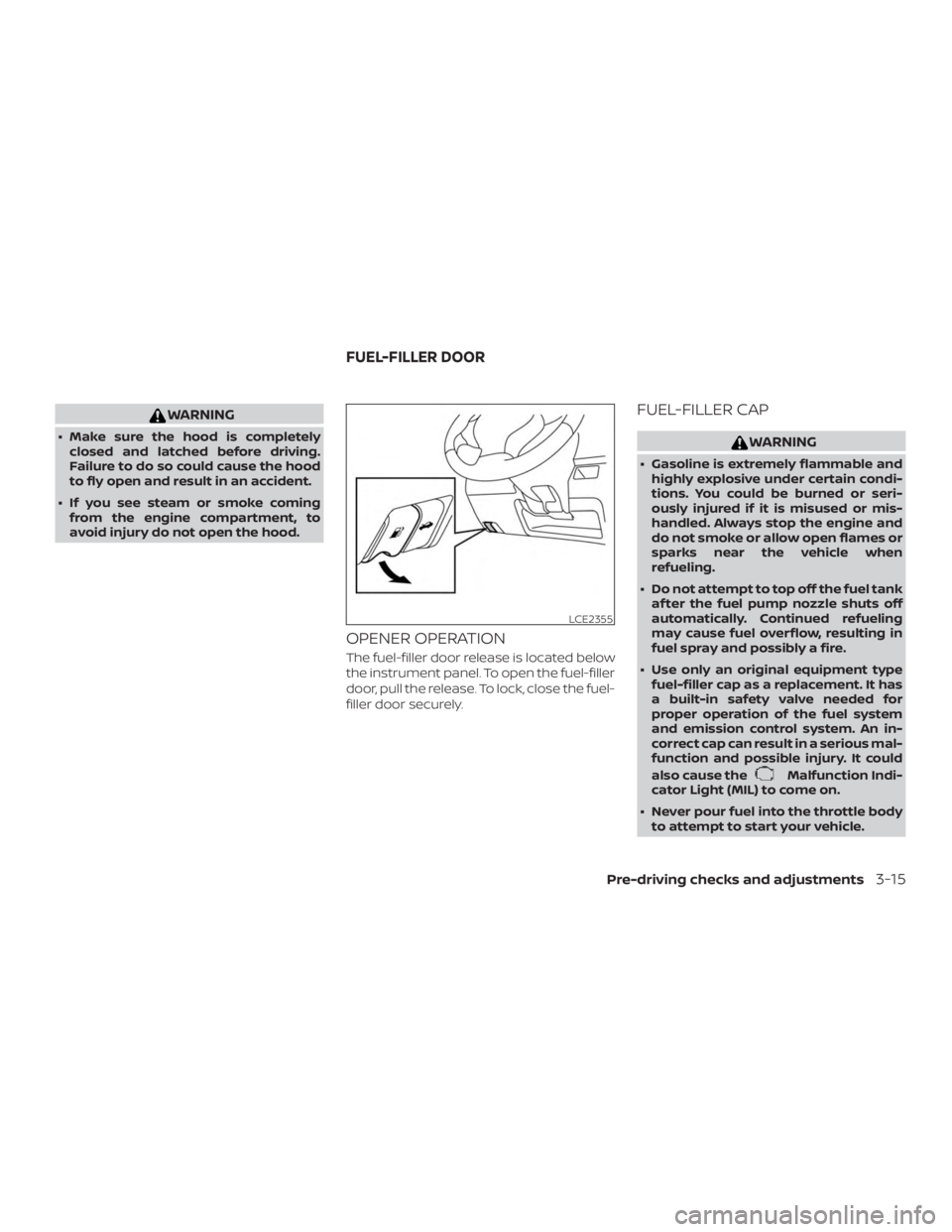
OPENER OPERATION
The fuel-filler door release is located below
the instrument panel. To open the fuel-filler
door, pull the release. To lock, close the fuel-
filler door securely.
FUEL-FILLER CAP
Page 121 of 370
∙ Do not fill a portable fuel container inthe vehicle or trailer. Static electricity
can cause an explosion of flammable
liquid, vapor or gas in any vehicle or
trailer. To reduce the risk of serious
injury or death when filling portable
fuel containers:
– Always place the container on the ground when filling.
– Do not use electronic devices when filling.
– Keep the pump nozzle in contact with the container while you are
filling it.
– Use only approved portable fuel containers for flammable liquid.
Page 142 of 370

∙ Objects viewed in the RearView Moni-tor differ from actual distance be-
cause a wide-angle lens is used.
∙ Objects in the RearView Monitor will appear visually opposite compared to
when viewed in the rearview and out-
side mirrors.
∙ Use the displayed lines as a reference. The lines are highly affected by the
number of occupants, fuel level, ve-
hicle position, road conditions and
road grade.
∙ Make sure that the back door(s) is se- curely closed when backing up.
∙ Do not put anything on the rearview camera. The rearview camera is in-
stalled above the license plate.
∙ When washing the vehicle with high pressure water, be sure not to spray it
around the camera. Otherwise, water
may enter the camera unit causing
water condensation on the lens, a
malfunction, fire or an electric shock.
∙ Do not strike the camera. It is a preci- sion instrument. Otherwise, it may
malfunction or cause damage result-
ing in a fire or an electric shock. The following are operating limitations and
do not represent a system malfunction:
∙ When the temperature is extremely high or low, the screen may not clearly
display objects.
∙ When strong light directly shines on the camera, objects may not be displayed
clearly.
∙ Vertical lines may be seen in objects on the screen. This is due to strong re-
flected light from the bumper.
∙ The screen may flicker under fluores- cent light.
∙ The colors of objects on the RearView Monitor may differ somewhat from the
actual color of objects.
∙ Objects on the monitor may not be clear in a dark environment.
∙ There may be a delay when switching between views.
∙ If dirt, rain or snow accumulate on the camera, RearView Monitor may not dis-
play objects clearly. Clean the camera. ∙ Do not use wax on the camera lens.
Wipe off any wax with a clean cloth
dampened with a diluted mild cleaning
agent, then wipe with a dry cloth.
Monitor, climate, audio, phone and voice recognition systems4-17
Page 220 of 370
CAUTION
∙ Do not use leaded gasoline. Depositsfrom leaded gasoline will seriously re-
duce the three-way catalyst’s ability
to help reduce exhaust pollutants.
∙ Keep your engine tuned up. Malfunc- tions in the ignition, fuel injection, or
electrical systems can cause over rich
fuel flow into the three-way catalyst,
causing it to overheat. Do not keep
driving if the engine misfires, or if no-
ticeable loss of performance or other
unusual operating conditions are de-
tected. Have the vehicle inspected
promptly. It is recommended that you
visit a NISSAN dealer for this service.
∙ Avoid driving with an extremely low fuel level. Running out of fuel could
cause the engine to misfire, damag-
ing the three-way catalyst.
∙ Do not race the engine while warming it up.
∙ Do not push or tow your vehicle to start the engine.
TIRE PRESSURE MONITORING
SYSTEM (TPMS)
Each tire, including the spare (if provided),
should be checked monthly when cold and
inflated to the inflation pressure recom-
mended by the vehicle manufacturer on
the vehicle placard or tire inflation pressure
label.
(If your vehicle has tires of a different size
than the size indicated on the vehicle plac-
ard or tire inflation pressure label, you
should determine the proper tire inflation
pressure for those tires.)
As an added safety feature, your vehicle
has been equipped with a Tire Pressure
Monitoring System (TPMS) that illuminates
a low tire pressure telltale when one or
more of your tires is significantly under-
inflated. Accordingly, when the low tire
pressure telltale illuminates, you should
stop and check your tires as soon as pos-
sible, and inflate them to the proper pres-
sure. Driving on a significantly under-
inflated tire causes the tire to overheat and
can lead to tire failure. Under-inflation also
reduces fuel efficiency and tire tread life,
and may affect the vehicle’s handling and
stopping ability. Please note that the TPMS is not a substi-
tute for proper tire maintenance, and it is
the driver’s responsibility to maintain cor-
rect tire pressure, even if under-inflation
has not reached the level to trigger illumi-
nation of the TPMS low tire pressure telltale.
Your vehicle has also been equipped with a
TPMS malfunction indicator to indicate
when the system is not operating properly.
The TPMS malfunction indicator is com-
bined with the low tire pressure telltale.
When the system detects a malfunction,
the telltale will flash for approximately one
minute and then remain continuously illu-
minated. This sequence will continue upon
subsequent vehicle start-ups as long as
the malfunction exists. When the malfunc-
tion indicator is illuminated, the system
may not be able to detect or signal low tire
pressure as intended. TPMS malfunctions
may occur for a variety of reasons, includ-
ing the installation of replacement or alter-
nate tires or wheels on the vehicle that
prevent the TPMS from functioning prop-
erly. Always check the TPMS malfunction
telltale af ter replacing one or more tires or
wheels on your vehicle to ensure that the
replacement or alternate tires and wheels
allow the TPMS to continue to function
properly.
Starting and driving5-3
Page 227 of 370
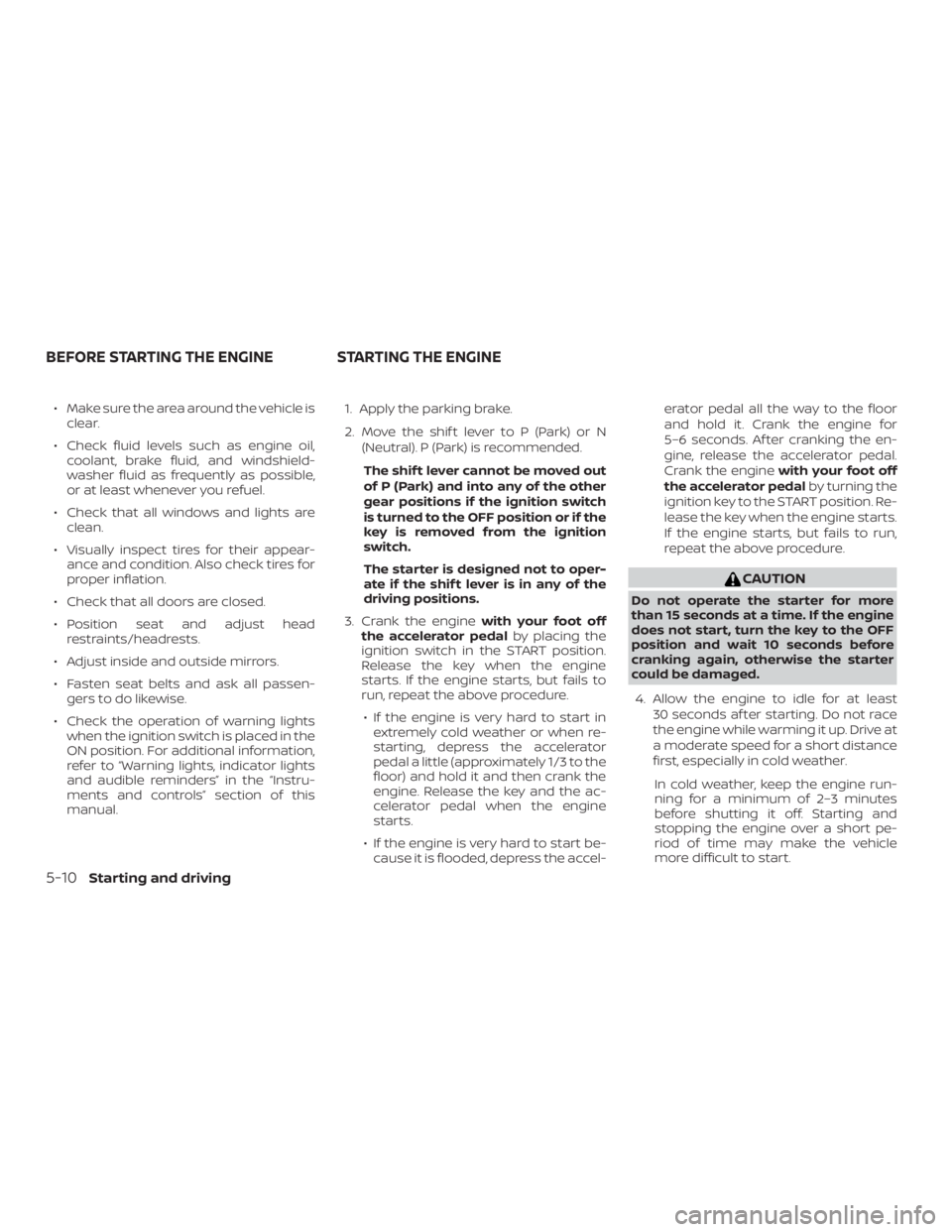
∙ Make sure the area around the vehicle isclear.
∙ Check fluid levels such as engine oil, coolant, brake fluid, and windshield-
washer fluid as frequently as possible,
or at least whenever you refuel.
∙ Check that all windows and lights are clean.
∙ Visually inspect tires for their appear- ance and condition. Also check tires for
proper inflation.
∙ Check that all doors are closed.
∙ Position seat and adjust head restraints/headrests.
∙ Adjust inside and outside mirrors.
∙ Fasten seat belts and ask all passen- gers to do likewise.
∙ Check the operation of warning lights when the ignition switch is placed in the
ON position. For additional information,
refer to “Warning lights, indicator lights
and audible reminders” in the “Instru-
ments and controls” section of this
manual. 1. Apply the parking brake.
2. Move the shif t lever to P (Park) or N
(Neutral). P (Park) is recommended.
The shif t lever cannot be moved out
of P (Park) and into any of the other
gear positions if the ignition switch
is turned to the OFF position or if the
key is removed from the ignition
switch.
The starter is designed not to oper-
ate if the shif t lever is in any of the
driving positions.
3. Crank the engine with your foot off
the accelerator pedal by placing the
ignition switch in the START position.
Release the key when the engine
starts. If the engine starts, but fails to
run, repeat the above procedure.
∙ If the engine is very hard to start in extremely cold weather or when re-
starting, depress the accelerator
pedal a little (approximately 1/3 to the
floor) and hold it and then crank the
engine. Release the key and the ac-
celerator pedal when the engine
starts.
∙ If the engine is very hard to start be- cause it is flooded, depress the accel- erator pedal all the way to the floor
and hold it. Crank the engine for
5–6 seconds. Af ter cranking the en-
gine, release the accelerator pedal.
Crank the engine
with your foot off
the accelerator pedal by turning the
ignition key to the START position. Re-
lease the key when the engine starts.
If the engine starts, but fails to run,
repeat the above procedure.
Page 340 of 370
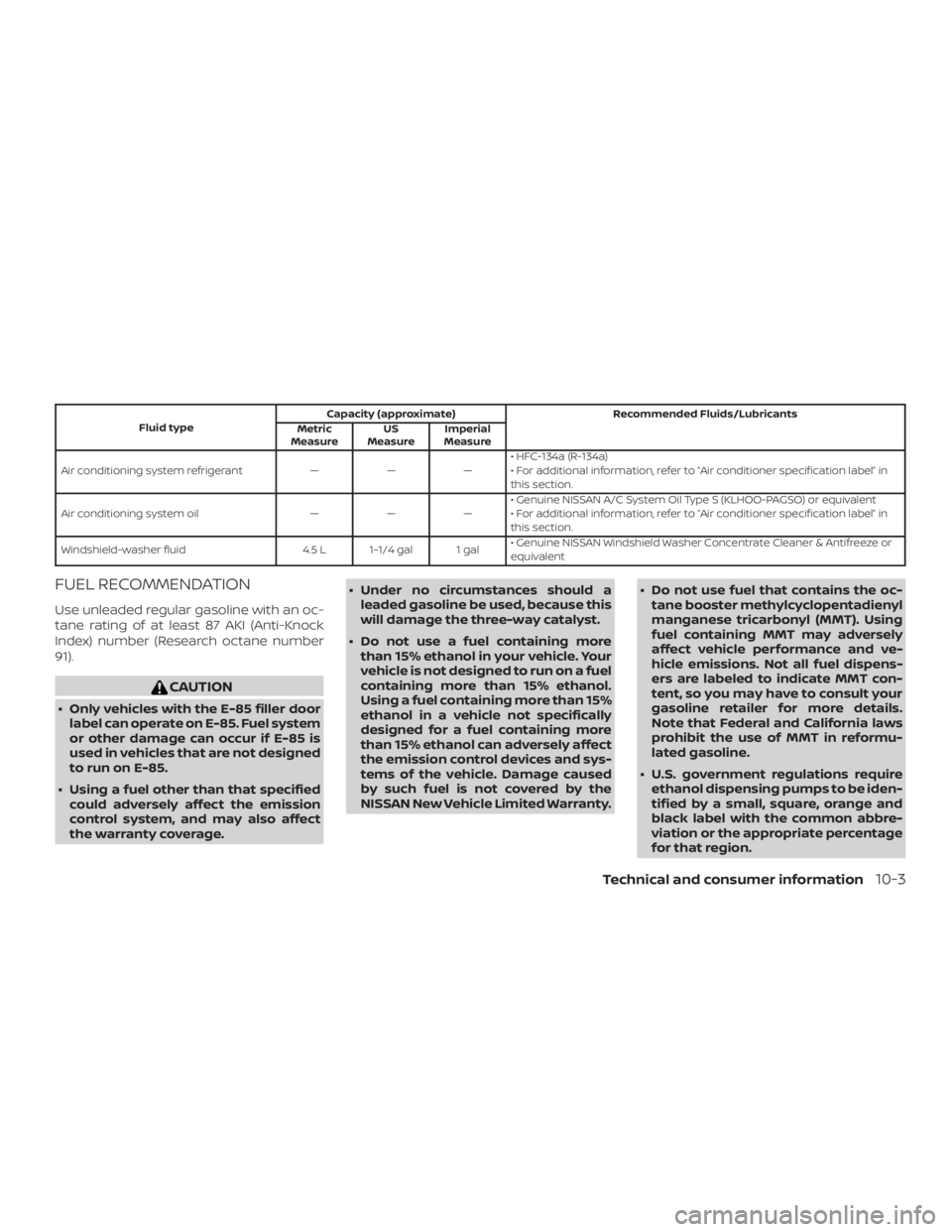
Fluid typeCapacity (approximate)
Recommended Fluids/Lubricants
Metric
Measure US
Measure Imperial
Measure
Air conditioning system refrigerant ———• HFC-134a (R-134a)
• For additional information, refer to “Air conditioner specification label” in
this section.
Air conditioning system oil ———• Genuine NISSAN A/C System Oil Type S (KLHOO-PAGSO) or equivalent
• For additional information, refer to “Air conditioner specification label” in
this section.
Windshield-washer fluid 4.5 L 1-1/4 gal 1 gal• Genuine NISSAN Windshield Washer Concentrate Cleaner & Antifreeze or
equivalent
FUEL RECOMMENDATION
Use unleaded regular gasoline with an oc-
tane rating of at least 87 AKI (Anti-Knock
Index) number (Research octane number
91).
Page 361 of 370
CD player (See audio system)....4-40,4-47
Childrestraints ...........1-19, 1-19, 1-21 Precautions on child
restraints............1-22, 1-24, 1-28
Top tether strap anchor point
locations.................. .1-23
Child restraint with top tether strap . . . .1-23
Chimes, audible reminders ..........2-17
Cleaningexteriorandinterior......7-2,7-4
Clock setting (models with Navigation
System)......................4-7
Clock setting (models without Navigation
System)..................4-38,4-39
C.M.V.S.S. certification label .........10-11
Coldweatherdriving.............5-33
Compact disc (CD) player .......4-40,4-47
Continuously Variable
Transmission (CVT) ............5-8,5-12
Continuously Variable Transmission (CVT)
fluid......................8-10
Driving with Continuously Variable
Transmission (CVT) ..........5-8,5-12
Control panel buttons .............4-4
Brightness/contrast button .......4-9
Settingbutton................4-7
Controls Audio controls (steering wheel) ....4-62
Heater and air conditioner controls . .4-19
Coolant Capacities and recommended
fuel/lubricants...............10-2
Changing engine coolant .........8-6
Checking engine coolant level ......8-6
Corrosionprotection..............7-7
Cruisecontrol..................5-18
Cupholders ..................2-28 D
Daytimelightsystem.............2-22
Defroster switch Rear window and outside mirror
defrosterswitch..............2-21
Dimensions and weights ...........10-9
Dimmer switch for instrument panel . . .2-23
Display controls
(see control panel buttons) ..........4-4
Door locks ....................3-4
Door open warning light ...........2-11
Doors .......................3-3
D-ring ...................2-29,10-16
Drivebelt ....................8-15
Driving Cold weather driving ...........5-33
Driving with Continuously Variable
Transmission (CVT) ..........5-8,5-12
Precautions when starting and
driving.....................5-2
Drivingthevehicle...............5-11
E
Economy - fuel .................5-21
Emission control information label . . . .10-11
Emission control system warranty . . . .10-19
Engine Before starting the engine ........5-10
Capacities and recommended
fuel/lubricants...............10-2
Changing engine coolant .........8-6
Changing engine oil ............8-8
Changing engine oil filter .........8-9Checking engine coolant level
......8-6
Checking engine oil level .........8-7
Engine compartment check
locations...................8-4
Engine cooling system ..........8-5
Engine oil ...................8-7
Engine oil and oil filter
recommendation .............10-6
Engine oil pressure warning light ....2-11
Engine oil viscosity .............10-6
Engine serial number ..........10-10
Engine specifications ...........10-8
Starting the engine ............5-10
Engine Block Heater .............5-35
EventDatarecorders ............10-21
Exhaust gas (Carbon monoxide) .......5-2
Explanation of maintenance items .....9-2
Explanation of scheduled maintenance
items .......................9-5
Extended storage switch...........8-21
F
Flasher
s
(Seehazardwarningflasherswitch)....6-2
Flattire....................6-2,6-3
Floormatpositioningaid...........7-5
Fluid Brakefluid..................8-10
Capacities and recommended
fuel/lubricants...............10-2
Continuously Variable Transmission (CVT)
fluid......................8-10
Engine coolant ...............8-5
Engine oil ...................8-7
11-2
Page 362 of 370
Windshield-washer fluid.........8-11
F.M.V.S.S. certification label ..........10-11
Front air bag system
(See supplemental restraint system) . . .1-39
Front-door pocket ...............2-27
Frontseats................... .1-2
Fuel Capacities and recommended
fuel/lubricants...............10-2
Fuel economy ...............5-21
Fuel-filler door and cap ..........3-15
Fuel-filler door lock opener lever ....3-15
Fuel gauge ..................2-6
Fueloctanerating.............10-5
Fuel recommendation ..........10-3
Loose fuel cap warning ..........2-5
Fuelefficientdrivingtips...........5-20
Fuel-filler door .................3-15
Fuel gauge ....................2-6
Fuses .......................8-19
Fusiblelinks...................8-20
G
Gascap .....................3-15
Gauge Fuel gauge ..................2-6
Odometer ..................2-4
Speedometer ................2-4
Tachometer .................2-6
Trip computer ................2-7
Trip odometer ................2-4
General maintenance .............9-2
Glovebox....................2-28
Gloveboxlock.................2-28 H
Hands-free phone system,
Bluetooth®................4-65,4-76
Hazard warning flasher switch ........6-2
Headlight and turn signal switch ......2-21
Headlightcontrolswitch...........2-21
Headlights ...................8-24
Headrestraints................. .1-7
Heater Heater and air conditioner controls . .4-19
Heater operation ..............4-21
Hill start assist system ............5-29
Hood .......................3-14
Horn.......................2-24
I
Ignition switch ..................5-8
Immobilizer system .........2-19,3-2,5-9
Important vehicle information label . . . .10-11
Increasing fuel economy ...........5-21
Indicator lights and audible reminders
(See warning/indicator lights and audible
reminders) .................2-9,2-15
Instrument brightness control .......2-23
Instrument panel .............0-6,2-2
Instrument panel dimmer switch .....2-23
Interiorlight...............2-32,2-34
iPod®Player...............4-53,4-55
J
Jumpstarting..............6-10,8-14 K
Key........................ .3-2
Key fob battery replacement .....8-22,8-22
Keyless entry Without Intelligent Key system
(See remote keyless entry
system).................3-10, 3-11
Keys NISSAN Vehicle Immobilizer System
keys......................3-2
L
Label Tirewarning................10-12
Labels Air conditioner specification label . . .10-12
C.M.V.S.S. certification label .......10-11
Emission control information label . .10-11
Engine serial number ..........10-10
F.M.V.S.S. certification label ........10-11
Tir
e and Loading Information label . .10-11
Vehicle identification number (VIN) . .10-10
Vehicle identification number (VIN)
plate.....................10-10
Warning labels (for SRS) .........1-49
License plate Installing the license plate .......10-12
Light Airbagwarninglight........1-50, 2-14
Brakelight(Seestoplight)........8-29
Bulb check/instrument panel ......2-9
Bulb replacement .............8-29
Charge warning light ...........2-11
11-3
Page 363 of 370
Headlight and turn signal switch....2-21
Headlightcontrolswitch.........2-21
Headlights .................8-24
Interiorlight.............2-32,2-34
Lightbulbs.................8-24
Low tire pressure warning light .....2-12
Low windshield-washer fluid warning
light......................2-13
Passenger air bag and status light . . .1-41
Security indicator light ..........2-16
Warning/indicator lights and audible
reminders ...............2-9,2-15
Lights......................8-24 Maplights..................2-33
Lock Door locks ..................3-4
Fuel-filler door lock opener lever ....3-15
Gloveboxlock...............2-28
Power door locks ..............3-6
Loose fuel cap warning ............2-5
Lowfuelwarninglight.............2-11
Low tire pressure warning light .......2-12
Low windshield-washer fluid warning
light........................2-13
Luggage
(See vehicle loading information) .....10-13
M
Maintenance General maintenance ...........9-2
Insidethevehicle..............9-3
Maintenance precautions .........8-2
Outsidethevehicle.............9-2
Seat belt maintenance ..........1-18 Under the hood and vehicle
.......9-4
Maintenance log ................9-13
Maintenance requirements ..........9-2
Maintenance schedules ............9-7
Maintenance under severe operation
conditions....................9-12
Malfunctionindicatorlight..........2-15
Manual front seat adjustment ........1-3
Maplights....................2-33
Meters and gauges ...............2-3
Instrument brightness control .....2-23
Mirror Outsidemirrors ..............3-19
Rearview...................3-19
Mirrors......................3-19
Mobile apps ...................4-63
N
NissanConnect® ................4-63
NISSAN Vehicle Immobilizer
System...................2-19,5-9
NISSAN voice recognition system .....4-86
O
Octane rating (See fuel octane rating). . .10-5
Odometer ....................2-4
Oil Capacities and recommended
fuel/lubricants...............10-2
Changing engine oil ............8-8
Changing engine oil filter .........8-9
Checking engine oil level .........8-7Engine oil
...................8-7
Engine oil and oil filter
recommendation .............10-6
Engine oil viscosity .............10-6
One shot call ...............4-69,4-79
Outsidemirrors ................3-19
Overheat Ifyourvehicleoverheats.........6-12
Owner's manual order form ........10-22
Owner's manual/service manual order
information..................10-22
P
Parking Parking/parkingonhills.........5-23
Parkingbrake..................5-17
Phone, Bluetooth® hands-free
system..................4-65,4-76
Power Power door locks ..............3-6
Poweroutlet................2-26
Power steering system ..........5-23
Powerwindows..............2-30
Poweroutlet..................2-26
Powersteering.................5-23
Precautions Maintenance precautions .........8-2
Precautions on booster
seats...............1-22, 1-24, 1-28
Precautions on child
restraints............1-22, 1-24, 1-28
Precautionsonseatbeltusage.....1-11
Precautions on supplemental restraint
system ....................1-32
11-4