service NISSAN PATHFINDER 1997 R50 / 2.G User Guide
[x] Cancel search | Manufacturer: NISSAN, Model Year: 1997, Model line: PATHFINDER, Model: NISSAN PATHFINDER 1997 R50 / 2.GPages: 233, PDF Size: 1.9 MB
Page 165 of 233
When performing any inspection or mainte-
nance work on your vehicle, always take care
to prevent serious accidental injury to yourself
or damage to the vehicle. The following are
general precautions which should be closely
observed.
IPark the vehicle on a level surface,
apply the parking brake securely and
block the wheels to prevent the ve-
hicle from moving. For a manual
transmission, move the shift lever to
Neutral. For an automatic transmis-
sion, move the selector lever to ªPº
(Park).
IBe sure the ignition key is in the
ªOFFº or ªLOCKº position when per-
forming any replacement or repair.
IIf you must work with the engine
running, keep your hands, clothing,
hair and tools away from moving fans
and fan belts.
IIt is advisable to remove necktie and
any jewelry, such as rings, watches,
etc. before working on your vehicle.IIf you must run the engine in an
enclosed space such as a garage, be
sure there is proper ventilation for
exhaust gases.
INever get under the vehicle while it is
supported only by a jack. If it is nec-
essary to work under the vehicle,
support it with safety stands.
IKeep smoking materials, flame and
sparks away from fuel and battery.
IThe fuel filter or fuel lines should be
serviced by a NISSAN dealer because
the fuel lines are under high pressure
even when the engine is off.
IDo not work under the engine hood
while it is hot. Always turn off the
engine and wait until it cools down.
INever connect or disconnect either
the battery or any transistorized com-
ponent connector while the ignition
key is on.
IAvoid direct contact with used engineoil. Improperly disposed motor oil and/
or other vehicle fluids can hurt the
environment. Always conform to lo-
cal regulations for disposal of vehicle
fluid.
This ªDo-it-yourself operationsº section gives
instructions regarding only those items which
are relatively easy for an owner to perform.
You should be aware that incomplete or im-
proper servicing may result in operating diffi-
culties or excessive emissions, and could af-
fect your warranty coverage.If in doubt about
any servicing, have it done by your NISSAN
dealer.
PRECAUTIONS
7-2
Z01.2.1/R50-DX
Page 168 of 233
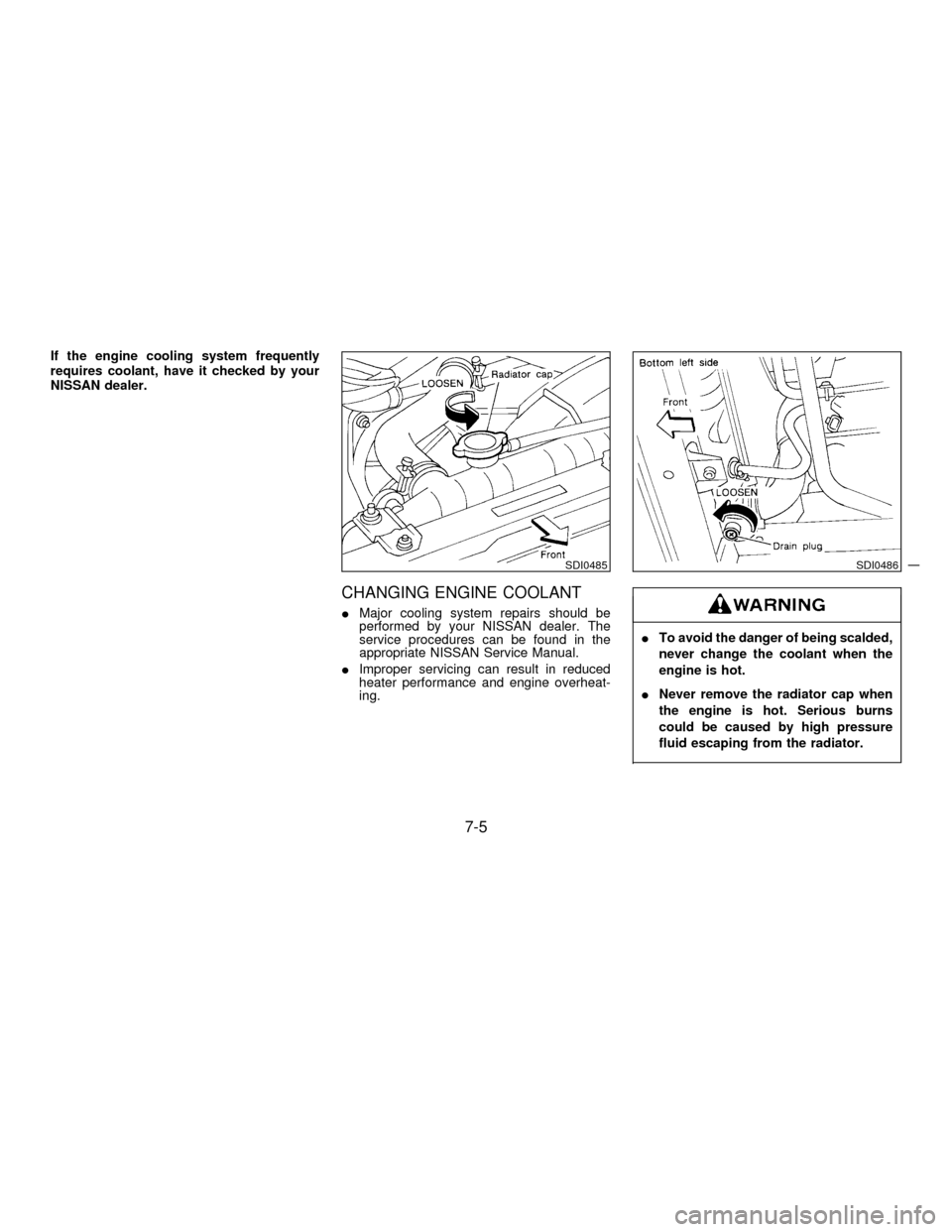
If the engine cooling system frequently
requires coolant, have it checked by your
NISSAN dealer.
CHANGING ENGINE COOLANT
IMajor cooling system repairs should be
performed by your NISSAN dealer. The
service procedures can be found in the
appropriate NISSAN Service Manual.
IImproper servicing can result in reduced
heater performance and engine overheat-
ing.
ITo avoid the danger of being scalded,
never change the coolant when the
engine is hot.
INever remove the radiator cap when
the engine is hot. Serious burns
could be caused by high pressure
fluid escaping from the radiator.
SDI0485SDI0486
7-5
Z01.2.1/R50-DX
Page 192 of 233

replaced.
Changing tires and wheels
When replacing a tire, use the same size,
speed rating and load carrying capacity as
originally equipped. Recommended types and
sizes are shown in ªWheels and tiresº in the
ªTechnical informationº section.
IThe use of tires other than those
recommended or the mixed use of
tires of different brands, construction
(bias, bias-belted or radial), or tread
patterns can adversely affect the ride,
braking, handling, ground clearance,
body-to-tire clearance, snow chain
clearance, speedometer calibration,
headlight aim and bumper height.
Some of these effects may lead to
accidents and could result in serious
personal injury.
IIf the wheels are changed for any
reason, always replace with wheels
which have the same offset dimen-
sion. Wheels of a different offset
could cause early tire wear, possiblydegraded vehicle handling character-
istics and/or interference with the
brake discs/drums. Such interference
can lead to decreased braking effi-
ciency and/or early brake pad/shoe
wear.
IDo not install a deformed wheel or
tire even if it has been repaired. Such
wheels or tires could have structural
damage and could fail without
warning.
4-WHEEL DRIVE MODELS
Always use tires of the same size, brand,
construction (bias, bias-belted or ra-
dial), and tread pattern on all four
wheels. Failure to do so may result in a
circumference difference between tires
on the front and rear axles which will
cause excessive tire wear and may dam-
age the transmission, transfer case and
differential gears.
If excessive tire wear is found, it is recom-
mended that all four tires be replaced with tiresof the same size, brand, construction and
tread pattern. The tire pressure and wheel
alignment should also be checked and cor-
rected as necessary. Contact your NISSAN
dealer.
ONLY use spare tires specified for each
4-wheel drive model.
Wheel balance
Unbalanced wheels may affect vehicle han-
dling and tire life. Even with regular use,
wheels can get out of balance. Therefore, they
should be balanced as required.
Wheel balance service should be performed
with the wheels off the vehicle. Spin balancing
the rear wheels on the vehicle could lead to
transmission damage.
7-29
Z01.2.1/R50-DX
Page 195 of 233
Your new NISSAN has been designed to have
minimum maintenance requirements with
longer service intervals to save you both time
and money. However, some day- to-day and
regular maintenance is essential to maintain
your NISSAN's good mechanical condition, as
well as its emission and engine performance.
It is the owner's responsibility to make sure
that the specified maintenance, as well as
general maintenance, is performed.
As the vehicle owner, you are the only one
who can ensure that your vehicle receives the
proper maintenance care. You are a vital link
in the maintenance chain.
General maintenance
General maintenance includes those items
which should be checked during normal day-
to-day operation of the vehicle. They are es-
sential if your vehicle is to continue to operate
properly. It is your responsibility to perform
these procedures regularly as prescribed.
These checks or inspections can be done by
yourself, a qualified technician or, if you prefer,
your NISSAN dealer.
Periodic maintenance
The maintenance items listed in this part are
required to be serviced at regular intervals.However, under severe driving conditions, ad-
ditional or more frequent maintenance will be
required.
Where to go for service
If maintenance service is required or your
vehicle appears to malfunction, have the sys-
tems checked and tuned by an authorized
NISSAN dealer.
NISSAN technicians are well-trained special-
ists and are kept up to date with the latest
service information through technical bulletins,
service tips, and in-dealership training pro-
grams. They are completely qualified to work
on NISSAN's vehicles before they work on
your vehicle, rather than after they have
worked on it.
You can be confident that your NISSAN deal-
er's service department performs the best job
to meet the maintenance requirements on your
vehicle Ð in a reliable and economic way.During the normal day-to-day operation of the
vehicle, general maintenance should be per-
formed regularly as prescribed in this section.
If you detect any unusual sounds, vibrations or
smell, be sure to check for the cause or have
your NISSAN dealer do it promptly. In addition,
you should notify your NISSAN dealer if you
think that repairs are required.
When performing any checks or maintenance
work, closely observe the precautions in the
ªDo-it-yourself operationsº section.
Additional information on the following
items with ª*º is found in the ªDo-it-
yourself operationsº section.
OUTSIDE THE VEHICLE
The maintenance items listed here should be
performed from time to time, unless otherwise
specified.
Tires*Check the pressure with a gauge peri-
odically when at a service station, including the
spare, and adjust to the specified pressure if
necessary. Check carefully for damage, cuts
or excessive wear.
Wheel nuts*When checking the tires, make
sure no nuts are missing, and check for any
loose nuts. Tighten if necessary.
Tire rotation*Tires should be rotated every
GENERAL MAINTENANCE
8-2
Z01.2.1/R50-DX
Page 198 of 233

To ensure smooth, trouble-free, safe and eco-
nomical driving, NISSAN provides two differ-
ent maintenance schedules that may be used,
depending upon the conditions in which you
usually drive. These schedules contain both
distance and time intervals, up to 60,000 miles
(96,000 km)/48 months. For most people, the
odometer reading will indicate when service is
needed. However, if you drive very little, your
vehicle should be serviced at the regular time
intervals shown in the schedule.
After 60,000 miles (96,000 km) or 48
months, continue periodic maintenance at
the same mileage/time intervals.
SCHEDULE 1
Follow Periodic Maintenance Schedule 1 if
your driving habits frequently include one or
more of the following driving conditions:
IRepeated short trips of less than 5 miles
(8 km).
IRepeated short trips of less than 10
miles (16 km) with outside temperatures
remaining below freezing.
IOperating in hot weather in stop-and-go
ªrush hourº traffic.
IExtensive idling and/or low speed driv-
ing for long distances, such as police,taxi or door-to-door delivery use.
IDriving in dusty conditions.
IDriving on rough, muddy, or salt spread
roads.
ITowing a trailer, using a camper or a
car-top carrier.
SCHEDULE 2
Follow Periodic Maintenance Schedule 2 if
none of the driving conditions shown in Sched-
ule 1 apply to your driving habits.
Maintenance for off-road driving
Whenever you drive off-road through sand,
mud or water as deep as the wheel hub, more
frequent maintenance may be required of the
following items:
GBrake pads and discs
GBrake lining and drums
GBrake lines and hoses
GWheel bearing grease
GDifferential, transmission and transfer oil
GSteering linkage
GPropeller shafts and front drive shafts
GAir cleaner filter
GClutch housing (Check water entry. Refer to
ªDo-it-yourself operationsº section.)
These items should be checked frequently to
assure safe and proper operation of your ve-
hicle.
PERIODIC MAINTENANCE
8-5
Z01.2.1/R50-DX
Page 210 of 233
eastern Nevada, southern Idaho, western
South Dakota, western Nebraska, and that
part of Texas which is directly south of New
Mexico.
Using unleaded gasoline with an octane
rating lower than stated above can cause
persistent, heavy ªspark knockº. (ªSpark
knockº is a metallic rapping noise.) If se-
vere, this can lead to engine damage. If you
detect a persistent heavy spark knock even
when using gasoline of the stated octane
rating, or if you hear steady spark knock
while holding a steady speed on level
roads, have your dealer correct the condi-
tion. Failure to correct the condition is
misuse of the vehicle, for which NISSAN is
not responsible.
Incorrect ignition timing will result in knocking,
after-run or overheating. This in turn may
cause excessive fuel consumption or damage
to the engine. If any of the above symptoms
are encountered, have your vehicle checked at
a NISSAN dealer or other competent service
facility.
However, now and then you may notice
light spark knock for a short time while
accelerating or driving up hills. This is no
cause for concern, because you get the
greatest fuel benefit when there is lightspark knock for a short time.
9-5
Z01.2.1/R50-DX
Page 211 of 233
ENGINE OIL AND OIL FILTER
RECOMMENDATION
Selecting the correct oil
It is essential to choose the correct quality, and
viscosity oil to ensure satisfactory engine life
and performance. Nissan recommends the
use of a low friction oil (energy conserving oil)
in order to improve fuel economy and con-
serve energy. Oils which do not have the
specified quality label should not be used as
they could cause engine damage.
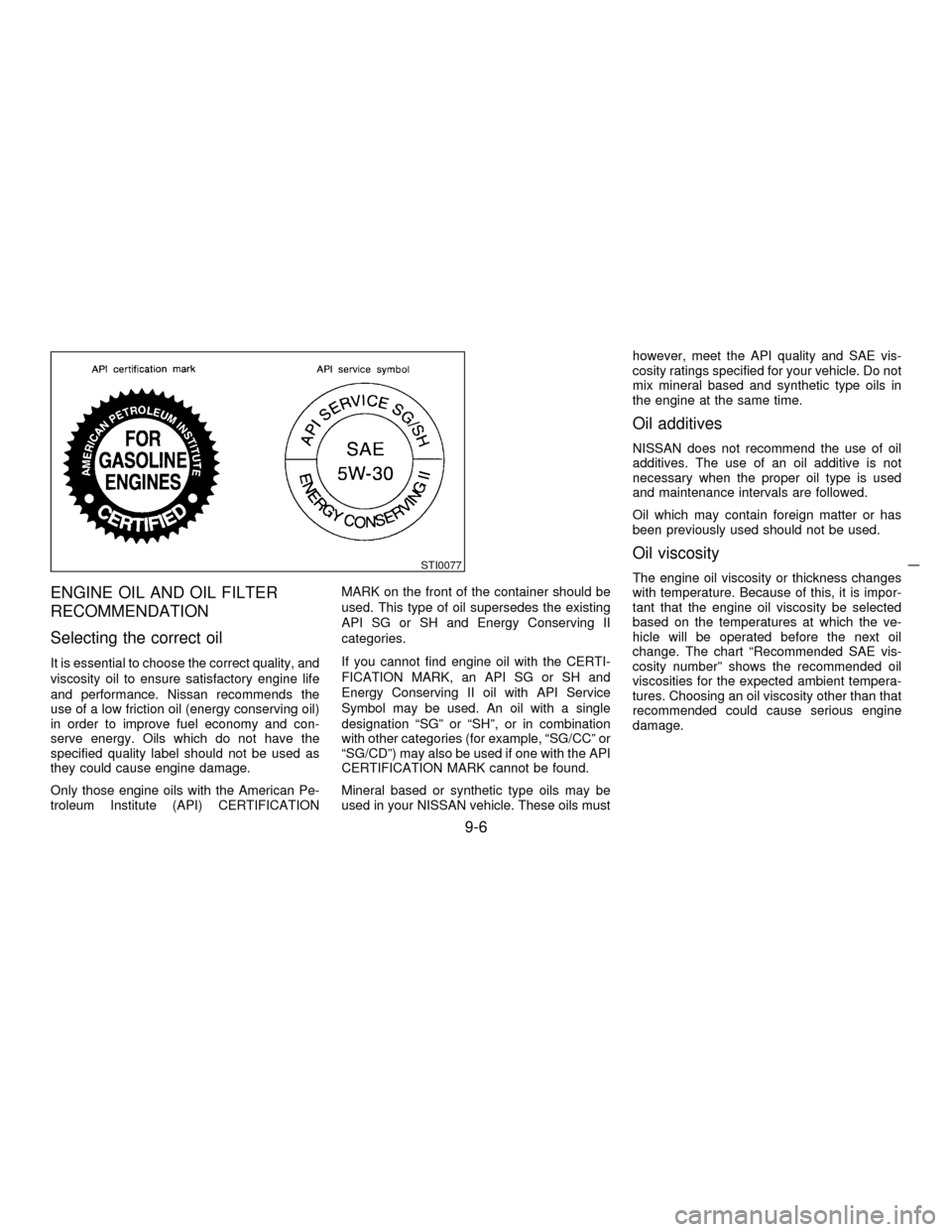
Only those engine oils with the American Pe-
troleum Institute (API) CERTIFICATIONMARK on the front of the container should be
used. This type of oil supersedes the existing
API SG or SH and Energy Conserving II
categories.
If you cannot find engine oil with the CERTI-
FICATION MARK, an API SG or SH and
Energy Conserving II oil with API Service
Symbol may be used. An oil with a single
designation ªSGº or ªSHº, or in combination
with other categories (for example, ªSG/CCº or
ªSG/CDº) may also be used if one with the API
CERTIFICATION MARK cannot be found.
Mineral based or synthetic type oils may be
used in your NISSAN vehicle. These oils musthowever, meet the API quality and SAE vis-
cosity ratings specified for your vehicle. Do not
mix mineral based and synthetic type oils in
the engine at the same time.
Oil additives
NISSAN does not recommend the use of oil
additives. The use of an oil additive is not
necessary when the proper oil type is used
and maintenance intervals are followed.
Oil which may contain foreign matter or has
been previously used should not be used.
Oil viscosity
The engine oil viscosity or thickness changes
with temperature. Because of this, it is impor-
tant that the engine oil viscosity be selected
based on the temperatures at which the ve-
hicle will be operated before the next oil
change. The chart ªRecommended SAE vis-
cosity numberº shows the recommended oil
viscosities for the expected ambient tempera-
tures. Choosing an oil viscosity other than that
recommended could cause serious engine
damage.STI0077
9-6
Z01.2.1/R50-DX
Page 214 of 233

AIR CONDITIONING SYSTEM
REFRIGERANT AND LUBRICANT
RECOMMENDATIONS
The air conditioning system in this NISSAN
vehicle must be charged with the refriger-
ant HFC-134a (R-134a) and the lubricant,
Nissan A/C System Oil Type S or the exact
equivalents.Use of any other refrigerants or
lubricants will cause severe damage and you
will need to replace your vehicle's entire air
conditioning system.
The refrigerant HFC-134a (R-134a) in your
NISSAN vehicle will not harm the earth's
ozone layer. Although this refrigerant does not
affect the earth's atmosphere, certain govern-
mental regulations require the recovery and
recycling of any refrigerant during automotive
air conditioning system service. Your NISSAN
dealer has the trained technicians and equip-
ment needed to recover and recycle your air
conditioning system refrigerant.
Contact your NISSAN dealer when servicing
your air conditioning system.
9-9
Z01.2.1/R50-DX
Page 225 of 233

opening the windows, switching the fan
control to high and setting the temperature
control to the ªHOTº position.
ITrailer towing requires more fuel than nor-
mal circumstances.
IAvoid towing a trailer for the first 500 miles
(800 km).
IHave your vehicle serviced more often than
at intervals specified in the recommended
Maintenance Schedule.
When towing a trailer, change oil in the
transmission more frequently. See the
Maintenance Schedule.Your NISSAN is covered by the following
emission warranties.
For U.S.A.
1) Emission Defects Warranty
2) Emissions Performance Warranty
For Canada
Emission Control System Warranty
Details of these warranties may be found with
other vehicle warranties in your Warranty In-
formation and Maintenance Log Booklet which
comes with your NISSAN. If you did not re-
ceive a Warranty Information and Mainte-
nance Log Booklet or it becomes lost, you may
obtain a replacement by writing.
INissan Motor Corporation U.S.A. Con-
sumer Affairs Department P.O. Box 191
Gardena. CA 90248-0191
INissan Canada Inc. P.O. Box 1709, Station
ªBº Mississauga, Ontario, L4Y 4H6
If you believe that your vehicle has
a defect which could cause a crash
or could cause injury or death, you
should immediately inform the Na-
tional Highway Traffic Safety Ad-
ministration (NHTSA) in addition to
notifying NISSAN.
If NHTSA receives similar com-
plaints, it may open an investiga-
tion, and if it finds that a safety
defect exists in a group of vehicles,
it may order a recall and remedy
campaign. However, NHTSA can-
not become involved in individual
problems between you, your dealer,
or NISSAN.
To contact NHTSA, you may either
call the Auto Safety Hotline toll-free
at 1-800-424-9393 (or 366-0123 in
Washington, D.C. area) or write to:
NHTSA, U.S. Department of Trans-
portation, Washington, D.C. 20590.
You can also obtain other informa-
tion about motor vehicle safety from
the Hotline.
EMISSION CONTROL SYSTEM
WARRANTYREPORTING SAFETY DEFECTS
(For U.S.A.)
9-20
Z01.2.1/R50-DX
Page 227 of 233

A Genuine Nissan Service Manual is the best
source of service and repair information for
your vehicle. Filled with wiring diagrams, illus-
trations and step-by-step diagnostic and ad-
justment procedures, this manual is the same
one used by the factory trained technicians
working at your Nissan dealership. Also avail-
able are Genuine NISSAN Owner's Manuals.
For current pricing and availability of a Genu-
ine NISSAN Service Manual or Genuine
NISSAN Owner's Manual, contact:In the U.S.A.:
See your NISSAN dealer or contact:
Dyment Distribution Services
20770 Westwood Dr.
Strongsville OH 44136
In a hurry? Call 1-800-247-5321 and charge
your purchase to Visa/Master Card.
In Canada:
To purchase a copy of a Genuine NISSAN
Service Manual or Owner's Manual please
contact your nearest NISSAN Dealer. For the
phone number and location of a NISSAN
Dealer in your area call the Nissan Satis-
faction Center at 1-800-387-0122 and abilingual NISSAN representative will assist
you.
Also available are Genuine NISSAN Service
and Owner's Manuals for older Nissan models.
9-22
Z01.2.1/R50-DX