Engine number NISSAN PATHFINDER 2000 R50 / 2.G Owners Manual
[x] Cancel search | Manufacturer: NISSAN, Model Year: 2000, Model line: PATHFINDER, Model: NISSAN PATHFINDER 2000 R50 / 2.GPages: 265, PDF Size: 2.2 MB
Page 206 of 265
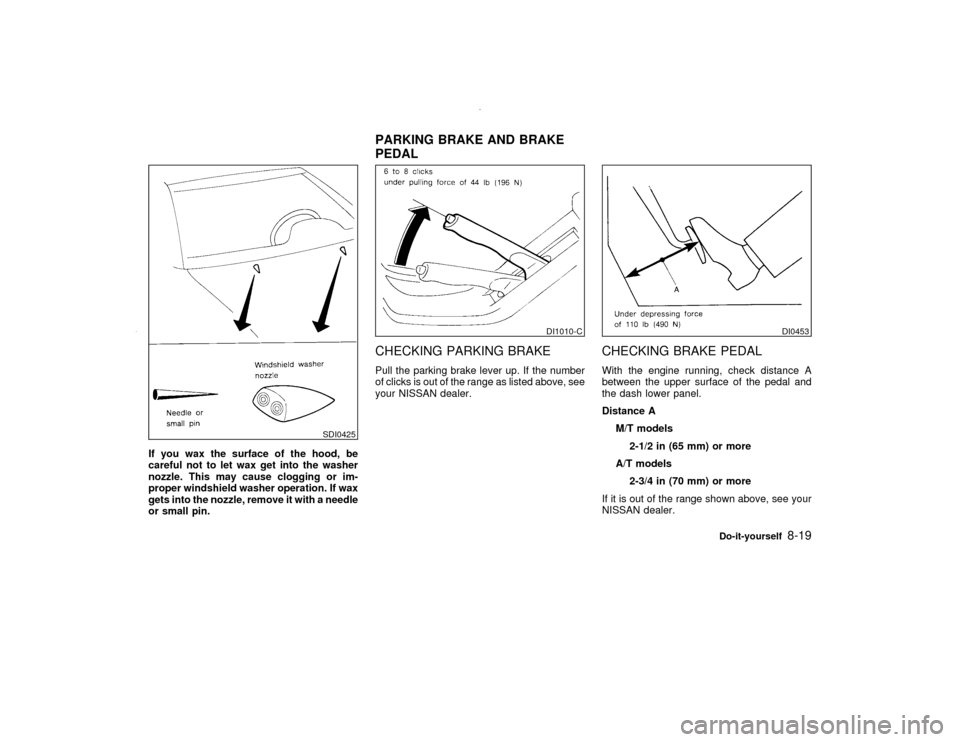
If you wax the surface of the hood, be
careful not to let wax get into the washer
nozzle. This may cause clogging or im-
proper windshield washer operation. If wax
gets into the nozzle, remove it with a needle
or small pin.
CHECKING PARKING BRAKEPull the parking brake lever up. If the number
of clicks is out of the range as listed above, see
your NISSAN dealer.
CHECKING BRAKE PEDALWith the engine running, check distance A
between the upper surface of the pedal and
the dash lower panel.
Distance A
M/T models
2-1/2 in (65 mm) or more
A/T models
2-3/4 in (70 mm) or more
If it is out of the range shown above, see your
NISSAN dealer.
SDI0425
DI1010-C
DI0453
PARKING BRAKE AND BRAKE
PEDAL
Do-it-yourself
8-19
Z
00.1.17/R50-D/V5
X
Page 212 of 265
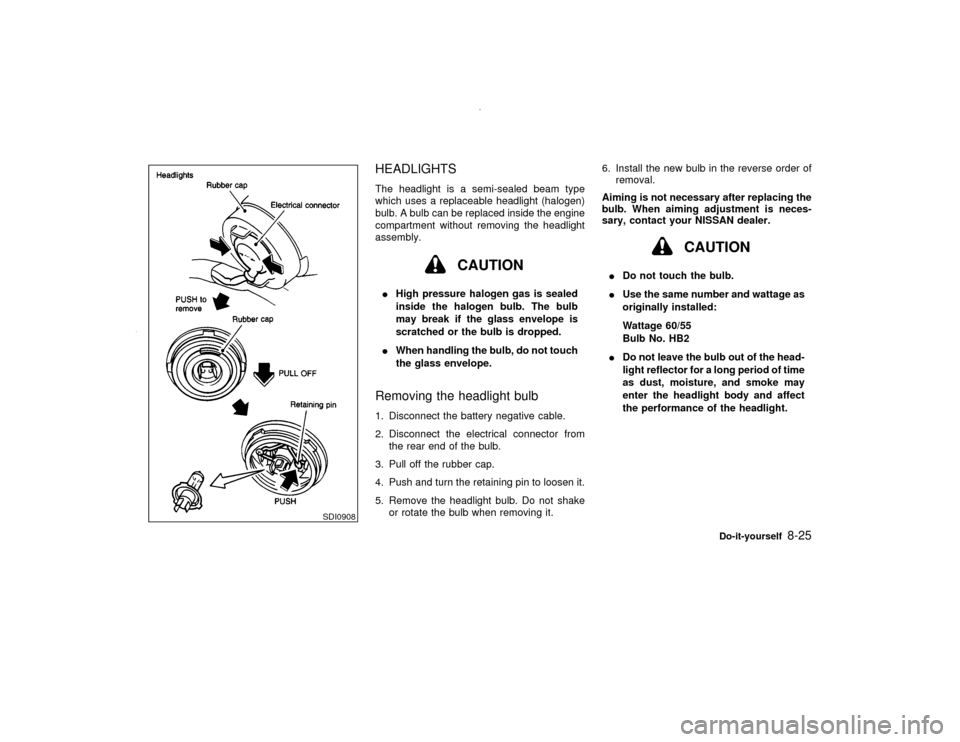
HEADLIGHTSThe headlight is a semi-sealed beam type
which uses a replaceable headlight (halogen)
bulb. A bulb can be replaced inside the engine
compartment without removing the headlight
assembly.
CAUTION
IHigh pressure halogen gas is sealed
inside the halogen bulb. The bulb
may break if the glass envelope is
scratched or the bulb is dropped.
IWhen handling the bulb, do not touch
the glass envelope.Removing the headlight bulb1. Disconnect the battery negative cable.
2. Disconnect the electrical connector from
the rear end of the bulb.
3. Pull off the rubber cap.
4. Push and turn the retaining pin to loosen it.
5. Remove the headlight bulb. Do not shake
or rotate the bulb when removing it.6. Install the new bulb in the reverse order of
removal.
Aiming is not necessary after replacing the
bulb. When aiming adjustment is neces-
sary, contact your NISSAN dealer.
CAUTION
IDo not touch the bulb.
IUse the same number and wattage as
originally installed:
Wattage 60/55
Bulb No. HB2
IDo not leave the bulb out of the head-
light reflector for a long period of time
as dust, moisture, and smoke may
enter the headlight body and affect
the performance of the headlight.
SDI0908
Do-it-yourself
8-25
Z
00.1.17/R50-D/V5
X
Page 227 of 265
![NISSAN PATHFINDER 2000 R50 / 2.G Owners Manual Schedule 1Abbreviations: R = Replace I = Inspect. Correct or replace if necessary. [ ]: At the mileage intervals onlyMAINTENANCE OPERATIONMAINTENANCE INTERVAL
Perform at number of miles, kilometers or](/img/5/640/w960_640-226.png "NISSAN PATHFINDER 2000 R50 / 2.G Owners Manual Schedule 1Abbreviations: R = Replace I = Inspect. Correct or replace if necessary. [ ]: At the mileage intervals onlyMAINTENANCE OPERATIONMAINTENANCE INTERVAL
Perform at number of miles, kilometers or")
Schedule 1Abbreviations: R = Replace I = Inspect. Correct or replace if necessary. [ ]: At the mileage intervals onlyMAINTENANCE OPERATIONMAINTENANCE INTERVAL
Perform at number of miles, kilometers or
months, whichever comes first.Miles´1,000 3.75 7.5 11.25 15 18.75 22.5 26.25 30 33.75 37.5 41.25 45 48.75 52.5 56.25 60
(km´1,000) (6) (12) (18) (24) (30) (36) (42) (48) (54) (60) (66) (72) (78) (84) (90) (96)
Months 3 6 9 12 15 18 21 24 27 30 33 36 39 42 45 48
Emission control system maintenance
Drive beltsI* I*
Air cleaner filter See NOTE (1) [R] [R]
EVAP vapor linesI* I*
Fuel linesI* I*
Fuel filter See NOTE (2)*
Engine coolant See NOTE (3)R*
Engine oilRRRRRRRRRRRRRRRR
Engine oil filter
(Use Part No. 15208 31U00 or equivalent.)RRRRRRRRRRRRRRRR
Spark plugs (PLATINUM-TIPPED type)[R]
Timing beltReplace every 105,000 miles (168,000 km)NOTE: (1) If operating mainly in dusty conditions, more frequent maintenance may be required.
(2) When the filter becomes clogged, the vehicle speed cannot be increased as the driver wishes. In such an event, replace the filter.
(3) After 60,000 miles (96,000 km) or 48 months, replace every 30,000 miles (48,000 km) or 24 months.
HMaintenance items and intervals with ª*º are recommended by NISSAN for reliable vehicle operation. The owner need not perform such
maintenance in order to maintain the emission warranty or manufacturer recall liability. Other maintenance items and intervals are required.9-6
Maintenance
Z
00.1.17/R50-D/V5
X
Page 229 of 265
![NISSAN PATHFINDER 2000 R50 / 2.G Owners Manual Schedule 2Abbreviations: R = Replace I = Inspect. Correct or replace if necessary. [ ]: At the mileage intervals onlyMAINTENANCE OPERATIONMAINTENANCE INTERVAL
Perform at number of miles, kilometers or](/img/5/640/w960_640-228.png "NISSAN PATHFINDER 2000 R50 / 2.G Owners Manual Schedule 2Abbreviations: R = Replace I = Inspect. Correct or replace if necessary. [ ]: At the mileage intervals onlyMAINTENANCE OPERATIONMAINTENANCE INTERVAL
Perform at number of miles, kilometers or")
Schedule 2Abbreviations: R = Replace I = Inspect. Correct or replace if necessary. [ ]: At the mileage intervals onlyMAINTENANCE OPERATIONMAINTENANCE INTERVAL
Perform at number of miles, kilometers or
months, whichever comes first.Miles´1,000 7.5 15 22.5 30 37.5 45 52.5 60
(km´1,000) (12) (24) (36) (48) (60) (72) (84) (96)
Months 6 12 18 24 30 36 42 48
Emission control system maintenance
Drive beltsI* I*
Air cleaner filter[R] [R]
EVAP vapor linesI* I*
Fuel linesI* I*
Fuel filter See NOTE (1)*
Engine coolant See NOTE (2)R*
Engine oilRRRRRRRR
Engine oil filter (Use Part No. 15208 31U00 or equivalent.)RRRRRRRR
Spark plugs (PLATINUM-TIPPED type)[R]
Timing beltReplace every 105,000 miles (168,000 km)
NOTE: (1) When the filter becomes clogged, the vehicle speed cannot be increased as the driver wishes. In such an event, replace the filter.
(2) After 60,000 miles (96,000 km) or 48 months, replace every 30,000 miles (48,000 km) or 24 months.
HMaintenance items and intervals with ª*º are recommended by NISSAN for reliable vehicle operation. The owner need not perform such
maintenance in order to maintain the emission warranty or manufacturer recall liability. Other maintenance items and intervals are required.9-8
Maintenance
Z
00.1.17/R50-D/V5
X
Page 234 of 265

10 Technical and consumer informationCapacities and recommended fuel/lubricants ......... 10-2
Fuel recommendation ............................................. 10-4
Engine oil and oil filter recommendation................. 10-6
Recommended SAE oil viscosity number ............... 10-7
Air conditioning system refrigerant and lubricant
recommendations .................................................... 10-8
Specifications .......................................................... 10-9
Engine ..................................................................... 10-9
Wheels and tires ................................................... 10-10
Dimensions and weights ....................................... 10-10
When traveling or registering your vehicle in another
country................................................................... 10-11
Vehicle identification ............................................. 10-11
Vehicle identification number (VIN) plate.............. 10-11
Vehicle identification number (Chassis
number) ................................................................. 10-11
Engine serial number ............................................ 10-12F.M.V.S.S. certification label ................................. 10-12
Emission control information label ........................ 10-12
Tire placard ........................................................... 10-13
Air conditioner specification label.......................... 10-13
Vehicle loading information ................................... 10-13
Terms .................................................................... 10-13
Determining vehicle load capacity ........................ 10-14
Loading tips ........................................................... 10-14
Towing a trailer ..................................................... 10-15
Maximum load limits.............................................. 10-15
Towing load/specification chart ............................. 10-16
Towing safety ........................................................ 10-17
Emission control system warranty ........................ 10-18
Reporting safety defects (US only) ....................... 10-19
Readiness for inspection/maintenance (I/M) test (US
only)....................................................................... 10-19
Z
00.1.17/R50-D/V5
X
Page 235 of 265

The following values are approximate capacities. The actual refill capacities may be a little different from them. When refilling, follow the
procedure instructed in the ª8. Do-it-yourselfº section to determine the proper refill capacity.
Capacity (Approximate)
Recommended specifications
US
measureImp
measureLiter
Fuel 21-1/8 gal 17-5/8 gal 80Unleaded gasoline with an octane rating
of at least 87 AKI (RON 91)*1
Engine oil*4
Drain and refill
with oil filter
change3-7/8 qt 3-1/4 qt 3.7IAPI Certification Mark*2 *3
IAPI grade SG/SH, Energy Conserving I
& II or API grade SJ, Energy Conserv-
ing*2 *3
IILSAC grade GF-I & GF-II*2 *3 without oil filter
change3-5/8 qt 3 qt 3.4
Cooling system
(with heater and
reservoir tank)10-3/4 qt 9 qt 10.2Genuine Nissan Anti-Freeze Coolant or
equivalent
(Ethylene glycol base 50% demineralized
water or distilled water)
*1: See later in this section for fuel recommendation.
*2: See later in this section for recommended SAE viscosity number.
*3: See later in this section for engine oil and oil filter recommendation.
*4: See ªChanging engine oilº in the ª8. Do-it-yourselfº section for further details.CAPACITIES AND
RECOMMENDED
FUEL/LUBRICANTS10-2
Technical and consumer information
Z
00.1.17/R50-D/V5
X
Page 237 of 265

FUEL RECOMMENDATIONYour vehicle is designed to operate on
unleaded gasoline with an octane rating of
at least 87 AKI (Anti-Knock Index) number
(Research octane number 91).
CAUTION
Using a fuel other than that specified
could adversely affect the emission con-
trol devices and systems, and could
also affect the warranty coverage.
Under no circumstances should a
leaded gasoline be used since this will
damage the three way catalyst.Reformulated gasolineSome fuel suppliers are now producing refor-
mulated gasolines. These gasolines are spe-
cially designed to reduce vehicle emissions.
NISSAN supports efforts towards cleaner air
and suggest that you use reformulated gaso-
line when available.Gasoline containing oxygenatesSome fuel suppliers sell gasoline containing
oxygenates such as ethanol, MTBE andmethanol with or without advertising their pres-
ence. Nissan does not recommend the use of
fuels of which the oxygenate content and the
fuel compatibility for your Nissan cannot be
readily determined.
If you use oxygenate-blend gasoline, please
take the following precautions as the usage of
such fuels may cause vehicle performance
problems and/or fuel system damage.
IThe fuel should be unleaded and have
an octane rating no lower than that rec-
ommended for unleaded gasoline.
IIf an oxygenate-blend, excepting a
methanol blend, is used, it should con-
tain no more than 10% oxygenate.
(MTBE may, however, be added up to
15%.)
IIf a methanol blend is used, it should
contain no more than 5% methanol (me-
thyl alcohol, wood alcohol). It should
also contain a suitable amount of appro-
priate cosolvents and corrosion inhibi-
tors. If not properly formulated with ap-
propriate cosolvents and corrosion
inhibitors, such methanol blends may
cause fuel system damage and/or ve-
hicle performance problems. At this
time, sufficient data is not available to
ensure that all methanol blends are suit-able for use in Nissan vehicles.
If any undesirable driveability problems such
as engine stalling and hard hot starting are
experienced after using oxygenate-blend fu-
els, immediately change to a non-oxygenate
fuel or a fuel with a low blend of MTBE.
Take care not to spill gasoline during refu-
eling. Gasoline containing oxygenates can
cause paint damage.
Aftermarket fuel additivesNISSAN does not recommend the use of any
fuel additives (i.e.: fuel injector cleaner, octane
booster, intake valve deposit removers, etc.)
which are sold commercially. Many of these
additives intended for gum, varnish or deposit
removal may contain active solvents or similar
ingredients that can be harmful to the fuel
system and engine.Octane rating tipsIn most parts of North America, you should use
unleaded gasoline with an octane rating of at
least 87 AKI (Anti-Knock Index) number. How-
ever, you may use unleaded gasoline with an
octane rating as low as 85 AKI (Anti-Knock
Index) number in these high altitude areas
[over 4,000 ft (1,219 m)] such as: Colorado,
Montana, New Mexico, Utah, Wyoming, north-
10-4
Technical and consumer information
Z
00.1.17/R50-D/V5
X
Page 239 of 265
ENGINE OIL AND OIL FILTER
RECOMMENDATION
Selecting the correct oilIt is essential to choose the correct quality, and
viscosity oil to ensure satisfactory engine life
and performance. Nissan recommends the
use of a low friction oil (energy conserving oil)
in order to improve fuel economy and con-
serve energy. Oils which do not have the
specified quality label should not be used as
they could cause engine damage.
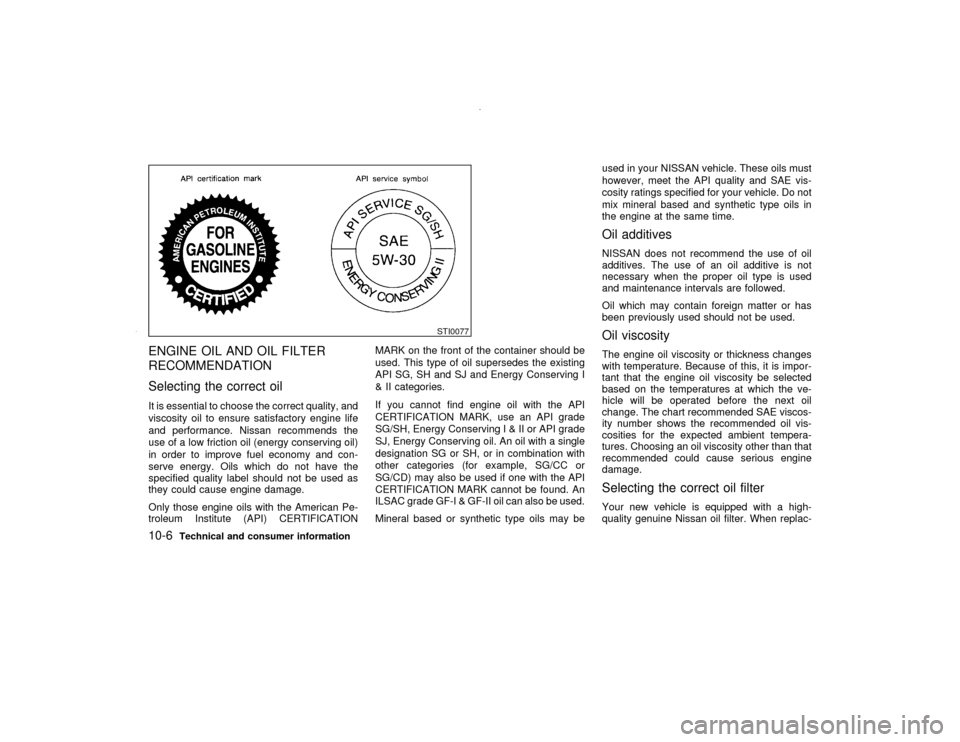
Only those engine oils with the American Pe-
troleum Institute (API) CERTIFICATIONMARK on the front of the container should be
used. This type of oil supersedes the existing
API SG, SH and SJ and Energy Conserving I
& II categories.
If you cannot find engine oil with the API
CERTIFICATION MARK, use an API grade
SG/SH, Energy ConservingI&IIorAPIgrade
SJ, Energy Conserving oil. An oil with a single
designation SG or SH, or in combination with
other categories (for example, SG/CC or
SG/CD) may also be used if one with the API
CERTIFICATION MARK cannot be found. An
ILSAC grade GF-I & GF-II oil can also be used.
Mineral based or synthetic type oils may beused in your NISSAN vehicle. These oils must
however, meet the API quality and SAE vis-
cosity ratings specified for your vehicle. Do not
mix mineral based and synthetic type oils in
the engine at the same time.
Oil additivesNISSAN does not recommend the use of oil
additives. The use of an oil additive is not
necessary when the proper oil type is used
and maintenance intervals are followed.
Oil which may contain foreign matter or has
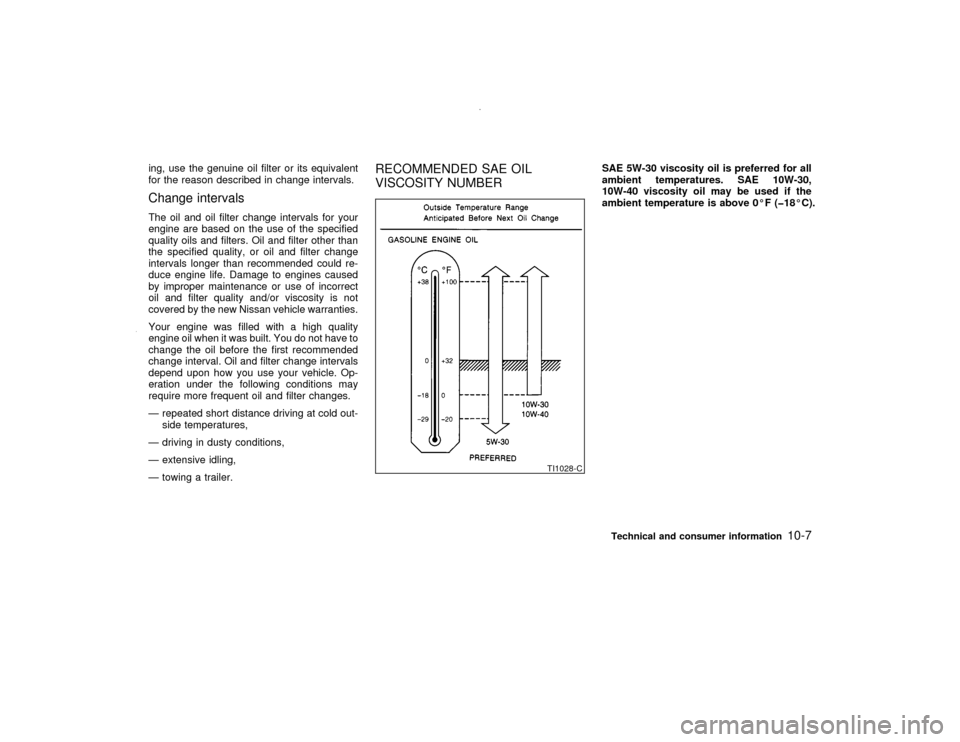
been previously used should not be used.Oil viscosityThe engine oil viscosity or thickness changes
with temperature. Because of this, it is impor-
tant that the engine oil viscosity be selected
based on the temperatures at which the ve-
hicle will be operated before the next oil
change. The chart recommended SAE viscos-
ity number shows the recommended oil vis-
cosities for the expected ambient tempera-
tures. Choosing an oil viscosity other than that
recommended could cause serious engine
damage.Selecting the correct oil filterYour new vehicle is equipped with a high-
quality genuine Nissan oil filter. When replac-
STI0077
10-6
Technical and consumer information
Z
00.1.17/R50-D/V5
X
Page 240 of 265
ing, use the genuine oil filter or its equivalent
for the reason described in change intervals.Change intervalsThe oil and oil filter change intervals for your
engine are based on the use of the specified
quality oils and filters. Oil and filter other than
the specified quality, or oil and filter change
intervals longer than recommended could re-
duce engine life. Damage to engines caused
by improper maintenance or use of incorrect
oil and filter quality and/or viscosity is not
covered by the new Nissan vehicle warranties.
Your engine was filled with a high quality
engine oil when it was built. You do not have to
change the oil before the first recommended
change interval. Oil and filter change intervals
depend upon how you use your vehicle. Op-
eration under the following conditions may
require more frequent oil and filter changes.
Ð repeated short distance driving at cold out-
side temperatures,
Ð driving in dusty conditions,
Ð extensive idling,
Ð towing a trailer.
RECOMMENDED SAE OIL
VISCOSITY NUMBER
SAE 5W-30 viscosity oil is preferred for all
ambient temperatures. SAE 10W-30,
10W-40 viscosity oil may be used if the
ambient temperature is above 0ÉF (þ18ÉC).
TI1028-C
Technical and consumer information
10-7
Z
00.1.17/R50-D/V5
X
Page 244 of 265
When planning to travel in another country,
you should first find out if the fuel available is
suitable for your vehicle's engine.
Using fuel with too low an octane rating
may cause engine damage. All gasoline
vehicles can be operated with unleaded
gasoline. Therefore, avoid taking your ve-
hicle to areas where appropriate fuel is not
available.
When transferring the registration of your
vehicle to another country, state, province
or district,it may be necessary to modify the
vehicle to meet local laws and regulations.
The laws and regulations for motor vehicle
emission control and safety standards vary
according to the country, state, province or
district; therefore, vehicle specifications may
differ.
When any vehicle is to be taken into an-
other country, state, province or district
and registered, its modifications, transpor-
tation and registration are the responsibil-
ity of the user. NISSAN is not responsible
for any inconvenience that may result.
VEHICLE IDENTIFICATION
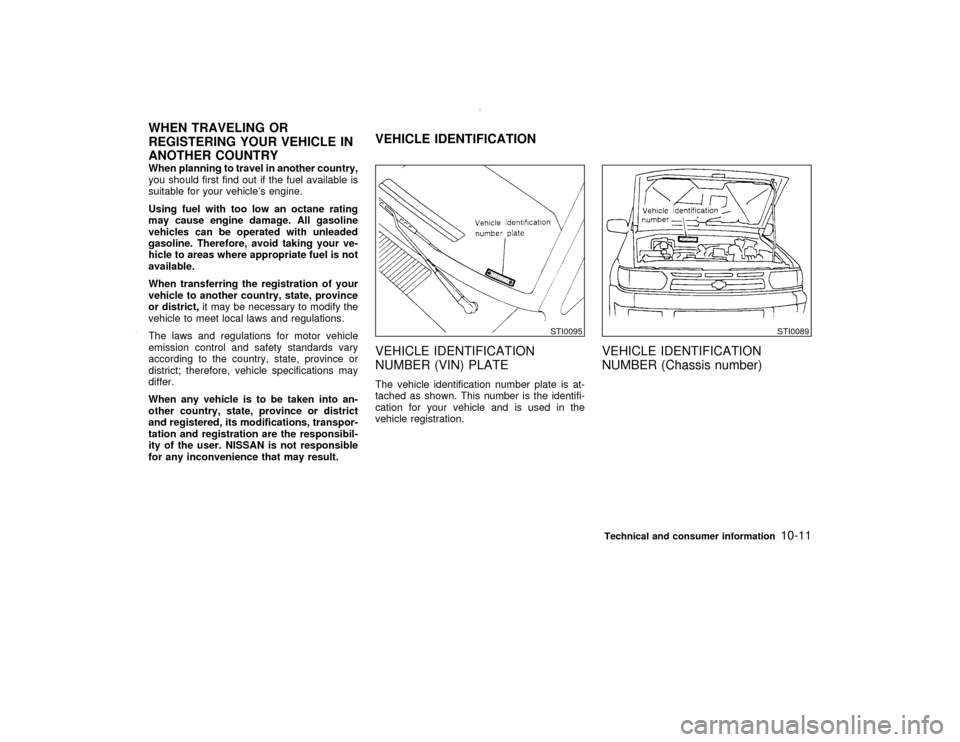
NUMBER (VIN) PLATEThe vehicle identification number plate is at-
tached as shown. This number is the identifi-
cation for your vehicle and is used in the
vehicle registration.
VEHICLE IDENTIFICATION
NUMBER (Chassis number)
STI0095
STI0089
WHEN TRAVELING OR
REGISTERING YOUR VEHICLE IN
ANOTHER COUNTRYVEHICLE IDENTIFICATION
Technical and consumer information
10-11
Z
00.1.17/R50-D/V5
X