child lock NISSAN PATHFINDER 2010 Owner´s Manual
[x] Cancel search | Manufacturer: NISSAN, Model Year: 2010, Model line: PATHFINDER, Model: NISSAN PATHFINDER 2010Pages: 463, PDF Size: 5.69 MB
Page 71 of 463
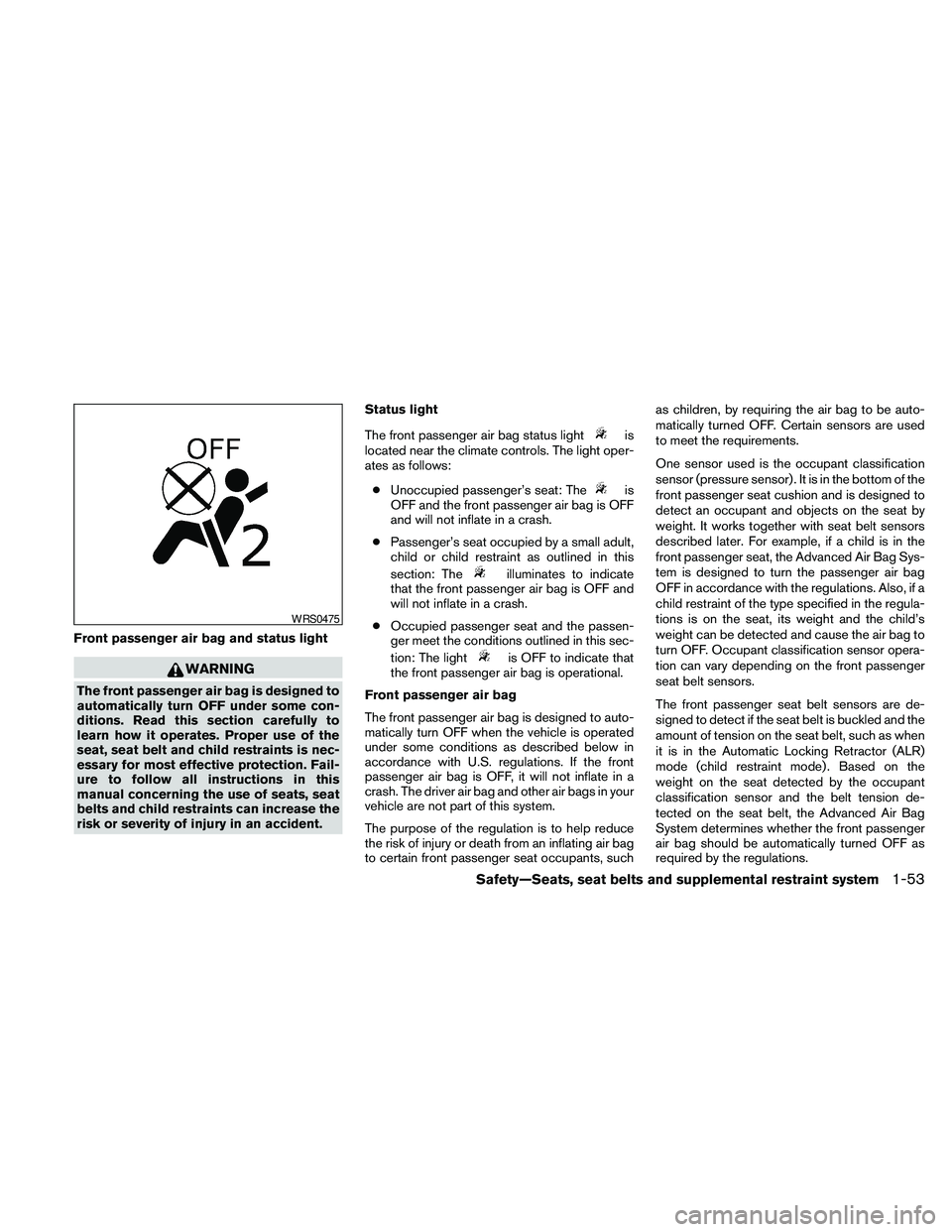
Front passenger air bag and status light
WARNING
The front passenger air bag is designed to
automatically turn OFF under some con-
ditions. Read this section carefully to
learn how it operates. Proper use of the
seat, seat belt and child restraints is nec-
essary for most effective protection. Fail-
ure to follow all instructions in this
manual concerning the use of seats, seat
belts and child restraints can increase the
risk or severity of injury in an accident.Status light
The front passenger air bag status light
is
located near the climate controls. The light oper-
ates as follows:
cUnoccupied passenger’s seat: The
is
OFF and the front passenger air bag is OFF
and will not inflate in a crash.
cPassenger’s seat occupied by a small adult,
child or child restraint as outlined in this
section: The
illuminates to indicate
that the front passenger air bag is OFF and
will not inflate in a crash.
cOccupied passenger seat and the passen-
ger meet the conditions outlined in this sec-
tion: The light
is OFF to indicate that
the front passenger air bag is operational.
Front passenger air bag
The front passenger air bag is designed to auto-
matically turn OFF when the vehicle is operated
under some conditions as described below in
accordance with U.S. regulations. If the front
passenger air bag is OFF, it will not inflate in a
crash. The driver air bag and other air bags in your
vehicle are not part of this system.
The purpose of the regulation is to help reduce
the risk of injury or death from an inflating air bag
to certain front passenger seat occupants, suchas children, by requiring the air bag to be auto-
matically turned OFF. Certain sensors are used
to meet the requirements.
One sensor used is the occupant classification
sensor (pressure sensor) . It is in the bottom of the
front passenger seat cushion and is designed to
detect an occupant and objects on the seat by
weight. It works together with seat belt sensors
described later. For example, if a child is in the
front passenger seat, the Advanced Air Bag Sys-
tem is designed to turn the passenger air bag
OFF in accordance with the regulations. Also, if a
child restraint of the type specified in the regula-
tions is on the seat, its weight and the child’s
weight can be detected and cause the air bag to
turn OFF. Occupant classification sensor opera-
tion can vary depending on the front passenger
seat belt sensors.
The front passenger seat belt sensors are de-
signed to detect if the seat belt is buckled and the
amount of tension on the seat belt, such as when
it is in the Automatic Locking Retractor (ALR)
mode (child restraint mode) . Based on the
weight on the seat detected by the occupant
classification sensor and the belt tension de-
tected on the seat belt, the Advanced Air Bag
System determines whether the front passenger
air bag should be automatically turned OFF as
required by the regulations.
WRS0475
Safety—Seats, seat belts and supplemental restraint system1-53
Page 123 of 463
Always distribute the luggage evenly on the roof
rack. Do not load more than 200 pounds (91 kg) .
Be careful that your vehicle does not exceed the
Gross Vehicle Weight Rating (GVWR) or its
Gross Axle Weight Rating (GAWR front and
rear) . The GVWR and GAWR are located on the
F.M.V.S.S. label (located on the driver’s door
pillar) . For more information regarding GVWR
and GAWR, refer to “Vehicle loading information”
in the “Technical and consumer information” sec-
tion later in this manual.
The front and rear cross bars (if so equipped) can
be adjusted or removed.
To adjust:
1. Loosen the 2 TorxThead fasteners
sAon
both ends of the crossbar.
2. Remove the plugs at the desired position
(
sC).
3. Slide the crossbar
sBto the desired position
(
sC) so that the holes in the crossbar line up
with the holes in the sidebar.
4. Tighten the 2 TorxThead fasteners on both
ends of the crossbar.
5. Reinstall the plugs at the previous position
sA.
6. Position your luggage on the crossbars and
secure the luggage with rope.7. Always check the tightness of the TorxT
head fasteners.
To remove:
1. Loosen the 2 TorxThead fasteners
sAon
both ends of the crossbar.
2. Remove the crossbar from the roof rack.
POWER WINDOWS
WARNING
cMake sure that all passengers have
their hands, etc. inside the vehicle while
it is in motion and before closing the
windows. Use the window lock switch
to prevent unexpected use of the power
windows.
cDo not leave children unattended inside
the vehicle. They could unknowingly ac-
tivate switches or controls and become
trapped in a window. Unattended chil-
dren could become involved in serious
accidents.
The power windows operate when the ignition
switch is placed in the ON position, or for about
45 seconds after the ignition switch is placed in
the OFF position. If the driver’s or passenger’s
door is opened during this period of about 45
seconds, power to the windows is canceled.
WINDOWS
Instruments and controls2-43
Page 133 of 463
3 Pre-driving checks and adjustments
Keys .............................................3-2
NISSAN Vehicle Immobilizer System keys.........3-2
NISSAN Intelligent Key™ (if so equipped).........3-3
Doors............................................3-4
Locking with key................................3-5
Locking with inside lock knob....................3-5
Locking with power door lock switch.............3-6
Automatic door locks...........................3-6
Child safety rear door lock.......................3-7
Remote keyless entry system (if so equipped).........3-7
How to use remote keyless entry system..........3-8
NISSAN Intelligent Key™ (if so equipped)...........3-11
Operating range...............................3-13
Door locks/unlocks precaution..................3-13
NISSAN Intelligent Key™ Operation..............3-14
How to use the remote keyless entry
function......................................3-17
Warning signals...............................3-19
Troubleshooting guide.........................3-20
Hood...........................................3-21Lift gate.........................................3-21
Glass hatch......................................3-22
Fuel-filler door...................................3-23
Opening the fuel-filler lid.......................3-23
Fuel-filler cap.................................3-23
Steering wheel...................................3-24
Tilt operation..................................3-24
Pedal position adjustment (if so equipped)..........3-25
Sun visors.......................................3-25
Vanity mirrors.................................3-26
Mirrors..........................................3-26
Rearview mirror (if so equipped).................3-26
Automatic anti-glare rearview mirror
(if so equipped)...............................3-27
Outside mirrors...............................3-29
Automatic drive positioner (if so equipped)..........3-30
Memory storage function.......................3-30
Entry/exit function.............................3-31
System operation..............................3-32
Page 136 of 463
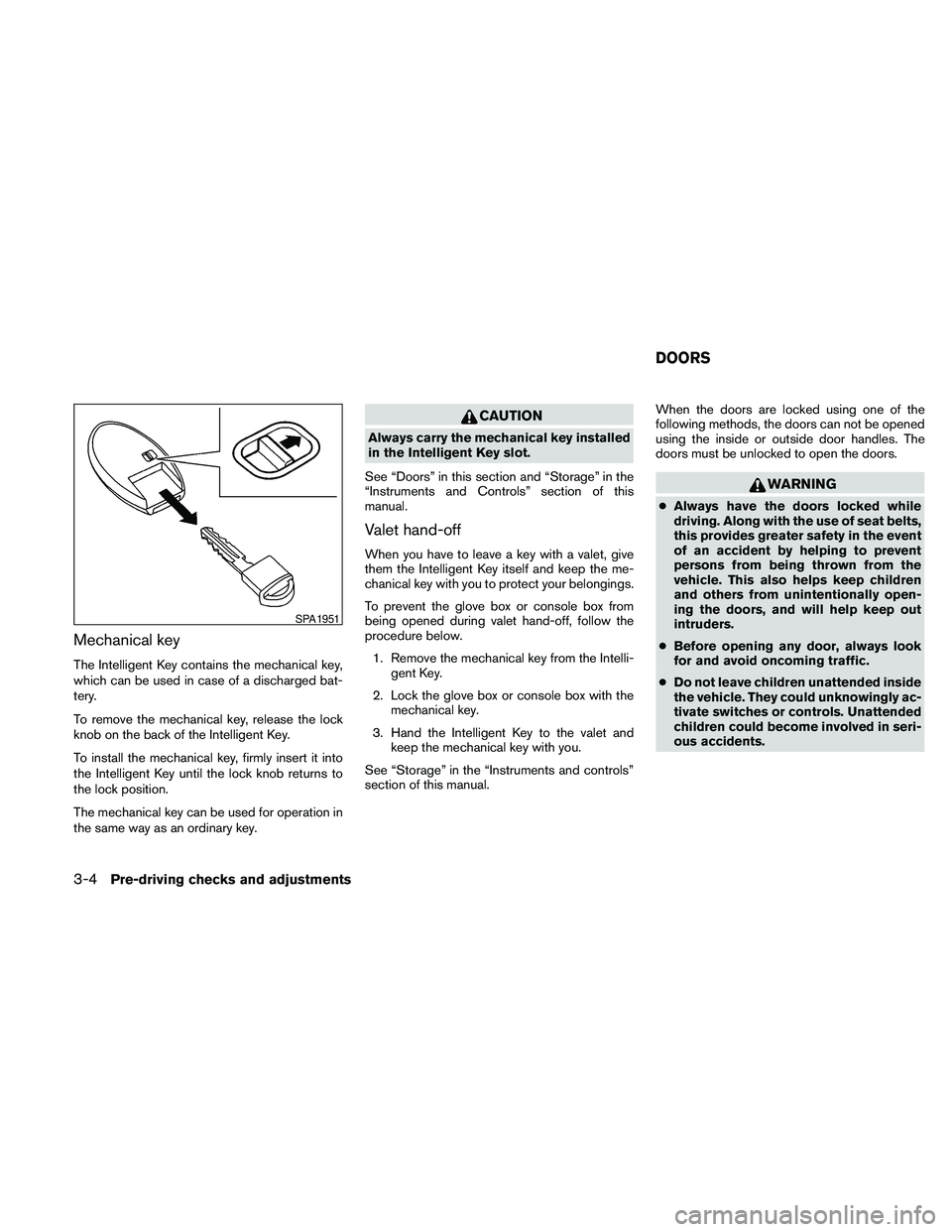
Mechanical key
The Intelligent Key contains the mechanical key,
which can be used in case of a discharged bat-
tery.
To remove the mechanical key, release the lock
knob on the back of the Intelligent Key.
To install the mechanical key, firmly insert it into
the Intelligent Key until the lock knob returns to
the lock position.
The mechanical key can be used for operation in
the same way as an ordinary key.
CAUTION
Always carry the mechanical key installed
in the Intelligent Key slot.
See “Doors” in this section and “Storage” in the
“Instruments and Controls” section of this
manual.
Valet hand-off
When you have to leave a key with a valet, give
them the Intelligent Key itself and keep the me-
chanical key with you to protect your belongings.
To prevent the glove box or console box from
being opened during valet hand-off, follow the
procedure below.
1. Remove the mechanical key from the Intelli-
gent Key.
2. Lock the glove box or console box with the
mechanical key.
3. Hand the Intelligent Key to the valet and
keep the mechanical key with you.
See “Storage” in the “Instruments and controls”
section of this manual.When the doors are locked using one of the
following methods, the doors can not be opened
using the inside or outside door handles. The
doors must be unlocked to open the doors.
WARNING
cAlways have the doors locked while
driving. Along with the use of seat belts,
this provides greater safety in the event
of an accident by helping to prevent
persons from being thrown from the
vehicle. This also helps keep children
and others from unintentionally open-
ing the doors, and will help keep out
intruders.
cBefore opening any door, always look
for and avoid oncoming traffic.
cDo not leave children unattended inside
the vehicle. They could unknowingly ac-
tivate switches or controls. Unattended
children could become involved in seri-
ous accidents.
SPA1951
DOORS
3-4Pre-driving checks and adjustments
Page 139 of 463
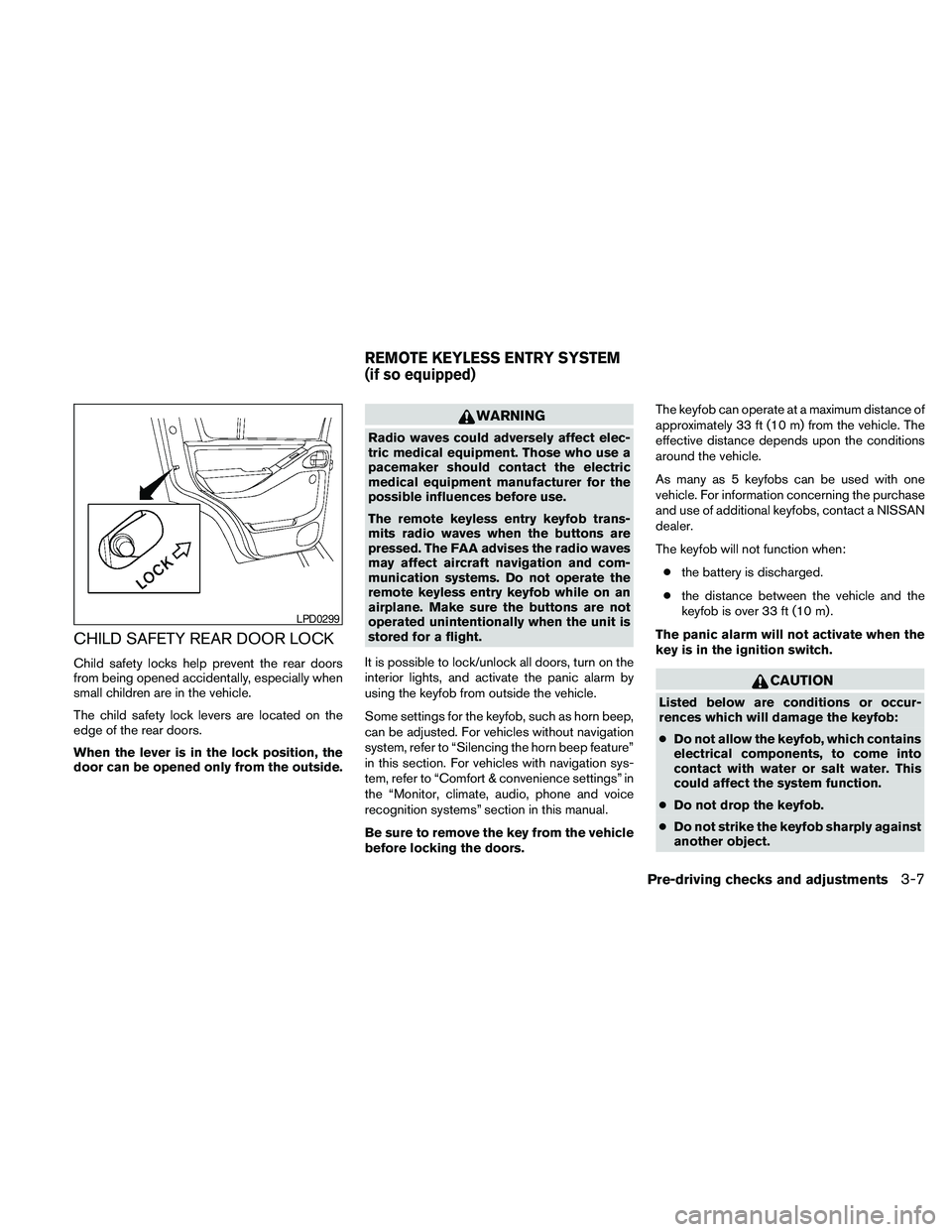
CHILD SAFETY REAR DOOR LOCK
Child safety locks help prevent the rear doors
from being opened accidentally, especially when
small children are in the vehicle.
The child safety lock levers are located on the
edge of the rear doors.
When the lever is in the lock position, the
door can be opened only from the outside.
WARNING
Radio waves could adversely affect elec-
tric medical equipment. Those who use a
pacemaker should contact the electric
medical equipment manufacturer for the
possible influences before use.
The remote keyless entry keyfob trans-
mits radio waves when the buttons are
pressed. The FAA advises the radio waves
may affect aircraft navigation and com-
munication systems. Do not operate the
remote keyless entry keyfob while on an
airplane. Make sure the buttons are not
operated unintentionally when the unit is
stored for a flight.
It is possible to lock/unlock all doors, turn on the
interior lights, and activate the panic alarm by
using the keyfob from outside the vehicle.
Some settings for the keyfob, such as horn beep,
can be adjusted. For vehicles without navigation
system, refer to “Silencing the horn beep feature”
in this section. For vehicles with navigation sys-
tem, refer to “Comfort & convenience settings” in
the “Monitor, climate, audio, phone and voice
recognition systems” section in this manual.
Be sure to remove the key from the vehicle
before locking the doors.The keyfob can operate at a maximum distance of
approximately 33 ft (10 m) from the vehicle. The
effective distance depends upon the conditions
around the vehicle.
As many as 5 keyfobs can be used with one
vehicle. For information concerning the purchase
and use of additional keyfobs, contact a NISSAN
dealer.
The keyfob will not function when:
cthe battery is discharged.
cthe distance between the vehicle and the
keyfob is over 33 ft (10 m) .
The panic alarm will not activate when the
key is in the ignition switch.
CAUTION
Listed below are conditions or occur-
rences which will damage the keyfob:
cDo not allow the keyfob, which contains
electrical components, to come into
contact with water or salt water. This
could affect the system function.
cDo not drop the keyfob.
cDo not strike the keyfob sharply against
another object.
LPD0299
REMOTE KEYLESS ENTRY SYSTEM
(if so equipped)
Pre-driving checks and adjustments3-7
Page 387 of 463
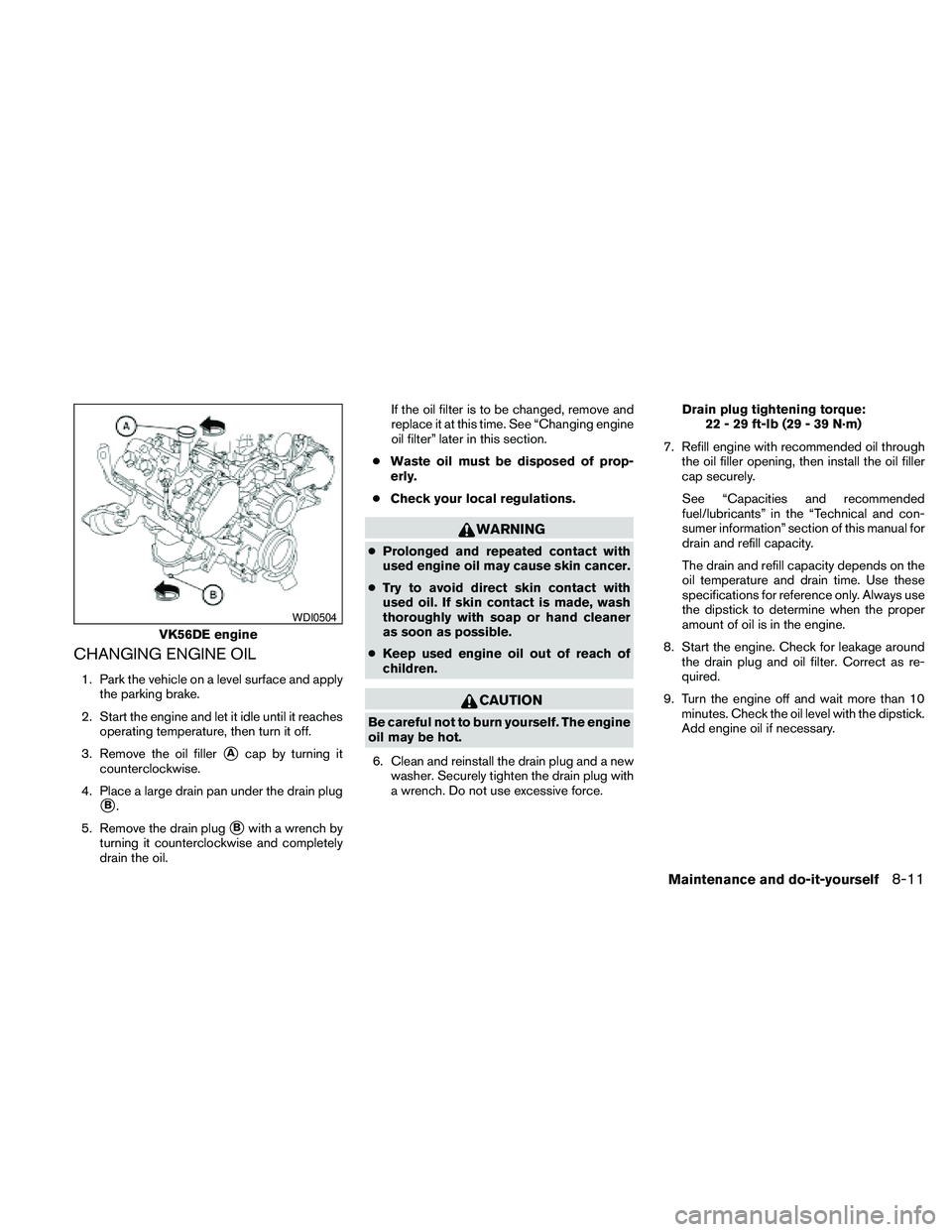
CHANGING ENGINE OIL
1. Park the vehicle on a level surface and apply
the parking brake.
2. Start the engine and let it idle until it reaches
operating temperature, then turn it off.
3. Remove the oil filler
sAcap by turning it
counterclockwise.
4. Place a large drain pan under the drain plug
sB.
5. Remove the drain plug
sBwith a wrench by
turning it counterclockwise and completely
drain the oil.If the oil filter is to be changed, remove and
replace it at this time. See “Changing engine
oil filter” later in this section.
cWaste oil must be disposed of prop-
erly.
cCheck your local regulations.
WARNING
cProlonged and repeated contact with
used engine oil may cause skin cancer.
cTry to avoid direct skin contact with
used oil. If skin contact is made, wash
thoroughly with soap or hand cleaner
as soon as possible.
cKeep used engine oil out of reach of
children.
CAUTION
Be careful not to burn yourself. The engine
oil may be hot.
6. Clean and reinstall the drain plug and a new
washer. Securely tighten the drain plug with
a wrench. Do not use excessive force.Drain plug tightening torque:
22 - 29 ft-lb (29 - 39 N·m)
7. Refill engine with recommended oil through
the oil filler opening, then install the oil filler
cap securely.
See “Capacities and recommended
fuel/lubricants” in the “Technical and con-
sumer information” section of this manual for
drain and refill capacity.
The drain and refill capacity depends on the
oil temperature and drain time. Use these
specifications for reference only. Always use
the dipstick to determine when the proper
amount of oil is in the engine.
8. Start the engine. Check for leakage around
the drain plug and oil filter. Correct as re-
quired.
9. Turn the engine off and wait more than 10
minutes. Check the oil level with the dipstick.
Add engine oil if necessary.
VK56DE engine
WDI0504
Maintenance and do-it-yourself8-11
Page 456 of 463
C
Capacities and recommended
fuel/lubricants...................9-2
Car phone or CB radio............4-103
Cargo light....................2-49
Cargo (See vehicle loading information). . . .9-12
CD care and cleaning..............4-83
CD changer (See audio system)........4-62
CD player (See audio system)......4-56, 4-70
Child restraint with top tether strap.......1-30
Child restraints.......1-24, 1-25, 1-26, 1-28
Precautions on child
restraints.........1-26, 1-33, 1-37, 1-41
Top tether strap anchor point locations . .1-30
Child safety rear door lock............3-7
Chimes, audible reminders...........2-21
Cleaning exterior and interior...........7-2
Clock................4-55, 4-60, 4-68
(models with navigation system) . . .4-13, 4-28
Clock set.................4-13, 4-28
C.M.V.S.S. certification label..........9-10
Cold weather driving..............5-37
Compact disc (CD) player........4-56, 4-70
CompactFlash (CF) player...........4-72
Console box...................2-36
Control panel buttons..............4-18
Brightness/contrast button......4-17, 4-33
Enter button...............4-4, 4-18
Setting button.............4-11, 4-26
Startup screen................4-21
Without navigation system..........4-4
Controls
Audio controls (steering wheel).......4-85Heater and air conditioner
controls................4-37, 4-44
Rear audio controls.............4-86
Rear seat air conditioner..........4-46
Coolant
Capacities and recommended
fuel/lubricants.................9-2
Changing engine coolant...........8-9
Checking engine coolant level........8-8
Engine coolant temperature gauge.....2-6
Corrosion protection...............7-5
Cruise control..................5-20
Cup holders...................2-38
Curtain side-impact and rollover air bag. . . .1-56
D
Daytime running light system (Canada only) . .2-29
Defroster switch
Rear window and outside mirror defroster
switch.....................2-26
Digital video disc DVD..............4-88
Dimensions and weights.............9-8
Dimmer switch for instrument panel......2-30
Display controls
(see control panel buttons)........4-4, 4-18
Distance to empty.............4-7, 4-22
Door locks.....................3-4
Door open warning light.............2-15
Drive belt.....................8-18
Drive positioner, Automatic...........3-30
Driving
Cold weather driving............5-37
Driving with automatic transmission. . . .5-14
Precautions when starting and driving. . . .5-2E
Economy - fuel..................5-22
Emission control information label.......9-11
Emission control system warranty.......9-28
Engine
Before starting the engine..........5-13
Block heater.................5-38
Capacities and recommended
fuel/lubricants.................9-2
Changing engine coolant...........8-9
Changing engine oil.............8-11
Changing engine oil filter..........8-12
Checking engine coolant level........8-8
Checking engine oil level...........8-9
Engine compartment check locations. . . .8-6
Engine coolant temperature gauge.....2-6
Engine cooling system............8-8
Engine oil...................8-9
Engine oil and oil filter recommendation . . .9-5
Engine oil pressure warning light......2-15
Engine oil viscosity..............9-5
Engine serial number............9-10
Engine specifications.............9-7
Starting the engine.............5-13
Engine oil pressure gauge............2-7
Enter button.................4-4, 4-18
Event data recorders..............9-29
Exhaust gas (Carbon monoxide).........5-2
Eyeglass case..................2-37
10-2
Page 458 of 463
K
Key.........................3-2
Keyfob battery replacement...........8-27
Keyless entry
With Intelligent Key system
(See Intelligent Key system).........3-17
Keyless entry system
(See remote keyless entry system)........3-7
L
Labels
Air conditioner specification label.....9-11
C.M.V.S.S. certification label........9-10
Emission control information label.....9-11
Engine serial number............9-10
F.M.V.S.S. certification label.........9-10
Tire and Loading Information label.....9-11
Vehicle identification number (VIN) plate . .9-9
Warning labels (for SRS)..........1-58
LATCH (Lower Anchors and Tethers for CHildren)
System......................1-28
License plate
Installing the license plate..........9-12
Lift gate......................3-21
Light
Air bag warning light.........1-59, 2-18
Brake light (See stop light).........8-32
Bulb check/instrument panel........2-13
Bulb replacement..............8-32
Charge warning light............2-14
Fog light switch...............2-30
Headlight and turn signal switch......2-27Headlight control switch..........2-27
Headlights..................8-30
Interior light..................2-47
Light bulbs..................8-30
Low tire pressure warning light.......2-16
Low washer fluid warning light.......2-17
Passenger air bag and status light.....1-53
Personal lights................2-48
Security indicator light............2-20
Warning/indicator lights and audible
reminders...................2-12
Lights
Map lights..................2-49
Lock
Child safety rear door lock..........3-7
Door locks...................3-4
Power door locks...............3-6
Low fuel warning light..............2-16
Low tire pressure warning light.........2-16
Low washer fluid warning light.........2-17
Luggage hook..................2-40
Luggage (See vehicle loading information) . .9-12
Luggage storage
(see vehicle loading information)........2-40
M
Maintenance
Changing the maintenance
interval.................4-10, 4-25
Displaying the maintenance notice
reminder................4-10, 4-25
General maintenance.............8-2
Inside the vehicle...............8-3
Maintenance precautions...........8-5Outside the vehicle..............8-2
Resetting the maintenance
interval.................4-10, 4-25
Seat belt maintenance............1-24
Setting.................4-9, 4-24
Under the hood and vehicle.........8-4
Malfunction indicator light............2-19
Manual front seat adjustment...........1-2
Map lights....................2-49
Map pocket....................2-38
Meters and gauges................2-3
Instrument brightness control........2-30
Mirror
Automatic anti-glare inside mirror......3-27
Inside mirror.................3-26
Outside mirror control............3-29
Outside mirrors...............3-29
Vanity mirror.................3-26
Moonroof.....................2-46
Music Box hard-disk drive audio system. . . .4-74
N
NISSAN Intelligent Key™..........3-3, 3-11
NISSAN mobile entertainment system
(MES).......................4-88
NISSAN vehicle immobilizer
system................2-23, 3-2, 5-12
NISSAN voice recognition system......4-129
O
Octane rating (See fuel octane rating)......9-4
Odometer.....................2-4
10-4
Page 459 of 463
Oil
Capacities and recommended
fuel/lubricants.................9-2
Changing engine oil.............8-11
Changing engine oil filter..........8-12
Checking engine oil level...........8-9
Engine oil...................8-9
Engine oil and oil filter recommendation . . .9-5
Engine oil viscosity..............9-5
Outside mirror control..............3-29
Outside mirrors.................3-29
Overdrive switch.................5-18
Overheat
If your vehicle overheats...........6-10
Owner’s manual order form...........9-30
Owner’s manual/service manual order
information....................9-30
P
Parking
Parking brake operation...........5-19
Parking/parking on hills...........5-32
Pedal position adjustment............3-25
Personal lights..................2-48
Phone, BluetoothThands-free
system.................4-103, 4-118
Power
Front seat adjustment.............1-4
Power door locks...............3-6
Power outlet.................2-34
Power rear windows.............2-45
Power steering fluid.............8-13
Power steering system...........5-33
Power windows...............2-43Rear power windows............2-45
Precautions
Maintenance precautions...........8-5
On-pavement and off-road driving
precautions..................5-5
Precautions on child
restraints.........1-26, 1-33, 1-37, 1-41
Precautions on seat belt usage.......1-17
Precautions on supplemental restraint
system....................1-44
Precautions when starting and driving. . . .5-2
Pre-tensioner seat belt system.........1-57
Programmable features..........4-11, 4-26
Push starting...................6-10
R
Radio
Car phone or CB radio..........4-103
Compact Disc (CD) changer........4-62
FM/AM radio with compact disc (CD)
player.....................4-54
FM/AM/SAT radio with compact disc
(CD) changer................4-59
FM/AM/SAT radio with compact disc
(CD) player..................4-67
Rear audio controls.............4-86
Steering wheel audio control switch. . . .4-85
Readiness for inspection maintenance
(I/M) test.....................9-28
Rear audio controls...............4-86
Rear power windows..............2-45
Rear seat air conditioner............4-46
Rear window and outside mirror defroster
switch.......................2-26Rear window wiper and washer switches . . .2-25
RearView Monitor................4-33
Recorders
Event data..................9-29
Refrigerant recommendation...........9-6
Registering your vehicle in another country . . .9-9
Remote controller (See NISSAN mobile
entertainment system)..............4-90
Remote keyless entry system...........3-7
Reporting safety defects (US only).......9-28
Resetting the fuel economy........4-7, 4-22
S
Safety
Child safety rear door lock..........3-7
Child seat belts.....1-26, 1-33, 1-37, 1-41
Reporting safety defects (US only).....9-28
Screen (See NISSAN mobile entertainment
system)......................4-90
Seat adjustment
Front manual seat adjustment........1-2
Front power seat adjustment.........1-4
Second row bench seats...........1-5
Seat belt
Child safety..................1-24
Infants and small children..........1-25
Injured Person................1-20
Larger children................1-25
Precautions on seat belt usage.......1-17
Pregnant women...............1-20
Pre-tensioner seat belt system.......1-57
Seat belt extenders.............1-23
Seat belt maintenance............1-24
Seat belts...................1-17
10-5
Page 460 of 463
Shoulder belt height adjustment......1-23
Three-point type with retractor.......1-20
Seat belt warning light..............2-17
Seatback pockets................2-38
Seats
Adjustment...................1-2
Automatic drive positioner..........3-30
Front seats...................1-2
Heated seats.................2-32
Manual front seat adjustment.........1-2
Security indicator light..............2-20
Security system (NISSAN vehicle immobilizer
system) , engine start........2-23, 3-2, 5-12
Self-adjusting brakes..............8-24
Service manual order form...........9-30
Servicing air conditioner.............4-47
Setting button...............4-11, 4-26
Shift lock release.................5-17
Shifting
Automatic transmission...........5-15
Shoulder belt height adjustment........1-23
Side air bag system (See supplemental side air
bag, curtain and rollover air bag systems) . . .1-56
Spark plug replacement.............8-19
Speedometer...................2-4
SRS warning label................1-58
Starting
Before starting the engine..........5-13
Jump starting.................6-8
Precautions when starting and driving. . . .5-2
Push starting.................6-10
Starting the engine.............5-13
Startup screen..................4-21
Steering
Heated steering wheel...........2-32
Power steering fluid.............8-13Power steering system...........5-33
Tilting steering wheel............3-24
Steering wheel audio control switch......4-85
Stop light.....................8-32
Storage......................2-35
Storage bin................2-36, 2-40
Storage tray...................2-35
Sun visors....................3-25
Sunglasses case.................2-37
Sunglasses holder................2-37
Sunroof......................2-46
Sunroof (see Moonroof).............2-46
Supplemental air bag warning labels......1-58
Supplemental air bag warning light . . .1-59, 2-18
Supplemental front impact air bag system . . .1-52
Supplemental restraint system
Information and warning labels.......1-58
Precautions on supplemental restraint
system....................1-44
Supplemental restraint system
(Supplemental air bag system).........1-44
Switch
Autolight switch...............2-28
Automatic power window switch......2-45
Fog light switch...............2-30
Hazard warning flasher switch.......2-31
Headlight and turn signal switch......2-27
Headlight control switch..........2-27
Ignition switch.................5-9
Overdrive switch...............5-18
Power door lock switch............3-6
Rear window and outside mirror defroster
switch.....................2-26
Rear window wiper and washer switches .2-25
Turn signal switch..............2-30Vehicle dynamic control (VDC) off
switch.....................2-33
Windshield wiper and washer switch . . .2-24
T
Tachometer....................2-6
Temperature gauge
Engine coolant temperature gauge.....2-6
Theft (NISSAN vehicle immobilizer system) ,
engine start.............2-23, 3-2, 5-12
Three-way catalyst................5-2
Tilting steering wheel..............3-24
Tire
Flat tire.....................6-2
Spare tire................6-3, 8-45
Tire and Loading Information label.....9-11
Tire chains..................8-42
Tire placard..................9-11
Tire pressure.................8-35
Tire rotation..................8-42
Tires of 4-wheel drive............8-44
Types of tires.................8-41
Uniform tire quality grading.........9-27
Wheels and tires...............8-35
Wheel/tire size.................9-8
Tire pressure
Low tire pressure warning light.......2-16
Tire pressure display............4-8, 4-23
Tire Pressure Monitoring System (TPMS). . . .5-3
Tire rotation maintenance reminder. . . .4-8, 4-23
Top tether strap child restraint.........1-30
Towing
2-wheel drive models............6-12
4-wheel drive models............6-13
10-6