ignition NISSAN PATROL 2006 Service Manual
[x] Cancel search | Manufacturer: NISSAN, Model Year: 2006, Model line: PATROL, Model: NISSAN PATROL 2006Pages: 1226, PDF Size: 37.18 MB
Page 848 of 1226
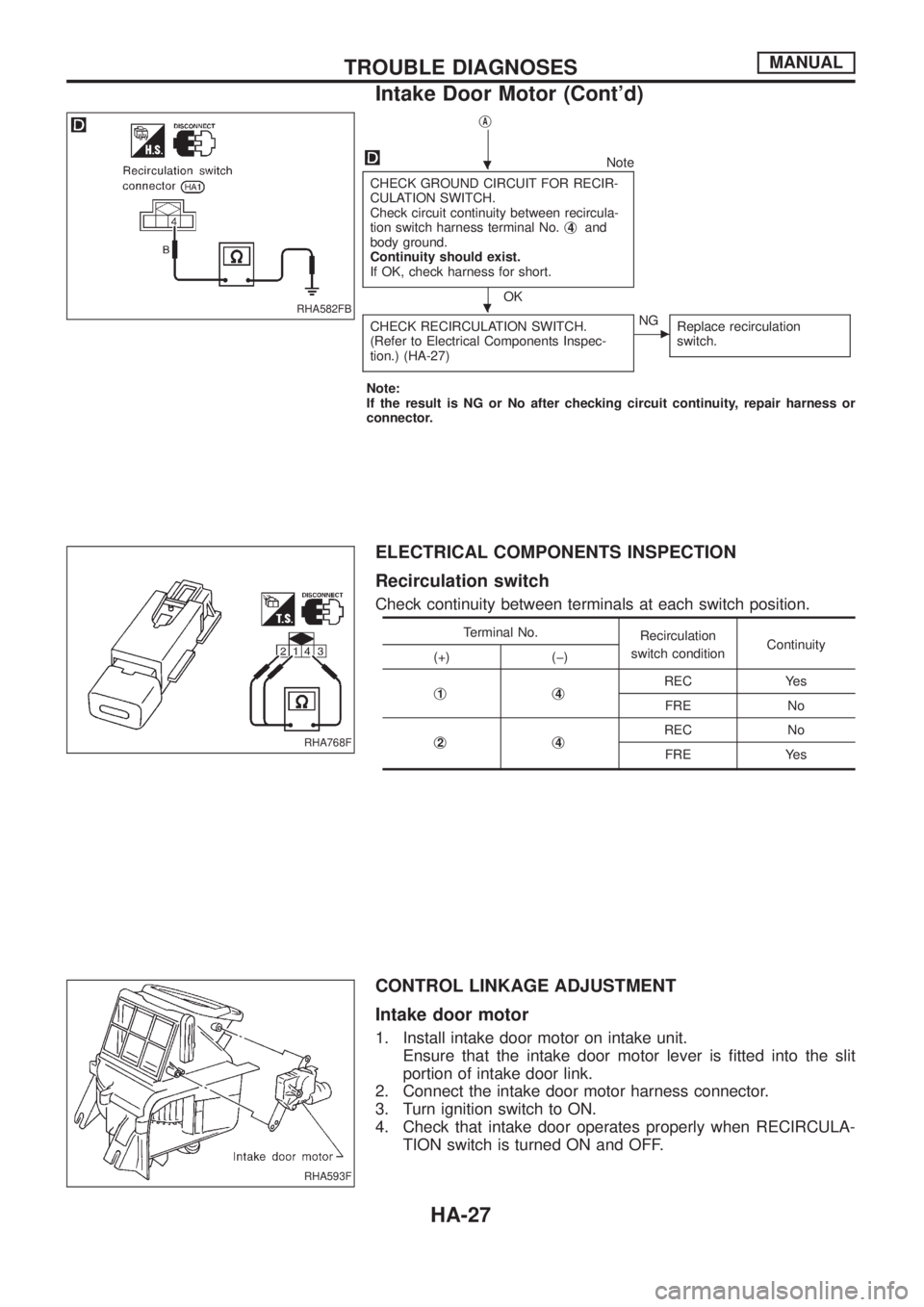
jA
Note
CHECK GROUND CIRCUIT FOR RECIR-
CULATION SWITCH.
Check circuit continuity between recircula-
tion switch harness terminal No.j
4and
body ground.
Continuity should exist.
If OK, check harness for short.
OK
CHECK RECIRCULATION SWITCH.
(Refer to Electrical Components Inspec-
tion.) (HA-27)
cNG
Replace recirculation
switch.
Note:
If the result is NG or No after checking circuit continuity, repair harness or
connector.
ELECTRICAL COMPONENTS INSPECTION
Recirculation switch
Check continuity between terminals at each switch position.
Terminal No.
Recirculation
switch conditionContinuity
(+) (þ)
j
1j4REC Yes
FRE No
j
2j4REC No
FRE Yes
CONTROL LINKAGE ADJUSTMENT
Intake door motor
1. Install intake door motor on intake unit.
Ensure that the intake door motor lever is ®tted into the slit
portion of intake door link.
2. Connect the intake door motor harness connector.
3. Turn ignition switch to ON.
4. Check that intake door operates properly when RECIRCULA-
TION switch is turned ON and OFF.
RHA582FB
RHA768F
RHA593F
.
.
TROUBLE DIAGNOSESMANUAL
Intake Door Motor (Cont'd)
HA-27
Page 884 of 1226
Self-diagnosis
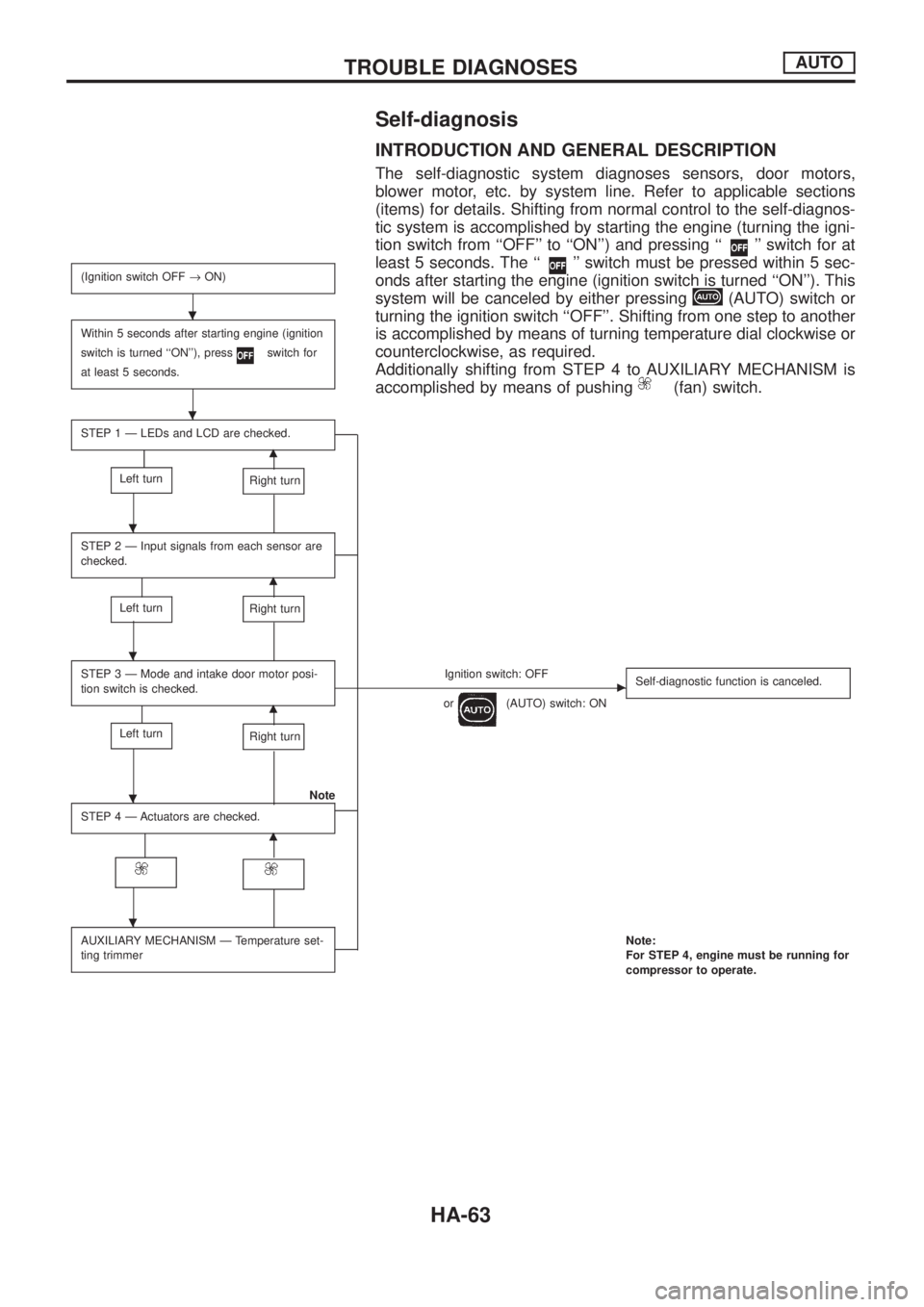
INTRODUCTION AND GENERAL DESCRIPTION
The self-diagnostic system diagnoses sensors, door motors,
blower motor, etc. by system line. Refer to applicable sections
(items) for details. Shifting from normal control to the self-diagnos-
tic system is accomplished by starting the engine (turning the igni-
tion switch from ``OFF'' to ``ON'') and pressing ``
'' switch for at
least 5 seconds. The ``
'' switch must be pressed within 5 sec-
onds after starting the engine (ignition switch is turned ``ON''). This
system will be canceled by either pressing
(AUTO) switch or
turning the ignition switch ``OFF''. Shifting from one step to another
is accomplished by means of turning temperature dial clockwise or
counterclockwise, as required.
Additionally shifting from STEP 4 to AUXILIARY MECHANISM is
accomplished by means of pushing
(fan) switch.
(Ignition switch OFF®ON)
Within 5 seconds after starting engine (ignition
switch is turned ``ON''), press
switch for
at least 5 seconds.
STEP 1 Ð LEDs and LCD are checked.
m
Left turnRight turn
STEP 2 Ð Input signals from each sensor are
checked.
m
Left turnRight turn
STEP 3 Ð Mode and intake door motor posi-
tion switch is checked.Ignition switch: OFFc
or(AUTO) switch: ONSelf-diagnostic function is canceled.m
Left turnRight turn
Note
STEP 4 Ð Actuators are checked.
m
AUXILIARY MECHANISM Ð Temperature set-
ting trimmerNote:
For STEP 4, engine must be running for
compressor to operate.
.
.
.
.
.
.
TROUBLE DIAGNOSESAUTO
HA-63
Page 885 of 1226
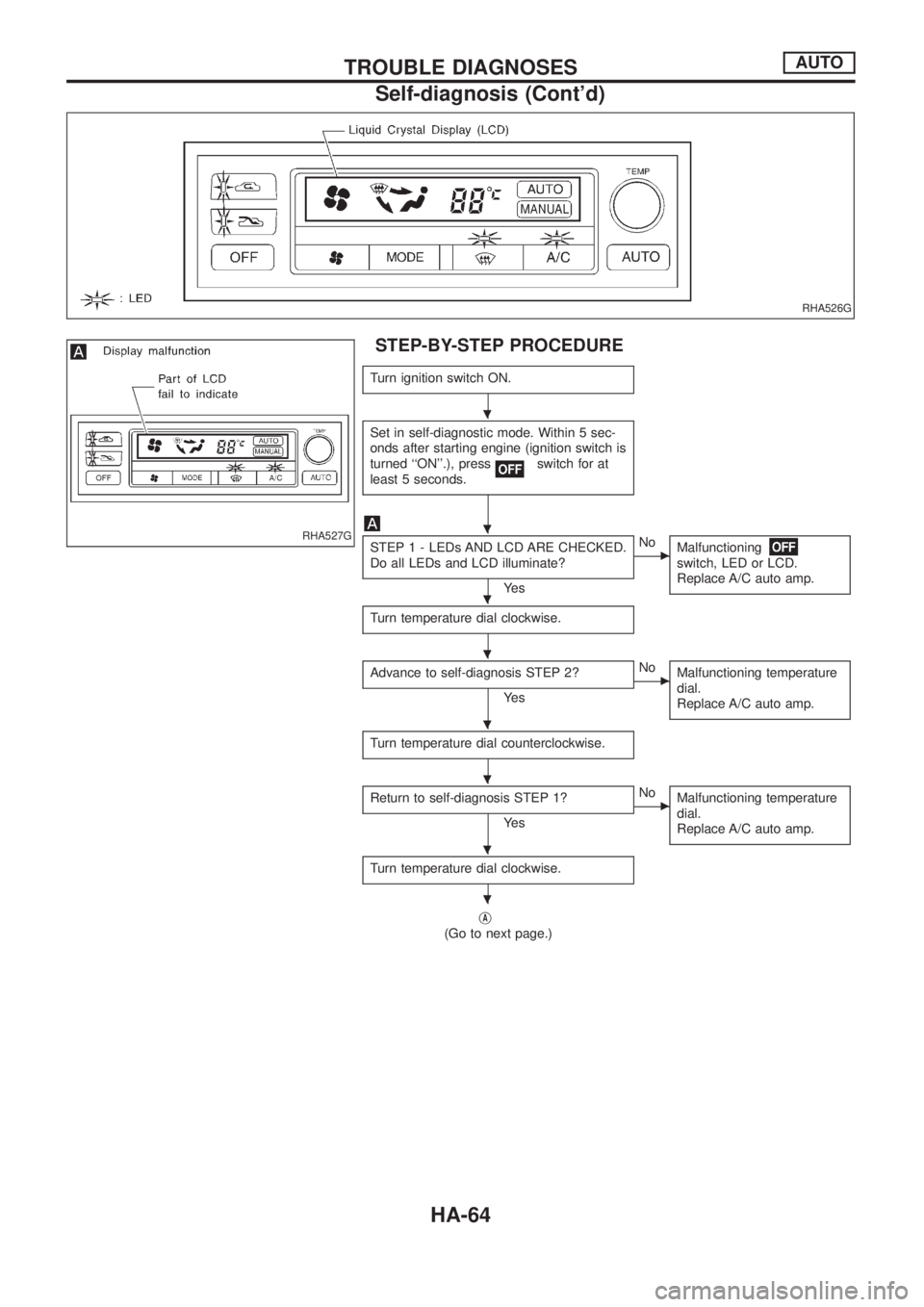
STEP-BY-STEP PROCEDURE
Turn ignition switch ON.
Set in self-diagnostic mode. Within 5 sec-
onds after starting engine (ignition switch is
turned ``ON''.), press
switch for at
least 5 seconds.
STEP 1 - LEDs AND LCD ARE CHECKED.
Do all LEDs and LCD illuminate?
Ye s
cNo
Malfunctioning
switch, LED or LCD.
Replace A/C auto amp.
Turn temperature dial clockwise.
Advance to self-diagnosis STEP 2?
Ye s
cNo
Malfunctioning temperature
dial.
Replace A/C auto amp.
Turn temperature dial counterclockwise.
Return to self-diagnosis STEP 1?
Ye s
cNo
Malfunctioning temperature
dial.
Replace A/C auto amp.
Turn temperature dial clockwise.
jA
(Go to next page.)
RHA526G
RHA527G
.
.
.
.
.
.
.
.
TROUBLE DIAGNOSESAUTO
Self-diagnosis (Cont'd)
HA-64
Page 888 of 1226
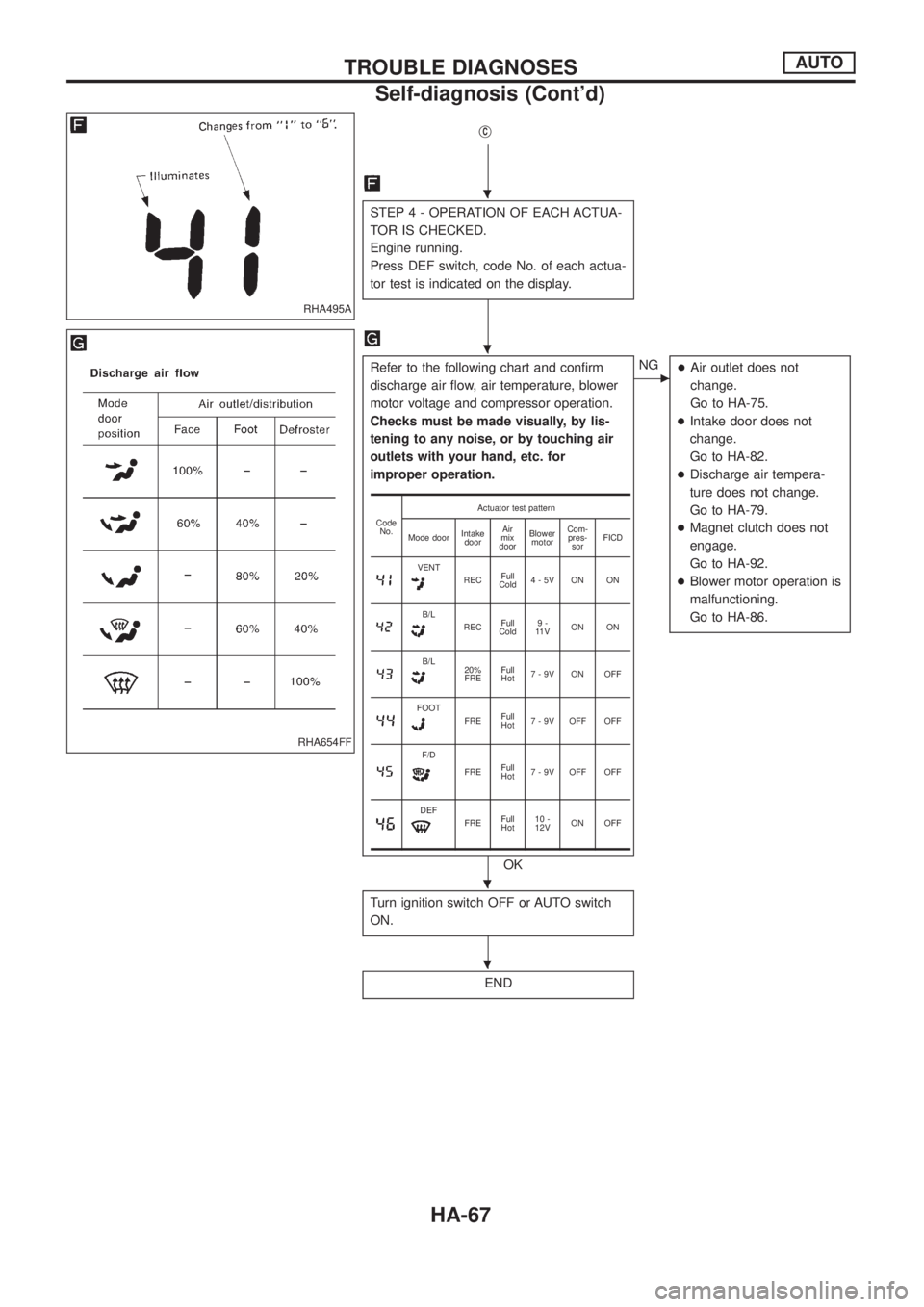
jC
STEP 4 - OPERATION OF EACH ACTUA-
TOR IS CHECKED.
Engine running.
Press DEF switch, code No. of each actua-
tor test is indicated on the display.
Refer to the following chart and con®rm
discharge air ¯ow, air temperature, blower
motor voltage and compressor operation.
Checks must be made visually, by lis-
tening to any noise, or by touching air
outlets with your hand, etc. for
improper operation.
OK
cNG
+Air outlet does not
change.
Go to HA-75.
+Intake door does not
change.
Go to HA-82.
+Discharge air tempera-
ture does not change.
Go to HA-79.
+Magnet clutch does not
engage.
Go to HA-92.
+Blower motor operation is
malfunctioning.
Go to HA-86.
Turn ignition switch OFF or AUTO switch
ON.
END
Code
No.Actuator test pattern
Mode doorIntake
doorAir
mix
doorBlower
motorCom-
pres-
sorFICD
VENTRECFull
Cold4-5V ON ON
B/LRECFull
Cold9-
11 VON ON
B/L20%
FREFull
Hot7-9V ON OFF
FOOTFREFull
Hot7 - 9V OFF OFF
F/D
FREFull
Hot7 - 9V OFF OFF
DEFFREFull
Hot10 -
12VON OFF
RHA495A
RHA654FF
.
.
.
.
TROUBLE DIAGNOSESAUTO
Self-diagnosis (Cont'd)
HA-67
Page 891 of 1226
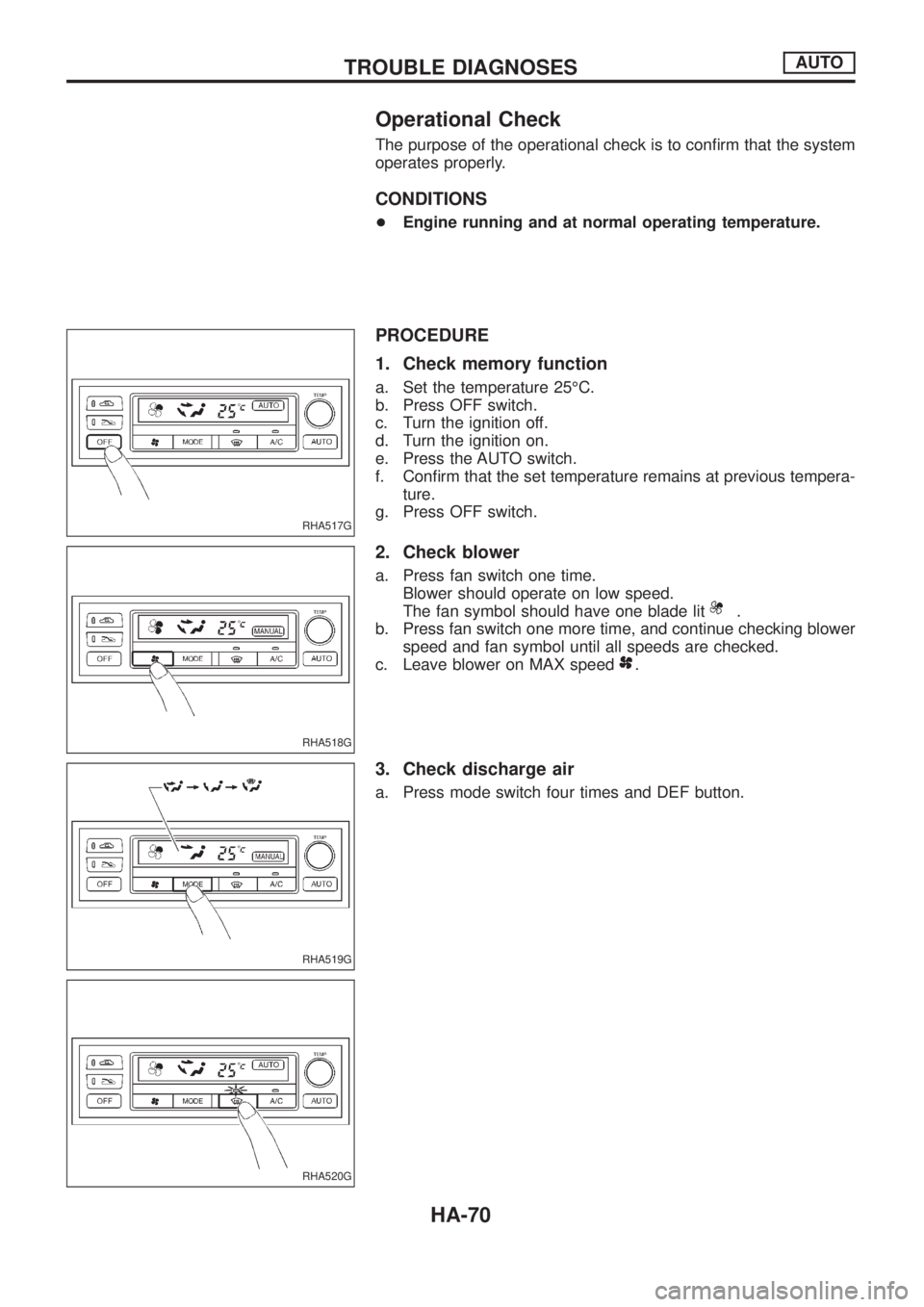
Operational Check
The purpose of the operational check is to con®rm that the system
operates properly.
CONDITIONS
+Engine running and at normal operating temperature.
PROCEDURE
1. Check memory function
a. Set the temperature 25ÉC.
b. Press OFF switch.
c. Turn the ignition off.
d. Turn the ignition on.
e. Press the AUTO switch.
f. Con®rm that the set temperature remains at previous tempera-
ture.
g. Press OFF switch.
2. Check blower
a. Press fan switch one time.
Blower should operate on low speed.
The fan symbol should have one blade lit
.
b. Press fan switch one more time, and continue checking blower
speed and fan symbol until all speeds are checked.
c. Leave blower on MAX speed
.
3. Check discharge air
a. Press mode switch four times and DEF button.
RHA517G
RHA518G
RHA519G
RHA520G
TROUBLE DIAGNOSESAUTO
HA-70
Page 895 of 1226
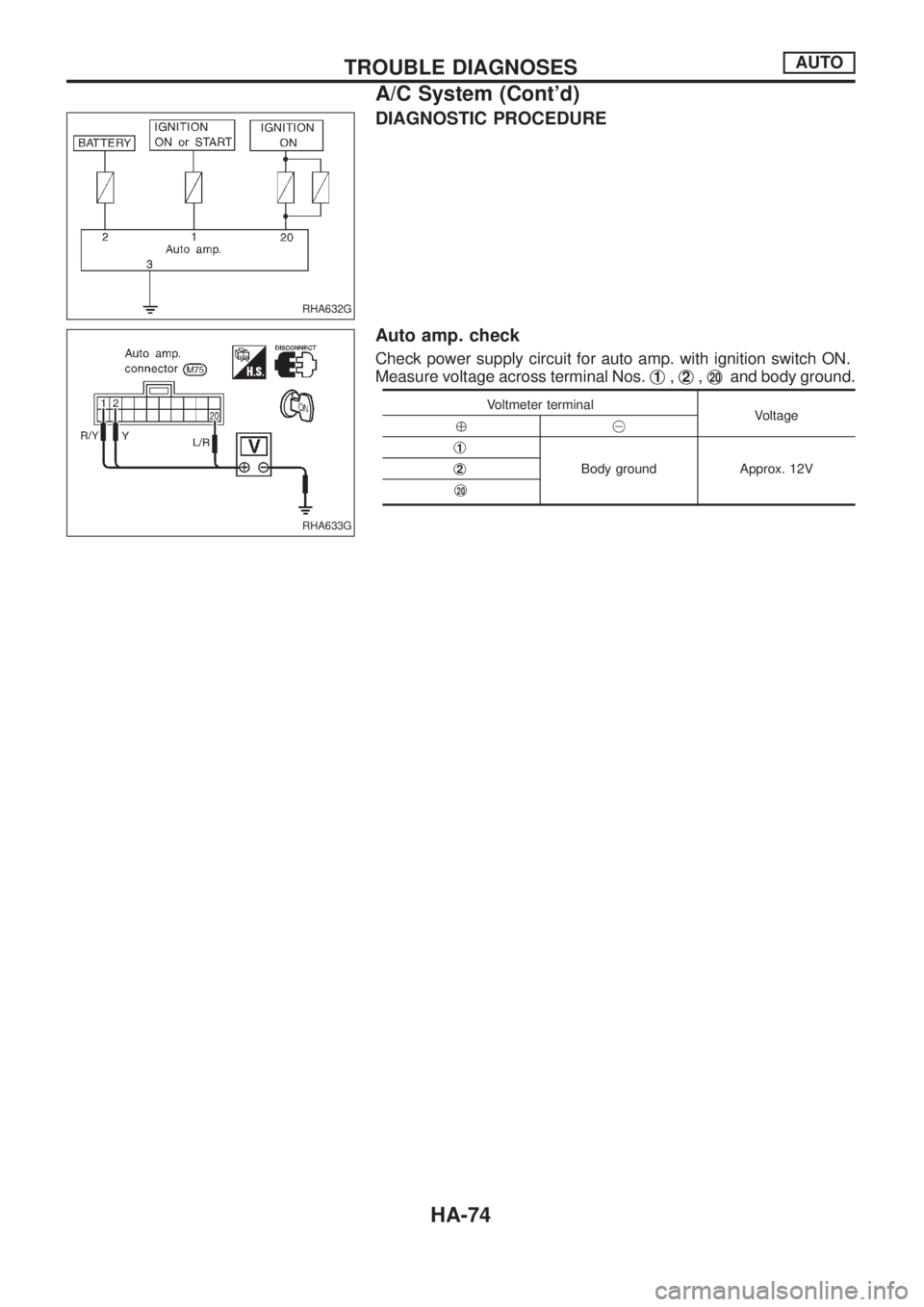
DIAGNOSTIC PROCEDURE
Auto amp. check
Check power supply circuit for auto amp. with ignition switch ON.
Measure voltage across terminal Nos.j
1,j2,j20and body ground.
Voltmeter terminal
Voltage
%@
j
1
Body ground Approx. 12V j2
j20
RHA632G
RHA633G
TROUBLE DIAGNOSESAUTO
A/C System (Cont'd)
HA-74
Page 975 of 1226
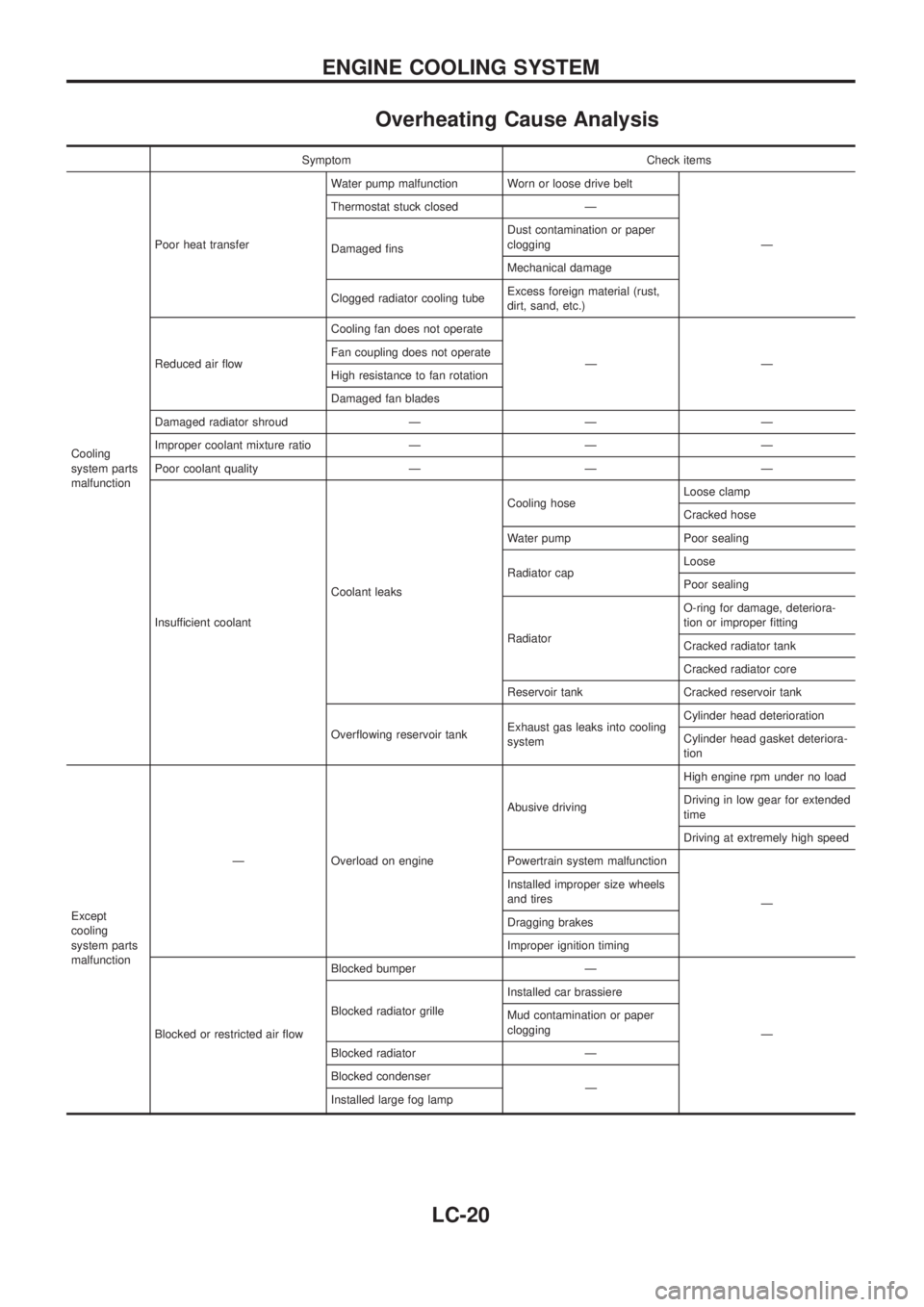
Overheating Cause Analysis
Symptom Check items
Cooling
system parts
malfunctionPoor heat transferWater pump malfunction Worn or loose drive belt
Ð Thermostat stuck closed Ð
Damaged ®nsDust contamination or paper
clogging
Mechanical damage
Clogged radiator cooling tubeExcess foreign material (rust,
dirt, sand, etc.)
Reduced air ¯owCooling fan does not operate
ÐÐ Fan coupling does not operate
High resistance to fan rotation
Damaged fan blades
Damaged radiator shroud Ð Ð Ð
Improper coolant mixture ratio Ð Ð Ð
Poor coolant quality Ð Ð Ð
Insufficient coolantCoolant leaksCooling hoseLoose clamp
Cracked hose
Water pump Poor sealing
Radiator capLoose
Poor sealing
RadiatorO-ring for damage, deteriora-
tion or improper ®tting
Cracked radiator tank
Cracked radiator core
Reservoir tank Cracked reservoir tank
Over¯owing reservoir tankExhaust gas leaks into cooling
systemCylinder head deterioration
Cylinder head gasket deteriora-
tion
Except
cooling
system parts
malfunctionÐ Overload on engineAbusive drivingHigh engine rpm under no load
Driving in low gear for extended
time
Driving at extremely high speed
Powertrain system malfunction
Ð Installed improper size wheels
and tires
Dragging brakes
Improper ignition timing
Blocked or restricted air ¯owBlocked bumper Ð
Ð Blocked radiator grilleInstalled car brassiere
Mud contamination or paper
clogging
Blocked radiator Ð
Blocked condenser
Ð
Installed large fog lamp
ENGINE COOLING SYSTEM
LC-20
Page 979 of 1226
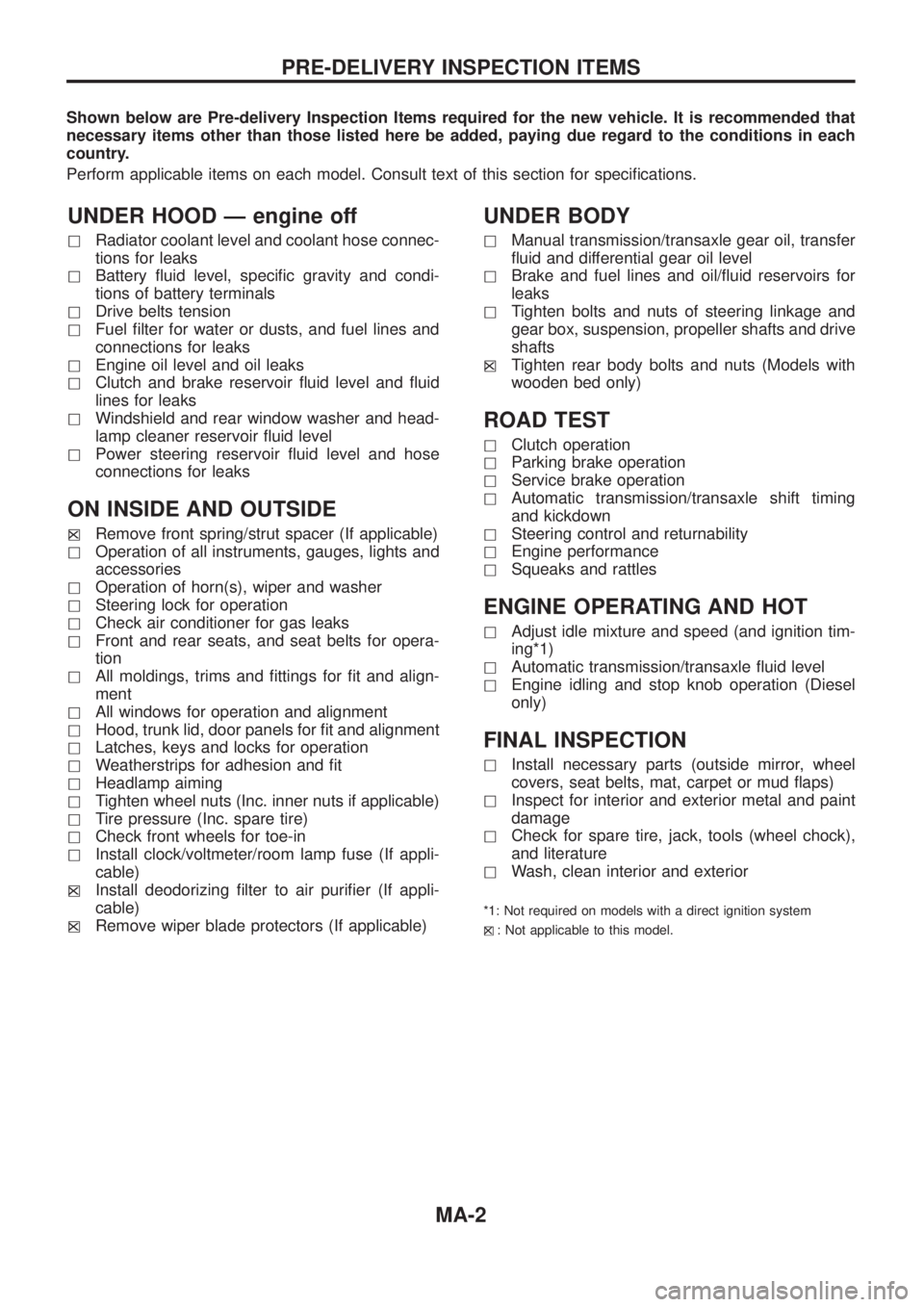
Shown below are Pre-delivery Inspection Items required for the new vehicle. It is recommended that
necessary items other than those listed here be added, paying due regard to the conditions in each
country.
Perform applicable items on each model. Consult text of this section for speci®cations.
UNDER HOOD Ð engine off
hRadiator coolant level and coolant hose connec-
tions for leaks
hBattery ¯uid level, speci®c gravity and condi-
tions of battery terminals
hDrive belts tension
hFuel ®lter for water or dusts, and fuel lines and
connections for leaks
hEngine oil level and oil leaks
hClutch and brake reservoir ¯uid level and ¯uid
lines for leaks
hWindshield and rear window washer and head-
lamp cleaner reservoir ¯uid level
hPower steering reservoir ¯uid level and hose
connections for leaks
ON INSIDE AND OUTSIDE
hXRemove front spring/strut spacer (If applicable)
hOperation of all instruments, gauges, lights and
accessories
hOperation of horn(s), wiper and washer
hSteering lock for operation
hCheck air conditioner for gas leaks
hFront and rear seats, and seat belts for opera-
tion
hAll moldings, trims and ®ttings for ®t and align-
ment
hAll windows for operation and alignment
hHood, trunk lid, door panels for ®t and alignment
hLatches, keys and locks for operation
hWeatherstrips for adhesion and ®t
hHeadlamp aiming
hTighten wheel nuts (Inc. inner nuts if applicable)
hTire pressure (Inc. spare tire)
hCheck front wheels for toe-in
hInstall clock/voltmeter/room lamp fuse (If appli-
cable)
h
XInstall deodorizing ®lter to air puri®er (If appli-
cable)
h
XRemove wiper blade protectors (If applicable)
UNDER BODY
hManual transmission/transaxle gear oil, transfer
¯uid and differential gear oil level
hBrake and fuel lines and oil/¯uid reservoirs for
leaks
hTighten bolts and nuts of steering linkage and
gear box, suspension, propeller shafts and drive
shafts
h
XTighten rear body bolts and nuts (Models with
wooden bed only)
ROAD TEST
hClutch operation
hParking brake operation
hService brake operation
hAutomatic transmission/transaxle shift timing
and kickdown
hSteering control and returnability
hEngine performance
hSqueaks and rattles
ENGINE OPERATING AND HOT
hAdjust idle mixture and speed (and ignition tim-
ing*1)
hAutomatic transmission/transaxle ¯uid level
hEngine idling and stop knob operation (Diesel
only)
FINAL INSPECTION
hInstall necessary parts (outside mirror, wheel
covers, seat belts, mat, carpet or mud ¯aps)
hInspect for interior and exterior metal and paint
damage
hCheck for spare tire, jack, tools (wheel chock),
and literature
hWash, clean interior and exterior
*1: Not required on models with a direct ignition system
h
X: Not applicable to this model.
PRE-DELIVERY INSPECTION ITEMS
MA-2
Page 1116 of 1226
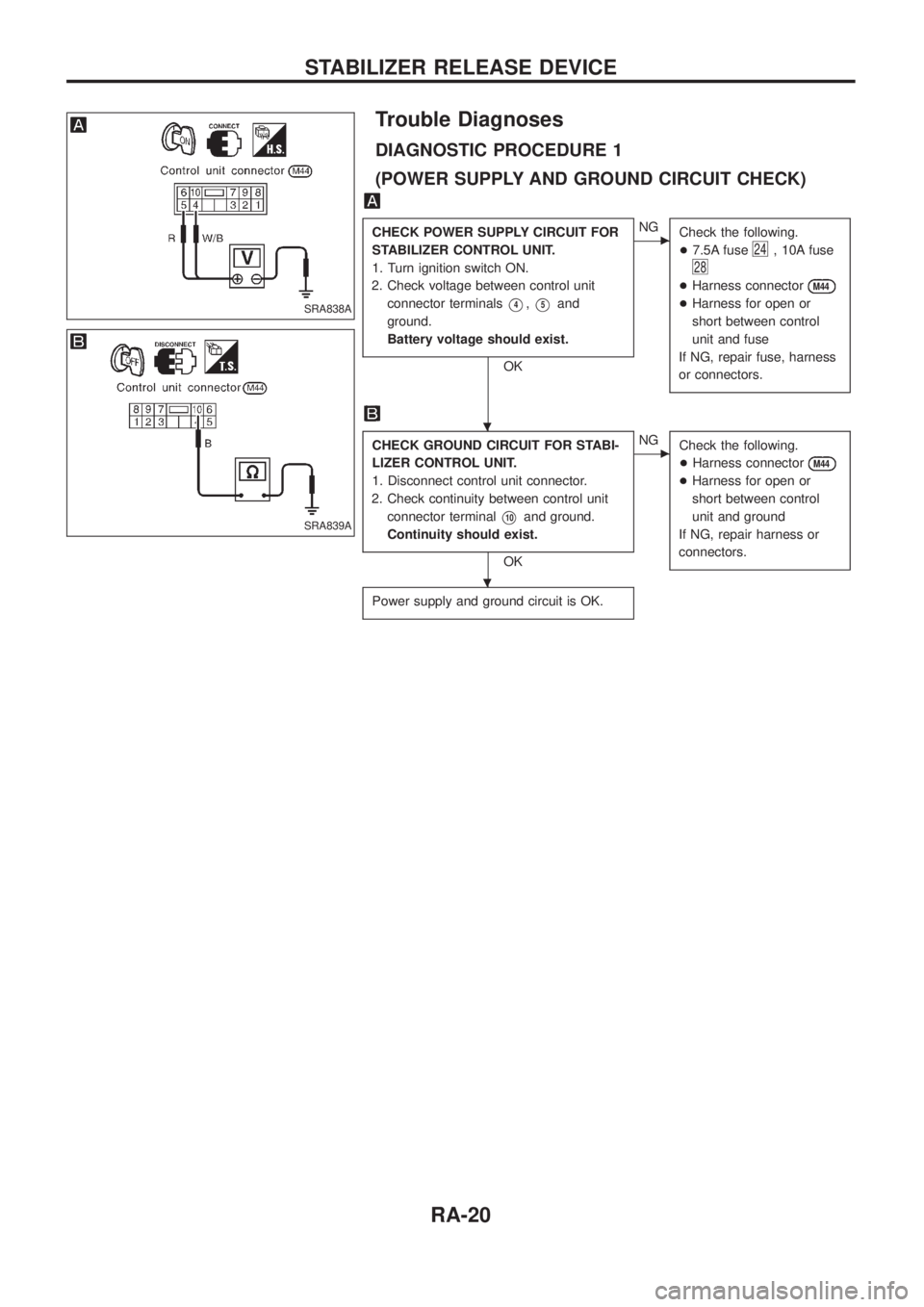
Trouble Diagnoses
DIAGNOSTIC PROCEDURE 1
(POWER SUPPLY AND GROUND CIRCUIT CHECK)
CHECK POWER SUPPLY CIRCUIT FOR
STABILIZER CONTROL UNIT.
1. Turn ignition switch ON.
2. Check voltage between control unit
connector terminals
V4,V5and
ground.
Battery voltage should exist.
OK
cNG
Check the following.
+7.5A fuse
24, 10A fuse
28
+Harness connectorM44
+Harness for open or
short between control
unit and fuse
If NG, repair fuse, harness
or connectors.
CHECK GROUND CIRCUIT FOR STABI-
LIZER CONTROL UNIT.
1. Disconnect control unit connector.
2. Check continuity between control unit
connector terminal
V10and ground.
Continuity should exist.
OK
cNG
Check the following.
+Harness connector
M44
+Harness for open or
short between control
unit and ground
If NG, repair harness or
connectors.
Power supply and ground circuit is OK.
SRA838A
SRA839A
.
.
STABILIZER RELEASE DEVICE
RA-20
Page 1118 of 1226
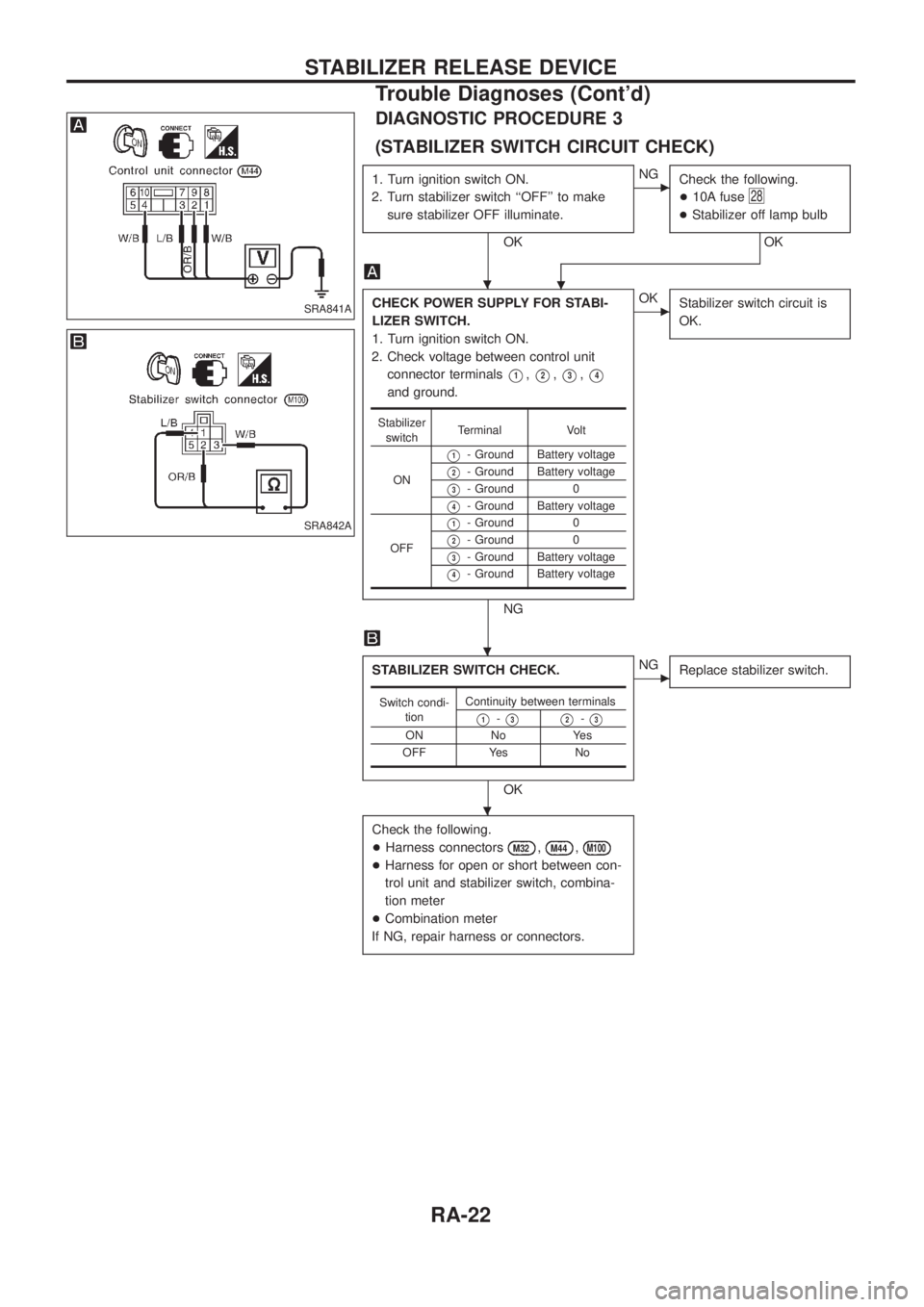
DIAGNOSTIC PROCEDURE 3
(STABILIZER SWITCH CIRCUIT CHECK)
1. Turn ignition switch ON.
2. Turn stabilizer switch ``OFF'' to make
sure stabilizer OFF illuminate.
OK
cNG
Check the following.
+10A fuse
28
+Stabilizer off lamp bulb
OK
.
CHECK POWER SUPPLY FOR STABI-
LIZER SWITCH.
1. Turn ignition switch ON.
2. Check voltage between control unit
connector terminals
V1,V2,V3,V4
and ground.
NG
cOK
Stabilizer switch circuit is
OK.
STABILIZER SWITCH CHECK.
OK
cNG
Replace stabilizer switch.
Check the following.
+Harness connectors
M32,M44,M100
+Harness for open or short between con-
trol unit and stabilizer switch, combina-
tion meter
+Combination meter
If NG, repair harness or connectors.
Stabilizer
switchTerminal Volt
ON
V1- Ground Battery voltage
V2- Ground Battery voltage
V3- Ground 0
V4- Ground Battery voltage
OFF
V1- Ground 0
V2- Ground 0
V3- Ground Battery voltage
V4- Ground Battery voltage
Switch condi-
tionContinuity between terminals
V1-V3V2-V3
ON No Yes
OFF Yes No
SRA841A
SRA842A
.
.
.
STABILIZER RELEASE DEVICE
Trouble Diagnoses (Cont'd)
RA-22