ignition NISSAN PATROL 2006 Manual Online
[x] Cancel search | Manufacturer: NISSAN, Model Year: 2006, Model line: PATROL, Model: NISSAN PATROL 2006Pages: 1226, PDF Size: 37.18 MB
Page 296 of 1226
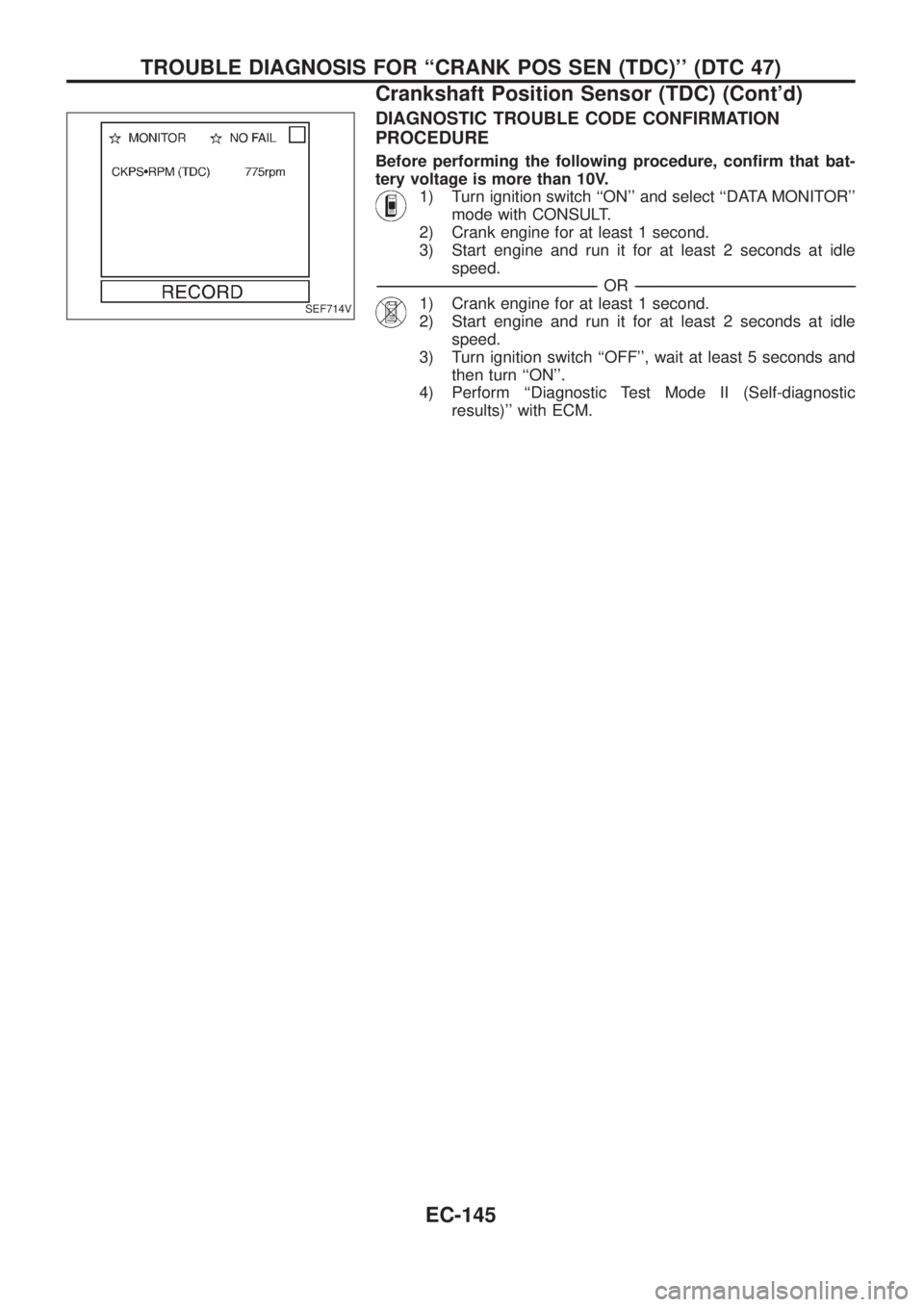
DIAGNOSTIC TROUBLE CODE CONFIRMATION
PROCEDURE
Before performing the following procedure, con®rm that bat-
tery voltage is more than 10V.
1) Turn ignition switch ``ON'' and select ``DATA MONITOR''
mode with CONSULT.
2) Crank engine for at least 1 second.
3) Start engine and run it for at least 2 seconds at idle
speed.
-------------------------------------------------------------------------------------------------------------------------------------------------------------------------------------------------------------------------------------------------------OR-------------------------------------------------------------------------------------------------------------------------------------------------------------------------------------------------------------------------------------------------------
1) Crank engine for at least 1 second.
2) Start engine and run it for at least 2 seconds at idle
speed.
3) Turn ignition switch ``OFF'', wait at least 5 seconds and
then turn ``ON''.
4) Perform ``Diagnostic Test Mode II (Self-diagnostic
results)'' with ECM.SEF714V
TROUBLE DIAGNOSIS FOR ``CRANK POS SEN (TDC)'' (DTC 47)
Crankshaft Position Sensor (TDC) (Cont'd)
EC-145
Page 298 of 1226
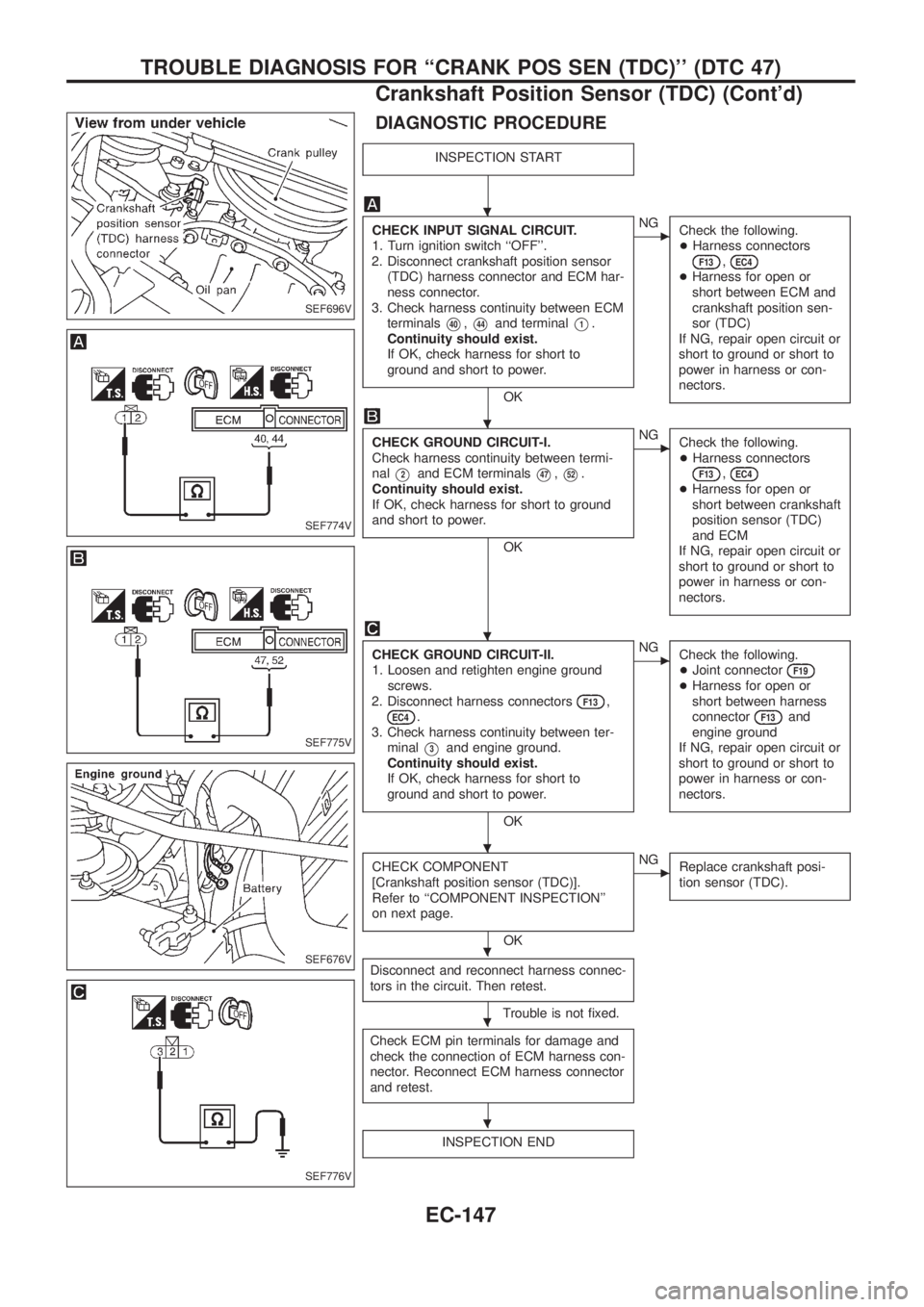
DIAGNOSTIC PROCEDURE
INSPECTION START
CHECK INPUT SIGNAL CIRCUIT.
1. Turn ignition switch ``OFF''.
2. Disconnect crankshaft position sensor
(TDC) harness connector and ECM har-
ness connector.
3. Check harness continuity between ECM
terminals
V40,V44and terminalV1.
Continuity should exist.
If OK, check harness for short to
ground and short to power.
OK
cNG
Check the following.
+Harness connectors
F13,EC4+Harness for open or
short between ECM and
crankshaft position sen-
sor (TDC)
If NG, repair open circuit or
short to ground or short to
power in harness or con-
nectors.
CHECK GROUND CIRCUIT-I.
Check harness continuity between termi-
nal
V2and ECM terminalsV47,V52.
Continuity should exist.
If OK, check harness for short to ground
and short to power.
OK
cNG
Check the following.
+Harness connectors
F13,EC4+Harness for open or
short between crankshaft
position sensor (TDC)
and ECM
If NG, repair open circuit or
short to ground or short to
power in harness or con-
nectors.
CHECK GROUND CIRCUIT-II.
1. Loosen and retighten engine ground
screws.
2. Disconnect harness connectors
F13,EC4.
3. Check harness continuity between ter-
minal
V3and engine ground.
Continuity should exist.
If OK, check harness for short to
ground and short to power.
OK
cNG
Check the following.
+Joint connector
F19+Harness for open or
short between harness
connector
F13and
engine ground
If NG, repair open circuit or
short to ground or short to
power in harness or con-
nectors.
CHECK COMPONENT
[Crankshaft position sensor (TDC)].
Refer to ``COMPONENT INSPECTION''
on next page.
OK
cNG
Replace crankshaft posi-
tion sensor (TDC).
Disconnect and reconnect harness connec-
tors in the circuit. Then retest.
Trouble is not ®xed.
Check ECM pin terminals for damage and
check the connection of ECM harness con-
nector. Reconnect ECM harness connector
and retest.
INSPECTION END
SEF696V
SEF774V
SEF775V
SEF676V
SEF776V
.
.
.
.
.
.
.
TROUBLE DIAGNOSIS FOR ``CRANK POS SEN (TDC)'' (DTC 47)
Crankshaft Position Sensor (TDC) (Cont'd)
EC-147
Page 300 of 1226
Governor Cut Circuit
ON BOARD DIAGNOSIS LOGIC
This diagnostic procedure checks whether or not fuel cut is being performed during deceleration.
Signals from the accelerator switch and camshaft position sensor (PUMP) are sent to the ECM. The ECM uses
these signals to control the electric governor operation.
Accelerator switch (F/C)cAccelerator position
ECM
cElectric
governor
Camshaft position sensor (PUMP)cEngine speed
Diagnostic
Trouble Code
No.Malfunction is detected when ....Check Item
(Possible Cause)
48+Accelerator switch circuit is shorted.
+Crankshaft position sensor (PUMP) or ECM is mal-
functioning.+Harness or connectors
[Accelerator switch (F/C) and camshaft position sen-
sor (PUMP) circuits]
+Accelerator switch (F/C)
+Camshaft position sensor (PUMP)
+ECM
DIAGNOSTIC TROUBLE CODE CONFIRMATION
PROCEDURE
Note: If both DTC 48 and 11 or 23 are displayed, perform
TROUBLE DIAGNOSIS FOR DTC 11 or 23 (See EC-69 or
106).
1) Turn ignition switch ``ON''.
2) Select ``DATA MONITOR'' mode with CONSULT.
3) Start engine and run it to 3,000 rpm, then quickly release
accelerator pedal.
-------------------------------------------------------------------------------------------------------------------------------------------------------------------------------------------------------------------------------------------------------OR-------------------------------------------------------------------------------------------------------------------------------------------------------------------------------------------------------------------------------------------------------
1) Start engine and run it to 3,000 rpm, then quickly release
accelerator pedal.
2) Turn ignition switch ``OFF'', wait at least 5 seconds and
then turn ``ON''.
3) Perform ``Diagnostic Test Mode II (Self-diagnostic
results)''.
TROUBLE DIAGNOSIS FOR ``GOV CUT CIRCUIT'' (DTC 48)
EC-149
Page 301 of 1226
DIAGNOSTIC PROCEDURE
INSPECTION START
1) Turn ignition switch ``ON''.
2) Select ``SELF DIAG RESULTS''
mode with CONSULT.
3) Touch ``ERASE''.
--------------------------------------------------------------------------------------------------------------------------------------OR--------------------------------------------------------------------------------------------------------------------------------------
1) Turn ignition switch ``ON''.
2) Erase the diagnostic test mode
II (Self-diagnostic results)
memory.
PERFORM DIAGNOSTIC TROUBLE
CODE CONFIRMATION PROCEDURE.
See previous page.
Is the DTC 48 displayed again?
No
cYe s
Replace ECM.
INSPECTION END
.
.
.
.
TROUBLE DIAGNOSIS FOR ``GOV CUT CIRCUIT'' (DTC 48)
Governor Cut Circuit (Cont'd)
EC-150
Page 302 of 1226
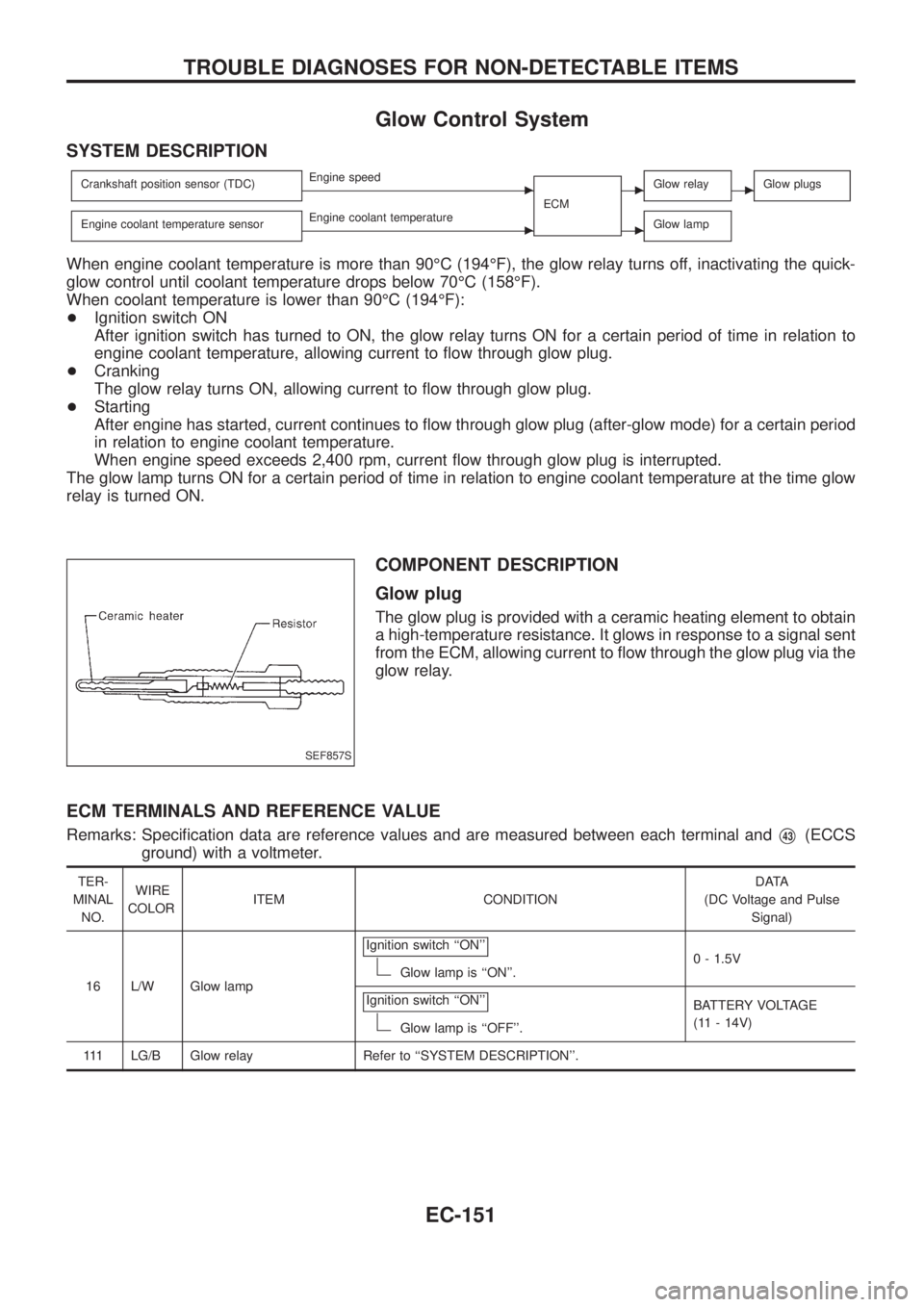
Glow Control System
SYSTEM DESCRIPTION
Crankshaft position sensor (TDC)cEngine speed
ECMcGlow relaycGlow plugs
Engine coolant temperature sensorcEngine coolant temperaturecGlow lamp
When engine coolant temperature is more than 90ÉC (194ÉF), the glow relay turns off, inactivating the quick-
glow control until coolant temperature drops below 70ÉC (158ÉF).
When coolant temperature is lower than 90ÉC (194ÉF):
+Ignition switch ON
After ignition switch has turned to ON, the glow relay turns ON for a certain period of time in relation to
engine coolant temperature, allowing current to ¯ow through glow plug.
+Cranking
The glow relay turns ON, allowing current to ¯ow through glow plug.
+Starting
After engine has started, current continues to ¯ow through glow plug (after-glow mode) for a certain period
in relation to engine coolant temperature.
When engine speed exceeds 2,400 rpm, current ¯ow through glow plug is interrupted.
The glow lamp turns ON for a certain period of time in relation to engine coolant temperature at the time glow
relay is turned ON.
COMPONENT DESCRIPTION
Glow plug
The glow plug is provided with a ceramic heating element to obtain
a high-temperature resistance. It glows in response to a signal sent
from the ECM, allowing current to ¯ow through the glow plug via the
glow relay.
ECM TERMINALS AND REFERENCE VALUE
Remarks: Speci®cation data are reference values and are measured between each terminal andV43(ECCS
ground) with a voltmeter.
TER-
MINAL
NO.WIRE
COLORITEM CONDITIONDATA
(DC Voltage and Pulse
Signal)
16 L/W Glow lampIgnition switch ``ON''
Glow lamp is ``ON''.0 - 1.5V
Ignition switch ``ON''
Glow lamp is ``OFF''.BATTERY VOLTAGE
(11 - 14V)
111 LG/B Glow relay Refer to ``SYSTEM DESCRIPTION''.
SEF857S
TROUBLE DIAGNOSES FOR NON-DETECTABLE ITEMS
EC-151
Page 304 of 1226
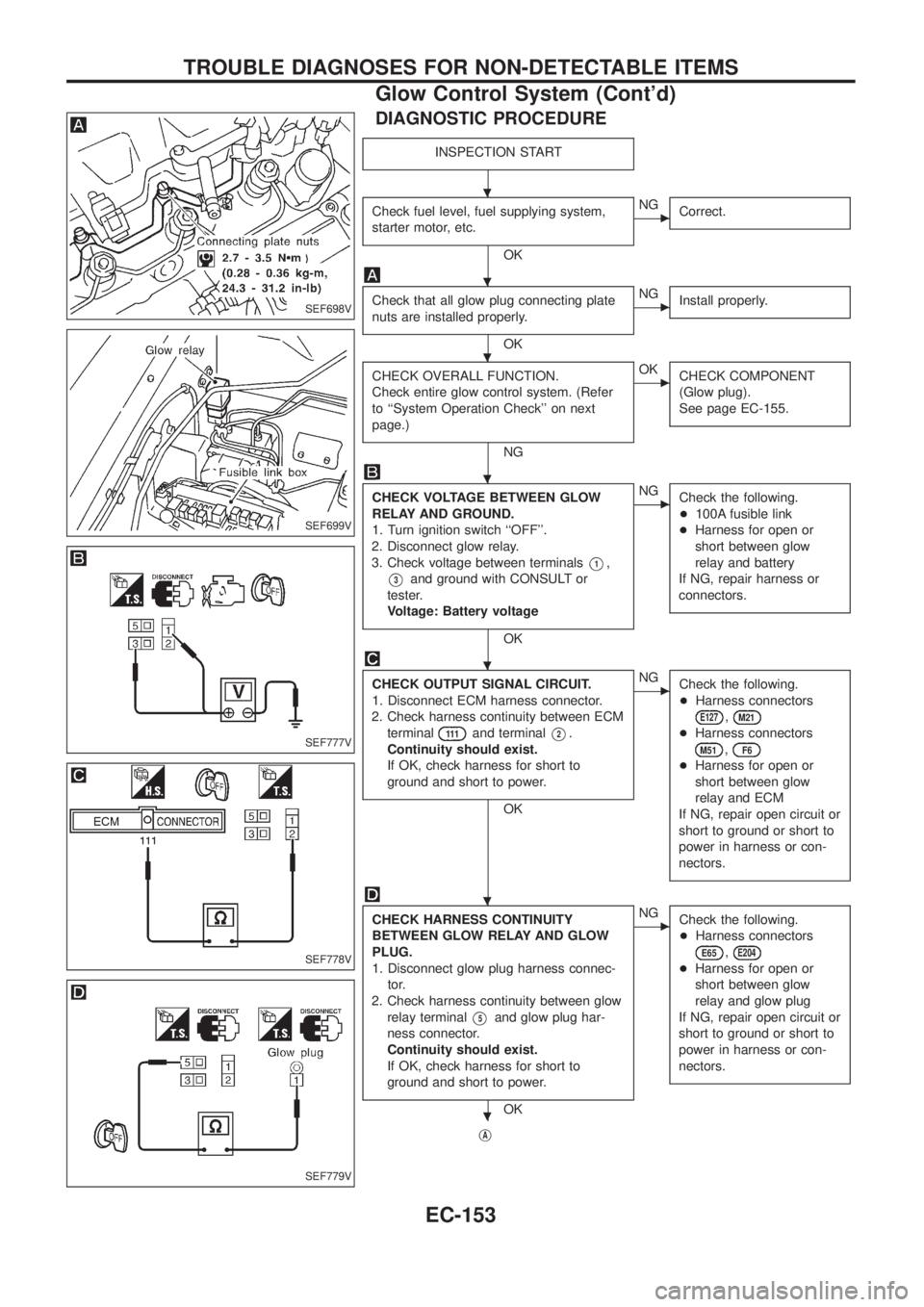
DIAGNOSTIC PROCEDURE
INSPECTION START
Check fuel level, fuel supplying system,
starter motor, etc.
OK
cNG
Correct.
Check that all glow plug connecting plate
nuts are installed properly.
OK
cNG
Install properly.
CHECK OVERALL FUNCTION.
Check entire glow control system. (Refer
to ``System Operation Check'' on next
page.)
NG
cOK
CHECK COMPONENT
(Glow plug).
See page EC-155.
CHECK VOLTAGE BETWEEN GLOW
RELAY AND GROUND.
1. Turn ignition switch ``OFF''.
2. Disconnect glow relay.
3. Check voltage between terminals
V1,
V3and ground with CONSULT or
tester.
Voltage: Battery voltage
OK
cNG
Check the following.
+100A fusible link
+Harness for open or
short between glow
relay and battery
If NG, repair harness or
connectors.
CHECK OUTPUT SIGNAL CIRCUIT.
1. Disconnect ECM harness connector.
2. Check harness continuity between ECM
terminal
111and terminalV2.
Continuity should exist.
If OK, check harness for short to
ground and short to power.
OK
cNG
Check the following.
+Harness connectors
E127,M21
+Harness connectors
M51,F6
+Harness for open or
short between glow
relay and ECM
If NG, repair open circuit or
short to ground or short to
power in harness or con-
nectors.
CHECK HARNESS CONTINUITY
BETWEEN GLOW RELAY AND GLOW
PLUG.
1. Disconnect glow plug harness connec-
tor.
2. Check harness continuity between glow
relay terminal
V5and glow plug har-
ness connector.
Continuity should exist.
If OK, check harness for short to
ground and short to power.
OK
cNG
Check the following.
+Harness connectors
E65,E204
+Harness for open or
short between glow
relay and glow plug
If NG, repair open circuit or
short to ground or short to
power in harness or con-
nectors.
jA
SEF698V
SEF699V
SEF777V
SEF778V
SEF779V
.
.
.
.
.
.
.
TROUBLE DIAGNOSES FOR NON-DETECTABLE ITEMS
Glow Control System (Cont'd)
EC-153
Page 305 of 1226
jA
CHECK COMPONENTS
(Glow relay, Glow plug).
Refer to ``COMPONENT INSPECTION'',
EC-155.
OK
cNG
Replace malfunctioning
component(s).
Disconnect and reconnect harness connec-
tors in the circuit. Then retest.
Trouble is not ®xed.
Check ECM pin terminals for damage and
check the connection of ECM harness con-
nector. Reconnect ECM harness connector
and retest.
INSPECTION END
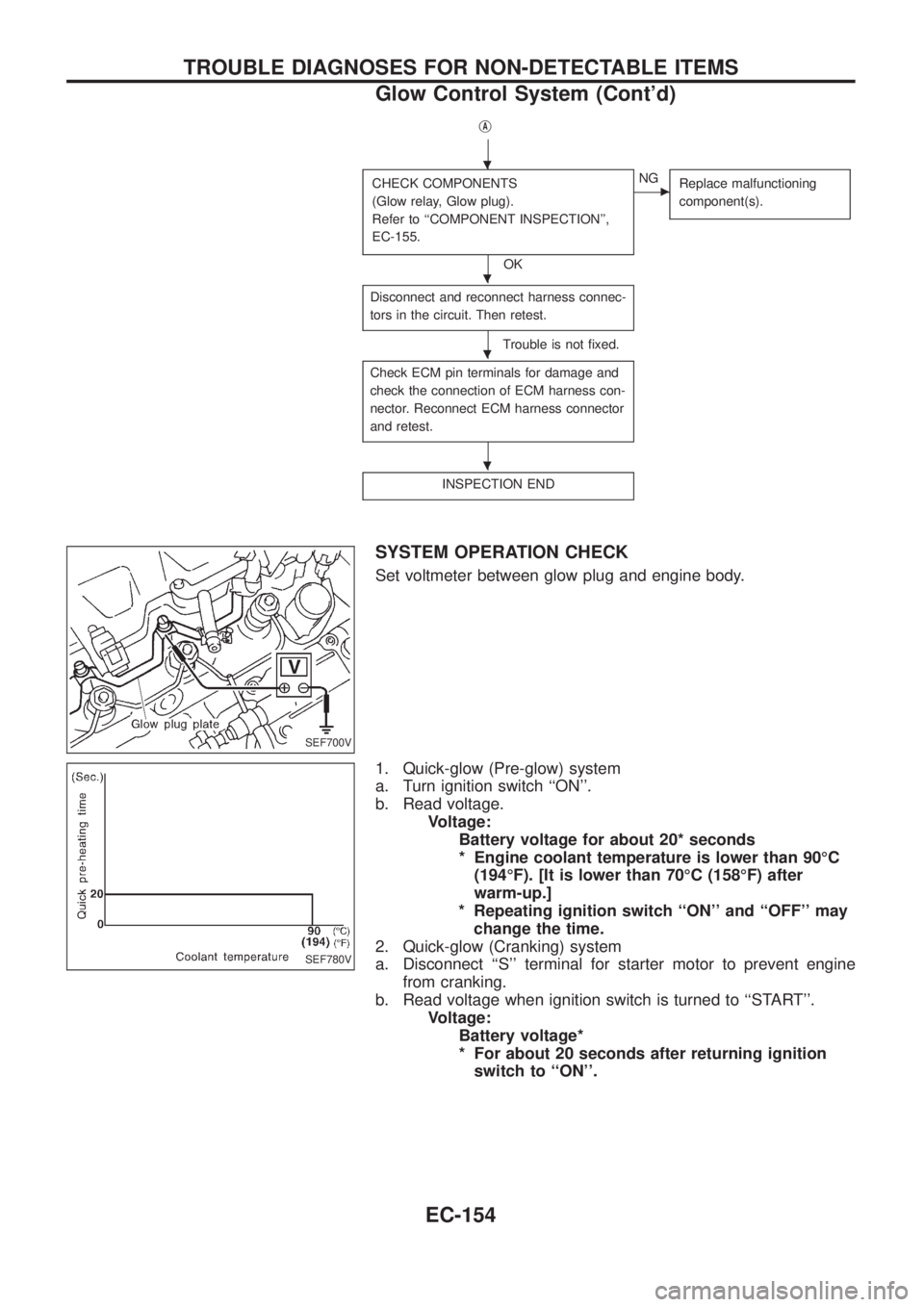
SYSTEM OPERATION CHECK
Set voltmeter between glow plug and engine body.
1. Quick-glow (Pre-glow) system
a. Turn ignition switch ``ON''.
b. Read voltage.
Voltage:
Battery voltage for about 20* seconds
* Engine coolant temperature is lower than 90ÉC
(194ÉF). [It is lower than 70ÉC (158ÉF) after
warm-up.]
* Repeating ignition switch ``ON'' and ``OFF'' may
change the time.
2. Quick-glow (Cranking) system
a. Disconnect ``S'' terminal for starter motor to prevent engine
from cranking.
b. Read voltage when ignition switch is turned to ``START''.
Voltage:
Battery voltage*
* For about 20 seconds after returning ignition
switch to ``ON''.
SEF700V
SEF780V
.
.
.
.
TROUBLE DIAGNOSES FOR NON-DETECTABLE ITEMS
Glow Control System (Cont'd)
EC-154
Page 307 of 1226
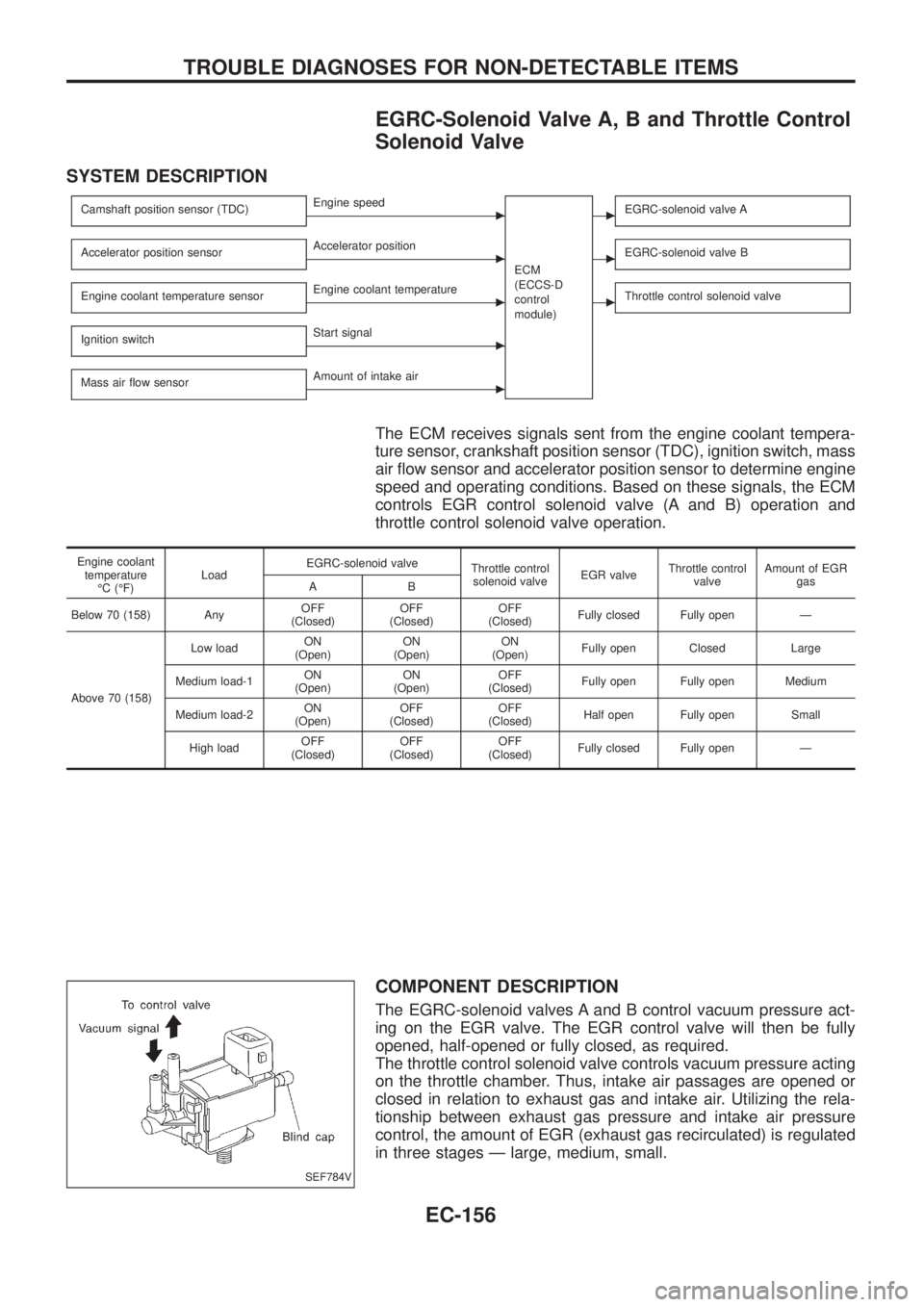
EGRC-Solenoid Valve A, B and Throttle Control
Solenoid Valve
SYSTEM DESCRIPTION
Camshaft position sensor (TDC)cEngine speed
ECM
(ECCS-D
control
module)cEGRC-solenoid valve A
Accelerator position sensorcAccelerator positioncEGRC-solenoid valve B
Engine coolant temperature sensorcEngine coolant temperaturecThrottle control solenoid valve
Ignition switchcStart signal
Mass air ¯ow sensor
cAmount of intake air
The ECM receives signals sent from the engine coolant tempera-
ture sensor, crankshaft position sensor (TDC), ignition switch, mass
air ¯ow sensor and accelerator position sensor to determine engine
speed and operating conditions. Based on these signals, the ECM
controls EGR control solenoid valve (A and B) operation and
throttle control solenoid valve operation.
Engine coolant
temperature
ÉC (ÉF)LoadEGRC-solenoid valve
Throttle control
solenoid valveEGR valveThrottle control
valveAmount of EGR
gas
AB
Below 70 (158) AnyOFF
(Closed)OFF
(Closed)OFF
(Closed)Fully closed Fully open Ð
Above 70 (158)Low loadON
(Open)ON
(Open)ON
(Open)Fully open Closed Large
Medium load-1ON
(Open)ON
(Open)OFF
(Closed)Fully open Fully open Medium
Medium load-2ON
(Open)OFF
(Closed)OFF
(Closed)Half open Fully open Small
High loadOFF
(Closed)OFF
(Closed)OFF
(Closed)Fully closed Fully open Ð
COMPONENT DESCRIPTION
The EGRC-solenoid valves A and B control vacuum pressure act-
ing on the EGR valve. The EGR control valve will then be fully
opened, half-opened or fully closed, as required.
The throttle control solenoid valve controls vacuum pressure acting
on the throttle chamber. Thus, intake air passages are opened or
closed in relation to exhaust gas and intake air. Utilizing the rela-
tionship between exhaust gas pressure and intake air pressure
control, the amount of EGR (exhaust gas recirculated) is regulated
in three stages Ð large, medium, small.
SEF784V
TROUBLE DIAGNOSES FOR NON-DETECTABLE ITEMS
EC-156
Page 311 of 1226
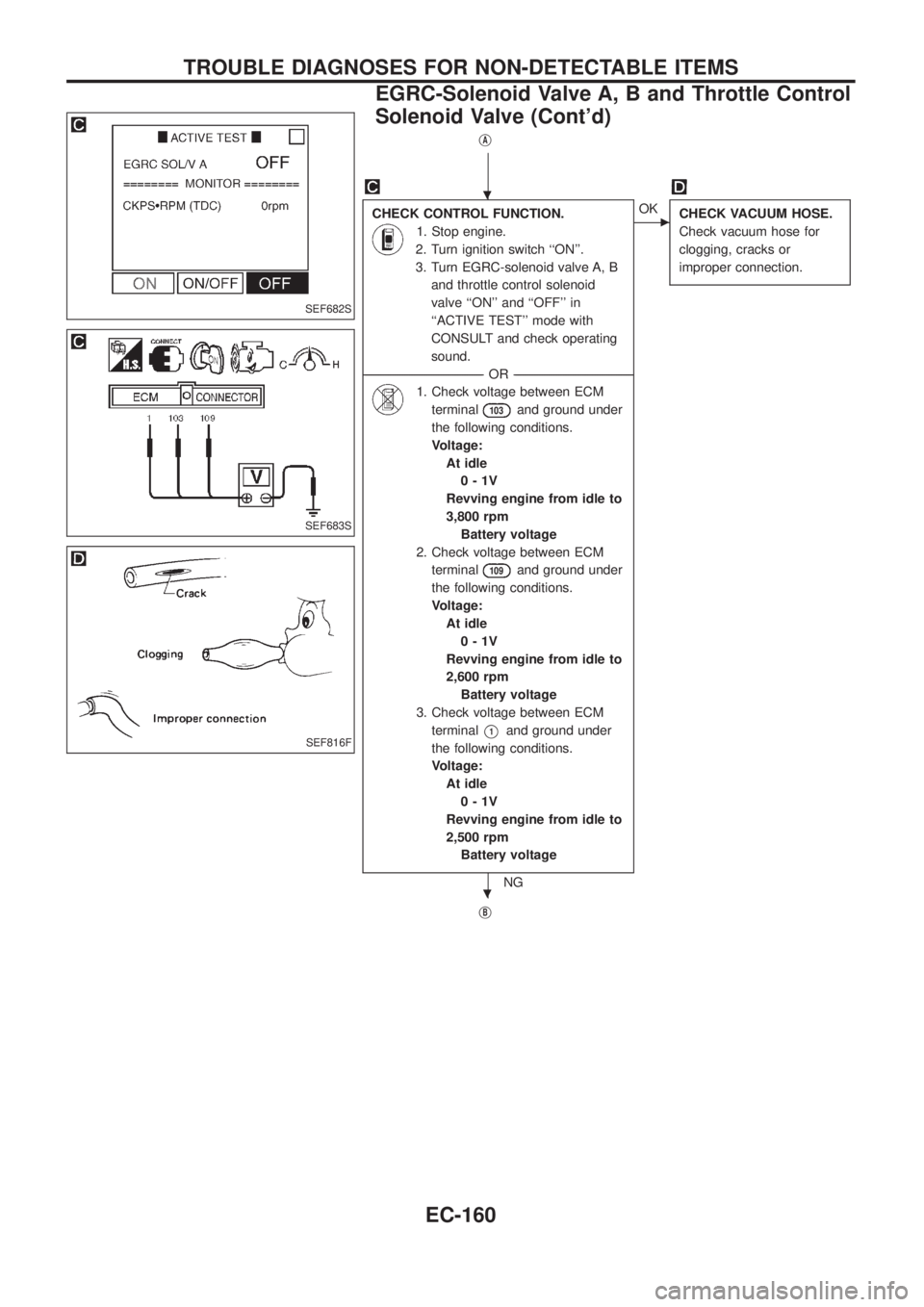
jA
CHECK CONTROL FUNCTION.
1. Stop engine.
2. Turn ignition switch ``ON''.
3. Turn EGRC-solenoid valve A, B
and throttle control solenoid
valve ``ON'' and ``OFF'' in
``ACTIVE TEST'' mode with
CONSULT and check operating
sound.
--------------------------------------------------------------------------------------------------------------------------------------OR--------------------------------------------------------------------------------------------------------------------------------------
1. Check voltage between ECM
terminal
103and ground under
the following conditions.
Voltage:
At idle
0-1V
Revving engine from idle to
3,800 rpm
Battery voltage
2. Check voltage between ECM
terminal
109and ground under
the following conditions.
Voltage:
At idle
0-1V
Revving engine from idle to
2,600 rpm
Battery voltage
3. Check voltage between ECM
terminal
V1and ground under
the following conditions.
Voltage:
At idle
0-1V
Revving engine from idle to
2,500 rpm
Battery voltage
NG
cOK
CHECK VACUUM HOSE.
Check vacuum hose for
clogging, cracks or
improper connection.
jB
SEF682S
SEF683S
SEF816F
.
.
TROUBLE DIAGNOSES FOR NON-DETECTABLE ITEMS
EGRC-Solenoid Valve A, B and Throttle Control
Solenoid Valve (Cont'd)
EC-160
Page 312 of 1226
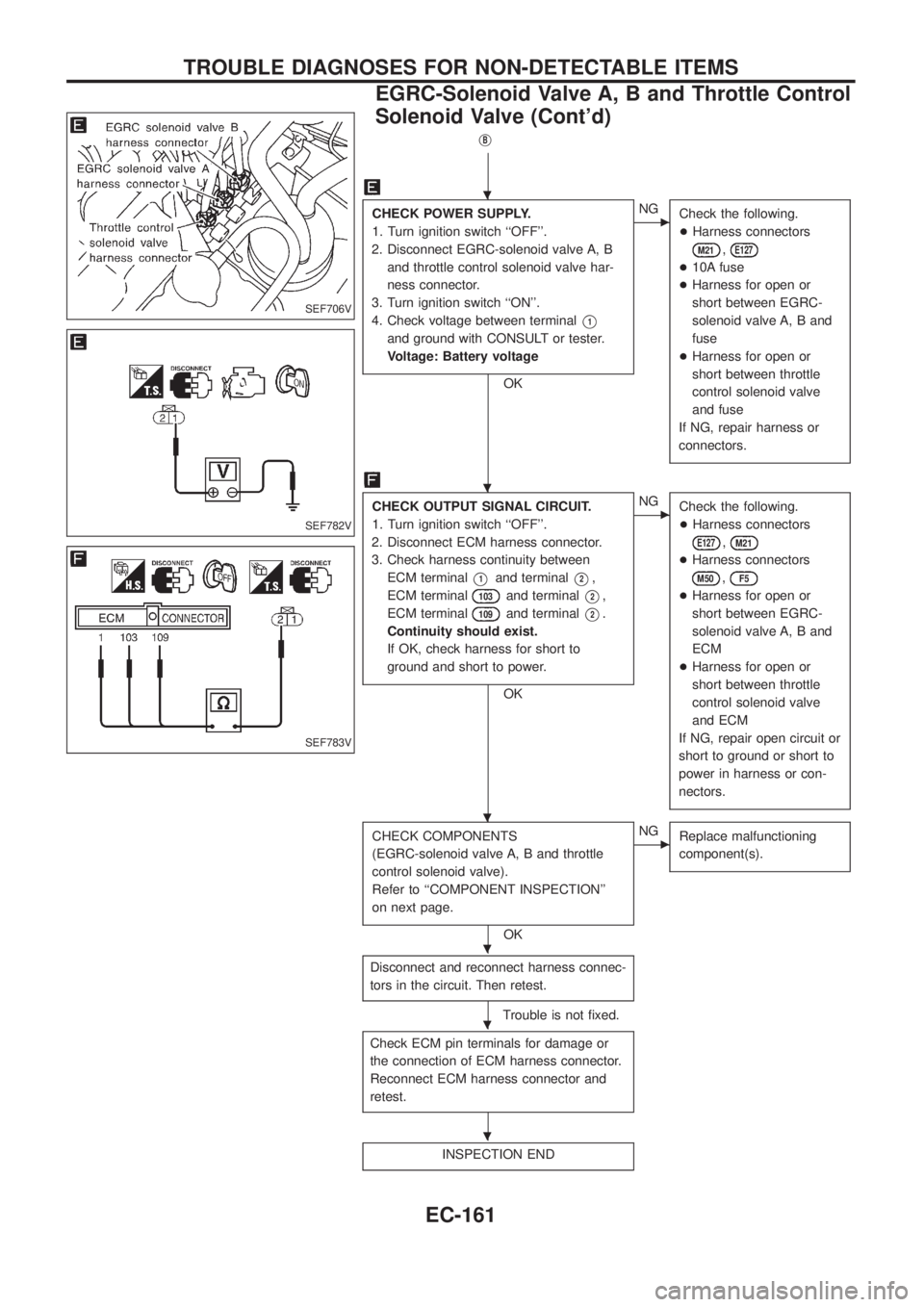
jB
CHECK POWER SUPPLY.
1. Turn ignition switch ``OFF''.
2. Disconnect EGRC-solenoid valve A, B
and throttle control solenoid valve har-
ness connector.
3. Turn ignition switch ``ON''.
4. Check voltage between terminal
V1
and ground with CONSULT or tester.
Voltage: Battery voltage
OK
cNG
Check the following.
+Harness connectors
M21,E127
+10A fuse
+Harness for open or
short between EGRC-
solenoid valve A, B and
fuse
+Harness for open or
short between throttle
control solenoid valve
and fuse
If NG, repair harness or
connectors.
CHECK OUTPUT SIGNAL CIRCUIT.
1. Turn ignition switch ``OFF''.
2. Disconnect ECM harness connector.
3. Check harness continuity between
ECM terminal
V1and terminalV2,
ECM terminal
103and terminalV2,
ECM terminal
109and terminalV2.
Continuity should exist.
If OK, check harness for short to
ground and short to power.
OK
cNG
Check the following.
+Harness connectors
E127,M21
+Harness connectors
M50,F5
+Harness for open or
short between EGRC-
solenoid valve A, B and
ECM
+Harness for open or
short between throttle
control solenoid valve
and ECM
If NG, repair open circuit or
short to ground or short to
power in harness or con-
nectors.
CHECK COMPONENTS
(EGRC-solenoid valve A, B and throttle
control solenoid valve).
Refer to ``COMPONENT INSPECTION''
on next page.
OK
cNG
Replace malfunctioning
component(s).
Disconnect and reconnect harness connec-
tors in the circuit. Then retest.
Trouble is not ®xed.
Check ECM pin terminals for damage or
the connection of ECM harness connector.
Reconnect ECM harness connector and
retest.
INSPECTION END
SEF706V
SEF782V
SEF783V
.
.
.
.
.
.
TROUBLE DIAGNOSES FOR NON-DETECTABLE ITEMS
EGRC-Solenoid Valve A, B and Throttle Control
Solenoid Valve (Cont'd)
EC-161