check engine NISSAN PICK-UP 1998 Repair Manual
[x] Cancel search | Manufacturer: NISSAN, Model Year: 1998, Model line: PICK-UP, Model: NISSAN PICK-UP 1998Pages: 1659, PDF Size: 53.39 MB
Page 1010 of 1659
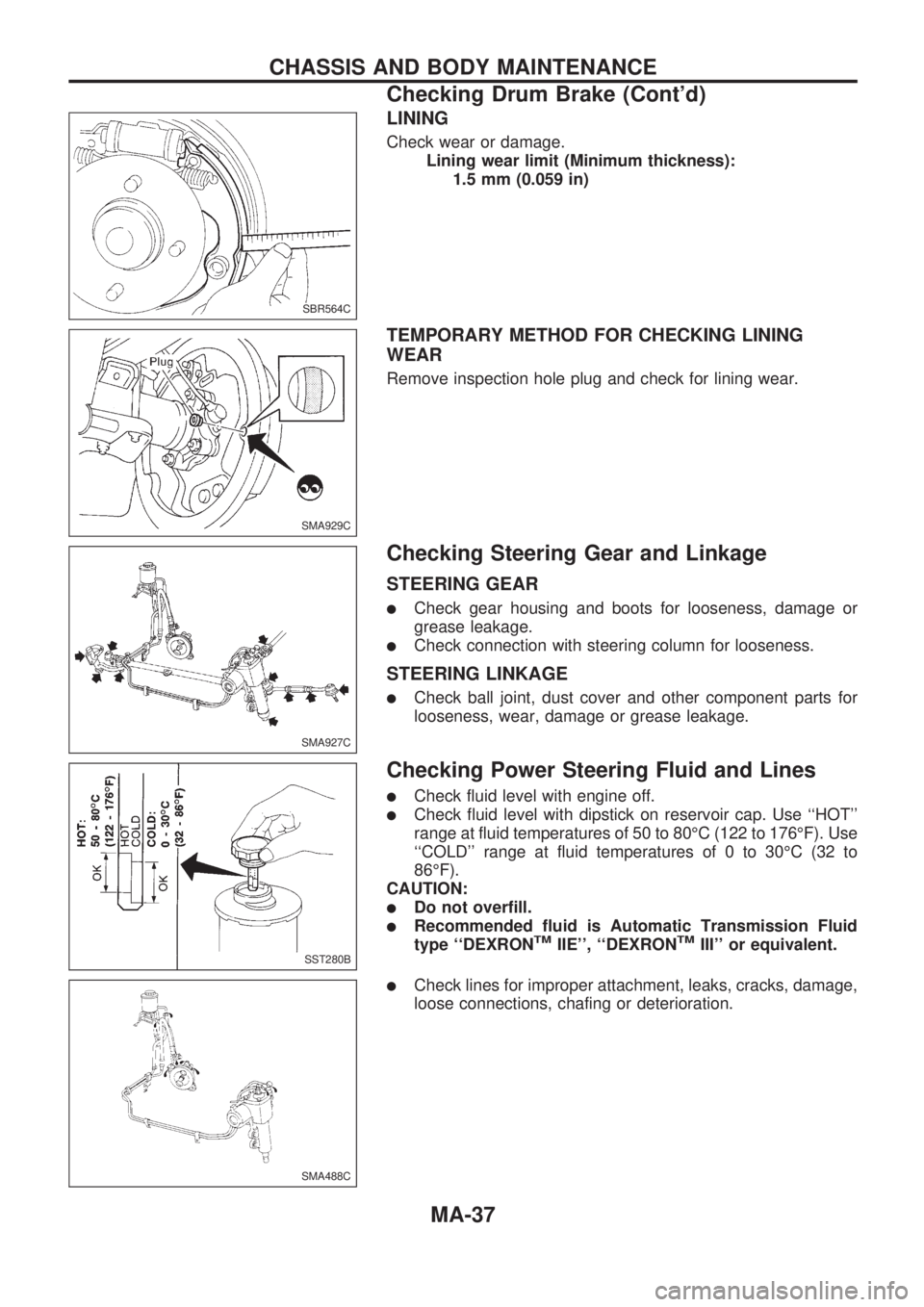
LINING
Check wear or damage.
Lining wear limit (Minimum thickness):
1.5 mm (0.059 in)
TEMPORARY METHOD FOR CHECKING LINING
WEAR
Remove inspection hole plug and check for lining wear.
Checking Steering Gear and Linkage
STEERING GEAR
lCheck gear housing and boots for looseness, damage or
grease leakage.
lCheck connection with steering column for looseness.
STEERING LINKAGE
lCheck ball joint, dust cover and other component parts for
looseness, wear, damage or grease leakage.
Checking Power Steering Fluid and Lines
lCheck fluid level with engine off.
lCheck fluid level with dipstick on reservoir cap. Use ``HOT''
range at fluid temperatures of 50 to 80ÉC (122 to 176ÉF). Use
``COLD'' range at fluid temperatures of 0 to 30ÉC (32 to
86ÉF).
CAUTION:
lDo not overfill.
lRecommended fluid is Automatic Transmission Fluid
type ``DEXRONTMIIE'', ``DEXRONTMIII'' or equivalent.
lCheck lines for improper attachment, leaks, cracks, damage,
loose connections, chafing or deterioration.
SBR564C
SMA929C
SMA927C
SST280B
SMA488C
CHASSIS AND BODY MAINTENANCE
Checking Drum Brake (Cont'd)
MA-37
Page 1014 of 1659
Checking Body Corrosion
Visually check the body sheet metal panel for corrosion, paint damage (scratches, chipping, rubbing, etc.)
or damage to the anti-corrosion materials. In particular, check the following locations.
Hemmed portion
Hood front end, door lower end, trunk lid rear end, etc.
Panel joint
Side sill of rear fender and center pillar, rear wheel housing of rear fender, around strut tower in engine
compartment, etc.
Panel edge
Trunk lid opening, sunroof opening, fender wheelarch flange, fuel filler lid flange, around holes in panel, etc.
Parts contact
Waist molding, windshield molding, bumper, etc.
Protectors
Damage or condition of mudguard, fender protector, chipping protector, etc.
Anti-corrosion materials
Damage or separation of anti-corrosion materials under the body.
Drain holes
Condition of drain holes at door and side sill.
When repairing corroded areas, refer to the Corrosion Repair Manual.
CHASSIS AND BODY MAINTENANCE
MA-41
Page 1026 of 1659
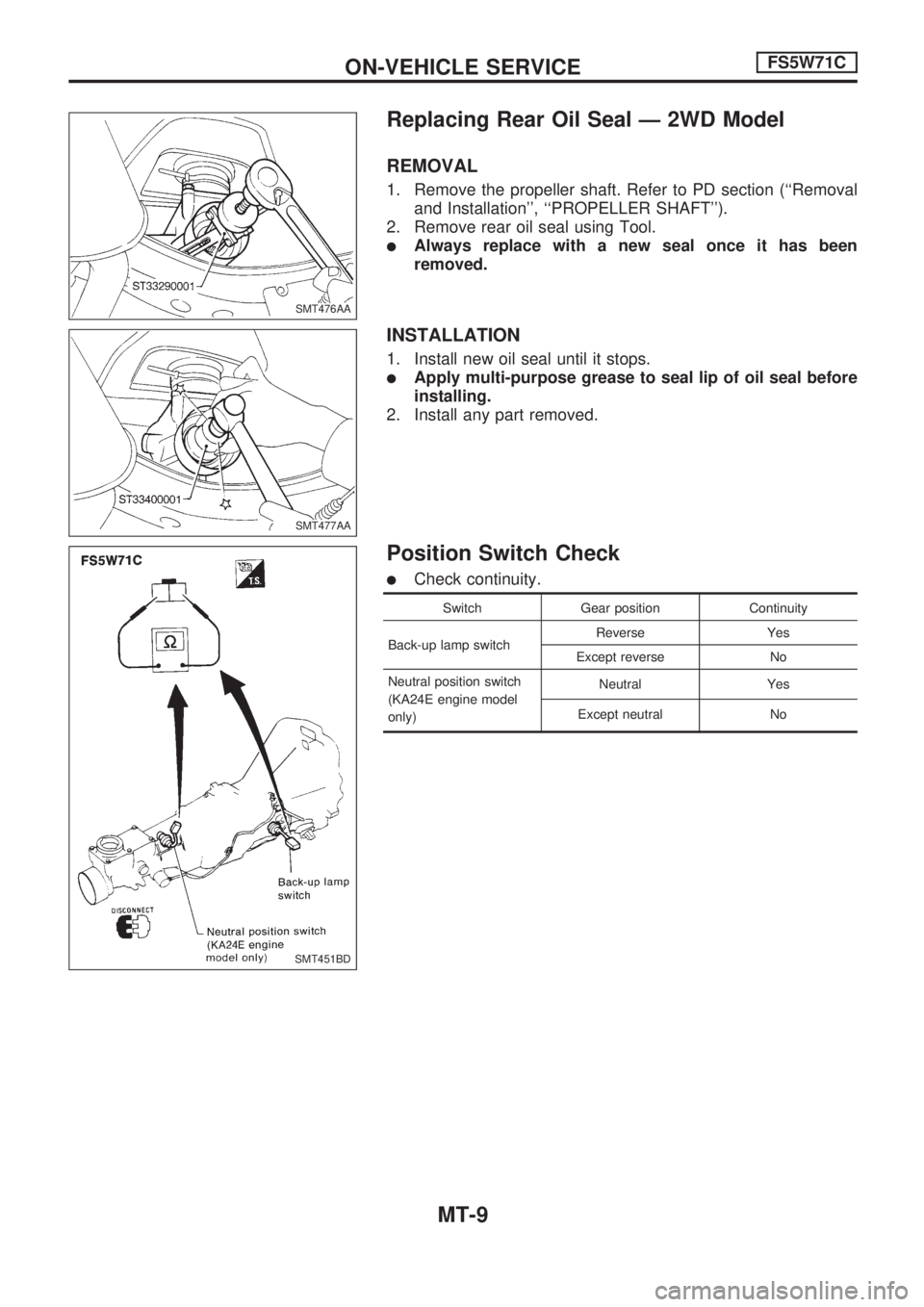
Replacing Rear Oil Seal Ð 2WD Model
REMOVAL
1. Remove the propeller shaft. Refer to PD section (``Removal
and Installation'', ``PROPELLER SHAFT'').
2. Remove rear oil seal using Tool.
lAlways replace with a new seal once it has been
removed.
INSTALLATION
1. Install new oil seal until it stops.
lApply multi-purpose grease to seal lip of oil seal before
installing.
2. Install any part removed.
Position Switch Check
lCheck continuity.
Switch Gear position Continuity
Back-up lamp switchReverse Yes
Except reverse No
Neutral position switch
(KA24E engine model
only)Neutral Yes
Except neutral No
SMT476AA
SMT477AA
SMT451BD
ON-VEHICLE SERVICEFS5W71C
MT-9
Page 1120 of 1659
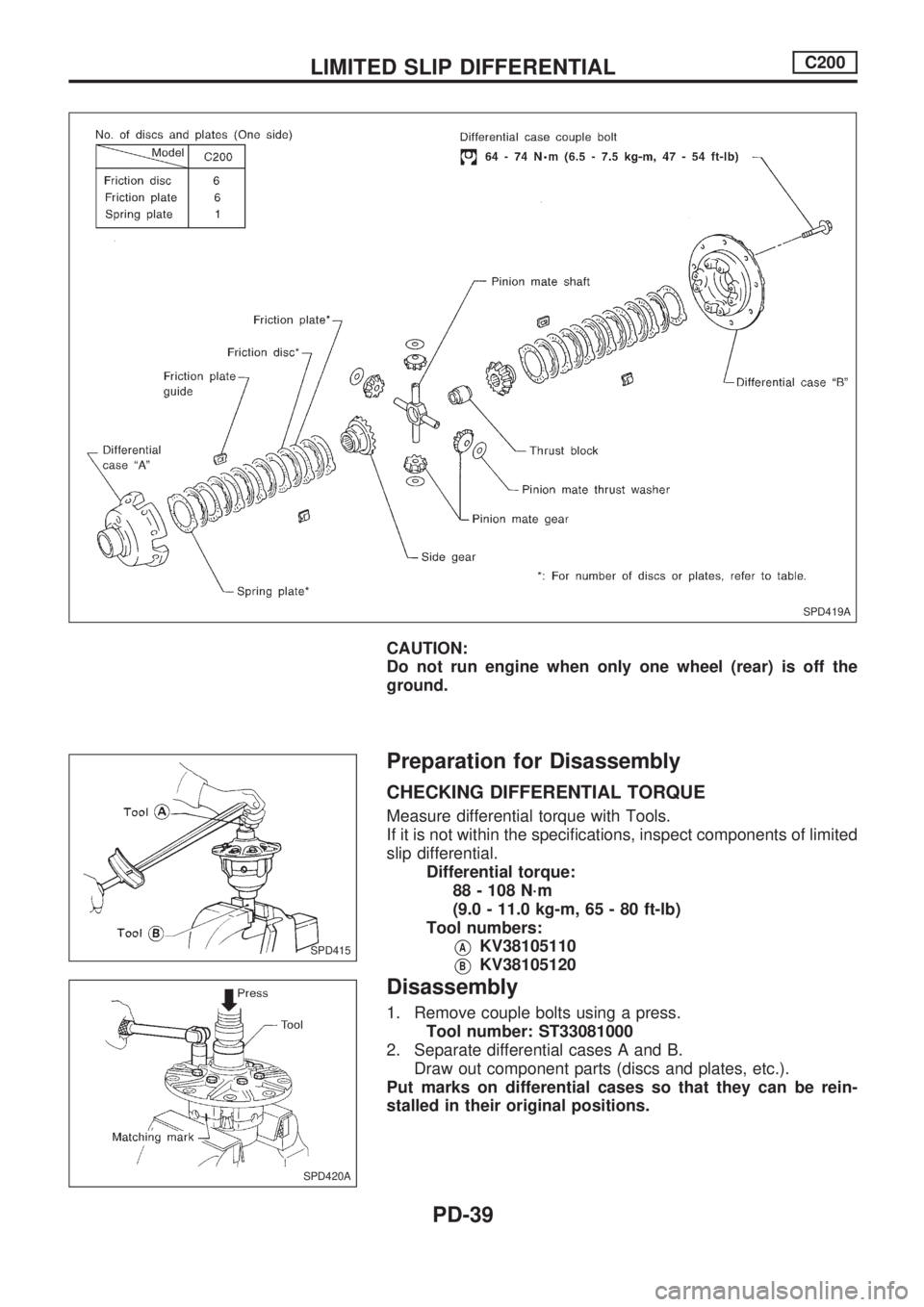
CAUTION:
Do not run engine when only one wheel (rear) is off the
ground.
Preparation for Disassembly
CHECKING DIFFERENTIAL TORQUE
Measure differential torque with Tools.
If it is not within the specifications, inspect components of limited
slip differential.
Differential torque:
88 - 108 N´m
(9.0 - 11.0 kg-m, 65 - 80 ft-lb)
Tool numbers:
VAKV38105110
VBKV38105120
Disassembly
1. Remove couple bolts using a press.
Tool number: ST33081000
2. Separate differential cases A and B.
Draw out component parts (discs and plates, etc.).
Put marks on differential cases so that they can be rein-
stalled in their original positions.
SPD419A
SPD415
SPD420A
LIMITED SLIP DIFFERENTIALC200
PD-39
Page 1142 of 1659
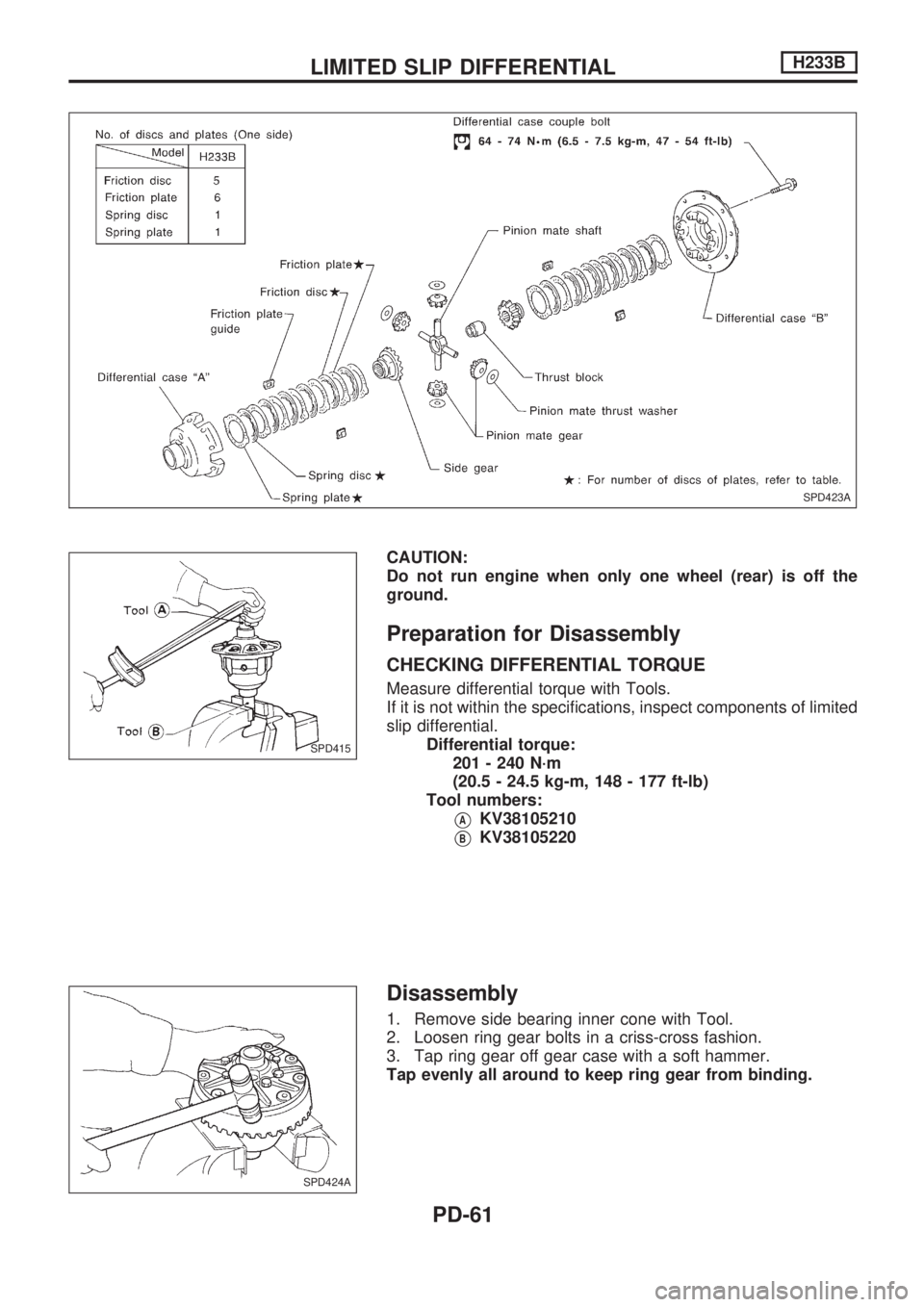
CAUTION:
Do not run engine when only one wheel (rear) is off the
ground.
Preparation for Disassembly
CHECKING DIFFERENTIAL TORQUE
Measure differential torque with Tools.
If it is not within the specifications, inspect components of limited
slip differential.
Differential torque:
201 - 240 N´m
(20.5 - 24.5 kg-m, 148 - 177 ft-lb)
Tool numbers:
VAKV38105210
VBKV38105220
Disassembly
1. Remove side bearing inner cone with Tool.
2. Loosen ring gear bolts in a criss-cross fashion.
3. Tap ring gear off gear case with a soft hammer.
Tap evenly all around to keep ring gear from binding.
SPD423A
SPD415
SPD424A
LIMITED SLIP DIFFERENTIALH233B
PD-61
Page 1207 of 1659
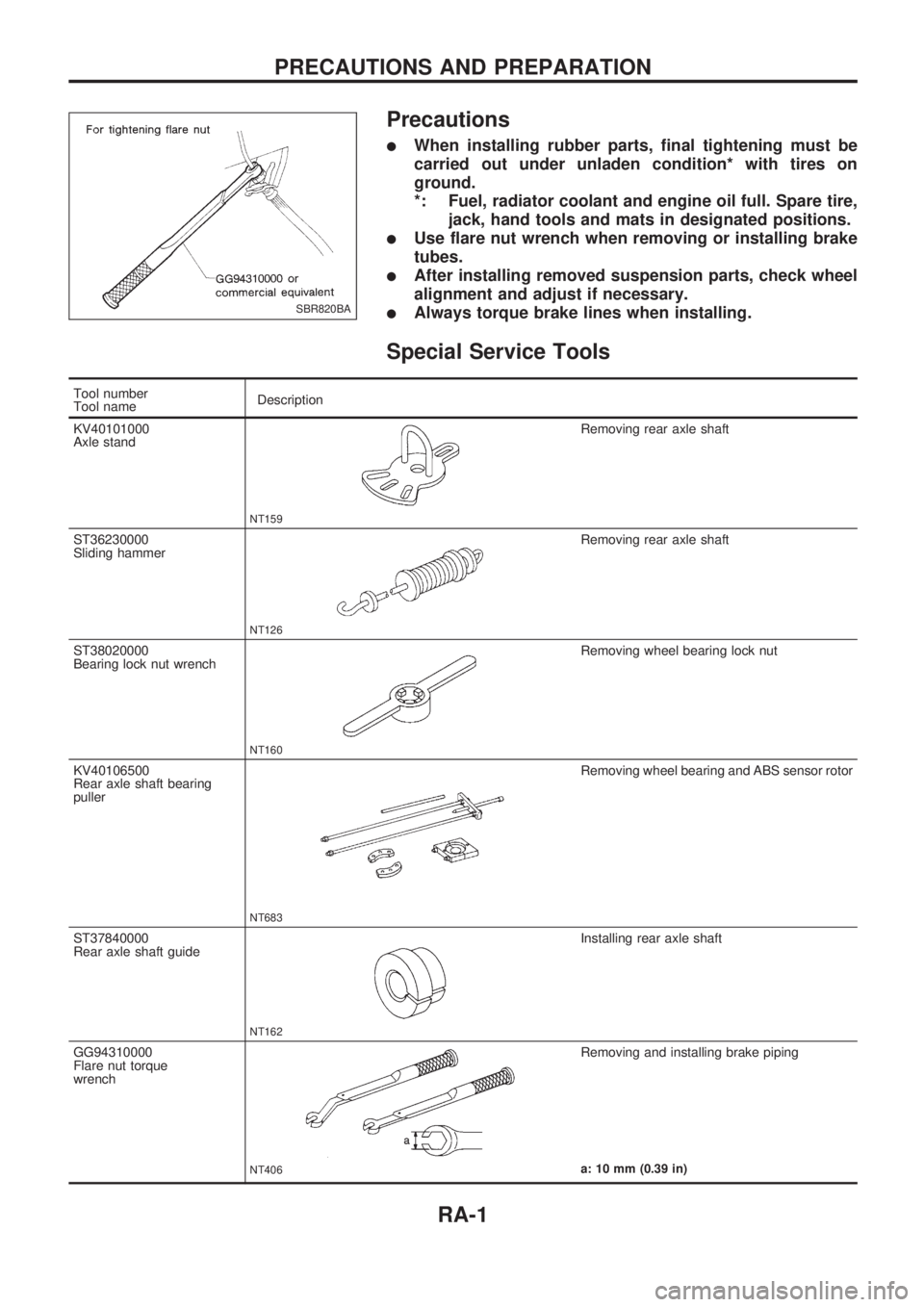
Precautions
lWhen installing rubber parts, final tightening must be
carried out under unladen condition* with tires on
ground.
*: Fuel, radiator coolant and engine oil full. Spare tire,
jack, hand tools and mats in designated positions.
lUse flare nut wrench when removing or installing brake
tubes.
lAfter installing removed suspension parts, check wheel
alignment and adjust if necessary.
lAlways torque brake lines when installing.
Special Service Tools
Tool number
Tool nameDescription
KV40101000
Axle stand
NT159
Removing rear axle shaft
ST36230000
Sliding hammer
NT126
Removing rear axle shaft
ST38020000
Bearing lock nut wrench
NT160
Removing wheel bearing lock nut
KV40106500
Rear axle shaft bearing
puller
NT683
Removing wheel bearing and ABS sensor rotor
ST37840000
Rear axle shaft guide
NT162
Installing rear axle shaft
GG94310000
Flare nut torque
wrench
NT406
Removing and installing brake piping
a: 10 mm (0.39 in)
SBR820BA
PRECAUTIONS AND PREPARATION
RA-1
Page 1220 of 1659
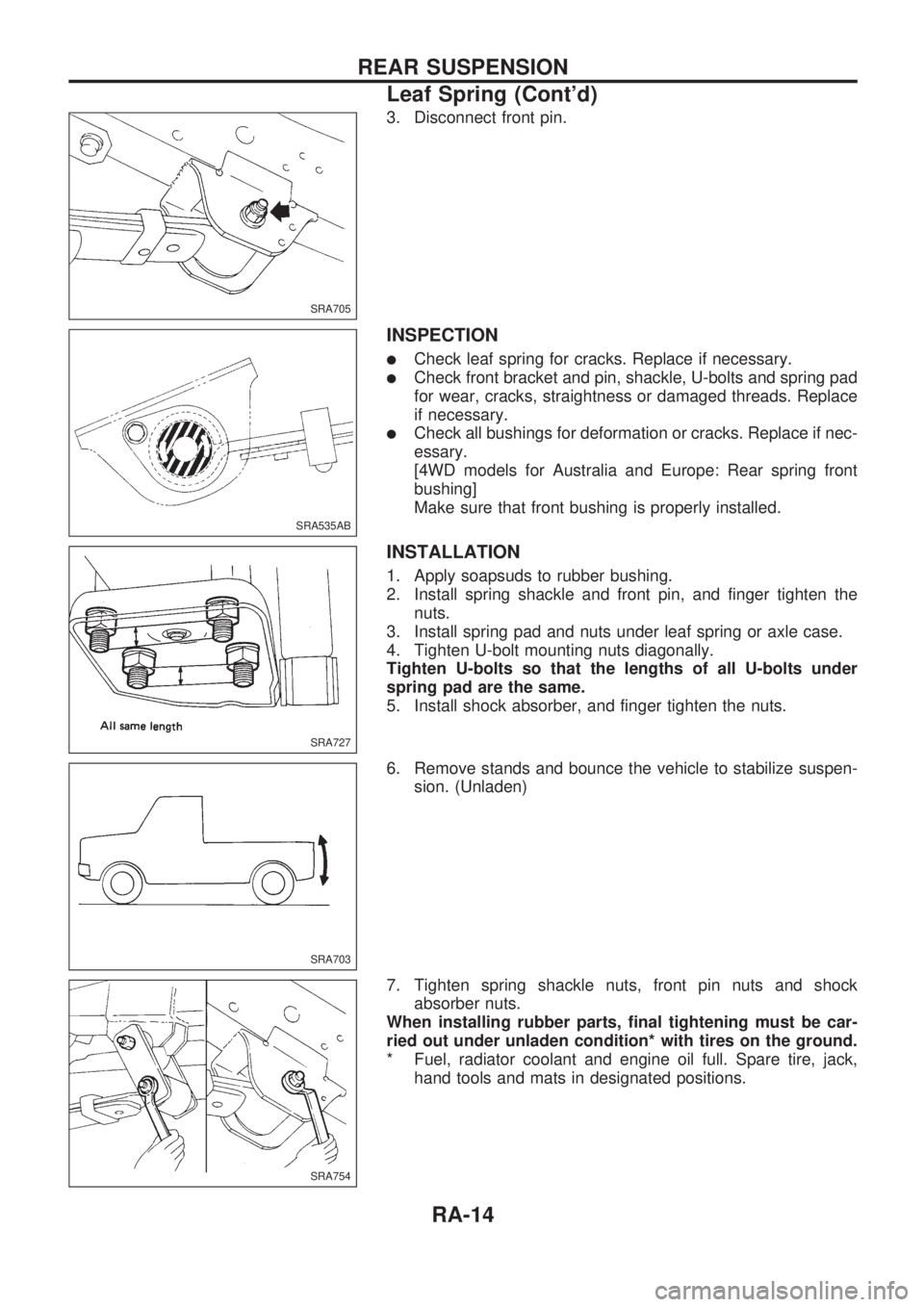
3. Disconnect front pin.
INSPECTION
lCheck leaf spring for cracks. Replace if necessary.
lCheck front bracket and pin, shackle, U-bolts and spring pad
for wear, cracks, straightness or damaged threads. Replace
if necessary.
lCheck all bushings for deformation or cracks. Replace if nec-
essary.
[4WD models for Australia and Europe: Rear spring front
bushing]
Make sure that front bushing is properly installed.
INSTALLATION
1. Apply soapsuds to rubber bushing.
2. Install spring shackle and front pin, and finger tighten the
nuts.
3. Install spring pad and nuts under leaf spring or axle case.
4. Tighten U-bolt mounting nuts diagonally.
Tighten U-bolts so that the lengths of all U-bolts under
spring pad are the same.
5. Install shock absorber, and finger tighten the nuts.
6. Remove stands and bounce the vehicle to stabilize suspen-
sion. (Unladen)
7. Tighten spring shackle nuts, front pin nuts and shock
absorber nuts.
When installing rubber parts, final tightening must be car-
ried out under unladen condition* with tires on the ground.
* Fuel, radiator coolant and engine oil full. Spare tire, jack,
hand tools and mats in designated positions.
SRA705
SRA535AB
.
SRA727
SRA703
SRA754
REAR SUSPENSION
Leaf Spring (Cont'd)
RA-14
Page 1226 of 1659
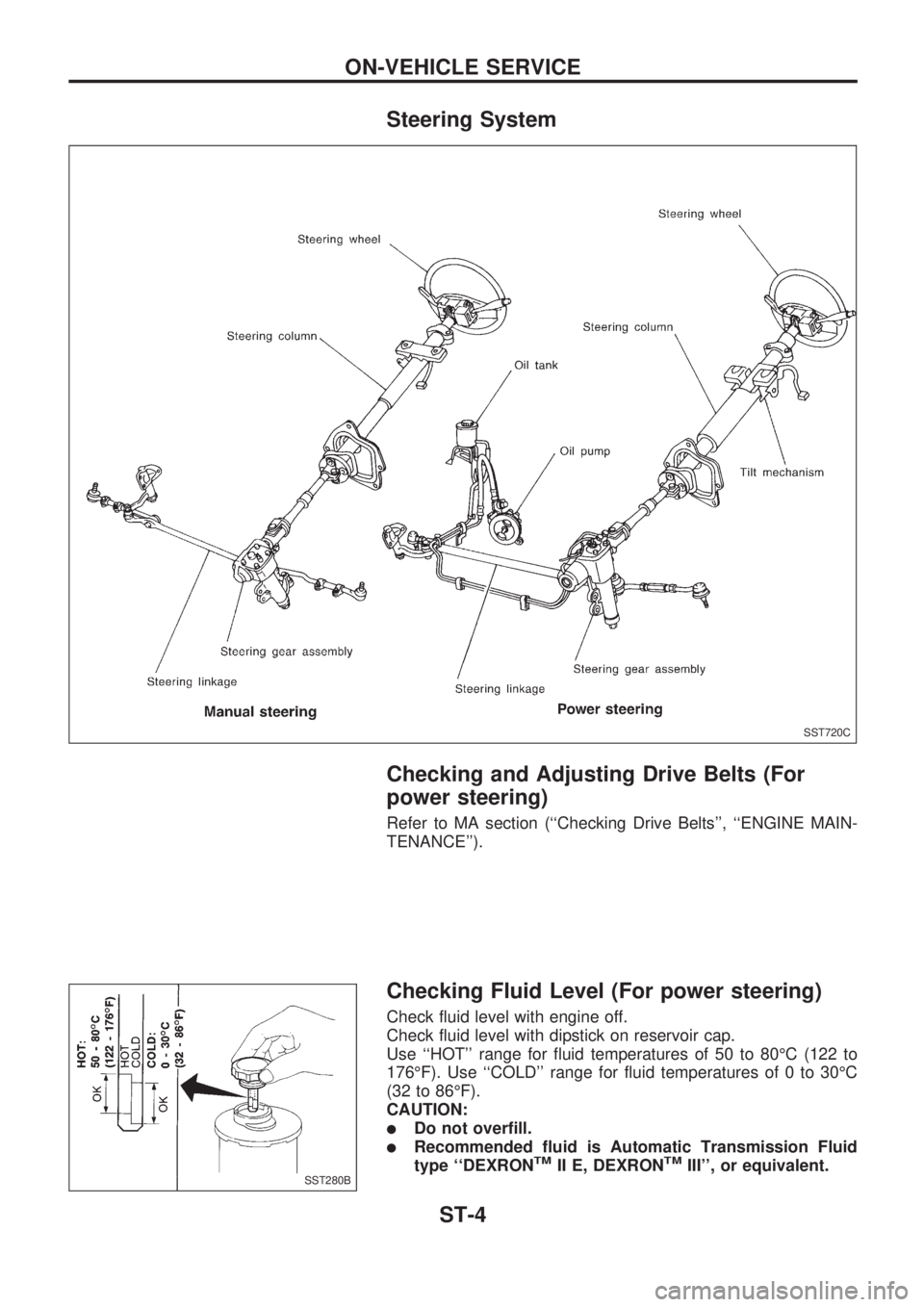
Steering System
Checking and Adjusting Drive Belts (For
power steering)
Refer to MA section (``Checking Drive Belts'', ``ENGINE MAIN-
TENANCE'').
Checking Fluid Level (For power steering)
Check fluid level with engine off.
Check fluid level with dipstick on reservoir cap.
Use ``HOT'' range for fluid temperatures of 50 to 80ÉC (122 to
176ÉF). Use ``COLD'' range for fluid temperatures of 0 to 30ÉC
(32 to 86ÉF).
CAUTION:
lDo not overfill.
lRecommended fluid is Automatic Transmission Fluid
type ``DEXRONTMII E, DEXRONTMIII'', or equivalent.
SST720C
SST280B
ON-VEHICLE SERVICE
ST-4
Page 1227 of 1659
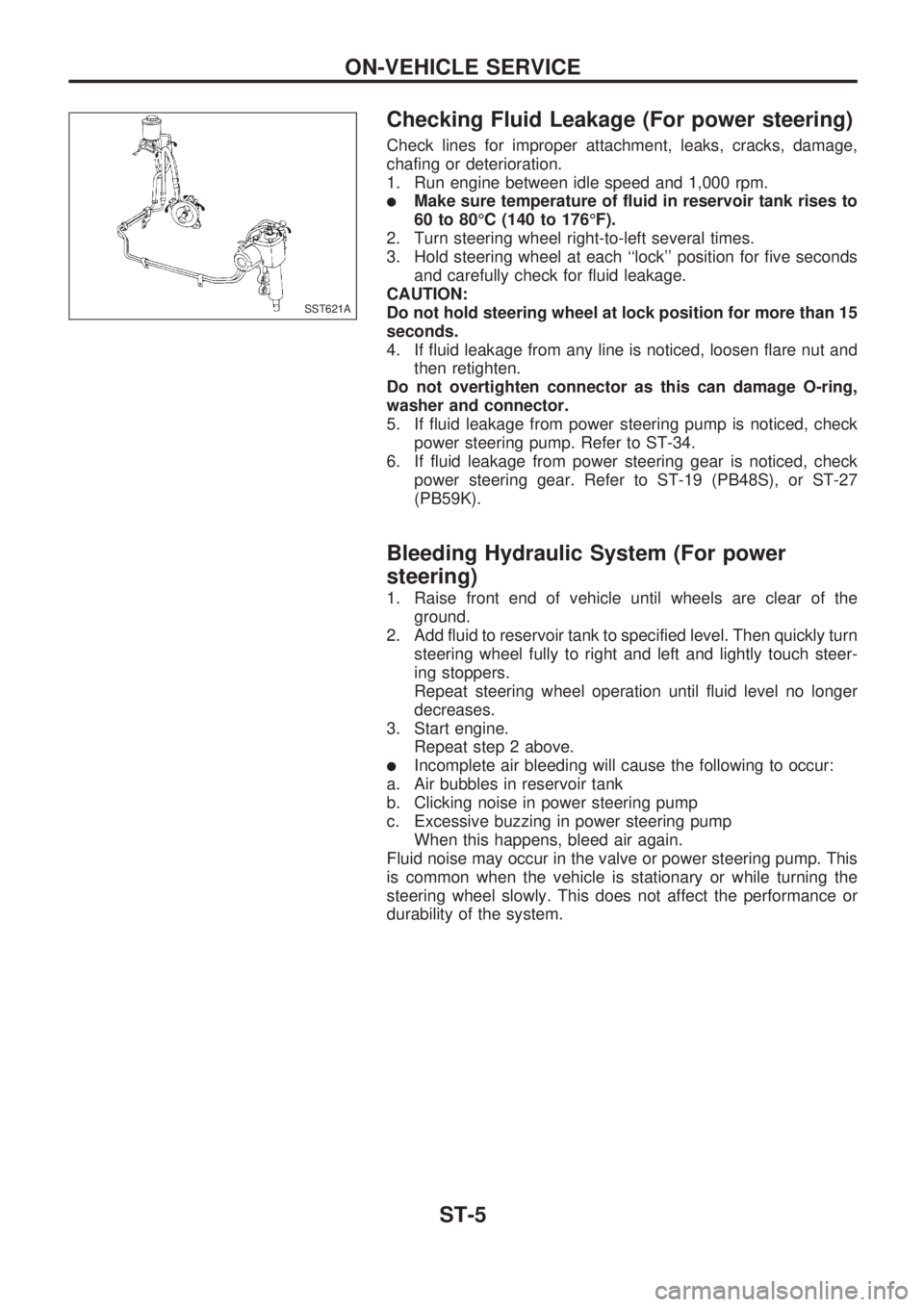
Checking Fluid Leakage (For power steering)
Check lines for improper attachment, leaks, cracks, damage,
chafing or deterioration.
1. Run engine between idle speed and 1,000 rpm.
lMake sure temperature of fluid in reservoir tank rises to
60 to 80ÉC (140 to 176ÉF).
2. Turn steering wheel right-to-left several times.
3. Hold steering wheel at each ``lock'' position for five seconds
and carefully check for fluid leakage.
CAUTION:
Do not hold steering wheel at lock position for more than 15
seconds.
4. If fluid leakage from any line is noticed, loosen flare nut and
then retighten.
Do not overtighten connector as this can damage O-ring,
washer and connector.
5. If fluid leakage from power steering pump is noticed, check
power steering pump. Refer to ST-34.
6. If fluid leakage from power steering gear is noticed, check
power steering gear. Refer to ST-19 (PB48S), or ST-27
(PB59K).
Bleeding Hydraulic System (For power
steering)
1. Raise front end of vehicle until wheels are clear of the
ground.
2. Add fluid to reservoir tank to specified level. Then quickly turn
steering wheel fully to right and left and lightly touch steer-
ing stoppers.
Repeat steering wheel operation until fluid level no longer
decreases.
3. Start engine.
Repeat step 2 above.
lIncomplete air bleeding will cause the following to occur:
a. Air bubbles in reservoir tank
b. Clicking noise in power steering pump
c. Excessive buzzing in power steering pump
When this happens, bleed air again.
Fluid noise may occur in the valve or power steering pump. This
is common when the vehicle is stationary or while turning the
steering wheel slowly. This does not affect the performance or
durability of the system.
SST621A
ON-VEHICLE SERVICE
ST-5
Page 1228 of 1659
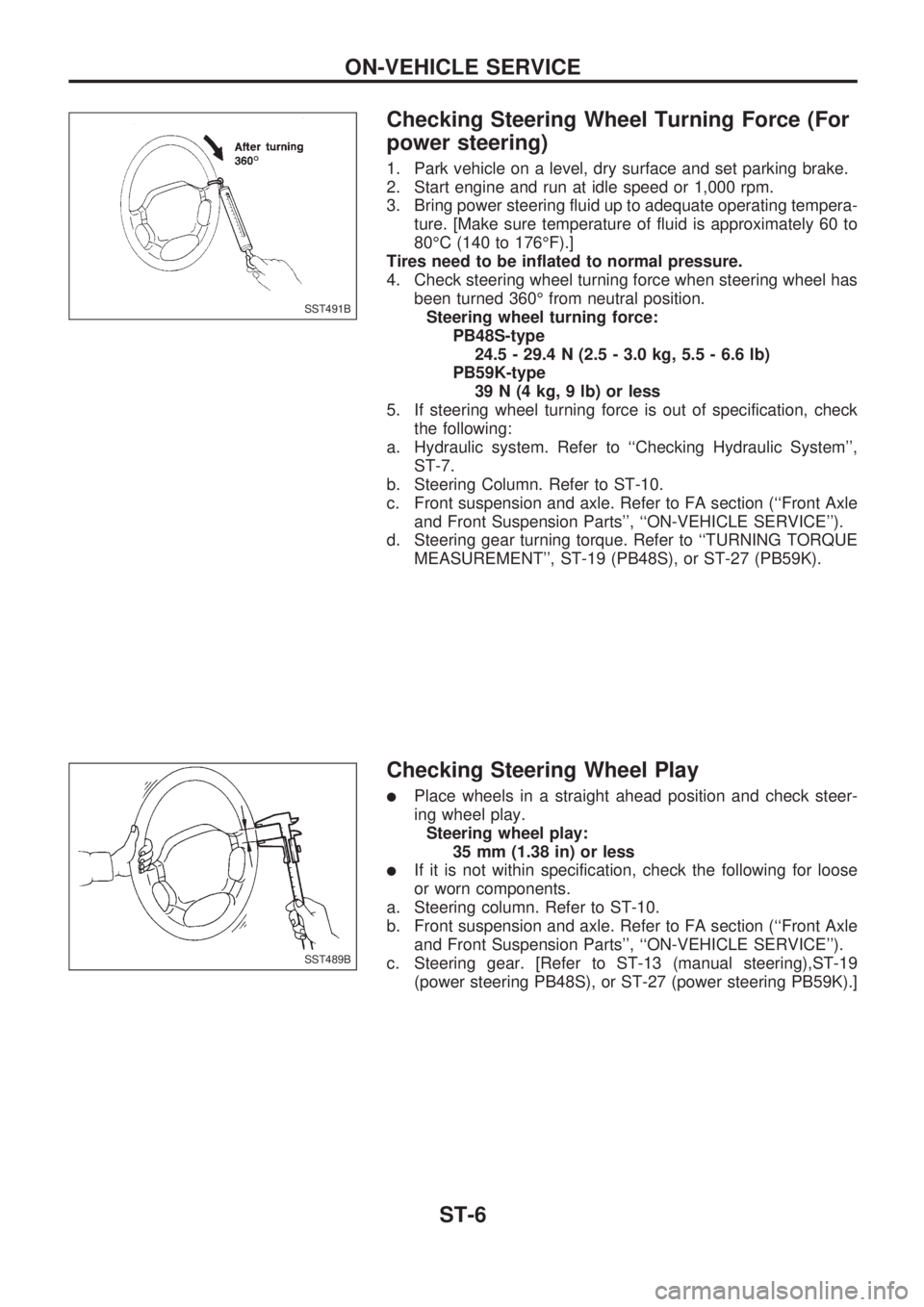
Checking Steering Wheel Turning Force (For
power steering)
1. Park vehicle on a level, dry surface and set parking brake.
2. Start engine and run at idle speed or 1,000 rpm.
3. Bring power steering fluid up to adequate operating tempera-
ture. [Make sure temperature of fluid is approximately 60 to
80ÉC (140 to 176ÉF).]
Tires need to be inflated to normal pressure.
4. Check steering wheel turning force when steering wheel has
been turned 360É from neutral position.
Steering wheel turning force:
PB48S-type
24.5 - 29.4 N (2.5 - 3.0 kg, 5.5 - 6.6 lb)
PB59K-type
39 N (4 kg, 9 lb) or less
5. If steering wheel turning force is out of specification, check
the following:
a. Hydraulic system. Refer to ``Checking Hydraulic System'',
ST-7.
b. Steering Column. Refer to ST-10.
c. Front suspension and axle. Refer to FA section (``Front Axle
and Front Suspension Parts'', ``ON-VEHICLE SERVICE'').
d. Steering gear turning torque. Refer to ``TURNING TORQUE
MEASUREMENT'', ST-19 (PB48S), or ST-27 (PB59K).
Checking Steering Wheel Play
lPlace wheels in a straight ahead position and check steer-
ing wheel play.
Steering wheel play:
35 mm (1.38 in) or less
lIf it is not within specification, check the following for loose
or worn components.
a. Steering column. Refer to ST-10.
b. Front suspension and axle. Refer to FA section (``Front Axle
and Front Suspension Parts'', ``ON-VEHICLE SERVICE'').
c. Steering gear. [Refer to ST-13 (manual steering),ST-19
(power steering PB48S), or ST-27 (power steering PB59K).]
SST491B
SST489B
ON-VEHICLE SERVICE
ST-6