engine NISSAN PICK-UP 2001 Repair Manual
[x] Cancel search | Manufacturer: NISSAN, Model Year: 2001, Model line: PICK-UP, Model: NISSAN PICK-UP 2001Pages: 1306, PDF Size: 31.7 MB
Page 278 of 1306

3 PERFORM POWER BALANCE TEST
With CONSULT-II
1. Perform ªPOWER BALANCEº in ªACTIVE TESTº mode.
SEF981Z
2. Is there any cylinder which does not produce a momentary engine speed drop?
Without CONSULT-II
When disconnecting each injector harness connector one at a time, is there any cylinder which does not produce a
momentary engine speed drop?
SEF319V
YesorNo
Ye s©GO TO 4.
No©GO TO 7.
4 CHECK INJECTOR
Does each injector make an operating sound at idle?
MEC703B
YesorNo
Ye s©GO TO 5.
No©Check injector(s) and circuit(s). Refer to EC-3370.
DTC P0300 - P0304 NO.4-1CYLINDER MISFIRE, MULTIPLE CYLINDER
MISFIRE
KA24DE (EURO OBD)
Diagnostic Procedure
EC-3253
Page 279 of 1306
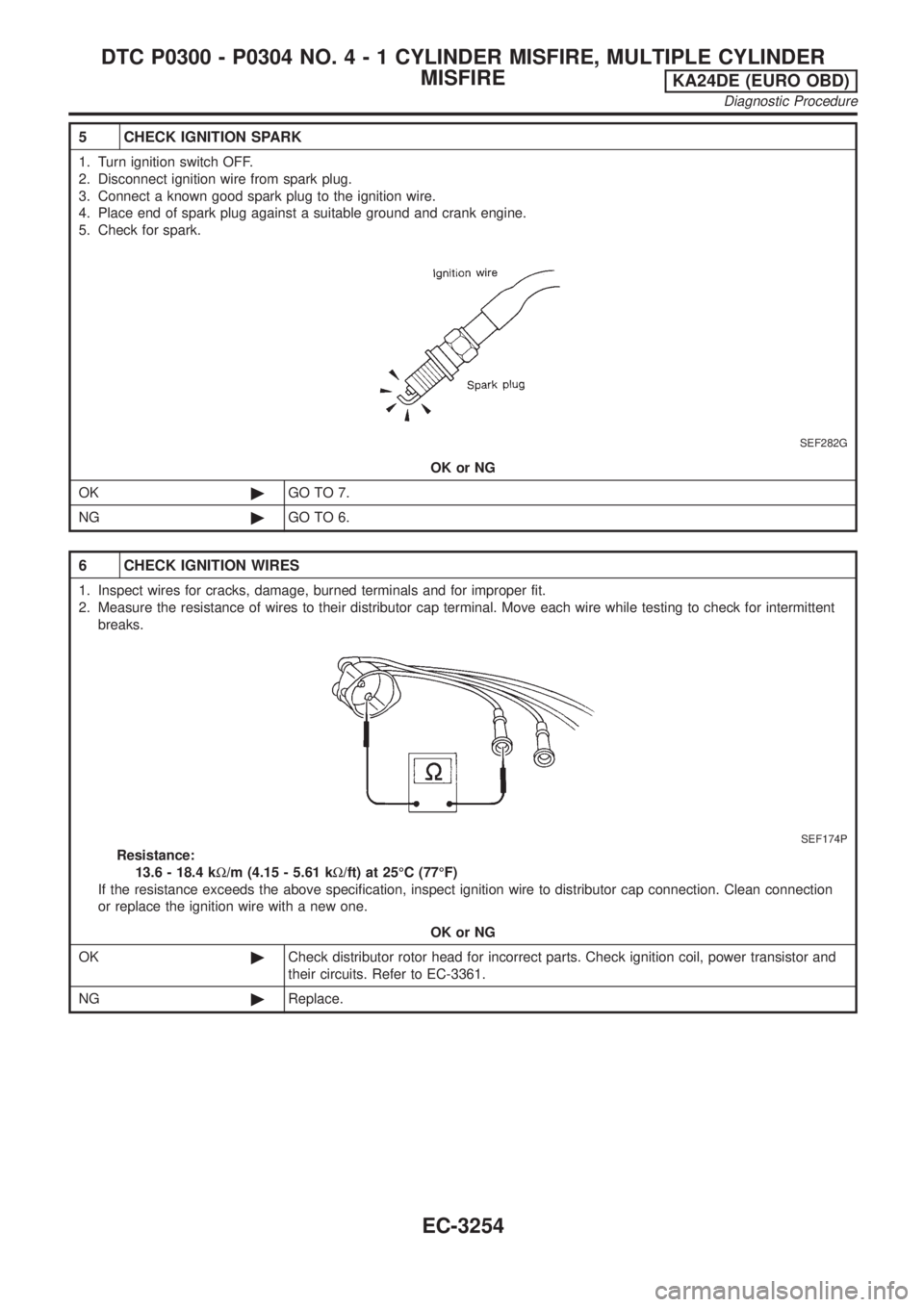
5 CHECK IGNITION SPARK
1. Turn ignition switch OFF.
2. Disconnect ignition wire from spark plug.
3. Connect a known good spark plug to the ignition wire.
4. Place end of spark plug against a suitable ground and crank engine.
5. Check for spark.
SEF282G
OK or NG
OK©GO TO 7.
NG©GO TO 6.
6 CHECK IGNITION WIRES
1. Inspect wires for cracks, damage, burned terminals and for improper fit.
2. Measure the resistance of wires to their distributor cap terminal. Move each wire while testing to check for intermittent
breaks.
SEF174P
Resistance:
13.6 - 18.4 kW/m (4.15 - 5.61 kW/ft) at 25ÉC (77ÉF)
If the resistance exceeds the above specification, inspect ignition wire to distributor cap connection. Clean connection
or replace the ignition wire with a new one.
OK or NG
OK©Check distributor rotor head for incorrect parts. Check ignition coil, power transistor and
their circuits. Refer to EC-3361.
NG©Replace.
DTC P0300 - P0304 NO.4-1CYLINDER MISFIRE, MULTIPLE CYLINDER
MISFIRE
KA24DE (EURO OBD)
Diagnostic Procedure
EC-3254
Page 280 of 1306
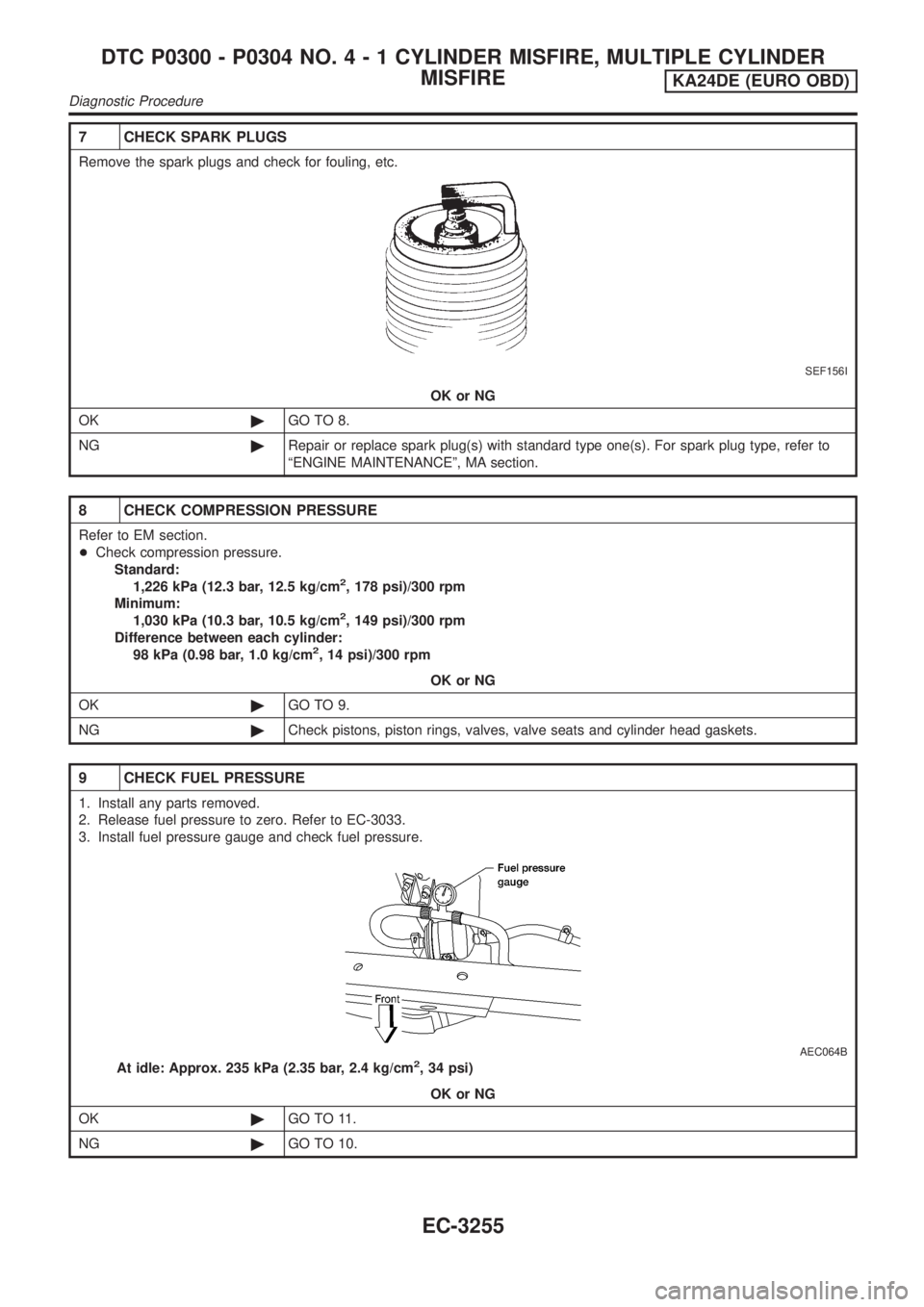
7 CHECK SPARK PLUGS
Remove the spark plugs and check for fouling, etc.
SEF156I
OK or NG
OK©GO TO 8.
NG©Repair or replace spark plug(s) with standard type one(s). For spark plug type, refer to
ªENGINE MAINTENANCEº, MA section.
8 CHECK COMPRESSION PRESSURE
Refer to EM section.
+Check compression pressure.
Standard:
1,226 kPa (12.3 bar, 12.5 kg/cm
2, 178 psi)/300 rpm
Minimum:
1,030 kPa (10.3 bar, 10.5 kg/cm
2, 149 psi)/300 rpm
Difference between each cylinder:
98 kPa (0.98 bar, 1.0 kg/cm
2, 14 psi)/300 rpm
OK or NG
OK©GO TO 9.
NG©Check pistons, piston rings, valves, valve seats and cylinder head gaskets.
9 CHECK FUEL PRESSURE
1. Install any parts removed.
2. Release fuel pressure to zero. Refer to EC-3033.
3. Install fuel pressure gauge and check fuel pressure.
AEC064B
At idle: Approx. 235 kPa (2.35 bar, 2.4 kg/cm2, 34 psi)
OK or NG
OK©GO TO 11.
NG©GO TO 10.
DTC P0300 - P0304 NO.4-1CYLINDER MISFIRE, MULTIPLE CYLINDER
MISFIRE
KA24DE (EURO OBD)
Diagnostic Procedure
EC-3255
Page 282 of 1306
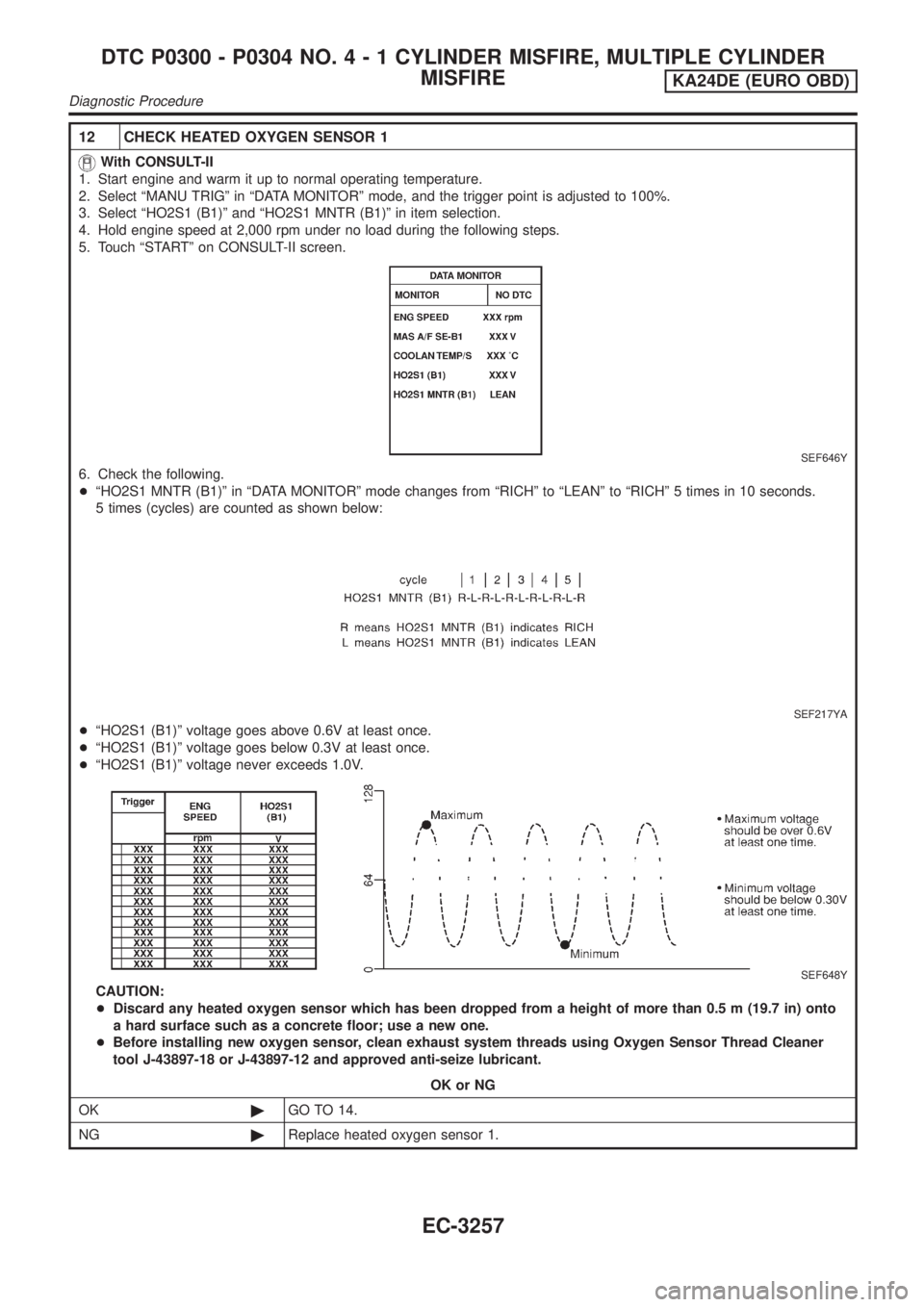
12 CHECK HEATED OXYGEN SENSOR 1
With CONSULT-II
1. Start engine and warm it up to normal operating temperature.
2. Select ªMANU TRIGº in ªDATA MONITORº mode, and the trigger point is adjusted to 100%.
3. Select ªHO2S1 (B1)º and ªHO2S1 MNTR (B1)º in item selection.
4. Hold engine speed at 2,000 rpm under no load during the following steps.
5. Touch ªSTARTº on CONSULT-II screen.
SEF646Y
6. Check the following.
+ªHO2S1 MNTR (B1)º in ªDATA MONITORº mode changes from ªRICHº to ªLEANº to ªRICHº 5 times in 10 seconds.
5 times (cycles) are counted as shown below:
SEF217YA
+ªHO2S1 (B1)º voltage goes above 0.6V at least once.
+ªHO2S1 (B1)º voltage goes below 0.3V at least once.
+ªHO2S1 (B1)º voltage never exceeds 1.0V.
SEF648Y
CAUTION:
+Discard any heated oxygen sensor which has been dropped from a height of more than 0.5 m (19.7 in) onto
a hard surface such as a concrete floor; use a new one.
+Before installing new oxygen sensor, clean exhaust system threads using Oxygen Sensor Thread Cleaner
tool J-43897-18 or J-43897-12 and approved anti-seize lubricant.
OK or NG
OK©GO TO 14.
NG©Replace heated oxygen sensor 1.
DTC P0300 - P0304 NO.4-1CYLINDER MISFIRE, MULTIPLE CYLINDER
MISFIRE
KA24DE (EURO OBD)
Diagnostic Procedure
EC-3257
Page 283 of 1306

13 CHECK HEATED OXYGEN SENSOR 1
Without CONSULT-II
1. Start engine and warm it up to normal operating temperature.
2. Set voltmeter probes between ECM terminal 50 (Heated oxygen sensor 1 signal) and ECM ground.
AEC873A
3. Check the following with engine speed held at 2,000 rpm constant under no load.
+The voltage fluctuates between 0 to 0.3V and 0.6 to 1.0V more than five times within 10 seconds.
1 time: 0 ± 0.3V®0.6 ± 1.0V®0 ± 0.3V
2 times: 0 ± 0.3V®0.6 ± 1.0V®0 ± 0.3V®0.6 ± 1.0V®0 ± 0.3V
+The maximum voltage is over 0.6V at least one time.
+The minimum voltage is below 0.3V at least one time.
+The voltage never exceeds 1.0V.
CAUTION:
+Discard any heated oxygen sensor which has been dropped from a height of more than 0.5 m (19.7 in) onto
a hard surface such as a concrete floor; use a new one.
+Before installing new oxygen sensor, clean exhaust system threads using Oxygen Sensor Thread Cleaner
tool J-43897-18 or J-43897-12 and approved anti-seize lubricant.
OK or NG
OK©GO TO 14.
NG©Replace heated oxygen sensor 1.
14 CHECK MASS AIR FLOW SENSOR
With CONSULT-II
Check ªMASS AIR FLOWº in ªDATA MONITORº mode with CONSULT-II.
at idling: 0.9 - 5.8 g´m/sec
at 2,500 rpm: 7.5 - 13.2 g´m/sec
With GST
Check mass air flow sensor signal in MODE 1 with GST.
at idling: 0.9 - 5.8 g´m/sec
at 2,500 rpm: 7.5 - 13.2 g´m/sec
OK or NG
OK©GO TO 16.
NG©GO TO 15.
15 CHECK CONNECTORS
Check connectors for rusted terminals or loose connections in the mass air flow sensor circuit or engine grounds.
Refer to EC-3143, EC-3151.
OK or NG
NG©Repair or replace it.
DTC P0300 - P0304 NO.4-1CYLINDER MISFIRE, MULTIPLE CYLINDER
MISFIRE
KA24DE (EURO OBD)
Diagnostic Procedure
EC-3258
Page 285 of 1306
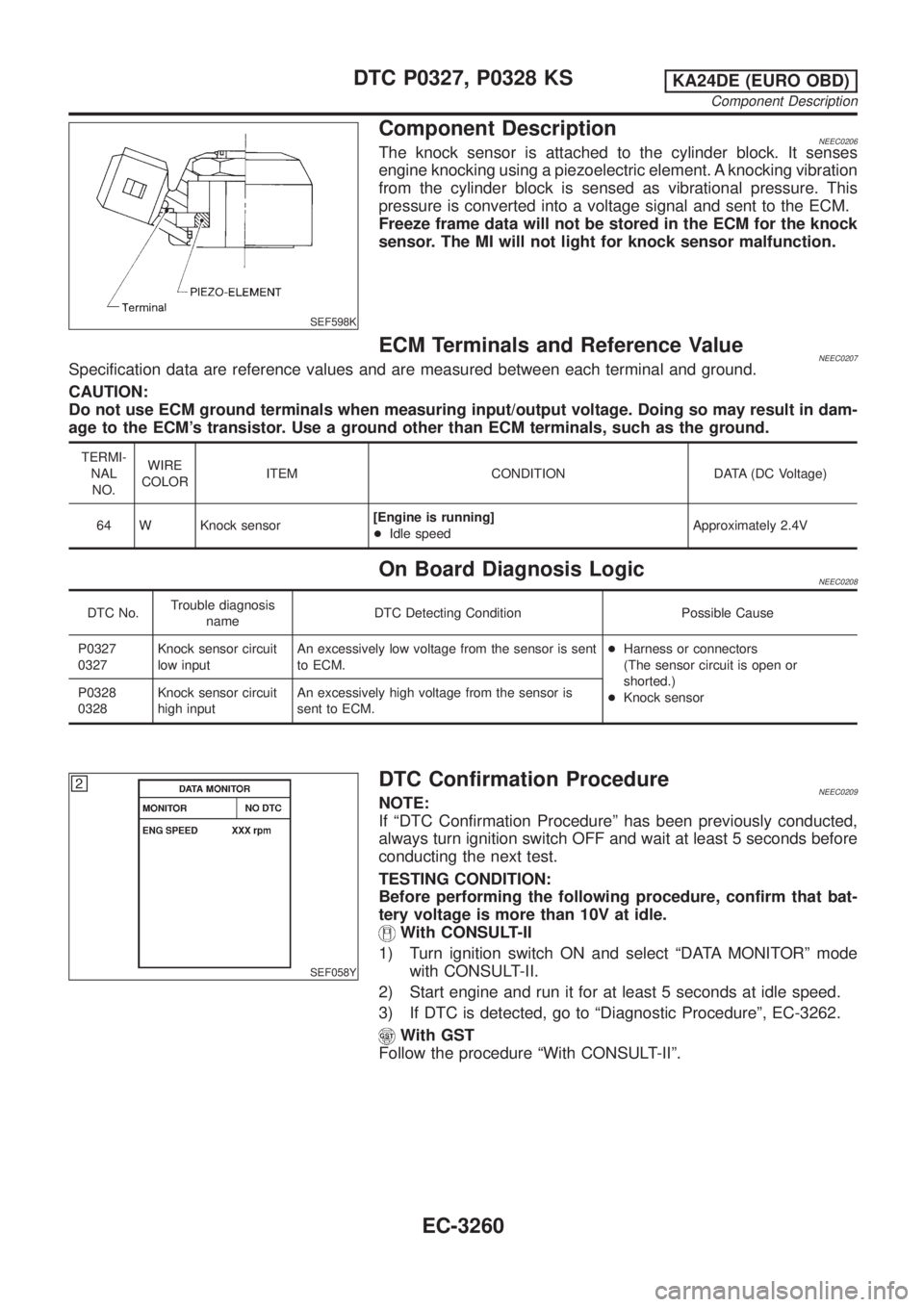
SEF598K
Component DescriptionNEEC0206The knock sensor is attached to the cylinder block. It senses
engine knocking using a piezoelectric element. A knocking vibration
from the cylinder block is sensed as vibrational pressure. This
pressure is converted into a voltage signal and sent to the ECM.
Freeze frame data will not be stored in the ECM for the knock
sensor. The MI will not light for knock sensor malfunction.
ECM Terminals and Reference ValueNEEC0207Specification data are reference values and are measured between each terminal and ground.
CAUTION:
Do not use ECM ground terminals when measuring input/output voltage. Doing so may result in dam-
age to the ECM's transistor. Use a ground other than ECM terminals, such as the ground.
TERMI-
NAL
NO.WIRE
COLORITEM CONDITION DATA (DC Voltage)
64 W Knock sensor[Engine is running]
+Idle speedApproximately 2.4V
On Board Diagnosis LogicNEEC0208
DTC No.Trouble diagnosis
nameDTC Detecting Condition Possible Cause
P0327
0327Knock sensor circuit
low inputAn excessively low voltage from the sensor is sent
to ECM.+Harness or connectors
(The sensor circuit is open or
shorted.)
+Knock sensor P0328
0328Knock sensor circuit
high inputAn excessively high voltage from the sensor is
sent to ECM.
SEF058Y
DTC Confirmation ProcedureNEEC0209NOTE:
If ªDTC Confirmation Procedureº has been previously conducted,
always turn ignition switch OFF and wait at least 5 seconds before
conducting the next test.
TESTING CONDITION:
Before performing the following procedure, confirm that bat-
tery voltage is more than 10V at idle.
With CONSULT-II
1) Turn ignition switch ON and select ªDATA MONITORº mode
with CONSULT-II.
2) Start engine and run it for at least 5 seconds at idle speed.
3) If DTC is detected, go to ªDiagnostic Procedureº, EC-3262.
With GST
Follow the procedure ªWith CONSULT-IIº.
DTC P0327, P0328 KSKA24DE (EURO OBD)
Component Description
EC-3260
Page 287 of 1306
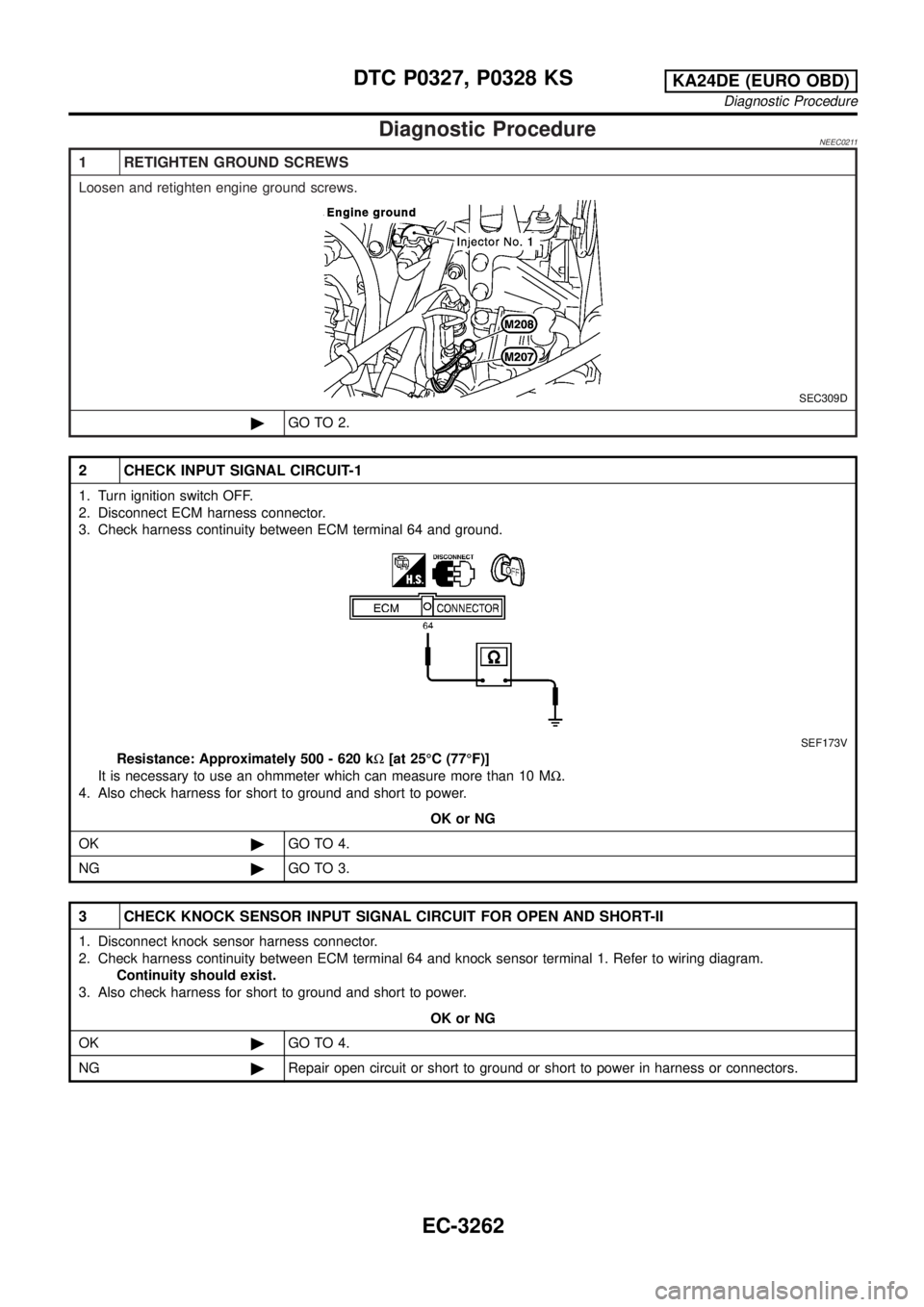
Diagnostic ProcedureNEEC0211
1 RETIGHTEN GROUND SCREWS
Loosen and retighten engine ground screws.
SEC309D
©GO TO 2.
2 CHECK INPUT SIGNAL CIRCUIT-1
1. Turn ignition switch OFF.
2. Disconnect ECM harness connector.
3. Check harness continuity between ECM terminal 64 and ground.
SEF173V
Resistance: Approximately 500 - 620 kW[at 25ÉC (77ÉF)]
It is necessary to use an ohmmeter which can measure more than 10 MW.
4. Also check harness for short to ground and short to power.
OK or NG
OK©GO TO 4.
NG©GO TO 3.
3 CHECK KNOCK SENSOR INPUT SIGNAL CIRCUIT FOR OPEN AND SHORT-II
1. Disconnect knock sensor harness connector.
2. Check harness continuity between ECM terminal 64 and knock sensor terminal 1. Refer to wiring diagram.
Continuity should exist.
3. Also check harness for short to ground and short to power.
OK or NG
OK©GO TO 4.
NG©Repair open circuit or short to ground or short to power in harness or connectors.
DTC P0327, P0328 KSKA24DE (EURO OBD)
Diagnostic Procedure
EC-3262
Page 289 of 1306
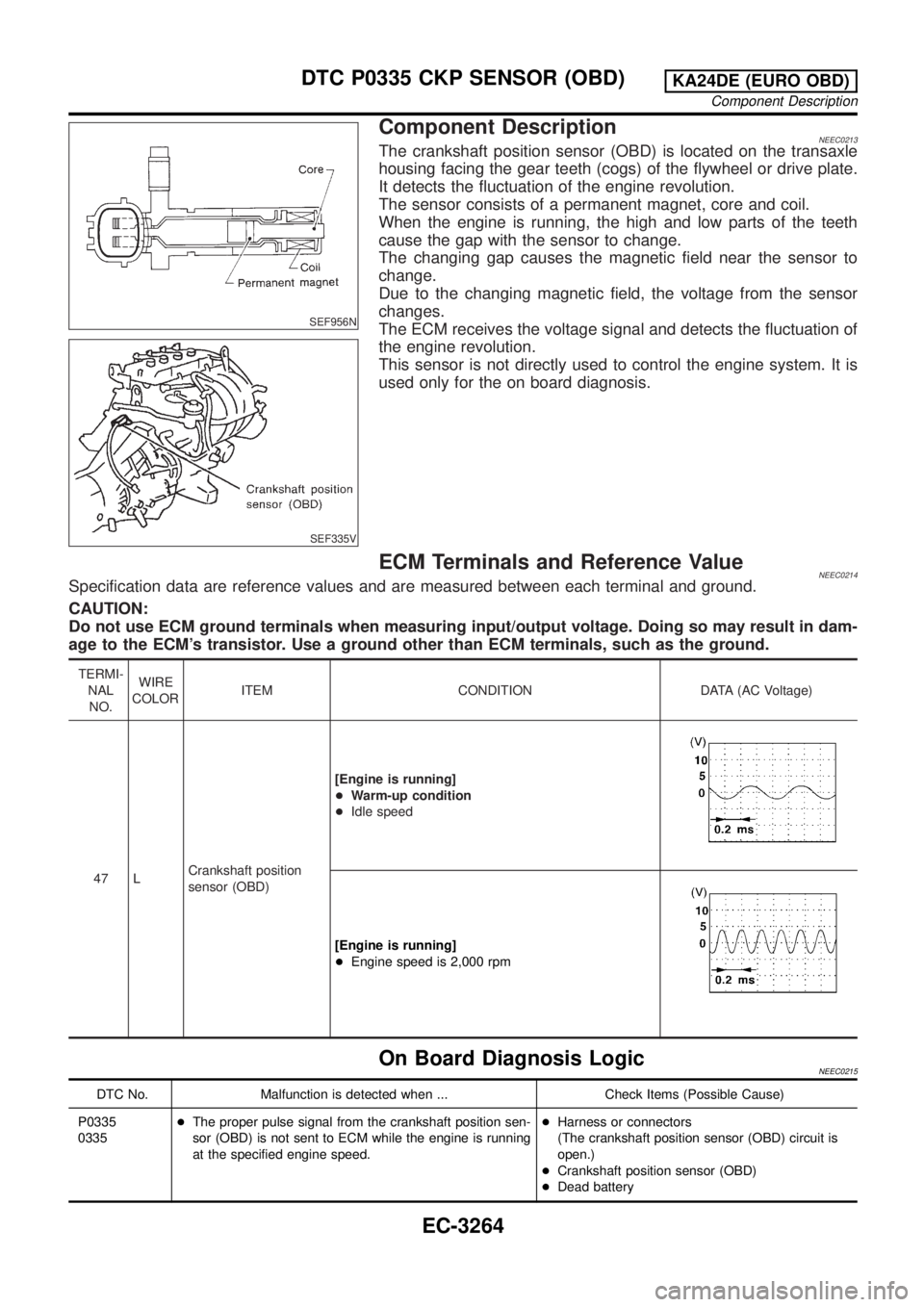
SEF956N
SEF335V
Component DescriptionNEEC0213The crankshaft position sensor (OBD) is located on the transaxle
housing facing the gear teeth (cogs) of the flywheel or drive plate.
It detects the fluctuation of the engine revolution.
The sensor consists of a permanent magnet, core and coil.
When the engine is running, the high and low parts of the teeth
cause the gap with the sensor to change.
The changing gap causes the magnetic field near the sensor to
change.
Due to the changing magnetic field, the voltage from the sensor
changes.
The ECM receives the voltage signal and detects the fluctuation of
the engine revolution.
This sensor is not directly used to control the engine system. It is
used only for the on board diagnosis.
ECM Terminals and Reference ValueNEEC0214Specification data are reference values and are measured between each terminal and ground.
CAUTION:
Do not use ECM ground terminals when measuring input/output voltage. Doing so may result in dam-
age to the ECM's transistor. Use a ground other than ECM terminals, such as the ground.
TERMI-
NAL
NO.WIRE
COLORITEM CONDITION DATA (AC Voltage)
47 LCrankshaft position
sensor (OBD)[Engine is running]
+Warm-up condition
+Idle speed
[Engine is running]
+Engine speed is 2,000 rpm
On Board Diagnosis LogicNEEC0215
DTC No. Malfunction is detected when ... Check Items (Possible Cause)
P0335
0335+The proper pulse signal from the crankshaft position sen-
sor (OBD) is not sent to ECM while the engine is running
at the specified engine speed.+Harness or connectors
(The crankshaft position sensor (OBD) circuit is
open.)
+Crankshaft position sensor (OBD)
+Dead battery
DTC P0335 CKP SENSOR (OBD)KA24DE (EURO OBD)
Component Description
EC-3264
Page 290 of 1306

SEF058Y
DTC Confirmation ProcedureNEEC0216NOTE:
If ªDTC Confirmation Procedureº has been previously conducted,
always turn ignition switch OFF and wait at least 5 seconds before
conducting the next test.
With CONSULT-II
1) Turn ignition switch ON and select ªDATA MONITORº mode
with CONSULT-II.
2) Start engine and run it for at least 15 seconds at idle speed.
3) If 1st trip DTC is detected, go to ªDiagnostic Procedureº,
EC-3267.
With GST
Follow the procedure ªWith CONSULT-IIº.
DTC P0335 CKP SENSOR (OBD)KA24DE (EURO OBD)
DTC Confirmation Procedure
EC-3265
Page 292 of 1306
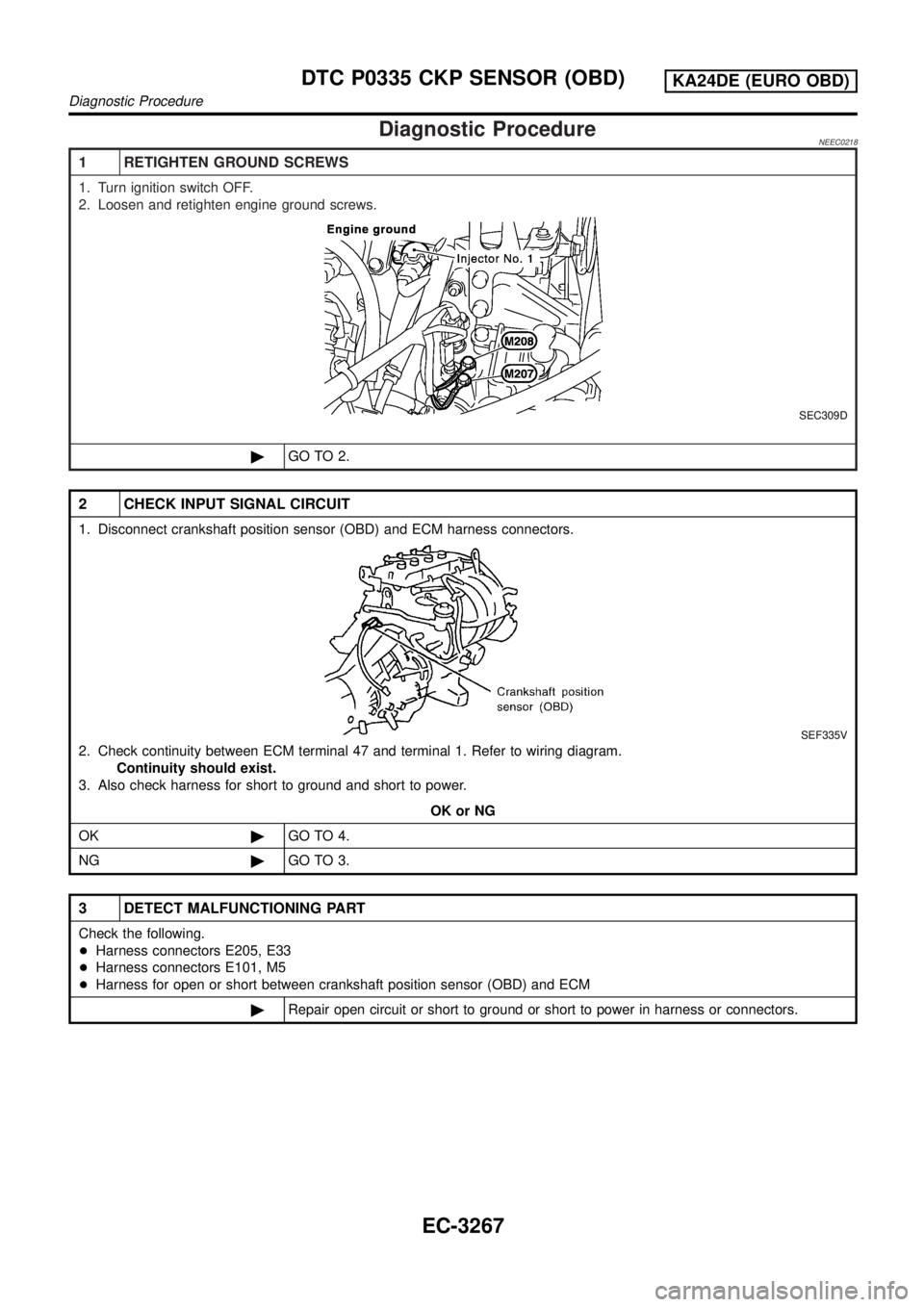
Diagnostic ProcedureNEEC0218
1 RETIGHTEN GROUND SCREWS
1. Turn ignition switch OFF.
2. Loosen and retighten engine ground screws.
SEC309D
©GO TO 2.
2 CHECK INPUT SIGNAL CIRCUIT
1. Disconnect crankshaft position sensor (OBD) and ECM harness connectors.
SEF335V
2. Check continuity between ECM terminal 47 and terminal 1. Refer to wiring diagram.
Continuity should exist.
3. Also check harness for short to ground and short to power.
OK or NG
OK©GO TO 4.
NG©GO TO 3.
3 DETECT MALFUNCTIONING PART
Check the following.
+Harness connectors E205, E33
+Harness connectors E101, M5
+Harness for open or short between crankshaft position sensor (OBD) and ECM
©Repair open circuit or short to ground or short to power in harness or connectors.
DTC P0335 CKP SENSOR (OBD)KA24DE (EURO OBD)
Diagnostic Procedure
EC-3267