battery NISSAN PICK-UP 2001 Repair Manual
[x] Cancel search | Manufacturer: NISSAN, Model Year: 2001, Model line: PICK-UP, Model: NISSAN PICK-UP 2001Pages: 1306, PDF Size: 31.7 MB
Page 31 of 1306
DTC 0403 ACCEL POS SENSOR...................... 3515
Description ....................................................... 3515
CONSULT-II Reference Value in Data Monitor
Mode ................................................................ 3515
ECM Terminals and Reference Value ............. 3516
On Board Diagnosis Logic ............................... 3516
DTC Confirmation Procedure .......................... 3517
Wiring Diagram ................................................ 3518
Diagnostic Procedure....................................... 3522
DTC 0406 INT AIR VOL...................................... 3531
On Board Diagnosis Logic ............................... 3531
DTC Confirmation Procedure .......................... 3531
Diagnostic Procedure....................................... 3532
DTC 0407 CRANK POS SEN (TDC).................. 3534
Description ....................................................... 3534
CONSULT-II Reference Value in Data Monitor
Mode ................................................................ 3534
ECM Terminals and Reference Value ............. 3534
On Board Diagnosis Logic ............................... 3535
DTC Confirmation Procedure .......................... 3535
Wiring Diagram ................................................ 3536
Diagnostic Procedure....................................... 3537
DTC 0502 BATTERY VOLTAGE........................ 3540
On Board Diagnosis Logic ............................... 3540
DTC Confirmation Procedure .......................... 3540
Diagnostic Procedure....................................... 3540
DTC 0701 P1zCAM POS SEN............................. 3542
Description ....................................................... 3542
CONSULT-II Reference Value in Data Monitor
Mode ................................................................ 3543
ECM Terminals and Reference Value ............. 3543
On Board Diagnosis Logic ............................... 3544
DTC Confirmation Procedure .......................... 3544
Wiring Diagram ................................................ 3545
Diagnostic Procedure....................................... 3547
DTC 0702 P2zTDC PULSE SIG........................... 3549
Description ....................................................... 3549
CONSULT-II Reference Value in Data Monitor
Mode ................................................................ 3550
ECM Terminals and Reference Value ............. 3550
On Board Diagnosis Logic ............................... 3550
DTC Confirmation Procedure .......................... 3551
Wiring Diagram ................................................ 3552
Diagnostic Procedure....................................... 3554
DTC 0703 P3zPUMP COMM LINE...................... 3556
Description ....................................................... 3556
CONSULT-II Reference Value in Data Monitor
Mode ................................................................ 3557
ECM Terminals and Reference Value ............. 3557
On Board Diagnosis Logic ............................... 3557
DTC Confirmation Procedure .......................... 3558
Wiring Diagram ................................................ 3559
Diagnostic Procedure....................................... 3561DTC 0704 P4zSPILL/V CIRC, DTC 0706
P6zSPILL VALVE................................................. 3563
Description ....................................................... 3563
CONSULT-II Reference Value in Data Monitor
Mode ................................................................ 3564
ECM Terminals and Reference Value ............. 3564
On Board Diagnosis Logic ............................... 3564
DTC Confirmation Procedure .......................... 3565
Wiring Diagram ................................................ 3566
Diagnostic Procedure....................................... 3568
DTC 0705 P5zPUMP C/MODULE........................ 3570
Description ....................................................... 3570
CONSULT-II Reference Value in Data Monitor
Mode ................................................................ 3571
ECM Terminals and Reference Value ............. 3571
On Board Diagnosis Logic ............................... 3571
DTC Confirmation Procedure .......................... 3572
Diagnostic Procedure....................................... 3572
DTC 0707 P7zF/INJ TIMG FB.............................. 3573
Description ....................................................... 3573
CONSULT-II Reference Value in Data Monitor
Mode ................................................................ 3574
ECM Terminals and Reference Value ............. 3574
On Board Diagnosis Logic ............................... 3574
DTC Confirmation Procedure .......................... 3575
Wiring Diagram ................................................ 3576
Diagnostic Procedure....................................... 3578
DTC 0802 ECM 10............................................... 3581
Description ....................................................... 3581
On Board Diagnosis Logic ............................... 3581
DTC Confirmation Procedure .......................... 3581
Diagnostic Procedure....................................... 3582
DTC 0804 ECM 11............................................... 3583
Description ....................................................... 3583
On Board Diagnosis Logic ............................... 3583
DTC Confirmation Procedure .......................... 3583
Diagnostic Procedure....................................... 3584
DTC 0807 ECM 14............................................... 3585
Description ....................................................... 3585
ECM Terminals and Reference Value ............. 3585
On Board Diagnosis Logic ............................... 3585
DTC Confirmation Procedure .......................... 3585
Wiring Diagram ................................................ 3586
Diagnostic Procedure....................................... 3587
DTC 0902 ECM RLY........................................... 3593
ECM Terminals and Reference Value ............. 3593
On Board Diagnosis Logic ............................... 3593
DTC Confirmation Procedure .......................... 3593
Wiring Diagram ................................................ 3594
Diagnostic Procedure....................................... 3596
DTC 0903 ECM 15............................................... 3598
Description ....................................................... 3598
On Board Diagnosis Logic ............................... 3598
DTC Confirmation Procedure .......................... 3598
EC-3006
Page 37 of 1306
Supplemental Restraint System (SRS) ªAIR
BAGº and ªSEAT BELT PRE-TENSIONERº
NEEC0002The Supplemental Restraint System such as ªAIR BAGº and ªSEAT BELT PRE-TENSIONERº used along with
a seat belt, helps to reduce the risk or severity of injury to the driver and front passenger in a frontal collision.
The SRS system composition which is available to NISSAN MODEL D22 is as follows (The composition var-
ies according to the destination and optional equipment.):
Driver air bag module (located in the center of the steering wheel), front passenger air bag module (located
on the instrument panel on passenger side), seat belt pre-tensioner, a diagnosis sensor unit, warning lamp,
wiring harness and spiral cable.
Information necessary to service the system safely is included in theRS sectionof this Service Manual.
WARNING:
+To avoid rendering the SRS inoperative, which could increase the risk of personal injury or death
in the event of a collision which would result in air bag inflation, all maintenance must be performed
by an authorized NISSAN dealer.
+Improper maintenance, including incorrect removal and installation of the SRS, can lead to per-
sonal injury caused by unintentional activation of the system. For removal of Spiral Cable and Air
Bag Module, see the RS section.
+Do not use electrical test equipment on any circuit related to the SRS unless instructed to in this
Service Manual. SRS wiring harnesses can be identified by yellow harness connector.
Precautions for On Board Diagnostic (OBD)
System of Engine
NEEC0003The ECM has an on board diagnostic system. It will light up the malfunction indicator (MI) to warn the driver
of a malfunction causing emission deterioration.
CAUTION:
+Be sure to turn the ignition switch OFF and disconnect the negative battery terminal before any
repair or inspection work. The open/short circuit of related switches, sensors, solenoid valves, etc.
will cause the MI to light up.
+Be sure to connect and lock the connectors securely after work. A loose (unlocked) connector will
cause the MI to light up due to the open circuit. (Be sure the connector is free from water, grease,
dirt, bent terminals, etc.)
+Certain systems and components, especially those related to OBD, may use a new style slide-
locking type harness connector.
For description and how to disconnect, refer to EL section, ªHARNESS CONNECTORº.
+Be sure to route and secure the harnesses properly after work. The interference of the harness with
a bracket, etc. may cause the MI to light up due to the short circuit.
+Be sure to connect rubber tubes properly after work. A misconnected or disconnected rubber tube
may cause the MI to light up due to the malfunction of the fuel injection system, etc.
+Be sure to erase the unnecessary malfunction information (repairs completed) from the ECM before
returning the vehicle to the customer.
PRECAUTIONSKA24DE (EURO OBD)
Supplemental Restraint System (SRS) ªAIR BAGº and ªSEAT BELT PRE-TENSIONERº
EC-3012
Page 39 of 1306
SEF289H
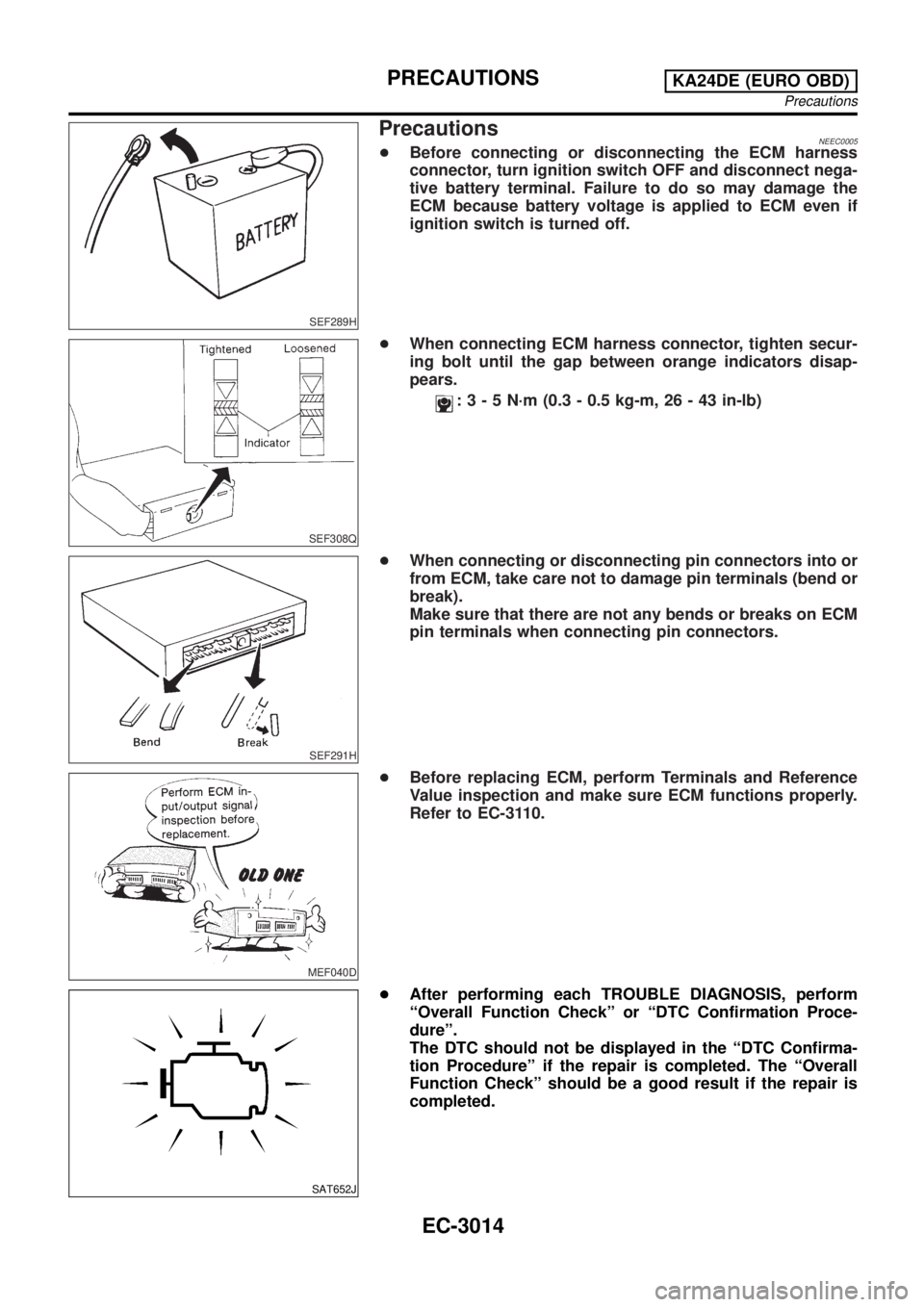
PrecautionsNEEC0005+Before connecting or disconnecting the ECM harness
connector, turn ignition switch OFF and disconnect nega-
tive battery terminal. Failure to do so may damage the
ECM because battery voltage is applied to ECM even if
ignition switch is turned off.
SEF308Q
+When connecting ECM harness connector, tighten secur-
ing bolt until the gap between orange indicators disap-
pears.
:3-5N´m(0.3 - 0.5 kg-m, 26 - 43 in-lb)
SEF291H
+When connecting or disconnecting pin connectors into or
from ECM, take care not to damage pin terminals (bend or
break).
Make sure that there are not any bends or breaks on ECM
pin terminals when connecting pin connectors.
MEF040D
+Before replacing ECM, perform Terminals and Reference
Value inspection and make sure ECM functions properly.
Refer to EC-3110.
SAT652J
+After performing each TROUBLE DIAGNOSIS, perform
ªOverall Function Checkº or ªDTC Confirmation Proce-
dureº.
The DTC should not be displayed in the ªDTC Confirma-
tion Procedureº if the repair is completed. The ªOverall
Function Checkº should be a good result if the repair is
completed.
PRECAUTIONSKA24DE (EURO OBD)
Precautions
EC-3014
Page 48 of 1306
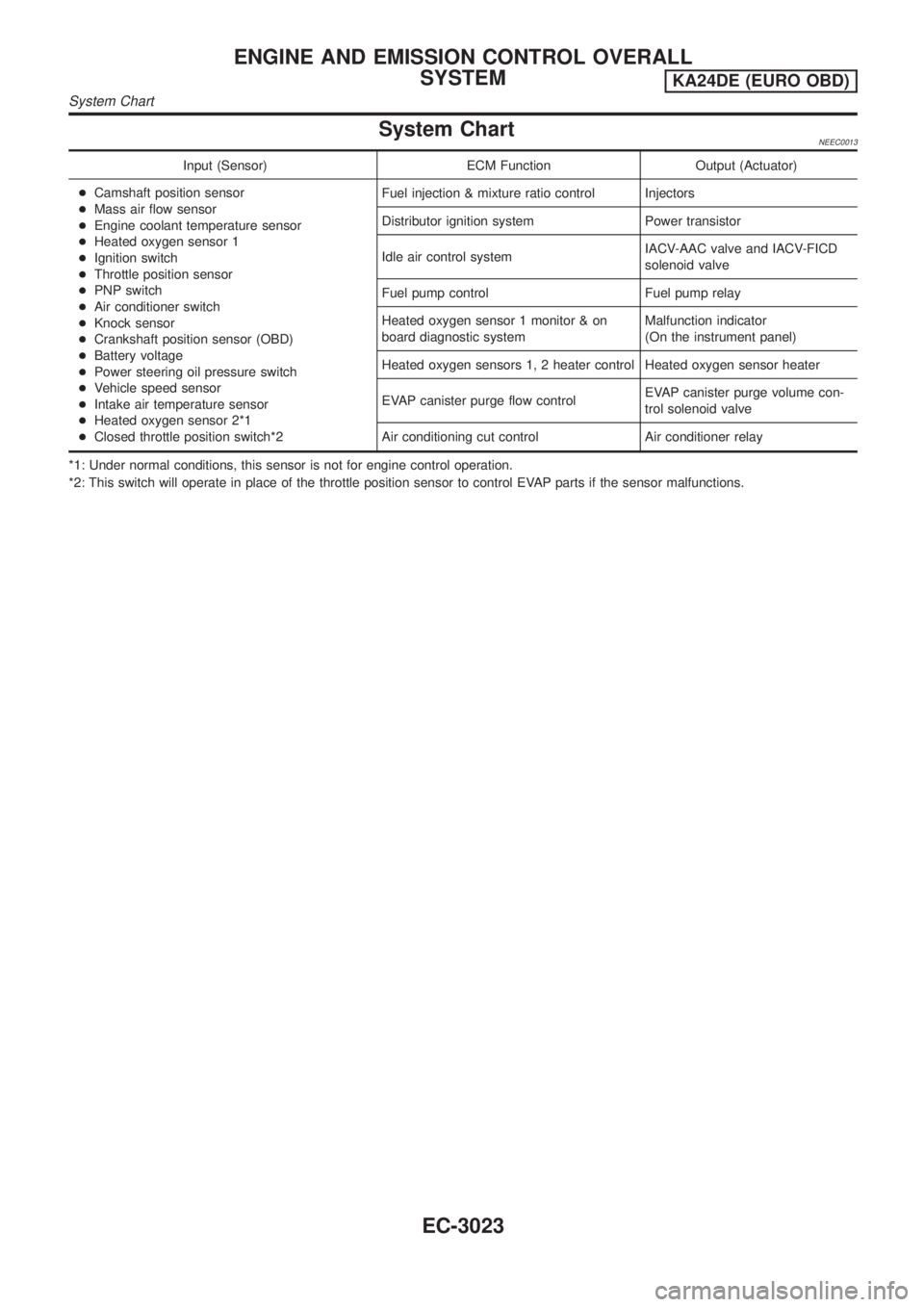
System ChartNEEC0013
Input (Sensor) ECM Function Output (Actuator)
+Camshaft position sensor
+Mass air flow sensor
+Engine coolant temperature sensor
+Heated oxygen sensor 1
+Ignition switch
+Throttle position sensor
+PNP switch
+Air conditioner switch
+Knock sensor
+Crankshaft position sensor (OBD)
+Battery voltage
+Power steering oil pressure switch
+Vehicle speed sensor
+Intake air temperature sensor
+Heated oxygen sensor 2*1
+Closed throttle position switch*2Fuel injection & mixture ratio control Injectors
Distributor ignition system Power transistor
Idle air control systemIACV-AAC valve and IACV-FICD
solenoid valve
Fuel pump control Fuel pump relay
Heated oxygen sensor 1 monitor & on
board diagnostic systemMalfunction indicator
(On the instrument panel)
Heated oxygen sensors 1, 2 heater control Heated oxygen sensor heater
EVAP canister purge flow controlEVAP canister purge volume con-
trol solenoid valve
Air conditioning cut control Air conditioner relay
*1: Under normal conditions, this sensor is not for engine control operation.
*2: This switch will operate in place of the throttle position sensor to control EVAP parts if the sensor malfunctions.
ENGINE AND EMISSION CONTROL OVERALL
SYSTEM
KA24DE (EURO OBD)
System Chart
EC-3023
Page 49 of 1306
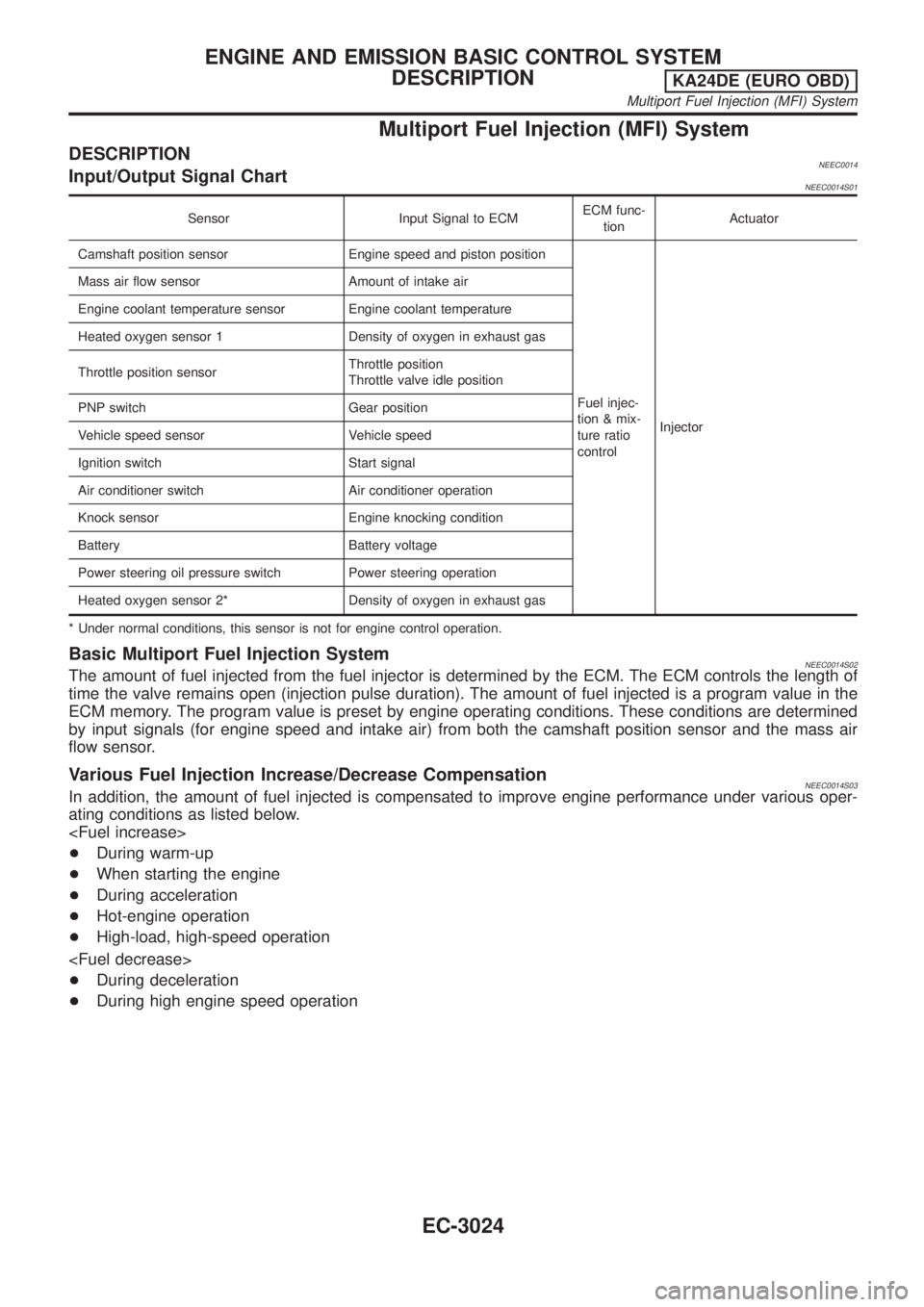
Multiport Fuel Injection (MFI) System
DESCRIPTIONNEEC0014Input/Output Signal ChartNEEC0014S01
Sensor Input Signal to ECMECM func-
tionActuator
Camshaft position sensor Engine speed and piston position
Fuel injec-
tion & mix-
ture ratio
controlInjector Mass air flow sensor Amount of intake air
Engine coolant temperature sensor Engine coolant temperature
Heated oxygen sensor 1 Density of oxygen in exhaust gas
Throttle position sensorThrottle position
Throttle valve idle position
PNP switch Gear position
Vehicle speed sensor Vehicle speed
Ignition switch Start signal
Air conditioner switch Air conditioner operation
Knock sensor Engine knocking condition
Battery Battery voltage
Power steering oil pressure switch Power steering operation
Heated oxygen sensor 2* Density of oxygen in exhaust gas
* Under normal conditions, this sensor is not for engine control operation.
Basic Multiport Fuel Injection SystemNEEC0014S02The amount of fuel injected from the fuel injector is determined by the ECM. The ECM controls the length of
time the valve remains open (injection pulse duration). The amount of fuel injected is a program value in the
ECM memory. The program value is preset by engine operating conditions. These conditions are determined
by input signals (for engine speed and intake air) from both the camshaft position sensor and the mass air
flow sensor.
Various Fuel Injection Increase/Decrease CompensationNEEC0014S03In addition, the amount of fuel injected is compensated to improve engine performance under various oper-
ating conditions as listed below.
+During warm-up
+When starting the engine
+During acceleration
+Hot-engine operation
+High-load, high-speed operation
+During deceleration
+During high engine speed operation
ENGINE AND EMISSION BASIC CONTROL SYSTEM
DESCRIPTION
KA24DE (EURO OBD)
Multiport Fuel Injection (MFI) System
EC-3024
Page 51 of 1306
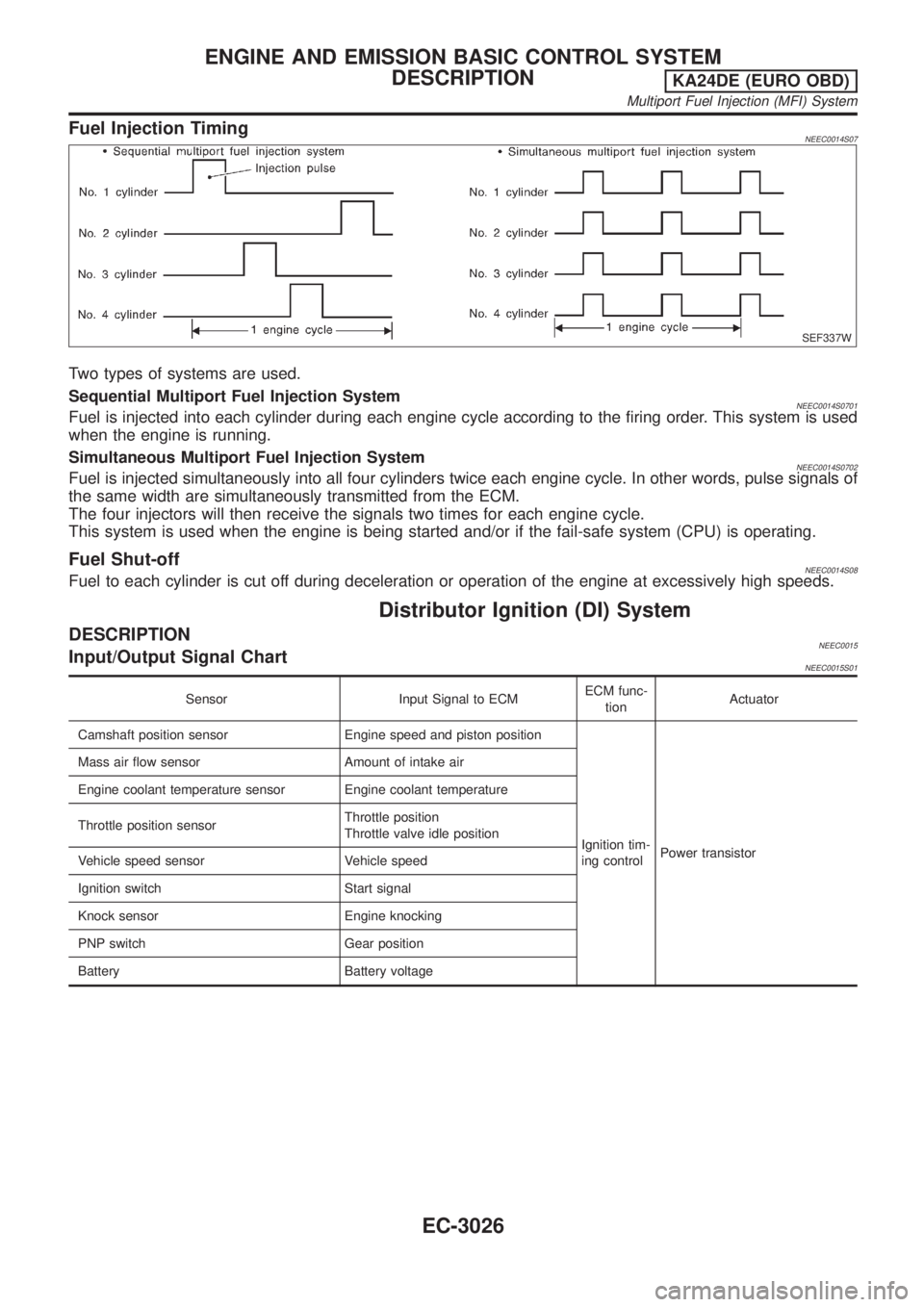
Fuel Injection TimingNEEC0014S07
SEF337W
Two types of systems are used.
Sequential Multiport Fuel Injection System
NEEC0014S0701Fuel is injected into each cylinder during each engine cycle according to the firing order. This system is used
when the engine is running.
Simultaneous Multiport Fuel Injection System
NEEC0014S0702Fuel is injected simultaneously into all four cylinders twice each engine cycle. In other words, pulse signals of
the same width are simultaneously transmitted from the ECM.
The four injectors will then receive the signals two times for each engine cycle.
This system is used when the engine is being started and/or if the fail-safe system (CPU) is operating.
Fuel Shut-offNEEC0014S08Fuel to each cylinder is cut off during deceleration or operation of the engine at excessively high speeds.
Distributor Ignition (DI) System
DESCRIPTIONNEEC0015Input/Output Signal ChartNEEC0015S01
Sensor Input Signal to ECMECM func-
tionActuator
Camshaft position sensor Engine speed and piston position
Ignition tim-
ing controlPower transistor Mass air flow sensor Amount of intake air
Engine coolant temperature sensor Engine coolant temperature
Throttle position sensorThrottle position
Throttle valve idle position
Vehicle speed sensor Vehicle speed
Ignition switch Start signal
Knock sensor Engine knocking
PNP switch Gear position
Battery Battery voltage
ENGINE AND EMISSION BASIC CONTROL SYSTEM
DESCRIPTION
KA24DE (EURO OBD)
Multiport Fuel Injection (MFI) System
EC-3026
Page 52 of 1306
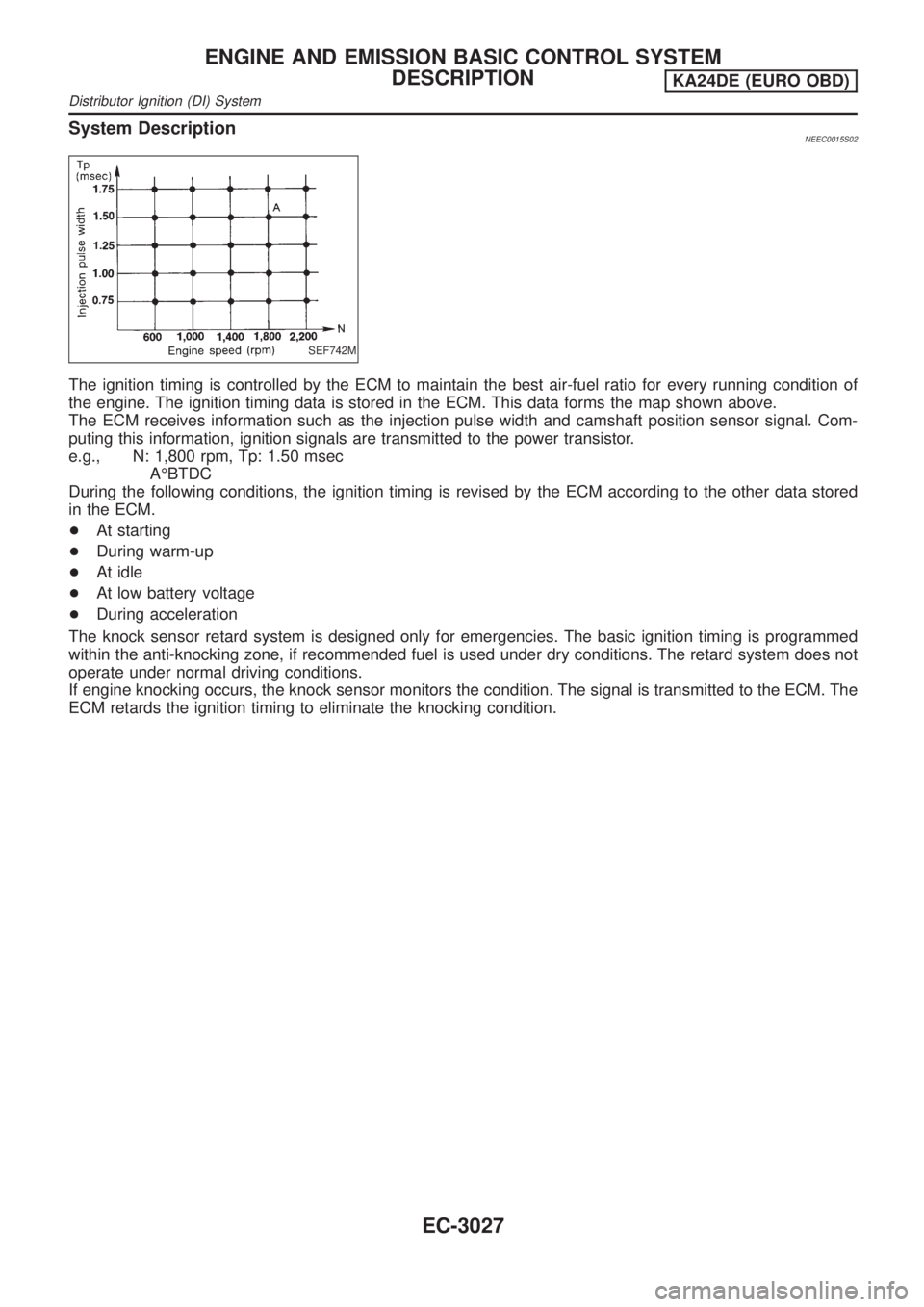
System DescriptionNEEC0015S02
SEF742M
The ignition timing is controlled by the ECM to maintain the best air-fuel ratio for every running condition of
the engine. The ignition timing data is stored in the ECM. This data forms the map shown above.
The ECM receives information such as the injection pulse width and camshaft position sensor signal. Com-
puting this information, ignition signals are transmitted to the power transistor.
e.g., N: 1,800 rpm, Tp: 1.50 msec
AÉBTDC
During the following conditions, the ignition timing is revised by the ECM according to the other data stored
in the ECM.
+At starting
+During warm-up
+At idle
+At low battery voltage
+During acceleration
The knock sensor retard system is designed only for emergencies. The basic ignition timing is programmed
within the anti-knocking zone, if recommended fuel is used under dry conditions. The retard system does not
operate under normal driving conditions.
If engine knocking occurs, the knock sensor monitors the condition. The signal is transmitted to the ECM. The
ECM retards the ignition timing to eliminate the knocking condition.
ENGINE AND EMISSION BASIC CONTROL SYSTEM
DESCRIPTION
KA24DE (EURO OBD)
Distributor Ignition (DI) System
EC-3027
Page 60 of 1306
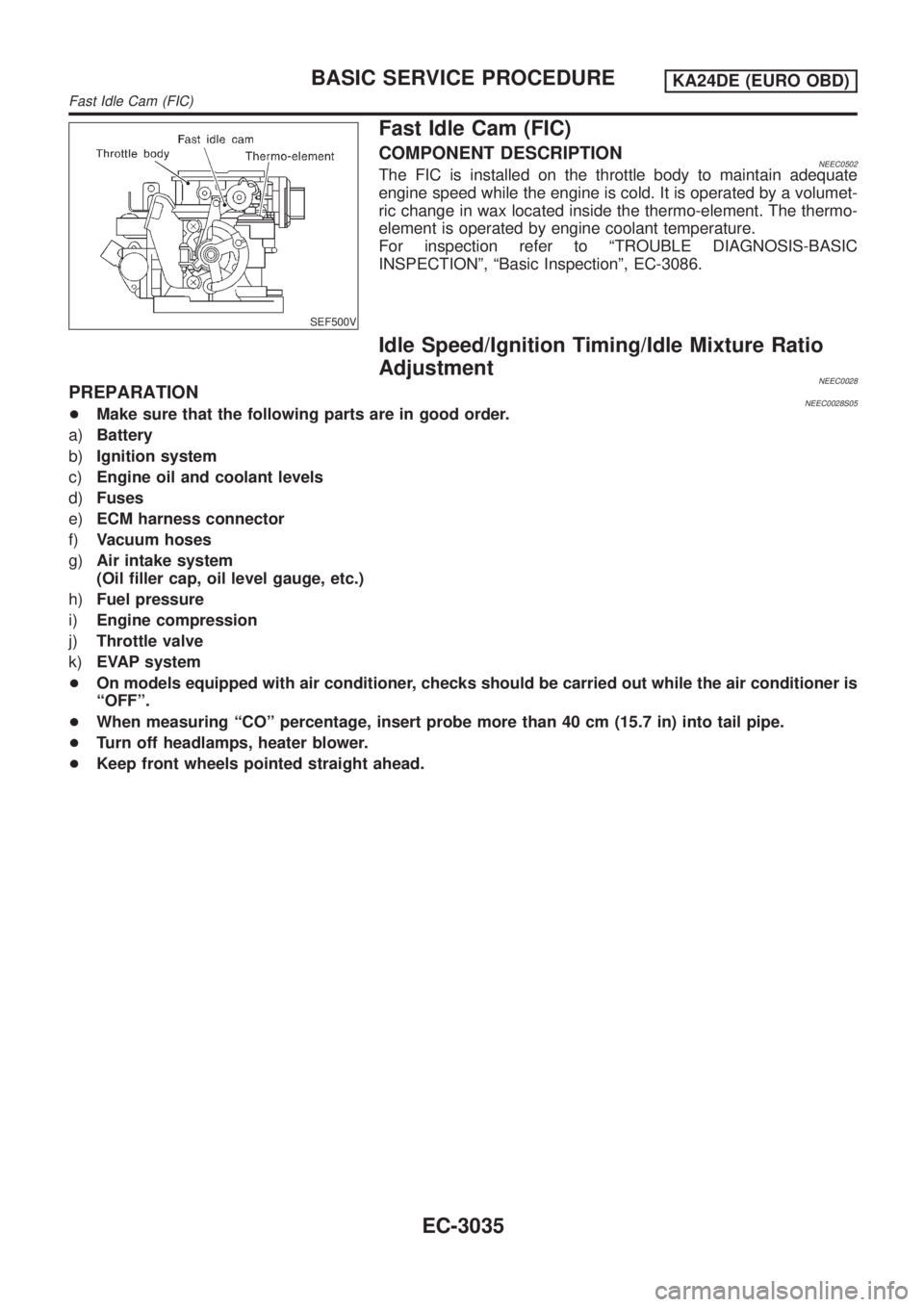
SEF500V
Fast Idle Cam (FIC)
COMPONENT DESCRIPTIONNEEC0502The FIC is installed on the throttle body to maintain adequate
engine speed while the engine is cold. It is operated by a volumet-
ric change in wax located inside the thermo-element. The thermo-
element is operated by engine coolant temperature.
For inspection refer to ªTROUBLE DIAGNOSIS-BASIC
INSPECTIONº, ªBasic Inspectionº, EC-3086.
Idle Speed/Ignition Timing/Idle Mixture Ratio
Adjustment
NEEC0028PREPARATIONNEEC0028S05+Make sure that the following parts are in good order.
a)Battery
b)Ignition system
c)Engine oil and coolant levels
d)Fuses
e)ECM harness connector
f)Vacuum hoses
g)Air intake system
(Oil filler cap, oil level gauge, etc.)
h)Fuel pressure
i)Engine compression
j)Throttle valve
k)EVAP system
+On models equipped with air conditioner, checks should be carried out while the air conditioner is
ªOFFº.
+When measuring ªCOº percentage, insert probe more than 40 cm (15.7 in) into tail pipe.
+Turn off headlamps, heater blower.
+Keep front wheels pointed straight ahead.
BASIC SERVICE PROCEDUREKA24DE (EURO OBD)
Fast Idle Cam (FIC)
EC-3035
Page 69 of 1306

11 CHECK HEATED OXYGEN SENSOR 1 HARNESS
1. Turn off engine and disconnect battery ground cable.
2. Disconnect ECM harness connector.
3. Disconnect heated oxygen sensor 1 harness connector.
4. Then connect harness connector terminal for heated oxygen sensor 1 to ground with a jumper wire.
SEC299D
5. Check for continuity between terminal 50 of ECM harness connector and body ground.
SEF250P
Continuity exists...OK
Continuity does not exist...NG
OK or NG
OK©1. Connect ECM harness connector to ECM.
2. Connect battery ground cable.
3. GO TO 13.
NG©1. Repair or replace harness.
2. GO TO 12.
BASIC SERVICE PROCEDUREKA24DE (EURO OBD)
Idle Speed/Ignition Timing/Idle Mixture Ratio Adjustment
EC-3044
Page 71 of 1306
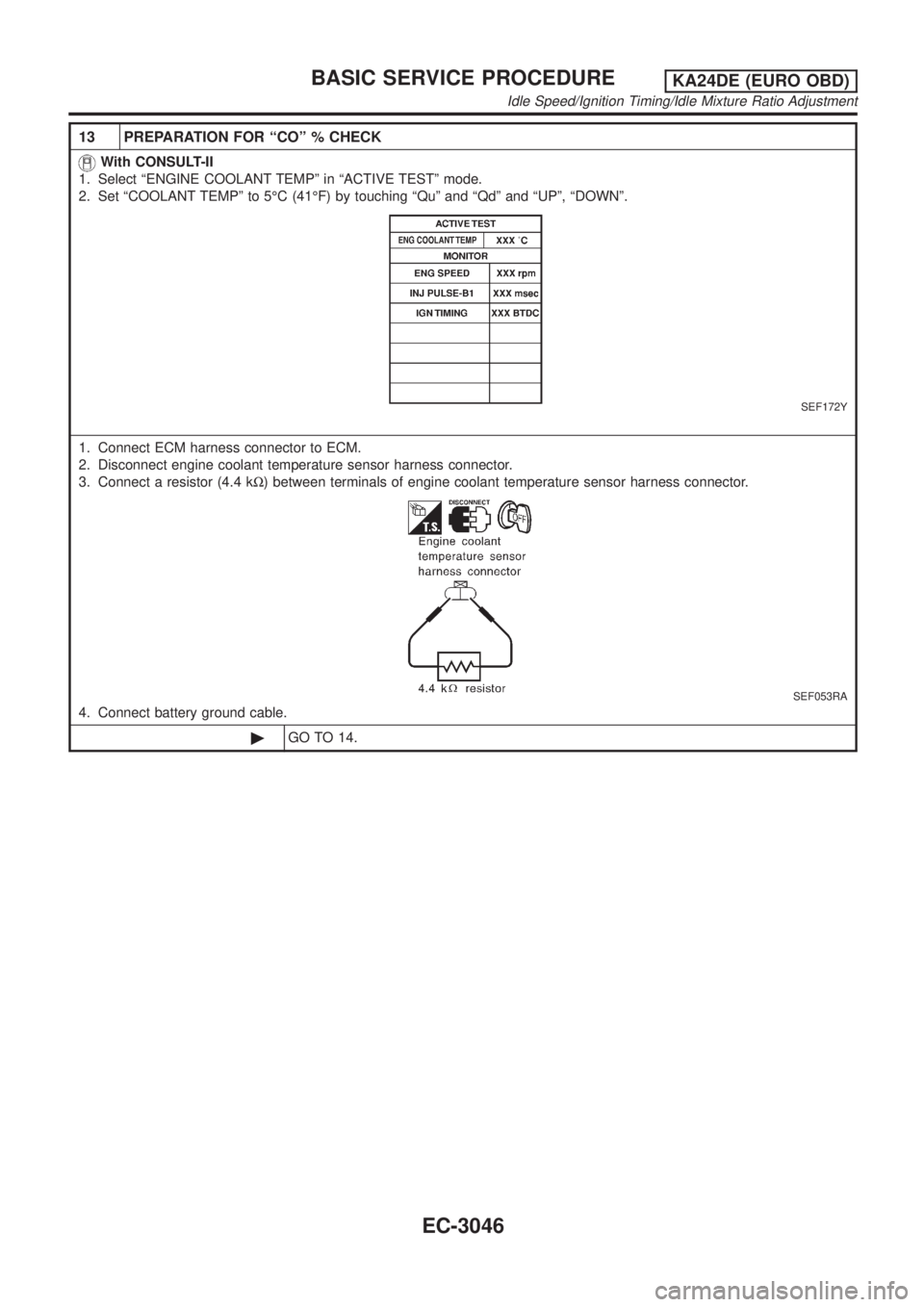
13 PREPARATION FOR ªCOº % CHECK
With CONSULT-II
1. Select ªENGINE COOLANT TEMPº in ªACTIVE TESTº mode.
2. Set ªCOOLANT TEMPº to 5ÉC (41ÉF) by touching ªQuº and ªQdº and ªUPº, ªDOWNº.
SEF172Y
1. Connect ECM harness connector to ECM.
2. Disconnect engine coolant temperature sensor harness connector.
3. Connect a resistor (4.4 kW) between terminals of engine coolant temperature sensor harness connector.
SEF053RA
4. Connect battery ground cable.
©GO TO 14.
BASIC SERVICE PROCEDUREKA24DE (EURO OBD)
Idle Speed/Ignition Timing/Idle Mixture Ratio Adjustment
EC-3046