Control NISSAN PRIMERA 1999 Electronic Repair Manual
[x] Cancel search | Manufacturer: NISSAN, Model Year: 1999, Model line: PRIMERA, Model: NISSAN PRIMERA 1999Pages: 2267, PDF Size: 35.74 MB
Page 334 of 2267
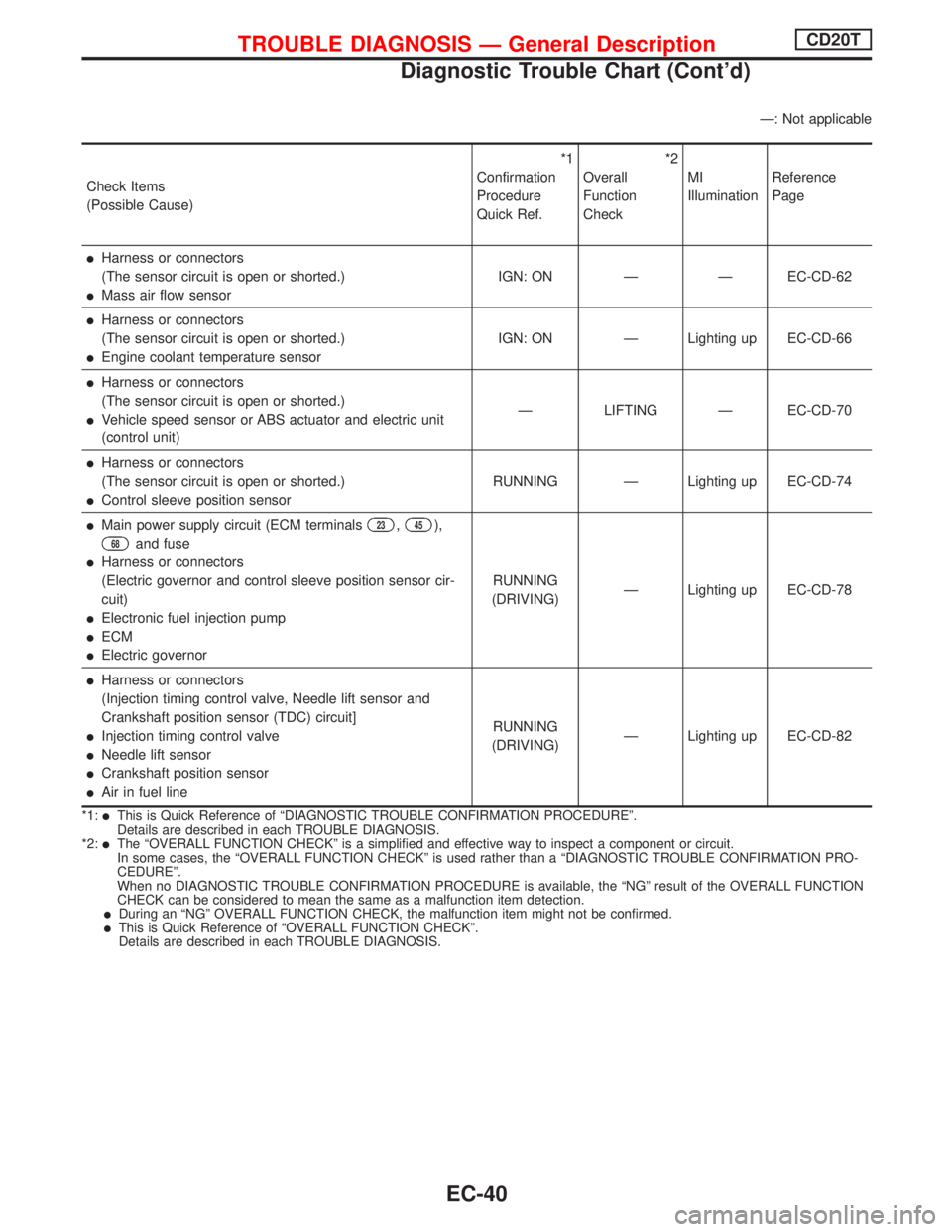
Ð: Not applicable
Check Items
(Possible Cause)*1
Confirmation
Procedure
Quick Ref.*2
Overall
Function
CheckMI
IlluminationReference
Page
lHarness or connectors
(The sensor circuit is open or shorted.)
lMass air flow sensorIGN: ON Ð Ð EC-CD-62
lHarness or connectors
(The sensor circuit is open or shorted.)
lEngine coolant temperature sensorIGN: ON Ð Lighting up EC-CD-66
lHarness or connectors
(The sensor circuit is open or shorted.)
lVehicle speed sensor or ABS actuator and electric unit
(control unit)Ð LIFTING Ð EC-CD-70
lHarness or connectors
(The sensor circuit is open or shorted.)
lControl sleeve position sensorRUNNING Ð Lighting up EC-CD-74
lMain power supply circuit (ECM terminals23,45),
68and fuse
lHarness or connectors
(Electric governor and control sleeve position sensor cir-
cuit)
lElectronic fuel injection pump
lECM
lElectric governorRUNNING
(DRIVING)Ð Lighting up EC-CD-78
lHarness or connectors
(Injection timing control valve, Needle lift sensor and
Crankshaft position sensor (TDC) circuit]
lInjection timing control valve
lNeedle lift sensor
lCrankshaft position sensor
lAir in fuel lineRUNNING
(DRIVING)Ð Lighting up EC-CD-82
*1:lThis is Quick Reference of ªDIAGNOSTIC TROUBLE CONFIRMATION PROCEDUREº.
Details are described in each TROUBLE DIAGNOSIS.
*2:
lThe ªOVERALL FUNCTION CHECKº is a simplified and effective way to inspect a component or circuit.
In some cases, the ªOVERALL FUNCTION CHECKº is used rather than a ªDIAGNOSTIC TROUBLE CONFIRMATION PRO-
CEDUREº.
When no DIAGNOSTIC TROUBLE CONFIRMATION PROCEDURE is available, the ªNGº result of the OVERALL FUNCTION
CHECK can be considered to mean the same as a malfunction item detection.
lDuring an ªNGº OVERALL FUNCTION CHECK, the malfunction item might not be confirmed.lThis is Quick Reference of ªOVERALL FUNCTION CHECKº.
Details are described in each TROUBLE DIAGNOSIS.
TROUBLE DIAGNOSIS Ð General DescriptionCD20T
Diagnostic Trouble Chart (Cont'd)
EC-40
Page 337 of 2267
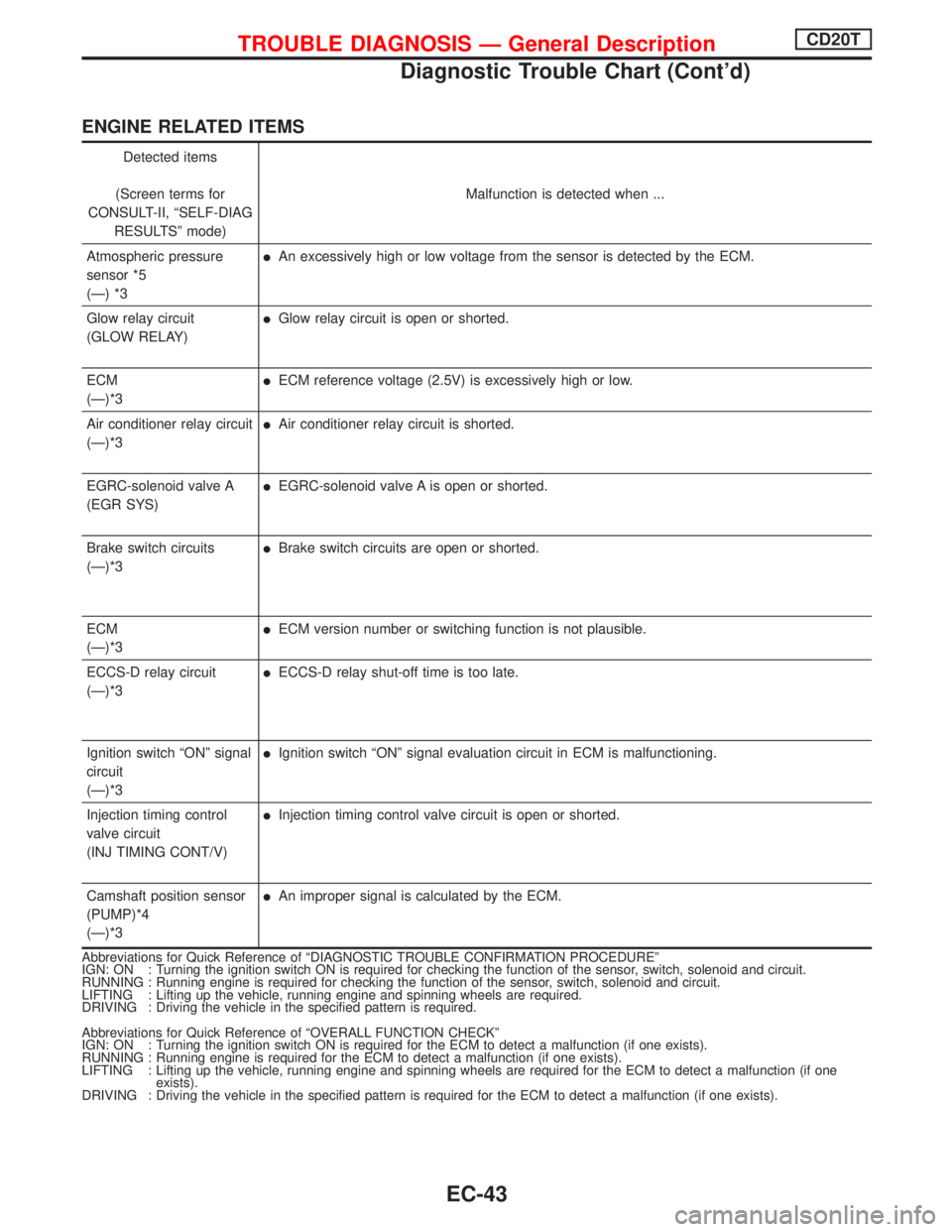
ENGINE RELATED ITEMS
Detected items
(Screen terms for
CONSULT-II, ªSELF-DIAG
RESULTSº mode)Malfunction is detected when ...
Atmospheric pressure
sensor *5
(Ð) *3
lAn excessively high or low voltage from the sensor is detected by the ECM.
Glow relay circuit
(GLOW RELAY)
lGlow relay circuit is open or shorted.
ECM
(Ð)*3
lECM reference voltage (2.5V) is excessively high or low.
Air conditioner relay circuit
(Ð)*3
lAir conditioner relay circuit is shorted.
EGRC-solenoid valve A
(EGR SYS)
lEGRC-solenoid valve A is open or shorted.
Brake switch circuits
(Ð)*3
lBrake switch circuits are open or shorted.
ECM
(Ð)*3
lECM version number or switching function is not plausible.
ECCS-D relay circuit
(Ð)*3
lECCS-D relay shut-off time is too late.
Ignition switch ªONº signal
circuit
(Ð)*3
lIgnition switch ªONº signal evaluation circuit in ECM is malfunctioning.
Injection timing control
valve circuit
(INJ TIMING CONT/V)
lInjection timing control valve circuit is open or shorted.
Camshaft position sensor
(PUMP)*4
(Ð)*3
lAn improper signal is calculated by the ECM.
Abbreviations for Quick Reference of ªDIAGNOSTIC TROUBLE CONFIRMATION PROCEDUREº
IGN: ON : Turning the ignition switch ON is required for checking the function of the sensor, switch, solenoid and circuit.
RUNNING : Running engine is required for checking the function of the sensor, switch, solenoid and circuit.
LIFTING : Lifting up the vehicle, running engine and spinning wheels are required.
DRIVING : Driving the vehicle in the specified pattern is required.
Abbreviations for Quick Reference of ªOVERALL FUNCTION CHECKº
IGN: ON : Turning the ignition switch ON is required for the ECM to detect a malfunction (if one exists).
RUNNING : Running engine is required for the ECM to detect a malfunction (if one exists).
LIFTING : Lifting up the vehicle, running engine and spinning wheels are required for the ECM to detect a malfunction (if one
exists).
DRIVING : Driving the vehicle in the specified pattern is required for the ECM to detect a malfunction (if one exists).
TROUBLE DIAGNOSIS Ð General DescriptionCD20T
Diagnostic Trouble Chart (Cont'd)
EC-43
Page 338 of 2267
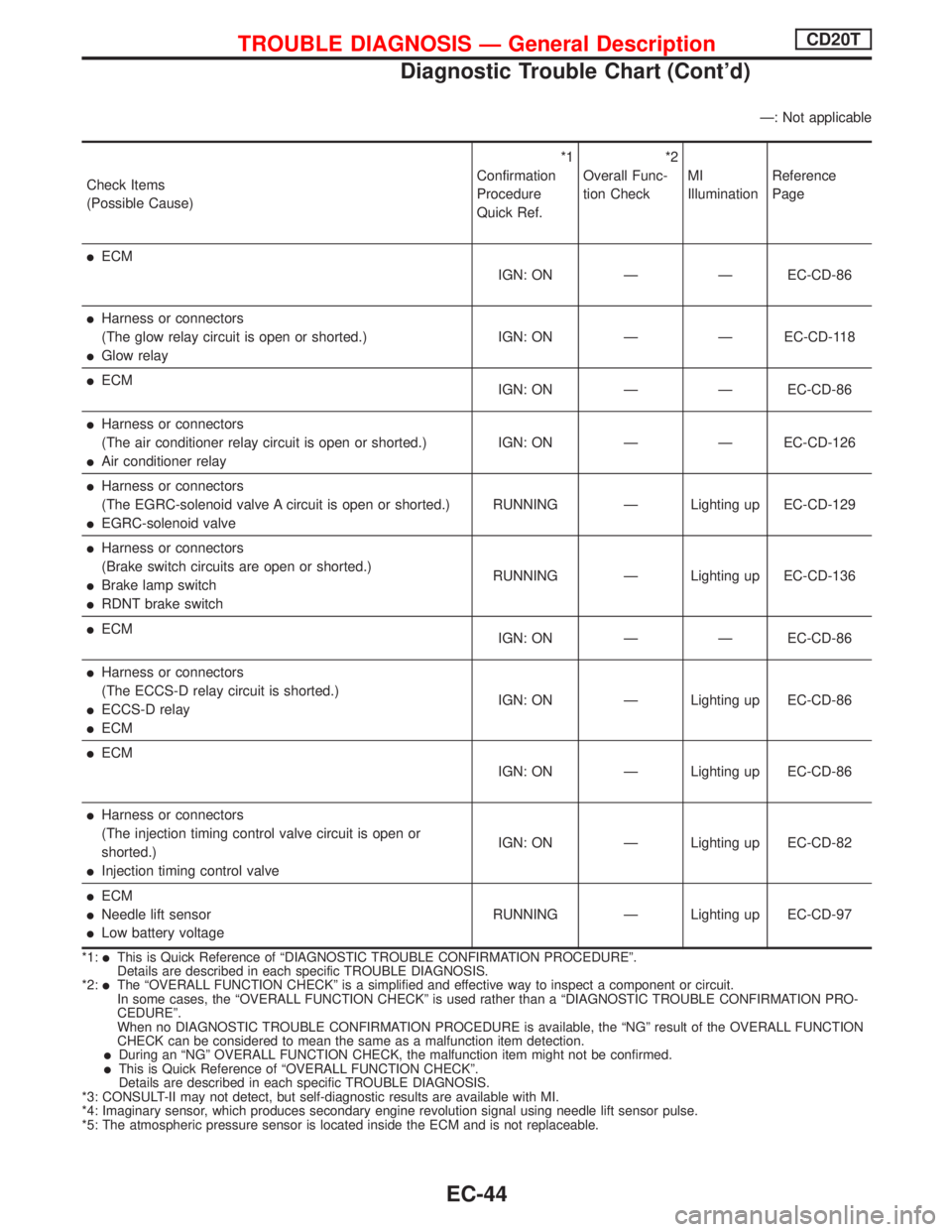
Ð: Not applicable
Check Items
(Possible Cause)*1
Confirmation
Procedure
Quick Ref.*2
Overall Func-
tion CheckMI
IlluminationReference
Page
lECM
IGN: ON Ð Ð EC-CD-86
lHarness or connectors
(The glow relay circuit is open or shorted.)
lGlow relayIGN: ON Ð Ð EC-CD-118
lECM
IGN: ON Ð Ð EC-CD-86
lHarness or connectors
(The air conditioner relay circuit is open or shorted.)
lAir conditioner relayIGN: ON Ð Ð EC-CD-126
lHarness or connectors
(The EGRC-solenoid valve A circuit is open or shorted.)
lEGRC-solenoid valveRUNNING Ð Lighting up EC-CD-129
lHarness or connectors
(Brake switch circuits are open or shorted.)
lBrake lamp switch
lRDNT brake switchRUNNING Ð Lighting up EC-CD-136
lECM
IGN: ON Ð Ð EC-CD-86
lHarness or connectors
(The ECCS-D relay circuit is shorted.)
lECCS-D relay
lECMIGN: ON Ð Lighting up EC-CD-86
lECM
IGN: ON Ð Lighting up EC-CD-86
lHarness or connectors
(The injection timing control valve circuit is open or
shorted.)
lInjection timing control valveIGN: ON Ð Lighting up EC-CD-82
lECM
lNeedle lift sensor
lLow battery voltageRUNNING Ð Lighting up EC-CD-97
*1:lThis is Quick Reference of ªDIAGNOSTIC TROUBLE CONFIRMATION PROCEDUREº.
Details are described in each specific TROUBLE DIAGNOSIS.
*2:
lThe ªOVERALL FUNCTION CHECKº is a simplified and effective way to inspect a component or circuit.
In some cases, the ªOVERALL FUNCTION CHECKº is used rather than a ªDIAGNOSTIC TROUBLE CONFIRMATION PRO-
CEDUREº.
When no DIAGNOSTIC TROUBLE CONFIRMATION PROCEDURE is available, the ªNGº result of the OVERALL FUNCTION
CHECK can be considered to mean the same as a malfunction item detection.
lDuring an ªNGº OVERALL FUNCTION CHECK, the malfunction item might not be confirmed.lThis is Quick Reference of ªOVERALL FUNCTION CHECKº.
Details are described in each specific TROUBLE DIAGNOSIS.
*3: CONSULT-II may not detect, but self-diagnostic results are available with MI.
*4: Imaginary sensor, which produces secondary engine revolution signal using needle lift sensor pulse.
*5: The atmospheric pressure sensor is located inside the ECM and is not replaceable.
TROUBLE DIAGNOSIS Ð General DescriptionCD20T
Diagnostic Trouble Chart (Cont'd)
EC-44
Page 341 of 2267
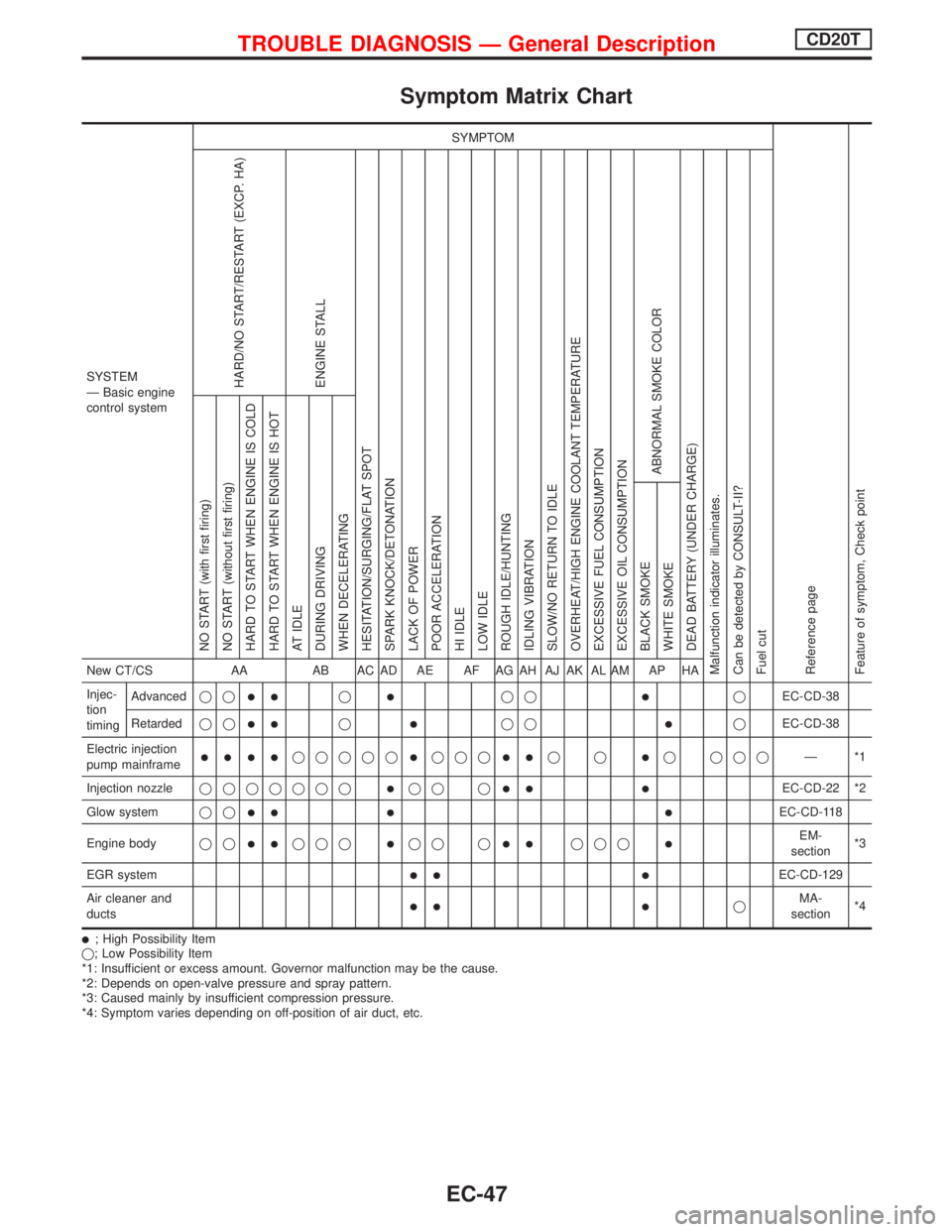
Symptom Matrix Chart
SYSTEM
Ð Basic engine
control systemSYMPTOM
Reference page
Feature of symptom, Check pointHARD/NO START/RESTART (EXCP. HA)
ENGINE STALL
HESITATION/SURGING/FLAT SPOT
SPARK KNOCK/DETONATION
LACK OF POWER
POOR ACCELERATION
HI IDLE
LOW IDLE
ROUGH IDLE/HUNTING
IDLING VIBRATION
SLOW/NO RETURN TO IDLE
OVERHEAT/HIGH ENGINE COOLANT TEMPERATURE
EXCESSIVE FUEL CONSUMPTION
EXCESSIVE OIL CONSUMPTION
ABNORMAL SMOKE COLOR
DEAD BATTERY (UNDER CHARGE)
Malfunction indicator illuminates.
Can be detected by CONSULT-II?
Fuel cutNO START (with first firing)
NO START (without first firing)
HARD TO START WHEN ENGINE IS COLD
HARD TO START WHEN ENGINE IS HOT
AT IDLE
DURING DRIVING
WHEN DECELERATING
BLACK SMOKE
WHITE SMOKENew CT/CS AA AB AC AD AE AF AG AH AJ AK AL AM AP HA
Injec-
tion
timingAdvancedqq
llqlqqlqEC-CD-38
Retardedqq
llqlqqlqEC-CD-38
Electric injection
pump mainframe
llllqqqqqlqqqllqqlq qqqÐ*1
Injection nozzleqqqqqqq
lqq qll lEC-CD-22 *2
Glow systemqq
ll l lEC-CD-118
Engine bodyqq
llqqqlqq qllqqqlEM-
section*3
EGR system
ll lEC-CD-129
Air cleaner and
ducts
ll lqMA-
section*4
l; High Possibility Item
q; Low Possibility Item
*1: Insufficient or excess amount. Governor malfunction may be the cause.
*2: Depends on open-valve pressure and spray pattern.
*3: Caused mainly by insufficient compression pressure.
*4: Symptom varies depending on off-position of air duct, etc.
TROUBLE DIAGNOSIS Ð General DescriptionCD20T
EC-47
Page 342 of 2267
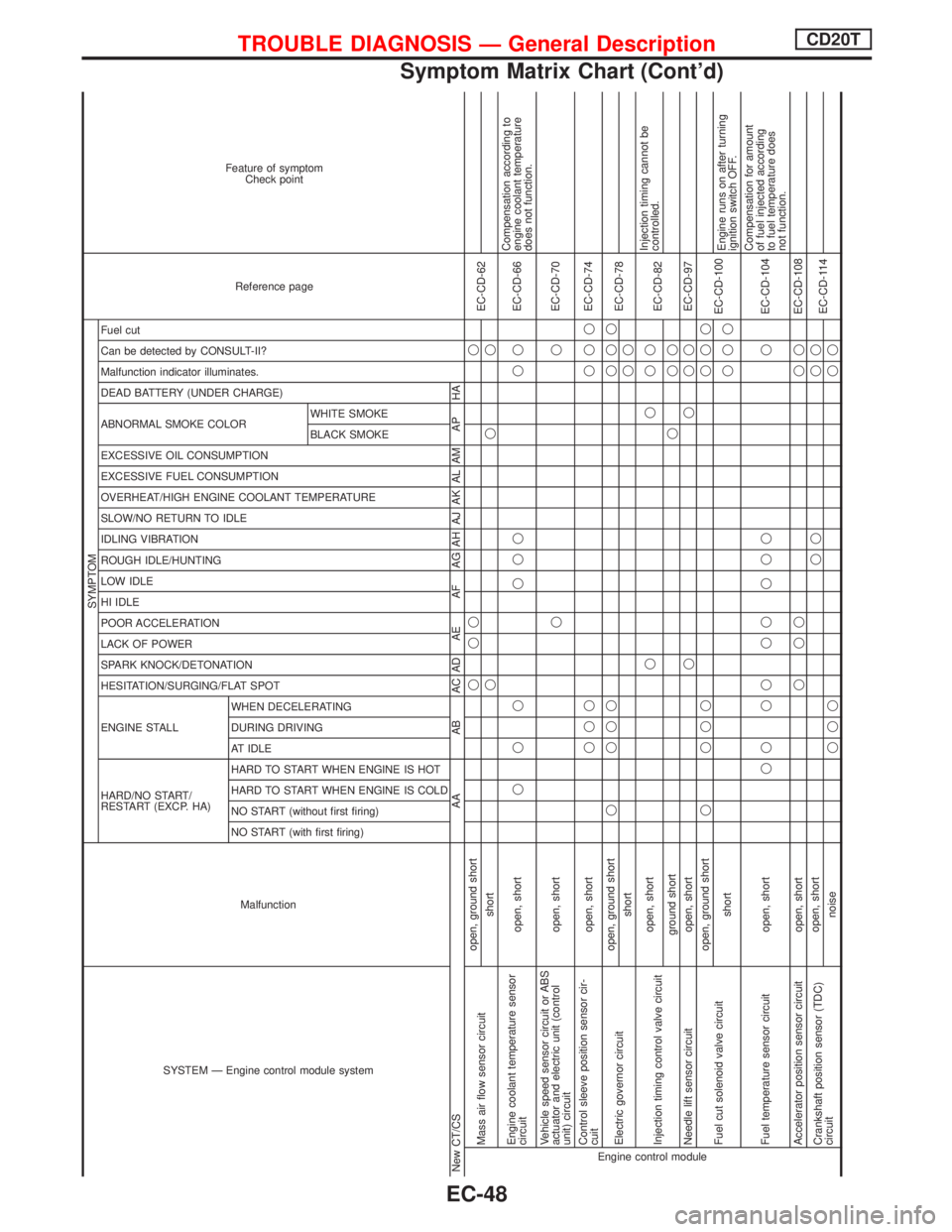
SYSTEM Ð Engine control module systemMalfunction
SYMPTOM
Reference page Feature of symptom
Check point
HARD/NO START/
RESTART (EXCP. HA) ENGINE STALL HESITATION/SURGING/FLAT SPOT SPARK KNOCK/DETONATION
LACK OF POWER
POOR ACCELERATION
HI IDLE
LOW IDLE
ROUGH IDLE/HUNTING
IDLING VIBRATION
SLOW/NO RETURN TO IDLE
OVERHEAT/HIGH ENGINE COOLANT TEMPERATURE
EXCESSIVE FUEL CONSUMPTION
EXCESSIVE OIL CONSUMPTION ABNORMAL SMOKE COLOR
DEAD BATTERY (UNDER CHARGE) Malfunction indicator illuminates.
Can be detected by CONSULT-II?
Fuel cut
NO START (with first firing) NO START (without first firing)
HARD TO START WHEN ENGINE IS COLD
HARD TO START WHEN ENGINE IS HOT
AT IDLE
DURING DRIVING
WHEN DECELERATINGBLACK SMOKE WHITE SMOKE
New CT/CS AA AB AC AD AE AF AG AH AJ AK AL AM AP HAEngine control moduleMass air flow sensor circuitopen, ground shortqqq q
EC-CD-62
shortqqq
Engine coolant temperature sensor
circuitopen, shortqqq qqq qqEC-CD-66Compensation according to
engine coolant temperature
does not function.
Vehicle speed sensor circuit or ABS
actuator and electric unit (control
unit) circuitopen, shortqqEC-CD-70
Control sleeve position sensor cir-
cuitopen, shortqqq qqqEC-CD-74
Electric governor circuitopen, ground shortq qqq qqq
EC-CD-78
shortqq
Injection timing control valve circuitopen, shortqqqq
EC-CD-82Injection timing cannot be
controlled.
ground shortqqq
Needle lift sensor circuit open, shortqqqqEC-CD-97
Fuel cut solenoid valve circuitopen, ground shortq qqq qqq
EC-CD-100
shortqqqEngine runs on after turning
ignition switch OFF.
Fuel temperature sensor circuit open, shortqq qq qq q qq qEC-CD-104Compensation for amount
of fuel injected according
to fuel temperature does
not function.
Accelerator position sensor circuit open, shortqqq qqEC-CD-108
Crankshaft position sensor (TDC)
circuitopen, shortqq qq
EC-CD-114
noiseqqq qq
TROUBLE DIAGNOSIS Ð General DescriptionCD20T
Symptom Matrix Chart (Cont'd)
EC-48
Page 343 of 2267
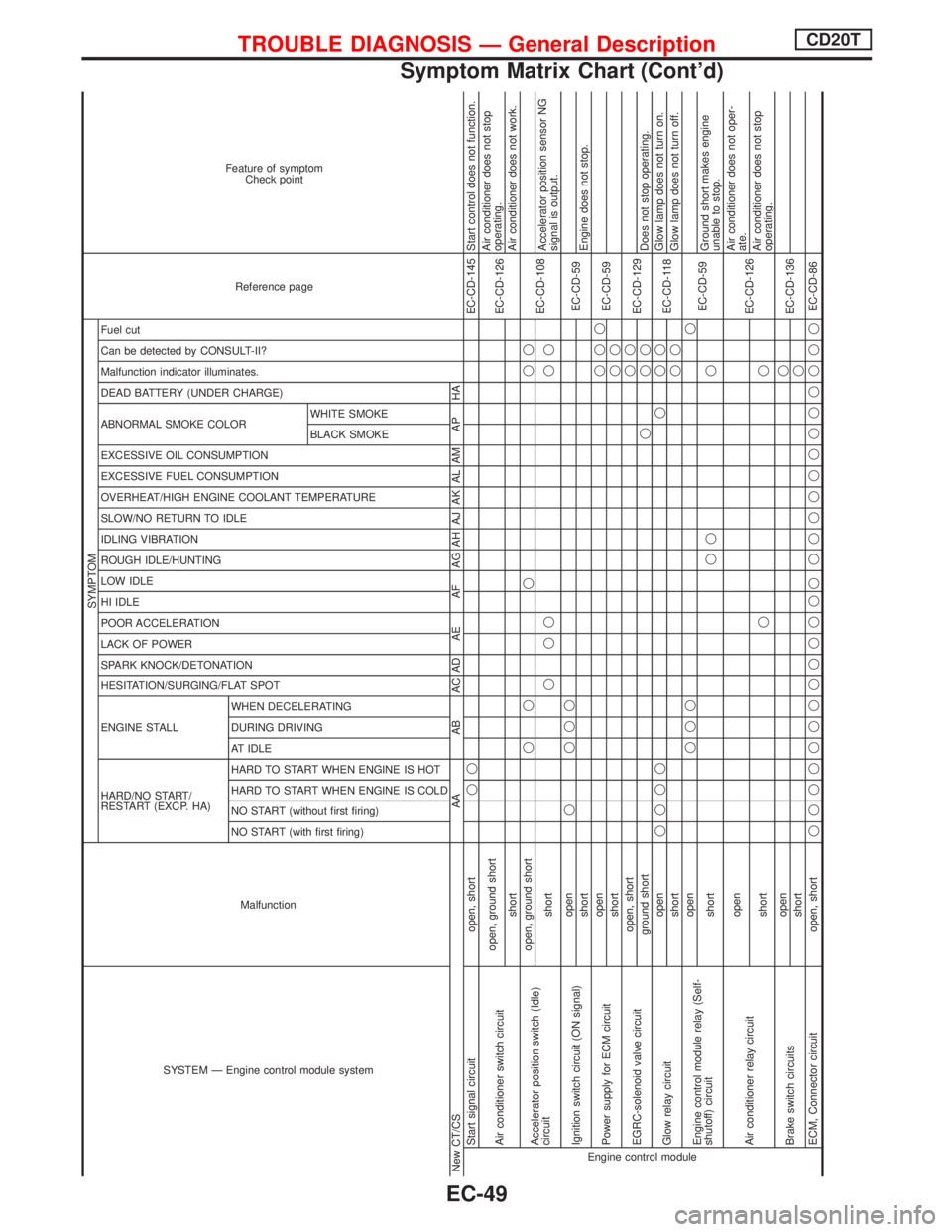
SYSTEM Ð Engine control module systemMalfunction
SYMPTOM
Reference page Feature of symptom
Check point
HARD/NO START/
RESTART (EXCP. HA) ENGINE STALL HESITATION/SURGING/FLAT SPOT SPARK KNOCK/DETONATION
LACK OF POWER
POOR ACCELERATION
HI IDLE
LOW IDLE
ROUGH IDLE/HUNTING
IDLING VIBRATION
SLOW/NO RETURN TO IDLE
OVERHEAT/HIGH ENGINE COOLANT TEMPERATURE
EXCESSIVE FUEL CONSUMPTION
EXCESSIVE OIL CONSUMPTION ABNORMAL SMOKE COLOR
DEAD BATTERY (UNDER CHARGE) Malfunction indicator illuminates.
Can be detected by CONSULT-II?
Fuel cut
NO START (with first firing) NO START (without first firing)
HARD TO START WHEN ENGINE IS COLD
HARD TO START WHEN ENGINE IS HOT
AT IDLE
DURING DRIVING
WHEN DECELERATINGBLACK SMOKE WHITE SMOKE
New CT/CS AA AB AC AD AE AF AG AH AJ AK AL AM AP HAEngine control moduleStart signal circuit open, shortqqEC-CD-145 Start control does not function.
Air conditioner switch circuitopen, ground short
EC-CD-126Air conditioner does not stop
operating.
shortAir conditioner does not work.
Accelerator position switch (Idle)
circuitopen, ground shortqq q qq
EC-CD-108
shortqqq qqAccelerator position sensor NG
signal is output.
Ignition switch circuit (ON signal)openq qqq
EC-CD-59
shortEngine does not stop.
Power supply for ECM circuitopenqqq
EC-CD-59
shortqq
EGRC-solenoid valve circuitopen, shortqq
EC-CD-129
ground shortqqqDoes not stop operating.
Glow relay circuitopenqqqq q qq
EC-CD-118Glow lamp does not turn on.
shortqqGlow lamp does not turn off.
Engine control module relay (Self-
shutoff) circuitopenqqqq
EC-CD-59
shortqq qGround short makes engine
unable to stop.
Air conditioner relay circuitopen
EC-CD-126Air conditioner does not oper-
ate.
shortqqAir conditioner does not stop
operating.
Brake switch circuitsopenq
EC-CD-136
shortq
ECM, Connector circuit open, shortqqqqqqqqqqqqq qqqqqqqqqqqqEC-CD-86
TROUBLE DIAGNOSIS Ð General DescriptionCD20T
Symptom Matrix Chart (Cont'd)
EC-49
Page 347 of 2267
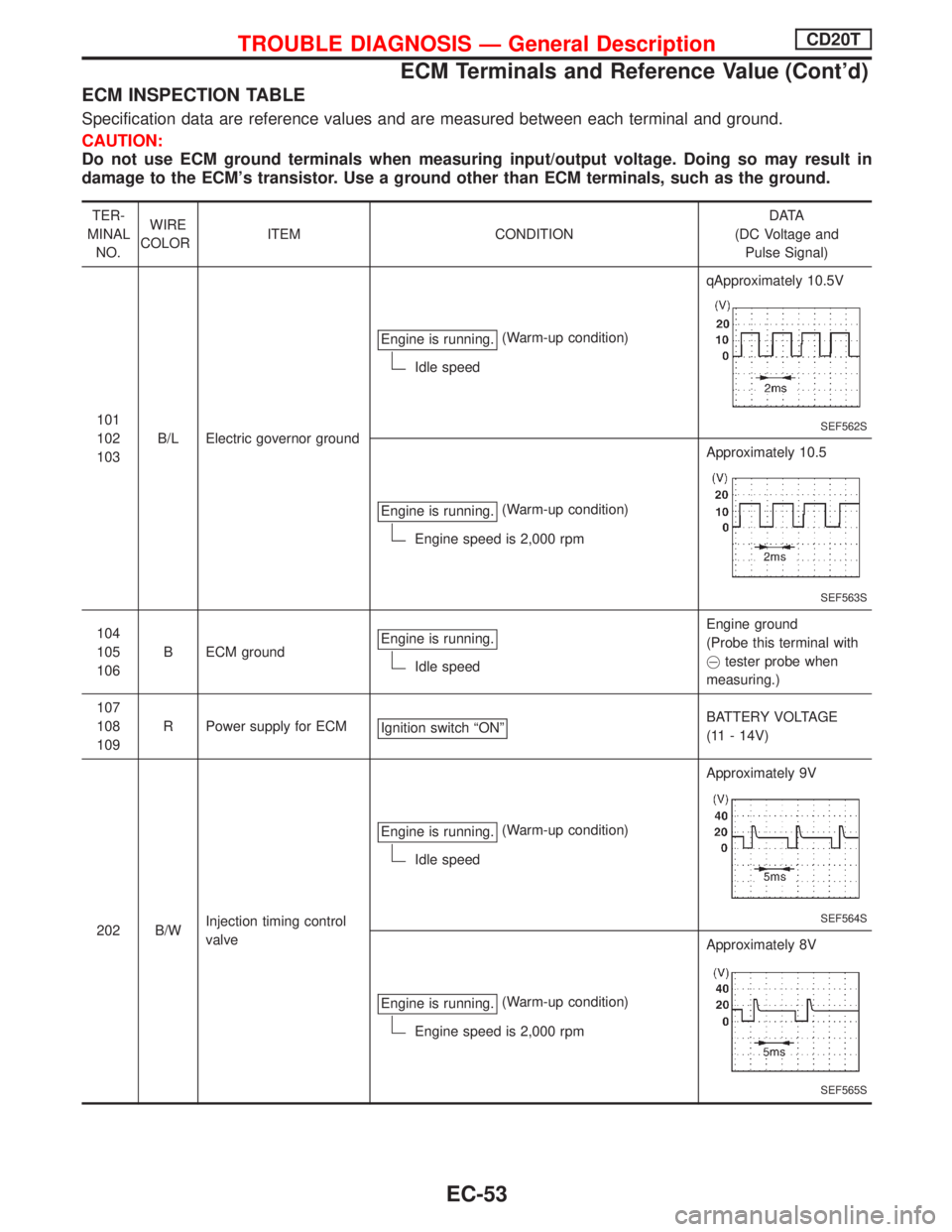
ECM INSPECTION TABLE
Specification data are reference values and are measured between each terminal and ground.
CAUTION:
Do not use ECM ground terminals when measuring input/output voltage. Doing so may result in
damage to the ECM's transistor. Use a ground other than ECM terminals, such as the ground.
TER-
MINAL
NO.WIRE
COLORITEM CONDITIOND ATA
(DC Voltage and
Pulse Signal)
101
102
103B/L Electric governor groundEngine is running.
(Warm-up condition)
Idle speedqApproximately 10.5V
SEF562S
Engine is running.(Warm-up condition)
Engine speed is 2,000 rpmApproximately 10.5
SEF563S
104
105
106B ECM groundEngine is running.
Idle speedEngine ground
(Probe this terminal with
@tester probe when
measuring.)
107
108
109R Power supply for ECM
Ignition switch ªONº
BATTERY VOLTAGE
(11 - 14V)
202 B/WInjection timing control
valveEngine is running.
(Warm-up condition)
Idle speedApproximately 9V
SEF564S
Engine is running.(Warm-up condition)
Engine speed is 2,000 rpmApproximately 8V
SEF565S
TROUBLE DIAGNOSIS Ð General DescriptionCD20T
ECM Terminals and Reference Value (Cont'd)
EC-53
Page 348 of 2267
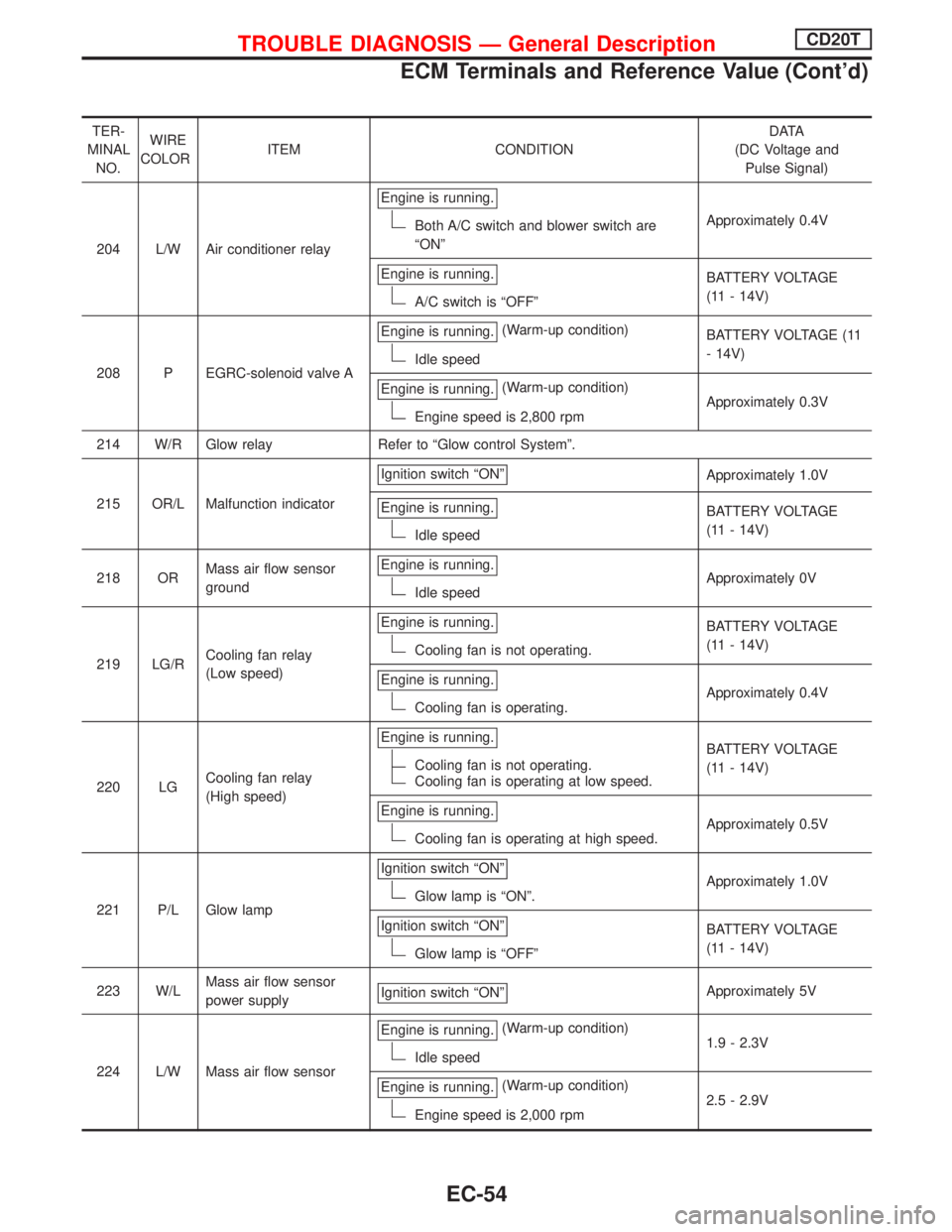
TER-
MINAL
NO.WIRE
COLORITEM CONDITIOND ATA
(DC Voltage and
Pulse Signal)
204 L/W Air conditioner relayEngine is running.
Both A/C switch and blower switch are
ªONºApproximately 0.4V
Engine is running.
A/C switch is ªOFFºBATTERY VOLTAGE
(11 - 14V)
208 P EGRC-solenoid valve AEngine is running.
(Warm-up condition)
Idle speedBATTERY VOLTAGE (11
- 14V)
Engine is running.
(Warm-up condition)
Engine speed is 2,800 rpmApproximately 0.3V
214 W/R Glow relay Refer to ªGlow control Systemº.
215 OR/L Malfunction indicatorIgnition switch ªONº
Approximately 1.0V
Engine is running.
Idle speedBATTERY VOLTAGE
(11 - 14V)
218 ORMass air flow sensor
groundEngine is running.
Idle speedApproximately 0V
219 LG/RCooling fan relay
(Low speed)Engine is running.
Cooling fan is not operating.BATTERY VOLTAGE
(11 - 14V)
Engine is running.
Cooling fan is operating.Approximately 0.4V
220 LGCooling fan relay
(High speed)Engine is running.
Cooling fan is not operating.
Cooling fan is operating at low speed.BATTERY VOLTAGE
(11 - 14V)
Engine is running.
Cooling fan is operating at high speed.Approximately 0.5V
221 P/L Glow lampIgnition switch ªONº
Glow lamp is ªONº.Approximately 1.0V
Ignition switch ªONº
Glow lamp is ªOFFºBATTERY VOLTAGE
(11 - 14V)
223 W/LMass air flow sensor
power supplyIgnition switch ªONº
Approximately 5V
224 L/W Mass air flow sensorEngine is running.
(Warm-up condition)
Idle speed1.9 - 2.3V
Engine is running.
(Warm-up condition)
Engine speed is 2,000 rpm2.5 - 2.9V
TROUBLE DIAGNOSIS Ð General DescriptionCD20T
ECM Terminals and Reference Value (Cont'd)
EC-54
Page 349 of 2267
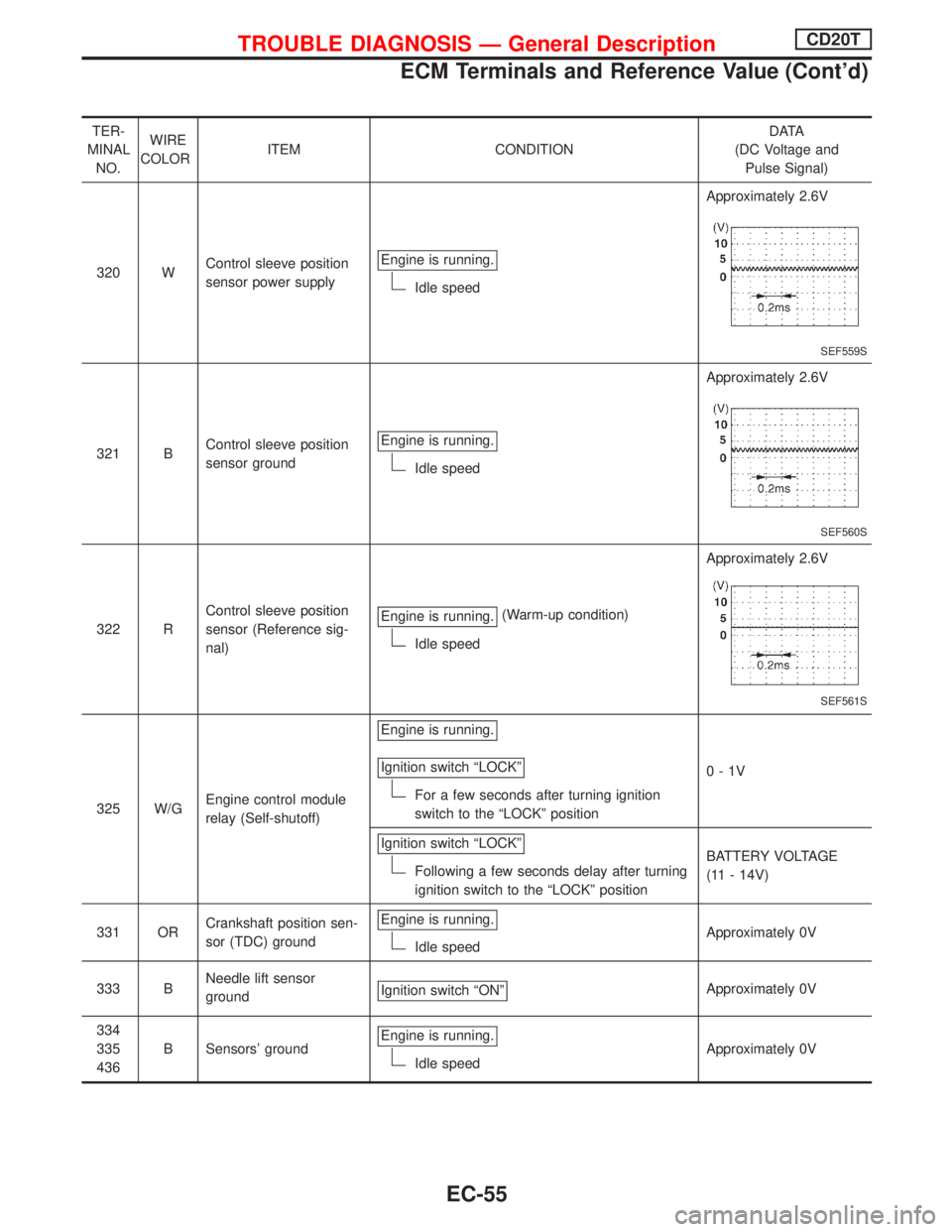
TER-
MINAL
NO.WIRE
COLORITEM CONDITIOND ATA
(DC Voltage and
Pulse Signal)
320 WControl sleeve position
sensor power supplyEngine is running.
Idle speedApproximately 2.6V
SEF559S
321 BControl sleeve position
sensor groundEngine is running.Idle speedApproximately 2.6V
SEF560S
322 RControl sleeve position
sensor (Reference sig-
nal)Engine is running.(Warm-up condition)
Idle speedApproximately 2.6V
SEF561S
325 W/GEngine control module
relay (Self-shutoff)Engine is running.
Ignition switch ªLOCKº
For a few seconds after turning ignition
switch to the ªLOCKº position0-1V
Ignition switch ªLOCKº
Following a few seconds delay after turning
ignition switch to the ªLOCKº positionBATTERY VOLTAGE
(11 - 14V)
331 ORCrankshaft position sen-
sor (TDC) groundEngine is running.
Idle speedApproximately 0V
333 BNeedle lift sensor
groundIgnition switch ªONº
Approximately 0V
334
335
436B Sensors' groundEngine is running.
Idle speedApproximately 0V
TROUBLE DIAGNOSIS Ð General DescriptionCD20T
ECM Terminals and Reference Value (Cont'd)
EC-55
Page 351 of 2267
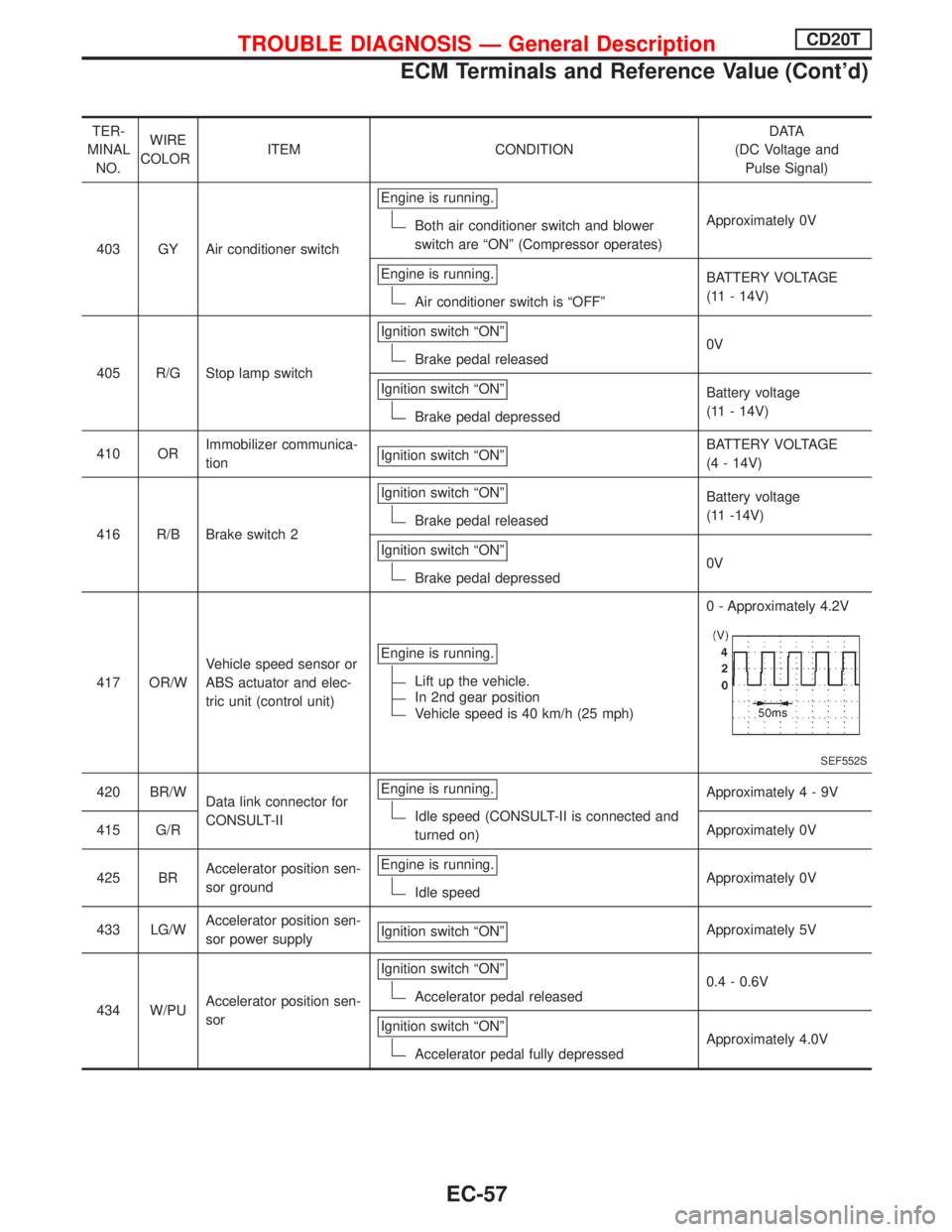
TER-
MINAL
NO.WIRE
COLORITEM CONDITIOND ATA
(DC Voltage and
Pulse Signal)
403 GY Air conditioner switchEngine is running.
Both air conditioner switch and blower
switch are ªONº (Compressor operates)Approximately 0V
Engine is running.
Air conditioner switch is ªOFFºBATTERY VOLTAGE
(11 - 14V)
405 R/G Stop lamp switchIgnition switch ªONº
Brake pedal released0V
Ignition switch ªONº
Brake pedal depressedBattery voltage
(11 - 14V)
410 ORImmobilizer communica-
tionIgnition switch ªONº
BATTERY VOLTAGE
(4 - 14V)
416 R/B Brake switch 2Ignition switch ªONº
Brake pedal releasedBattery voltage
(11 -14V)
Ignition switch ªONº
Brake pedal depressed0V
417 OR/WVehicle speed sensor or
ABS actuator and elec-
tric unit (control unit)Engine is running.
Lift up the vehicle.
In 2nd gear position
Vehicle speed is 40 km/h (25 mph)0 - Approximately 4.2V
SEF552S
420 BR/W
Data link connector for
CONSULT-IIEngine is running.
Idle speed (CONSULT-II is connected and
turned on)Approximately4-9V
415 G/RApproximately 0V
425 BRAccelerator position sen-
sor groundEngine is running.
Idle speedApproximately 0V
433 LG/WAccelerator position sen-
sor power supplyIgnition switch ªONº
Approximately 5V
434 W/PUAccelerator position sen-
sorIgnition switch ªONº
Accelerator pedal released0.4 - 0.6V
Ignition switch ªONº
Accelerator pedal fully depressedApproximately 4.0V
TROUBLE DIAGNOSIS Ð General DescriptionCD20T
ECM Terminals and Reference Value (Cont'd)
EC-57