handbrake NISSAN PULSAR 1987 User Guide
[x] Cancel search | Manufacturer: NISSAN, Model Year: 1987, Model line: PULSAR, Model: NISSAN PULSAR 1987Pages: 238, PDF Size: 28.91 MB
Page 173 of 238
Brakes 173
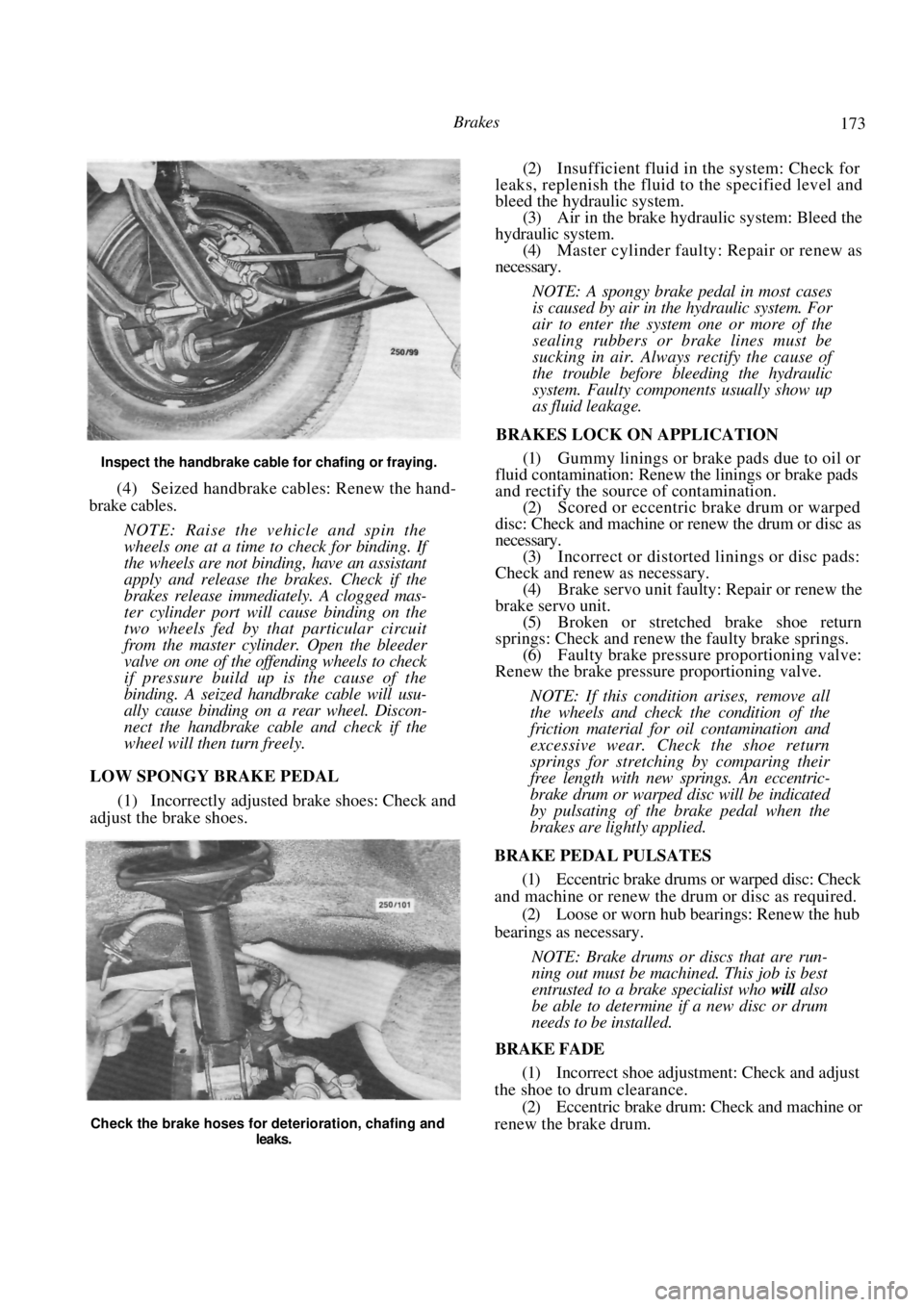
Inspect the handbrake cable for chafing or fraying.
(4) Seized handbrake cables: Renew the hand-
brake cables.
NOTE: Raise the vehicle and spin the
wheels one at a time to check for binding. If
the wheels are not binding, have an assistant
apply and release the brakes. Check if the
brakes release immediately. A clogged mas-
ter cylinder port will cause binding on the
two wheels fed by that particular circuit
from the master cylinder. Open the bleeder
valve on one of the o ffending wheels to check
if pressure build up is the cause of the
binding. A seized handbrake cable will usu-
ally cause binding on a rear wheel. Discon-
nect the handbrake cable and check if the
wheel will then turn freely.
LOW SPONGY BRAKE PEDAL
(1) Incorrectly adjusted brake shoes: Check and
adjust the brake shoes.
(2) Insufficient fluid in the system: Check for
leaks, replenish the fluid to the specified level and
bleed the hydraulic system.
(3) Air in the brake hydraulic system: Bleed the
hydraulic system. (4) Master cylinder faulty: Repair or renew as
necessary.
NOTE: A spongy brake pedal in most cases
is caused by air in the hydraulic system. For
air to enter the system one or more of the
sealing rubbers or brake lines must be
sucking in air. Always rectify the cause of
the trouble before bleeding the hydraulic
system. Faulty components usually show up
as fluid leakage.
BRAKES LOCK ON APPLICATION
(1) Gummy linings or brake pads due to oil or
fluid contamination: Renew the linings or brake pads
and rectify the source of contamination. (2) Scored or eccentric brake drum or warped
disc: Check and machine or renew the drum or disc as
necessary.
(3) Incorrect or distorted linings or disc pads:
Check and renew as necessary. (4) Brake servo unit faulty: Repair or renew the
brake servo unit. (5) Broken or stretched brake shoe return
springs: Check and renew th e faulty brake springs.
(6) Faulty brake pressure proportioning valve:
Renew the brake pressure proportioning valve.
NOTE: If this condition arises, remove all
the wheels and check the condition of the
friction material for oil contamination and
excessive wear. Check the shoe return
springs for stretching by comparing their
free length with new sp rings. An eccentric-
brake drum or warped disc will be indicated
by pulsating of the brake pedal when the
brakes are lightly applied.
BRAKE PEDAL PULSATES
(1) Eccentric brake drums or warped disc: Check
and machine or renew the drum or disc as required.
(2) Loose or worn hub bearings: Renew the hub
bearings as necessary.
NOTE: Brake drums or discs that are run-
ning out must be machined. This job is best
entrusted to a brake specialist who will also
be able to determine if a new disc or drum
needs to be installed.
BRAKE FADE
(1) Incorrect shoe adjustment: Check and adjust
the shoe to drum clearance. (2) Eccentric brake drum: Check and machine or
renew the brake drum.
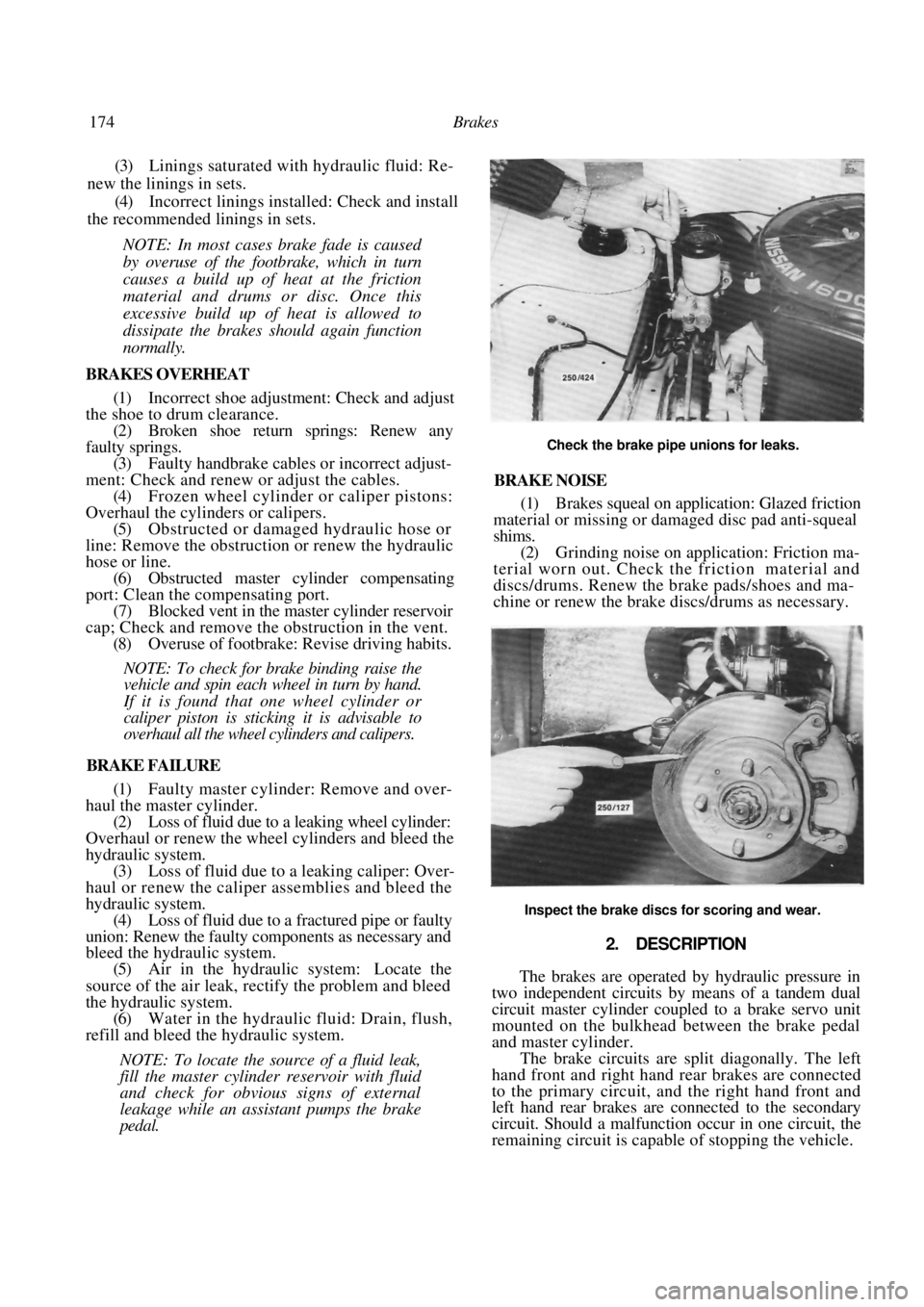
Check the brake hoses for deterioration, chafing and
leaks.
Page 174 of 238
174 Brakes
(3) Linings saturated with hydraulic fluid: Re-
new the linings in sets. (4) Incorrect linings installed: Check and install
the recommended linings in sets.
NOTE: In most cases brake fade is caused
by overuse of the footbrake, which in turn
causes a build up of heat at the friction
material and drums or disc. Once this
excessive build up of heat is allowed to
dissipate the brakes should again function
normally.
BRAKES OVERHEAT
(1) Incorrect shoe adjustment: Check and adjust
the shoe to drum clearance.
(2) Broken shoe return springs: Renew any
faulty springs.
(3) Faulty handbrake cables or incorrect adjust-
ment: Check and renew or adjust the cables. (4) Frozen wheel cylinder or caliper pistons:
Overhaul the cylinders or calipers. (5) Obstructed or damaged hydraulic hose or
line: Remove the obstruction or renew the hydraulic
hose or line.
(6) Obstructed master cylinder compensating
port: Clean the compensating port. (7) Blocked vent in the master cylinder reservoir
cap; Check and remove the obstruction in the vent. (8) Overuse of footbrake: Revise driving habits.
NOTE: To check for brake binding raise the
vehicle and spin each wheel in turn by hand.
If it is found that one wheel cylinder or
caliper piston is sti cking it is advisable to
overhaul all the wheel cylinders and calipers.
BRAKE FAILURE
(1) Faulty master cylinder: Remove and over-
haul the master cylinder. (2) Loss of fluid due to a leaking wheel cylinder:
Overhaul or renew the wheel cylinders and bleed the
hydraulic system.
(3) Loss of fluid due to a leaking caliper: Over-
haul or renew the caliper assemblies and bleed the
hydraulic system. (4) Loss of fluid due to a fractured pipe or faulty
union: Renew the faulty components as necessary and
bleed the hydraulic system. (5) Air in the hydraulic system: Locate the
source of the air leak, rectify the problem and bleed
the hydraulic system. (6) Water in the hydraulic fluid: Drain, flush,
refill and bleed the hydraulic system.
NOTE: To locate the source of a fluid leak,
fill the master cylinder reservoir with fluid
and check for obvious signs of external
leakage while an assistant pumps the brake
pedal.
Check the brake pipe unions for leaks.
BRAKE NOISE
(1) Brakes squeal on application: Glazed friction
material or missing or da maged disc pad anti-squeal
shims. (2) Grinding noise on application: Friction ma-
terial worn out. Check the friction material and
discs/drums. Renew the brake pads/shoes and ma-
chine or renew the brake discs/drums as necessary.
Inspect the brake discs for scoring and wear.
2. DESCRIPTION
The brakes are operated by hydraulic pressure in
two independent circuits by means of a tandem dual
circuit master cylinder coupled to a brake servo unit
mounted on the bulkhead between the brake pedal
and master cylinder.
The brake circuits are sp lit diagonally. The left
hand front and right hand rear brakes are connected
to the primary circuit, and the right hand front and
left hand rear brakes are connected to the secondary
circuit. Should a malfunction occur in one circuit, the
remaining circuit is capable of stopping the vehicle.
Page 175 of 238
Brakes 175
A pressure proportioning valve is incorporated in
each circuit to prevent premature locking of the rear
wheels during severe braking.
The four wheel hydraulically operated brakes
utilize disc brakes on each front wheel and disc brakes
or leading and trailing drum brake shoes on each rear
wheel.
The front disc brakes comprise a disc attached to
the hub assembly and a caliper bolted to the steering
knuckle.
The rear disc brakes comprise a disc and hub
assembly attached to the rear stub axle and a caliper
and anchor plate bolted to the backing plate.
The front and rear calipers are of the sliding type.
As pad wear takes place, the caliper piston is allowed
to slide outwards through the seal to take up a new
position in the caliper bore. Elastic deformation of the
seal takes place when the brakes are applied, which
returns the piston slightly when the brakes are re-
leased. Thus a constant clearance is maintained
between the pads and the disc when the brakes are in
the off position.
The disc brakes do not require periodical adjust-
ment in service to compensate for pad wear as they
are self adjusting.
The leading and trailing shoe drum brakes on the
rear wheels use a double ended wheel cylinder to
operate both brake shoes at the top. The lower end of
each brake shoe abuts a fixed anchor point. The brake
shoes are automatically adju sted when the brakes are
operated.
The handbrake operates the rear brakes via a
cable arrangement.
3. MASTER CYLINDER
Special Equipment Required:
To Install New Seals — Suitable machined drift
TO REMOVE
(1) Depress the brake pedal several times to
deplete the vacuum from the system.
(2) Raise the bonnet and install covers to
both
the front mudguards. Cover the areas of paintwork
beneath the master cylinder with absorbent cloth.
(3) Disconnect the wiring from the pressure
sensing switch. (4) Disconnect the brake pipes from the master
cylinder and plug the outlets and pipes to prevent the
loss of fluid and the ingress of dirt.
(5) Remove the nuts retaining the master cylin-
der to the brake servo unit and remove the master
cylinder from the vehicle.
TO DISMANTLE
(1) Remove the master cylinder as previously
described. (2) Remove the reservoir cap and diaphragm,
drain and discard the brake fluid from the reservoir. (3) Carefully remove the reservoir from the
master cylinder by pulling it from the reservoir
retainers by hand. Remove and discard the retainers
from the master cylinder. (4) Using internal snap ring pliers, remove the
snap ring from the primary reservoir port. (5) Remove the fast fill valve assembly and the
O ring from the port. Remove and discard the valve
washer from the fast fill valve.
(6) Remove the proportioning valve plugs and
the O rings. Discard the O rings. Withdraw the springs
and valve plungers from the master cylinder. Remove
and discard the seals from the valve plungers. (7) Remove the pressure sensing switch and
lever assembly from the master cylinder. {8) Remove the cylinder end plug from the
master cylinder. Remove and discard the O ring from
the plug.
(9) Carefully tap the front of the master cylinder
vertically on a block of wo od and remove the pressure
differential pistons from the master cylinder. Remove
and discard the O rings from the pistons. (10) Push the primary piston forward in the
cylinder with a blunt rod and while holding the
pressure, remove the stop pin from the master cylin-
der.
(11) The primary piston may now be withdrawn
from the cylinder bore. The secondary piston, retainer
and spring can also be withdrawn by carefully tapping
the master cylinder on a block of wood. (12) Prise the legs of the seal retainer upwards
and remove it from the primary piston. Remove the
seal and guide. Discard the seal and retainer.
NOTE: The secondary piston must no! be
dismantled by removing the screw. This
assembly has a factory p reset length and the
screw must not be altered in service.
(13) Remove the main seal and the guide from
the front of the secondary piston. Stretch the rear seal
from the groove and remove it from the piston. Take
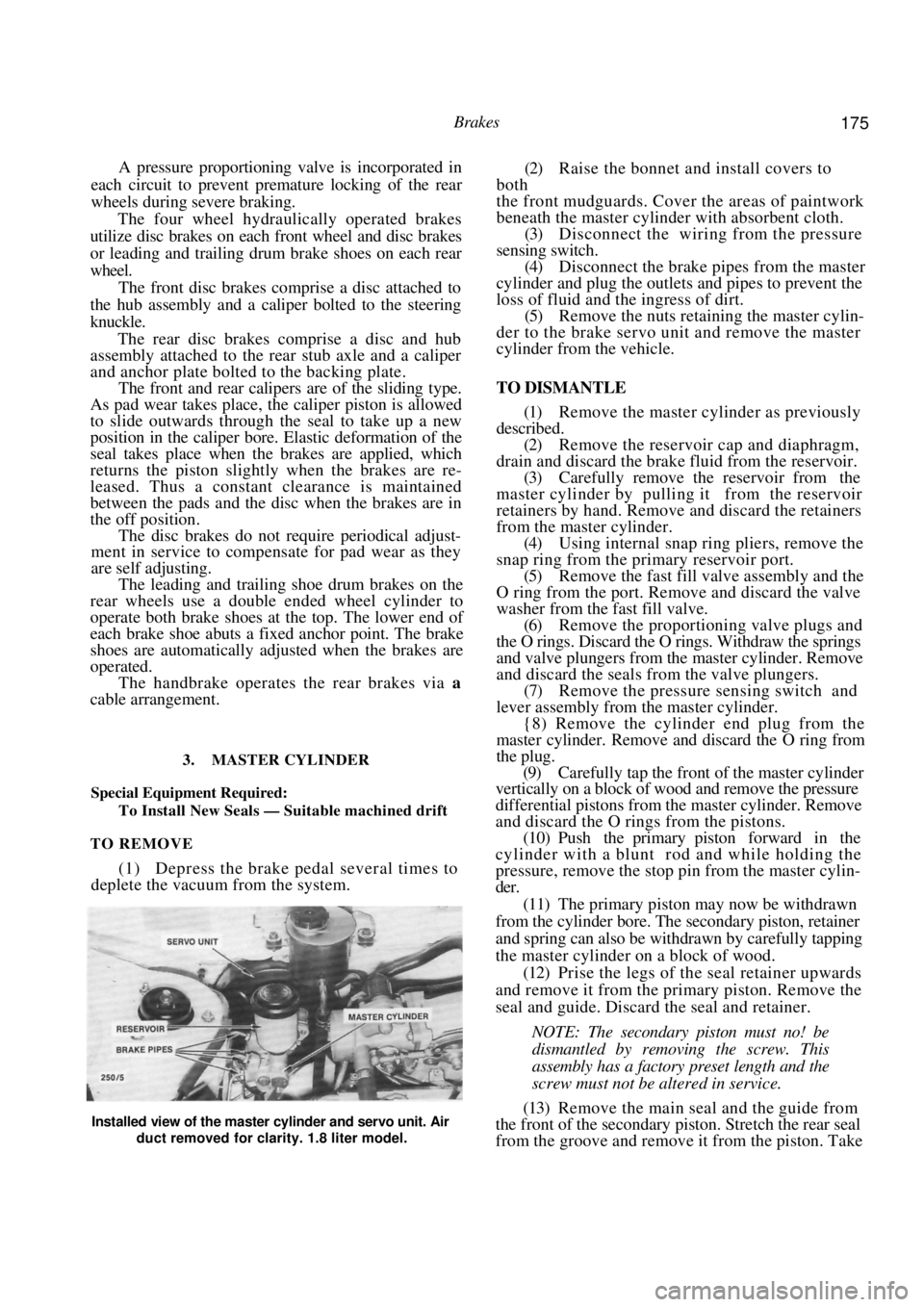
Installed view of the master cylinder and servo unit. Air
duct removed for clarity. 1.8 liter model.
Page 182 of 238
182 Brakes
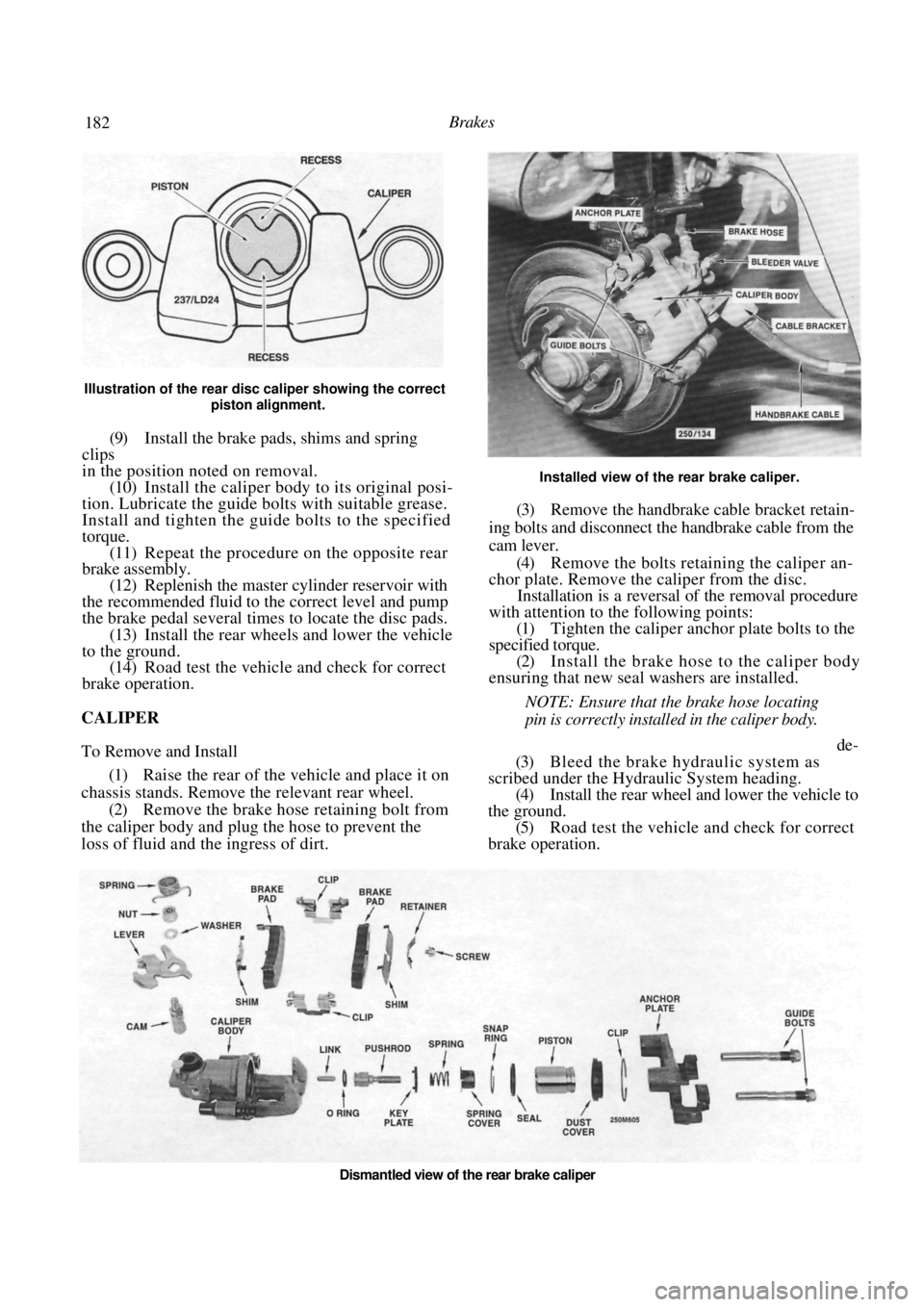
Illustration of the rear disc caliper showing the correct
piston alignment.
(9) Install the brake pads, shims and spring
clips
in the position noted on removal. (10) Install the caliper body to its original posi-
tion. Lubricate the guide bolts with suitable grease.
Install and tighten the guide bolts to the specified
torque. (11) Repeat the procedure on the opposite rear
brake assembly.
(12) Replenish the master cylinder reservoir with
the recommended fluid to the correct level and pump
the brake pedal several times to locate the disc pads. (13) Install the rear wheels and lower the vehicle
to the ground. (14) Road test the vehicle and check for correct
brake operation.
CALIPER
To Remove and Install
(1) Raise the rear of the vehicle and place it on
chassis stands. Remove the relevant rear wheel. (2) Remove the brake hose retaining bolt from
the caliper body and plug the hose to prevent the
loss of fluid and the ingress of dirt.
Installed view of the rear brake caliper.
(3) Remove the handbrake cable bracket retain-
ing bolts and disconnect the handbrake cable from the
cam lever. (4) Remove the bolts retaining the caliper an-
chor plate. Remove the caliper from the disc. Installation is a reversal of the removal procedure
with attention to the following points:
(1) Tighten the caliper anch or plate bolts to the
specified torque. (2) Install the brake hose to the caliper body
ensuring that new seal washers are installed.
NOTE: Ensure that the brake hose locating
pin is correctly installed in the caliper body.
de-
(3) Bleed the brake hydraulic system as
scribed under the Hydraulic System heading. (4) Install the rear wheel and lower the vehicle to
the ground. (5) Road test the vehicle and check for correct
brake operation.
Dismantled view of the rear brake caliper
Page 183 of 238
Brakes 183
To Dismantle
(1) Raise the rear of the vehicle and place it on
chassis stands. Remove the relevant rear wheel.
(2) Remove the brake hose retaining bolt from
the caliper body and plug the hose to prevent the loss
of fluid and the ingress of dirt. (3) Remove the handbrake cable bracket retain-
ing bolt and disconnect the handbrake cable from the
cam lever.
(4) Remove the guide bolts and slide the caliper
body off the pads. (5) Using a pair of long nose pliers with the nose
located in the recesses of the piston, rotate the piston
anticlockwise to remove it from the caliper body.
(6) Remove the dust cover retaining clip and dust
cover. Discard the dust cover. (7) Using a thin blunt probe, preferably made
from wood or plastic, remove and discard the piston
seal from the groove in the caliper bore. (8) Using internal snap ring pliers, remove the
snap ring from the caliper bore. (9) Withdraw the spring cover, spring, key plate,
pushrod and link from the caliper bore. Do not mix
these components from the left and right hand sides as
they differ. (10) Remove and discard the O ring from the
pushrod. (11) Remove the spring, nut and washer from the
cam lever. Remove the cam lever and cam from the
caliper body. (12) Remove the cam seal from the caliper using a
screwdriver.
(13) Clean all the caliper components in methy-
lated spirits and arrange the components in order on a
clean dry surface to aid assembly.
To Inspect
(1) Inspect the caliper bore and piston for pit-
ting, wear or damage. Renew the caliper assembly or
piston if damage is evident.
NOTE: Slight rust spots in the caliper bore
may be removed with fine emery paper. The
piston must not be polished as the plated
surface will be damaged.
(2) Inspect the guide bolts for wear or damage
and renew as necessary.
(3) Inspect the threads of the pushrod for wear or
damage and renew as necessary. (4) Inspect the nut inside the piston for wear,
damage and security. Renew the piston if any damage
is evident. (5) Inspect the cam for wear, damage or pitting,
renew as necessary. (6) Inspect the cam bearing in the caliper body
for wear, damage or pitting and renew the seal and
bearing as necessary. (7) Inspect the guide bolt rubbers for deteriora-
tion, wear or damage. Renew as required. To Assemble
(1)
Lubricate the cam bearing with multipurpose
grease and install the seal. (2) Install the cam and cam lever to the
caliper
body. Install the cam lever spring, washer and nut, and
tighten the nut to the specified torque. (3) Install a new O ring to the pushrod and
install
the link, pushrod, key plate, spring and spring cover to
the caliper body. The key plate must engage the caliper
body. Secure the assembly with the snap ring. (4) Dip a new piston seal in clean hydraulic brake
fluid. Insert the seal into the groove in the caliper bore
ensuring that the seal is correctly seated and not
twisted. (5) Install a new dust cover to the piston prior
to
installing the piston to the caliper bore.
(6) Coat the piston and caliper bore with clean
hydraulic brake fluid and using long nose pliers rotate
the piston clockwise into the caliper bore. (7) Locate the dust seal in the groove of the
caliper body and install the retaining clip.
(8) Lubricate the guide bolts using a suitable
grease. Install the caliper body and tighten the guide
bolts to the specified torque. (9) Replenish the master cylinder reservoir with
the recommended fluid and bleed the brakes as
described under the Hydraulic System heading. (10) Install the rear wheel and lower the vehicle to
the ground. (11) Road test the vehicle and check for correct
brake operation.
BRAKE DISC
To Check Runout
(1) Raise the rear of the vehicle and support it on
chassis stands. Remove the relevant rear wheel.
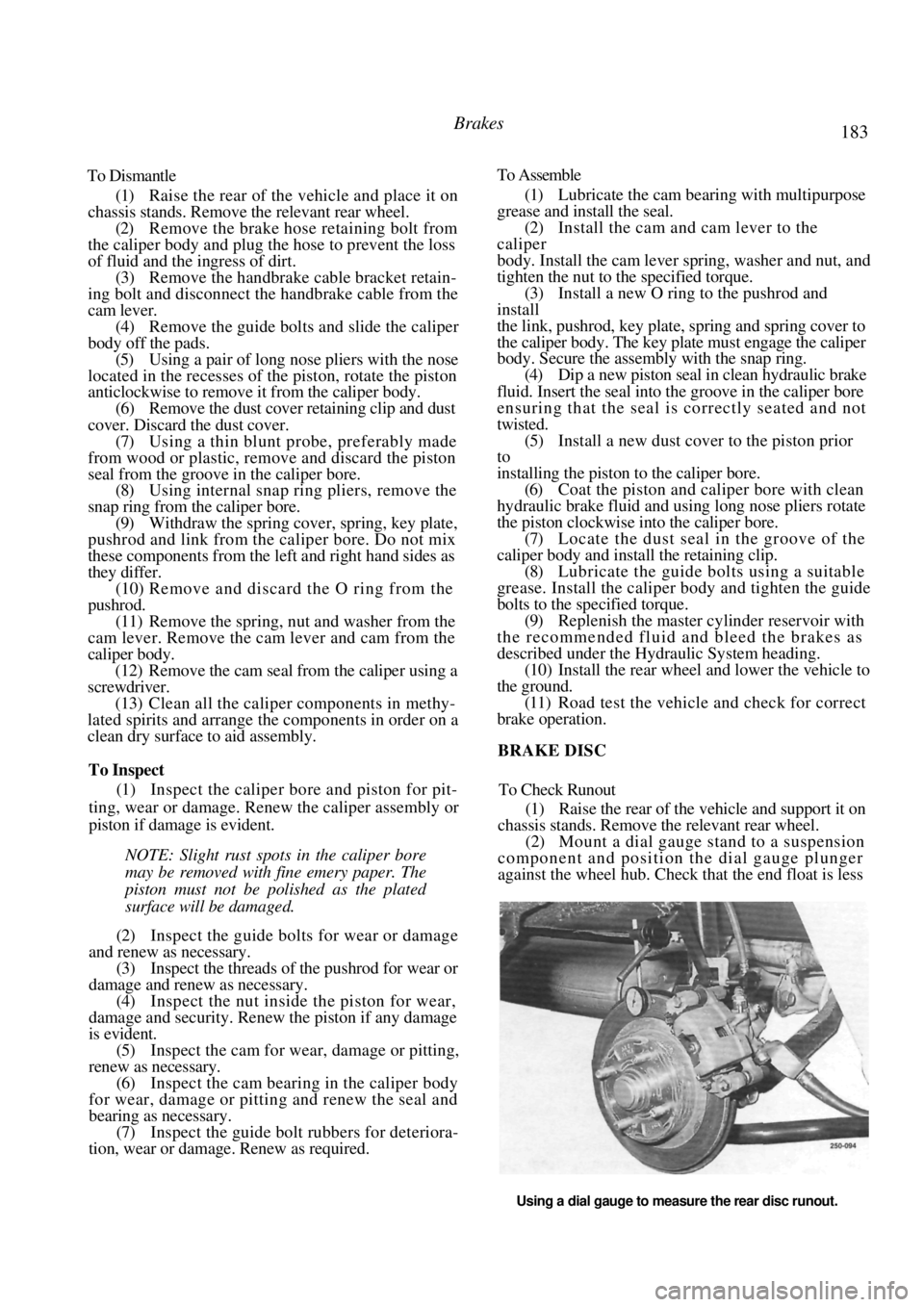
(2) Mount a dial gauge stand to a suspension
component and position the dial gauge plunger
against the wheel hub. Check that the end float is less
Using a dial gauge to measure the rear disc runout.
Page 184 of 238
184 Brakes
than 0.05 mm. If the wheel hub end float exceeds
Specifications, the bearing must be renewed as de-
scribed in the Rear Suspension section.
(3) Position the dial gauge plunger against the
centre of the brake disc contact area. Rotate the hub
and measure the runout. Ma ximum allowable runout
is 0.07 mm. (4) If the runout exceeds the specified amount,
machine or renew the brake disc. (5) Install the rear wheel and lower the vehicle to
the ground. (6) Road test the vehicle and check for correct
brake operation.
To Remove and Install
(1) Raise the rear of the vehicle and support it
on chassis stands. Remove the relevant rear wheel.
(2) Remove the clip securing the brake hose to
the suspension unit and disengage the hose. (3) Remove the bolts retaining the caliper an-
chor plate. (4) Slide the caliper from the brake disc and
suspend the caliper clear of the work area using wire
or cord.
NOTE: Do not allow the caliper to hang on
the brake hose.
(5) Remove the grease cap from the rear hub.
(6) Remove the split pin, nut retainer, hub nut
and washer from the stub axle. (7) Remove the hub assembly from the stud
axle. Installation is a reversal of the removal procedure
with attention to the following points:
(1) Tighten the rear hub to the specified torque.
(2) Install the brake caliper and tighten all the
bolts to the specified torque. (3) Rotate the hub and check for roughness. If
the hub does not rotate smoothly, renew the hub
bearing as described in the Rear Suspension section. (4) Install the rear wheel and lower the vehicle to
the ground.
(5) Road test the vehicle and check for correct
brake operation.
To Inspect
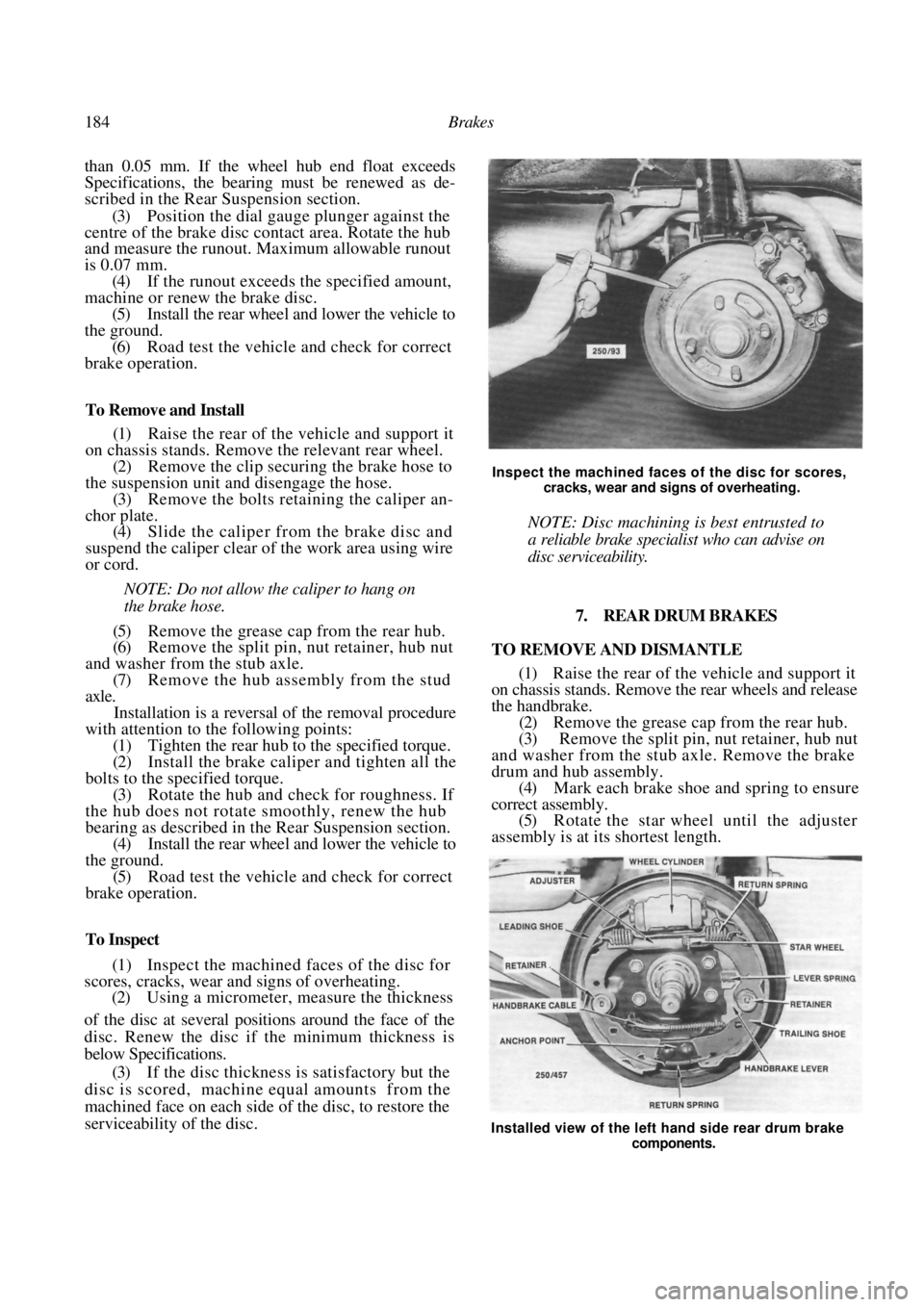
(1) Inspect the machined faces of the disc for
scores, cracks, wear and signs of overheating. (2) Using a micrometer, measure the thickness
of the disc at several posit ions around the face of the
disc. Renew the disc if the minimum thickness is
below Specifications.
(3) If the disc thickness is satisfactory but the
disc is scored, machine equal amounts from the
machined face on each side of the disc, to restore the
serviceability of the disc.
Inspect the machined faces of the disc for scores,
cracks, wear and signs of overheating.
NOTE: Disc machining is best entrusted to
a reliable brake specialist who can advise on
disc serviceability.
7. REAR DRUM BRAKES
TO REMOVE AND DISMANTLE
(1) Raise the rear of the vehicle and support it
on chassis stands. Remove th e rear wheels and release
the handbrake.
(2) Remove the grease cap from the rear hub.
(3) Remove the split pin, nut retainer, hub nut
and washer from the stub axle. Remove the brake
drum and hub assembly.
(4) Mark each brake shoe and spring to ensure
correct assembly. (5) Rotate the star wheel until the adjuster
assembly is at its shortest length.
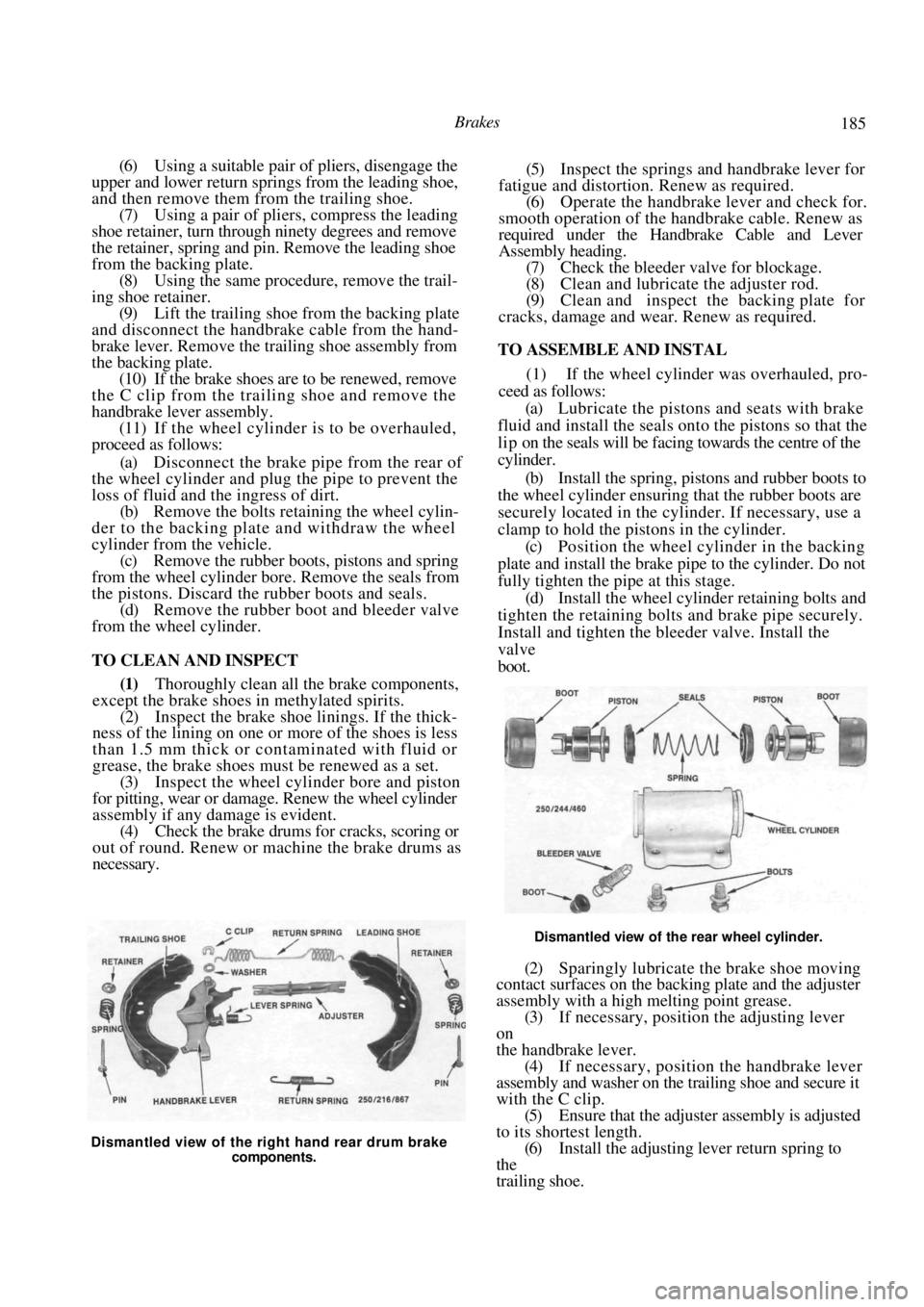
Installed view of the left hand side rear drum brake
components.
Page 185 of 238
Brakes 185
(6) Using a suitable pair of pliers, disengage the
upper and lower return springs from the leading shoe,
and then remove them from the trailing shoe. (7) Using a pair of pliers, compress the leading
shoe retainer, turn through ninety degrees and remove
the retainer, spring and pin. Remove the leading shoe
from the backing plate. (8) Using the same procedure, remove the trail-
ing shoe retainer. (9) Lift the trailing shoe from the backing plate
and disconnect the handbrake cable from the hand-
brake lever. Remove the trailing shoe assembly from
the backing plate.
(10) If the brake shoes are to be renewed, remove
the C clip from the trailing shoe and remove the
handbrake lever assembly. (11) If the wheel cylinder is to be overhauled,
proceed as follows:
(a) Disconnect the brake pipe from the rear of
the wheel cylinder and plug the pipe to prevent the
loss of fluid and the ingress of dirt. (b) Remove the bolts retaining the wheel cylin-
der to the backing plate and withdraw the wheel
cylinder from the vehicle. (c) Remove the rubber boots, pistons and spring
from the wheel cylinder bore. Remove the seals from
the pistons. Discard th e rubber boots and seals.
(d) Remove the rubber boot and bleeder valve
from the wheel cylinder.
TO CLEAN AND INSPECT
(1) Thoroughly clean all the brake components,
except the brake shoes in methylated spirits.
(2) Inspect the brake shoe linings. If the thick-
ness of the lining on one or more of the shoes is less
than 1.5 mm thick or contaminated with fluid or
grease, the brake shoes must be renewed as a set. (3) Inspect the wheel cylinder bore and piston
for pitting, wear or damage. Renew the wheel cylinder
assembly if any damage is evident. (4) Check the brake drums for cracks, scoring or
out of round. Renew or machine the brake drums as
necessary.
(5) Inspect the springs and handbrake lever for
fatigue and distortion. Renew as required. (6) Operate the handbrake lever and check for.
smooth operation of the handbrake cable. Renew as
required under the Hand brake Cable and Lever
Assembly heading. (7) Check the bleeder valve for blockage.
(8) Clean and lubricate the adjuster rod.
(9) Clean and inspect the backing plate for
cracks, damage and wear. Renew as required.
TO ASSEMBLE AND INSTAL
(1) If the wheel cylinder was overhauled, pro-
ceed as follows:
(a) Lubricate the pistons and seats with brake
fluid and install the seals on to the pistons so that the
l i p on the seals will be facing towards the centre of the
cylinder.
(b) Install the spring, pistons and rubber boots to
the wheel cylinder ensuring that the rubber boots are
securely located in the cy linder. If necessary, use a
clamp to hold the pistons in the cylinder.
(c) Position the wheel cylinder in the backing
plate and install the brake pi pe to the cylinder. Do not
fully tighten the pipe at this stage. (d) Install the wheel cylinder retaining bolts and
tighten the retaining bolts and brake pipe securely.
Install and tighten the bleeder valve. Install the
valve
boot.
Dismantled view of the right hand rear drum brake
components. Dismantled view of the rear wheel cylinder.
(2) Sparingly lubricate the brake shoe moving
contact surfaces on the backing plate and the adjuster
assembly with a high melting point grease.
(3) If necessary, position the adjusting lever
on
the handbrake lever. (4) If necessary, position the handbrake lever
assembly and washer on the trailing shoe and secure it
with the C clip.
(5) Ensure that the adjuster assembly is adjusted
to its shortest length. (6) Install the adjusting lever return spring to
the
trailing shoe.
Page 186 of 238

186 Brakes
(7) Using a pair of pliers, compress the hand-
brake cable spring and install the cable to the hand-
brake lever.
(8) Position the trailing shoe on the backing
plate with the upper end located on the wheel cylinder
piston and the lower end on the anchor plate. (9) Install the adjuster assembly to the
trailing
shoe ensuring that the adjuster fork is correctly
located on the upper end of the shoe. (10) Install the pin, spring and retainer to the
trailing shoe, turn the reta iner through 90 degrees and
secure the brake shoe to the backing plate. (11) Connect the upper and lower return springs
to the trailing shoe as noted on removal. (12) Position the leading shoe on the backing
plate with the upper end located on the wheel cylinder
piston and the lower end on the anchor plate. Ensure
that the adjuster assembly is correctly located on the
upper end of the shoe. (13) Install the pin, spring and retainer to the
leading shoe, turn the retainer through 90 degrees and
secure the shoe to the backing plate. (14) Connect the upper and lower return springs
to the leading shoe.
(15) By alternatively adjust ing the automatic ad-
juster manually and sliding the brake drum on and off
the brake shoe assembly, adjust the brakes until the
brake drum will just slide over the brake shoes. Ensure
that the adjuster lever contacts the adjuster star wheel.
Install the brake drum and operate the handbrake
several times to adjust the brake shoes. (16) Install the rear wheels and rotate each wheel
to ensure that the brake shoe linings are not dragging.
(17) Bleed the hydraulic system as described
under the Hydraulic System heading. (18) Adjust the handbrake as described under the
Brake Adjustments heading.
8. HANDBRAKE CABLE AND LEVER
ASSEMBLY
HANDBRAKE LEVER AND FRONT CABLE
ASSEMBLY
To Remove and Install
(1) Raise the vehicle and support it on chassis
stands. Release the handbrake.
(2) Working beneath the vehicle, remove the
exhaust pipe centre heat shield retaining bolts and
maneuver the shield from the vehicle. (3) Remove the rear handbrake cable front
clamp retaining nuts and disconnect the rear hand-
brake cable from the equalizer. (4) Working within the vehicle, remove the
carpet square from the rear of the console. Remove
the retaining screw from the front and rear of the rear
console section and maneuver the rear console from
the vehicle.
Dismantled view of the handbrake lever components.
(5) Disconnect the handbrake warning lamp
switch wiring. (6) Remove the handbrake lever assembly re-
taining bolts and remove the handbrake lever and
front cable assembly. (7) If necessary slide the boot and cover towards
the equalizer, straighten the tang on the lower edge of
the lever and remove the adjuster nut and washer.
(8) Withdraw the front cable from the lever and
remove the boot and cover. Inspect the cable for
chafing or broken strands. Renew the cable if damage
is evident. (9) Check the handbrake lever ratchet and pawl
for wear and renew as necessary. Installation is a reversal of the removal procedure
with attention to the following points:
(1) Apply lubricant to all the working parts prior
to installation. (2) Ensure that the handbrake cable clamp is
correctly installed. (3) Adjust the handbrake cable as described
under the Brake Adjustments heading.
REAR HANDBRAKE CABLES
TO Remove and Install
(1) Raise the rear of the vehicle and support it
on chassis stands. Remove th e rear wheels and release
the handbrake.
(2) Working beneath the vehicle, remove the
exhaust pipe centre and rear heat shield retaining
bolts and maneuver the heat shields from the
vehicle.
(3) Remove the bolts and nuts retaining the
handbrake cable clamps to the underbody and discon-
nect the rear handbrake cable from the equalizer.
(4) On disc brake models, remove the handbrake
cable to bracket retaining clip on the rear of the
caliper and disconnect the handbrake cable from the
cam lever. Remove the cable from the vehicle.
(5) On drum brake models , proceed as follows:
(a) Remove and dismantle the rear brakes as
previously described.
Page 187 of 238
Brakes 187
(b) Disengage the handbrake cable return spring
from the backing plate.
plate and remove the cable from the vehicle.
(6) Inspect the rear handbrake cables for chafing
or broken strands. Renew the cables if damage is
evident.
Installation is a reversal of the removal procedure
with attention to the following points:
(1) Ensure that the handbrake cable clamps are
correctly installed. (2) On drum brake models, install the
handbrake
cable to the backing plate by carefully tapping the
flange on the handbrake cable. Ensure that the cable is
not damaged. (3) Adjust the handbrake cable as described
under the Brake Adjustments heading.
9. BRAKE ADJUSTMENTS
FRONT AND REAR DISC BRAKES
The disc brakes are self adjusting and no manual
adjustment is required or provided.
REAR DRUM BRAKES
Depress the handbrake lever button, apply and
release the handbrake lever several times to adjust the
rear brake shoes.
HANDBRAKE
(1) Raise the rear of the vehicle and support it
on chassis stands. (2) Remove the carpet square from the rear of
the console. Remove the retaining screws from the
front and rear of the rear console section and manoeu-
vre the rear console from the vehicle. (3) Tighten the adjusting nut until the hand-
brake lever pull is between 7-11 notches. (4) Check that the rear wheels are not binding. If
the rear wheels do not rotate freely refer to the Brakes
Trouble Shooting for possible causes.
(5) With the ignition switched On, check that
the handbrake warning lamp is extinguished when the
lever is fully released. (6) Lower the vehicle to the ground and test the
handbrake on an incline.
10. BRAKE PEDAL
TO REMOVE AND INSTAL
(1) Working inside the vehicle remove the re-
taining clip from the clevis pin and remove the clevis
pin connecting the brake pedal to the pushrod.
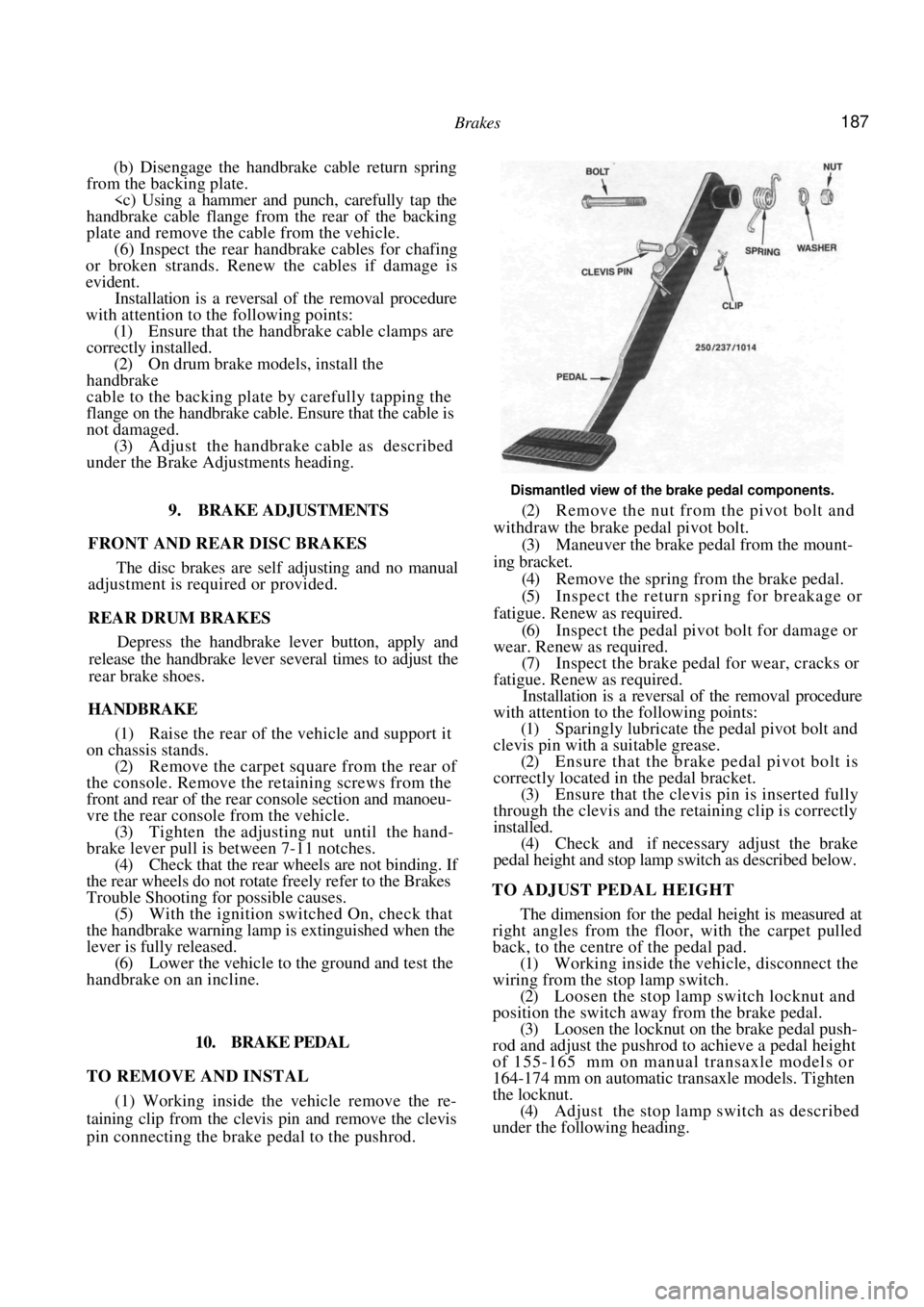
Dismantled view of the brake pedal components.
(2) Remove the nut from the pivot bolt and
withdraw the brake pedal pivot bolt.
(3) Maneuver the brake pedal from the mount-
ing bracket. (4) Remove the spring from the brake pedal.
(5) Inspect the return spring for breakage or
fatigue. Renew as required.
(6) Inspect the pedal pivot bolt for damage or
wear. Renew as required. (7) Inspect the brake pedal for wear, cracks or
fatigue. Renew as required. Installation is a reversal of the removal procedure
with attention to the following points:
(1) Sparingly lubricate the pedal pivot bolt and
clevis pin with a suitable grease. (2) Ensure that the brake pedal pivot bolt is
correctly located in the pedal bracket. (3) Ensure that the clevis pin is inserted fully
through the clevis and the retaining clip is correctly
installed. (4) Check and if necessary adjust the brake
pedal height and stop lamp switch as described below.
TO ADJUST PEDAL HEIGHT
The dimension for the pedal height is measured at
right angles from the floor, with the carpet pulled
back, to the centre of the pedal pad.
(1) Working inside the ve hicle, disconnect the
wiring from the stop lamp switch.
(2) Loosen the stop lamp switch locknut and
position the switch away from the brake pedal. (3) Loosen the locknut on the brake pedal push-
rod and adjust the pushrod to achieve a pedal height
of 155-165 mm on manual transaxle models or
164-174 mm on automatic transaxle models. Tighten
the locknut. (4) Adjust the stop lamp switch as described
under the following heading.
Page 208 of 238
208 Electrical System
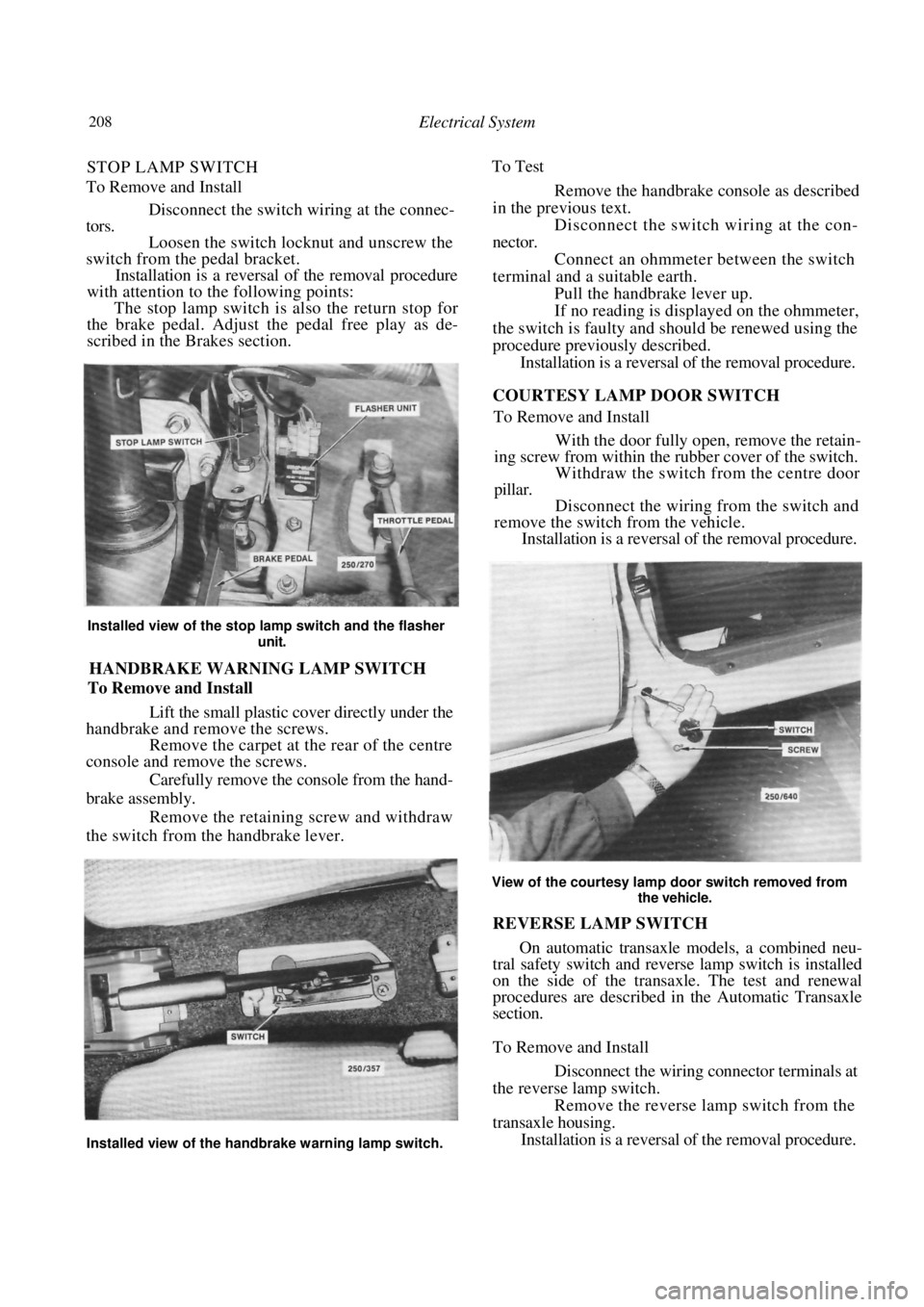
STOP LAMP SWITCH
To Remove and Install
Disconnect the switch wi ring at the connec-
tors.
Loosen the switch locknut and unscrew the
switch from the pedal bracket.
Installation is a reversal of the removal procedure
with attention to the following points:
The stop lamp switch is also the return stop for
the brake pedal. Adjust the pedal free play as de-
scribed in the Brakes section.
Installed view of the stop lamp switch and the flasher
unit.
HANDBRAKE WARNING LAMP SWITCH
To Remove and Install
Lift the small plastic cover directly under the
handbrake and remove the screws.
Remove the carpet at the rear of the centre
console and remove the screws.
Carefully remove the console from the hand-
brake assembly. Remove the retaining screw and withdraw
the switch from the handbrake lever. To Test
Remove the handbrake console as described
in the previous text.
Disconnect the switch wiring at the con-
nector. Connect an ohmmeter between the switch
terminal and a suitable earth. Pull the handbrake lever up.
If no reading is displayed on the ohmmeter,
the switch is faulty and should be renewed using the
procedure previously described. Installation is a reversal of the removal procedure.
COURTESY LAMP DOOR SWITCH
To Remove and Install
With the door fully open, remove the retain-
ing screw from within the rubber cover of the switch. Withdraw the switch from the centre door
pillar.
Disconnect the wiring from the switch and
remove the switch from the vehicle. Installation is a reversal of the removal procedure.
View of the courtesy lamp door switch removed from
the vehicle.
REVERSE LAMP SWITCH
On automatic transaxle models, a combined neu-
tral safety switch and reverse lamp switch is installed
on the side of the transaxle. The test and renewal
procedures are described in the Automatic Transaxle
section.
To Remove and Install
Disconnect the wiring connector terminals at
the reverse lamp switch. Remove the reverse lamp switch from the
transaxle housing. Installation is a reversal of the removal procedure.
Installed view of the handbrake warning lamp switch.