maintenance NISSAN PULSAR 1987 User Guide
[x] Cancel search | Manufacturer: NISSAN, Model Year: 1987, Model line: PULSAR, Model: NISSAN PULSAR 1987Pages: 238, PDF Size: 28.91 MB
Page 20 of 238

20 Lubrication and Maintenance
This Section Removed
Page 23 of 238
Wheels and Tires 23
(3) Excessive play in the front suspension ball
joints: Check and renew the ball joints.
(4) Excessive play in the hub bearing assembly:
Check and renew the hub bearing assembly.
WORN SPOTS ON CENTRE OF TREAD
(1) Static unbalance of the wheel and tire asem-
bly: Check the balance of the wheel and tire assembly
(2) Radial run out (eccentricity) of the wheel:
Check and renew the wheel.
FEATHERED EDGES ON TREAD PATTERN
(1) Excessive speed when cornering: Revise driv-
ing habits. (2) Excessive toe-in or toe-out: Check and adjust
the wheel alignment.
(3) Bent, loose or worn suspension components:
Check and renew any faulty components.
NOTE: To preserve tire life it is good policy
to periodically have the front wheel balanced
and the steering geometry checked on a
reliable wheel alignment machine.
Under no circumstances mix radial ply
and conventional ply tire s. Install only tires
of the same construction to all four wheels.
3. CARE AND MAINTENANCE
STEEL WHEELS
Steel wheels should be regularly cleaned of all
foreign matter, such as dirt and mud. If foreign matter
is allowed to build up it will affect the balance of the
wheel and may cause vibrations and uneven tire wear.
If the paint has been chipped or scratched it should be
touched up as soon as possible to prevent rust.
Any minor damage to the wheel rim can usually
be repaired using a suitable hammer after the wheel
has been removed from the vehicle. However, any
major rim damage or buckling of the wheel will
necessitate the renewal of the wheel. It is good policy
to occasionally remove the wheels from the vehicle
and inspect them for damage, cracks or corrosion.
ALLOY WHEELS
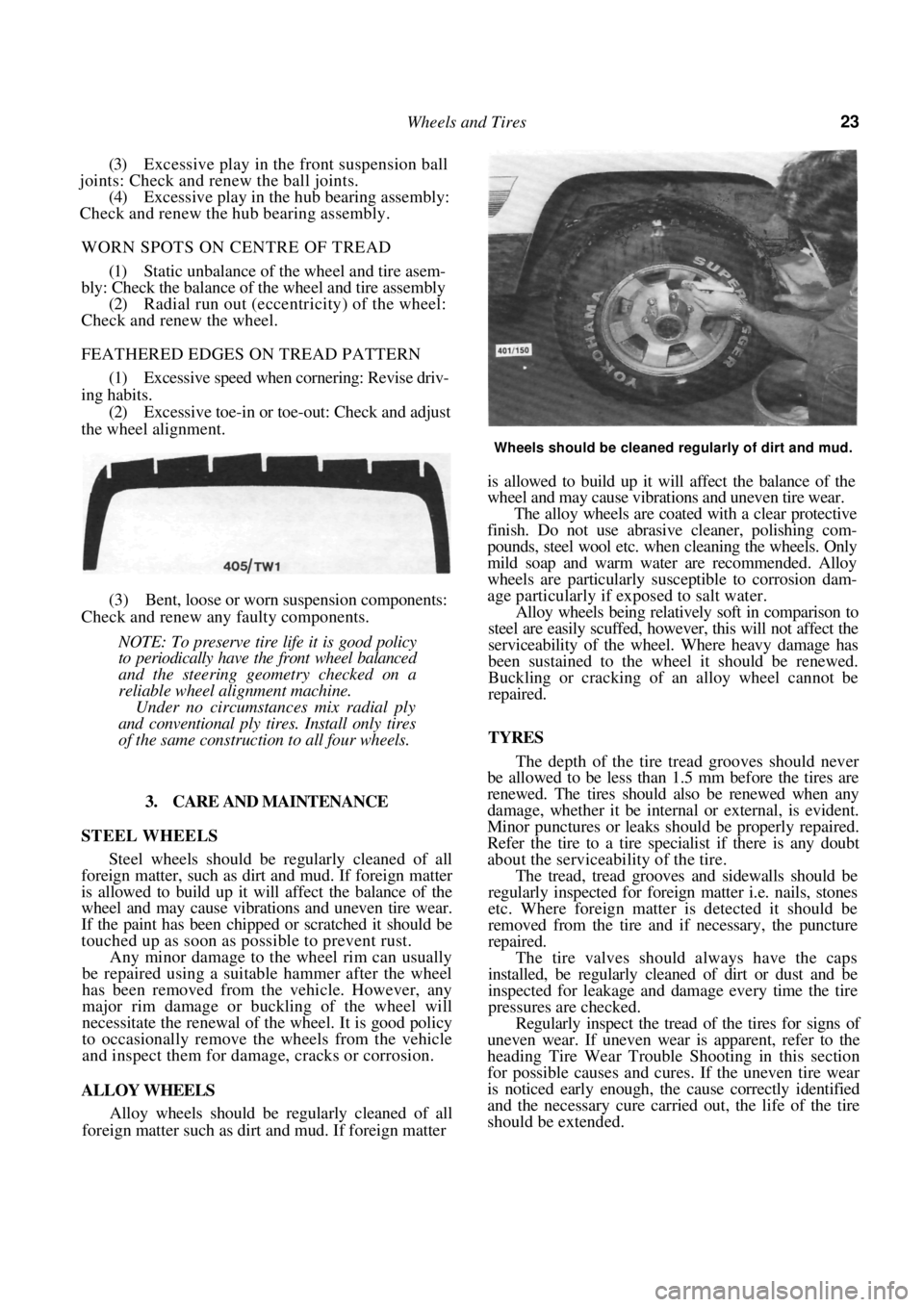
Alloy wheels should be regularly cleaned of all
foreign matter such as dirt and mud. If foreign matter
Wheels should be cleaned regularly of dirt and mud.
is allowed to build up it will affect the balance of the
wheel and may cause vibrations and uneven tire wear.
The alloy wheels are coated with a clear protective
finish. Do not use abrasive cleaner, polishing com-
pounds, steel wool etc. when cleaning the wheels. Only
mild soap and warm wate r are recommended. Alloy
wheels are particularly su sceptible to corrosion dam-
age particularly if exposed to salt water.
Alloy wheels being relatively soft in comparison to
steel are easily scuffed, however, this will not affect the
serviceability of the wheel. Where heavy damage has
been sustained to the wheel it should be renewed.
Buckling or cracking of an alloy wheel cannot be
repaired.
TYRES
The depth of the tire tread grooves should never
be allowed to be less than 1.5 mm before the tires are
renewed. The tires should also be renewed when any
damage, whether it be internal or external, is evident.
Minor punctures or leaks s hould be properly repaired.
Refer the tire to a tire spec ialist if there is any doubt
about the serviceability of the tire.
The tread, tread grooves and sidewalls should be
regularly inspected for foreign matter i.e. nails, stones
etc. Where foreign matter is detected it should be
removed from the tire and if necessary, the puncture
repaired.
The tire valves should always have the caps
installed, be regularly cleaned of dirt or dust and be
inspected for leakage and damage every time the tire
pressures are checked.
Regularly inspect the tread of the tires for signs of
uneven wear. If uneven wear is apparent, refer to the
heading Tire Wear Trouble Shooting in this section
for possible causes and cures. If the uneven tire wear
is noticed early enough, the cause correctly identified
and the necessary cure carried out, the life of the tire
should be extended.
Page 29 of 238
Engine Tune-up 29
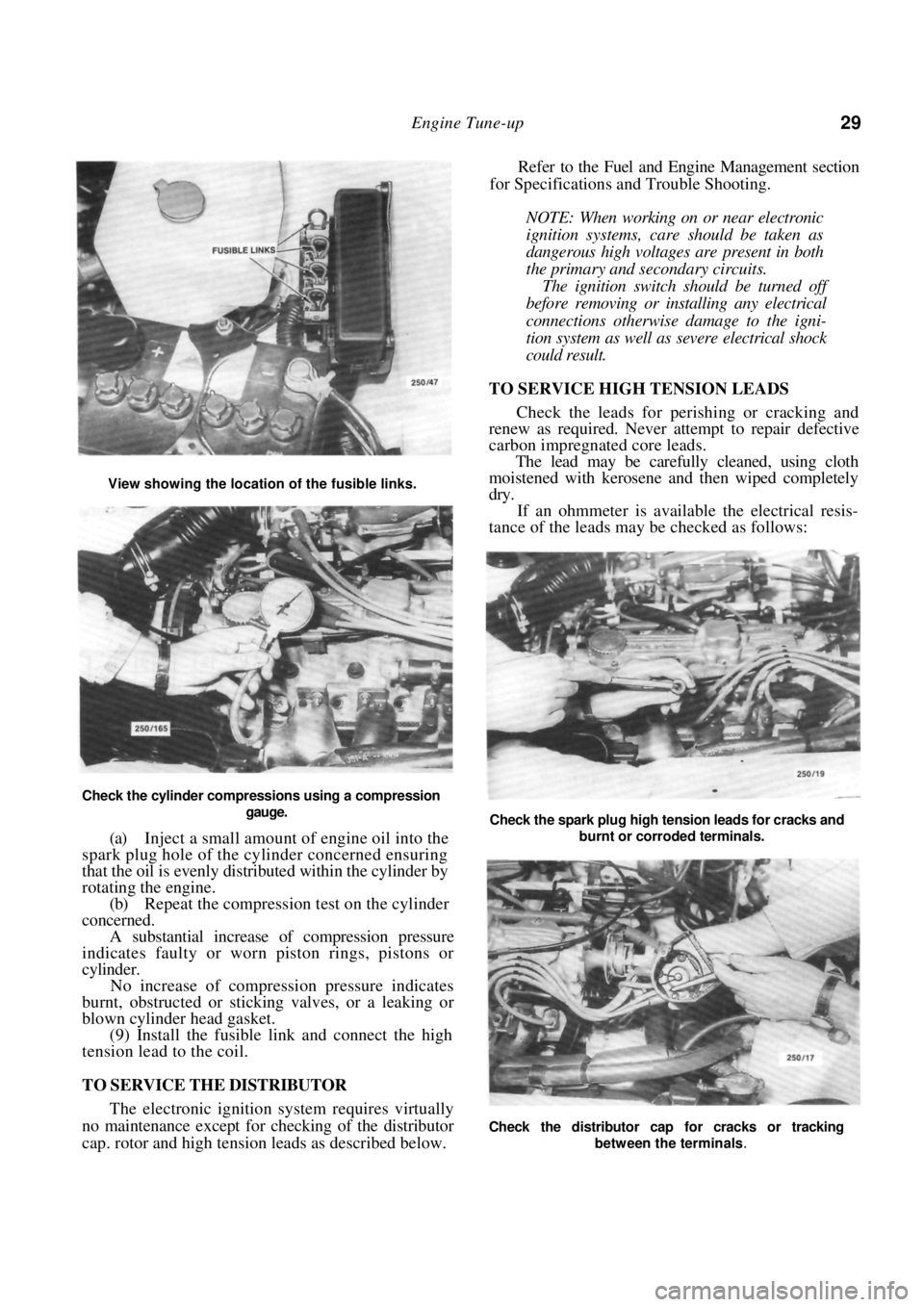
Check the cylinder compressions using a compression gauge.
(a) Inject a small amount of engine oil into the
spark plug hole of the cylinder concerned ensuring
that the oil is evenly distributed within the cylinder by
rotating the engine.
(b) Repeat the compression test on the cylinder
concerned.
A substantial increase of compression pressure
indicates faulty or worn piston rings, pistons or
cylinder.
No increase of compression pressure indicates
burnt, obstructed or sticking valves, or a leaking or
blown cylinder head gasket.
(9) Install the fusible li nk and connect the high
tension lead to the coil.
TO SERVICE THE DISTRIBUTOR
The electronic ignition system requires virtually
no maintenance except for checking of the distributor
cap. rotor and high tension leads as described below.
Refer to the Fuel and Engine Management section
for Specifications and Trouble Shooting.
NOTE: When working on or near electronic
ignition systems, care should be taken as
dangerous high voltages are present in both
the primary and secondary circuits.
The ignition switch should be turned off
before removing or inst alling any electrical
connections otherwise damage to the igni-
tion system as well as severe electrical shock
could result.
TO SERVICE HIGH TENSION LEADS
Check the leads for perishing or cracking and
renew as required. Never a ttempt to repair defective
carbon impregnated core leads.
The lead may be carefully cleaned, using cloth
moistened with kerosene a nd then wiped completely
dry.
If an ohmmeter is available the electrical resis-
tance of the leads may be checked as follows:
View showing the location of the fusible links.
Check the spark plug high tension leads for cracks and
burnt or corroded terminals.
Check the distributor cap for cracks or tracking
between the terminals
.
Page 54 of 238

54 Engine
in the valve stem groove before releasing the spring
compressor. A sharp tap to the top of the valve stem
with a soft faced hammer will ensure that the collets
are correctly seated.
(7) Install the inlet and exhaust manifolds using
new gaskets and tighten the mounting nuts to the
specified torque as previously described. (8) Install a new sealing ring to the
thermostat
housing, install the housing to the cylinder head and
tighten the mounting bolts to the specified torque.
(9) Ensure that the lappet assemblies are filled
with clean engine oil and install the tappets in
their
respective bores in the cylinder head. (10) Install the thrust pads to the top of each
valve
assembly, ensuring that they are returned to their
original locations. (11) Coat the contact surfaces of the rocker arms
with molybdenum disulphide grease and install the
rocker arms to their origin al locations on the cylinder
head. (12) Install the cylinder head to the engine as
previously described.
8. ENGINE SUMP AND OIL PUMP PICKUP . PIPE
TO REMOVE
(1) Disconnect the negative battery terminal.
(2) Raise the front of the vehicle and support it
on chassis stands. Refer to the Wheels and Tires
section for the correct procedure.
(3) Remove the sump plug and drain the engine
oil into a container. Install and tighten the plug
after the oil has been drained.
(4)
Remove the engine pipe as described at the
end of this section.
(5) Remove the nuts and bolts retaining the
engine crossmember to the vehicle underbody and
withdraw the crossmember from the vehicle. On
automatic transaxle models, it will be necessary to
release the selector cable from the crossmember
bracket.
(6) Remove the sump retaining bolts and wash-
ers and if necessary firmly bump the sump with the
palm of the hand and remove it from the engine. (7) Remove the bolts retaining the oil pump
pickup pipe to the oil pump and disconnect the
pickup pipe from the support bracket. Remove the
pickup pipe and discard the O ring seal. (8) Remove the scraper and gasket from the
engine. (9) Clean the gasket material from the sump,
engine block and the scraper.
NOTE: If the scraper assembly is damaged
it should be renewed.
TO INSTAL
(1) Wash the inside of the sump to remove
carbon and sludge deposits. Check for any metal
deposits which may indicate an imminent component
failure. (2) Inspect the sump for dents and cracks.
Ensure that the gasket sea ling face is not distorted or
damaged. (3) Clean the pickup pipe screen with solvent
and a brush. (4) Using a new O ring seal, install the pickup
pipe. Coat the pipe retain ing bolts with Loctite 242
and tighten to the specified torque. (5) Apply a bead of KP510-00150 sealer or
equivalent to the oil pump to cylinder block mating
joint area. (6) Ensure that the sump gasket is correctly
located on the scraper and install the sump to
the
engine. Apply Loctite 242 to the threads of the sump
bolts and tighten the bolts to the specified torque.
(7) Install the front exhaust pipe using a
new
gasket and coat the threads of the flange nuts with an
anti-seize compound before tightening the nuts to the
specified torque. (8) Install the engine crossmember and
tighten
the nuts and bolts securely. If applicable, connect the
automatic transaxle selector cable to the crossmember
bracket. (9) Ensure that the sump drain plug is secure
and lower the vehicle to the ground. (10) Fill the engine with the specified amount and
grade of engine oil. Refer to the Lubrication and
Maintenance section if necessary. (11) Start and run the engine and check for oil
leaks.
View of the sump, oil pump pickup, gasket and scraper
removed from the engine.
Page 81 of 238

Cooling and Heating Systems 81
continuous stream of bubbles indicates that the refriger-
ant charge is low.
A large number of bubbles or foam indicates that
the refrigerant charge is very low.
No bubbles or the presen ce of oil streaks in the
sight glass indicate that the system is completely
empty.
NOTE: If the outside air temperature is
high, a certain number of bubbles may be
observed in the sight gl ass, even though the
system is fully charged.
If the system requires recharging, the vehicle
should be taken to an authorized dealer for evacu-
ation, leak testing and recharging.
Do not operate the system if it is known that the
refrigerant charge is low as damage may result.
MAINTENANCE
The air conditioning system requires l i t t l e main-
tenance other than the following. Where applicable,
refer to the Lubrication an d Maintenance section for
the recommended service intervals.
(1) Check the refrigerant charge level in the
receiver/dryer sight glass. Recharge the system as
necessary. It is considered normal for the system to
require periodic recharging. (2) Inspect the air conditioner pipes and hoses
for leaks, deterioration and alignment. Evidence of oil
leakage is an indication of refrigerant leakage. Repair
or renew as necessary.
(3) Inspect the evaporator drain tube and the
condenser cooling fins for blockage. Clean as neces-
sary.
(4) Check the drive belt for deterioration and for
correct tension. Refer to the Engine Tune-up section
for the correct procedure.
(5) Operate the system at least once a week for
approximately 15 minutes to keep the compressor
seals lubricated.
Page 117 of 238
117
EMISSION CONTROL
INTRODUCTION
To reduce the output level of the three primary
automotive emissions, carbon monoxide (CO), hydro-
carbons (HC) and oxides of nitrogen (NOx), and thus
comply with legislation on the maintenance of clean
air, several different emissi on control systems are used
in the Pulsar range of vehicles covered by this manual.
The systems will be discussed under the headings
( 1 ) Crankcase Ventilation System, (2) Evaporative
Control System, (3) Air Preheat System — 1.6 Liter
Engine and (4) Exhaust Control System.
1. CRANKCASE VENTILATION SYSTEM
DESCRIPTION
The crankcase ventilation system is of the closed
type and is designed to prevent crankcase vapors
being emitted into the atmosphere. Crankcase
vapors are caused by gases escaping past the piston
rings into the crankcase during the combustion pro-
cess.
The crankcase vapors are collected in the cam-
shaft housing from the cra nkcase via the various oil
drain passages and the pipe from the side of the
crankcase.
The crankcase vapors are then drawn into the
engine via a branched hose connected to the camshaft
housing oil baffle and the throttle body (1.8 liter
engines) or inlet manifold (1.6 liter engines).
At idle speed, vapors are drawn through the
small branch of the hose and into the engine.
As the engine speed increases, vapors are also
drawn into the engine via the main hose.
TO SERVICE THE SYSTEM
(1) At intervals of 40 000 km, disconnect the
small engine ventilation hose from the throttle body
or inlet manifold and check that the metering orifice
is not blocked.
If necessary, clean the orifice using compressed air
and solvent.
(2) Disconnect all the engine ventilation hoses
and check for blocking, collapsing and deterioration.
Renew the hoses as necessary.
2. EVAPORATIVE CONTROL SYSTEM
Special Equipment Required:
To Test Purge Valve — Hand vacuum pump
DESCRIPTION
The evaporative control system reduces the
amount of hydrocarbons emitted to the atmosphere
through fuel evaporation.
The vehicles covered by this manual use an
absorption regeneration system to reduce vapor loss.
The system utilizes a canister of activated charcoal to
trap and hold the fuel vapors until they can be fed
into the induction system for burning in the combus-
tion chambers.
The basic components of the evaporative control
system are a fuel tank with a sealed filler cap, a
charcoal canister with a pur ge control valve, a fuel
check valve and pipes a nd hoses to connect the
various components.
NOTE: The fuel tank filler cap is not vented
to the atmosphere but is equipped with a one
way relief valve to prevent a vacuum form-
ing in the fuel tank.
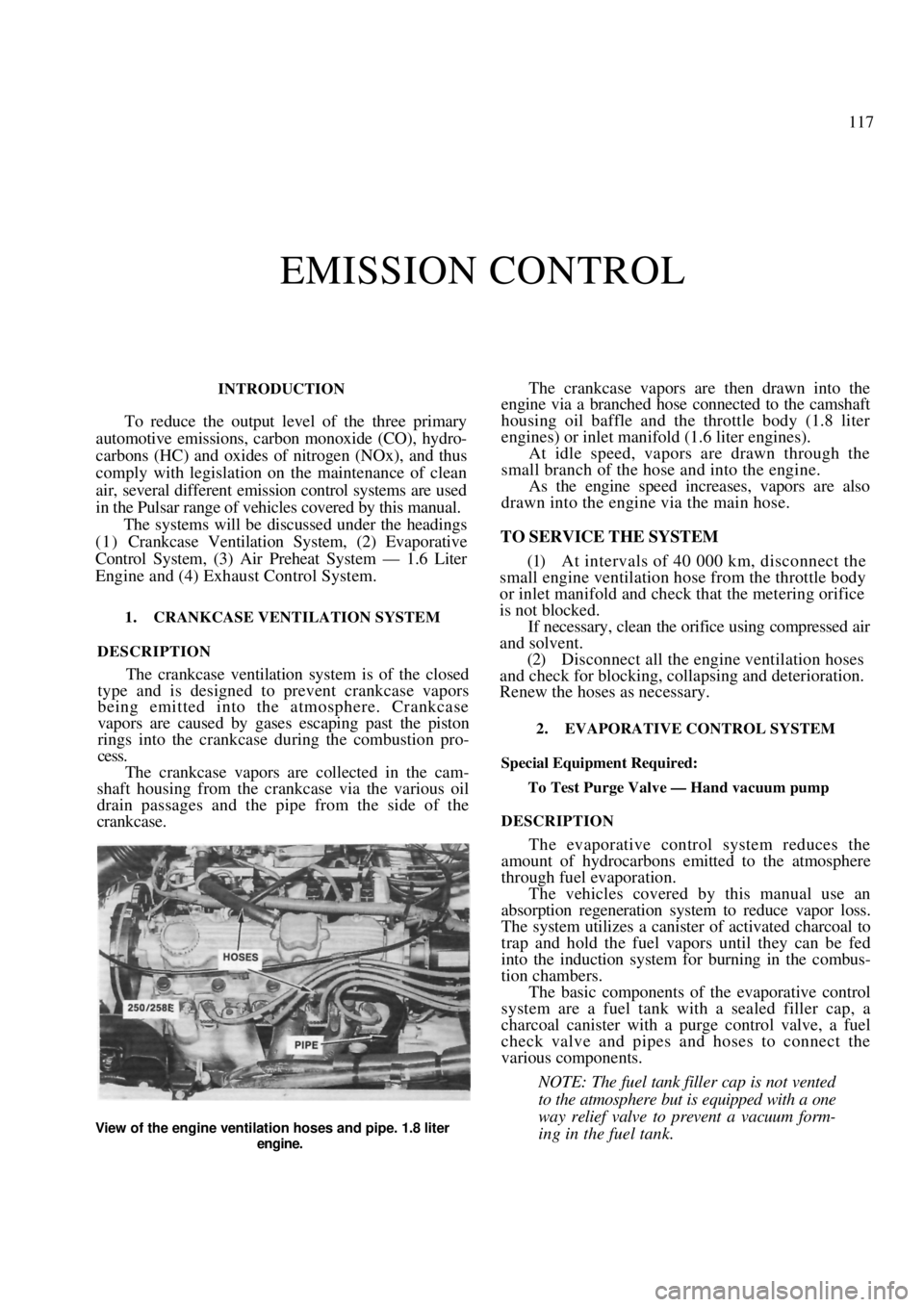
View of the engine ventilation hoses and pipe. 1.8 liter
engine.
Page 120 of 238

120 Emission Control
If the flap does not operate as described, renew
the air cleaner housing.
(2) Disconnect the vacuum hose from the servo
unit and connect it to a vacuum gauge.
(3) Start and run the engine at approximately
1 200 rpm. If the engine is cold there should be
vacuum. (4) As the engine temperature increases the
vacuum should decrease to zero. If the vacuum gauge does not read as described,
check that the vacuum supply hose is connected to the
thermal vacuum valve and the throttle body.
If no fault is found, renew the thermal vacuum
valve.
4. EXHAUST CONTROL SYSTEM
DESCRIPTION
The exhaust system is the greatest source of
pollutant emission from the internal combustion
engine.
On the Pulsar range of vehicles covered by this
manual, the exhaust control system consists of a
catalytic converter and the engine management sys-
tem. The engine management system constantly mon-
itors the exhaust gases via an oxygen sensor located in
the exhaust system. Fuel injection is then adjusted
accordingly to give the minimum amount of exhaust
emissions. Refer to the Fuel and Engine Management
section for further information.
CATALYTIC CONVERTER
The catalytic converter, which is located in the
exhaust system, converts hydrocarbons, oxides of
nitrogen and carbon monoxide present in the exhaust
gases into carbon dioxide, nitrogen, water and heat.
The catalytic converter does not require periodic
maintenance or replacement under normal circum-
stances. However, it can be damaged or poisoned by
excessively high exhaust gas temperatures, raw fuel
and the use of leaded fuel.
Installed view of the catalytic converter.
To prevent the use of leaded fuel, a small diam-
eter fuel filler neck with a spring loaded trap door is
used.
To prevent damage to the catalytic converter, the
following precautions sh ould be observed.
(1) Do not operate the vehicle on leaded fuel.
(2) Do not push or tow start the vehicle.
(3) Do not allow the engine to idle for prolonged
periods. (4) Do not operate the vehicle if the engine is
misfiring.
(5) Avoid running the vehicle out of fuel.
(6) Ensure that the engine oil is formulated to
contain low phosphorous levels.
To Inspect Catalytic Converter
(1) Inspect the converter for dents and damage.
If the converter is damaged, it should be renewed. (2) Inspect the converter heat shield for damage
and ensure that it is positioned correctly. Renew the
converter heat shield if necessary.
To Remove and Install
To remove and install the catalytic converter,
refer
to the Exhaust System heading in the Engine section.
Page 142 of 238
142 Automatic Transaxle
(8) Install the dipstick and start the engine and
recheck the fluid level.
NOTE; Do not overfill the transaxle or
foaming and unsatisfactory operation of the
transaxle will result.
TO DRAIN AND REFILL
This is not a normal maintenance and lubrication
procedure. It is only necessary to drain the complete
system, including the torq ue converter and the oil
cooler, when the transaxle assembly is removed for
overhaul or the renewal of transaxle components such
as bearings, clutches or as semblies. When this condi-
tion arises, the torque converter and the cooler should
be cleaned and flushed to remove any dirt or sludge.
After transaxle overhaul, install approximately 6
liters of new transaxle fluid, and top up as previously
described.
4. BRAKE BAND
Band adjustment is not a normal maintenance
procedure.
The adjustment entails removal of the valve body
and for this reason the vehicle should be taken to an
authorized dealer.
5. KICKDOWN CABLE
TO ADJUST
(1) On models with a 1.6 liter engine, remove
the air cleaner assembly. (2) With the aid of an assistant, ensure that the
throttle valve is fully open when the throttle pedal is
fully depressed. (3) Push the clip on the outer kickdown cable
and pull the cable away from the throttle linkage.
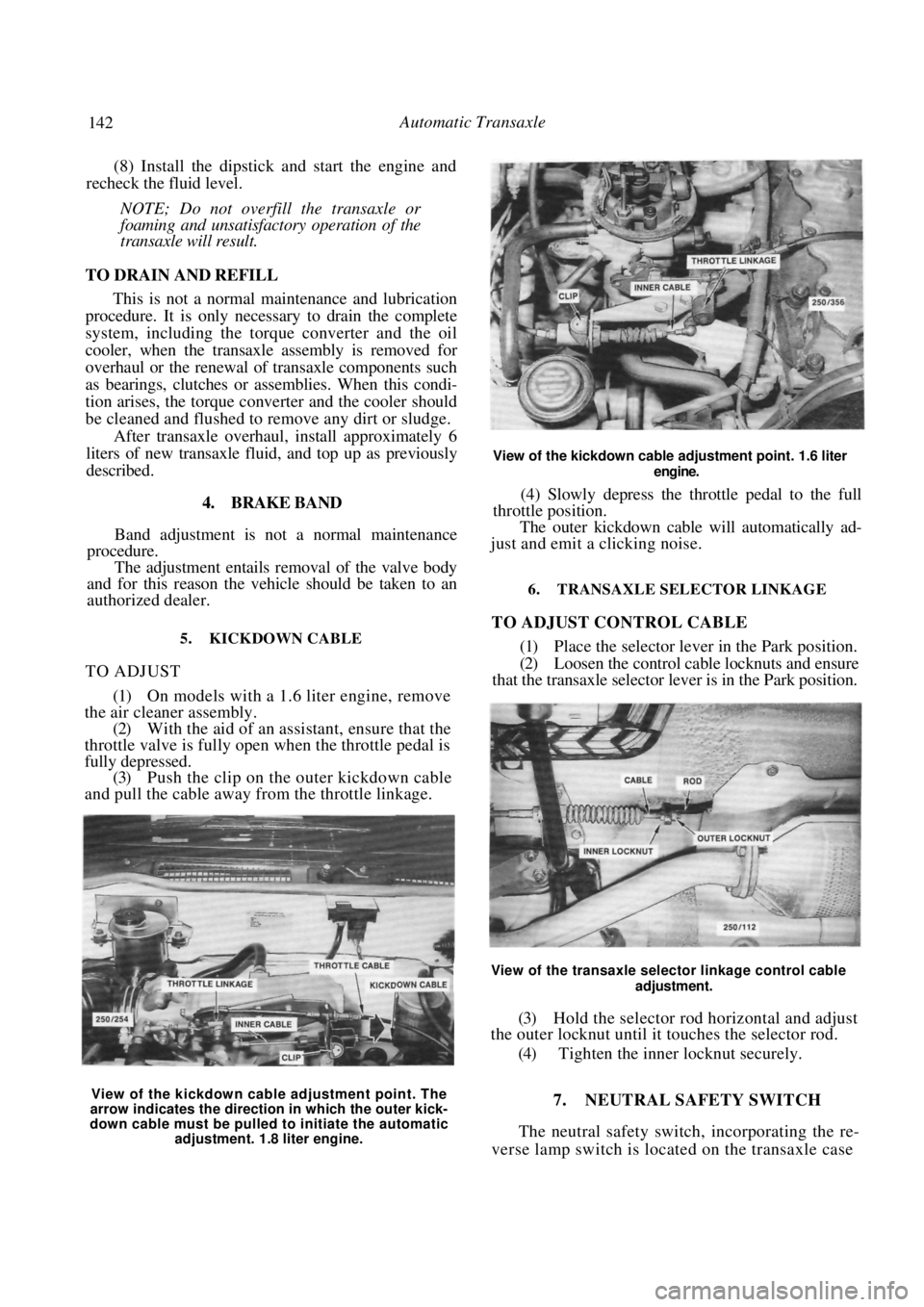
View of the kickdown cable adjustment point. 1.6 liter
engine.
(4) Slowly depress the throttle pedal to the full
throttle position.
The outer kickdown cable will automatically ad-
just and emit a clicking noise.
6. TRANSAXLE SELECTOR LINKAGE
TO ADJUST CONTROL CABLE
(1) Place the selector lever in the Park position.
(2) Loosen the control cable locknuts and ensure
that the transaxle selector lever is in the Park position.
View of the transaxle selector linkage control cable
adjustment.
(3) Hold the selector rod horizontal and adjust
the outer locknut until it touches the selector rod.
(4) Tighten the inner locknut securely.
7. NEUTRAL SAFETY SWITCH
The neutral safety switch, incorporating the re-
verse lamp switch is located on the transaxle case
View of the kickdown cable adjustment point. The
arrow indicates the direction in which the outer kick-
down cable must be pulled to initiate the automatic adjustment. 1.8 liter engine.
Page 195 of 238
Electrical System 195
(2) Remove the battery holding clamp and lift
the battery from the vehicle.
Installation is a reversal of the removal procedure
with attention to the following points:
Ensure that the terminals and posts are
clean. When connecting the l eads to the battery,
ensure that the polarity is correct. Connect the
positive lead first. Do not over tighten the terminal clamp
nuts.
Apply petroleum jelly to the battery termi-
nals to prevent corrosion.
MAINTENANCE
Battery maintenance should be performed at the
scheduled services.
NOTE: Keep naked flames away from the
battery as the battery gases are highly
explosive.
(1) Keep the battery and the surrounding area
clean and dry. In particular, ensure that the top of the
battery is free from dirt and moisture to prevent a
voltage drop between the terminals.
If necessary, clean the battery case as follows:
Remove the battery from the vehicle as
previously described.
Pour hot water over the battery being careful
not to allow any water to enter the battery through the
filler cap vent holes. Wipe the battery case clean.
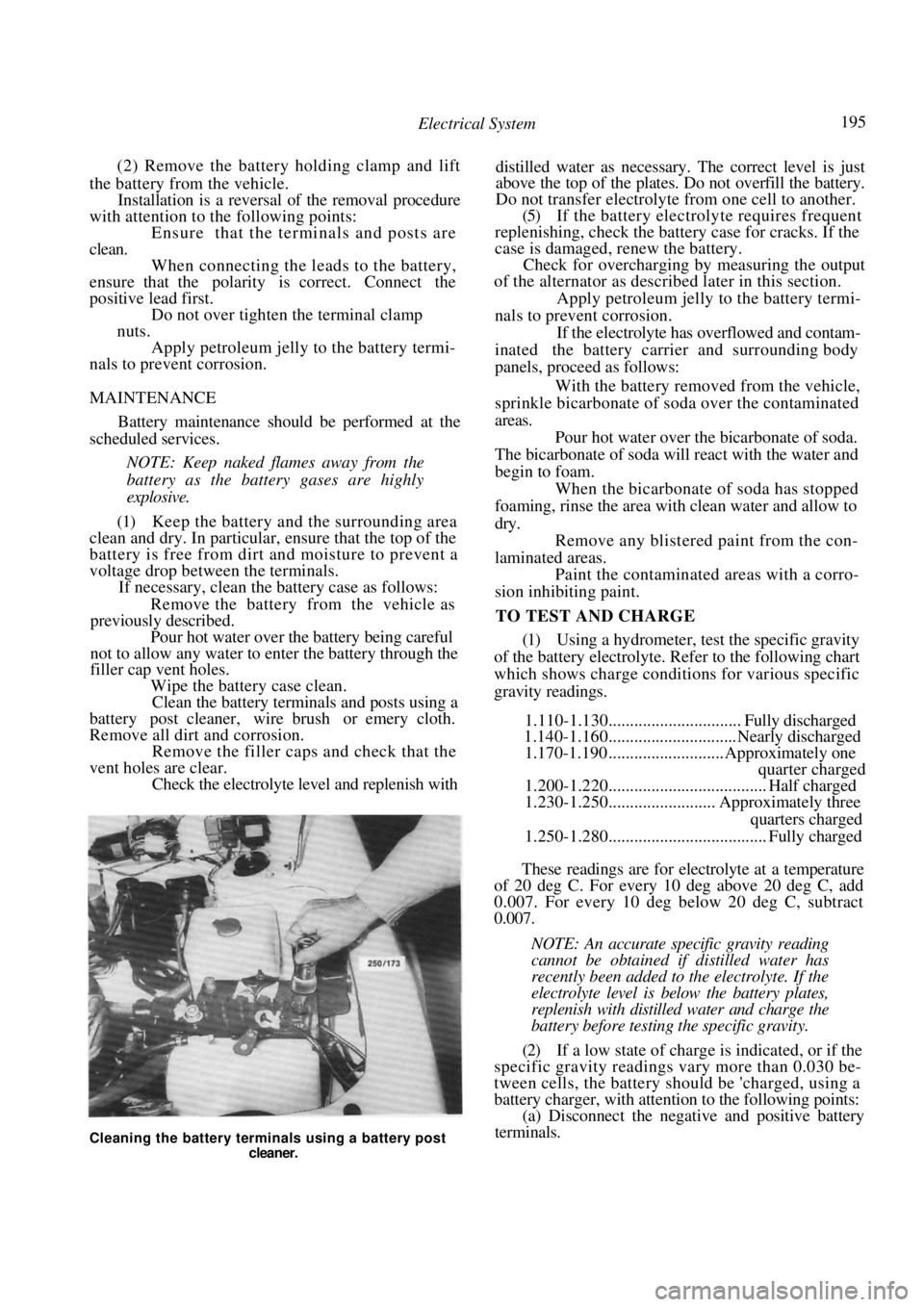
Clean the battery terminals and posts using a
battery post cleaner, wire brush or emery cloth.
Remove all dirt and corrosion.
Remove the filler caps and check that the
vent holes are clear. Check the electrolyte le vel and replenish with distilled water as necessary. The correct level is just
above the top of the plates. Do not overfill the battery.
Do not transfer electrolyte from one cell to another.
(5) If the battery electrolyte requires frequent
replenishing, check the batt ery case for cracks. If the
case is damaged, renew the battery.
Check for overcharging by measuring the output
of the alternator as described later in this section.
Apply petroleum jelly to the battery termi-
nals to prevent corrosion. If the electrolyte has overflowed and contam-
inated the battery carrier and surrounding body
panels, proceed as follows:
With the battery removed from the vehicle,
sprinkle bicarbonate of soda over the contaminated
areas.
Pour hot water over the bicarbonate of soda.
The bicarbonate of soda will react with the water and
begin to foam. When the bicarbonate of soda has stopped
foaming, rinse the area with clean water and allow to
dry. Remove any blistered paint from the con-
laminated areas. Paint the contaminated areas with a corro-
sion inhibiting paint.
TO TEST AND CHARGE
(1) Using a hydrometer, test the specific gravity
of the battery electrolyte. Refer to the following chart
which shows charge conditi ons for various specific
gravity readings.
1.110-1.130............................... Fully discharged
1.140-1.160..............................Nearly discharged
1.170-1.190 ........................... Approximately one
quarter charged
1.200-1.220..................................... Half charged
1.230-1.250......................... Approximately three
quarters charged
1.250-1.280..................................... Fully charged
These readings are for electrolyte at a temperature
of 20 deg C. For every 10 deg above 20 deg C, add
0.007. For every 10 deg below 20 deg C, subtract
0.007.
NOTE: An accurate specific gravity reading
cannot be obtained if distilled water has
recently been added to the electrolyte. If the
electrolyte level is below the battery plates,
replenish with distilled water and charge the
battery before testing the specific gravity.
(2) If a low state of charge is indicated, or if the
specific gravity readings vary more than 0.030 be-
tween cells, the battery s hould be 'charged, using a
battery charger, with attention to the following points:
(a) Disconnect the negati ve and positive battery
terminals.
Cleaning the battery terminals using a battery post
cleaner.