power steering NISSAN PULSAR 1987 User Guide
[x] Cancel search | Manufacturer: NISSAN, Model Year: 1987, Model line: PULSAR, Model: NISSAN PULSAR 1987Pages: 238, PDF Size: 28.91 MB
Page 48 of 238
48 Engine
TO INSTAL
(1) Check that the camshaft and crankshaft
timing gears have not been moved and that the timing
marks are still aligned. It will be necessary to tempo-
rarily install the crankshaft pulley to check that the
timing marks are still aligned. (2) Install the drive belt to the crankshaft timing
gear around the water pump gear and onto the
camshaft timing gear.
NOTE: If the original drive belt is being
installed, ensure that the arrow marked on
the belt prior to removal is pointing in the
direction of rotation.
(3) Use the adjusting tool to turn the water
pump assembly sufficiently to engage the water pump
pulley with the drive belt. (4) Install the inner cover lower retaining bolt.
(5) Ensure that the drive be lt is correctly meshed
with the teeth of the camshaft, crankshaft and water
pump gears. Install the crankshaft pulley and tighten
the bolts to Specifications. (6) Adjust the drive belt as described under the
following heading.
(7) Install the drive belt outer cover and fasten
the retaining clips. (8) Install and adjust the alternator and if
equipped, the power steeri ng and air conditioning
drive belts as desc ribed in the Engine Tune-up section.
TO ADJUST
(1) Remove the alternator drive belt and if
equipped, the power steering and air conditioning
drive belts. (2) Release the clips securing the camshaft drive
belt outer cover to the inner cover and remove the
outer cover. (3) Turn the engine in the direction of rotation
until the timing marks on the camshaft and the inner
cover are aligned. (4) Loosen the water pump retaining bolts and
using the adjusting tool, rotate the water pump
housing to gain the required belt tension. The belt is
correctly tensioned when it can be grasped between
the thumb and forefinger midway between the cam-
shaft timing gear and the water pump gear and turned
ninety degrees from i t s operating position.
After the belt has been tensioned, tighten the
water pump retaining bolts to the specified torque.
NOTE: Over tensioning of the drive belt will
result in noisy operation and premature
wear of the belt.
(6) Install the outer drive belt cover.
(7) Install and adjust the alternator, and if
equipped, the power steering and air conditioning
drive belts as desc ribed in the Engine Tune-up section. 6. CAMSHAFT. ROCKER ARMS AND TAPPETS
Special Equipment Required:
To Check Camshaft — Dial gauge, Vee blocks and
micrometers
To Install — Drive belt adjusting tool
It is recommended that a new cylinder head
gasket is installed and the cylinder head bolts renewed
when the camshaft housing is removed.
TO REMOVE
(1) Disconnect the negative battery terminal.
Remove the nuts securing the earth wires to the
cylinder head bolts and remove the earth wires.
(2) On 1.6 liter models, remove the air cleaner
wingnuts and withdraw the air cleaner.
(3) Disconnect the engine breather hoses from
the camshaft housing and the camshaft housing top
cover. (4) Remove the camshaft housing top cover
retaining bolts and remove the top cover. Discard the
gasket.
(5) Remove the camshaft dr ive belt as described
under the previous heading. (6) Using an open ended spanner, hold the
camshaft between the inle t and exhaust lobes of
number four cylinder and remove the camshaft timing
gear retaining bolt and the camshaft timing gear.
(7) Remove the distributor, distributor cap and
high tension leads. If necessary refer to the Fuel and
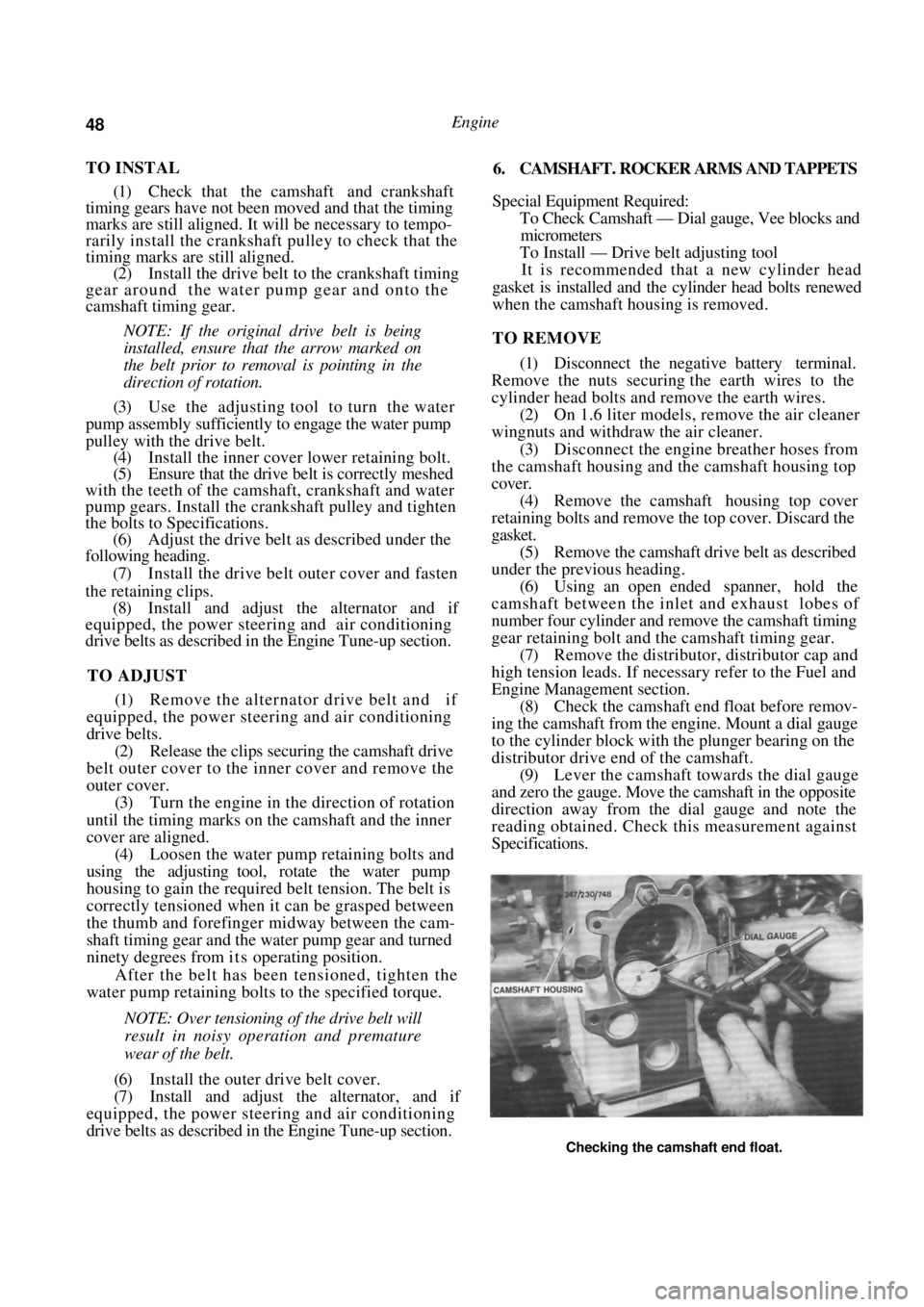
Engine Management section. (8) Check the camshaft end float before remov-
ing the camshaft from the engine. Mount a dial gauge
to the cylinder block with the plunger bearing on the
distributor drive end of the camshaft. (9) Lever the camshaft towards the dial gauge
and zero the gauge. Move the camshaft in the opposite
direction away from the dial gauge and note the
reading obtained. Check this measurement against
Specifications.
Checking the camshaft end float.
Page 108 of 238
108 Fuel and Engine Management
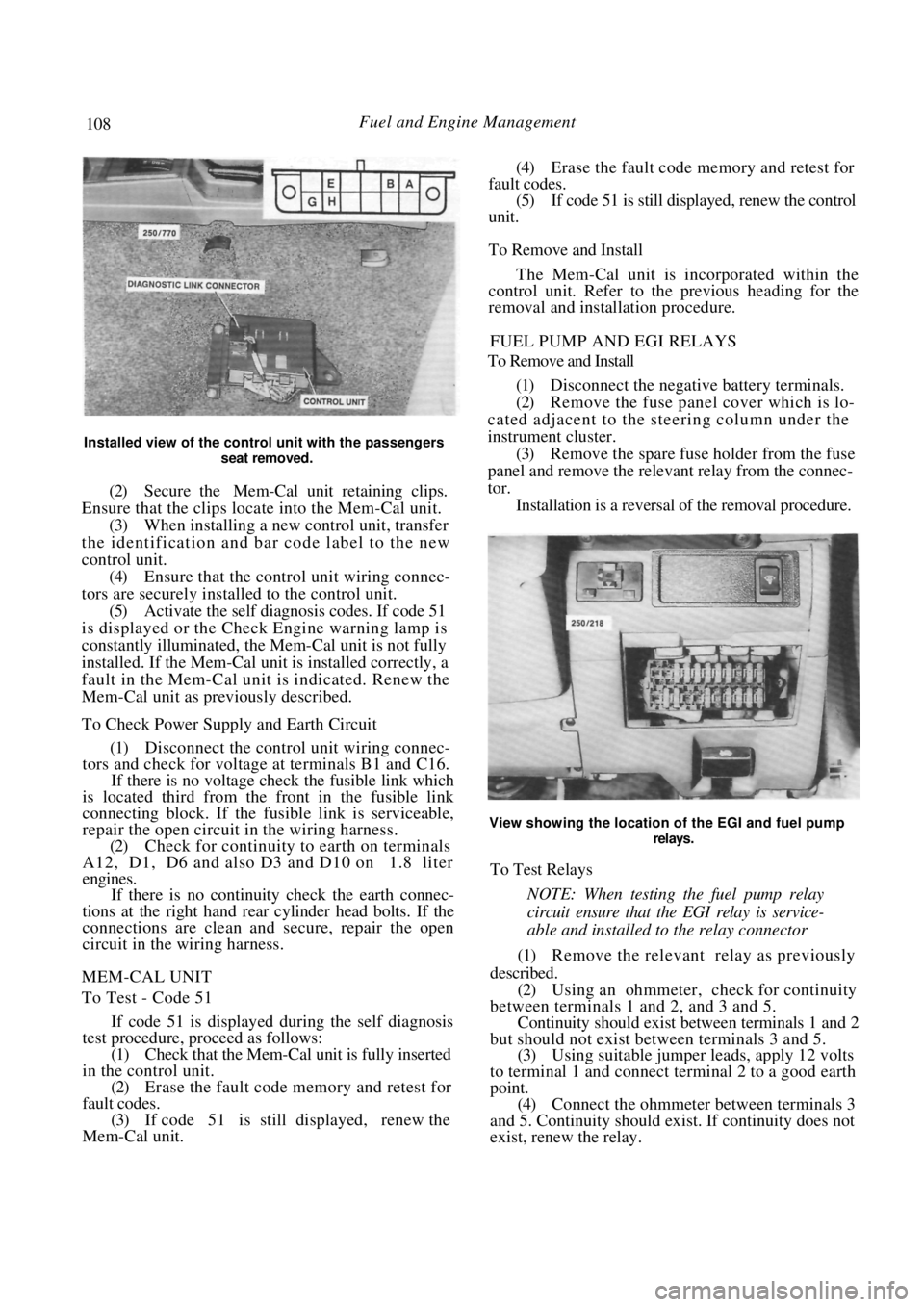
Installed view of the control unit with the passengers seat removed.
(2) Secure the Mem-Cal unit retaining clips.
Ensure that the clips locate into the Mem-Cal unit. (3) When installing a new control unit, transfer
the identification and bar code label to the new
control unit. (4) Ensure that the control unit wiring connec-
tors are securely installed to the control unit. (5) Activate the self diagnosis codes. If code 51
is displayed or the Check Engine warning lamp is
constantly illuminated, the Mem-Cal unit is not fully
installed. If the Mem-Cal uni t is installed correctly, a
fault in the Mem-Cal unit is indicated. Renew the
Mem-Cal unit as previously described.
To Check Power Supply and Earth Circuit
(1) Disconnect the control unit wiring connec-
tors and check for voltage at terminals B1 and C16.
If there is no voltage check the fusible link which
is located third from the front in the fusible link
connecting block. If the fu sible link is serviceable,
repair the open circuit in the wiring harness.
(2) Check for continuity to earth on terminals
A12, D1, D6 and also D3 and D10 on 1.8 liter
engines.
If there is no continuity check the earth connec-
tions at the right hand rear cylinder head bolts. If the
connections are clean and secure, repair the open
circuit in the wiring harness.
MEM-CAL UNIT
To Test - Code 51
If code 51 is displayed during the self diagnosis
test procedure, pr oceed as follows:
(1) Check that the Mem-Cal unit is fully inserted
in the control unit. (2) Erase the fault code memory and retest for
fault codes. (3) If code 51 is still displayed, renew the
Mem-Cal unit.
(4) Erase the fault code memory and retest for
fault codes. (5) If code 51 is still displayed, renew the control
unit.
To Remove and Install
The Mem-Cal unit is incorporated within the
control unit. Refer to the previous heading for the
removal and installation procedure.
FUEL PUMP AND EGI RELAYS
To Remove and Install
(1) Disconnect the negative battery terminals.
(2) Remove the fuse panel cover which is lo-
cated adjacent to the steering column under the
instrument cluster. (3) Remove the spare fuse holder from the fuse
panel and remove the releva nt relay from the connec-
tor. Installation is a reversal of the removal procedure.
View showing the location of the EGI and fuel pump
relays.
To Test Relays
NOTE: When testing the fuel pump relay
circuit ensure that th e EGI relay is service-
able and installed to the relay connector
(1) Remove the relevant relay as previously
described. (2) Using an ohmmeter, check for continuity
between terminals 1 and 2, and 3 and 5. Continuity should exist be tween terminals 1 and 2
but should not exist between terminals 3 and 5.
(3) Using suitable jumper leads, apply 12 volts
to terminal 1 and connect terminal 2 to a good earth
point. (4) Connect the ohmmeter between terminals 3
and 5. Continuity should exist. If continuity does not
exist, renew the relay.
Page 145 of 238
145
STEERING
PART 1. STEERING TROUBLE SHOOTING
FAULTS, CAUSES AND REMEDIES
EXCESSIVE PLAY OR LOOSENESS IN
STEERING GEAR
(1) Tie rod end ball joint loose or worn: Tighten
or renew the worn tie rod end ball joint. (2) Steering gear assembly loose on cross-
member: Inspect for damage and tighten the steering
gear mounting bolts. (3) Steering gear worn: Overhaul the steering
gear.
(2) Low fluid level in the power steering reser-
voir: Check for leakage, repa ir and/or renew the faulty
components. Top up the fluid level.
(3) Suspension worn or out of alignment: Check
the front suspension for wear, renew the worn com-
ponents and realign. (4) Misalignment between the steering gear and
column mountings: Check and align the steering gear
and column mountings. (5) Binding in the steering shaft universal coup-
ling joints: Check the join ts and renew if necessary.
(6) Ingress of dirt into the steering gear due to a
defective boot: Clean, check and lubricate the internal
components of the steering gear and renew the
defective boot. (7) Insufficient power steering pump pressure:
Check the pump drive belt tension and reservoir fluid
level. If necessary renew the pump assembly.
NOTE: Ensure that both front tires have
ample depth of tread and are inflated to the
correct pressure. Check the front suspension
components for wear before having the steer-
ing geometry checked. See the Front Sus-
pension section for the component checking
procedures.
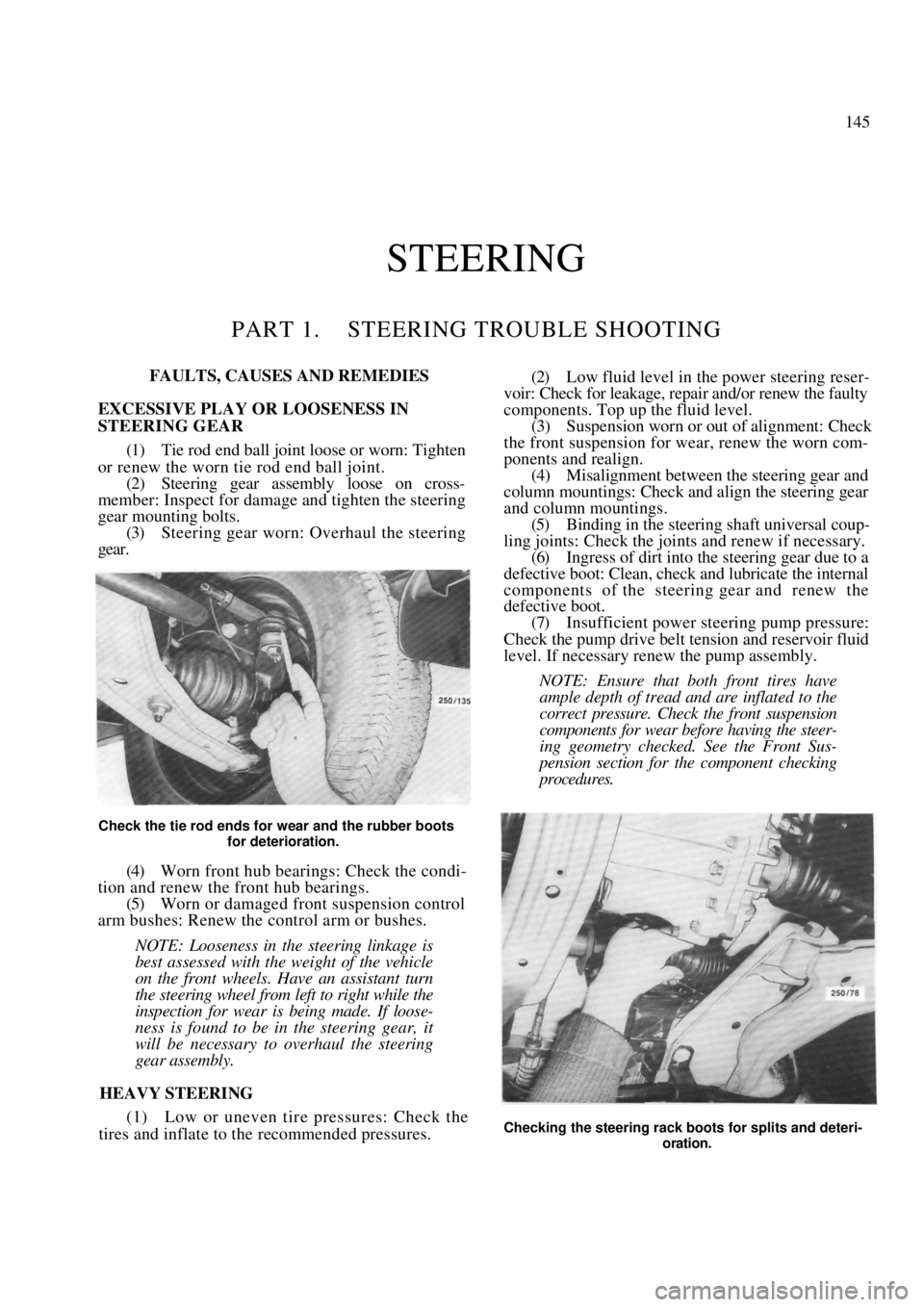
Check the tie rod ends for wear and the rubber boots for deterioration.
(4) Worn front hub bearings: Check the condi-
tion and renew the front hub bearings. (5) Worn or damaged front suspension control
arm bushes: Renew the control arm or bushes.
NOTE: Looseness in th e steering linkage is
best assessed with the weight of the vehicle
on the front wheels. Have an assistant turn
the steering wheel from left to right while the
inspection for wear is being made. If loose-
ness is found to be in the steering gear, it
will be necessary to overhaul the steering
gear assembly.
HEAVY STEERING
(1) Low or uneven tir e pressures: Check the
tires and inflate to the recommended pressures.
Checking the steering rack boot s for splits and deteri-
oration.
Page 146 of 238
146 Steering — Part 1
STEERING PULLS TO ONE SIDE
(1) Uneven tire wear or pressures: Check the
condition of the tires and inflate to the recommended
pressures.
(2) Incorrect front wheel alignment: Check and
align the front end.
(3) Dragging brakes: Check each wheel for drag-
ging brakes. Overhaul the brakes as necessary. (4) Damaged suspension or crossmember: In-
spect and renew the damaged components. (5) Faulty power steering gear assembly: Re-
move the power steering gear for overhaul.
FRONT WHEEL WOBBLE OR SHIMMY
(1) Uneven tire wear or incorrect tire pressures;
Check the condition of the tires and inflate to the
recommended pressures. (2) Tire or wheel imbalance: Check and balance
as necessary (3) Worn or badly adjusted hub bearings: Check
the condition and adjust the front hub bearings.
(4) Faulty or worn suspension, units: Check and
overhaul or renew as a pair.
NOTE: Check the steering linkage as previ-
ously described. Raise the front of the vehi-
cle and check the adjustment of the hub
bearings by moving the road wheel in and
out at the top and bottom. No movement in
the bearings should be felt. Check the sus-
pension units as outlined in the Front Sus-
pension section.
STEERING ERRATIC OR WANDERING
(1) Incorrect or uneven wheel alignment setting:
Check and adjust th e steering geometry.
(2) Smooth front tires: Check and renew the
tires as necessary.
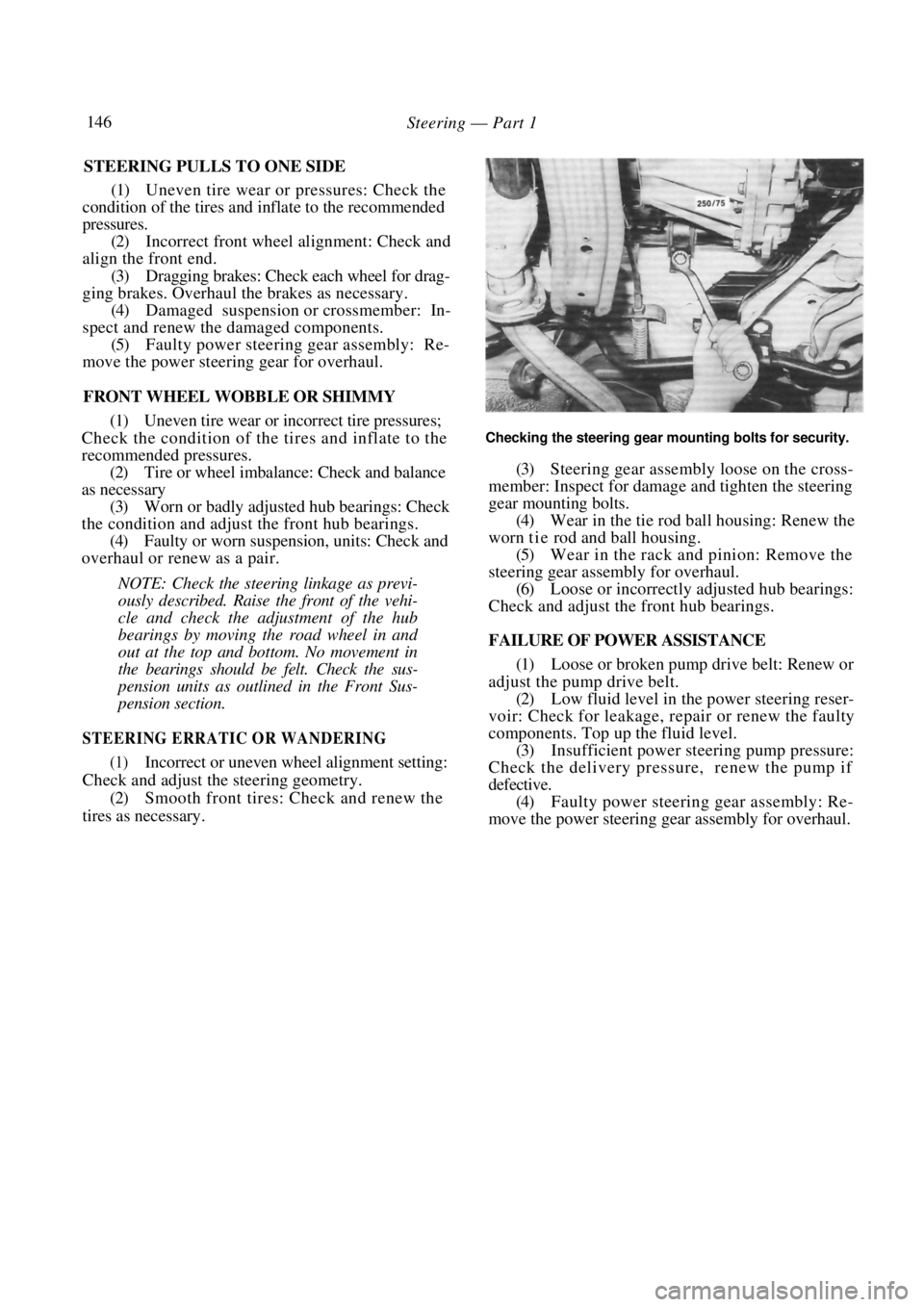
Checking the steering gear mounting bolts for security.
(3) Steering gear assembly loose on the cross-
member: Inspect for damage and tighten the steering
gear mounting bolts.
(4) Wear in the tie rod ball housing: Renew the
worn t i e rod and ball housing. (5) Wear in the rack and pinion: Remove the
steering gear assembly for overhaul. (6) Loose or incorrectly adjusted hub bearings:
Check and adjust the front hub bearings.
FAILURE OF POWER ASSISTANCE
(1) Loose or broken pump drive belt: Renew or
adjust the pump drive belt.
(2) Low fluid level in the power steering reser-
voir: Check for leakage, repair or renew the faulty
components. Top up the fluid level. (3) Insufficient power steering pump pressure:
Check the delivery pressure, renew the pump if
defective. (4) Faulty power steering gear assembly: Re-
move the power steering gear assembly for overhaul.
Page 152 of 238

152
PART 3. POWER STEERING
SPECIFICATIONS
Steering gear type ................Rack and pinion with
integral power cylinder
Steering column type .................... Energy absorbing
collapsible and lilt adjustable
Steering wheel free play ................................. 35 mm
Number of turns lock to lock:
TRW ...............................................................2.82
PR24SA ........................................................... 2.7
Linkage.....................................Direct from rack ends
to ti e rods and steering knuckles
Power steering pump
maximum pr essure.................................... 6 865 kPa
Lubricant ...................................................... Dexron II
TORQUE WRENCH SETTINGS
Steering gear to bulkhead mounting bolts... 108 Nm
Tie rod to steering knuckle nut ...................... 98 Nm
Tie rod to tie rod end locknut....................... 98 Nm
Tie rod ball housing to rack............................ 88 Nm
Power steering pump pulley nut ..................... 68 Nm
1. DESCRIPTION
The vehicles covered by this manual are equipped
with either a TRW power steering system or a
Japanese PR24SA power steering system.
Both types are similar in construction and appear-
ance.
The power steering is a rack and pinion type
which is mounted on the lower section of the engine
compartment bulkhead by rubber mountings and
brackets.
Hydraulic pressure is supplied to the power
steering gear by a pump driven by a drive belt from
the engine.
The power steering pump has a separate fluid
reservoir located on the righ t side of the bulkhead.
No lubrication of the steering gear or steering
pump is required in service and in the event of the
loss of power assistance, the steering will continue to
operate but will require a greatly increased effort.
However, as the steering gear and pump are lubricated
by the power steering fluid, the cause of the loss of
power steering or fluid loss must be determined and
repaired promptly to prevent damage to the steering
pump and to a lesser extent, the steering gear.
The t i e rod ends and rubb er boots can be renewed
without removing the steering gear from the vehicle.
To renew the integral t i e rod and tie rod ball housings,
the steering gear must be removed.
As specialist knowledge and equipment are re-
quired to overhaul the power steering gear and the
hydraulic pump, it is recommended that these op-
erations be carried out by an authorized dealer.
However, procedures for the removal and installa-
tion of the steering gear and pump are fully de-
scribed in this section.
The steering column is of the energy absorbing
type and is designed to collapse in the event of a
severe front end collision. The energy absorbing com-
ponents are the column tu bes, steering shaft and tilt
bracket breakaway capsules. All these components
should be handled with extr eme care if service opera-
tions are to be carried out on the steering column
assembly.
2. IN CAR ADJUSTMENTS, CHECKS AND
MINOR REPAIRS
If the power steering system becomes partially or
fully inoperative it is most important that the follow-
ing preliminary inspection and testing procedure be
performed prior to undertaking any trouble shooting
or repair operations.
PUMP DRIVE BELT
Inspect the pump drive belt for breakage, glazing
or wear. If any of these characteristics are evident,
renew the belt using only a genuine replacement.
If the belt is loose but still serviceable, adjust it
using the procedure outlined in the Engine Tune-up
section.
NOTE: In most cases a loose drive belt can
be heard squealing when a load is placed on
the pump as the steering wheel is turned or
as the engine speed is increased.
Checking the power steering pump drive belt for
deterioration.
Page 153 of 238

Steering — Part 3 153
TO CHECK FLUID LEVEL
Check the fluid level in the power steering reser-
voir when the fluid is cold.
If it is necessary to top up the fluid, fill to between
the arrow marks on the dipstick using the recom-
mended fluid.
NOTE: Do not overfill the reservoir.
Checking the power steering fluid level using the
dipstick incorporated in the cap.
TO CHECK FOR FLUID LEAKS
Using a suitable solvent, clean around all power
steering assemblies and hose fittings where fluid
leakage might occur and start the engine. Turn the
steering wheel from one steering lock to the other
several times and stop the engine. Check for leakage.
Where leakage is found at ho se fittings, tighten and
recheck.
If the leak remains, renew the hoses or fittings as
required.
Where leakage is found in the steering gear
assembly or pump assembly, specialist attention is
necessary.
TO CHECK STEERING WHEEL FREE PLAY
With the engine running and the steering wheel in
the straight ahead positi on, measure the free move-
ment of the steering wheel before the front wheels
move. This is specified as steering wheel free play and
if it exceeds Specifications, check for free play in the
steering linkages and the universal coupling joints. If
these components are satisfactory, it will be necessary
to remove the steering gear from the vehicle for
renewal or overhaul.
PUMP BELT TENSION
The procedure for adjusting the power steering
pump bell tension is describe d in the Engine Tune-up
section
TO PURGE THE POWER STEERING SYSTEM
OF AIR
(1) Check that the pump reservoir is filled to the
correct mark on the dipstick. (2) Raise the front of the vehicle and support it
on chassis stands. (3) Turn the steering wheel quickly from lock to
lock several times, recheck the fluid level within the
pump reservoir and top up if required. (4) Start the engine, allow it to idle and slowly
turn the steering wheel from lock to lock several times.
Do not hold the steering at full lock for more than 15
seconds. (5) Check the fluid level in the pump reservoir,
top up if necessary. (6) If the fluid is aerated within the pump
reservoir or if pump noise persists, repeat operations
(3) to (6).
3. STEERING WHEEL
The procedure for removing and installing the
steering wheel is fully covered in the Manual Steering
section under the above heading.
4. STEERING COLUMN
The procedure for removing, dismantling and
assembling the steering column is fully covered in the
Manual Steering section under the above heading.
5. POWER STEERING PUMP
TO REMOVE AND INSTAL
( 1 ) Disconnect the negative battery terminal.
View of the power steering pump removed from the
vehicle.
Page 154 of 238

154 Steering —
(2) Remove the air inlet duct from the air
cleaner and throttle body. (3) Position a container or a piece of cloth
beneath the steering pump reservoir and disconnect
the fluid return and power steering pump supply hose
from the reservoir.
(4) Loosen the steering pump drive belt as
described in the Engi ne Tune-up section.
(5) Loosen the return hose clamp and the supply
union and disconnect the hoses from the power
steering pump. Plug the hoses to prevent the loss of
fluid.
(6) Loosen the retaining bolts and withdraw the
pump. (7) Thoroughly clean the exterior of the steering
pump and inspect it for cracks, damage and signs of
leakage.
Installation is a reversal of the removal procedure
with attention to the following points:
(1) Install the pump and retaining bolts.
(2) Install the drive belt and adjust it as de-
scribed in the Engine Tune-up section. (3) Install the hoses to the power steering pump
and tighten securely. (4) Top up the pump reservoir and purge the
power steering system of air as previously described.
TO OVERHAUL
As specialist knowledge and equipment arc re-
quired to overhaul the power steering pump, it is
recommended that this operation be performed by an
authorized dealer or steering specialist.
6. POWER STEERING GEAR ASSEMBLY
Special Equipment Required:
To Renew Tie Rod Ball Housings — Large Still-
sons
TO REMOVE AND INSTAL
The procedures for removing and installing the
power steering gear are similar to those carried out in
the Manual Steering section under the Steering Gear
Assembly heading except fo r the following differences.
(1) Place a container under the pressure and
return pipes that are conn ected to the steering gear
valve housing. Remove the pipes and allow the fluid
to drain into the container. (2) Suitably seal the pipes and the steering gear
to prevent the entry of di rt whilst the pipes are
removed.
(3) Upon removal of the power steering gear,
thoroughly clean the steering gear except the tie rod
ends in a suitable solvent. Be careful not to allow the
solvent to enter the apertu res where the pressure and
return pipes were removed. (4) Check the pipes and co nnections for cracks,
damage or obstructions and renew as necessary.
Installed view of the power steering gear with the
engine removed.
Installation is a reversal of the removal procedure
with attention to the following points:
(1) Install the pressure and return pipes to the
steering gear valve housing and tighten securely. (2) Fill the power steering reservoir to the cor-
rect level and bleed the system as described previously
under the heading In Car Adjustments. Checks and
Minor Repairs. (3) Check all power steering pipe connections
for leaks and repair as necessary. (4) Check, and if necessary, adjust the front
wheel toe in as described in the Front Suspension
section. After adjustment ensure that the rubber boots
are not distorted or twisted and the rubber boot
clamps and clips are facing downward.
TO OVERHAUL
As specialist knowledge and equipment are re-
quired to overhaul the power steering gear, it is rec-
ommended that this opera tion be performed by an
authorized dealer or steering specialist.
TO RENEW TIE ROD BALL HOUSINGS
TRW Steering Gear
The renewal of the tie rod ball housings is the
same as for the manual steering gear. Refer to Part 2.
Manual Steering section.
PR24SA Steering Gear
(1) Remove the power steering gear assembly
from the vehicle as previously described.
(2) Carefully mount the power steering gear in a
vice equipped with soft jaws. Loosen the tie rod end
locknuts without disturbing the location of the tie rod
ends and unscrew the tie rod ends, taking note of the
number of turns required to remove them. Unscrew
and remove the locknuts from the tie rod. (3) Remove the clamps from the rubber boots
and remove the boots.
Page 155 of 238

Steering — Part 3 155
(4) Support the rack carefully and lever back the
tabs of the ball housing lock washers. To prevent
damage to the steering gear, avoid any impact to the
steering rack.
(5) Holding the rack with an adjustable spanner,
unscrew the ball housings from the rack using a
Stillsons wrench. Remove and discard the lock wash-
ers. Installation is a reversal of the removal procedure
with attention to the following points:
(1) Install the new lock washer to the
rack,
ensuring that the lockwasher tangs are located in the
rack end. (2) Install the ball housing as semblies to the rack.
Tighten the ball housings to the specified torque and
secure by bending the lock washer. (3) Before installing the rubber boots ensure that
the vent holes, located towards each end of the rack
near the ball housings, are clear. If necessary clear the
hole with a suitable probe. (4) Apply sealant to the la rge end of the rubber
boot and grease to the small end. and install the boots,
being careful not to damage or twist them. Secure the boots with the clamps and clip
s ensuring that the clips
are facing downwards.
(5) Install the t i e rod end locknuts and tie rod
ends to the t i e rod. Install the t i e rod ends the same
number of turns noted on removal. Tighten the lock-
nuts to the specified torque.
Install the power steerin g gear assembly to the
vehicle as described under the previous heading and
bleed the system as described under the heading In
Car Adjustments, Checks and Minor Repairs.
TO RENEW RUBBER BOOTS
The procedure to renew the rubber boots is fully
covered in the Manual Steering section under the
Steering Gear Assembly heading.
TO RENEW TIE ROD ENDS
The procedure to renew the t i e rod ends is fully
covered in the Manual Steering section under the
Steering Gear Assembly heading.
Page 178 of 238
178 Brakes
Let the vehicle stand for 1-2 minutes, press the
brake pedal two or three times and check its opera-
tion.
If there is no vacuum assistance, the vacuum
system has developed a leak or the one way check
valve is defective.
NOTE: Before removing the servo unit from
the vehicle for inspection, disconnect the
hose from the servo unit, start the engine
and check that the manifold vacuum is in
fact reaching the servo unit. Also test the one
way check valve as described below,
TO TEST ONE WAY CHECK VALVE
(1) Disconnect the hose and remove the check
valve from the servo unit.
(2) Check the valve for sticking. Suction on the
manifold side should allo w air to flow freely. Air
blown into the valve from the manifold side should
not be able to flow through the valve. (3) Install the valve and check the operation
of
the servo unit as previously described.
NOTE: Check that there are no air leaks at
the hose connections and that the hose clips
are tight. Also check that the hose is not
bulged or collapsed due to deterioration.
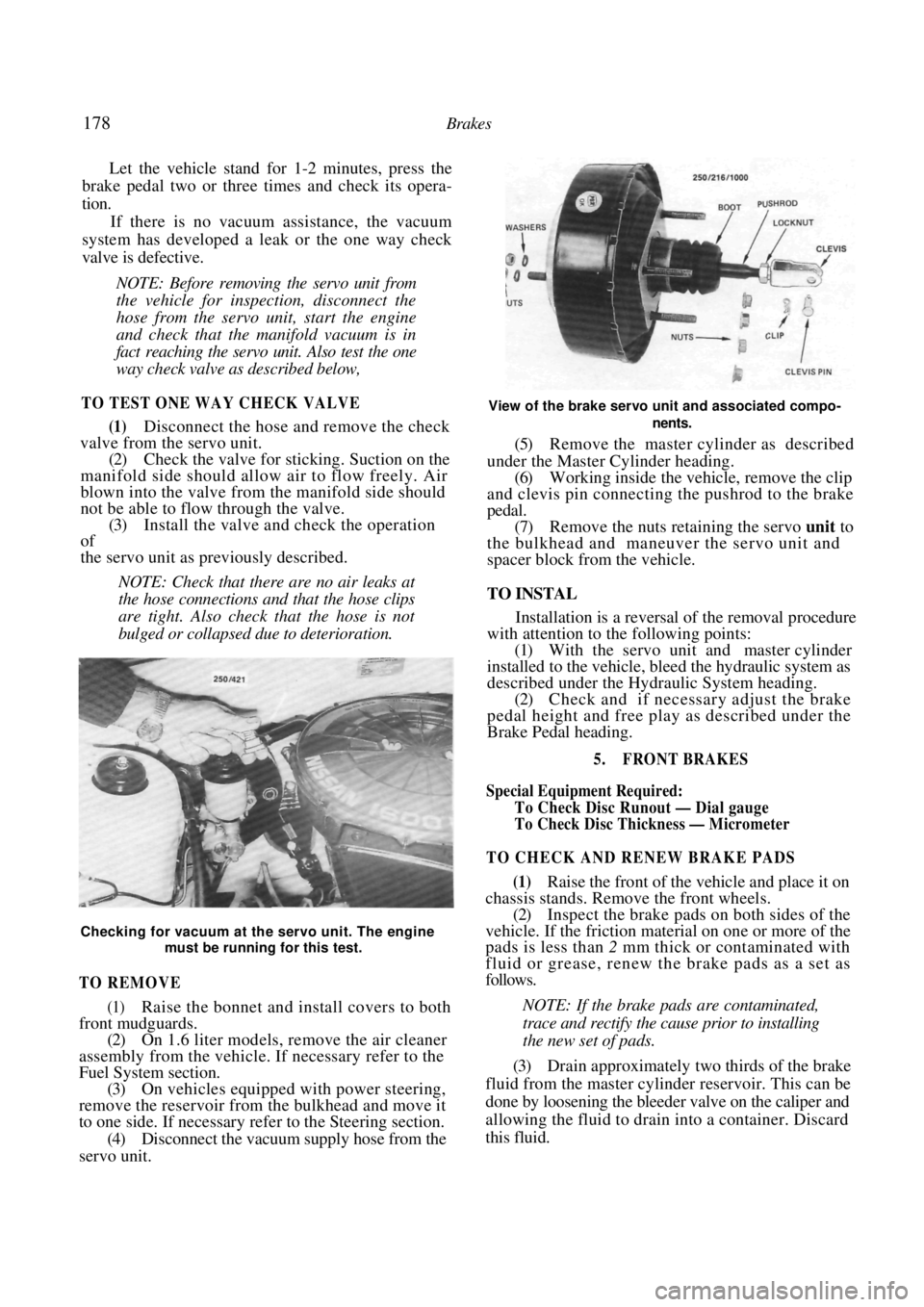
Checking for vacuum at the servo unit. The engine
must be running for this test.
TO REMOVE
(1) Raise the bonnet and install covers to both
front mudguards.
(2) On 1.6 liter models, remove the air cleaner
assembly from the vehicle. If necessary refer to the
Fuel System section.
(3) On vehicles equipped with power steering,
remove the reservoir from the bulkhead and move it
to one side. If necessary refer to the Steering section.
(4) Disconnect the vacuum supply hose from the
servo unit.
View of the brake servo unit and associated compo-
nents.
(5) Remove the master cylinder as described
under the Master Cylinder heading. (6) Working inside the vehicle, remove the clip
and clevis pin connecting the pushrod to the brake
pedal. (7) Remove the nuts retaining the servo unit to
the bulkhead and maneuver the servo unit and
spacer block from the vehicle.
TO INSTAL
Installation is a reversal of the removal procedure
with attention to the following points:
(1) With the servo unit and master cylinder
installed to the vehicle, bleed the hydraulic system as
described under the Hydr aulic System heading.
(2) Check and if necessary adjust the brake
pedal height and free play as described under the
Brake Pedal heading.
5. FRONT BRAKES
Special Equipment Required:
To Check Disc Runout — Dial gauge
To Check Disc Thickness — Micrometer
TO CHECK AND RENEW BRAKE PADS
(1) Raise the front of the vehicle and place it on
chassis stands. Remove the front wheels.
(2) Inspect the brake pads on both sides of the
vehicle. If the friction material on one or more of the
pads is less than 2 mm thick or contaminated with
fluid or grease, renew the brake pads as a set as
follows.
NOTE: If the brake pads are contaminated,
trace and rectify the cause prior to installing
the new set of pads.
(3) Drain approximately two thirds of the brake
fluid from the master cylinde r reservoir. This can be
done by loosening the bleeder valve on the caliper and
allowing the fluid to drai n into a container. Discard
this fluid.
Page 207 of 238
Electrical System 207
Disconnect the wiring connectors from the
rear of the combination switch.
Loosen the clamping screw located at the left
hand side of the combination switch. Push, turn and slide the combination switch
from the steering column. Installation is a reversal of the removal procedure.
REAR WINDOW DEMISTER
SWITCH/HAZARD WARNING LAMP SWITCH
To Remove and Install
Disconnect the negative battery terminal.
Using two small flat bladed screwdrivers,
carefully lever the edges of the switch forward to
release it from the instrument cluster surround.
Withdraw the switch from the surround and
disconnect the switch wiri ng at the connectors.
Installation is a reversal of the removal procedure.
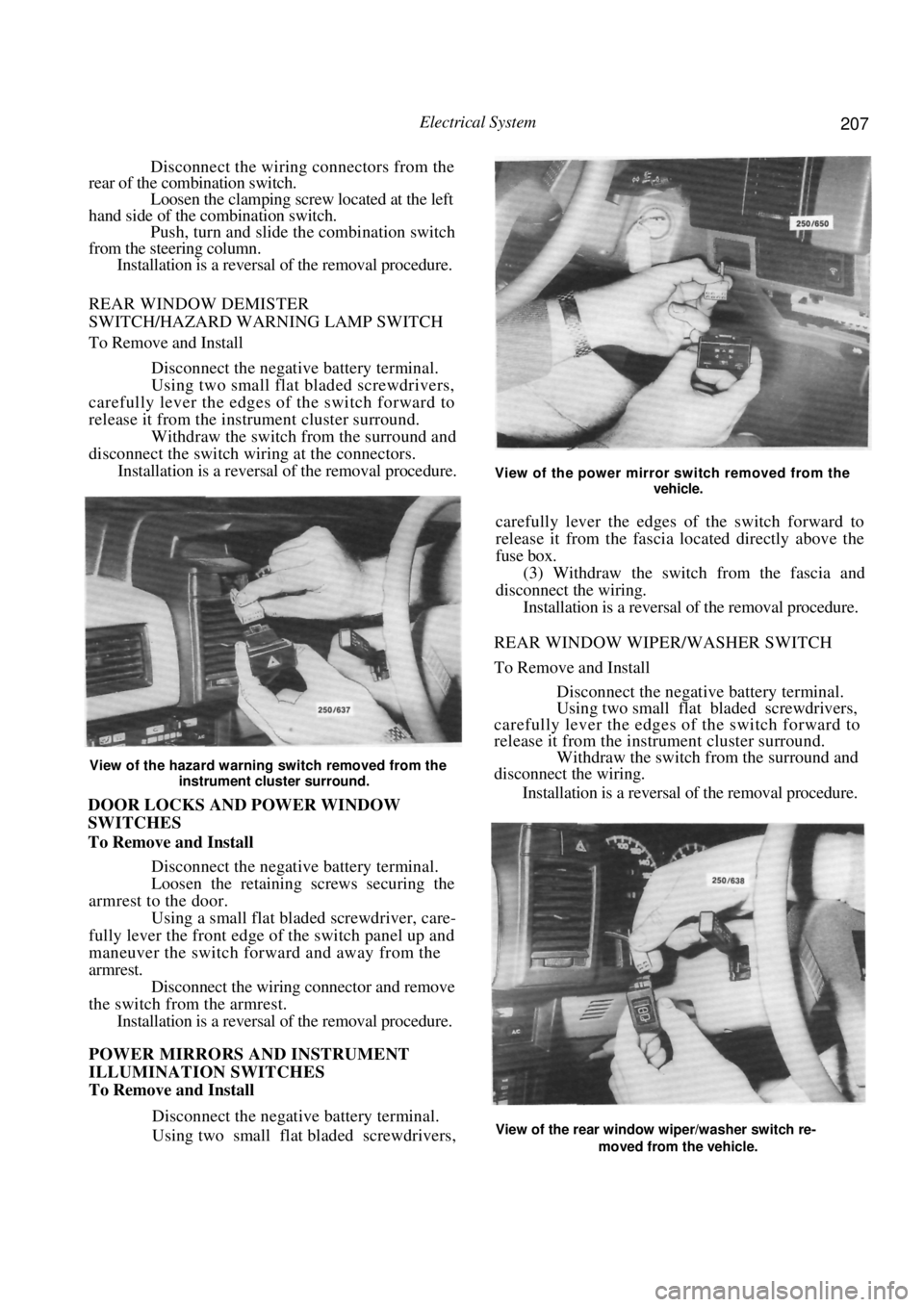
View of the hazard warning switch removed from the
instrument cluster surround.
DOOR LOCKS AND POWER WINDOW
SWITCHES
To Remove and Install
Disconnect the negative battery terminal.
Loosen the retaining screws securing the
armrest to the door. Using a small flat bladed screwdriver, care-
fully lever the front edge of the switch panel up and
maneuver the switch forward and away from the
armrest. Disconnect the wiring connector and remove
the switch from the armrest. Installation is a reversal of the removal procedure.
POWER MIRRORS AND INSTRUMENT
ILLUMINATION SWITCHES
To Remove and Install
Disconnect the negative battery terminal.
Using two small flat bladed screwdrivers,
View of the power mirror switch removed from the
vehicle.
carefully lever the edges of the switch forward to
release it from the fascia lo cated directly above the
fuse box.
(3) Withdraw the switch from the fascia and
disconnect the wiring.
Installation is a reversal of the removal procedure.
REAR WINDOW WIPER/WASHER SWITCH
To Remove and Install
Disconnect the negative battery terminal.
Using two small flat bladed screwdrivers,
carefully lever the edges of the switch forward to
release it from the instrument cluster surround. Withdraw the switch from the surround and
disconnect the wiring.
Installation is a reversal of the removal procedure.
View of the rear window wiper/washer switch re-
moved from the vehicle.