suspension NISSAN PULSAR 1987 User Guide
[x] Cancel search | Manufacturer: NISSAN, Model Year: 1987, Model line: PULSAR, Model: NISSAN PULSAR 1987Pages: 238, PDF Size: 28.91 MB
Page 151 of 238

Steering — Part 2 151
(8) Slide the rack out of the housing slightly so
that an adjustable spanner can be used to hold the
rack. (9) Using a Stillsons wrench, unscrew the ball
housings in turn using care not to allow the rack to
rotate. Keep all the tie rod parts in order. (10) Inspect the rack boots for cracks and deteri-
oration and renew as necessary. (11) Inspect the tie rod ends for wear and damage
and renew as necessary.
Dismantled view of the tie rod ball housing and the tie
rod end assemblies removed from the steering gear.
Assembly is a reversal of the dismantling proce-
dure with attention to the following points:
(1) Using large Stillsons and a large adjustable
spanner, install the tie rod and ball housing
assemblies
to the rack. Tighten the ball housings to the specified
torque.
NOTE: To avoid damage to the rack or
pinion the adjustable spanner must be
firmly tightened over the rack teeth and the
rack must not be allowed to rotate when
installing the ball housings.
(2) Measure a point 9 mm in from the rear face
of the ball housing of the rack and at 90 deg to the
rack teeth. Centre punch this point.
(3) At this point drill a 4 mm hole, 10 mm deep
through the rack and into the ball housing thread.
(4) Place a locking pin above the hole and drive
it into position.
(5) Lubricate the rack, rack teeth and t i e rod
boot groove with suitable EPL 1 grease. (6) Install the rack boots and secure with the
clamps. Renew the clamps if necessary. (7) Install the tie rod end locknuts and then the
tie rod ends, ensuring that they are screwed on the
same number of turns as was necessary to remove
them.
(8) Tighten the locknuts to the specified torque.
(9) Install the mounting rubbers and brackets
to
the steering gear as noted on removal. (10) Install the steering gear assembly to
the
vehicle as previously described. (11) Check and if necessary adjust the front wheel toe in as described in the Front Suspension section
under the appropriate heading.
TO RENEW TIE ROD END
(1)
Raise the front of the vehicle and support it
on chassis stands. (2) Remove the relevant front wheel.
(3) Loosen the tie rod end locknut and remove
the tie rod end castellated nut. Disconnect the tie rod
from the steering arm by plac ing a suitable dolly or
hammer against one side of the steering arm eye and
striking the opposite side with a hammer. (4) Unscrew the tie rod end from the tie rod,
noting the number of turns necessary to remove it.
(5) Screw the new tie rod end onto the t i e rod
the same number of turn s noted during removal.
(6) Connect the t i e rod to the steering arm and
install the castellated nut. Tighten the nut to the
specified torque and secure it with a new split pin.
(7) Install the front wheel and lower the vehicle
to the ground. (8) Check and if necessary, adjust the front
wheel toe in as described in the Front Suspension
section. Ensure that the rubber boots are not distorted
or twisted on the tie rod when the adjustment is
completed.
TO RENEW RUBBER BOOT
(1) Raise the front of the vehicle and support it
on chassis stands. (2) Remove the relevant t i e rod end as previ-
ously described. (3) Release the clamps securi ng the boot to the
tie rod and steering gear housing. (4) Unscrew and remove the locknut from the
tie rod. (5) Remove the rubber boot together with the
outer retaining clamp from the t i e rod. (6) Sparingly lubricate th e tie rod boot groove
with EPL 1 grease, install the new boot to the t i e
rod
and push it onto the steering gear rack housing. Install
and secure the inner and outer retaining clamps.
(7) Install the tie rod end locknut and screw
the
tie rod end onto the tie ro d the same number of turns
noted during removal. (8) Connect the tie rod to the steering arm and
install the castellated nut. Tighten the nut to the
specified torque and secure it with a new split pin. (9) Install the wheel and lower the vehicle to the
ground. (10) Check and if necessary, adjust the front
wheel toe in as described in the Front Suspension
section. Ensure that the rubber boots are not distorted
or twisted when the adjustment is completed.
Page 154 of 238

154 Steering —
(2) Remove the air inlet duct from the air
cleaner and throttle body. (3) Position a container or a piece of cloth
beneath the steering pump reservoir and disconnect
the fluid return and power steering pump supply hose
from the reservoir.
(4) Loosen the steering pump drive belt as
described in the Engi ne Tune-up section.
(5) Loosen the return hose clamp and the supply
union and disconnect the hoses from the power
steering pump. Plug the hoses to prevent the loss of
fluid.
(6) Loosen the retaining bolts and withdraw the
pump. (7) Thoroughly clean the exterior of the steering
pump and inspect it for cracks, damage and signs of
leakage.
Installation is a reversal of the removal procedure
with attention to the following points:
(1) Install the pump and retaining bolts.
(2) Install the drive belt and adjust it as de-
scribed in the Engine Tune-up section. (3) Install the hoses to the power steering pump
and tighten securely. (4) Top up the pump reservoir and purge the
power steering system of air as previously described.
TO OVERHAUL
As specialist knowledge and equipment arc re-
quired to overhaul the power steering pump, it is
recommended that this operation be performed by an
authorized dealer or steering specialist.
6. POWER STEERING GEAR ASSEMBLY
Special Equipment Required:
To Renew Tie Rod Ball Housings — Large Still-
sons
TO REMOVE AND INSTAL
The procedures for removing and installing the
power steering gear are similar to those carried out in
the Manual Steering section under the Steering Gear
Assembly heading except fo r the following differences.
(1) Place a container under the pressure and
return pipes that are conn ected to the steering gear
valve housing. Remove the pipes and allow the fluid
to drain into the container. (2) Suitably seal the pipes and the steering gear
to prevent the entry of di rt whilst the pipes are
removed.
(3) Upon removal of the power steering gear,
thoroughly clean the steering gear except the tie rod
ends in a suitable solvent. Be careful not to allow the
solvent to enter the apertu res where the pressure and
return pipes were removed. (4) Check the pipes and co nnections for cracks,
damage or obstructions and renew as necessary.
Installed view of the power steering gear with the
engine removed.
Installation is a reversal of the removal procedure
with attention to the following points:
(1) Install the pressure and return pipes to the
steering gear valve housing and tighten securely. (2) Fill the power steering reservoir to the cor-
rect level and bleed the system as described previously
under the heading In Car Adjustments. Checks and
Minor Repairs. (3) Check all power steering pipe connections
for leaks and repair as necessary. (4) Check, and if necessary, adjust the front
wheel toe in as described in the Front Suspension
section. After adjustment ensure that the rubber boots
are not distorted or twisted and the rubber boot
clamps and clips are facing downward.
TO OVERHAUL
As specialist knowledge and equipment are re-
quired to overhaul the power steering gear, it is rec-
ommended that this opera tion be performed by an
authorized dealer or steering specialist.
TO RENEW TIE ROD BALL HOUSINGS
TRW Steering Gear
The renewal of the tie rod ball housings is the
same as for the manual steering gear. Refer to Part 2.
Manual Steering section.
PR24SA Steering Gear
(1) Remove the power steering gear assembly
from the vehicle as previously described.
(2) Carefully mount the power steering gear in a
vice equipped with soft jaws. Loosen the tie rod end
locknuts without disturbing the location of the tie rod
ends and unscrew the tie rod ends, taking note of the
number of turns required to remove them. Unscrew
and remove the locknuts from the tie rod. (3) Remove the clamps from the rubber boots
and remove the boots.
Page 156 of 238

156
FRONT SUSPENSION
SPECIFICATIONS
Type.................. Independent MacPherson strut with
coil springs and control arms
Shock absorber .................. Hydraulic, non-repairable
Hub bearing end float (maximum) ............. 0.05 mm
Ball joint axial play (maximum) ....................0.7 mm
Ball joint turning torque (used)...............0.5-4.9 Nm
Wheel alignment:
Toe in ..................................................... 0-2 mm
Camber ........................................- 0 ° 1 0 ' ± 4 5 '
Caster ..............................................1 ° 1 0 ' ± 4 5 '
King pin inclination..................... 1 3 ° 5 5 ' ± 4 5 '
TORQUE WRENCH SETTINGS
Hub bearing nut..................................... 196-235 Nm
Suspension unit to steering knuckle nut ...... 118 Nm
Suspension unit to body nuts ......................... 29 Nm
Piston rod nut .................................................. 72 Nm
Brake caliper to steering knuckle bolts ........... 52 Nm
Ball joint to steering knuckle bolt ................... 86 Nm
Control arm bracket bolts ............................... 98 Nm
Control arm pivot bolt ................................ 118 Nm
Stabiliser bar link nuts..................................... 44 Nm
Stabiliser bar bracket bolts .............................. 21 Nm
1. FRONT SUSPENSION TROUBLE
SHOOTING
FRONT END NOISE
(1) Loose upper suspension mounting or piston
rod: Tighten the mounting or piston rod nuts. (2) Loose or worn suspension unit lower ball
joint: Tighten or renew the lower ball joint.
(3) Noise in the suspension unit: Renew the
faulty suspension unit, preferably in pairs.
(4) Worn or loose steering gear: Overhaul the
steering gear assembly. (5) Worn front hub bearings: Renew the hub
bearings:
(6) Loose or defective stab ilizer bar, control arm
or mountings: Check, tighten or renew the mounting
rubbers.
Check the ball joints for wear and deterioration.
(7) Worn stabilizer bar link ball joints: Renew
the stabilizer bar links.
(8) Drive shafts worn or insufficiently lubri-
cated: Check the lubricant and the dust boots and
renew as necessary. (9) Drive shaft splines in the hub or the
differential worn or dama ged: Check and renew as
necessary.
NOTE: To check the front suspension com-
ponents for wear, raise the front of the
vehicle, support it on chassis stands and
allow both front wheel to hang free. With an
assistant pushing and pulling the front
wheels in and out at the top and then at the
bottom, check for excessive looseness at the
front hub bearings and lower control arm
inner pivot bushes. Noise or vibration in the
front end can also be caused by excessive
tire or wheel unbalance. Drive shaft joint
noise is usually more pronounced when
moving slowly with the steering on full lock.
POOR OR ERRATIC ROAD HOLDING
ABILITY
(1) Low or uneven tire pressures: Inflate the
tires to the recommended pressures.
(2) Defective suspension unit: Renew the faulty
unit, preferably in pairs.
Page 157 of 238

Front Suspension 157
Check the stabilizer bar links for wear and damage.
(3) Incorrect front end alignment: Check and
adjust the alignment as necessary. (4) Defective stabilizer bar mounting rubbers or
worn link ball joints: Renew component as necessary. (5) Weak or broken front coil spring: Renew
both springs as a matching pair. (6) Broken or weak rear coil spring: Renew both
springs as matching pair. (7) Drive shaft bent or distorted: Check and
renew as necessary. (8) Tie rod end worn or damaged: Check and
renew as necessary.
(9) Control arm ball joint worn or damaged:
Check and renew as necessary.
(10) Control arm mounting bolts loose: Tighten
the control arm bolts. (11) Wheel hub bearing worn: Check and renew
as necessary. NOTE: As a quick guide to suspension unit
condition, bounce the front of the vehicle up
and down (one side at a time), the vehicle
should come to rest in a single movement. If
it bounces two or three times before stop-
ping, the suspension unit should be renewed.
If the from of the vehicle is tower on one
side than the other, remove the coil spring
and check its free length against a new
spring. If the spring is found to be unservice-
able it is good practice to install two new
springs as a matching pair. This also applies
to the springs on the rear of the vehicle.
2. DESCRIPTION
The front suspension is an independent type
comprising two Macpherson strut suspension units
mounted vertically on each side of the vehicle. The
lower end of the suspension unit is bolted to the
steering knuckle, which in turn houses the front hub
bearings. The steering knuckle pivots on the control
arm by means of a ball joint.
The control arm pivots at its inner ends on rubber
bushes.
A stabilizer bar is attached to both ends of the
control arms using ball joint links. The stabilizer bar
is attached to the front underbody by brackets and
mounting rubbers.
Each front suspension unit assembly comprises a
tubular shock absorber type suspension unit, sur-
rounded at the upper end by a coil spring. On top of
the coil spring is the upper mounting which attaches
to the underside of the inner mudguard panel. The
piston rod of the suspensi on unit is attached to the
centre of the upper mounting by a rubber mounted
bearing.
When a suspension unit is found to be defective it
is recommended that both suspension units be re-
newed as a pair.
Camber is adjusted by means of a cam on the
upper steering knuckle to suspension unit mounting
bolt.
The kingpin inclination and caster are set in
production and cannot be adjusted. Any variation in
these angles will be caused by worn or damaged
components.
3. STEERING KNUCKLE
Special Equipment Required:
To Renew Wheel Bearing — Press and press plates
and suitable tubes and mandrels
To Check Hub End Float — Dial gauge
TO REMOVE AND INSTAL
(1) Raise the front of the vehicle and support it
on chassis stands. Remove the front wheel.
Checking the control arm bolts for security.
Page 158 of 238

158 Front Suspension
Installed view of the front suspension. When using a floor jack locate the head of the jack on the crossmember.
(2) Remove the cap, split pin, castellated re-
tainer and with the aid of an assistant applying the
brakes, loosen and remove the hub nut.
(3) Remove the split pin and the castellated nut
retaining the tie rod end to the steering knuckle. (4) Disconnect the tie rod end from the steering
knuckle using a suitable puller. Alternatively place a
suitable dolly or hammer against one side of the
steering knuckle eye and strike the opposite side with
a hammer.
(5) Remove the brake caliper anchor plate bolts,
withdraw the caliper from the disc and support it with
a piece of wire inside the inner mudguard. Ensure that
the brake hose is not twisted.
(6) Withdraw the brake disc from the hub.
(7) Loosely install the hub nut and tap on the nut
with a soft faced hammer to separate the drive shaft
from the hub. (8) Place a mark on the suspension unit to
steering knuckle cam head bolt to ensure correct wheel
alignment on assembly. (9) Remove the steering knuckle to suspension
unit nuts and bolts. (10) Remove the split pin and the castellated nut
retaining the lower ball joint stud to the steering
knuckle. (11) Disconnect the ball joint stud from the steering knuckle using a suitable puller or alternatively
place a suitable dolly or hammer against one side of
the steering knuckle eye and strike the opposite side
with a hammer.
(12)
Withdraw the steering knuckle from the
vehicle taking care not to drop the drive shaft or
damage its boot. (13) Clean and check the steering knuckle for
wear, cracks and damage. (14) If necessary, dismantle the hub and check
the bearing assembly using the dismantling procedure
described later in this section. Installation is a reversal of the removal procedure
with attention to the following points:
(1) Install the steering knuckle and hub assembly
over the drive shaft and loosely install the ball joint
stud nut and the suspension unit to knuckle bolts and
nuts.
(2) Ensure that the suspension unit to steering
knuckle cam head bolt mark s are aligned and tighten
the retaining nuts to the specified torque.
NOTE: If the cam head bolt is not installed
in its original position, a wheel alignment
should be performed.
(3) Tighten the ball joint to steering knuckle stud
bolt to the specified torque.
Page 159 of 238

Front Suspension 159
(4) Install the tie rod end to the steering knuckle
and tighten the castellated nut securely. Install a
new
split pin.
(5) Install the brake disc to the hub.
(6) Install the brake caliper to the steering
knuckle and tighten the retaining bolts to the specified
torque. (7) Install the hub nut and washer to the
drive
shaft and with the aid of an assistant applying the
brakes, tighten the hub nut to the specified torque. (8) Install the hub nut retainer and a new
split
pin to the drive shaft. (9) Check the hub end float as described later in
this section. (10) Install the fron t wheel and lower the vehicle
to the ground.
TO DISMANTLE
NOTE: The front wheel bearing assembly is
non-serviceable. If the wheel bearing is dis-
mantled for any reason it should be re-
newed.
(1) Remove the steering knuckle from the vehi-
cle as previously described. (2) Hold the steering knuckle assembly in a vice
with soft jaw guards. (3) Using a hammer and a suitable pipe or tube
that pushes on the inside of the hub, drive out the
wheel hub and outside inner race from the steering
knuckle assembly. (4) Using snap ring pliers, remove the snap ring
that retains the outer bearing race from the wheel side
of the steering knuckle. (5) Using a suitable press and press plates,
support the steering knuckle with the outside face
downwards. To aid in dismantling, position the inside
inner race in the bearing and press the assembly from
the steering knuckle. Discard the bearing assembly. (6) Using a bearing puller and a press, remove
the inner race from the hub assembly. If the inner race cannot be removed from the hub
in this manner, it may be necessary to grind the race
using an angle grinder and split the race using a cold
chisel.
(7) Thoroughly clean and dry the steering
knuckle and hub in a suitable solvent. (8) Inspect all the components for wear, damage
and cracks and renew if necessary.
TO ASSEMBLE
Assembly is a reversal of the dismantling proce-
dure with attention to the following points:
(1) Apply grease to the oil seal lips of the new
bearing assembly.
NOTE: Ensure that (he inside of the outer
race of the bearing is precoated with wheel
bearing grease. If necessary, pack the outer
race of the wheel bearing with wheel bearing
grease after it is installed to the steering
knuckle.
(2) Using the press and press plates, support the
steering knuckle with the outside face uppermost.
Using a suitable diameter steel tube that contacts on
the outer race only, press the outer race full into the
steering knuckle.
(3) Install the snap ring to the groove in the
steering knuckle.
(4) Install the inner races to the steering
knuckle
and support the inner race on the press using a
suitable tube or mandrel. (5) Using the press and a suitable tube press the
hub assembly into the steerin g knuckle. When using
the press ensure that the pressing force does not
exceed 29 kN. (6) With the press exerting a force of 44.1 kN
rotate the steering knuckle from side to side several
turns to ensure that the wh eel bearings are operating
smoothly.
(7) Install the steering knuckle to the vehicle
as
previously described.
TO CHECK HUB END FLOAT
(1) Raise the front of the vehicle and support it
on chassis stands. Remove the front wheel.
(2) Mount the dial gauge on the steering knuckle
so that the dial gauge plunger is against the wheel hub.
(3) Zero the dial gauge and attempt to move the
hub in and out. Total hub e nd float should not exceed
0.05 mm. (4) Renew the wheel bearing as previously de-
scribed if necessary.
4. SUSPENSION UNIT
Special Equipment Required:
To Dismantle — Spring compressor
TO REMOVE AND DISMANTLE
(1) Raise the front of the vehicle and support it
on chassis stands. Remove the front wheels.
Dismantled view of the steering knuckle and hub
components.
Page 160 of 238

160 Front Suspension
(2) Disconnect the flexible brake hoses from the
suspension unit bracket.
(3) Using quick drying paint, place mating
marks on the camber adjustin g cam head bolt and the
suspension unit lower mounti ng as an aid to installa-
tion. (4) Remove the bolts and nuts retaining the
suspension unit lower mounting to the steering
knuckle. (5) Open the bonnet and remove the nuts
retaining the suspension unit upper mounting to the
inner mudguard panel and remove the suspension
unit assembly from the vehicle. Use care when
removing not to damage the drive shaft boot.
(6) Remove the dust cover and loosen the piston
rod nut but do not remove it at this stage. (7) Install a spring compressor to the
suspension
unit assembly. Compress the coil spring and remove
the piston rod nut. (8) Remove the washer, upper mounting assem-
bly, the thrust washer, spring seat, insulator, coil
spring, bump rubber and dust cover from the suspen-
sion unit. (9) Check the operation of the suspension unit.
With the suspension unit in a vertical position, move
the piston rod up and down a number of times. A
Dismantled view of the front suspension unit.
uniform resistance should be felt with no abnormal
slack spots or noise evident. If the suspension unit is
defective, it should be renewed.
NOTE: It is recommended that the suspen-
sion unit on the opposite side be renewed at
the same time.
(10) Check the upper mounting assembly for
damage and fatigue. Check the thrust washer for wear.
Check all rubber components, the spring seat and
insulator for wear, damage and deterioration. Renew
worn or damaged components. (11) Check the coil spring for fatigue by compar-
ison with a new spring. Al so check the spring for
cracks and damage. If the coil spring is defective, it is
recommended that the springs on both sides be
renewed.
TO ASSEMBLE AND INSTAL
Assembly and installation is a reversal of the
removal and dismantling procedure with attention to
the following points:
View of the front suspension unit with the spring
compressor installed.
Page 161 of 238
Front Suspension 161
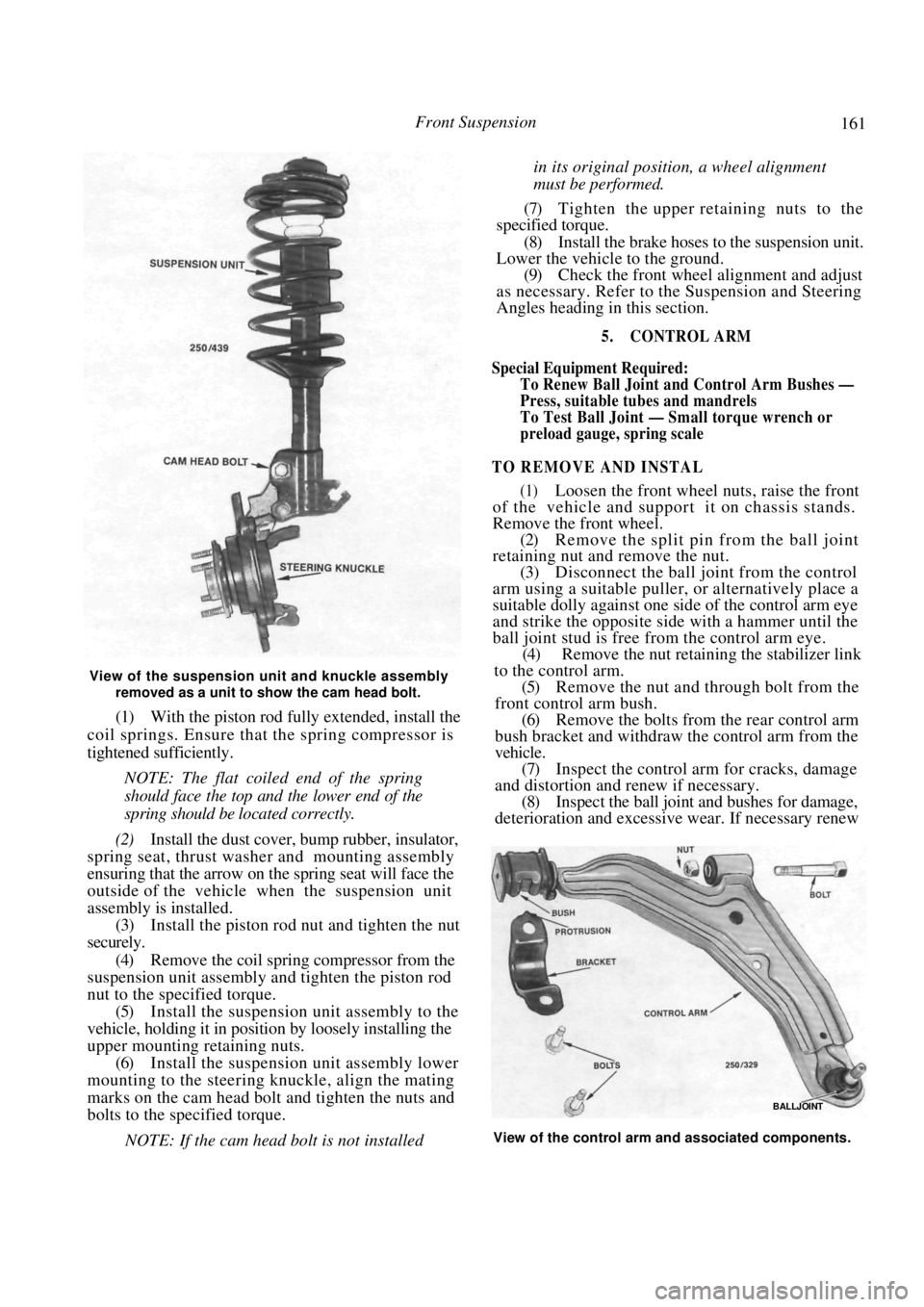
View of the suspension unit and knuckle assembly removed as a unit to show the cam head bolt.
(1) With the piston rod fully extended, install the
coil springs. Ensure that the spring compressor is
tightened sufficiently.
NOTE: The flat coiled end of the spring
should face the top and the lower end of the
spring should be located correctly.
(2) Install the dust cover, bump rubber, insulator,
spring seat, thrust washer and mounting assembly
ensuring that the arrow on the spring seat will face the
outside of the vehicle when the suspension unit
assembly is installed.
(3) Install the piston rod nut and tighten the nut
securely.
(4) Remove the coil spring compressor from the
suspension unit assembly and tighten the piston rod
nut to the specified torque. (5) Install the suspension unit assembly to the
vehicle, holding it in position by loosely installing the
upper mounting retaining nuts. (6) Install the suspension unit assembly lower
mounting to the steering knuckle, align the mating
marks on the cam head bolt and tighten the nuts and
bolts to the specified torque.
NOTE: If the cam head bolt is not installed
in its original position, a wheel alignment
must be performed.
(7) Tighten the upper retaining nuts to the
specified torque.
(8) Install the brake hoses to the suspension unit.
Lower the vehicle to the ground.
(9) Check the front wheel alignment and adjust
as necessary. Refer to the Suspension and Steering
Angles heading in this section.
5. CONTROL ARM
Special Equipment Required:
To Renew Ball Joint and Control Arm Bushes —
Press, suitable t ubes and mandrels
To Test Ball Joint — Small torque wrench or
preload gauge, spring scale
TO REMOVE AND INSTAL
(1) Loosen the front wheel nuts, raise the front
of the vehicle and support it on chassis stands.
Remove the front wheel.
(2) Remove the split pin from the ball joint
retaining nut and remove the nut.
(3) Disconnect the ball joint from the control
arm using a suitable puller, or alternatively place a
suitable dolly against one si de of the control arm eye
and strike the opposite side with a hammer until the
ball joint stud is free from the control arm eye. (4) Remove the nut retaining the stabilizer link
to the control arm.
(5) Remove the nut and through bolt from the
front control arm bush. (6) Remove the bolts from the rear control arm
bush bracket and withdraw the control arm from the
vehicle. (7) Inspect the control arm for cracks, damage
and distortion and renew if necessary. (8) Inspect the ball joint and bushes for damage,
deterioration and excessive wear. If necessary renew
BALLJOINT
View of the control arm and associated components.
Page 162 of 238

162 Front Suspension
the ball joint or bushes as described later in this
section.
Installation is a reversal of the removal procedure
with attention to the following points:
(1) When installing the control arm bush
bracket, ensure that the protrusion on the bracket is
towards the inside of the vehicle.
(2) Do not fully tighten the control arm bush
bolts and through bolt nut until the curb weight of the
vehicle is on the suspension.
NOTE: Curb weight is with the vehicle
unladen except for a full tank of fuel and
normal amounts of oil and water and with
the spare lyre, jack and hand tools in their
normal positions.
(3) Tighten the ball joint nut to the specified
torque and retain with a new split pin.
TO CHECK AND RENEW BALL JOINT
(1) Remove the control arm from the vehicle as
previously described.
(2) Install the ball joint nut and turn the ball
joint at least ten revolutions to ensure that the ball
joint is correctly seated. (3) Using a spring scale with the hook placed
over the split pin hole, check the ball joint swinging
torque. A new ball joint should measure 15.7-80.4 N
and a used ball joint should measure 7.8-80.4 N.
Renew the ball joint if necessary. (4) Using a small torque wrench or preload
gauge, measure the force requi red to rotate the ball
joint. A new ball joint should measure between
1.0-4.9 Nm and a used ball joint should measure
between 0.5-4.9 Nm. Renew the ball joint if neces-
sary.
(5) To renew the ball joint, remove the snap ring
from the stud end of the ball joint using snap ring
pliers. (6) Support the control arm in a press, ball joint
stud uppermost, with a suitable tube that is large
enough for the ball joint to pass through. (7) Press the ball joint out from the control arm.
(8) Press a new ball joint into the control arm
using a suitable tube that pushes on the outer circum-
ference of the joint only.
(9) Install the snap ring and install the
control
arm to the vehicle as previously described.
TO RENEW CONTROL ARM BUSHES
(1) Remove the control arm from the vehicle as
previously described. Mark the position of the rear
control arm bush. (2) To remove the rear control arm bush use a
bearing puller and a press. When installing the bush
use a suitable tube that pushes on the inner edge of the
bush only. NOTE: Ensure that the bush is installed
with the flat portion in its original location.
(3)
To remove the front control arm bush use a
suitable tube that pushes on the outer circumference
of the bush and a split tu be supporting the control
arm. (4) After the bush has been pressed out approx-
imately half way, cut the protruding part of the bush
using a hacksaw. Cutting the bush in this way will
allow removal.
(5) Support the control arm and push the new
bush in from the outside using a suitable tube that
pushes on the outer circumference only. (6) Install the control ar m to the vehicle as
previously described.
6. STABILISER BAR
TO REMOVE AND INSTAL
(1) Raise the front of the vehicle and support it
on chassis stands.
(2) Remove the bolts at the flexible joint retain-
ing the front engine pipe to the exhaust pipe located
below the stabilizer bar. (3) Remove the bolt from the exhaust pipe
mounting below the stabilizer bar. Disconnect the
exhaust pipe at the flexible joint and allow the front of
the pipe to hang down. (4) Remove the stabilizer bar bracket retaining
bolts and remove the stabilizer bar brackets from the
vehicle. (5) Remove the stabilizer bar lower link nuts
from each control arm. When removing the lower nuts
it may be necessary to hold the upper nuts with a
spanner.
(6) Maneuver the stabilizer bar from the
vehicle.
Installation is a reversal of the removal procedure
with attention to the following points:
(1) Ensure that the stabilizer bar mounting rub-
bers are in a serviceable condition and secure in the
mounting brackets.
Dismantled view of one end of the stabilizer bar.
Page 163 of 238
Front Suspension 163
(2) Ensure that the stabilizer bar links are in
good condition. Renew if necessary.
(3) When installing the stabilizer bar ensure that
the links are installed perpendicular to the control arm
with the ball joint socket face parallel to the end of the
stabilizer bar. (4) Ensure that the brackets are installed with
the flat portion facing towards the front of the vehicle.
Tighten the retaining bolts securely.
7. SUSPENSION AND STEERING ANGLES
ADJUSTMENT
NOTE: Extensive knowledge and special-
ised equipment are required to measure and
correct the suspension and steering angles
with the exception of the front wheel toe in.
Therefore, as it is not a viable proposition
for the average person to carry out a com-
plete wheel alignment, the vehicle should be
taken to a wheel alignment specialist.
Prior to carrying out a wheel alignment, a thor-
ough inspection of the steering linkage, front hub
bearings, ball joints and suspension units should be
carried out. Faulty components should be renewed or
repaired as necessary.
The tread of the front ti res should be examined
for excessive or uneven wear as certain conditions of
tire wear are indicative of damaged or worn compo-
nents in the suspension, stee ring linkage and/or wheels
and bearings. Refer to the heading Tire Wear Trouble
Shooting in the Wheels and Tires section. If the tires
are found to be defective, renew them with serviceable
lyres.
TO CHECK AND ADJUST TOE IN/OUT
NOTE: The vehicle s hould be unladen ex-
cept for the normal amount of fuel and with
the tires inflated to the correct pressures.
(1) With the vehicle on a level floor, raise the
front of the vehicle and s upport it on chassis stands.
(2) Spin each front wheel in turn and using a
piece of chalk, mark a line around the periphery of
each tire as near to the centre as possible. (3) Lower the vehicle to the ground and bounce
the front several times to stabilize the suspension. (4) Set the wheels in the straight ahead position.
(5) Mark the centre chalk line on both tires at a
point approximately 200 mm above the floor and
forward of the suspension. (6) Using a tape measure, measure and record
the distance between the two marked points on the
tire centers.
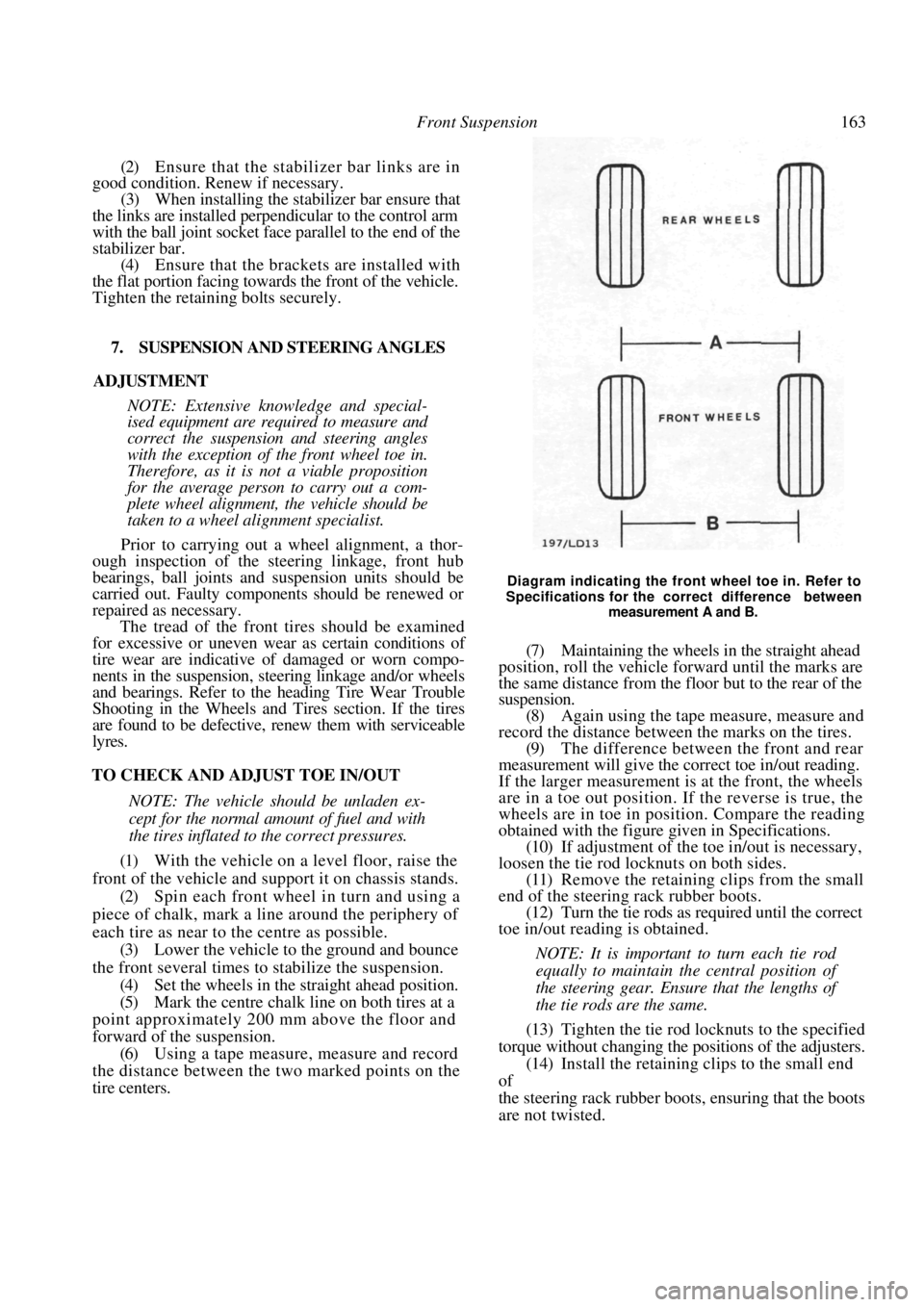
Diagram indicating the front wheel toe in. Refer to
Specifications for the correct difference between
measurement A and B.
(7) Maintaining the wheels in the straight ahead
position, roll the vehicle forward until the marks are
the same distance from the floor but to the rear of the
suspension. (8) Again using the tape measure, measure and
record the distance between the marks on the tires.
(9) The difference between the front and rear
measurement will give the correct toe in/out reading.
If the larger measurement is at the front, the wheels
are in a toe out position. If the reverse is true, the
wheels are in toe in position. Compare the reading
obtained with the figure given in Specifications.
(10) If adjustment of the to e in/out is necessary,
loosen the tie rod locknuts on both sides. (11) Remove the retaining clips from the small
end of the steering rack rubber boots. (12) Turn the tie rods as required until the correct
toe in/out reading is obtained.
NOTE: It is important to turn each tie rod
equally to maintain the central position of
the steering gear. Ensure that the lengths of
the tie rods are the same.
(13) Tighten the tie rod locknuts to the specified
torque without changing the positions of the adjusters.
(14) Install the retaining clips to the small end
of
the steering rack rubber boots, ensuring that the boots
are not twisted.