suspension NISSAN PULSAR 1987 Owner's Guide
[x] Cancel search | Manufacturer: NISSAN, Model Year: 1987, Model line: PULSAR, Model: NISSAN PULSAR 1987Pages: 238, PDF Size: 28.91 MB
Page 184 of 238
184 Brakes
than 0.05 mm. If the wheel hub end float exceeds
Specifications, the bearing must be renewed as de-
scribed in the Rear Suspension section.
(3) Position the dial gauge plunger against the
centre of the brake disc contact area. Rotate the hub
and measure the runout. Ma ximum allowable runout
is 0.07 mm. (4) If the runout exceeds the specified amount,
machine or renew the brake disc. (5) Install the rear wheel and lower the vehicle to
the ground. (6) Road test the vehicle and check for correct
brake operation.
To Remove and Install
(1) Raise the rear of the vehicle and support it
on chassis stands. Remove the relevant rear wheel.
(2) Remove the clip securing the brake hose to
the suspension unit and disengage the hose. (3) Remove the bolts retaining the caliper an-
chor plate. (4) Slide the caliper from the brake disc and
suspend the caliper clear of the work area using wire
or cord.
NOTE: Do not allow the caliper to hang on
the brake hose.
(5) Remove the grease cap from the rear hub.
(6) Remove the split pin, nut retainer, hub nut
and washer from the stub axle. (7) Remove the hub assembly from the stud
axle. Installation is a reversal of the removal procedure
with attention to the following points:
(1) Tighten the rear hub to the specified torque.
(2) Install the brake caliper and tighten all the
bolts to the specified torque. (3) Rotate the hub and check for roughness. If
the hub does not rotate smoothly, renew the hub
bearing as described in the Rear Suspension section. (4) Install the rear wheel and lower the vehicle to
the ground.
(5) Road test the vehicle and check for correct
brake operation.
To Inspect
(1) Inspect the machined faces of the disc for
scores, cracks, wear and signs of overheating. (2) Using a micrometer, measure the thickness
of the disc at several posit ions around the face of the
disc. Renew the disc if the minimum thickness is
below Specifications.
(3) If the disc thickness is satisfactory but the
disc is scored, machine equal amounts from the
machined face on each side of the disc, to restore the
serviceability of the disc.
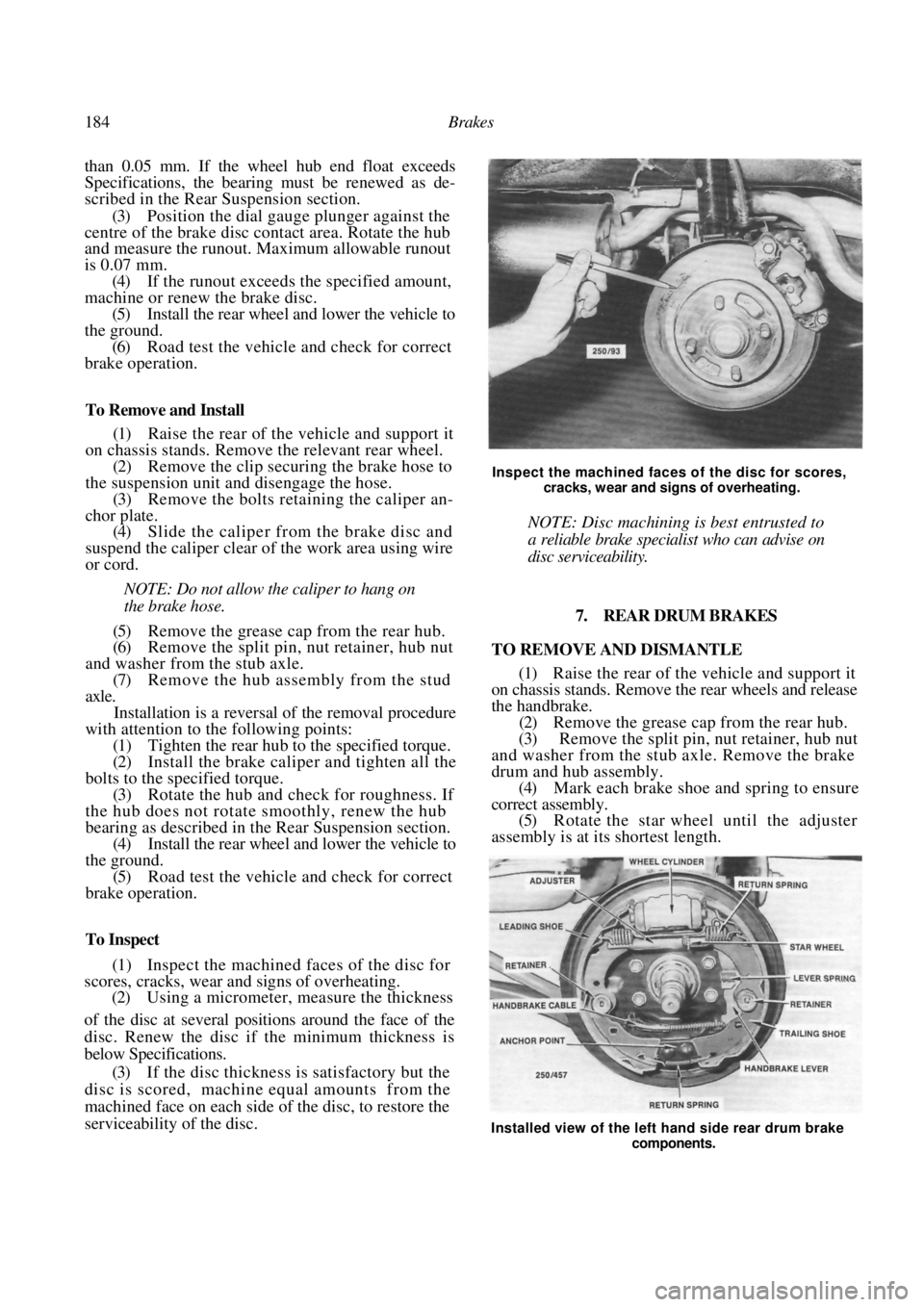
Inspect the machined faces of the disc for scores,
cracks, wear and signs of overheating.
NOTE: Disc machining is best entrusted to
a reliable brake specialist who can advise on
disc serviceability.
7. REAR DRUM BRAKES
TO REMOVE AND DISMANTLE
(1) Raise the rear of the vehicle and support it
on chassis stands. Remove th e rear wheels and release
the handbrake.
(2) Remove the grease cap from the rear hub.
(3) Remove the split pin, nut retainer, hub nut
and washer from the stub axle. Remove the brake
drum and hub assembly.
(4) Mark each brake shoe and spring to ensure
correct assembly. (5) Rotate the star wheel until the adjuster
assembly is at its shortest length.
Installed view of the left hand side rear drum brake
components.