warning NISSAN PULSAR 1987 User Guide
[x] Cancel search | Manufacturer: NISSAN, Model Year: 1987, Model line: PULSAR, Model: NISSAN PULSAR 1987Pages: 238, PDF Size: 28.91 MB
Page 109 of 238
Fuel and Engine Management 109
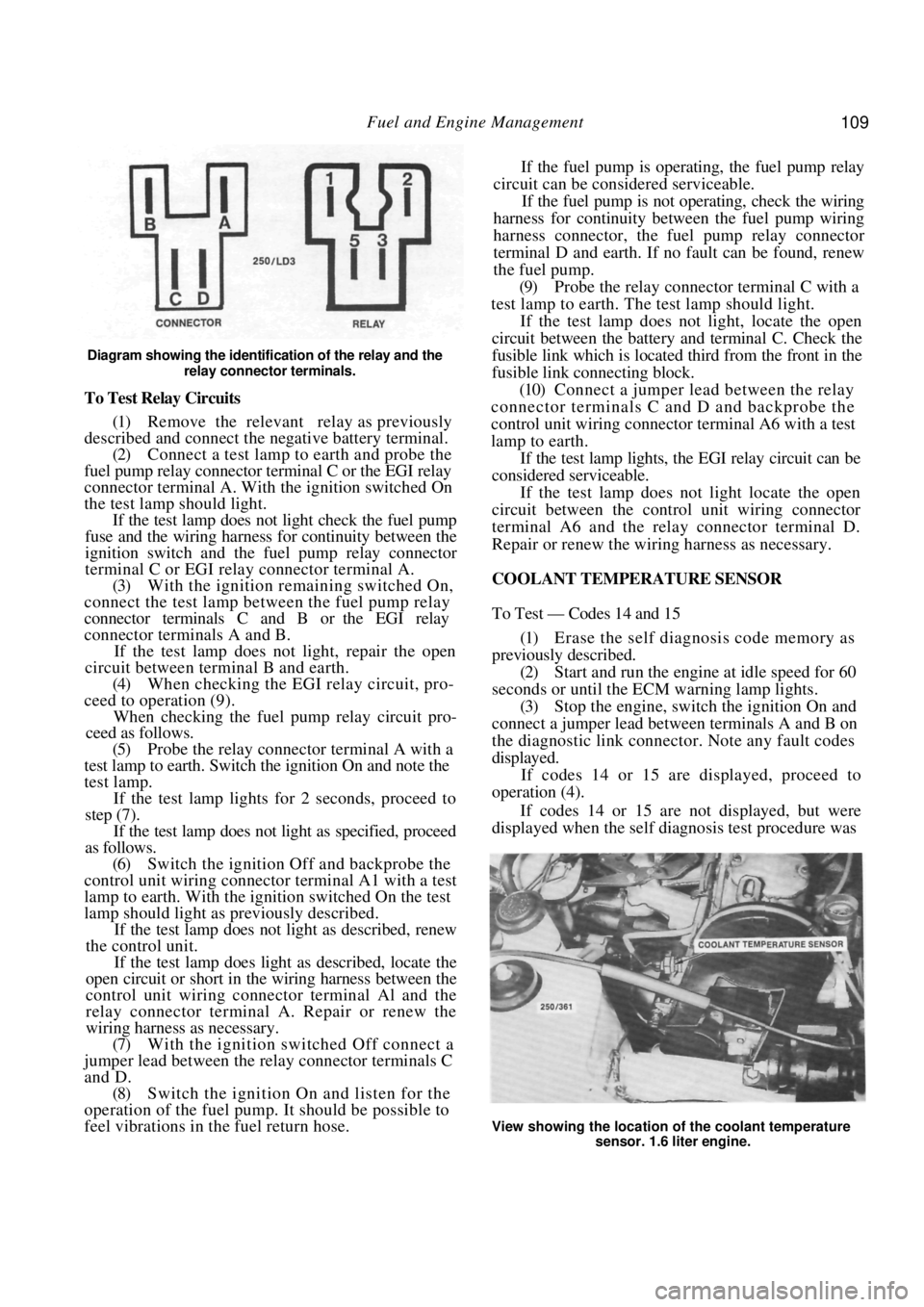
Diagram showing the identification of the relay and the relay connector terminals.
To Test Relay Circuits
(1) Remove the relevant relay as previously
described and connect the ne gative battery terminal.
(2) Connect a test lamp to earth and probe the
fuel pump relay connector terminal C or the EGI relay
connector terminal A. With the ignition switched On
the test lamp should light. If the test lamp does not light check the fuel pump
fuse and the wiring harness for continuity between the
ignition switch and the fuel pump relay connector
terminal C or EGI rela y connector terminal A.
(3) With the ignition remaining switched On,
connect the test lamp between the fuel pump relay
connector terminals C and B or the EGI relay
connector terminals A and B.
If the test lamp does not light, repair the open
circuit between terminal B and earth.
(4) When checking the EGI relay circuit, pro-
ceed to operation (9).
When checking the fuel pu mp relay circuit pro-
ceed as follows.
(5) Probe the relay connector terminal A with a
test lamp to earth. Switch the ignition On and note the
test lamp.
If the test lamp lights for 2 seconds, proceed to
step (7).
If the test lamp does not light as specified, proceed
as follows.
(6) Switch the ignition Off and backprobe the
control unit wiring connector terminal A1 with a test
lamp to earth. With the ignition switched On the test
lamp should light as previously described.
If the test lamp does not light as described, renew
the control unit.
If the test lamp does light as described, locate the
open circuit or short in the wiring harness between the
control unit wiring connector terminal Al and the
relay connector terminal A. Repair or renew the
wiring harness as necessary.
(7) With the ignition switched Off connect a
jumper lead between the relay connector terminals C
and D. (8) Switch the ignition On and listen for the
operation of the fuel pump. It should be possible to
feel vibrations in the fuel return hose. If the fuel pump is operating, the fuel pump relay
circuit can be considered serviceable.
If the fuel pump is not operating, check the wiring
harness for continuity between the fuel pump wiring
harness connector, the fuel pump relay connector
terminal D and earth. If no fault can be found, renew
the fuel pump.
(9) Probe the relay connector terminal C with a
test lamp to earth. The test lamp should light.
If the test lamp does not light, locate the open
circuit between the battery and terminal C. Check the
fusible link which is located third from the front in the
fusible link connecting block.
(10) Connect a jumper lead between the relay
connector terminals C and D and backprobe the
control unit wiring connector terminal A6 with a test
lamp to earth.
If the test lamp lights, the EGI relay circuit can be
considered serviceable.
If the test lamp does not light locate the open
circuit between the contro l unit wiring connector
terminal A6 and the relay connector terminal D.
Repair or renew the wiring harness as necessary.
COOLANT TEMPERATURE SENSOR
To Test — Codes 14 and 15
(1) Erase the self diagnosis code memory as
previously described. (2) Start and run the engine at idle speed for 60
seconds or until the ECM warning lamp lights.
(3) Stop the engine, switch the ignition On and
connect a jumper lead between terminals A and B on
the diagnostic link connect or. Note any fault codes
displayed. If codes 14 or 15 are displayed, proceed to
operation (4).
If codes 14 or 15 are not displayed, but were
displayed when the self diagnosis test procedure was
View showing the location of the coolant temperature
sensor. 1.6 liter engine.
Page 110 of 238

110 Fuel and Engine Management
originally performed, an intermittent fault is indi-
cated. Proceed as follows:
(a) Check for faulty wiri ng connections. Check
that all wiring connectors are clean and secure. (b) Check that all earth wires are secure.
(4) Disconnect the wiring connector from the
coolant temperature sensor. (5) With the ignition switched On, measure the
voltage across the terminals on the coolant tempera-
ture sensor wiring connector. The voltage should be
4-6 volts.
If the voltage is below 4 volts, proceed to opera-
tion (9).
If the voltage is as specified, proceed as follows.
(6) Remove the coolant temperature sensor
from the vehicle. (7) Connect an ohmmeter to the coolant temper-
ature sensor terminals. (8) Immerse the meta1 end of the coolant
tem-
perature sensor in a 50/50 mixture of glycol and iced
water at a temperature of 0 deg C. The resistance
should be 6 000 ohms. Slowly heat the mixture and measure the resis-
tance of the coolant temperature sensor at the follow-
ing temperatures. Compare the results with the spec-
ified values:
0 d e g C ................................................. 6 000 ohms
20 deg C .................................................. 2 500 ohms
30 deg C .................................................. 1 800 ohms
40 deg C.................................................. 1 200 ohms
70 deg C .......................................................450 ohms
90 degC .......................................................250 ohms
100 deg C.....................................................190 ohms
110 deg C.....................................................110 ohms
If the resistances obtained are not as specified at
any of the given temperatures, renew the coolant
temperature sensor and retest for fault codes.
(9) Disconnect the control unit wiring connec-
tors.
(10) Check the wiring harness for shorts and
continuity between the coolant temperature sensor
wiring connector terminals and the control unit wiring
connector terminals C10 and D2. Repair or renew the
wiring harness as necessary.
Also check the control unit terminals for damage.
If no fault is found, renew the control unit and
retest for fault codes.
To Remove and Install
(1) Disconnect the negative battery terminal.
(2) Disconnect the wiring connector from the
coolant temperature sensor.
(3) Drain the coolant as described in the Cooling
and Heating Systems section to a level below the
sensor.
(4) Unscrew the sensor from the thermostat
housing. Installation is a reversal of the removal procedure
with attention to the following points;
(1) Apply Loctite 675 or a similar conductive
sealer to the threads of th e sensor. Tighten the sensor
to the specified torque.
(2) Fill the cooling system with the correct
mixture of water and inhibitor as described in the
Cooling and Heating Systems section. (3) Ensure that the wiring connector is clean and
secure.
THROTTLE POSITION SENSOR
To Test - Codes 21 and 22
NOTE: The following test procedure as-
sumes that fault codes 21 or 22 have been
displayed during the se lf diagnosis test pro-
cedure. If no codes have been displayed but
the operation of the throttle position sensor
is suspect, begin the test procedure at oper-
ation (24).
(1) Erase the self diagnosis code memory as
previously described.
(2) Start and run the engine at idle speed for 60
seconds or until the ECM warning lamp lights. If the engine will not start, disconnect the throttle
position sensor wiring co nnector and proceed to
operation (8). .
(3) With the engine id ling, quickly increase the
engine speed to 3 000 rpm and return to idle.
If the ECM warning lamp remains illuminated,
proceed to operation (4).
If the ECM warning lamp extinguishes, an inter-
mittent fault is indicated. Proceed as follows:
(a) Check for faulty wiri ng connections. Check
that all wiring connectors are clean and secure. (b) Check that all earth wires are secure.
(4) Stop the engine, switch the ignition On and
connect a jumper lead between terminals A and B on
the diagnostic link connect or. Note any fault codes
displayed.
If codes 21 or 22 are displayed, proceed as
follows.
(5) Remove the jumper lead from the diagnostic
link connector. (6) Erase the self diagnosis codes as previously
described. (7) Disconnect the wiring connector from the
throttle position sensor. If code 22 was displayed in operation (4), proceed
to operation (13).
If code 21 was displayed in operation (4), proceed
as follows.
(8) Start and run the engine at idle speed for 2
minutes or until the ECM warning lamp lights. If the
engine will not start, pr oceed to operation (11).
(9) Stop the engine, switch the ignition On and
connect a jumper lead between terminals A and B on
Page 112 of 238
112 Fuel and Engine Management
If the voltage does not increase as specified, renew
the throttle position sensor.
If the voltage is as specified, proceed as follows.
(28) With the ignition switched On and the
throttle valve held fully open, measure the voltage at
control unit wiring connector terminal C13. The
voltage should be above 4 volts.
If the voltage is below 4 volts, renew the throttle
position sensor.
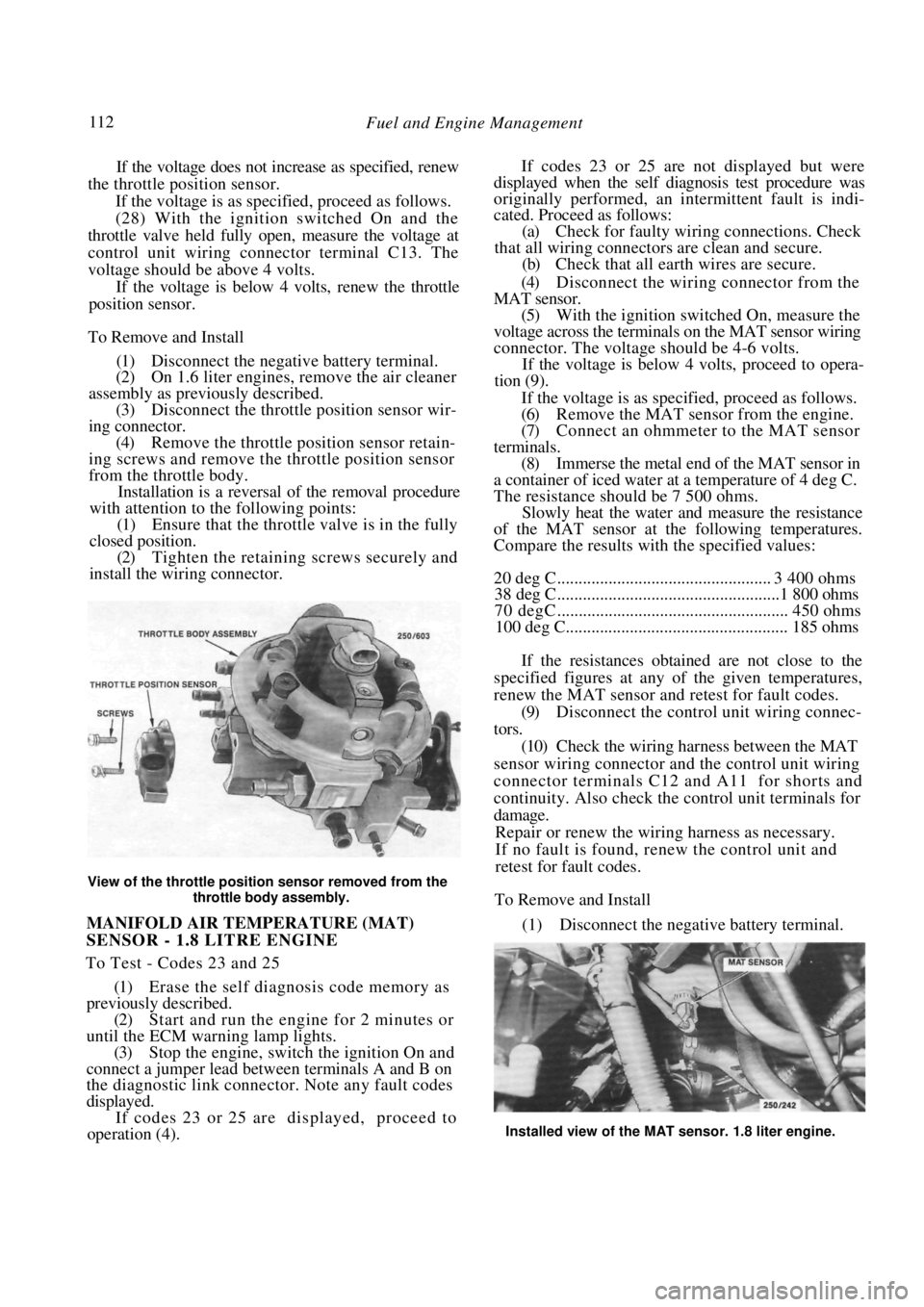
To Remove and Install
(1) Disconnect the negative battery terminal.
(2) On 1.6 liter engines, remove the air cleaner
assembly as previously described. (3) Disconnect the throttle position sensor wir-
ing connector. (4) Remove the throttle position sensor retain-
ing screws and remove the throttle position sensor
from the throttle body. Installation is a reversal of the removal procedure
with attention to the following points:
(1) Ensure that the throttle valve is in the fully
closed position. (2) Tighten the retaining screws securely and
install the wiring connector.
View of the throttle positi on sensor removed from the
throttle body assembly.
MANIFOLD AIR TEMPERATURE (MAT)
SENSOR - 1.8 LITRE ENGINE
To Test - Codes 23 and 25
(1) Erase the self diagnosis code memory as
previously described.
(2) Start and run the engine for 2 minutes or
until the ECM warning lamp lights. (3) Stop the engine, switch the ignition On and
connect a jumper lead between terminals A and B on
the diagnostic link connector . Note any fault codes
displayed. If codes 23 or 25 are displayed, proceed to
operation (4).
If codes 23 or 25 are not displayed but were
displayed when the self diagnosis test procedure was
originally performed, an intermittent fault is indi-
cated. Proceed as follows:
(a) Check for faulty wiri ng connections. Check
that all wiring connectors are clean and secure. (b) Check that all earth wires are secure.
(4) Disconnect the wiring connector from the
MAT sensor. (5) With the ignition switched On, measure the
voltage across the terminals on the MAT sensor wiring
connector. The voltage s hould be 4-6 volts.
If the voltage is below 4 volts, proceed to opera-
tion (9).
If the voltage is as specified, proceed as follows.
(6) Remove the MAT sensor from the engine.
(7) Connect an ohmmeter to the MAT sensor
terminals. (8) Immerse the metal end of the MAT sensor in
a container of iced water at a temperature of 4 deg C.
The resistance should be 7 500 ohms. Slowly heat the water and measure the resistance
of the MAT sensor at the following temperatures.
Compare the results with the specified values:
20 deg C .................................................. 3 400 ohms
38 deg C....................................................1 800 ohms
70 degC ...................................................... 450 ohms
100 deg C.................................................... 185 ohms
If the resistances obtained are not close to the
specified figures at any of the given temperatures,
renew the MAT sensor and retest for fault codes.
(9) Disconnect the control unit wiring connec-
tors. (10) Check the wiring harness between the MAT
sensor wiring connector and the control unit wiring
connector terminals C12 and A11 for shorts and
continuity. Also check the control unit terminals for
damage. Repair or renew the wiring harness as necessary.
If no fault is found, renew the control unit and
retest for fault codes.
To Remove and Install
(1) Disconnect the negative battery terminal.
Installed view of the MAT sensor. 1.8 liter engine.
Page 113 of 238

Fuel and Engine Management 113
(2) Disconnect the wiring connector from the
MAT sensor.
(3) Unscrew the sensor from the inlet manifold.
Installation is a reversal of the removal procedure
with attention to the following points:
(1) Apply Loctite 567 or a similar conductive
sealer to the threads of th e sensor. Tighten the sensor
to the specified torque. (2) Ensure that the wiring connector is clean and
tight.
OXYGEN SENSOR
To Test - Code 13
(1) Run the engine until the normal operating
temperature is obtained. (2) With the ignition switched Off, connect a
jumper lead between terminals A and B on the
diagnostic link connector.
(3) Start and run the engi ne at approximately
1 600-1 800 rpm for 2 minutes and note the ECM
warning lamp.
If the ECM warning lamp flashes at the rate of
twice per second, proceed to operation (5).
If the ECM warning lamp flashes at the rate of
once per second or slower, proceed as follows.
(4) Remove the jumper lead from the diagnostic
link connector and run th e engine above 2 000 rpm
for 2 minutes, noting the ECM warning lamp.
If the ECM warning lamp lights, stop the engine,
switch the ignition On and connect a jumper lead
between terminals A and B on the diagnostic link
connector. If code 13 is displayed proceed to opera-
tion (5).
If the ECM warning lamp does not light, an
intermittent fault is indicated. Proceed as follows:
(a) Check for faulty wiri ng connections. Check
that all wiring connectors are clean and secure.
(b) Check that all earth wires are secure.
(5) Switch the ignition Off and disconnect the
oxygen sensor wiring connector. Using a jumper lead
connect the oxygen sensor wiring connector to a
suitable engine earth. (6) Start and run the engi ne at approximately
1 600-1 800 rpm and note the ECM warning lamp.
The lamp may flash for a few seconds but should then
extinguish for at least 30 seconds.
If the ECM warning lamp functions as described,
proceed to operation (7).
If the ECM warning lamp does not function as
described proceed as follows:
(a) Check the wiring harness between the oxygen
sensor wiring connector and the control unit wiring
connector D7 for open circuits. Repair or renew the
wiring harness as necessary.
{b) Check the earth circuit between the control
unit wiring connect D6 and the right rear cylinder
head bolts. Repair or renew the wiring harness as
necessary.
(c) If no fault is found in (a) and (b) renew the
control unit and retest for fault codes.
(7) Check the wiring harness earth circuit be-
tween the control unit wiring connector D6 and the
right rear cylinder head bolts. Repair or renew the
wiring harness as necessary.
If no fault is found, thoroughly check the oxygen
sensor connector. If the conne ctor is not faulty, renew
the oxygen sensor.
To Test - Code 44
(1) Run the engine until normal operating tem-
perature is attained.
(2) With the ignition switched Off, connect a
jumper lead between terminals A and B on the
diagnostic link connector. (3) Start and run the engi ne at approximately
1 600-1 800 rpm for 2 minutes and note the ECM
warning lamp. If the ECM warning lamp is off more than on or
flashes at the rate of twice per second, proceed to
operation (4).
If the ECM warning lamp flashes evenly at the
rate of once per second an intermittent fault is
indicated. Proceed as follows:
(a) Check for faulty wiri ng connections. Check
that all wiring connectors are clean and secure. (b) Check that all earth wires are secure.
(4) Switch the engine Off and disconnect the
oxygen sensor wiring connector.
(5) Start and run the engine at 1 600-1 800 rpm
for at least 30 seconds and note the ECM warning
lamp. If the ECM warning lamp flashes at the rate of
twice per second procee d to operation (6).
If the ECM warning lamp extinguishes for at least
30 seconds, check the wiring harness between the
oxygen sensor wiring connector and the control unit
wiring connector terminal D7 for shorts to earth.
Repair or renew the wiring harness as necessary.
If no fault can be found in the wiring harness, renew
the control unit.
Installed view of the oxygen sensor.
Page 114 of 238

114 Fuel and Engine Management
(6) Check the vehicle for the following:
(a) Low fuel pressure.
(b) Contaminated fuel.
(c) Vacuum leaks at the inlet manifold, engine
vacuum hoses and engine ventilation hoses. (d) Exhaust manifold leaks before the oxygen
sensor. (e) Correct MAP sensor operation.
(f) Blocked oxygen sensor metal vent cover eg.
plugged with mud etc. (g) Fuel injectors) partially blocked. Refer to a
fuel injection specialis t or a Nissan dealer.
If the above items have been checked and no
faults have been found, a faulty oxygen sensor is
indicated. Renew the oxygen sensor, run the engine
and ensure that no fault codes are set.
To Test — Code 45
(1) Run the engine until normal operating tem-
perature is attained. (2) With the ignition switched Off, connect a
jumper lead between terminals B and A on the
diagnostic link connector. (3) Start and run the engine at approximately
1 600-1 800 rpm for 2 minutes and note the ECM
warning lamp. If the ECM warning lamp is on more than off or
flashes at the rate of twice per second, proceed to the
following operation.
If the ECM warning lamp flashes evenly at the
rate of once per second an intermittent fault is
indicated. Proceed as follows:
(a) Check for faulty wiri ng connections. Check
that all wiring connectors are clean and secure. (b) Check that all earth wires are secure.
(4) Switch the engine Off and disconnect the
oxygen sensor wiring connector. (5) Using a jumper lead, connect the oxygen
sensor wiring connector to a suitable engine earth. (6) Start and run the engine at 1 600-1 800 rpm
and note the ECM warning lamp.
If the ECM warning lamp extinguishes for at least
30 seconds, proceed to operation (7).
If the ECM warning lamp flashes on more than off
or flashes at the rate of twice per second, switch the
engine Off and disconnect the control unit wiring
connectors. Using an ohmmeter, check that there is no
resistance between the co ntrol unit wiring connector
terminal D6 and earth. Repair or renew the wiring as
necessary.
If no fault can be found in the wiring harness,
renew the control unit.
NOTE: The wiring harness for terminal D6
earths through the righ t hand rear cylinder
head bolt.
(7) Check the vehicl e for the following:
(a) High fuel pressure.
(b) Leaking injector(s).
(c) Faulty ignition wiring.
(d) Charcoal canister purge system blocked or
restricted.
(e) Faulty coolant temper ature sensor circuit.
(f) Faulty MAT sensor circuit (1.8 liter engine).
(g) MAP sensor operation.
(h) Throttle position sensor operation.
If the above items have been checked and no
faults have been found, a faulty oxygen sensor is
indicated.
Renew the oxygen sensor, run the engine and
ensure that no fault codes are set.
To Remove and Install
(1) If the engine is cold, run the engine for
approximately two minutes to allow easy oxygen
sensor removal. (2) Disconnect the negative battery terminal and
the oxygen sensor connector.
View of the oxygen sensor removed from the exhaust
manifold.
(3) Remove the exhaust manifold heat shield
retaining bolts and remove the heat shield from the
engine.
(4) Remove the oxygen sensor with a short ring
spanner using care not to damage the sensor wire. Installation is a reversal of the removal procedure
with attention to the following points:
(1) When installing a sensor that has previously
been removed, coat the sen sor threads with anti-seize
compound. Nissan recommend a mixture of liquid
graphite and glass beads. (2) Install the sensor and tighten to the specified
torque. (3) Connect the electrical connector ensuring
that the wiring is secured away from the exhaust. (4) Install the heat shield and tighten the retain-
ing bolts securely. On 1.6 liter engines, ensure that the hot air inlet
tube is located correctly be tween the heat shield and
the air cleaner housing.
(5) Start the engine and check for leaks.
VEHICLE SPEED SENSOR
To Test - Code 24
(1) Check the fuel pump and meter fuses. If the
fuses are serviceable, proceed to operation (5). If a
fuse is blown, rectify the cause and renew the fuse.
Page 115 of 238

Fuel and Engine Management 115
Erase the fault codes and retest for fault codes as
follows:
(2) Start and run the engine until normal oper-
ating temperature is attained. (3) Drive the vehicle at a speed of at least 80
km/h and, with the throttle closed, allow the vehicle to
decelerate until the engine speed is below 1 500 rpm.
NOTE: After rectifying any fault it will be
necessary to retest for fault codes. To test for
Code 24 the vehicle must be driven as
previously described.
(4) Switch the engine Off and connect a jumper
lead between terminals A and B on the diagnostic link
connector. Switch the ignition On and note the fault
codes. If code 24 is displayed proceed as follows. (5) Check the operation of the speedometer and
the instrument cluster warning lamps. If the speed-
ometer only is not functioning, proceed to operation
(13).
If the speedometer and the instrument cluster
warning lamps are not functioning, a fault in the
instrument cluster wiring harness is indicated. Refer
the fault to an auto electrical workshop or a Nissan
dealer.
If the speedometer is functioning, proceed as
follows:
(6) Raise the front of the vehicle and support it
on chassis stands. (7) Place the transaxle in Neutral and switch the
ignition On. (8) With the aid of assistants, slowly spin the
front wheels by hand while backprobing the control
unit wiring connector terminal A10 with a digital
voltmeter to earth. The voltage should alternate from under 1 volt to
over 10 volts.
If the voltmeter readi ng is not as specified,
proceed to operation (9).
If the voltmeter reading is as specified, the vehicle
speed sensor is operating satisfactorily, indicating an
intermittent fault was the cause of the fault code.
Proceed as follows:
(a) Check for faulty wiri ng connections. Check
that all wiring connectors are clean and secure. (b) Check that all earth c onnections are secure.
(9) Remove the instrument cluster as described
in the Electrical System section. (10) With the ignition switched On, backprobe
the control unit wiring connector terminal A10 with a
voltmeter to earth. The voltage should be over 10
volts. If the voltage is less than specified, check the
wiring harness for shorts to earth between the black
and yellow wire terminal on the instrument cluster
wiring connector and the control unit connector
terminal A10. Repair or renew the wiring harness as
necessary. If no fault can be found, renew the control
unit.
(11) With the ignition switched On, backprobe
the black and yellow wire terminal on the instrument
cluster wiring connector with a voltmeter to earth.
The voltage should be over 10 volts.
If the voltage is less than specified, locate the open
circuit between the instrument cluster black and
yellow wire terminal and the control unit wiring
connector terminal A10. Repair or renew the wiring
harness as necessary.
(12) With a test lamp connected to 12 volts,
backprobe the black wire terminals on the instrument
cluster wiring connectors. The test lamp should light.
If the test lamp does not light locate the open
circuit between the black wire terminals and earth.
Repair or renew the wiring harness as necessary.
If the test lamp does light, renew the signal
divider circuit board which is located in the instru-
ment cluster.
(13) With the ignition switched On and the
engine not running, disconnect the vehicle speed
sensor wiring connector from the harness connector.
(14) With a test lamp connected to earth, probe
the yellow wire terminal on the harness wiring con-
nector. The test lamp should light. If the test lamp does not light, locate the open
circuit between the yellow wi re terminal and the Fuel
Pump fuse. Repair or renew the wiring harness as
necessary.
(15) With a test lamp connected to 12 volts,
probe the black wire terminal on the harness wiring
connector. The test lamp should light.
If the test lamp does not light, locate the open
circuit between the black wire terminal and earth.
Repair or renew the wiring harness as necessary.
(16) Using a voltmeter measure the voltage at the
red wire terminal on the harness wiring connector.
If the voltage is 5-9 volts proceed to operation
(19).
If the voltage is over 9 vol ts proceed to operation
(18).
Installed view of the vehicle speed sensor.
Page 186 of 238

186 Brakes
(7) Using a pair of pliers, compress the hand-
brake cable spring and install the cable to the hand-
brake lever.
(8) Position the trailing shoe on the backing
plate with the upper end located on the wheel cylinder
piston and the lower end on the anchor plate. (9) Install the adjuster assembly to the
trailing
shoe ensuring that the adjuster fork is correctly
located on the upper end of the shoe. (10) Install the pin, spring and retainer to the
trailing shoe, turn the reta iner through 90 degrees and
secure the brake shoe to the backing plate. (11) Connect the upper and lower return springs
to the trailing shoe as noted on removal. (12) Position the leading shoe on the backing
plate with the upper end located on the wheel cylinder
piston and the lower end on the anchor plate. Ensure
that the adjuster assembly is correctly located on the
upper end of the shoe. (13) Install the pin, spring and retainer to the
leading shoe, turn the retainer through 90 degrees and
secure the shoe to the backing plate. (14) Connect the upper and lower return springs
to the leading shoe.
(15) By alternatively adjust ing the automatic ad-
juster manually and sliding the brake drum on and off
the brake shoe assembly, adjust the brakes until the
brake drum will just slide over the brake shoes. Ensure
that the adjuster lever contacts the adjuster star wheel.
Install the brake drum and operate the handbrake
several times to adjust the brake shoes. (16) Install the rear wheels and rotate each wheel
to ensure that the brake shoe linings are not dragging.
(17) Bleed the hydraulic system as described
under the Hydraulic System heading. (18) Adjust the handbrake as described under the
Brake Adjustments heading.
8. HANDBRAKE CABLE AND LEVER
ASSEMBLY
HANDBRAKE LEVER AND FRONT CABLE
ASSEMBLY
To Remove and Install
(1) Raise the vehicle and support it on chassis
stands. Release the handbrake.
(2) Working beneath the vehicle, remove the
exhaust pipe centre heat shield retaining bolts and
maneuver the shield from the vehicle. (3) Remove the rear handbrake cable front
clamp retaining nuts and disconnect the rear hand-
brake cable from the equalizer. (4) Working within the vehicle, remove the
carpet square from the rear of the console. Remove
the retaining screw from the front and rear of the rear
console section and maneuver the rear console from
the vehicle.
Dismantled view of the handbrake lever components.
(5) Disconnect the handbrake warning lamp
switch wiring. (6) Remove the handbrake lever assembly re-
taining bolts and remove the handbrake lever and
front cable assembly. (7) If necessary slide the boot and cover towards
the equalizer, straighten the tang on the lower edge of
the lever and remove the adjuster nut and washer.
(8) Withdraw the front cable from the lever and
remove the boot and cover. Inspect the cable for
chafing or broken strands. Renew the cable if damage
is evident. (9) Check the handbrake lever ratchet and pawl
for wear and renew as necessary. Installation is a reversal of the removal procedure
with attention to the following points:
(1) Apply lubricant to all the working parts prior
to installation. (2) Ensure that the handbrake cable clamp is
correctly installed. (3) Adjust the handbrake cable as described
under the Brake Adjustments heading.
REAR HANDBRAKE CABLES
TO Remove and Install
(1) Raise the rear of the vehicle and support it
on chassis stands. Remove th e rear wheels and release
the handbrake.
(2) Working beneath the vehicle, remove the
exhaust pipe centre and rear heat shield retaining
bolts and maneuver the heat shields from the
vehicle.
(3) Remove the bolts and nuts retaining the
handbrake cable clamps to the underbody and discon-
nect the rear handbrake cable from the equalizer.
(4) On disc brake models, remove the handbrake
cable to bracket retaining clip on the rear of the
caliper and disconnect the handbrake cable from the
cam lever. Remove the cable from the vehicle.
(5) On drum brake models , proceed as follows:
(a) Remove and dismantle the rear brakes as
previously described.
Page 187 of 238
Brakes 187
(b) Disengage the handbrake cable return spring
from the backing plate.
plate and remove the cable from the vehicle.
(6) Inspect the rear handbrake cables for chafing
or broken strands. Renew the cables if damage is
evident.
Installation is a reversal of the removal procedure
with attention to the following points:
(1) Ensure that the handbrake cable clamps are
correctly installed. (2) On drum brake models, install the
handbrake
cable to the backing plate by carefully tapping the
flange on the handbrake cable. Ensure that the cable is
not damaged. (3) Adjust the handbrake cable as described
under the Brake Adjustments heading.
9. BRAKE ADJUSTMENTS
FRONT AND REAR DISC BRAKES
The disc brakes are self adjusting and no manual
adjustment is required or provided.
REAR DRUM BRAKES
Depress the handbrake lever button, apply and
release the handbrake lever several times to adjust the
rear brake shoes.
HANDBRAKE
(1) Raise the rear of the vehicle and support it
on chassis stands. (2) Remove the carpet square from the rear of
the console. Remove the retaining screws from the
front and rear of the rear console section and manoeu-
vre the rear console from the vehicle. (3) Tighten the adjusting nut until the hand-
brake lever pull is between 7-11 notches. (4) Check that the rear wheels are not binding. If
the rear wheels do not rotate freely refer to the Brakes
Trouble Shooting for possible causes.
(5) With the ignition switched On, check that
the handbrake warning lamp is extinguished when the
lever is fully released. (6) Lower the vehicle to the ground and test the
handbrake on an incline.
10. BRAKE PEDAL
TO REMOVE AND INSTAL
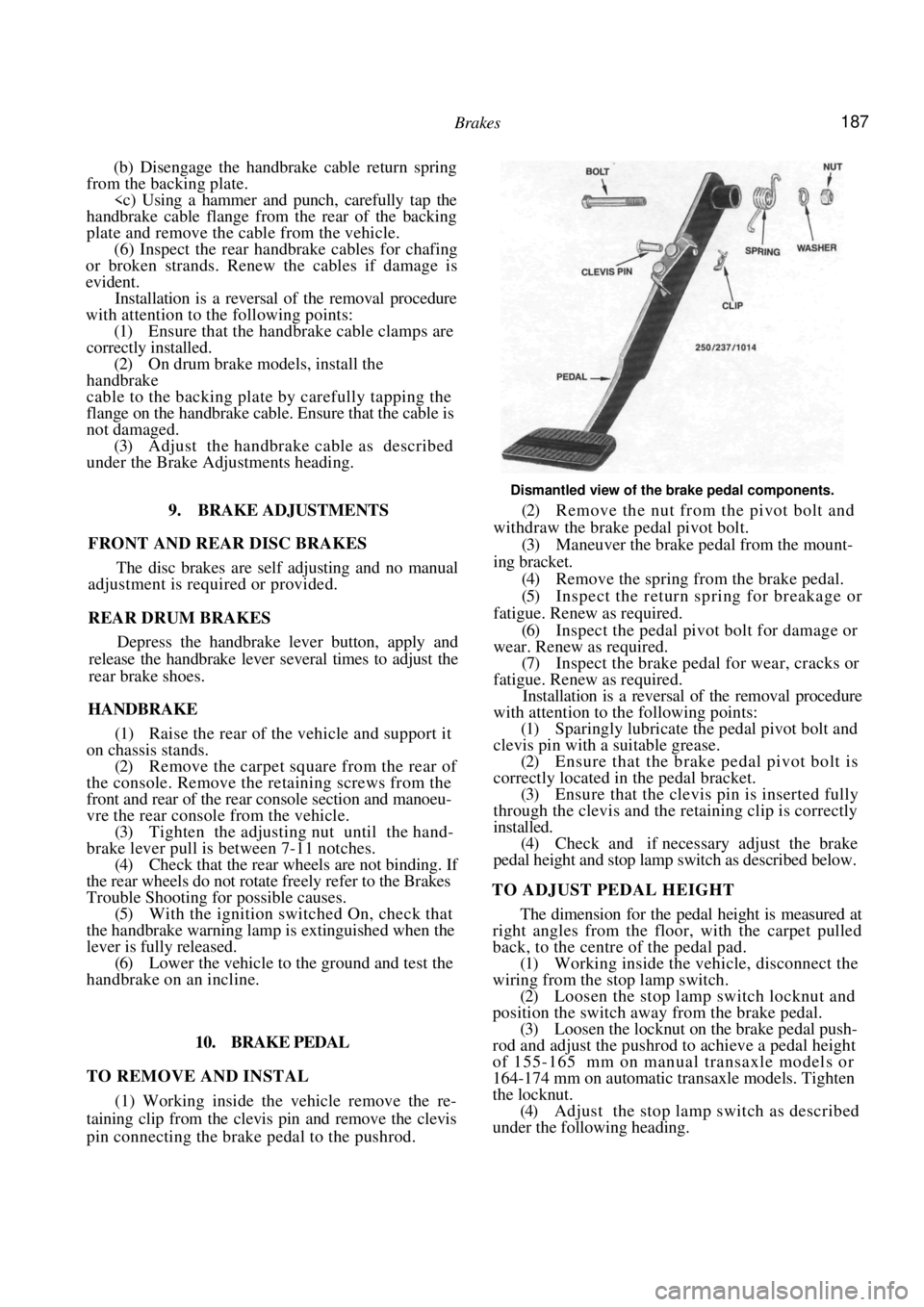
(1) Working inside the vehicle remove the re-
taining clip from the clevis pin and remove the clevis
pin connecting the brake pedal to the pushrod.
Dismantled view of the brake pedal components.
(2) Remove the nut from the pivot bolt and
withdraw the brake pedal pivot bolt.
(3) Maneuver the brake pedal from the mount-
ing bracket. (4) Remove the spring from the brake pedal.
(5) Inspect the return spring for breakage or
fatigue. Renew as required.
(6) Inspect the pedal pivot bolt for damage or
wear. Renew as required. (7) Inspect the brake pedal for wear, cracks or
fatigue. Renew as required. Installation is a reversal of the removal procedure
with attention to the following points:
(1) Sparingly lubricate the pedal pivot bolt and
clevis pin with a suitable grease. (2) Ensure that the brake pedal pivot bolt is
correctly located in the pedal bracket. (3) Ensure that the clevis pin is inserted fully
through the clevis and the retaining clip is correctly
installed. (4) Check and if necessary adjust the brake
pedal height and stop lamp switch as described below.
TO ADJUST PEDAL HEIGHT
The dimension for the pedal height is measured at
right angles from the floor, with the carpet pulled
back, to the centre of the pedal pad.
(1) Working inside the ve hicle, disconnect the
wiring from the stop lamp switch.
(2) Loosen the stop lamp switch locknut and
position the switch away from the brake pedal. (3) Loosen the locknut on the brake pedal push-
rod and adjust the pushrod to achieve a pedal height
of 155-165 mm on manual transaxle models or
164-174 mm on automatic transaxle models. Tighten
the locknut. (4) Adjust the stop lamp switch as described
under the following heading.
Page 191 of 238
Electrical System 191
This is usually accompanied by discoloura-
tion of the electrolyte.
CHARGE INDICATOR LAMP REMAINS ON
• Loose or broken alternator drive belt: Adjust
or renew the drive belt.
• Faulty regulator unit: Check and renew the
regulator unit. • Faulty alternator: Check and overhaul the
alternator. • Short to earth in the warning lamp circuit:
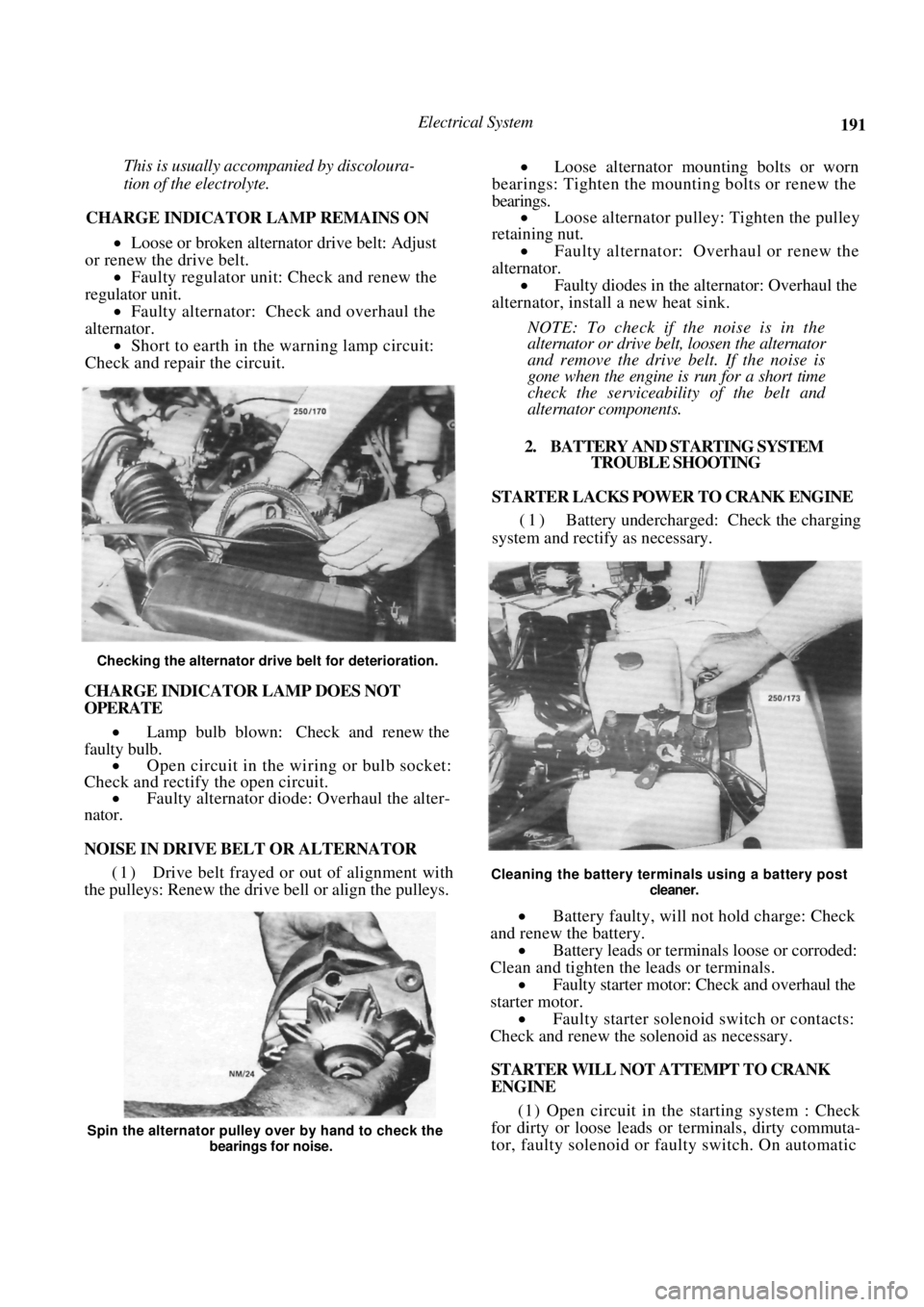
Check and repair the circuit.
Checking the alternator drive belt for deterioration.
CHARGE INDICATOR LAMP DOES NOT
OPERATE
• Lamp bulb blown: Check and renew the
faulty bulb. • Open circuit in the wi ring or bulb socket:
Check and rectify the open circuit. • Faulty alternator diode: Overhaul the alter-
nator.
NOISE IN DRIVE BELT OR ALTERNATOR
(1) Drive belt frayed or out of alignment with
the pulleys: Renew the drive bell or align the pulleys.
• Loose alternator moun ting bolts or worn
bearings: Tighten the mounting bolts or renew the
bearings. • Loose alternator pulley: Tighten the pulley
retaining nut.
• Faulty alternator: Overhaul or renew the
alternator. • Faulty diodes in the alternator: Overhaul the
alternator, install a new heat sink.
NOTE: To check if the noise is in the
alternator or drive belt, loosen the alternator
and remove the drive belt. If the noise is
gone when the engine is run for a short time
check the serviceability of the belt and
alternator components.
2. BATTERY AND STARTING SYSTEM TROUBLE SHOOTING
STARTER LACKS POWER TO CRANK ENGINE
(1) Battery undercharged: Check the charging
system and rectify as necessary.
Cleaning the battery terminals using a battery post
cleaner.
• Battery faulty, will not hold charge: Check
and renew the battery. • Battery leads or terminals loose or corroded:
Clean and tighten the leads or terminals.
• Faulty starter motor: Check and overhaul the
starter motor. • Faulty starter solenoid switch or contacts:
Check and renew the solenoid as necessary.
STARTER WILL NOT ATTEMPT TO CRANK
ENGINE
(1 ) Open circuit in the starting system : Check
for dirty or loose leads or terminals, dirty commuta-
tor, faulty solenoid or faulty switch. On automatic
Spin the alternator pulley over by hand to check the
bearings for noise.
Page 192 of 238
192 Electrical System
transaxle models, check for a faulty or incorrectly
adjusted neutral safety switch.
1. Discharged battery: Check for a fault or short
circuit in the system. 2. Battery fully charged but will not crank
engine. Check for a locked drive and ring gear,
internal starter faul t or seized engine.
3. Fusible link blown: Check and repair the
cause and renew as necessary.
NOTE: Rotate the engine by hand to ensure
that the starter drive is not locked with the
flywheel ring gear and t hat the engine is not
seized. Ensure that the ignition key is
turned off before rotating the engine.
3. LIGHTING SYSTEM TROUBLE SHOOTING
LAMP OR LAMPS FAIL TO LIGHT
1. Faulty bulb(s): Check and renew the faulty
bulb(s). 2. Open circuit in the wiring or connections:
Check the lamp circuits and rectify as necessary.
1. Faulty lamp switch: Check and if necessary
renew the lamp switch. 2. Faulty fuse or fuse connection: Repair the
fuse connection or renew the fuse. 3. Lamp relay faulty: Check and renew as
necessary.
NOTE: Switch on the lamps concerned and
using a test lamp, check that the lamp
circuits are operating. This is best done by
starting at the lamp wiring connector or
bulb holder and work ing back to the power
source.
LAMP OR LAMPS INCORRECTLY
ILLUMINATED
1. Lamp or lamps incorrectly earthed: Check
the lamp earth for loosene ss or clean the contact,
either at the lamp body or wire.
2. Incorrect bulbs installe d: Check the bulb
wattage and voltage and renew with the correct type if
necessary. 3. Dirty or damaged lamp reflector: Clean or
renew the lamp reflector. 4. Faulty bulb: Check with a known serviceable
bulb and renew if necessary. 5. Dirty lamp lens: Clean or renew the lamp
lens. 6. High resistance or faulty connections be-
tween the alternator and battery: Check the circuit
and rectify th e condition.
7. Poor earth connection between the battery
and the engine or alternat or: Check the battery earth
lead and the strap between the engine and the body. 8. Voltage regulator faulty: Check and renew
the voltage regulator.
NOTE: The most common cause for this
condition is dirty t erminals on the earth
leads. Check all earth leads at their earthing
points.
4. TURN SIGNAL LAMP TROUBLE SHOOTING
TURN SIGNAL LAMP DOES NOT LIGHT AND
NO AUDIBLE NOISE FROM FLASHER UNIT
(1) Fuse blown: Rectify the fault and renew the
fuse.
(2) The Flasher unit is faulty: Renew the unit
(3) Turn signal switch faulty: Renew the switch
(4) Fault in the wiring circuit: Check and repair
the fault.
TURN SIGNAL WARNING LAMP DOES NOT
FLASH BUT AUDIBLE CLICKING FROM
FLASHER UNIT
(1) Warning lamp bulb blown: Check and renew
the bulb.
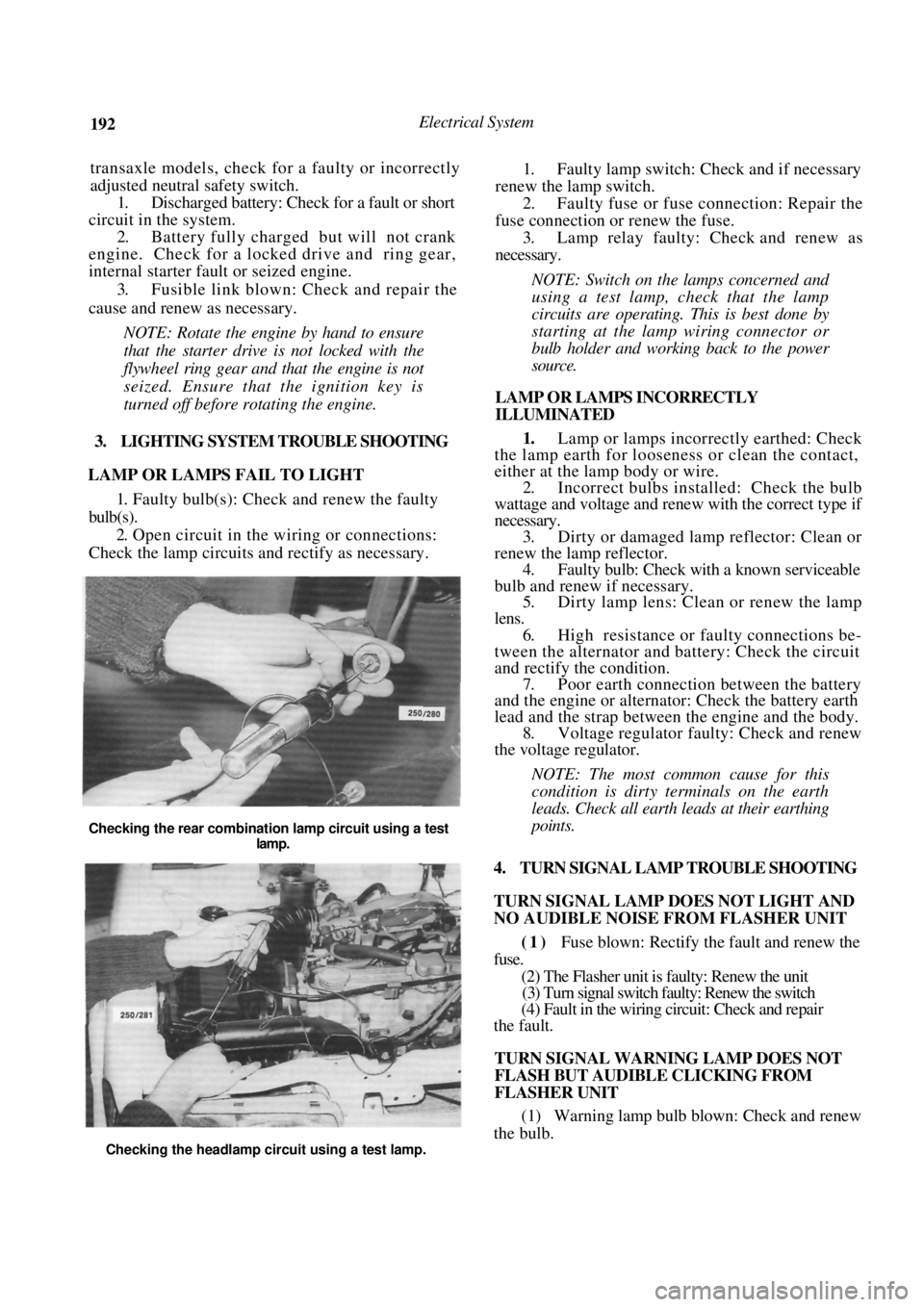
Checking the rear combination lamp circuit using a test
lamp.
Checking the headlamp circuit using a test lamp.