brake fluid NISSAN PULSAR 1987 Owner's Manual
[x] Cancel search | Manufacturer: NISSAN, Model Year: 1987, Model line: PULSAR, Model: NISSAN PULSAR 1987Pages: 238, PDF Size: 28.91 MB
Page 182 of 238
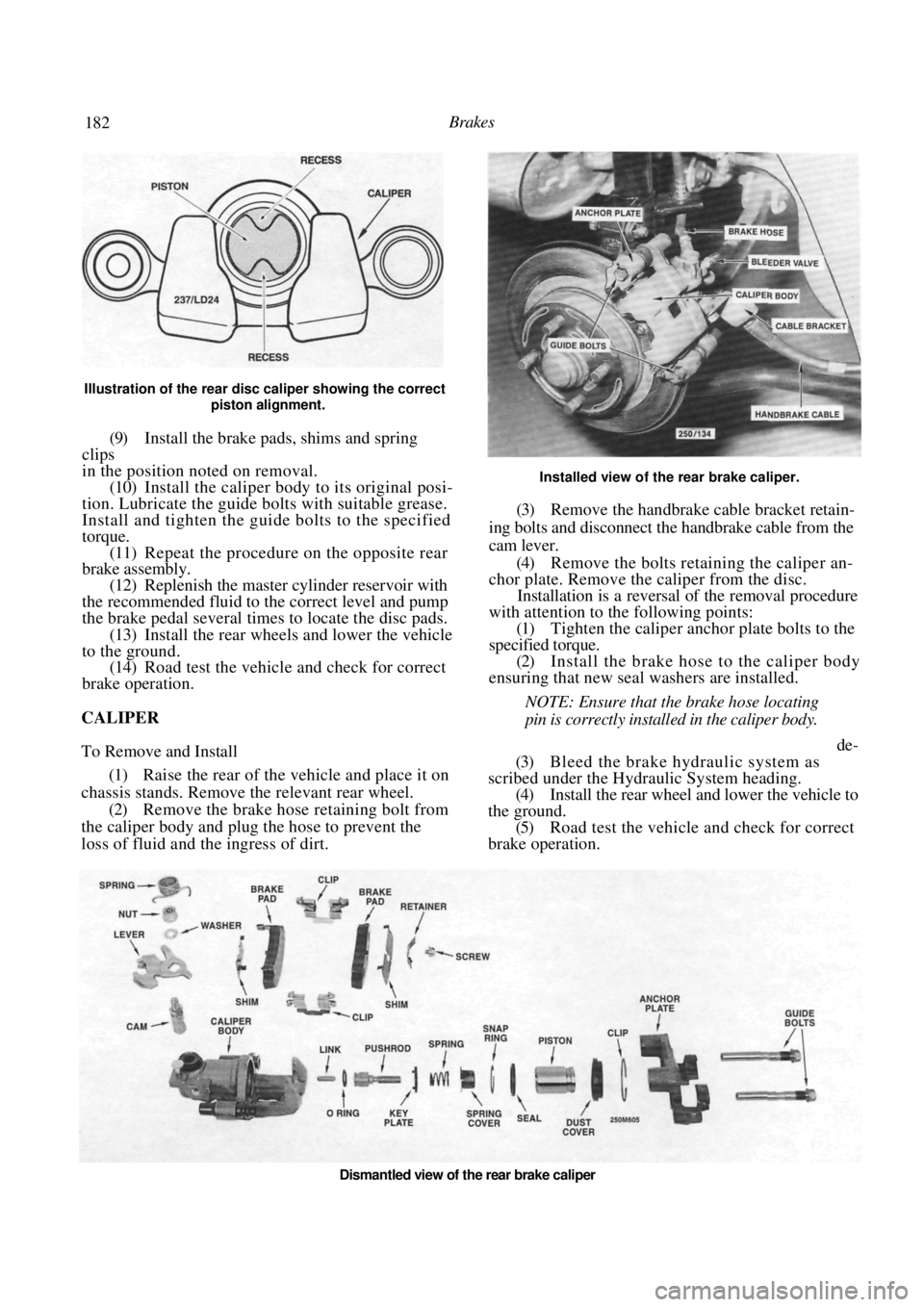
182 Brakes
Illustration of the rear disc caliper showing the correct
piston alignment.
(9) Install the brake pads, shims and spring
clips
in the position noted on removal. (10) Install the caliper body to its original posi-
tion. Lubricate the guide bolts with suitable grease.
Install and tighten the guide bolts to the specified
torque. (11) Repeat the procedure on the opposite rear
brake assembly.
(12) Replenish the master cylinder reservoir with
the recommended fluid to the correct level and pump
the brake pedal several times to locate the disc pads. (13) Install the rear wheels and lower the vehicle
to the ground. (14) Road test the vehicle and check for correct
brake operation.
CALIPER
To Remove and Install
(1) Raise the rear of the vehicle and place it on
chassis stands. Remove the relevant rear wheel. (2) Remove the brake hose retaining bolt from
the caliper body and plug the hose to prevent the
loss of fluid and the ingress of dirt.
Installed view of the rear brake caliper.
(3) Remove the handbrake cable bracket retain-
ing bolts and disconnect the handbrake cable from the
cam lever. (4) Remove the bolts retaining the caliper an-
chor plate. Remove the caliper from the disc. Installation is a reversal of the removal procedure
with attention to the following points:
(1) Tighten the caliper anch or plate bolts to the
specified torque. (2) Install the brake hose to the caliper body
ensuring that new seal washers are installed.
NOTE: Ensure that the brake hose locating
pin is correctly installed in the caliper body.
de-
(3) Bleed the brake hydraulic system as
scribed under the Hydraulic System heading. (4) Install the rear wheel and lower the vehicle to
the ground. (5) Road test the vehicle and check for correct
brake operation.
Dismantled view of the rear brake caliper
Page 183 of 238
Brakes 183
To Dismantle
(1) Raise the rear of the vehicle and place it on
chassis stands. Remove the relevant rear wheel.
(2) Remove the brake hose retaining bolt from
the caliper body and plug the hose to prevent the loss
of fluid and the ingress of dirt. (3) Remove the handbrake cable bracket retain-
ing bolt and disconnect the handbrake cable from the
cam lever.
(4) Remove the guide bolts and slide the caliper
body off the pads. (5) Using a pair of long nose pliers with the nose
located in the recesses of the piston, rotate the piston
anticlockwise to remove it from the caliper body.
(6) Remove the dust cover retaining clip and dust
cover. Discard the dust cover. (7) Using a thin blunt probe, preferably made
from wood or plastic, remove and discard the piston
seal from the groove in the caliper bore. (8) Using internal snap ring pliers, remove the
snap ring from the caliper bore. (9) Withdraw the spring cover, spring, key plate,
pushrod and link from the caliper bore. Do not mix
these components from the left and right hand sides as
they differ. (10) Remove and discard the O ring from the
pushrod. (11) Remove the spring, nut and washer from the
cam lever. Remove the cam lever and cam from the
caliper body. (12) Remove the cam seal from the caliper using a
screwdriver.
(13) Clean all the caliper components in methy-
lated spirits and arrange the components in order on a
clean dry surface to aid assembly.
To Inspect
(1) Inspect the caliper bore and piston for pit-
ting, wear or damage. Renew the caliper assembly or
piston if damage is evident.
NOTE: Slight rust spots in the caliper bore
may be removed with fine emery paper. The
piston must not be polished as the plated
surface will be damaged.
(2) Inspect the guide bolts for wear or damage
and renew as necessary.
(3) Inspect the threads of the pushrod for wear or
damage and renew as necessary. (4) Inspect the nut inside the piston for wear,
damage and security. Renew the piston if any damage
is evident. (5) Inspect the cam for wear, damage or pitting,
renew as necessary. (6) Inspect the cam bearing in the caliper body
for wear, damage or pitting and renew the seal and
bearing as necessary. (7) Inspect the guide bolt rubbers for deteriora-
tion, wear or damage. Renew as required. To Assemble
(1)
Lubricate the cam bearing with multipurpose
grease and install the seal. (2) Install the cam and cam lever to the
caliper
body. Install the cam lever spring, washer and nut, and
tighten the nut to the specified torque. (3) Install a new O ring to the pushrod and
install
the link, pushrod, key plate, spring and spring cover to
the caliper body. The key plate must engage the caliper
body. Secure the assembly with the snap ring. (4) Dip a new piston seal in clean hydraulic brake
fluid. Insert the seal into the groove in the caliper bore
ensuring that the seal is correctly seated and not
twisted. (5) Install a new dust cover to the piston prior
to
installing the piston to the caliper bore.
(6) Coat the piston and caliper bore with clean
hydraulic brake fluid and using long nose pliers rotate
the piston clockwise into the caliper bore. (7) Locate the dust seal in the groove of the
caliper body and install the retaining clip.
(8) Lubricate the guide bolts using a suitable
grease. Install the caliper body and tighten the guide
bolts to the specified torque. (9) Replenish the master cylinder reservoir with
the recommended fluid and bleed the brakes as
described under the Hydraulic System heading. (10) Install the rear wheel and lower the vehicle to
the ground. (11) Road test the vehicle and check for correct
brake operation.
BRAKE DISC
To Check Runout
(1) Raise the rear of the vehicle and support it on
chassis stands. Remove the relevant rear wheel.
(2) Mount a dial gauge stand to a suspension
component and position the dial gauge plunger
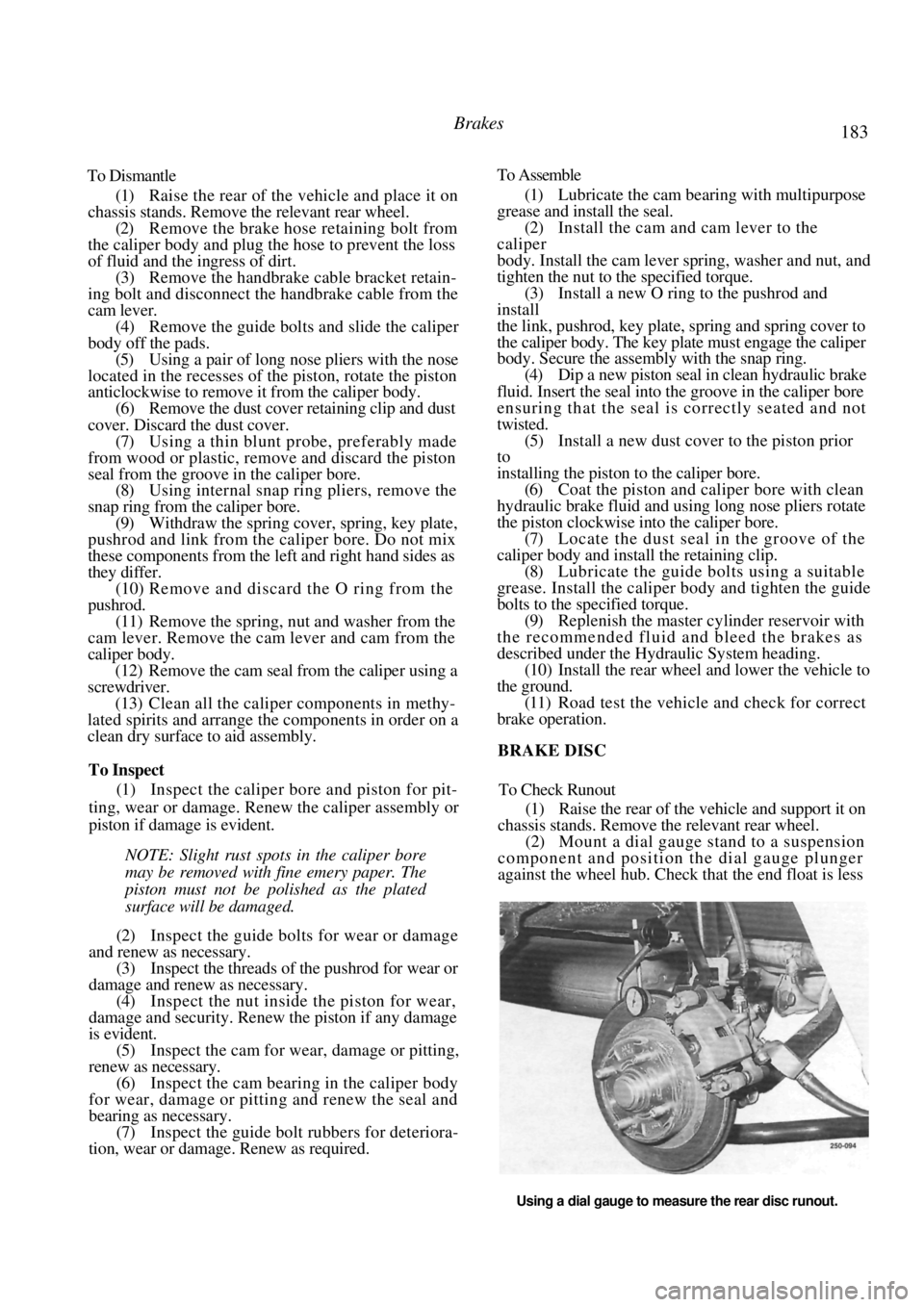
against the wheel hub. Check that the end float is less
Using a dial gauge to measure the rear disc runout.
Page 185 of 238
Brakes 185
(6) Using a suitable pair of pliers, disengage the
upper and lower return springs from the leading shoe,
and then remove them from the trailing shoe. (7) Using a pair of pliers, compress the leading
shoe retainer, turn through ninety degrees and remove
the retainer, spring and pin. Remove the leading shoe
from the backing plate. (8) Using the same procedure, remove the trail-
ing shoe retainer. (9) Lift the trailing shoe from the backing plate
and disconnect the handbrake cable from the hand-
brake lever. Remove the trailing shoe assembly from
the backing plate.
(10) If the brake shoes are to be renewed, remove
the C clip from the trailing shoe and remove the
handbrake lever assembly. (11) If the wheel cylinder is to be overhauled,
proceed as follows:
(a) Disconnect the brake pipe from the rear of
the wheel cylinder and plug the pipe to prevent the
loss of fluid and the ingress of dirt. (b) Remove the bolts retaining the wheel cylin-
der to the backing plate and withdraw the wheel
cylinder from the vehicle. (c) Remove the rubber boots, pistons and spring
from the wheel cylinder bore. Remove the seals from
the pistons. Discard th e rubber boots and seals.
(d) Remove the rubber boot and bleeder valve
from the wheel cylinder.
TO CLEAN AND INSPECT
(1) Thoroughly clean all the brake components,
except the brake shoes in methylated spirits.
(2) Inspect the brake shoe linings. If the thick-
ness of the lining on one or more of the shoes is less
than 1.5 mm thick or contaminated with fluid or
grease, the brake shoes must be renewed as a set. (3) Inspect the wheel cylinder bore and piston
for pitting, wear or damage. Renew the wheel cylinder
assembly if any damage is evident. (4) Check the brake drums for cracks, scoring or
out of round. Renew or machine the brake drums as
necessary.
(5) Inspect the springs and handbrake lever for
fatigue and distortion. Renew as required. (6) Operate the handbrake lever and check for.
smooth operation of the handbrake cable. Renew as
required under the Hand brake Cable and Lever
Assembly heading. (7) Check the bleeder valve for blockage.
(8) Clean and lubricate the adjuster rod.
(9) Clean and inspect the backing plate for
cracks, damage and wear. Renew as required.
TO ASSEMBLE AND INSTAL
(1) If the wheel cylinder was overhauled, pro-
ceed as follows:
(a) Lubricate the pistons and seats with brake
fluid and install the seals on to the pistons so that the
l i p on the seals will be facing towards the centre of the
cylinder.
(b) Install the spring, pistons and rubber boots to
the wheel cylinder ensuring that the rubber boots are
securely located in the cy linder. If necessary, use a
clamp to hold the pistons in the cylinder.
(c) Position the wheel cylinder in the backing
plate and install the brake pi pe to the cylinder. Do not
fully tighten the pipe at this stage. (d) Install the wheel cylinder retaining bolts and
tighten the retaining bolts and brake pipe securely.
Install and tighten the bleeder valve. Install the
valve
boot.
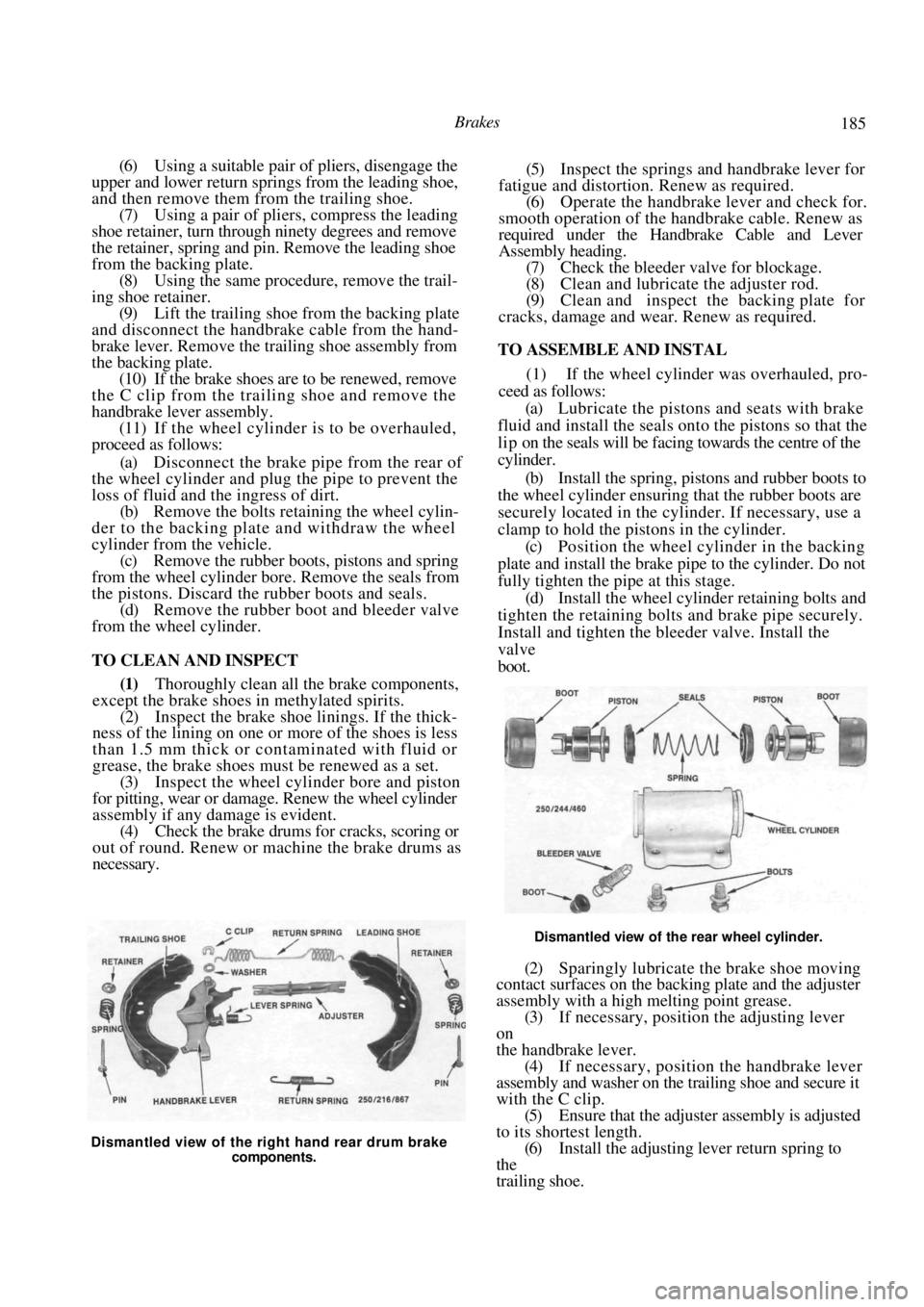
Dismantled view of the right hand rear drum brake
components. Dismantled view of the rear wheel cylinder.
(2) Sparingly lubricate the brake shoe moving
contact surfaces on the backing plate and the adjuster
assembly with a high melting point grease.
(3) If necessary, position the adjusting lever
on
the handbrake lever. (4) If necessary, position the handbrake lever
assembly and washer on the trailing shoe and secure it
with the C clip.
(5) Ensure that the adjuster assembly is adjusted
to its shortest length. (6) Install the adjusting lever return spring to
the
trailing shoe.
Page 188 of 238
188 Brakes
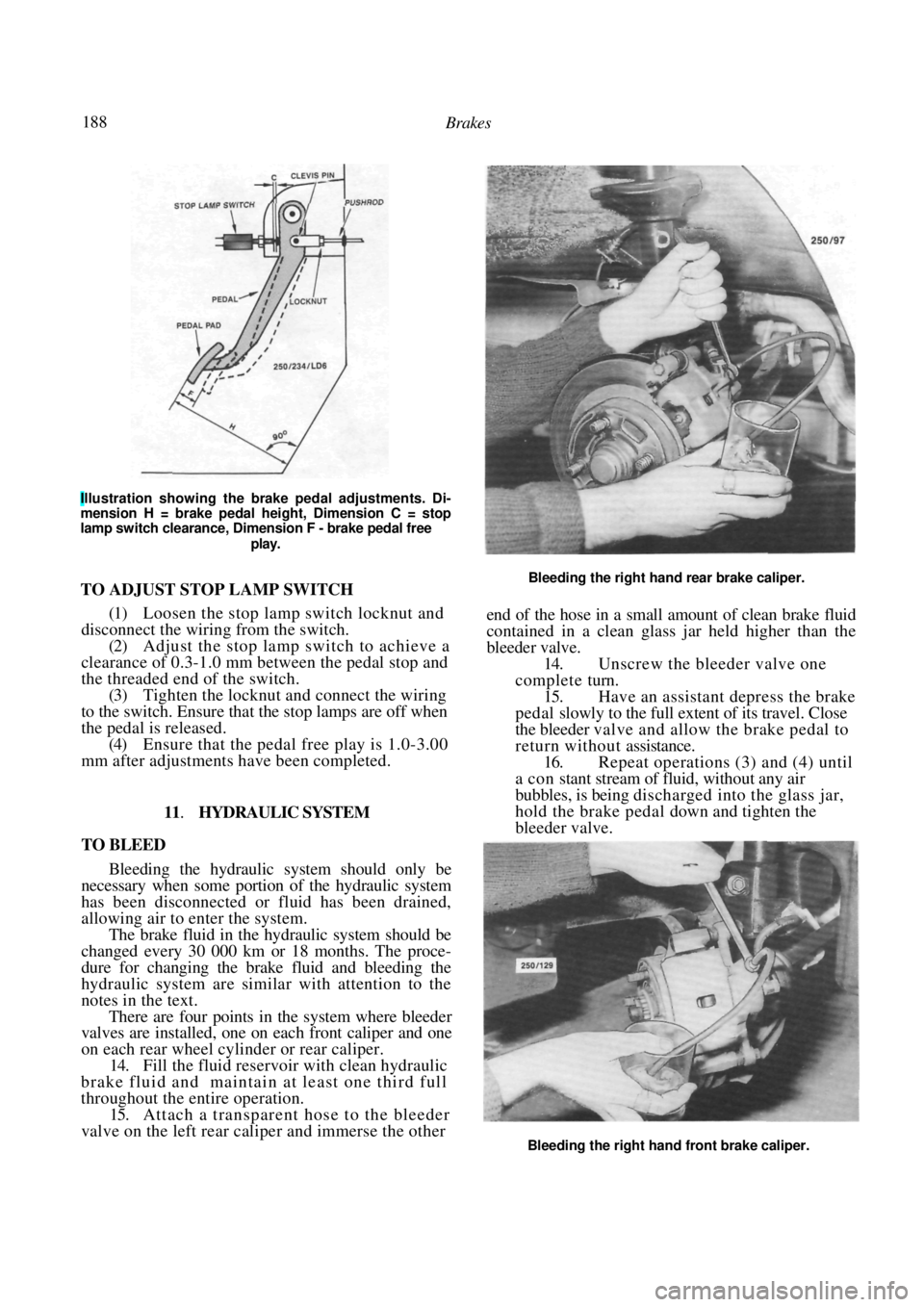
Illustration showing the brake pedal adjustments. Di-
mension H = brake pedal height, Dimension C = stop
lamp switch clearance, Dimension F - brake pedal free
play.
TO ADJUST STOP LAMP SWITCH
(1) Loosen the stop lamp switch locknut and
disconnect the wiring from the switch.
(2) Adjust the stop lamp switch to achieve a
clearance of 0.3-1.0 mm between the pedal stop and
the threaded end of the switch. (3) Tighten the locknut and connect the wiring
to the switch. Ensure that the stop lamps are off when
the pedal is released.
(4) Ensure that the pedal free play is 1.0-3.00
mm after adjustments have been completed.
11. HYDRAULIC SYSTEM
TO BLEED
Bleeding the hydraulic system should only be
necessary when some portion of the hydraulic system
has been disconnected or fluid has been drained,
allowing air to enter the system.
The brake fluid in the hydraulic system should be
changed every 30 000 km or 18 months. The proce-
dure for changing the brake fluid and bleeding the
hydraulic system are simila r with attention to the
notes in the text.
There are four points in the system where bleeder
valves are installed, one on each front caliper and one
on each rear wheel cylinder or rear caliper.
14. Fill the fluid reservoir with clean hydraulic
brake fluid and maintain at least one third full
throughout the entire operation. 15. Attach a transparent hose to the bleeder
valve on the left rear cali per and immerse the other
Bleeding the right hand rear brake caliper.
end of the hose in a small amount of clean brake fluid
contained in a clean glass jar held higher than the
bleeder valve.
14. Unscrew the bleeder valve one
complete turn.
15. Have an assistant depress the brake
pedal slowly to the full extent of its travel. Close
the bleeder valve and allow the brake pedal to
r e t u r n w i t h o u t assistance. 16. Repeat operations (3) and (4) until
a con stant stream of fluid, without any air
bubbles, is being discharged into the gl ass jar,
hold the brake pedal down and tighten the
bleeder valve.
Bleeding the right hand front brake caliper.
Page 189 of 238

Brakes 189
NOTE: If changing the brake fluid, continue to be made. Always use new brake fluid for
bleeding the system until clean new fluid t opping up the reservoir.
flows from the bleeder hose. (6) Carry out the operation on the right front,
Do not allow the fluid level in the reser- right rear, right rear and left front brake in that order.
voir to fall below the one third full level at (7) Replenish the reservoir with the specified
any time during the operation or air will brake fluid to the indicated level and install the
enter the system and a fresh start will have reservoir cap.