oil temperature NISSAN PULSAR 1987 Owner's Manual
[x] Cancel search | Manufacturer: NISSAN, Model Year: 1987, Model line: PULSAR, Model: NISSAN PULSAR 1987Pages: 238, PDF Size: 28.91 MB
Page 220 of 238
220 Electrical System
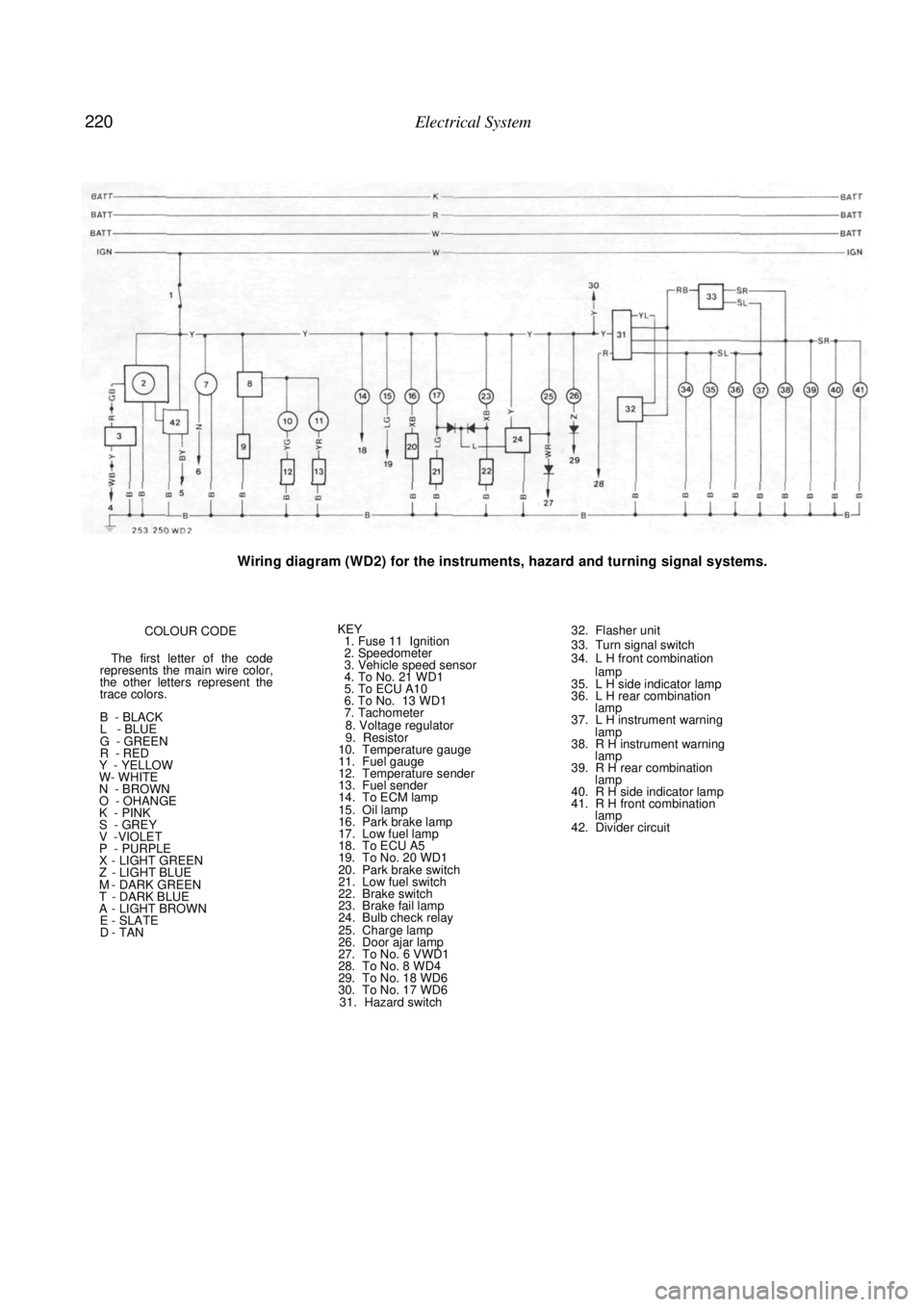
Wiring diagram (WD2) for the instruments, hazard and turning signal systems.
COLOUR CODE
The first letter of the code
represents the main wire color,
the other letters represent the
trace colors.
B - BLACK
L - BLUE
G - GREEN
R - RED
Y - YELLOW
W- WHITE
N - BROWN
O - OHANGE
K - PINK
S - GREY V -VIOLET
P - PURPLE X - LIGHT GREEN Z - LIGHT BLUE M - DARK GREEN T - DARK BLUE A - LIGHT BROWN E - SLATE D - TAN
KEY 1. Fuse 11 Ignition
2. Speedometer
3. Vehicle speed sensor
4. To No. 21 WD1
5. To ECU A10
6. To No. 13 WD1
7. Tachometer
8. Voltage regulator
9. Resistor
10. Temperature gauge
11. Fuel gauge
12. Temperature sender
13. Fuel sender
14. To ECM lamp
15. Oil lamp
16. Park brake lamp
17. Low fuel lamp
18. To ECU A5
19. To No. 20 WD1
20. Park brake switch
21. Low fuel switch
22. Brake switch
23. Brake fail lamp
24. Bulb check relay
25. Charge lamp
26. Door ajar lamp
27. To No. 6 VWD1
28. To No. 8 WD4
29. To No. 18 WD6
30. To No. 17 WD6 31. Hazard switch
32. Flasher unit
33. Turn signal switch
34. L H front combination
lamp
35. L H side indicator lamp
36. L H rear combination lamp
37. L H instrument warning
lamp
38. R H instrument warning lamp
39. R H rear combination lamp
40. R H side indicator lamp
41. R H front combination lamp
42. Divider circuit
Page 237 of 238

Body 237
Installed view of the front seat mounting bolts.
Installation is a reversal of the removal procedure
with attention to the following points:
Lubricate the seat slides with multi-purpose
grease prior to installation of the seat.
Install all mounting bolts by hand prior to
tightening the mounting bolts securely.
REAR SEAT CUSHION
To Remove and Install
Firmly bump the lower front of the seat
cushion rearwards and up lo release the retaining clips
from the vehicle floor panel.
With the retaining clips released, lift the
front of the seat cushion and release the rear mounting
wires. (3) Lift the rear seat cushion out of the vehicle.
Installation is a reversal of the removal procedure
with attention to the following points:
Position the centre seat belts on top of the
rear seat cushion prior to in stallation of the cushion.
Ensure that the clips at the forward edge of
the seat cushion are proper ly engaged in the floor
panel.
REAR SEAT BACKREST
To Remove and Install
Fold the rear seat backrest forward.
Remove the outer seat backrest hinge bolts.
Pull each backrest to wards the door and off
the centre hinge pins. Remove the rear seat backrest from the
vehicle. Installation is a reversal of the removal procedure.
12. VEHICLE CLEANING
CLEANING THE EXTERIOR
In order to remove dirt and road grime and thus
preserve paint finish, vehicles in continuous use
should be washed at least once a week.
Before washing the paintwork, it is good policy to
first hose all dirt from the underbody and clean out
the drain holes in the doors and sill panels.
Hose the vehicle to remove as much grit as
possible and wash using a clean chamois or sponge,
ensuring that the chamois or sponge is free from dirt
or grit which could scratch the paint surface.
Avoid washing the vehicle in bright sunlight with
high temperature as this will give the paintwork a
streaky watermarked finish.
If necessary, wash the vehicle using a reputable
brand Wash and Wax liquid. The Wash and Wax
liquid will restore the paint luster and leave the
paintwork with a protective coating of wax.
After a period it may become necessary to polish
the vehicle in order to remove built up foreign matter
and give the paintwork maximum protection from
industrial fall-out and salt from sea air etc. Before
polishing the paintwork, always wash the surface to
remove as much road grime as possible. When
polishing follow the polishing instructions which come
with the polish.
NOTE: Grease, oil or tar on the paint
surface can be removed with a little kerosene
or white spirits. To prevent staining, wash
and polish the affected area as soon as the
grease, oil or tar is removed.
CLEANING VINYL TRIM
To maintain the vinyl interior trim in good
condition it should be regularly vacuumed to remove
loose dirt and then wiped with a dry or damp cloth.
If the trim is soiled or stained, the following
cleaning procedure is recommended:
Using warm water, cheese cloth and a mild
soap, thoroughly wash the affected areas.
Repeat the operation using damp cheese
cloth only.
To complete the cleaning operation wipe the
trim over with a dry piece of cheese cloth.
NOTE: If the interior trim is badly soiled or
stained, wash with a reputable brand of
upholstery cleaner care fully following the
makers instructions.
CLEANING CLOTH TRIM
Loose dirt and dust on cloth trim should be
removed with a vacuum cleaner or a very soft brush.
Do not use a whisk brush or any other type of coarse
brush or damage to the cloth could result. If the fabric
is soiled the following cl eaning procedure is recom-
mended.
Sponge the fabric ligh tly with warm water
containing a little detergen t and household ammonia.
After sponging, rub the fabric lightly. If
soiling is still apparent, re peat the sponging operation.
Use a clean dry cloth to soak up excess fluid.