oil temperature NISSAN PULSAR 1987 User Guide
[x] Cancel search | Manufacturer: NISSAN, Model Year: 1987, Model line: PULSAR, Model: NISSAN PULSAR 1987Pages: 238, PDF Size: 28.91 MB
Page 68 of 238
68
COOLING AND HEATING SYSTEMS
SPECIFICATIONS
Coolant capacity ........................................ 6.0 liters
Thermostat:
Opening temperature........................... 91 deg
C
Fully open temperature .................... 103 deg
C
Cooling fan:
Fan cut in temperat ure ....................... 100 deg C
Fan cut out temperature ...................... 95 deg C
Radiator cap opening
pressure ................................................... 78 -98 kPa
TORQUE WRENCH SETTINGS
Water pump retaining bolts .............................25 Nm
Thermostat housing bolts .................................15 Nm
Sender unit .......................................................10 Nm
1. COOLING SYSTEM TROUBLE SHOOTING
COOLANT LEAKAGE - EXTERNAL
(1) Loose hose clips or faulty hoses: Tighten the
hose clips or renew the faulty water hoses.
(2) Leaking radiator core or tanks: Repair or
renew the radiator. (3) Leaking heater core or hoses: Repair or renew the heater core. Check the hose clips and hoses
and renew if necessary.
(4)
Leaks at the thermostat cover and/or water
pump O rings. Renew the O rings. (5) Worn or damaged water pump seal assembly:
Renew the water pump. (6) Worn or damaged water pump bearing as-
sembly: Renew the water pump.
(7) Loose or rusted welch plugs; Renew the
welch plugs. (8) Faulty cylinder head gasket or loose cylinder
head bolts: Renew the cylinder head gasket and
correctly tighten the cylinder head bolts. (9) External crack in the cy linder head or cylin-
der block: Repair or renew the faulty components.
NOTE: Check the system for external leak-
age by running the engine to operating
temperature over a dry floor and checking
for the leak source.
Check the vehicle interior below the
heater core for moisture. If a rusted welch
plug is found, it is a good practice to renew
all the welch plugs.
COOLANT LEAKAGE - INTERNAL
( 1 ) Cylinder head gasket leak due to warped
cylinder head or cylinder block gasket faces: Reface
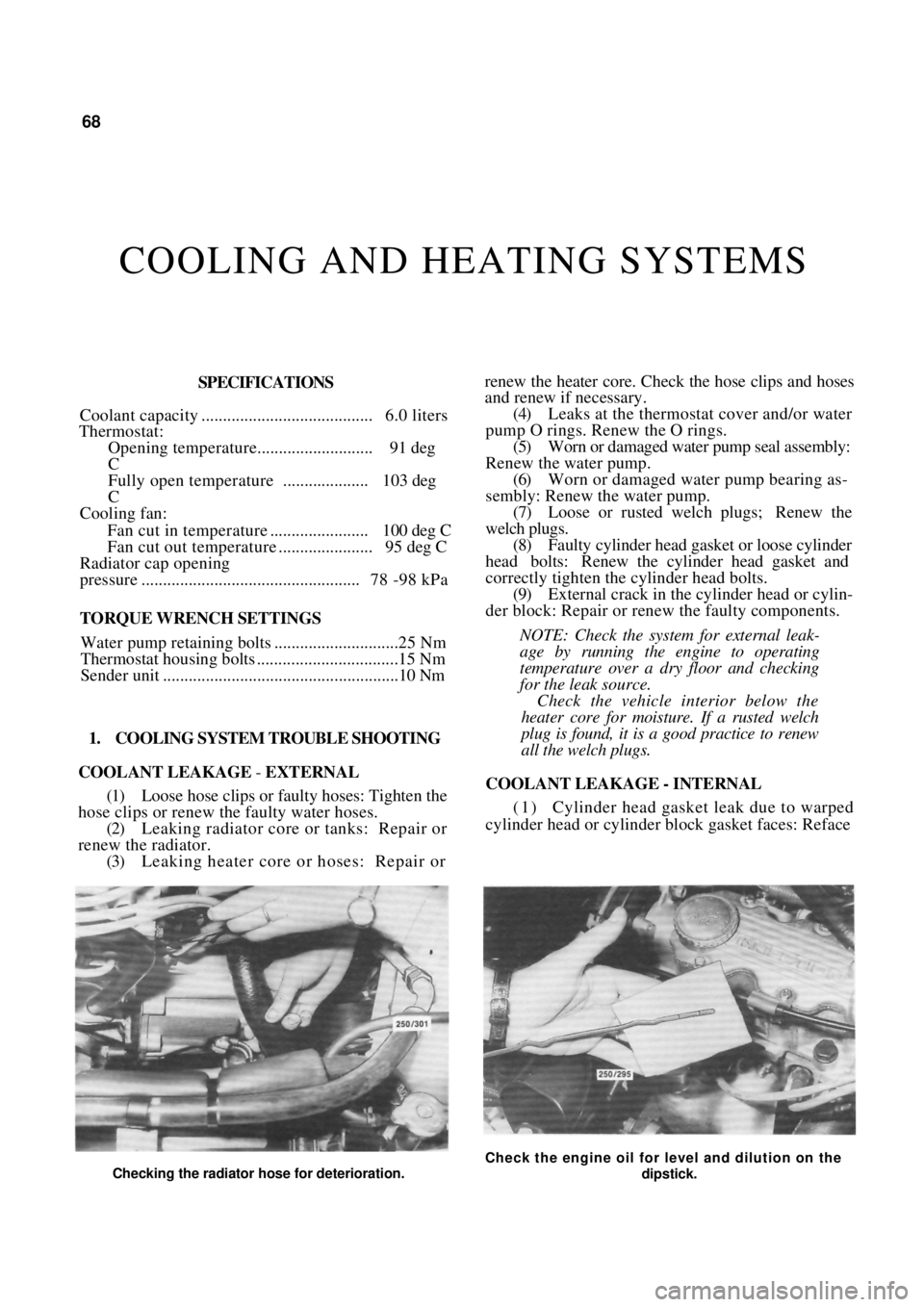
Checking the radiator hose for deterioration.
Check the engine oil for level and dilution on the
dipstick.
Page 69 of 238
Cooling and Heating Systems 69
the cylinder head or cylinder block and renew the
cylinder head gasket.
(2) Crack in the cylinder head or cylinder block:
Repair or renew as necessary.
NOTE; Check the engine for internal leak-
age by withdrawing the dipstick and inspect-
ing for emulsified oil. Run the engine and
check for excessive steam at the exhaust
pipe which would indi cate coolant leakage
into the combustion chamber.
COOLANT LOSS BY OVERFLOW
(1) Overfull system: Drain the excess coolant
from the system.
(2) Faulty radiator cap: Renew the faulty cap.
(3) Blocked radiator core tubes: Clean or renew
the radiator core.
(4) Faulty thermostat: Renew the thermostat.
(5) Coolant foaming due to poor quality anti-
freeze or corrosion inhibitor: Drain the system and
renew the coolant and additive.
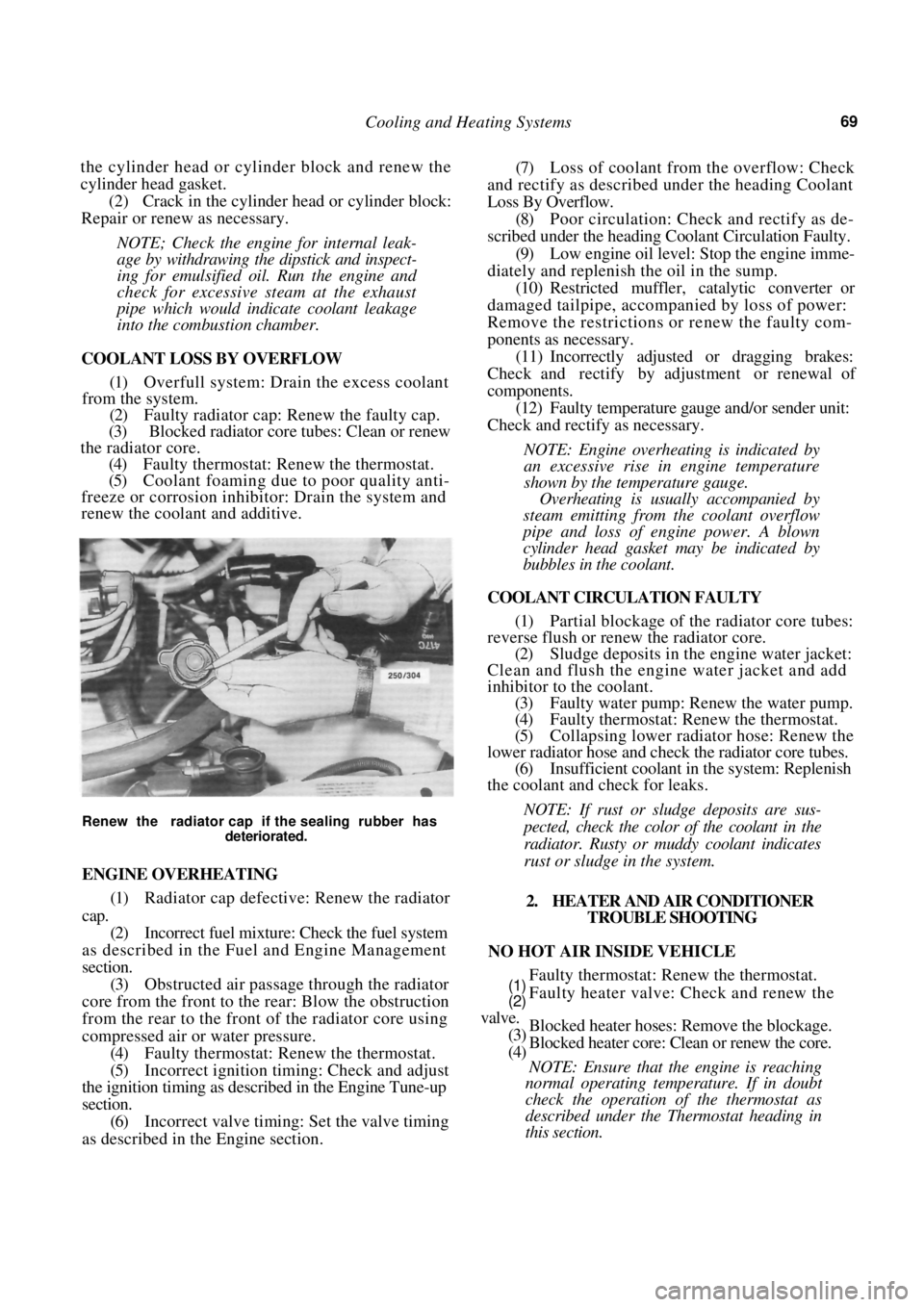
Renew the radiator cap if the sealing rubber has
deteriorated.
ENGINE OVERHEATING
(1) Radiator cap defective: Renew the radiator
cap.
(2) Incorrect fuel mixture: Check the fuel system
as described in the Fuel and Engine Management
section. (3) Obstructed air passage through the radiator
core from the front to the rear: Blow the obstruction
from the rear to the front of the radiator core using
compressed air or water pressure. (4) Faulty thermostat: Renew the thermostat.
(5) Incorrect ignition timing: Check and adjust
the ignition timing as described in the Engine Tune-up
section. (6) Incorrect valve timing: Set the valve timing
as described in th e Engine section.
(7) Loss of coolant from the overflow: Check
and rectify as described under the heading Coolant
Loss By Overflow.
(8) Poor circulation: Check and rectify as de-
scribed under the heading Coolant Circulation Faulty.
(9) Low engine oil level: Stop the engine imme-
diately and replenish the oil in the sump. (10) Restricted muffler, catalytic converter or
damaged tailpipe, accompanied by loss of power:
Remove the restrictions or renew the faulty com-
ponents as necessary.
(11) Incorrectly adjusted or dragging brakes:
Check and rectify by adjustment or renewal of
components. (12) Faulty temperature gauge and/or sender unit:
Check and rectify as necessary.
NOTE: Engine overheating is indicated by
an excessive rise in engine temperature
shown by the temperature gauge.
Overheating is usually accompanied by
steam emitting from the coolant overflow
pipe and loss of engine power. A blown
cylinder head gasket may be indicated by
bubbles in the coolant.
COOLANT CIRCULATION FAULTY
(1) Partial blockage of the radiator core tubes:
reverse flush or renew the radiator core.
(2) Sludge deposits in the engine water jacket:
Clean and flush the engine water jacket and add
inhibitor to the coolant. (3) Faulty water pump: Renew the water pump.
(4) Faulty thermostat: Renew the thermostat.
(5) Collapsing lower radiator hose: Renew the
lower radiator hose and check the radiator core tubes. (6) Insufficient coolant in the system: Replenish
the coolant and check for leaks.
NOTE: If rust or sludge deposits are sus-
pected, check the color of the coolant in the
radiator. Rusty or muddy coolant indicates
rust or sludge in the system.
2. HEATER AND AIR CONDITIONER TROUBLE SHOOTING
NO HOT AIR INSIDE VEHICLE
Faulty thermostat: Renew the thermostat.
Faulty heater valve: Check and renew the
Blocked heater hoses: Remove the blockage.
Blocked heater core: Clean or renew the core.
NOTE: Ensure that the engine is reaching
normal operating temperature. If in doubt
check the operation of the thermostat as
described under the Thermostat heading in
this section.
(1)
(2)
valve.
(3)
(4)
Page 70 of 238
70 Cooling and Heating Systems
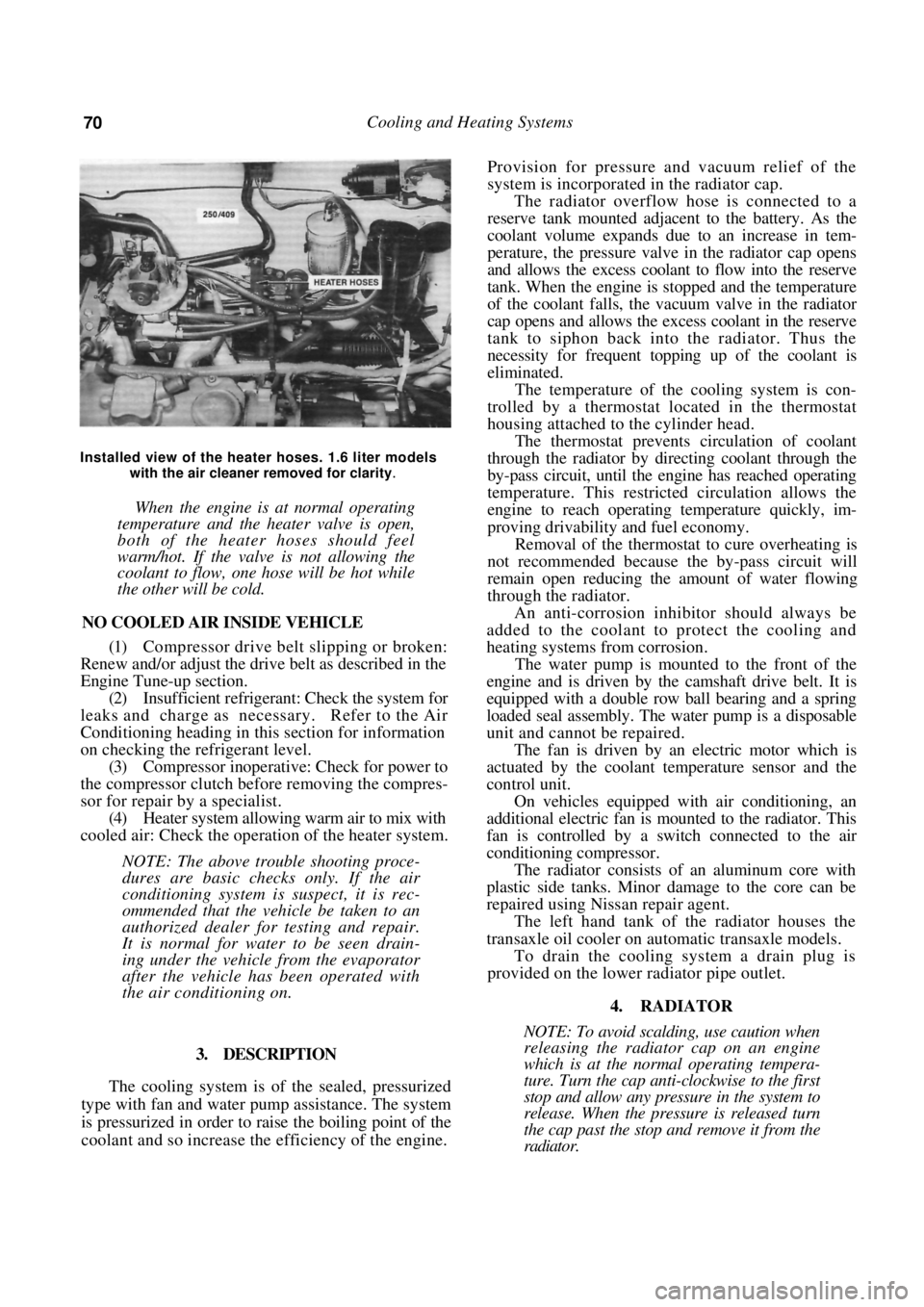
Installed view of the heater hoses. 1.6 liter models with the air cleaner removed for clarity
.
When the engine is at normal operating
temperature and the heater valve is open,
both of the heater hoses should feel
warm/hot. If the valve is not allowing the
coolant to flow, one hose will be hot while
the other will be cold.
NO COOLED AIR INSIDE VEHICLE
(1) Compressor drive belt slipping or broken:
Renew and/or adjust the drive belt as described in the
Engine Tune-up section.
(2) Insufficient refrigerant: Check the system for
leaks and charge as necessary. Refer to the Air
Conditioning heading in th is section for information
on checking the refrigerant level. (3) Compressor inoperative: Check for power to
the compressor clutch before removing the compres-
sor for repair by a specialist. (4) Heater system allowing warm air to mix with
cooled air: Check the operation of the heater system.
NOTE: The above trouble shooting proce-
dures are basic checks only. If the air
conditioning system is suspect, it is rec-
ommended that the vehicle be taken to an
authorized dealer for testing and repair.
It is normal for water to be seen drain-
ing under the vehicle from the evaporator
after the vehicle has been operated with
the air conditioning on.
3. DESCRIPTION
The cooling system is of the sealed, pressurized
type with fan and water pump assistance. The system
is pressurized in order to raise the boiling point of the
coolant and so increase the efficiency of the engine.
Provision for pressure a nd vacuum relief of the
system is incorporated in the radiator cap.
The radiator overflow hose is connected to a
reserve tank mounted adjacent to the battery. As the
coolant volume expands due to an increase in tem-
perature, the pressure valve in the radiator cap opens
and allows the excess coolant to flow into the reserve
tank. When the engine is stopped and the temperature
of the coolant falls, the vacuum valve in the radiator
cap opens and allows the excess coolant in the reserve
tank to siphon back into the radiator. Thus the
necessity for frequent topping up of the coolant is
eliminated.
The temperature of the cooling system is con-
trolled by a thermostat located in the thermostat
housing attached to the cylinder head.
The thermostat prevents circulation of coolant
through the radiator by directing coolant through the
by-pass circuit, until the engine has reached operating
temperature. This restricted circulation allows the
engine to reach operating temperature quickly, im-
proving drivability and fuel economy.
Removal of the thermostat to cure overheating is
not recommended because th e by-pass circuit will
remain open reducing the amount of water flowing
through the radiator.
An anti-corrosion inhibitor should always be
added to the coolant to protect the cooling and
heating systems from corrosion.
The water pump is mounted to the front of the
engine and is driven by the camshaft drive belt. It is
equipped with a double row ball bearing and a spring
loaded seal assembly. The water pump is a disposable
unit and cannot be repaired.
The fan is driven by an electric motor which is
actuated by the coolant temperature sensor and the
control unit.
On vehicles equipped with air conditioning, an
additional electric fan is m ounted to the radiator. This
fan is controlled by a sw itch connected to the air
conditioning compressor.
The radiator consists of an aluminum core with
plastic side tanks. Minor damage to the core can be
repaired using Nissan repair agent.
The left hand tank of the radiator houses the
transaxle oil cooler on automatic transaxle models.
To drain the cooling system a drain plug is
provided on the lower radiator pipe outlet.
4. RADIATOR
NOTE: To avoid scalding, use caution when
releasing the radiator cap on an engine
which is at the normal operating tempera-
ture. Turn the cap anti-clockwise to the first
stop and allow any pressure in the system to
release. When the pressure is released turn
the cap past the stop and remove it from the
radiator.
Page 80 of 238
Cooling and Heating Systems
11. BLOWER FAN
TO REMOVE AND INSTAL
(1) Disconnect the negative battery terminal.
(2) Working below the glov e compartment, dis-
connect the wiring connector to the blower fan motor.
(3) Remove the bolts retaining the blower fan
motor and carefully lower the motor while disconnect-
ing the drain hose.
Installation is a reversal of the removal procedure
with attention to the following points:
( t ) Tighten all bolts securely.
(2) Check that the blow er fan operates correctly.
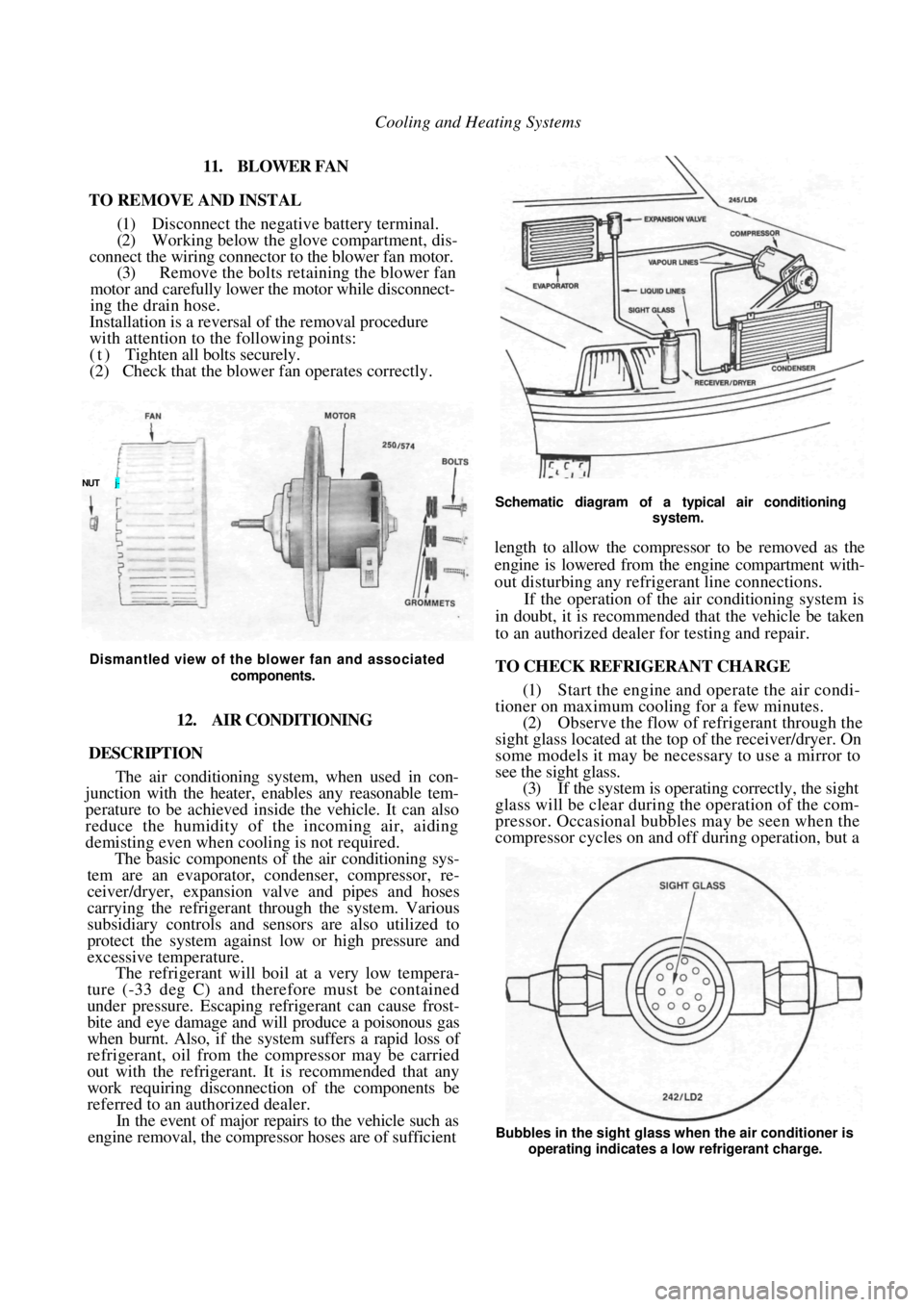
Dismantled view of the blower fan and associated
components.
12. AIR CONDITIONING
DESCRIPTION
The air conditioning system, when used in con-
junction with the heater, enables any reasonable tem-
perature to be achieved inside the vehicle. It can also
reduce the humidity of the incoming air, aiding
demisting even when cooling is not required.
The basic components of the air conditioning sys-
tem are an evaporator, co ndenser, compressor, re-
ceiver/dryer, expansion valve and pipes and hoses
carrying the refrigerant through the system. Various
subsidiary controls and sensors are also utilized to
protect the system against low or high pressure and
excessive temperature.
The refrigerant will boil at a very low tempera-
ture (-33 deg C) and therefore must be contained
under pressure. Escaping refrigerant can cause frost-
bite and eye damage and will produce a poisonous gas
when burnt. Also, if the system suffers a rapid loss of
refrigerant, oil from the compressor may be carried
out with the refrigerant. It is recommended that any
work requiring disconnection of the components be
referred to an au thorized dealer.
In the event of major repair s to the vehicle such as
engine removal, the compress or hoses are of sufficient
Schematic diagram of a typical air conditioning
system.
length to allow the compressor to be removed as the
engine is lowered from the engine compartment with-
out disturbing any refrigerant line connections.
If the operation of the air conditioning system is
in doubt, it is recommended that the vehicle be taken
to an authorized dealer for testing and repair.
TO CHECK REFRIGERANT CHARGE
(1) Start the engine and operate the air condi-
tioner on maximum cooling for a few minutes.
(2) Observe the flow of refrigerant through the
sight glass located at the top of the receiver/dryer. On
some models it may be necessary to use a mirror to
see the sight glass. (3) If the system is operating correctly, the sight
glass will be clear during the operation of the com-
pressor. Occasional bubbles may be seen when the
compressor cycles on and off during operation, but a
NUT j-
Bubbles in the sight glass when the air conditioner is
operating indicates a low refrigerant charge.
Page 81 of 238

Cooling and Heating Systems 81
continuous stream of bubbles indicates that the refriger-
ant charge is low.
A large number of bubbles or foam indicates that
the refrigerant charge is very low.
No bubbles or the presen ce of oil streaks in the
sight glass indicate that the system is completely
empty.
NOTE: If the outside air temperature is
high, a certain number of bubbles may be
observed in the sight gl ass, even though the
system is fully charged.
If the system requires recharging, the vehicle
should be taken to an authorized dealer for evacu-
ation, leak testing and recharging.
Do not operate the system if it is known that the
refrigerant charge is low as damage may result.
MAINTENANCE
The air conditioning system requires l i t t l e main-
tenance other than the following. Where applicable,
refer to the Lubrication an d Maintenance section for
the recommended service intervals.
(1) Check the refrigerant charge level in the
receiver/dryer sight glass. Recharge the system as
necessary. It is considered normal for the system to
require periodic recharging. (2) Inspect the air conditioner pipes and hoses
for leaks, deterioration and alignment. Evidence of oil
leakage is an indication of refrigerant leakage. Repair
or renew as necessary.
(3) Inspect the evaporator drain tube and the
condenser cooling fins for blockage. Clean as neces-
sary.
(4) Check the drive belt for deterioration and for
correct tension. Refer to the Engine Tune-up section
for the correct procedure.
(5) Operate the system at least once a week for
approximately 15 minutes to keep the compressor
seals lubricated.
Page 82 of 238

82
FUEL AND ENGINE MANAGEMENT
CAUTION: To prevent severe electrical shock, extreme care must be taken when
working on or near the electronic ignition system as dangerous high tension voltages
are produced in both the primary and secondary circuits. See the text fo\
r
precautionary notes.
SPECIFICATIONS
FUEL INJECTION
Type:
1.6 liter engine .................................. Single point
1.8 liter engine................................... Multi point
FUEL PUMP
Type ................................................................ Electric
Pressure at idle:
1.6 liter engine ..................................... 62-90 kPa
1.8 liter engine ................................ 190-230 kPa
FUEL FILTER
Type ................................................ Inline, disposable
AIR FILTER
Type ................................... Disposable paper element
DISTRIBUTOR
Make ........................................................ Delco Remy
Advance contro l .......................................... Electronic
Rotation of rotor .................................. Anti-clockwise
Firing order....................................................1 -3-4-2
ADJUSTMENTS
Base idle speed ..................................... 550-650 rpm
Ignition timing.......................................... 10° BTDC
TORQUE WRENCH SETTINGS
Throttle body nuts.......................................... 10 Nm
*Throttle body bolts ........................................ 12 Nm
*Fuel hose fittings............................................ 35 Nm
Fuel rail bolts ....................................................8 Nm
Fuel tank drain plug ........................................ 24 Nm
Coolant temperature sensor ............................ 12 Nm
Oxygen sensor .................................................. 40 Nm
MAT sensor..................................................... 14 Nm
*1.6 liter engine
l . 8 liter engine
1. FUEL AND ENGINE MANAGEMENT
TROUBLE SHOOTING
NOTE: The following Trouble Shooting pro-
cedures are basic checks only. If these pro-
cedures fail to locate the fault, refer to the
System Diagnosis and Adjustments heading
for more thorough testing.
Prior to performing any of the following
operations, refer to the Service Precautions
and Procedures heading.
ENGINE WILL NOT START OR HARD TO
START
(1) Water in the fuel: Dr ain the fuel from the
system and renew the fuel filter.
(2) Fault in the power supply: Check the battery,
fusible links and fuses. Check for clean, secure con-
nections, particularly the earth connections. Check the
EG1 and fuel pump relays.
NOTE: If the fuel pump relay fails, power
will be supplied to the fuel pump via the oil
pressure switch. When starting the engine,
Check that the MAP sensor hose is not blocked or split
and ensure that all electrical connections are clean and
secure.
Page 83 of 238

Fuel and Engine Management 83
the fuel pump will not operate until the oil
pressure is sufficient to extinguish the oil
pressure warning lamp. Therefore it will be
necessary to operate the starter motor for a
longer period than usual to start the engine.
(3) Faulty EFI component wiring connections:
Check that all component wiring connections are
clean and secure.
(4) Manifold absolute pressure (MAP) sensor
vacuum hose blocked or disconnected: Clear or recon-
nect the vacuum hose. (5) Fault in the ignition system: Check the
primary and secondary ignition circuits.
(6) Engine flooded: Fully depress the throttle
pedal until the engine starts. Check the coolant
temperature sensor. Check th e injector(s) for leakage.
ENGINE STARTS THEN STALLS
(1) Water in the fuel: Dr ain the fuel from the
system and renew the fuel filter.
(2) Air leakage at the inlet manifold: Check all
joints and hoses for air leaks. (3) Faulty EFI wiring connections: Check that
all component wiring connections are clean and
secure.
(4) Ignition timing incorrectly set: Check and
adjust the timing. (5) MAP sensor faulty or supply hose discon-
nected or blocked: Check the vacuum supply hose.
Check the operation of the MAP sensor.
ENGINE MISFIRES
(1) Faulty, dirty or incorrectly adjusted spark
plugs: Renew or clean and adjust the spark plugs.
(2) Condensation in the distributor cap: Dry and
examine the cap for cracks. (3) Faulty high tension leads: Check and renew
the high tension leads.
Testing the fuel system pressure using a pressure
gauge.
(4) Faulty ignition coil: Check and renew the
ignition coil.
(5) Fuel blockage: Check for blockage in the fuel
filter, lines and injector(s). (6) Low fuel pressure: Check the fuel pump and
fuel pressure regulator. (7) Water in the fuel: Dr ain the fuel from the
system and renew the fuel filter. (8) Loose fuel supply wiring connectors: Check
all connectors for tightness. (9) Faulty fuel injector: Check the connections
and test the condition of the fuel injectors.
ENGINE LACKS POWER
(1) Ignition timing incorrectly set: Check and
adjust the timing.
(2) Water in the fuel: Dr ain the fuel from the
system and renew the fuel filter.
(3) Incorrectly adjusted throttle cable: Adjust the
throttle cable.
Check the distributor cap for cracks or tracking be- tween the terminals. The air filter element should be renewed at 40 000 km
intervals. 1.8 liter engine.
Page 120 of 238

120 Emission Control
If the flap does not operate as described, renew
the air cleaner housing.
(2) Disconnect the vacuum hose from the servo
unit and connect it to a vacuum gauge.
(3) Start and run the engine at approximately
1 200 rpm. If the engine is cold there should be
vacuum. (4) As the engine temperature increases the
vacuum should decrease to zero. If the vacuum gauge does not read as described,
check that the vacuum supply hose is connected to the
thermal vacuum valve and the throttle body.
If no fault is found, renew the thermal vacuum
valve.
4. EXHAUST CONTROL SYSTEM
DESCRIPTION
The exhaust system is the greatest source of
pollutant emission from the internal combustion
engine.
On the Pulsar range of vehicles covered by this
manual, the exhaust control system consists of a
catalytic converter and the engine management sys-
tem. The engine management system constantly mon-
itors the exhaust gases via an oxygen sensor located in
the exhaust system. Fuel injection is then adjusted
accordingly to give the minimum amount of exhaust
emissions. Refer to the Fuel and Engine Management
section for further information.
CATALYTIC CONVERTER
The catalytic converter, which is located in the
exhaust system, converts hydrocarbons, oxides of
nitrogen and carbon monoxide present in the exhaust
gases into carbon dioxide, nitrogen, water and heat.
The catalytic converter does not require periodic
maintenance or replacement under normal circum-
stances. However, it can be damaged or poisoned by
excessively high exhaust gas temperatures, raw fuel
and the use of leaded fuel.
Installed view of the catalytic converter.
To prevent the use of leaded fuel, a small diam-
eter fuel filler neck with a spring loaded trap door is
used.
To prevent damage to the catalytic converter, the
following precautions sh ould be observed.
(1) Do not operate the vehicle on leaded fuel.
(2) Do not push or tow start the vehicle.
(3) Do not allow the engine to idle for prolonged
periods. (4) Do not operate the vehicle if the engine is
misfiring.
(5) Avoid running the vehicle out of fuel.
(6) Ensure that the engine oil is formulated to
contain low phosphorous levels.
To Inspect Catalytic Converter
(1) Inspect the converter for dents and damage.
If the converter is damaged, it should be renewed. (2) Inspect the converter heat shield for damage
and ensure that it is positioned correctly. Renew the
converter heat shield if necessary.
To Remove and Install
To remove and install the catalytic converter,
refer
to the Exhaust System heading in the Engine section.
Page 141 of 238
Automatic Transaxle 141
(2) Incorrectly adjusted kickdown cable: Check
and adjust or renew the kickdown cable as required.
NOTE: Check and adjust the throttle cable
before adjusting the kickdown cable.
ENGINE WILL NOT START IN P OR N
RANGE OR WILL START IN ANY RANGE
(1) Neutral safety switch faulty: Adjust or renew
the neutral safety switch. (2) Incorrectly adjusted selector cable: Check
and adjust the selector cable as detailed.
2. DESCRIPTION
The automatic transaxle combines a fluid coup-
ling or torque converter with a fully automatic three
speed epicyclic gear system.
The transaxle provides th ree forward ratios and
one reverse. The hydraulic system consists of a single
pump and valv e arrangement.
The final drive or differential and the transaxle
use a common lubricant. The transaxle oil pan and
final drive drain plug will have to be removed to drain
the transaxle completely. Topping up or refilling is
done through the dipstick tube.
The gear selector lever is floor mounted and
connected to the transaxle by an adjustable cable. The
selector quadrant adjacent to the base of the lever is
marked P, R, N, D, 2, 1.
It is necessary for the selector lever to be in P or
N before the engine can be started. When testing or
tuning the engine, the handbrake must be firmly
applied and the selector lever placed in the P position,
otherwise the vehicle could move forward or back-
wards as the engine speed is increased.
For long distance towing the vehicle should be
towed with the front end raised.
It is not possible to start the engine by either
towing or pushing the vehicle.
The transaxle can be removed from the vehicle
without engine removal.
NOTE: As extensive knowledge and equip-
ment is required to overhaul the automatic
transaxle assembly, it is therefore not a
worthwhile repair proposition for the aver-
age person. However if the transaxle must
be overhauled by a specialist or be replaced
with a reconditioned unit, the removal and
installation procedure is fully described at
the end of this section.
3. TRANSAXLE FLUID
Only use the recommended transaxle fluid speci-
fied by the manufacturer when topping up or changing
the fluid in the system.
TO CHECK AND TOP UP
NOTE: The fluid level should be checked
after approximately 5 minutes driving on
the road when the engine has achieved its
normal operating temperature of approxi-
mately 65 deg C.
(1) Place the vehicle on a level floor and open
the engine bonnet.
NOTE: When working on the automatic
transaxle cleanliness is very important. Do
not reuse transaxle fluid and do not allow
foreign matter to enter the filler opening.
(2) Clean around the top of the dipstick to
ensure that no dirt or foreign matter can enter the
dipstick tube.
(3) Place the selector in the P position and
firmly apply the handbrake. (4) Move the selector thro ugh each gear return-
ing it to the P position.
(5) Check the fluid level with the engine running
at idle. Install the dipstick fully into the dipstick tube.
NOTE: If the vehicle has been driven at high
speed, or has been towing a load, or driven
through heavy city traffic in hot weather, a
period of about 30 minutes should be
allowed to permit the transaxle to cool
before checking the fluid level.
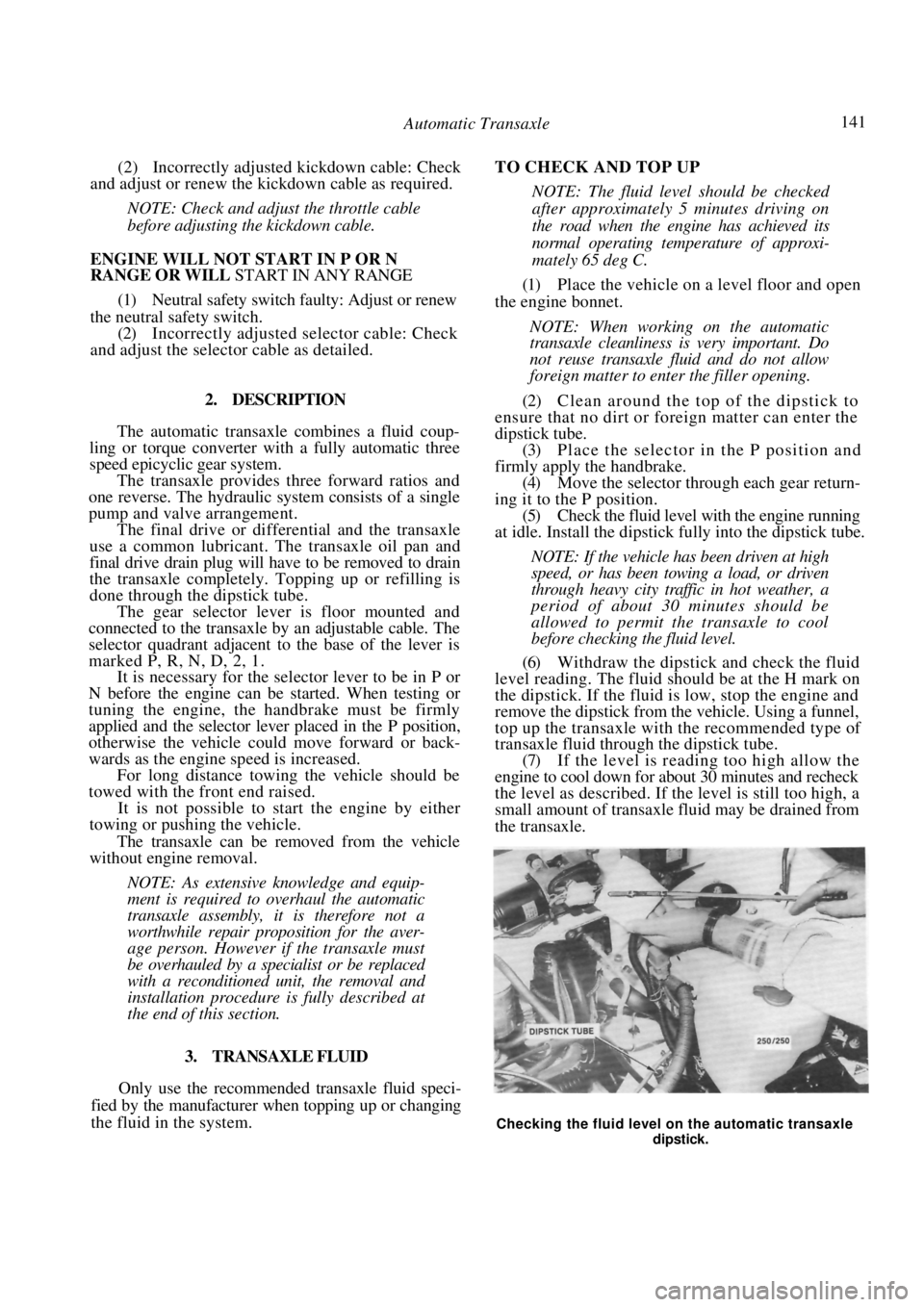
(6) Withdraw the dipstick and check the fluid
level reading. The fluid should be at the H mark on
the dipstick. If the fluid is low, stop the engine and
remove the dipstick from the vehicle. Using a funnel,
top up the transaxle with the recommended type of
transaxle fluid through the dipstick tube. (7) If the level is reading too high allow the
engine to cool down for about 30 minutes and recheck
the level as described. If the level is still too high, a
small amount of transaxle fluid may be drained from
the transaxle.
Checking the fluid level on the automatic transaxle
dipstick.
Page 203 of 238
Electrical System 203
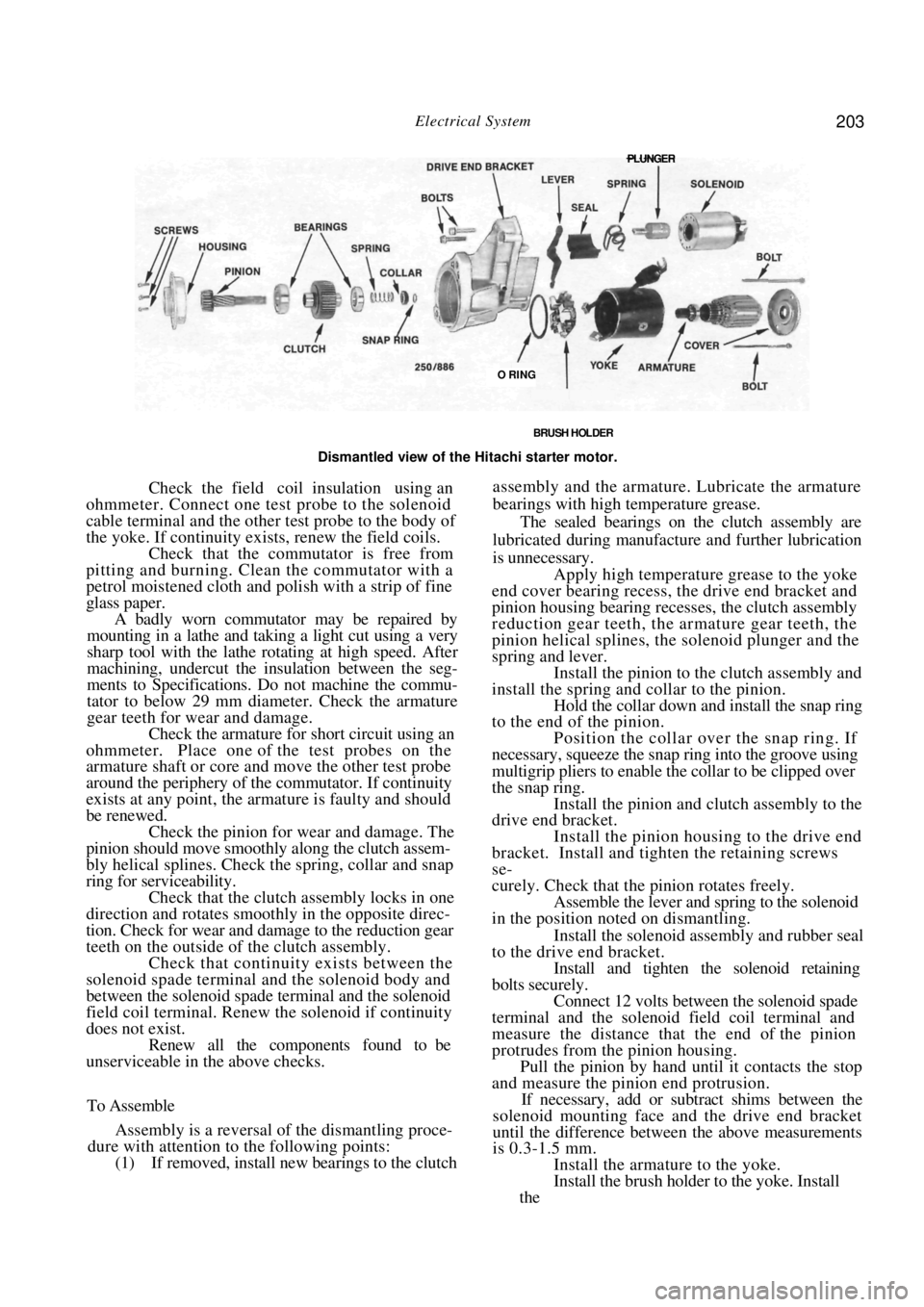
BRUSH HOLDER
Dismantled view of the Hitachi starter motor.
Check the field coil insulation using an
ohmmeter. Connect one test probe to the solenoid
cable terminal and the other test probe to the body of
the yoke. If continuity exists, renew the field coils. Check that the commutator is free from
pitting and burning. Clean the commutator with a
petrol moistened cloth and polish with a strip of fine
glass paper.
A badly worn commutator may be repaired by
mounting in a lathe and taking a light cut using a very
sharp tool with the lathe rotating at high speed. After
machining, undercut the insulation between the seg-
ments to Specifications. Do not machine the commu-
tator to below 29 mm diameter. Check the armature
gear teeth for wear and damage.
Check the armature for short circuit using an
ohmmeter. Place one of the test probes on the
armature shaft or core and move the other test probe
around the periphery of the commutator. If continuity
exists at any point, the armature is faulty and should
be renewed. Check the pinion for wear and damage. The
pinion should move smoothl y along the clutch assem-
bly helical splines. Check the spring, collar and snap
ring for serviceability.
Check that the clutch assembly locks in one
direction and rotates smoothly in the opposite direc-
tion. Check for wear and damage to the reduction gear
teeth on the outside of the clutch assembly.
Check that continuity exists between the
solenoid spade terminal and the solenoid body and
between the solenoid spade terminal and the solenoid
field coil terminal. Renew the solenoid if continuity
does not exist. Renew all the components found to be
unserviceable in the above checks.
To Assemble
Assembly is a reversal of the dismantling proce-
dure with attention to the following points:
(1) If removed, install new bearings to the clutch
assembly and the armature. Lubricate the armature
bearings with high temperature grease.
The sealed bearings on the clutch assembly are
lubricated during manufacture and further lubrication
is unnecessary.
Apply high temperature grease to the yoke
end cover bearing recess, the drive end bracket and
pinion housing bearing recesses, the clutch assembly
reduction gear teeth, the armature gear teeth, the
pinion helical splines, th e solenoid plunger and the
spring and lever. Install the pinion to the clutch assembly and
install the spring and collar to the pinion. Hold the collar down and install the snap ring
to the end of the pinion.
Position the collar over the snap ring. If
necessary, squeeze the snap ring into the groove using
multigrip pliers to enable the collar to be clipped over
the snap ring. Install the pinion and clutch assembly to the
drive end bracket.
Install the pinion housing to the drive end
bracket. Install and tighten the retaining screws
se-
curely. Check that the pinion rotates freely.
Assemble the lever and spring to the solenoid
in the position noted on dismantling.
Install the solenoid assembly and rubber seal
to the drive end bracket.
Install and tighten the solenoid retaining
bolts securely. Connect 12 volts between the solenoid spade
terminal and the solenoid field coil terminal and
measure the distance that the end of the pinion
protrudes from the pinion housing. Pull the pinion by hand until it contacts the stop
and measure the pinion end protrusion.
If necessary, add or subt ract shims between the
solenoid mounting face and the drive end bracket
until the difference between the above measurements
is 0.3-1.5 mm.
Install the armature to the yoke.
Install the brush holder to the yoke. Install
the
PLUNGER
O RING