oil type NISSAN PULSAR 1987 Owner's Manual
[x] Cancel search | Manufacturer: NISSAN, Model Year: 1987, Model line: PULSAR, Model: NISSAN PULSAR 1987Pages: 238, PDF Size: 28.91 MB
Page 165 of 238
Rear Suspension 165
Checking the rear control arm outer pivot bolt for security.
(5) Loose or worn control arm bushes or pivot
bolts: Check and tighten or renew the worn compo-
nents.
NOTE: Check the service ability of the sus-
pension units, control arm bushes and pivot
bolts as previously described.
If incorrect rear wheel alignment is sus-
pected, it is recommended that the vehicle be
taken to a wheel alignment specialist or a
Nissan dealer to be checked and if necessary
adjusted.
Visually inspect the stabilizer bar for
damage.
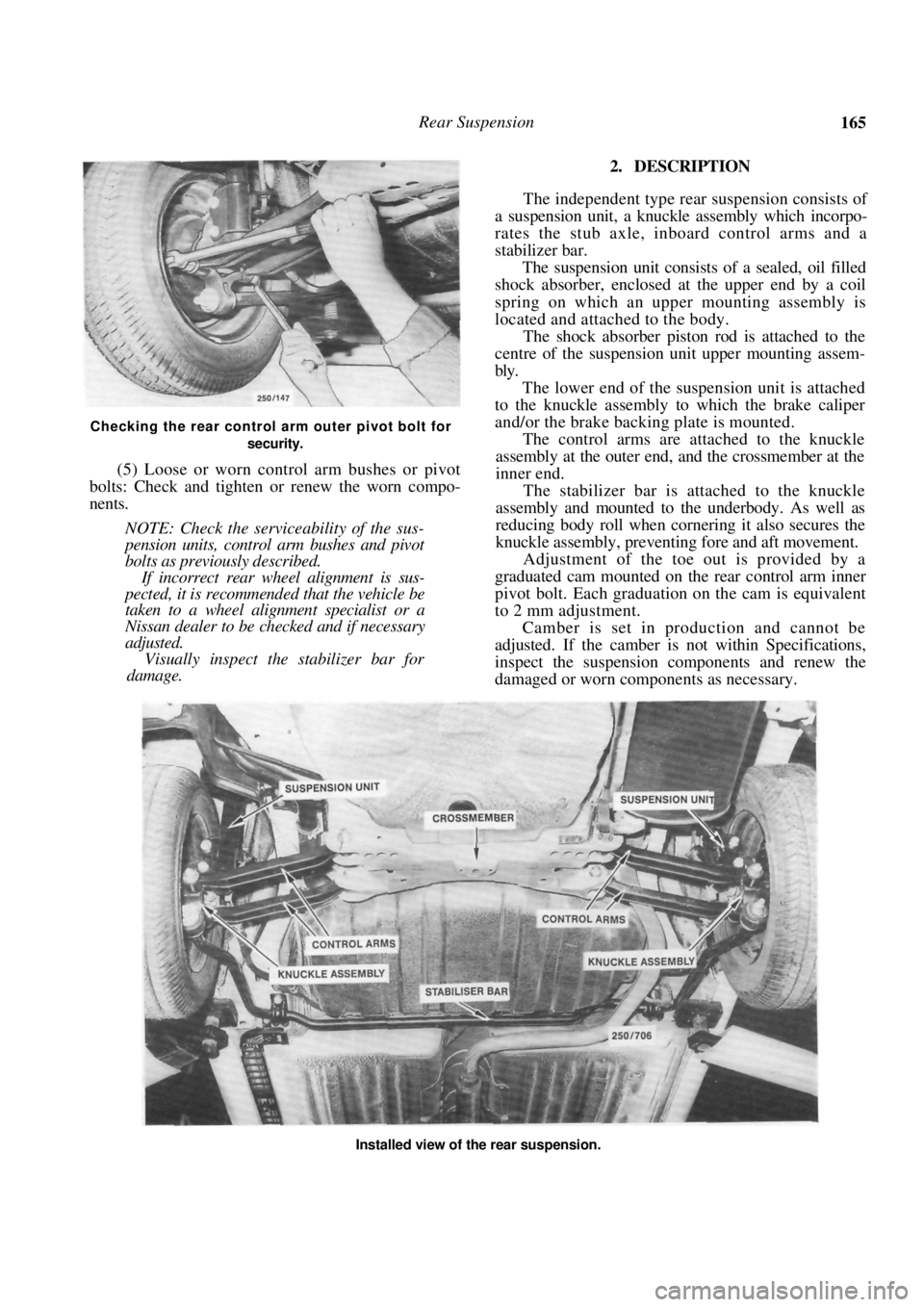
2. DESCRIPTION
The independent type rear suspension consists of
a suspension unit, a knuckle assembly which incorpo-
rates the stub axle, inboard control arms and a
stabilizer bar.
The suspension unit consists of a sealed, oil filled
shock absorber, enclosed at the upper end by a coil
spring on which an upper mounting assembly is
located and attached to the body.
The shock absorber piston rod is attached to the
centre of the suspension unit upper mounting assem-
bly.
The lower end of the suspension unit is attached
to the knuckle assembly to which the brake caliper
and/or the brake backing plate is mounted.
The control arms are attached to the knuckle
assembly at the outer end, and the crossmember at the
inner end.
The stabilizer bar is attached to the knuckle
assembly and mounted to the underbody. As well as
reducing body roll when cornering it also secures the
knuckle assembly, preventing fore and aft movement.
Adjustment of the toe out is provided by a
graduated cam mounted on the rear control arm inner
pivot bolt. Each graduation on the cam is equivalent
to 2 mm adjustment.
Camber is set in production and cannot be
adjusted. If the camber is not within Specifications,
inspect the suspension components and renew the
damaged or worn components as necessary.
Installed view of the rear suspension.
Page 190 of 238

190
ELECTRICAL SYSTEM
CAUTION: To prevent severe electrical shock extreme care must be taken when
working on or near the electronic ignition system as dangerous high tension voltages
are produced in both the primary and secondary circuits. See the text fo\
r
precautionary notes.
SPECIFICATIONS
BATTERY
Type ..................................................12 volt lead acid
Polarity to earth .................................... Negative ( - )
Specific gravity:
Fully charged ................................... A bove 1.250
Fully discharged ................................Below 1.130
ALTERNATOR
Make .................................................Bosch or Hitachi
Maximum output .......................................... 70 amps
Polarity to earth .................................... Negative ( - )
Stator windings ......................................... Star wound
Regulator type ................................................ Integral
Brush length minimum:
Bosch ........................................................ 5.0 mm
Hitachi ............................. 6.0 mm or limit mark
STARTER MOTOR
Make .................................................Hitach i or Bosch
Type ............................ 4 pole 4 brush reduction gear
Operation control.................................. Solenoid and
overrunning clutch
Undercut of commutator (maximum):
Hitachi ...................................................... 0.8 mm
Brush length (minimum):
Bosch ........................................................ 8.0 mm
Hitachi ........................................................11 mm
Brush spring tension;
Hitachi ............................................... 15.7-19.6 N
Hitachi:
Drive pinion stopper clearance ........ 0.3-1.5 mm
Selective fit adjuster plates ........ 0.5 and 0.8 mm
IGNITION SYSTEM
The ignition system is an integral part of the
engine management system. The Specifications, testing
and overhaul procedures are fully covered in the Fuel
and Engine Management section.
TORQUE WRENCH SETTINGS
Alternator pulley retaining nut:
Bosch ......................................................... 50 Nm
Hitachi ....................................................... 59 Nm
1. BATTERY AND CHARGING SYSTEM
TROUBLE SHOOTING
BATTERY UNDERCHARGED
3. Loose or broken drive belt: Adjust or renew
the drive belt. 4. Faulty alternator regulator; Renew the regu-
lator unit.
5. Faulty battery: Install a new battery of
the
recommended type and capacity. 6. Faulty alternator: Overhaul or renew the
alternator. 7. Fault in the charging circuit wiring: Check
and repair or renew the wiring harness. 8. Faulty connections in the charging circuit:
Check and repair the connections. 9. Fusible link blown; Rectify the fault and
renew as necessary.
NOTE: Check the state of charge (specific
gravity) of the battery- as described under
the
Battery heading in this section. If the battery
is undercharged, check the possible causes in
the order given.
BATTERY OVERCHARGED
• Faulty alternator regulator unit:
Renew the
regulator unit.
• Faulty alternator: Overhaul or
renew the
alternator. • Faulty charging circuit wiring or
connec-
tions: Check and renew or repair the faulty
compo-
nents.
NOTE: An overcharged battery is indicated
by continual loss of water through boiling.
Page 201 of 238

Electrical System 201
nosed pliers. This will safeguard the diodes
by transferring any excess heat to the jaws of
the pliers.
Using a suitable drift, install the bearing into
the drive end bracket, install the retainer plate and
screws. Tighten the screws securely. Using a suitable press and press plates, install
the bearing to the slip ring end of the rotor shaft.
Ensure that pressure is ex erted only on the inner race
and that the stop ring groove is nearest to the sl i p
rings. Ensure that the rotor sh aft rear bearing stop
ring is positioned so that the protruding part of the
ring is located in the deepest part of the groove. Install the stator, diode pack and
regulator
assembly to the slip ring e nd bracket. Install the
retaining nuts and washers and tighten securely. Install the nut and insulator to the terminal
and tighten securely. Using a piece of wire, hold the brushes in a
retracted position. Hold the drive end bracket in a soft jawed
vice and install the rotor shaft assembly to the drive
end bracket. Install the pulley, retaining nut and washer to
the rotor shaft and tighten the retaining nut to the
specified torque. Apply a heated 200 watt soldering iron to the
slip ring end bracket at the bearing mounting boss for
3-4 minutes to heat the bracket and allow the
installation of the rotor shaft rear bearing. Aligning the marks made on dismantling and
ensuring that the rotor sh aft rear bearing retaining
ring protrusion is located in the deepest part of its
groove, install the rotor/stator assembly to the slip ring
end bracket.
Remove the brush retr acting wire from the
alternator, ensure that the alternator component
marks are aligned, install the retaining through bolts
and tighten them securely. Check the alternator rotor for smooth oper-
ation and install the al ternator to the vehicle
as
previously described.
Check the alternator operation on the vehicle
as previously described.
8. STARTER MOTOR
Special Equipment Required:
To Renew Brushes — Soldering iron
To Renew Armature Bearings — Bearing puller
DESCRIPTION
Two types of starter motors are installed to the
range of vehicles covere d by this manual, either
Hitachi or Bosch.
The starter motor is the induced pole type with
four brushes and four pole shoes with field coils.
A solenoid switch is attached to the starter drive
end bracket. The solenoid plunger is connected to
the overrunning clutch and drive pinion assembly
through a lever and pivot arrangement.
When the solenoid windings are energized, the
plunger acting on the lever and pivot engages the drive
pinion with the flywheel ri ng gear and at the same
time closes the switch supplying power from the
positive lead of the battery to the starter motor field
coils and armature to operate the motor.
As the engine fires, the over-running clutch of the
drive pinion assembly prevents high speed rotation of.
and possible damage to, the starter armature if the
solenoid windings are not immediately de-energized
by releasing the ignition key.
The starter solenoid switch windings are energized
by the ignition switch.
TO TEST ON VEHICLE
Should the starter motor fail to operate when the
ignition switch is turned to the Start position, check
the following points:
Check the battery condition and state of
charge. Refer to the Battery heading for the correct
procedure.
Clean the battery terminals, taking particular
care to remove the scale from the positive ( + )
terminal post and terminal. Check the earth connection for tightness and
cleanliness.
Switch on the headlamps and turn the igni-
tion switch to Start. If the lamps dim but the starter
motor does not operate, it could indicate that a short
circuit has developed in the starting system. Check that the engine is not seized or that the
starter motor drive pinion and ring gear are not
locked as these conditions would -give the same
indications as above.
(5) If the lamps do not dim and the starter
motor does not operate, this would indicate an open
circuit such as a broken or disconnected wire or a
switch not operating.
If the vehicle is equipped with an automatic
transaxle, turn the ignition switch to Start and move
the selector lever through all the gear selection range.
If the starter motor operates in any position other
than N or P, the neutral safety switch is faulty.
(6) Check all the external wiring to ensure that
the fault is not external. If the external circuit proves
satisfactory, indicating that the problem is in the
starter motor, the unit will have to be removed and
tested.
TO REMOVE AND INSTAL
Disconnect the negative battery terminal.
Disconnect the wiring from the starter motor
solenoid. Remove the starter motor mounting bolts,
Page 237 of 238

Body 237
Installed view of the front seat mounting bolts.
Installation is a reversal of the removal procedure
with attention to the following points:
Lubricate the seat slides with multi-purpose
grease prior to installation of the seat.
Install all mounting bolts by hand prior to
tightening the mounting bolts securely.
REAR SEAT CUSHION
To Remove and Install
Firmly bump the lower front of the seat
cushion rearwards and up lo release the retaining clips
from the vehicle floor panel.
With the retaining clips released, lift the
front of the seat cushion and release the rear mounting
wires. (3) Lift the rear seat cushion out of the vehicle.
Installation is a reversal of the removal procedure
with attention to the following points:
Position the centre seat belts on top of the
rear seat cushion prior to in stallation of the cushion.
Ensure that the clips at the forward edge of
the seat cushion are proper ly engaged in the floor
panel.
REAR SEAT BACKREST
To Remove and Install
Fold the rear seat backrest forward.
Remove the outer seat backrest hinge bolts.
Pull each backrest to wards the door and off
the centre hinge pins. Remove the rear seat backrest from the
vehicle. Installation is a reversal of the removal procedure.
12. VEHICLE CLEANING
CLEANING THE EXTERIOR
In order to remove dirt and road grime and thus
preserve paint finish, vehicles in continuous use
should be washed at least once a week.
Before washing the paintwork, it is good policy to
first hose all dirt from the underbody and clean out
the drain holes in the doors and sill panels.
Hose the vehicle to remove as much grit as
possible and wash using a clean chamois or sponge,
ensuring that the chamois or sponge is free from dirt
or grit which could scratch the paint surface.
Avoid washing the vehicle in bright sunlight with
high temperature as this will give the paintwork a
streaky watermarked finish.
If necessary, wash the vehicle using a reputable
brand Wash and Wax liquid. The Wash and Wax
liquid will restore the paint luster and leave the
paintwork with a protective coating of wax.
After a period it may become necessary to polish
the vehicle in order to remove built up foreign matter
and give the paintwork maximum protection from
industrial fall-out and salt from sea air etc. Before
polishing the paintwork, always wash the surface to
remove as much road grime as possible. When
polishing follow the polishing instructions which come
with the polish.
NOTE: Grease, oil or tar on the paint
surface can be removed with a little kerosene
or white spirits. To prevent staining, wash
and polish the affected area as soon as the
grease, oil or tar is removed.
CLEANING VINYL TRIM
To maintain the vinyl interior trim in good
condition it should be regularly vacuumed to remove
loose dirt and then wiped with a dry or damp cloth.
If the trim is soiled or stained, the following
cleaning procedure is recommended:
Using warm water, cheese cloth and a mild
soap, thoroughly wash the affected areas.
Repeat the operation using damp cheese
cloth only.
To complete the cleaning operation wipe the
trim over with a dry piece of cheese cloth.
NOTE: If the interior trim is badly soiled or
stained, wash with a reputable brand of
upholstery cleaner care fully following the
makers instructions.
CLEANING CLOTH TRIM
Loose dirt and dust on cloth trim should be
removed with a vacuum cleaner or a very soft brush.
Do not use a whisk brush or any other type of coarse
brush or damage to the cloth could result. If the fabric
is soiled the following cl eaning procedure is recom-
mended.
Sponge the fabric ligh tly with warm water
containing a little detergen t and household ammonia.
After sponging, rub the fabric lightly. If
soiling is still apparent, re peat the sponging operation.
Use a clean dry cloth to soak up excess fluid.