oil type NISSAN PULSAR 1987 User Guide
[x] Cancel search | Manufacturer: NISSAN, Model Year: 1987, Model line: PULSAR, Model: NISSAN PULSAR 1987Pages: 238, PDF Size: 28.91 MB
Page 89 of 238
Fuel and Engine Management 89
The procedure for fabricating an LED test lamp is
fully described in the El ectrical System section.
If a conventional test lamp with a filament type
bulb is to be used, ensure that the current draw of the
test lamp does not exceed 0.3 amp to avoid damage to
the electronic components.
To check the current draw connect an accurate
ammeter, such as the multimeter described previ-
ously, in series with the test lamp and a battery.
If the ammeter reads less than 0.3 amp the test
lamp is suitable.
Tachometer
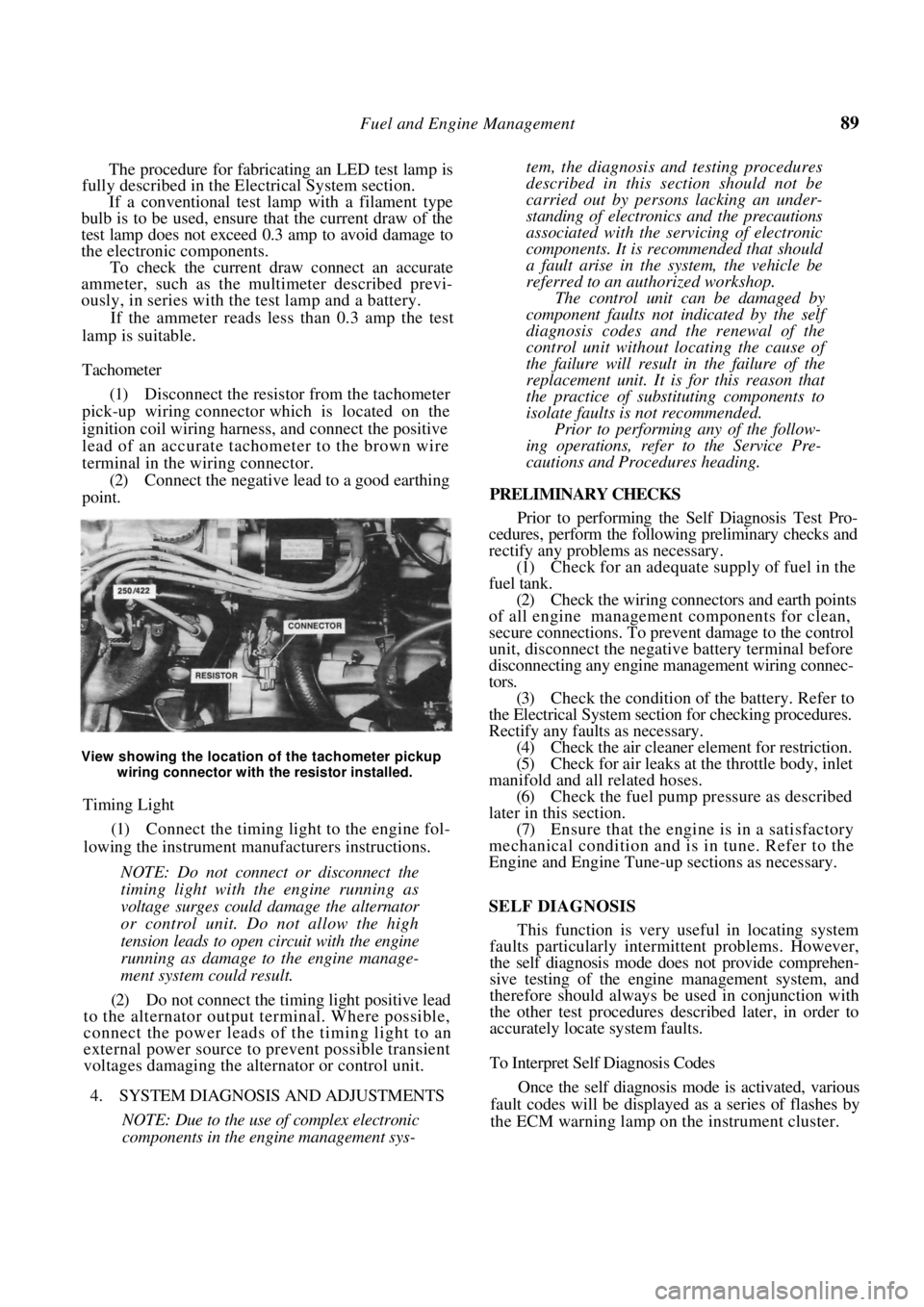
(1) Disconnect the resistor from the tachometer
pick-up wiring connector which is located on the
ignition coil wiring harness, and connect the positive
lead of an accurate tachometer to the brown wire
terminal in the wiring connector. (2) Connect the negative lead to a good earthing
point.
View showing the location of the tachometer pickup
wiring connector with the resistor installed.
Timing Light
(1) Connect the timing light to the engine fol-
lowing the instrument manufacturers instructions.
NOTE: Do not connect or disconnect the
timing light with the engine running as
voltage surges could damage the alternator
or control unit. Do not allow the high
tension leads to open circuit with the engine
running as damage to the engine manage-
ment system could result.
(2) Do not connect the timing light positive lead
to the alternator output terminal. Where possible,
connect the power leads of the timing light to an
external power source to prevent possible transient
voltages damaging the alternator or control unit.
4. SYSTEM DIAGNOSIS AND ADJUSTMENTS
NOTE: Due to the use of complex electronic
components in the engine management sys-
tem, the diagnosis and testing procedures
described in this section should not be
carried out by persons lacking an under-
standing of electronics and the precautions
associated with the servicing of electronic
components. It is rec ommended that should
a fault arise in the system, the vehicle be
referred to an authorized workshop.
The control unit can be damaged by
component faults not indicated by the self
diagnosis codes and the renewal of the
control unit without lo cating the cause of
the failure will result in the failure of the
replacement unit. It is for this reason that
the practice of substituting components to
isolate faults is not recommended.
Prior to performing any of the follow-
ing operations, refer to the Service Pre-
cautions and Procedures heading.
PRELIMINARY CHECKS
Prior to performing the Self Diagnosis Test Pro-
cedures, perform the following preliminary checks and
rectify any problems as necessary.
(1) Check for an adequate supply of fuel in the
fuel tank. (2) Check the wiring connectors and earth points
of all engine management components for clean,
secure connections. To prevent damage to the control
unit, disconnect the negative battery terminal before
disconnecting any engine ma nagement wiring connec-
tors. (3) Check the condition of the battery. Refer to
the Electrical System sectio n for checking procedures.
Rectify any faults as necessary. (4) Check the air cleaner element for restriction.
(5) Check for air leaks at the throttle body, inlet
manifold and all related hoses. (6) Check the fuel pump pr essure as described
later in this section. (7) Ensure that the engine is in a satisfactory
mechanical condition and is in tune. Refer to the
Engine and Engine Tune-up sections as necessary.
SELF DIAGNOSIS
This function is very useful in locating system
faults particularly intermittent problems. However,
the self diagnosis mode does not provide comprehen-
sive testing of the engine management system, and
therefore should always be used in conjunction with
the other test procedures described later, in order to
accurately locate system faults.
To Interpret Self Diagnosis Codes
Once the self diagnosis mode is activated, various
fault codes will be displayed as a series of flashes by
the ECM warning lamp on the instrument cluster.
Page 117 of 238
117
EMISSION CONTROL
INTRODUCTION
To reduce the output level of the three primary
automotive emissions, carbon monoxide (CO), hydro-
carbons (HC) and oxides of nitrogen (NOx), and thus
comply with legislation on the maintenance of clean
air, several different emissi on control systems are used
in the Pulsar range of vehicles covered by this manual.
The systems will be discussed under the headings
( 1 ) Crankcase Ventilation System, (2) Evaporative
Control System, (3) Air Preheat System — 1.6 Liter
Engine and (4) Exhaust Control System.
1. CRANKCASE VENTILATION SYSTEM
DESCRIPTION
The crankcase ventilation system is of the closed
type and is designed to prevent crankcase vapors
being emitted into the atmosphere. Crankcase
vapors are caused by gases escaping past the piston
rings into the crankcase during the combustion pro-
cess.
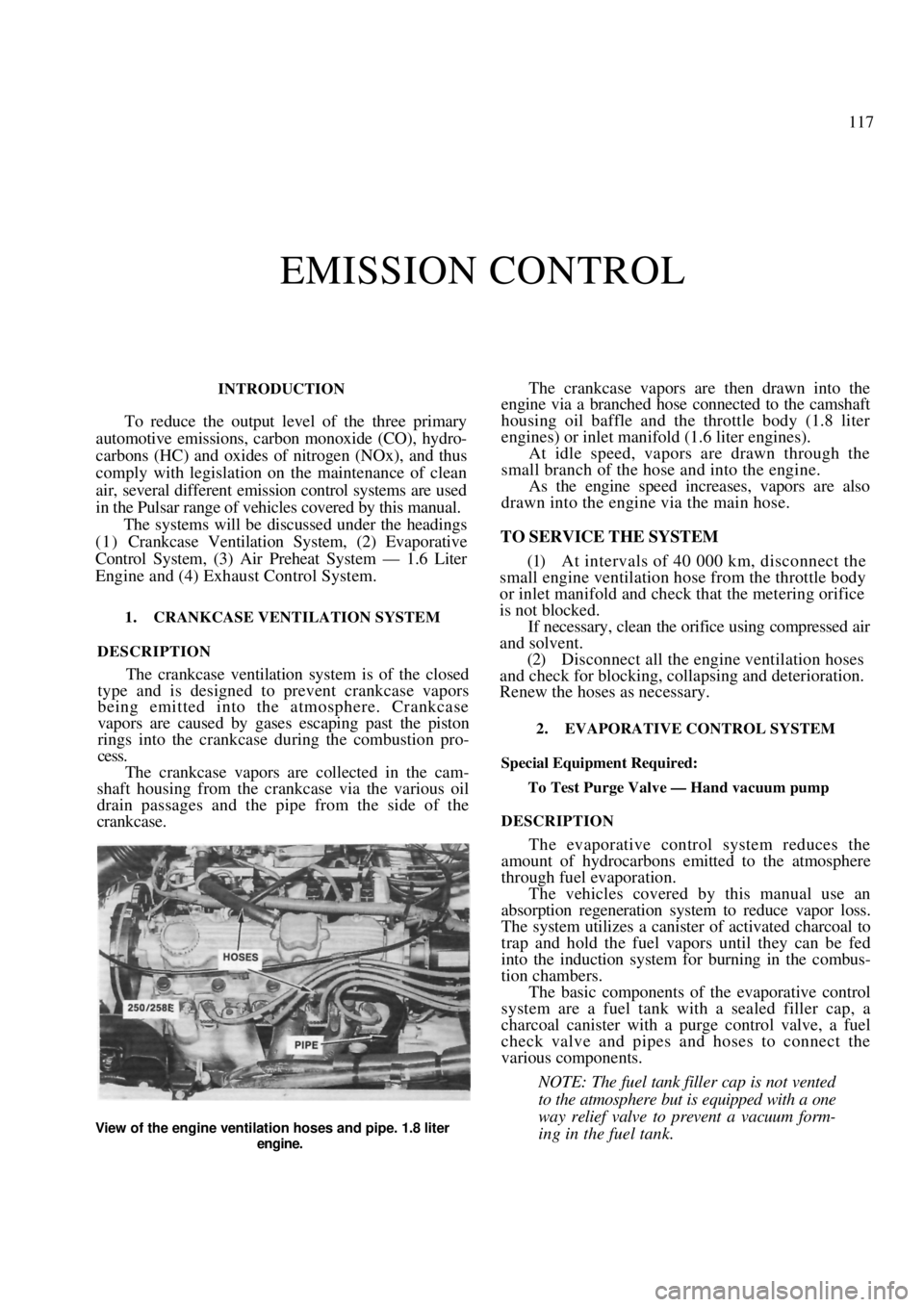
The crankcase vapors are collected in the cam-
shaft housing from the cra nkcase via the various oil
drain passages and the pipe from the side of the
crankcase.
The crankcase vapors are then drawn into the
engine via a branched hose connected to the camshaft
housing oil baffle and the throttle body (1.8 liter
engines) or inlet manifold (1.6 liter engines).
At idle speed, vapors are drawn through the
small branch of the hose and into the engine.
As the engine speed increases, vapors are also
drawn into the engine via the main hose.
TO SERVICE THE SYSTEM
(1) At intervals of 40 000 km, disconnect the
small engine ventilation hose from the throttle body
or inlet manifold and check that the metering orifice
is not blocked.
If necessary, clean the orifice using compressed air
and solvent.
(2) Disconnect all the engine ventilation hoses
and check for blocking, collapsing and deterioration.
Renew the hoses as necessary.
2. EVAPORATIVE CONTROL SYSTEM
Special Equipment Required:
To Test Purge Valve — Hand vacuum pump
DESCRIPTION
The evaporative control system reduces the
amount of hydrocarbons emitted to the atmosphere
through fuel evaporation.
The vehicles covered by this manual use an
absorption regeneration system to reduce vapor loss.
The system utilizes a canister of activated charcoal to
trap and hold the fuel vapors until they can be fed
into the induction system for burning in the combus-
tion chambers.
The basic components of the evaporative control
system are a fuel tank with a sealed filler cap, a
charcoal canister with a pur ge control valve, a fuel
check valve and pipes a nd hoses to connect the
various components.
NOTE: The fuel tank filler cap is not vented
to the atmosphere but is equipped with a one
way relief valve to prevent a vacuum form-
ing in the fuel tank.
View of the engine ventilation hoses and pipe. 1.8 liter
engine.
Page 121 of 238
121
CLUTCH
SPECIFICATIONS
Type................................................... Single dry plate
Operation................................................... Mechanical
Pressure plate type .................................... Diaphragm
Release bearing type .......................Prelubri cated ball
Driven plate:
Outside diameter .................................... 215 mm
Rivet depth limit ....................................0.3 mm
Runout limit .........................................0.5 mm
Maximum spline backlash ...................0.7 mm
Pressure plate:
Diaphragm spring height
(installed) ...................................... 30.5-32.5 mm
Spring finger vari ation limit.....................0.5 mm
Clutch pedal:
Height .............................................. 175-185 mm
Free play ....................................... 12.5-17.5 mm
Release lever free play............................ 2.5-3.5 mm
Flywheel machining limit ...............................0.3 mm
TORQUE WRENCH SETTINGS
Pressure plate bolts.......................................... 29 Nm
Pedal pivot pin nut ......................................... 22 Nm
Cable loc knut.................................................... 4 Nm
Lower clutch housing to engine bolts.............. 21 Nm
Centre and upper clutch housing
to engine bolts .................................................. 49 Nm
1. CLUTCH TROUBLE SHOOTING
CLUTCH SLIPPING
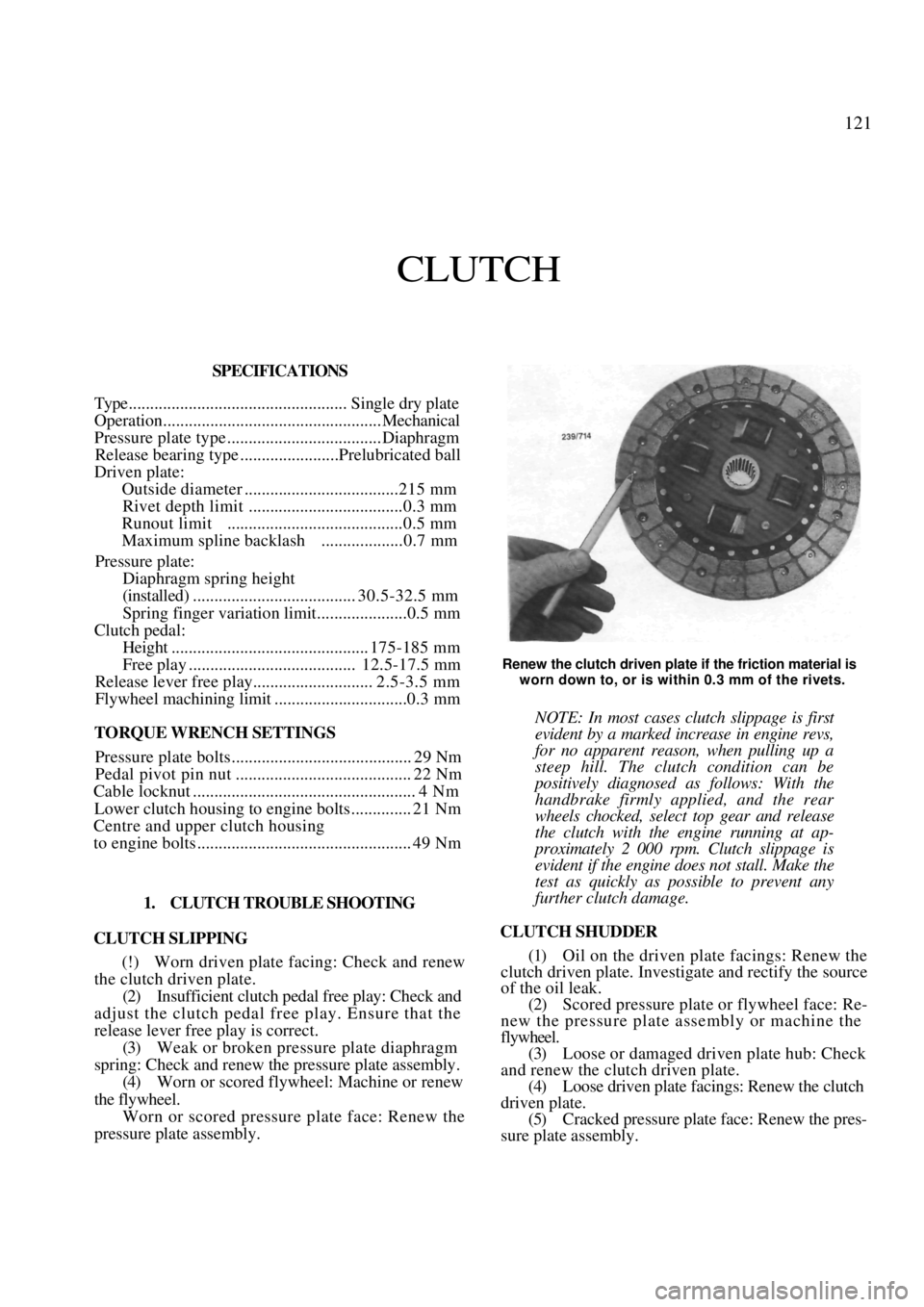
(!) Worn driven plate facing: Check and renew
the clutch driven plate.
(2) Insufficient clutch pedal free play: Check and
adjust the clutch pedal free play. Ensure that the
release lever free play is correct.
(3) Weak or broken pressure plate diaphragm
spring: Check and renew the pressure plate assembly. (4) Worn or scored flywh eel: Machine or renew
the flywheel. Worn or scored pressure plate face: Renew the
pressure plate assembly.
Renew the clutch driven plate if the friction material is
worn down to, or is within 0.3 mm of the rivets.
NOTE: In most cases clutch slippage is first
evident by a marked increase in engine revs,
for no apparent reason, when pulling up a
steep hill. The clutch condition can be
positively diagnosed as follows: With the
handbrake firmly applied, and the rear
wheels chocked, select top gear and release
the clutch with the engine running at ap-
proximately 2 000 rpm. Clutch slippage is
evident if the engine does not stall. Make the
test as quickly as possible to prevent any
further clutch damage.
CLUTCH SHUDDER
(1) Oil on the driven plate facings: Renew the
clutch driven plate. Invest igate and rectify the source
of the oil leak.
(2) Scored pressure plate or flywheel face: Re-
new the pressure plate assembly or machine the
flywheel. (3) Loose or damaged driven plate hub: Check
and renew the clutch driven plate. (4) Loose driven plate facings: Renew the clutch
driven plate. (5) Cracked pressure plate face: Renew the pres-
sure plate assembly.
Page 122 of 238
122 Clutch
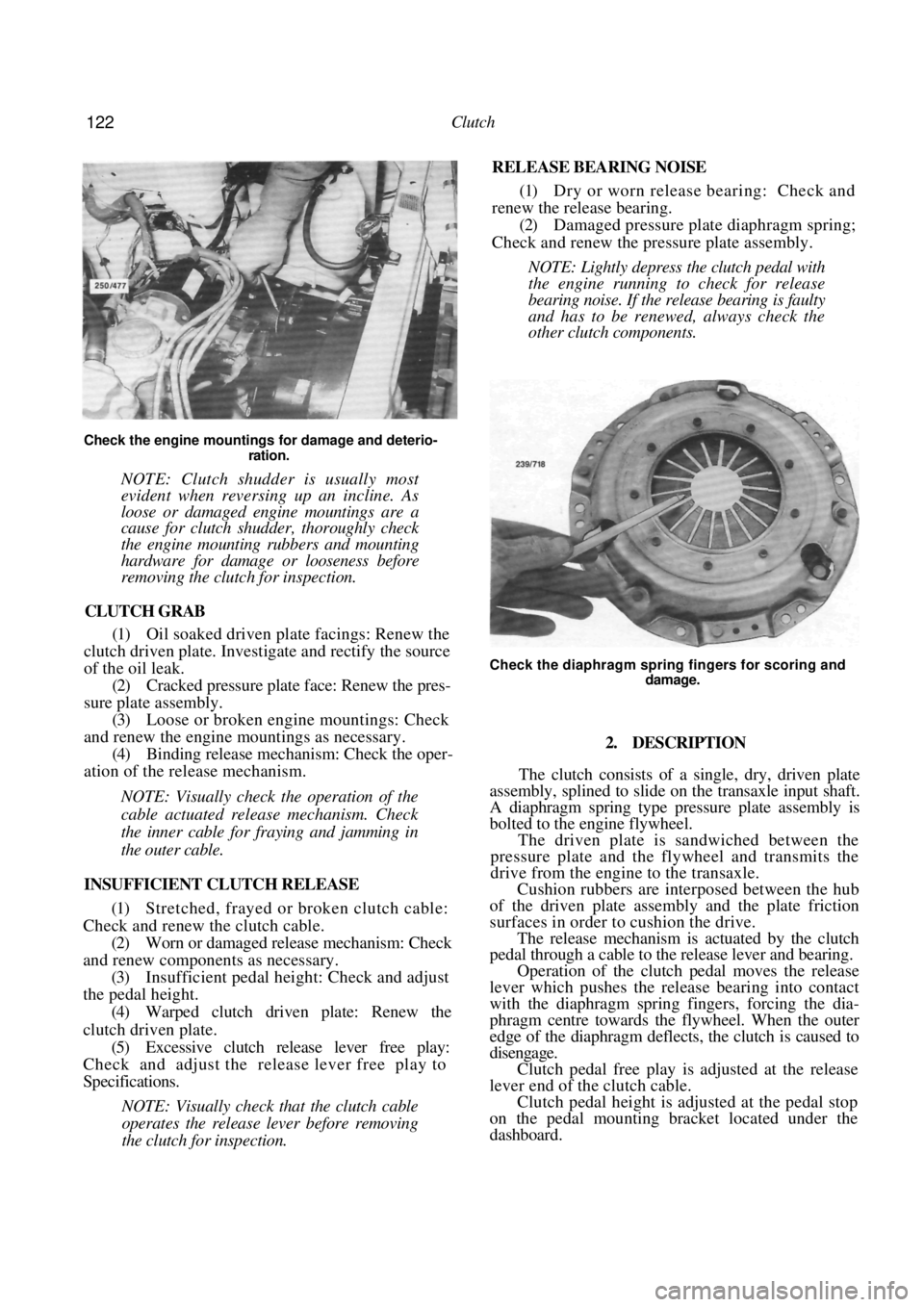
Check the engine mountings for damage and deterio- ration.
NOTE: Clutch shudder is usually most
evident when reversing up an incline. As
loose or damaged engine mountings are a
cause for clutch shudder, thoroughly check
the engine mounting rubbers and mounting
hardware for damage or looseness before
removing the clutch for inspection.
CLUTCH GRAB
(1) Oil soaked driven plate facings: Renew the
clutch driven plate. Invest igate and rectify the source
of the oil leak.
(2) Cracked pressure plate face: Renew the pres-
sure plate assembly. (3) Loose or broken engine mountings: Check
and renew the engine mountings as necessary.
(4) Binding release mechanism: Check the oper-
ation of the release mechanism.
NOTE: Visually check the operation of the
cable actuated release mechanism. Check
the inner cable for fraying and jamming in
the outer cable.
INSUFFICIENT CLUTCH RELEASE
(1) Stretched, frayed or broken clutch cable:
Check and renew the clutch cable. (2) Worn or damaged release mechanism: Check
and renew components as necessary. (3) Insufficient pedal height: Check and adjust
the pedal height.
(4) Warped clutch driven plate: Renew the
clutch driven plate. (5) Excessive clutch release lever free play:
Check and adjust the release lever free play to
Specifications.
NOTE: Visually check that the clutch cable
operates the release lever before removing
the clutch for inspection.
RELEASE BEARING NOISE
(1) Dry or worn release bearing: Check and
renew the release bearing.
(2) Damaged pressure plate diaphragm spring;
Check and renew the pressure plate assembly.
NOTE: Lightly depress the clutch pedal with
the engine running to check for release
bearing noise. If the release bearing is faulty
and has to be renewed, always check the
other clutch components.
Check the diaphragm spring fingers for scoring and damage.
2. DESCRIPTION
The clutch consists of a single, dry, driven plate
assembly, splined to slide on the transaxle input shaft.
A diaphragm spring type pr essure plate assembly is
bolted to the engine flywheel.
The driven plate is sandwiched between the
pressure plate and the flywheel and transmits the
drive from the engine to the transaxle.
Cushion rubbers are interposed between the hub
of the driven plate assembly and the plate friction
surfaces in order to cushion the drive.
The release mechanism is actuated by the clutch
pedal through a cable to the release lever and bearing.
Operation of the clutch pedal moves the release
lever which pushes the release bearing into contact
with the diaphragm spring fingers, forcing the dia-
phragm centre towards the flywheel. When the outer
edge of the diaphragm deflects, the clutch is caused to
disengage.
Clutch pedal free play is adjusted at the release
lever end of the clutch cable.
Clutch pedal height is adjusted at the pedal stop
on the pedal mounting bracket located under the
dashboard.
Page 127 of 238
Manual Transaxle and Drive Shafts 127
(6) Lubricating oil too thick: Drain the transaxle
and refill with the corre ct amount and grade of
lubricating oil. (7) Excessive end float in the mainshaft or input
shaft gears: Overhaul the transaxle.
NOTE: Check the clutch for correct opera-
tion. If reverse gear can be selected without
any gear clash this is a good indication that
the clutch is operating normally. Also check
that the correct type and grade of lubricating
oil is being used.
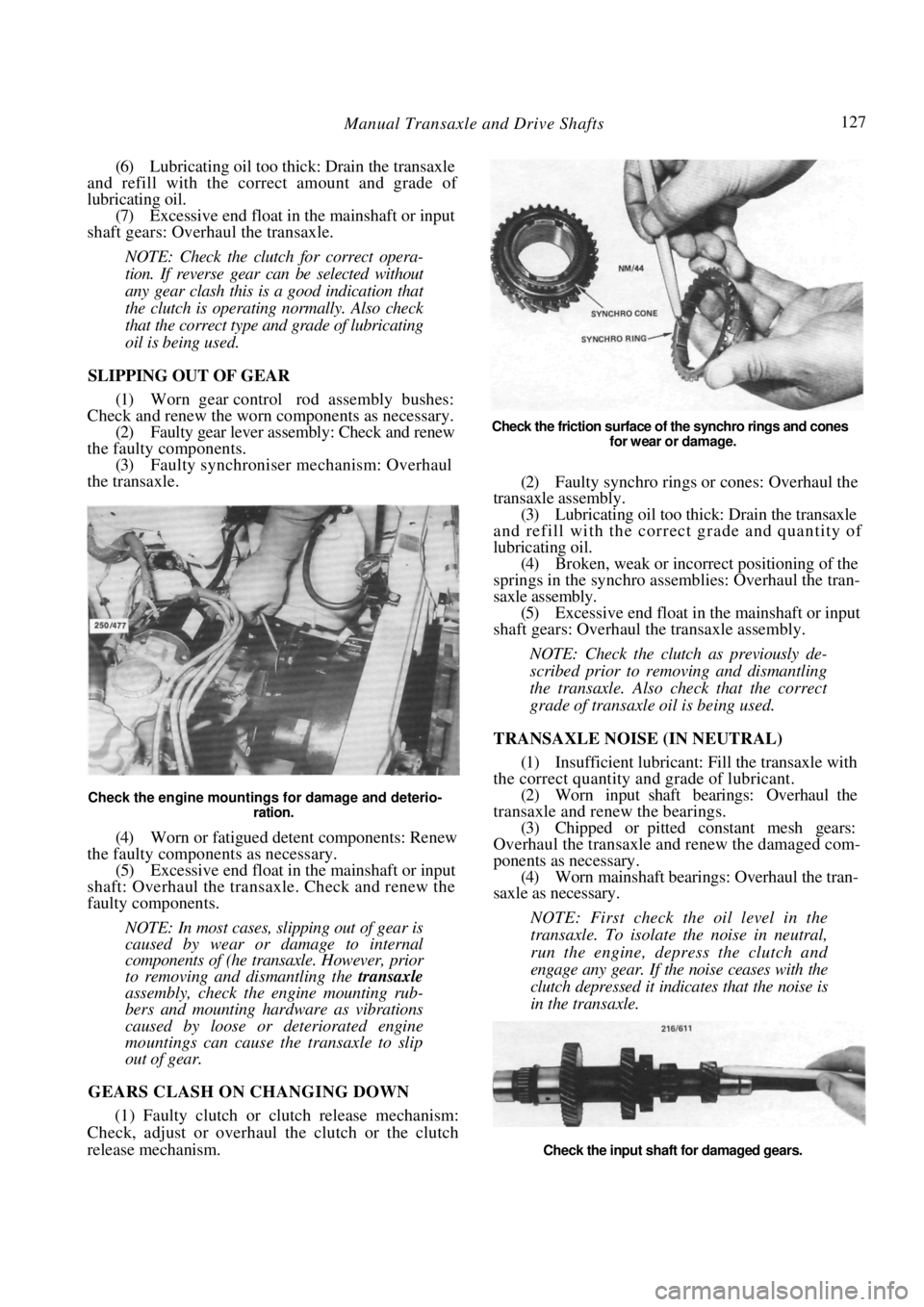
SLIPPING OUT OF GEAR
(1) Worn gear control rod assembly bushes:
Check and renew the worn components as necessary. (2) Faulty gear lever assembly: Check and renew
the faulty components. (3) Faulty synchroniser mechanism: Overhaul
the transaxle.
Check the engine mountings for damage and deterio-
ration.
(4) Worn or fatigued detent components: Renew
the faulty components as necessary.
(5) Excessive end float in the mainshaft or input
shaft: Overhaul the transaxle. Check and renew the
faulty components.
NOTE: In most cases, slipping out of gear is
caused by wear or damage to internal
components of (he tran saxle. However, prior
to removing and dismantling the transaxle
assembly, check the engine mounting rub-
bers and mounting hardware as vibrations
caused by loose or deteriorated engine
mountings can cause the transaxle to slip
out of gear.
GEARS CLASH ON CHANGING DOWN
(1) Faulty clutch or clutch release mechanism:
Check, adjust or overhaul the clutch or the clutch
release mechanism.
Check the friction surface of the synchro rings and cones
for wear or damage.
(2) Faulty synchro rings or cones: Overhaul the
transaxle assembly.
(3) Lubricating oil too thick: Drain the transaxle
and refill with the correct grade and quantity of
lubricating oil. (4) Broken, weak or incorrect positioning of the
springs in the synchro asse mblies: Overhaul the tran-
saxle assembly.
(5) Excessive end float in the mainshaft or input
shaft gears: Overhaul the transaxle assembly.
NOTE: Check the clutch as previously de-
scribed prior to removing and dismantling
the transaxle. Also check that the correct
grade of transaxle oil is being used.
TRANSAXLE NOISE (IN NEUTRAL)
(1) Insufficient lubricant: Fill the transaxle with
the correct quantity and grade of lubricant. (2) Worn input shaft bearings: Overhaul the
transaxle and renew the bearings. (3) Chipped or pitted constant mesh gears:
Overhaul the transaxle and renew the damaged com-
ponents as necessary. (4) Worn mainshaft bearings: Overhaul the tran-
saxle as necessary.
NOTE: First check the oil level in the
transaxle. To isolate the noise in neutral,
run the engine, depress the clutch and
engage any gear. If the noise ceases with the
clutch depressed it indicates that the noise is
in the transaxle.
Check the input shaft for damaged gears.
Page 140 of 238
140
AUTOMATIC TRANSAXLE
SPECIFICATIONS
Make .............................................. JATCO RL3F01A
Type .....................3 speed and reverse epicyclic gear
train with lock up torque converter
Operation .................................... Automatic hydraulic
Lubricant:
Type....................................................... Dexron IT
Capacity................................................. 6.3 liters
TORQUE WRENCH SETTINGS
Drive plate to crankshaft bolls ........................60 Nm
Drive plate to torque converter bolts ..............49 Nm
Convener housing to engine ...........................22 Nm
Converter housing to transaxle ........................23 Nm
Transaxle sump to transaxle ............................. 7 Nm
Oil cooler pipe to transaxle .............................49 Nm
Selector shaft locknut .......................................42 Nm
Transaxle filter bolts.........................................12 Nm
1. AUTOMATIC TRANSAXLE TROUBLE SHOOTING
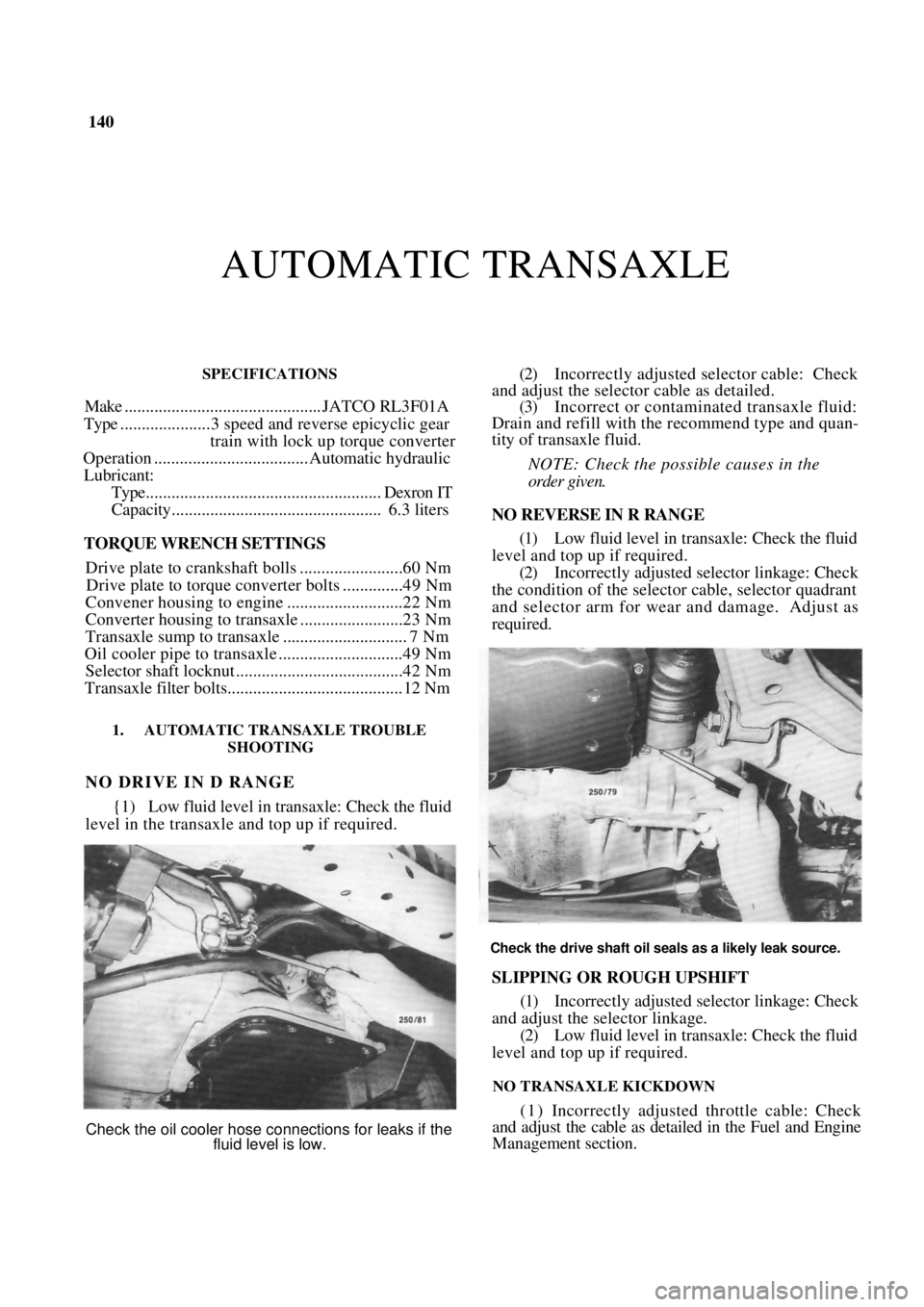
NO DRIVE IN D RANGE
{1) Low fluid level in transaxle: Check the fluid
level in the transaxle and top up if required.
(2) Incorrectly adjusted selector cable: Check
and adjust the selector cable as detailed. (3) Incorrect or contaminated transaxle fluid:
Drain and refill with the recommend type and quan-
tity of transaxle fluid.
NOTE: Check the possible causes in the
order given.
NO REVERSE IN R RANGE
(1) Low fluid level in transaxle: Check the fluid
level and top up if required. (2) Incorrectly adjusted selector linkage: Check
the condition of the selector cable, selector quadrant
and selector arm for wear and damage. Adjust as
required.
Check the drive shaft oil seals as a likely leak source.
SLIPPING OR ROUGH UPSHIFT
(1) Incorrectly adjusted selector linkage: Check
and adjust the selector linkage. (2) Low fluid level in transaxle: Check the fluid
level and top up if required.
NO TRANSAXLE KICKDOWN
(1) Incorrectly adjusted throttle cable: Check
and adjust the cable as detailed in the Fuel and Engine
Management section.
Check the oil cooler hose connections for leaks if the
fluid level is low.
Page 141 of 238
Automatic Transaxle 141
(2) Incorrectly adjusted kickdown cable: Check
and adjust or renew the kickdown cable as required.
NOTE: Check and adjust the throttle cable
before adjusting the kickdown cable.
ENGINE WILL NOT START IN P OR N
RANGE OR WILL START IN ANY RANGE
(1) Neutral safety switch faulty: Adjust or renew
the neutral safety switch. (2) Incorrectly adjusted selector cable: Check
and adjust the selector cable as detailed.
2. DESCRIPTION
The automatic transaxle combines a fluid coup-
ling or torque converter with a fully automatic three
speed epicyclic gear system.
The transaxle provides th ree forward ratios and
one reverse. The hydraulic system consists of a single
pump and valv e arrangement.
The final drive or differential and the transaxle
use a common lubricant. The transaxle oil pan and
final drive drain plug will have to be removed to drain
the transaxle completely. Topping up or refilling is
done through the dipstick tube.
The gear selector lever is floor mounted and
connected to the transaxle by an adjustable cable. The
selector quadrant adjacent to the base of the lever is
marked P, R, N, D, 2, 1.
It is necessary for the selector lever to be in P or
N before the engine can be started. When testing or
tuning the engine, the handbrake must be firmly
applied and the selector lever placed in the P position,
otherwise the vehicle could move forward or back-
wards as the engine speed is increased.
For long distance towing the vehicle should be
towed with the front end raised.
It is not possible to start the engine by either
towing or pushing the vehicle.
The transaxle can be removed from the vehicle
without engine removal.
NOTE: As extensive knowledge and equip-
ment is required to overhaul the automatic
transaxle assembly, it is therefore not a
worthwhile repair proposition for the aver-
age person. However if the transaxle must
be overhauled by a specialist or be replaced
with a reconditioned unit, the removal and
installation procedure is fully described at
the end of this section.
3. TRANSAXLE FLUID
Only use the recommended transaxle fluid speci-
fied by the manufacturer when topping up or changing
the fluid in the system.
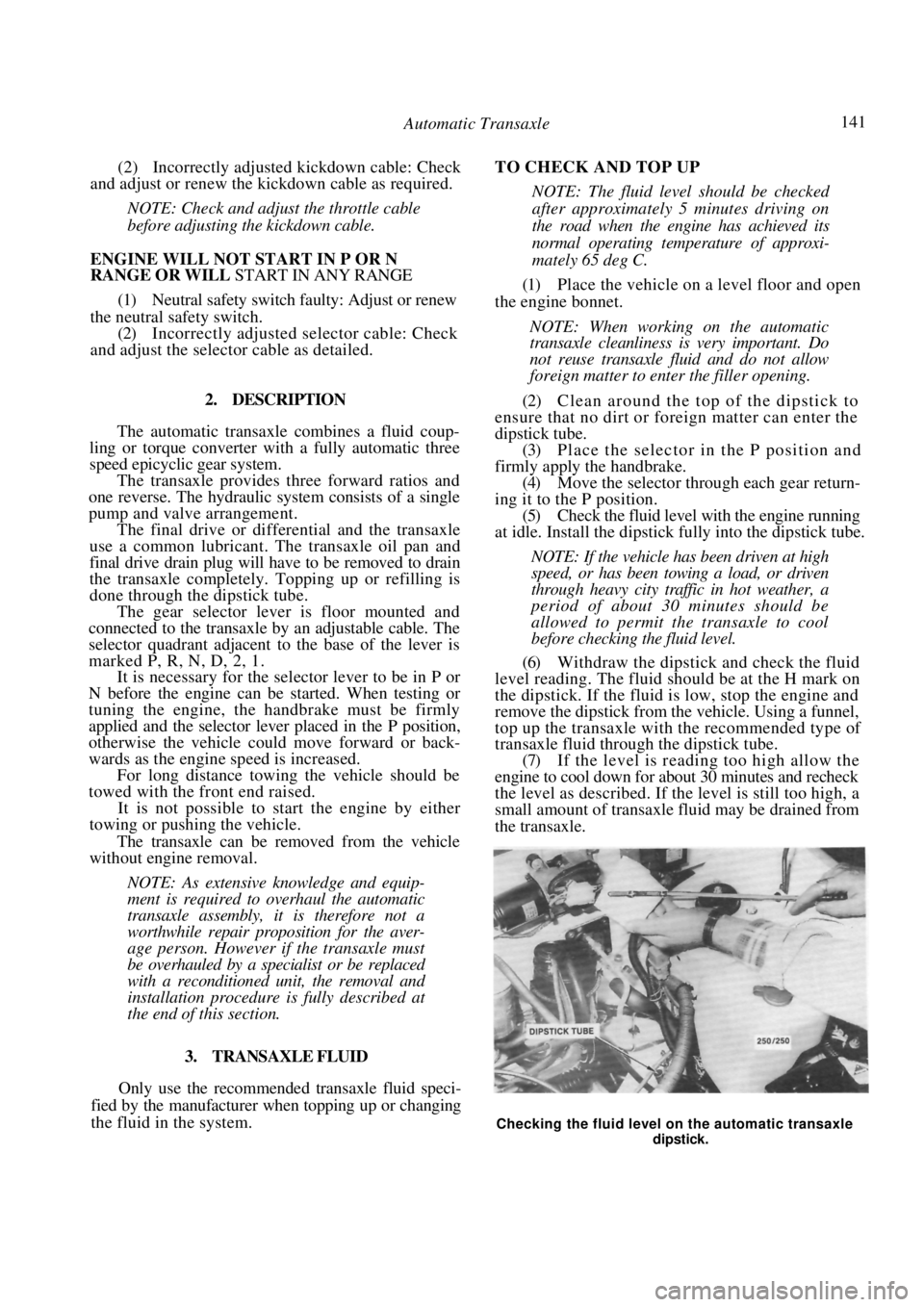
TO CHECK AND TOP UP
NOTE: The fluid level should be checked
after approximately 5 minutes driving on
the road when the engine has achieved its
normal operating temperature of approxi-
mately 65 deg C.
(1) Place the vehicle on a level floor and open
the engine bonnet.
NOTE: When working on the automatic
transaxle cleanliness is very important. Do
not reuse transaxle fluid and do not allow
foreign matter to enter the filler opening.
(2) Clean around the top of the dipstick to
ensure that no dirt or foreign matter can enter the
dipstick tube.
(3) Place the selector in the P position and
firmly apply the handbrake. (4) Move the selector thro ugh each gear return-
ing it to the P position.
(5) Check the fluid level with the engine running
at idle. Install the dipstick fully into the dipstick tube.
NOTE: If the vehicle has been driven at high
speed, or has been towing a load, or driven
through heavy city traffic in hot weather, a
period of about 30 minutes should be
allowed to permit the transaxle to cool
before checking the fluid level.
(6) Withdraw the dipstick and check the fluid
level reading. The fluid should be at the H mark on
the dipstick. If the fluid is low, stop the engine and
remove the dipstick from the vehicle. Using a funnel,
top up the transaxle with the recommended type of
transaxle fluid through the dipstick tube. (7) If the level is reading too high allow the
engine to cool down for about 30 minutes and recheck
the level as described. If the level is still too high, a
small amount of transaxle fluid may be drained from
the transaxle.
Checking the fluid level on the automatic transaxle
dipstick.
Page 156 of 238

156
FRONT SUSPENSION
SPECIFICATIONS
Type.................. Independent MacPherson strut with
coil springs and control arms
Shock absorber .................. Hydraulic, non-repairable
Hub bearing end float (maximum) ............. 0.05 mm
Ball joint axial play (maximum) ....................0.7 mm
Ball joint turning torque (used)...............0.5-4.9 Nm
Wheel alignment:
Toe in ..................................................... 0-2 mm
Camber ........................................- 0 ° 1 0 ' ± 4 5 '
Caster ..............................................1 ° 1 0 ' ± 4 5 '
King pin inclination..................... 1 3 ° 5 5 ' ± 4 5 '
TORQUE WRENCH SETTINGS
Hub bearing nut..................................... 196-235 Nm
Suspension unit to steering knuckle nut ...... 118 Nm
Suspension unit to body nuts ......................... 29 Nm
Piston rod nut .................................................. 72 Nm
Brake caliper to steering knuckle bolts ........... 52 Nm
Ball joint to steering knuckle bolt ................... 86 Nm
Control arm bracket bolts ............................... 98 Nm
Control arm pivot bolt ................................ 118 Nm
Stabiliser bar link nuts..................................... 44 Nm
Stabiliser bar bracket bolts .............................. 21 Nm
1. FRONT SUSPENSION TROUBLE
SHOOTING
FRONT END NOISE
(1) Loose upper suspension mounting or piston
rod: Tighten the mounting or piston rod nuts. (2) Loose or worn suspension unit lower ball
joint: Tighten or renew the lower ball joint.
(3) Noise in the suspension unit: Renew the
faulty suspension unit, preferably in pairs.
(4) Worn or loose steering gear: Overhaul the
steering gear assembly. (5) Worn front hub bearings: Renew the hub
bearings:
(6) Loose or defective stab ilizer bar, control arm
or mountings: Check, tighten or renew the mounting
rubbers.
Check the ball joints for wear and deterioration.
(7) Worn stabilizer bar link ball joints: Renew
the stabilizer bar links.
(8) Drive shafts worn or insufficiently lubri-
cated: Check the lubricant and the dust boots and
renew as necessary. (9) Drive shaft splines in the hub or the
differential worn or dama ged: Check and renew as
necessary.
NOTE: To check the front suspension com-
ponents for wear, raise the front of the
vehicle, support it on chassis stands and
allow both front wheel to hang free. With an
assistant pushing and pulling the front
wheels in and out at the top and then at the
bottom, check for excessive looseness at the
front hub bearings and lower control arm
inner pivot bushes. Noise or vibration in the
front end can also be caused by excessive
tire or wheel unbalance. Drive shaft joint
noise is usually more pronounced when
moving slowly with the steering on full lock.
POOR OR ERRATIC ROAD HOLDING
ABILITY
(1) Low or uneven tire pressures: Inflate the
tires to the recommended pressures.
(2) Defective suspension unit: Renew the faulty
unit, preferably in pairs.
Page 157 of 238

Front Suspension 157
Check the stabilizer bar links for wear and damage.
(3) Incorrect front end alignment: Check and
adjust the alignment as necessary. (4) Defective stabilizer bar mounting rubbers or
worn link ball joints: Renew component as necessary. (5) Weak or broken front coil spring: Renew
both springs as a matching pair. (6) Broken or weak rear coil spring: Renew both
springs as matching pair. (7) Drive shaft bent or distorted: Check and
renew as necessary. (8) Tie rod end worn or damaged: Check and
renew as necessary.
(9) Control arm ball joint worn or damaged:
Check and renew as necessary.
(10) Control arm mounting bolts loose: Tighten
the control arm bolts. (11) Wheel hub bearing worn: Check and renew
as necessary. NOTE: As a quick guide to suspension unit
condition, bounce the front of the vehicle up
and down (one side at a time), the vehicle
should come to rest in a single movement. If
it bounces two or three times before stop-
ping, the suspension unit should be renewed.
If the from of the vehicle is tower on one
side than the other, remove the coil spring
and check its free length against a new
spring. If the spring is found to be unservice-
able it is good practice to install two new
springs as a matching pair. This also applies
to the springs on the rear of the vehicle.
2. DESCRIPTION
The front suspension is an independent type
comprising two Macpherson strut suspension units
mounted vertically on each side of the vehicle. The
lower end of the suspension unit is bolted to the
steering knuckle, which in turn houses the front hub
bearings. The steering knuckle pivots on the control
arm by means of a ball joint.
The control arm pivots at its inner ends on rubber
bushes.
A stabilizer bar is attached to both ends of the
control arms using ball joint links. The stabilizer bar
is attached to the front underbody by brackets and
mounting rubbers.
Each front suspension unit assembly comprises a
tubular shock absorber type suspension unit, sur-
rounded at the upper end by a coil spring. On top of
the coil spring is the upper mounting which attaches
to the underside of the inner mudguard panel. The
piston rod of the suspensi on unit is attached to the
centre of the upper mounting by a rubber mounted
bearing.
When a suspension unit is found to be defective it
is recommended that both suspension units be re-
newed as a pair.
Camber is adjusted by means of a cam on the
upper steering knuckle to suspension unit mounting
bolt.
The kingpin inclination and caster are set in
production and cannot be adjusted. Any variation in
these angles will be caused by worn or damaged
components.
3. STEERING KNUCKLE
Special Equipment Required:
To Renew Wheel Bearing — Press and press plates
and suitable tubes and mandrels
To Check Hub End Float — Dial gauge
TO REMOVE AND INSTAL
(1) Raise the front of the vehicle and support it
on chassis stands. Remove the front wheel.
Checking the control arm bolts for security.
Page 164 of 238
164
REAR SUSPENSION
SPECIFICATIONS
Type........................... Independent MacPherson strut
Shock absorber.................... Oil filled, non-repairable
Maximum hub bearing end float ................. 0.05 mm
Rear wheel alignment:
Toe out ........................................3 mm ± 2 mm
Camber ............................................. - 1 ° ± 4 5 '
TORQUE WRENCH SETTINGS
Hub retaining nut ......................................... 255 Nm
Suspension unit retaining nuts ....................... 29 Nm
Upper mounting retaining nut ........................ 72 Nm
Suspension unit to knuckle nuts .................. 118 Nm
Control arms to knuckle nut ........................ 118 Nm
Control arms to crossmember nut ............... 118 Nm
Stabiliser bar mounting bracket bolts .......... 108 Nm
Stabiliser bar retaining nut.............................. 83 Nm
Backing plate bolts........................................... 45 Nm
1. REAR SUSPENSION TROUBLE SHOOTING
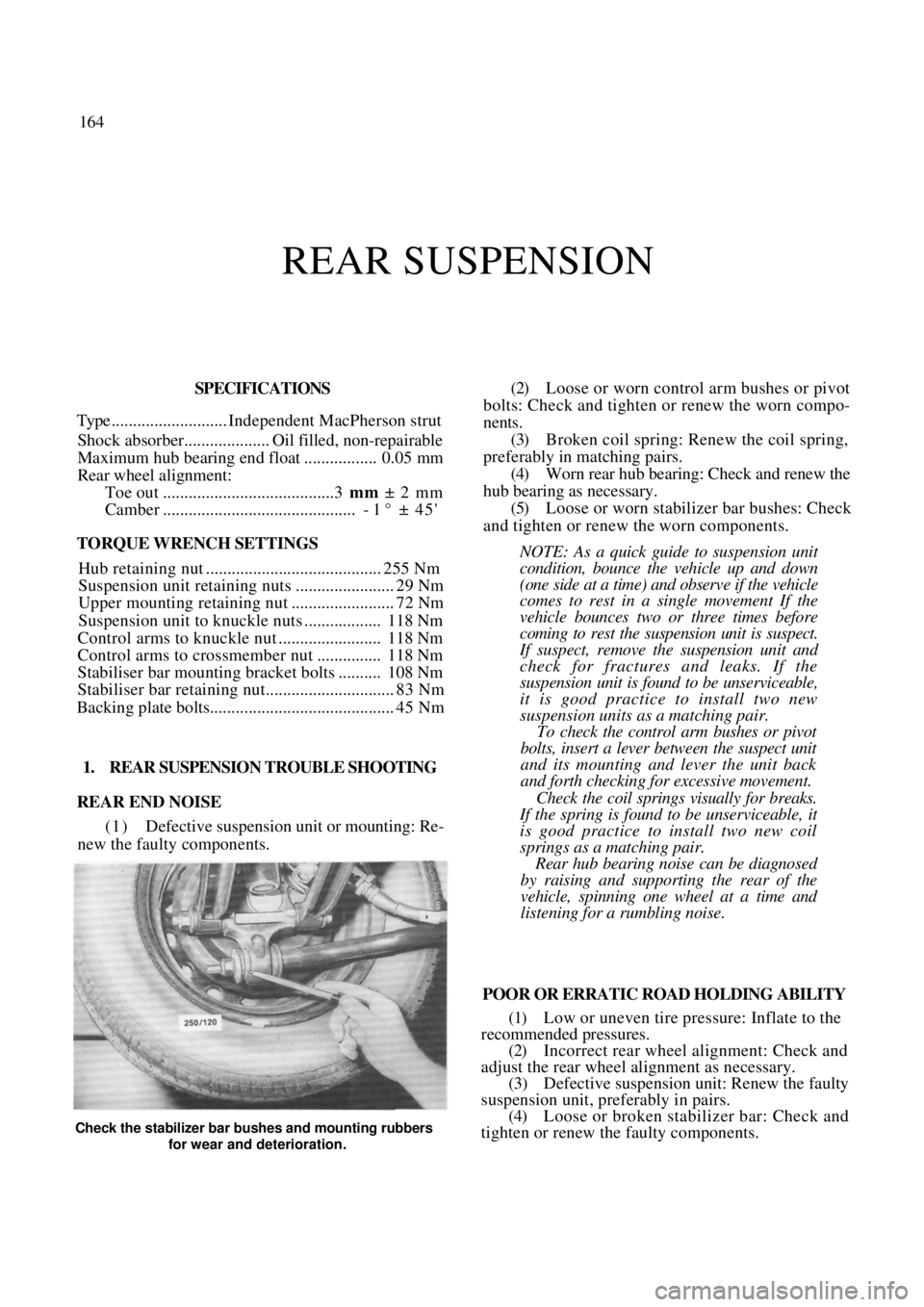
REAR END NOISE
( 1 ) Defective suspension unit or mounting: Re-
new the faulty components.
(2) Loose or worn control arm bushes or pivot
bolts: Check and tighten or renew the worn compo-
nents. (3) Broken coil spring: Renew the coil spring,
preferably in matching pairs. (4) Worn rear hub bearing: Check and renew the
hub bearing as necessary. (5) Loose or worn stabilizer bar bushes: Check
and tighten or renew the worn components.
NOTE: As a quick guide to suspension unit
condition, bounce the vehicle up and down
(one side at a time) and observe if the vehicle
comes to rest in a single movement If the
vehicle bounces two or three times before
coming to rest the susp ension unit is suspect.
If suspect, remove the suspension unit and
check for fractures and leaks. If the
suspension unit is found to be unserviceable,
it is good practice to install two new
suspension units as a matching pair.
To check the control arm bushes or pivot
bolts, insert a lever between the suspect unit
and its mounting and lever the unit back
and forth checking for excessive movement.
Check the coil springs visually for breaks.
If the spring is found to be unserviceable, it
is good practice to install two new coil
springs as a matching pair.
Rear hub bearing noise can be diagnosed
by raising and supporting the rear of the
vehicle, spinning one wheel at a time and
listening for a rumbling noise.
POOR OR ERRATIC ROAD HOLDING ABILITY
(1) Low or uneven tire pressure: Inflate to the
recommended pressures.
(2) Incorrect rear wheel alignment: Check and
adjust the rear wheel alignment as necessary.
(3) Defective suspension unit: Renew the faulty
suspension unit, preferably in pairs. (4) Loose or broken stabilizer bar: Check and
tighten or renew the faulty components.
Check the stabilizer bar bushes and mounting rubbers
for wear and deterioration.