length NISSAN PULSAR 1987 Owner's Guide
[x] Cancel search | Manufacturer: NISSAN, Model Year: 1987, Model line: PULSAR, Model: NISSAN PULSAR 1987Pages: 238, PDF Size: 28.91 MB
Page 200 of 238
200 Electrical System
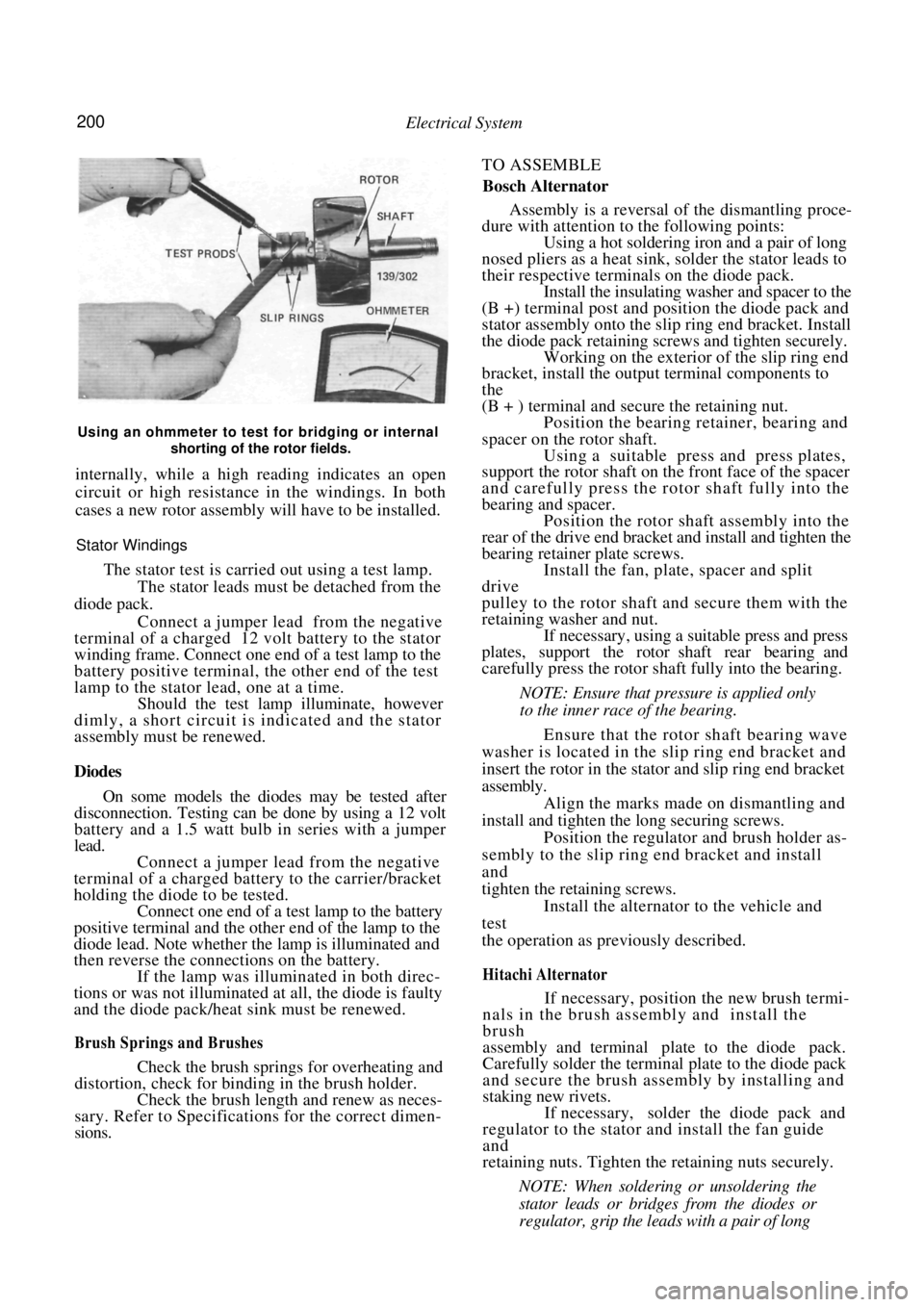
Using an ohmmeter to test for bridging or internal shorting of the rotor fields.
internally, while a high reading indicates an open
circuit or high resistance in the windings. In both
cases a new rotor assembly will have to be installed.
Stator Windings
The stator test is carried out using a test lamp.
The stator leads must be detached from the
diode pack.
Connect a jumper lead from the negative
terminal of a charged 12 volt battery to the stator
winding frame. Connect one en d of a test lamp to the
battery positive terminal, the other end of the test
lamp to the stator lead, one at a time. Should the test lamp illuminate, however
dimly, a short circuit is indicated and the stator
assembly must be renewed.
Diodes
On some models the diod es may be tested after
disconnection. Testing can be done by using a 12 volt
battery and a 1.5 watt bulb in series with a jumper
lead.
Connect a jumper lead from the negative
terminal of a charged battery to the carrier/bracket
holding the diode to be tested. Connect one end of a test lamp to the battery
positive terminal and the other end of the lamp to the
diode lead. Note whether the lamp is illuminated and
then reverse the connections on the battery. If the lamp was illuminated in both direc-
tions or was not illuminated at all, the diode is faulty
and the diode pack/heat sink must be renewed.
Brush Springs and Brushes
Check the brush spring s for overheating and
distortion, check for binding in the brush holder.
Check the brush length and renew as neces-
sary. Refer to Specifications for the correct dimen-
sions. TO ASSEMBLE
Bosch Alternator
Assembly is a reversal of the dismantling proce-
dure with attention to the following points:
Using a hot soldering iron and a pair of long
nosed pliers as a heat sink, solder the stator leads to
their respective terminals on the diode pack. Install the insulating washer and spacer to the
(B +) terminal post and position the diode pack and
stator assembly onto the slip ring end bracket. Install
the diode pack retaining screws and tighten securely. Working on the exterior of the slip ring end
bracket, install the output terminal components to
the
(B + ) terminal and secure the retaining nut.
Position the bearing retainer, bearing and
spacer on the rotor shaft. Using a suitable press and press plates,
support the rotor sh aft on the front face of the spacer
and carefully press the rotor shaft fully into the
bearing and spacer. Position the rotor shaft assembly into the
rear of the drive end bracket and install and tighten the
bearing retainer plate screws. Install the fan, plate, spacer and split
drive
pulley to the rotor shaft and secure them with the
retaining washer and nut. If necessary, using a suitable press and press
plates, support the rotor shaft rear bearing and
carefully press the rotor shaft fully into the bearing.
NOTE: Ensure that pressure is applied only
to the inner race of the bearing.
Ensure that the rotor shaft bearing wave
washer is located in the slip ring end bracket and
insert the rotor in the stator and slip ring end bracket
assembly. Align the marks made on dismantling and
install and tighten the long securing screws.
Position the regulator and brush holder as-
sembly to the slip ring end bracket and install
and
tighten the retaining screws. Install the alternator to the vehicle and
test
the operation as prev iously described.
Hitachi Alternator
If necessary, position the new brush termi-
nals in the brush assembly and install the
brush
assembly and terminal plate to the diode pack.
Carefully solder the terminal plate to the diode pack
and secure the brush assembly by installing and
staking new rivets.
If necessary, solder the diode pack and
regulator to the stator and install the fan guide
and
retaining nuts. Tighten the retaining nuts securely.
NOTE: When soldering or unsoldering the
stator leads or bridges from the diodes or
regulator, grip the leads with a pair of long
Page 202 of 238
202 Electrical System
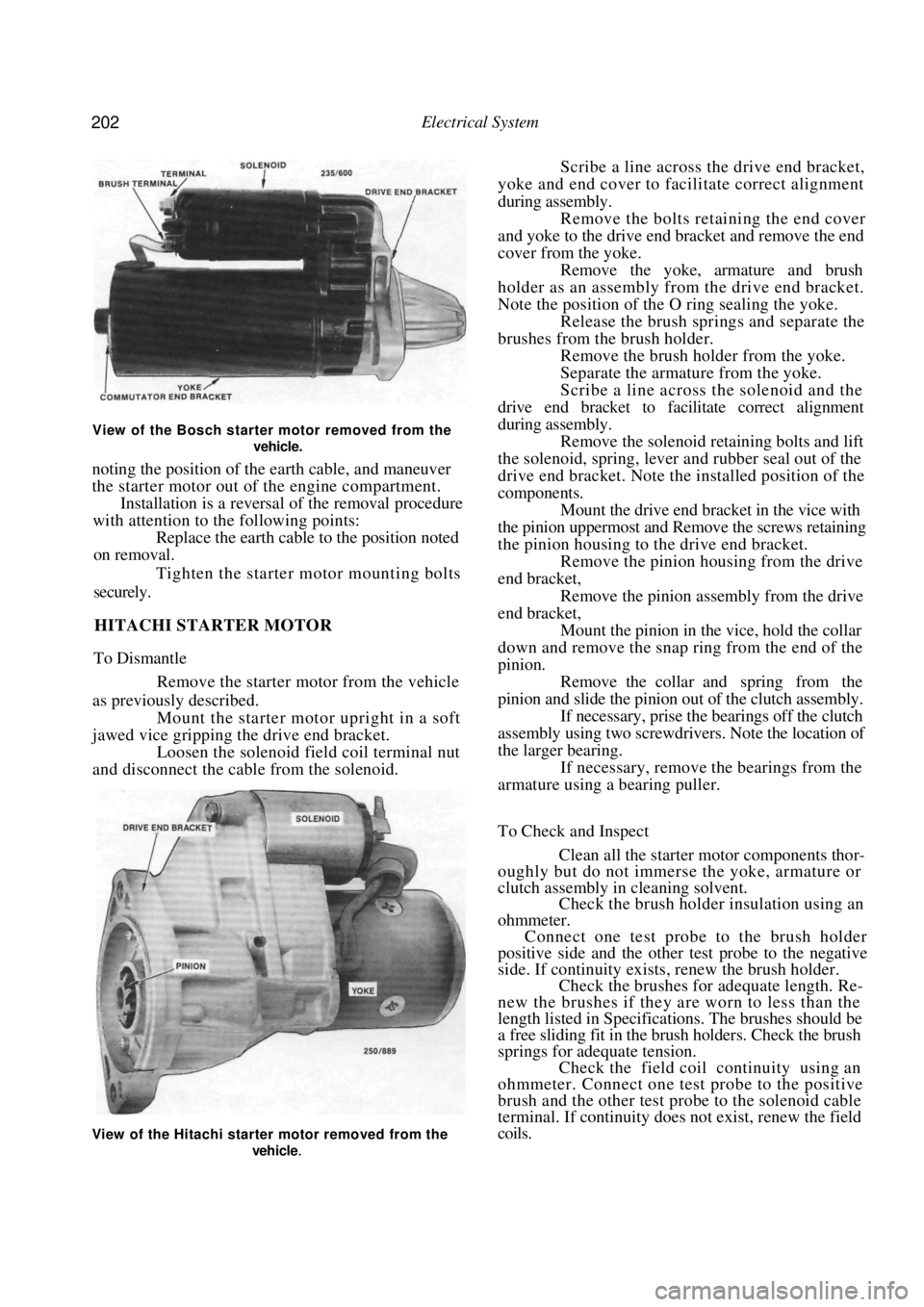
View of the Bosch starter motor removed from the
vehicle.
noting the position of the earth cable, and maneuver
the starter motor out of the engine compartment.
Installation is a reversal of the removal procedure
with attention to the following points:
Replace the earth cable to the position noted
on removal.
Tighten the starter motor mounting bolts
securely.
HITACHI STARTER MOTOR
To Dismantle
Remove the starter motor from the vehicle
as previously described. Mount the starter motor upright in a soft
jawed vice gripping the drive end bracket. Loosen the solenoid field coil terminal nut
and disconnect the cable from the solenoid.
Scribe a line across the drive end bracket,
yoke and end cover to facilitate correct alignment
during assembly. Remove the bolts retaining the end cover
and yoke to the drive end bracket and remove the end
cover from the yoke. Remove the yoke, armature and brush
holder as an assembly from the drive end bracket.
Note the position of the O ring sealing the yoke. Release the brush spri ngs and separate the
brushes from the brush holder. Remove the brush holder from the yoke.
Separate the armature from the yoke.
Scribe a line across the solenoid and the
drive end bracket to facilitate correct alignment
during assembly. Remove the solenoid retaining bolts and lift
the solenoid, spring, lever an d rubber seal out of the
drive end bracket. Note the installed position of the
components. Mount the drive end bracket in the vice with
the pinion uppermost and Remove the screws retaining
the pinion housing to the drive end bracket. Remove the pinion housing from the drive
end bracket,
Remove the pinion assembly from the drive
end bracket, Mount the pinion in the vice, hold the collar
down and remove the snap ring from the end of the
pinion. Remove the collar and spring from the
pinion and slide the pinion out of the clutch assembly. If necessary, prise the bearings off the clutch
assembly using two screwdri vers. Note the location of
the larger bearing. If necessary, remove the bearings from the
armature using a bearing puller.
To Check and Inspect
Clean all the starter motor components thor-
oughly but do not immerse the yoke, armature or
clutch assembly in cleaning solvent.
Check the brush holder insulation using an
ohmmeter. Connect one test probe to the brush holder
positive side and the other test probe to the negative
side. If continuity exists , renew the brush holder.
Check the brushes for adequate length. Re-
new the brushes if they are worn to less than the
length listed in Specifications. The brushes should be
a free sliding fit in the brush holders. Check the brush
springs for adequate tension.
Check the field coil continuity using an
ohmmeter. Connect one test probe to the positive
brush and the other test probe to the solenoid cable
terminal. If continuity does not exist, renew the field
coils.
View of the Hitachi starter motor removed from the
vehicle
.
Page 205 of 238

Electrical System 205
Dismantled view of the brush holder assembly. Bosch
starter motor.
side and the other lead to the negative side. If there is
any indication of leakage the ohmmeter will show a
reading other than infinity. Repair or renew the brush
holder if leakage is evident.
(2) Check the brushes for adequate length.
Brushes should be renewed when their length is below
Specifications. They should be a free sliding fit in the
brush holders.
NOTE: Due to the difficulty involved in
removing and installing the brushes in the
Bosch starter motor, it is recommended that
the brush holder be renewed as an assembly.
(3) Check that the commutator is free from
pitting and burning. Clean with a petrol moistened
cloth and polish with a strip of fine glass paper.
A badly worn commutator may be repaired by
mounting in a lathe, spi nning at high speed, and
taking a light cut with a very sharp tool. After turning,
undercut the insulation between the segments.
(4) Check the armature for short circuit using an
ohmmeter.
Place one of the test lead s on the armature shaft
or core and move the other lead around the circum-
ference of the commutator. If the ohmmeter shows a
reading at any point the armature is faulty and should
be renewed.
Check the drive assembly clutch pinion teeth
for wear, scoring or chipping. A clutch in good
condition should take up the drive in one direction
only. It should rotate easily and smoothly in the
non-drive direction and the assembly should move
smoothly along the armature or drive shaft helical
splines.
Check the armature shaft bushes for wear
and renew as necessary. The old bushes must be
removed and the new ones pressed into the end
brackets using a polished mandrel of the exact diam-
eter of the armature shaft. NOTE: The new bushes must not be reamed
to size, as reaming will impair the porosity
of the bushes and cause early failure. New
bushes should be allowed to stand immersed
in clean light engine oil for one hour before
installation.
To Assemble
Assembly is a reversal of the dismantling proce-
dure with attention to the following points:
Lubricate the helix of the drive shaft lightly
with graphite grease and install the drive assembly
to
the drive shaft. Install the stop collar and snap ring, slide the
stop collar over the snap ring to lock the snap ring in
position.
Lubricate the bushes in both end brackets
sparingly with engine oil. Install the engaging lever and gear set into the
drive end bracket. Install the centre rear bracket and the engag-
ing lever seal into the drive end bracket.
Slide the brush holder assembly into position
on the commutator ensuring that the brush holders
are correctly positioned in the anchor points. Install the commutator end bracket to
the
armature, install the shims and C clip. Check that the armature end float is satisfac-
tory and adjust as necessary using shims of the correct
thickness.
Align the slot in the commutator end bracket
with the cut out on the wiring seal and install the
armature end cover to the commutator end bracket.
Install the cover retaini ng screws but do not tighten.
Ensure that the permanent magnets in the
yoke have not picked up any debris and slide the yoke
over the armature ensuring that the wiring seal locates
correctly in the slot in the yoke.
View showing the planetary gear set. Bosch starter
motor.
Page 217 of 238
Electrical System 217
When installing a trailer socket, it may be neces-
sary to replace the original vehicle flasher unit with a
heavy duty unit to maintain the flash rate in accor-
dance with local regulations. Local regulations may
also require the installation of a dashboard mounted
repeater lamp.
Should the trailer socket and plug not be matched,
adaptors can be made or obtained to facilitate con-
nection.
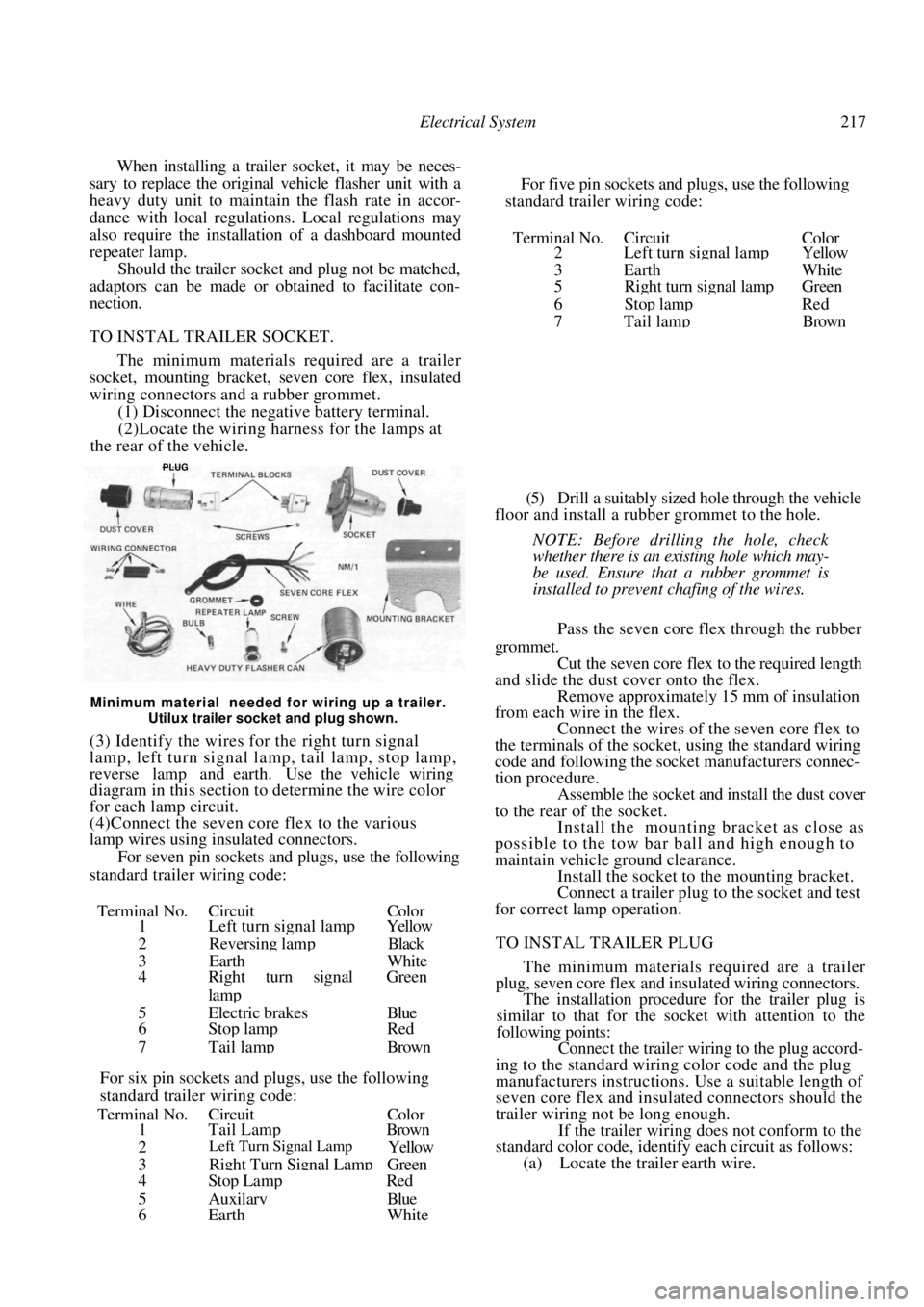
TO INSTAL TRAILER SOCKET.
The minimum materials required are a trailer
socket, mounting bracket, seven core flex, insulated
wiring connectors and a rubber grommet.
(1) Disconnect the negative battery terminal.
(2)Locate the wiring harness for the lamps at
the rear of the vehicle.
For five pin sockets and plugs, use the following
standard trailer wiring code:
Terminal No.CircuitColor2 Left turn signal lampYellow
3Earth White
5 Ri
ght turn signal lampGreen
6Stop lamp Red
7 Tail lam
p Brown
Minimum material needed for wiring up a trailer.
Utilux trailer socket and plug shown.
(3) Identify the wires for the right turn signal
lamp, left turn signal lamp, tail lamp, stop lamp,
reverse lamp and earth. Use the vehicle wiring
diagram in this section to determine the wire color
for each lamp circuit.
(4)Connect the seven core flex to the various
lamp wires using insulated connectors.
For seven pin sockets and plugs, use the following
standard trailer wiring code:
Terminal No.CircuitColor1 Left turn signal lamp Yellow
2 Reversing lamp Black
3EarthWhite
4 Right turn signal Green
lamp
5Electric brakesBlue
6 Stop lampRed
7
Tail lampBrown
For six pin sockets and pl ugs, use the following
standard trailer wiring code:
Terminal No.CircuitColor1 Tail LampBrown
2 Left Turn Signal Lamp Yellow
3Right Turn Signal LampGreen
4 Stop LampRed
5AuxilaryBlue
6 Earth White
(5) Drill a suitably si
zed hole through the vehicle
floor and install a rubber grommet to the hole.
NOTE: Before drilling the hole, check
whether there is an existing hole which may-
be used. Ensure that a rubber grommet is
installed to prevent chafing of the wires.
Pass the seven core flex through the rubber
grommet. Cut the seven core flex to the required length
and slide the dust cover onto the flex. Remove approximately 15 mm of insulation
from each wire in the flex.
Connect the wires of the seven core flex to
the terminals of the socket, using the standard wiring
code and following the socket manufacturers connec-
tion procedure. Assemble the socket and install the dust cover
to the rear of the socket. Install the mounting bracket as close as
possible to the tow bar ball and high enough to
maintain vehicle ground clearance. Install the socket to the mounting bracket.
Connect a trailer plug to the socket and test
for correct lamp operation.
TO INSTAL TRAILER PLUG
The minimum materials required are a trailer
plug, seven core flex and insulated wiring connectors.
The installation procedure for the trailer plug is
similar to that for the socket with attention to the
following points:
Connect the trailer wiring to the plug accord-
ing to the standard wiring color code and the plug
manufacturers instructions. Use a suitable length of
seven core flex and insulated connectors should the
trailer wiring not be long enough.
If the trailer wiring does not conform to the
standard color code, identify each circuit as follows: (a) Locate the trailer earth wire.
PLUG
Page 236 of 238

236 Body
top of the dashboard rearwards and maneuver the
dashboard through the front door opening.
Installation is a reversal of the removal procedure
with attention to the following points:
With the aid of an assistant, ensure that the
outer edges of the dashboard engage properly with the
door pillar brackets.
Hold the dashboard in position and loosely
install all retaining bolts. Align the dashboard
and
tighten all screws and bolts securely.
10. SEAT BELTS
The front and outer rear seats are equipped with
lap/sash inertia reel seat belts, which are designed to
lock with any sudden change in vehicle motion.
The centre rear seat is equipped with a manually
adjustable lap seat belt.
Child restraint anchorages are located on the
parcel shelf behind the rear seat on Sedan models and
at the rear of the lugg age compartment floor on
Hatchback models. These anchorages must be used if
a child's seat or capsule is installed to the vehicle. The
anchorages should not be used for adult scat bells or
harnesses.
The seat belts should be periodically inspected as
described below. Any seat belt assembly that is worn
or damaged, or has been subjected to abnormal
loadings in a collision, should be renewed as a
complete assembly.
Only mild soap and water should be used to clean
the webbing. Contamination wi th polish, oil, bleaches
and other chemicals should be avoided.
TO INSPECT
(1) Check the seat belt webbing for fraying, cuts,
burns or other damage. On inertia reel belts, slowly
pull the belt from the reel to allow the entire length to
be examined. If the webbing is damaged or worn,
renew the seat belt assembly.
Check the seat belt webbing for fraying, cuts, burns or
other damage.
Ensure that the belts are not twisted.
Check all retaining nuts and bolts for secu-
rity.
Inspect the belt buckles for correct and
secure engagement. If the buckles are damaged or do
not function correctly, renew the seat belt assembly. On inertia reel seat belts, check the retractor
mechanism as follows:
Pull the belt slowly from the reel and check
for smooth operation. Release the belt and ensure that
it retracts fully.
Pull the belt rapidly from the reel. The reel
should lock.
Drive the vehicle at walking pace and at-
tempt to withdraw the belt slowly while braking
sharply. The reel should lock. If the retractor mechanism does not function
correctly, renew the seat belt assembly.
11. SEATS
FRONT SEAT
To Remove and Install
Adjust the seat to the most forward position.
Remove the mounting bolts from the rear of
the seat.
Adjust the seat to allow access to the mount-
ing bolts at the front of the seat. Remove the mounting bolts and withdraw
the seat from the vehicle.
Installed view of the fron t seat belt with the door pillar
trim removed showing the mounting points.