length NISSAN PULSAR 1987 User Guide
[x] Cancel search | Manufacturer: NISSAN, Model Year: 1987, Model line: PULSAR, Model: NISSAN PULSAR 1987Pages: 238, PDF Size: 28.91 MB
Page 93 of 238
Fuel and Engine Management 93
liter engines, or the throttle body hose fitting on 1.6
liter engines.
(5) Tighten all connectors securely. Check for
external leaks as previously described. (6) Start the engine and note the pressure while
the engine is idling.
(7) Switch the engine Off and check that the
residual pressure does not decrease.
If the fuel pressure is within Specifications and
does not decrease, the fuel system is in a serviceable
condition. Depressurize the fuel system and discon-
nect the pressure gauge.
If the fuel pressure is a bove Specifications proceed
to operation (9).
If the fuel pressure is below Specifications proceed
to the following operation.
If the fuel pressure decreases, an internal leak is
indicated. Proceed to the following heading and carry
out the test procedure.
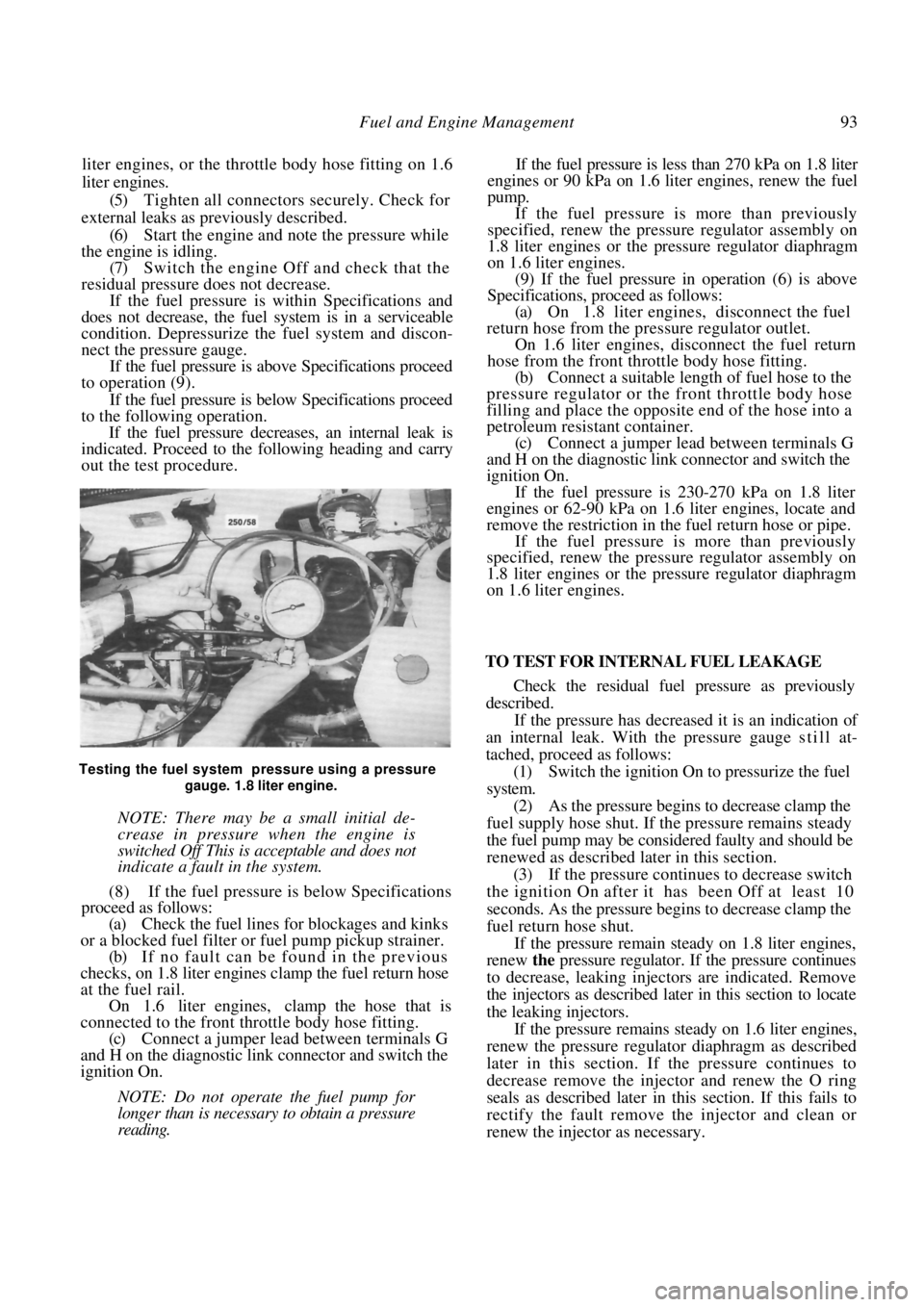
Testing the fuel system pressure using a pressure
gauge. 1.8 liter engine.
NOTE: There may be a small initial de-
crease in pressure when the engine is
switched Off This is acceptable and does not
indicate a fault in the system.
(8) If the fuel pressure is below Specifications
proceed as follows:
(a) Check the fuel lines for blockages and kinks
or a blocked fuel filter or fuel pump pickup strainer. (b) If no fault can be found in the previous
checks, on 1.8 liter engines clamp the fuel return hose
at the fuel rail. On 1.6 liter engines, clamp the hose that is
connected to the front throttle body hose fitting.
(c) Connect a jumper lead between terminals G
and H on the diagnostic link connector and switch the
ignition On.
NOTE: Do not operate the fuel pump for
longer than is necessary to obtain a pressure
reading.
If the fuel pressure is less than 270 kPa on 1.8 liter
engines or 90 kPa on 1.6 liter engines, renew the fuel
pump.
If the fuel pressure is more than previously
specified, renew the pressure regulator assembly on
1.8 liter engines or the pressure regulator diaphragm
on 1.6 liter engines.
(9) If the fuel pressure in operation (6) is above
Specifications, proceed as follows:
(a) On 1.8 liter engines, disconnect the fuel
return hose from the pressure regulator outlet.
On 1.6 liter engines, disc onnect the fuel return
hose from the front throttle body hose fitting.
(b) Connect a suitable length of fuel hose to the
pressure regulator or the front throttle body hose
filling and place the opposite end of the hose into a
petroleum resistant container. (c) Connect a jumper lead between terminals G
and H on the diagnostic link connector and switch the
ignition On. If the fuel pressure is 230-270 kPa on 1.8 liter
engines or 62-90 kPa on 1.6 liter engines, locate and
remove the restriction in the fuel return hose or pipe.
If the fuel pressure is more than previously
specified, renew the pressure regulator assembly on
1.8 liter engines or the pressure regulator diaphragm
on 1.6 liter engines.
TO TEST FOR INTERNAL FUEL LEAKAGE
Check the residual fuel pressure as previously
described.
If the pressure has decreased it is an indication of
an internal leak. With the pressure gauge still at-
tached, proceed as follows:
(1) Switch the ignition On to pressurize the fuel
system.
(2) As the pressure begins to decrease clamp the
fuel supply hose shut. If the pressure remains steady
the fuel pump may be consid ered faulty and should be
renewed as described later in this section. (3) If the pressure continues to decrease switch
the ignition On after it has been Off at least 10
seconds. As the pressure begi ns to decrease clamp the
fuel return hose shut. If the pressure remain steady on 1.8 liter engines,
renew the pressure regulator. If the pressure continues
to decrease, leaking inject ors are indicated. Remove
the injectors as described later in this section to locate
the leaking injectors.
If the pressure remains stea dy on 1.6 liter engines,
renew the pressure regulator diaphragm as described
later in this section. If the pressure continues to
decrease remove the injector and renew the O ring
seals as described later in this section. If this fails to
rectify the fault remove the injector and clean or
renew the injector as necessary.
Page 99 of 238
Fuel and Engine Management 99
stalled on each side of the air cleaner mounting
bracket when installing the mounting bolts.
(2) If renewing the element, ensure that the
specified element is installed and is correctly seated in
the air cleaner housing. (3) Ensure that the air intake hose clamps are
tightened securely.
To Remove and Install — 1.6 Liter Engine
(1) Disconnect the negative battery terminal.
(2) Remove the nuts and washers retaining the
air cleaner to the throttle body assembly. (3) Release the top cover retaining clips and
remove the top cover and the air cleaner element.
Remove the air cleaner retainer from the throttle body
bolts. (4) Disconnect the engine vent hose from the air
cleaner support clamp. (5) Slightly raise the air cleaner and tilt it
towards the windscreen. Disc onnect the engine vent
hose and the temperature sensor vacuum hose from
the underside of the air cleaner. (6) Remove the air cleaner housing from the
engine.
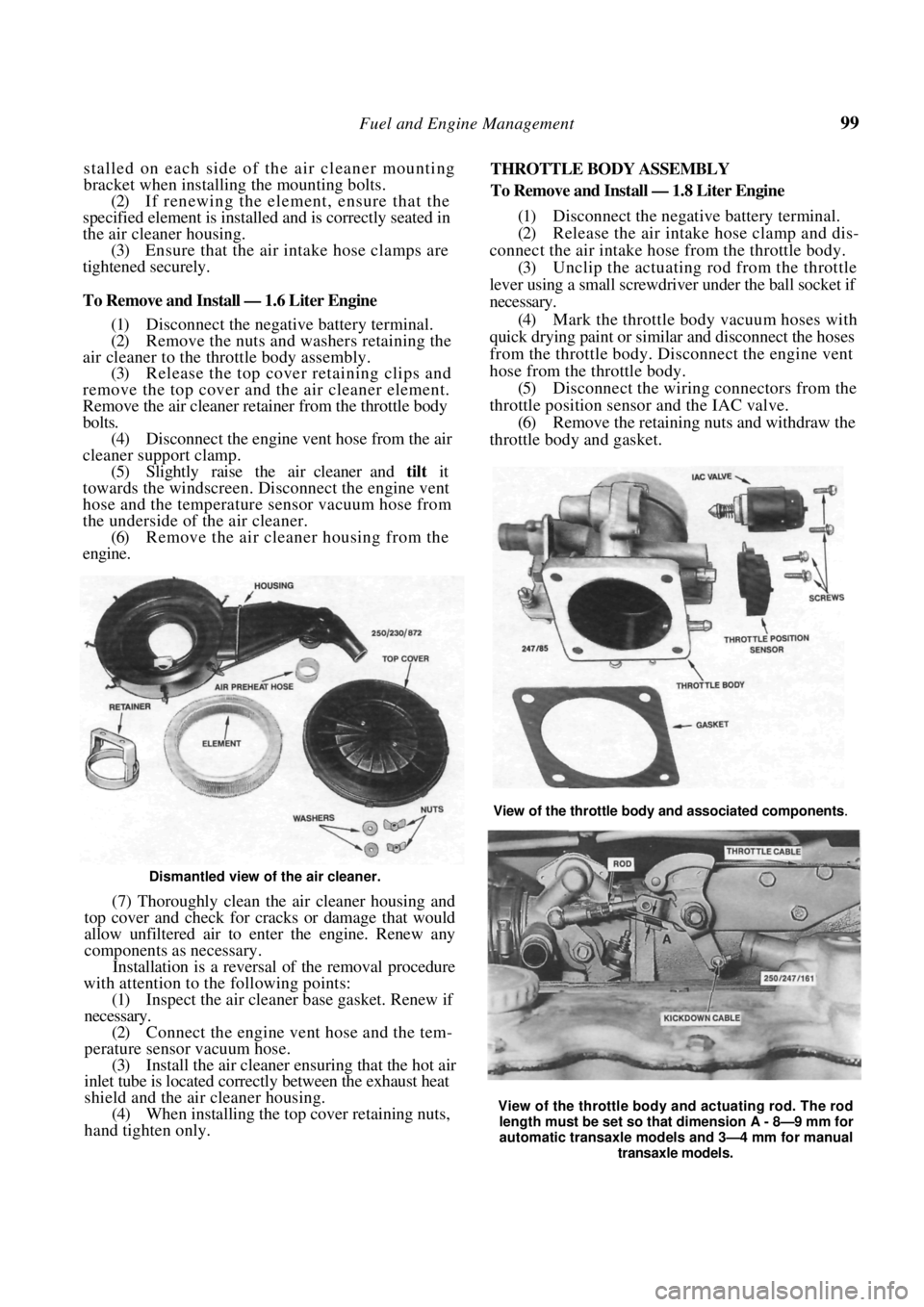
Dismantled view of the air cleaner.
(7) Thoroughly clean the air cleaner housing and
top cover and check for cracks or damage that would
allow unfiltered air to enter the engine. Renew any
components as necessary.
Installation is a reversal of the removal procedure
with attention to the following points:
(1) Inspect the air cleaner base gasket. Renew if
necessary. (2) Connect the engine vent hose and the tem-
perature sensor vacuum hose. (3) Install the air cleaner ensuring that the hot air
inlet tube is located correc tly between the exhaust heat
shield and the air cleaner housing. (4) When installing the top cover retaining nuts,
hand tighten only. THROTTLE BODY ASSEMBLY
To Remove and Install — 1.8 Liter Engine
(1)
Disconnect the negative battery terminal.
(2) Release the air intake hose clamp and dis-
connect the air intake hose from the throttle body. (3) Unclip the actuating rod from the throttle
lever using a small screwdriver under the ball socket if
necessary.
(4) Mark the throttle body vacuum hoses with
quick drying paint or similar and disconnect the hoses
from the throttle body. Disconnect the engine vent
hose from the throttle body. (5) Disconnect the wiring connectors from the
throttle position sensor and the IAC valve.
(6) Remove the retaining nuts and withdraw the
throttle body and gasket.
View of the throttle body and actuating rod. The rod
length must be set so that dimension A - 8—9 mm for
automatic transaxle models and 3—4 mm for manual
transaxle models.
View of the throttle body and associated components.
Page 100 of 238
100 Fuel and Engine Management
Installation is a reversal of the removal procedure
with attention to the following points:
(1) Ensure that all throttle body passages are
clean. Blow out with compressed air if necessary. (2) Install the throttle body to the inlet
manifold
using a new gasket and tighten the retaining nuts to
the specified torque. (3) Connect the vacuum hoses to the throttle
body in the positions previously marked. (4) Clip the actuating rod to the throttle body
lever. Check the dimensions shown in the illustration
and adjust the rod length if necessary.
(5) Check the adjustment of the throttle cable as
described later in this section.
(6) Connect the air intake hose and tighten the
hose clamps securely.
To Remove and Install — 1.6 Liter Engine
(1) Depressurize the fuel system as previously
described. (2) Disconnect the negative battery terminal.
(3) Remove the air cleane r assembly and base
gasket as previously described. (4) Mark the fuel supply and return hoses,
release the clamps and disconnect the hoses from the
throttle body assembly. (5) Disconnect the injector, throttle position
sensor and the IAC valve wiring connectors. Remove
the injector wiring harness from the throttle body
assembly and place it to one side.
(6) Mark and disconnect the vacuum hoses from
the throttle body assembly. (7) On automatic transaxle models, disconnect
the kickdown actuating rod from the throttle linkage.
(8) Slide the outer throttle cable from the
mounting bracket, rotate the throttle linkage and disconnect the inner throttle cable from the throttle
linkage.
(9)
Remove the bolts retaining the throttle body
assembly to the inlet manifold and remove the
assembly and the gasket from the engine. (10) If necessary remove the retaining screws and
remove the fuel meter assembly, the IAC valve and
the throttle position sensor from the throttle body
assembly. Installation is a reversal of the removal procedure
with attention to the following points:
(1) If removed, install the fuel meter assembly,
the throttle position sensor and the IAC valve as
described under the relevant headings. (2) Install the throttle body assembly to the inlet
manifold using a new gasket and tighten the retaining
bolts to the specified torque. (3) Connect the vacuum ho ses to the throttle
body using the marks made on removal to ensure
correct installation. (4) On automatic transaxle models, connect the
kickdown actuating rod to the throttle linkage.
(5) Install the throttle cable and check the adjust-
ment as described later in this section.
INLET MANIFOLD
To Remove and Install
To remove and install the inlet manifold, refer to
the relevant heading in the Engine section.
IDLE AIR CONTROL (IAC) VALVE
To Test
(1) Connect an accurate tachometer to the en-
gine. (2) With the engine at normal operating temper-
ature and all accessories switched Off, note the idle
speed.
(3) With the ignition switched Off, disconnect
the IAC valve wiring connector. (4) Start the engine and check the idle speed.
If the idle speed is the same as that noted in
operation (2) proceed to operation (7).
If the idle speed is higher than noted in operation
(2) proceed as follows.
(5) With the ignition switched Off, connect the
IAC valve wiring connector.
(6) Start the engine and check the idle speed.
If the idle speed is not the same as that noted in
operation (2) proceed to operation (7).
If the idle speed is the same as noted in operation
(2) the IAC valve is operating correctly. However, if
the engine is not idling correctly carry out the
following checks.
(a) Check the air inlet system for vacuum leaks.
NOTE: Any vacuum leak will cause a fast
idle.
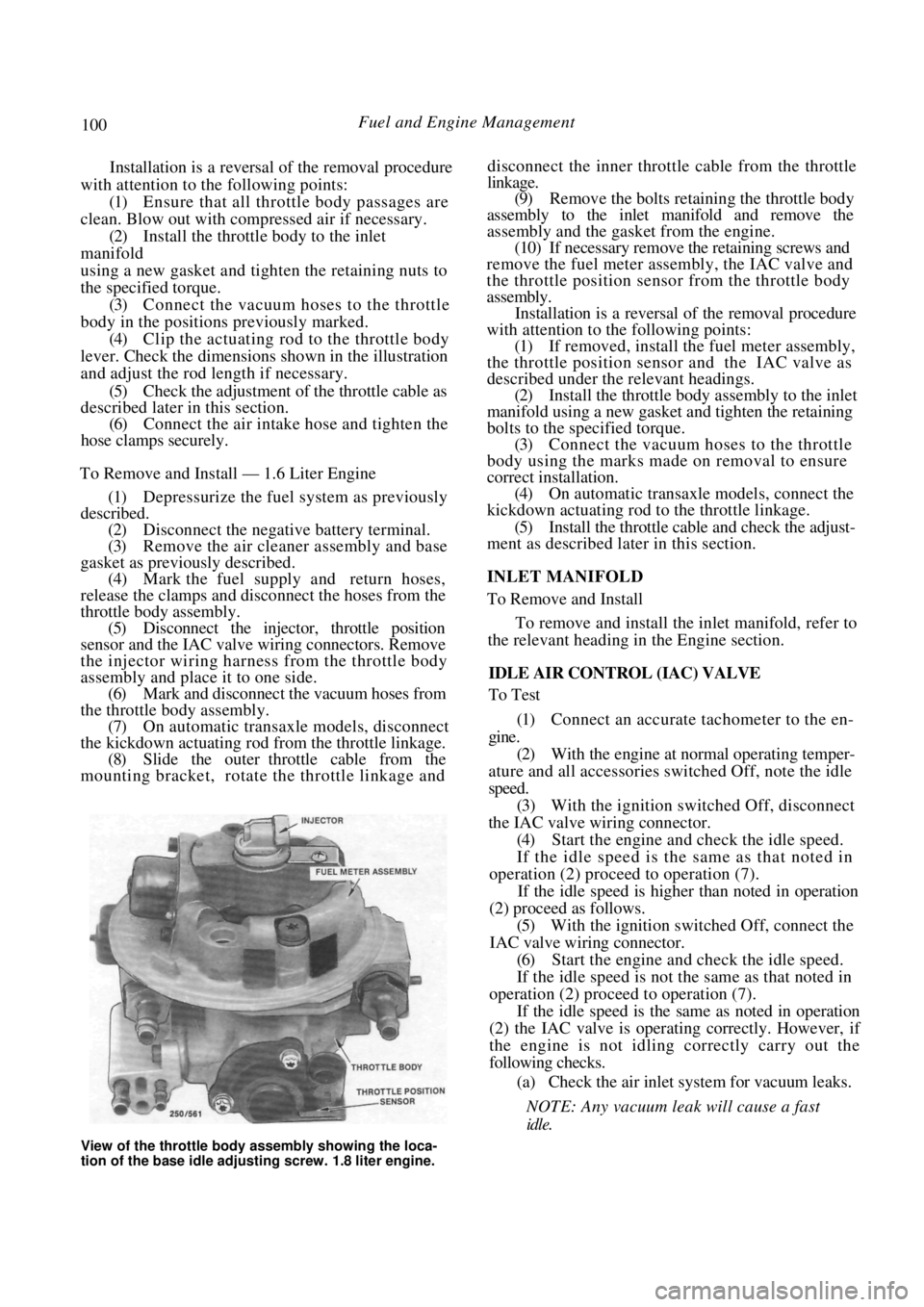
View of the throttle body assembly showing the loca-
tion of the base idle adjusting screw. 1.8 literengine.
Page 101 of 238
Fuel and Engine Management 101
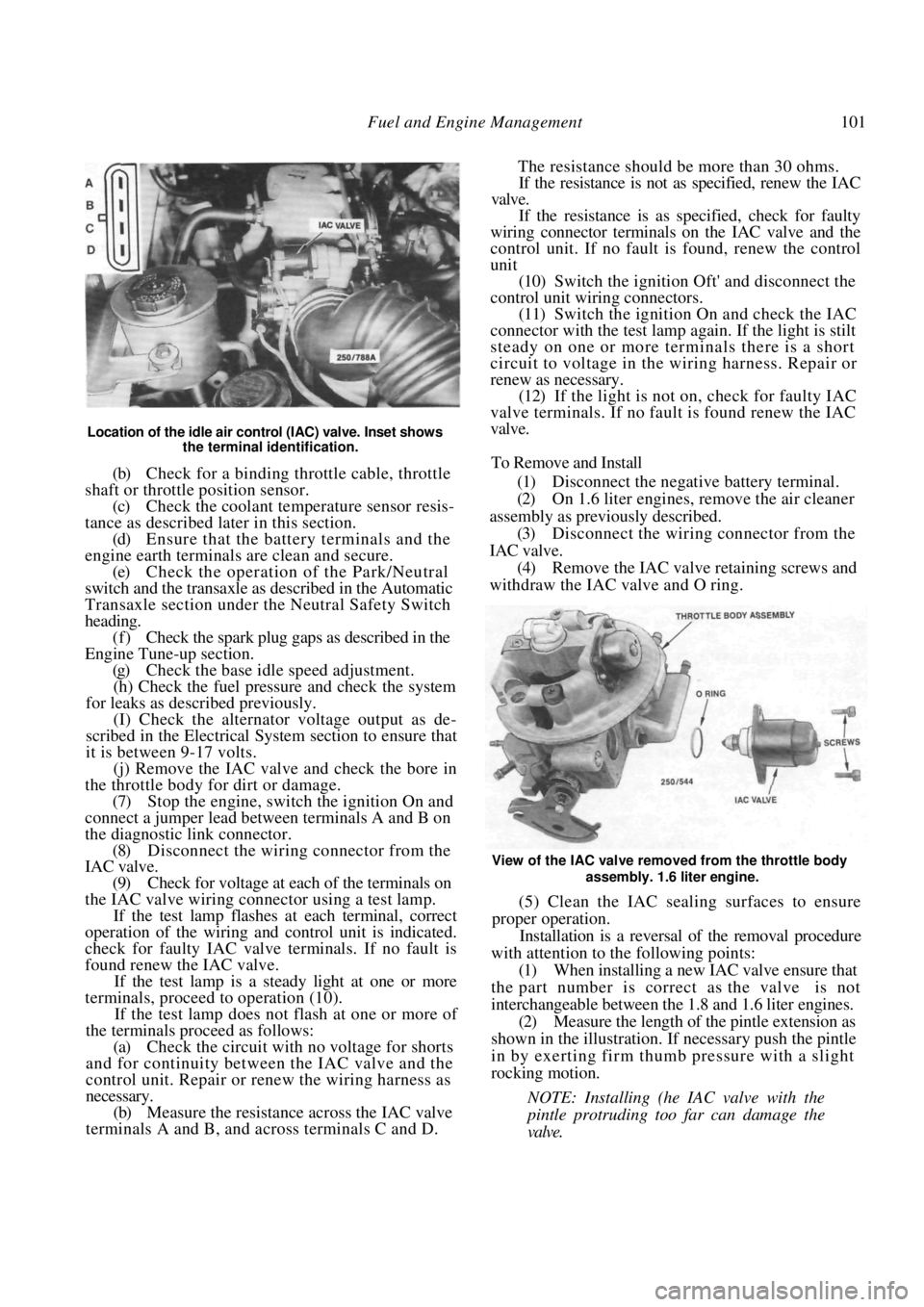
Location of the idle air control (IAC) valve. Inset shows the terminal identification.
(b) Check for a binding throttle cable, throttle
shaft or throttle position sensor. (c) Check the coolant temperature sensor resis-
tance as described later in this section. (d) Ensure that the battery terminals and the
engine earth terminals are clean and secure.
(e) Check the operation of the Park/Neutral
switch and the transaxle as described in the Automatic
Transaxle section under the Neutral Safety Switch
heading. (f) Check the spark plug gaps as described in the
Engine Tune-up section.
(g) Check the base idle speed adjustment.
(h) Check the fuel pressure and check the system
for leaks as described previously.
(I) Check the alternator voltage output as de-
scribed in the Electrical System section to ensure that
it is between 9-17 volts.
(j) Remove the IAC valve and check the bore in
the throttle body for dirt or damage.
(7) Stop the engine, switch the ignition On and
connect a jumper lead between terminals A and B on
the diagnostic link connector. (8) Disconnect the wiring connector from the
IAC valve.
(9) Check for voltage at each of the terminals on
the IAC valve wiring connector using a test lamp. If the test lamp flashes at each terminal, correct
operation of the wiring and control unit is indicated.
check for faulty IAC valve terminals. If no fault is
found renew the IAC valve.
If the test lamp is a steady light at one or more
terminals, proceed to operation (10).
If the test lamp does not flash at one or more of
the terminals proceed as follows:
(a) Check the circuit with no voltage for shorts
and for continuity between the IAC valve and the
control unit. Repair or renew the wiring harness as
necessary.
(b) Measure the resistance across the IAC valve
terminals A and B, and across terminals C and D. The resistance should be more than 30 ohms.
If the resistance is not as specified, renew the IAC
valve.
If the resistance is as specified, check for faulty
wiring connector terminals on the IAC valve and the
control unit. If no fault is found, renew the control
unit
(10) Switch the ignition Oft' and disconnect the
control unit wiring connectors. (11) Switch the ignition On and check the IAC
connector with the test lamp again. If the light is stilt
steady on one or more terminals there is a short
circuit to voltage in the wiring harness. Repair or
renew as necessary. (12) If the light is not on, check for faulty IAC
valve terminals. If no fault is found renew the IAC
valve.
To Remove and Install
(1) Disconnect the negative battery terminal.
(2) On 1.6 liter engines, remove the air cleaner
assembly as previously described. (3) Disconnect the wiring connector from the
IAC valve. (4) Remove the IAC valve retaining screws and
withdraw the IAC valve and O ring.
View of the IAC valve removed from the throttle body
assembly. 1.6 liter engine.
(5) Clean the IAC sealing surfaces to ensure
proper operation.
Installation is a reversal of the removal procedure
with attention to the following points:
(1) When installing a new IAC valve ensure that
the part number is correct as the valve is not
interchangeable between the 1.8 and 1.6 liter engines.
(2) Measure the length of the pintle extension as
shown in the illustration. If necessary push the pintle
in by exerting firm thum b pressure with a slight
rocking motion.
NOTE: Installing (he IAC valve with the
pintle protruding too far can damage the
valve.
Page 124 of 238
124 Clutch
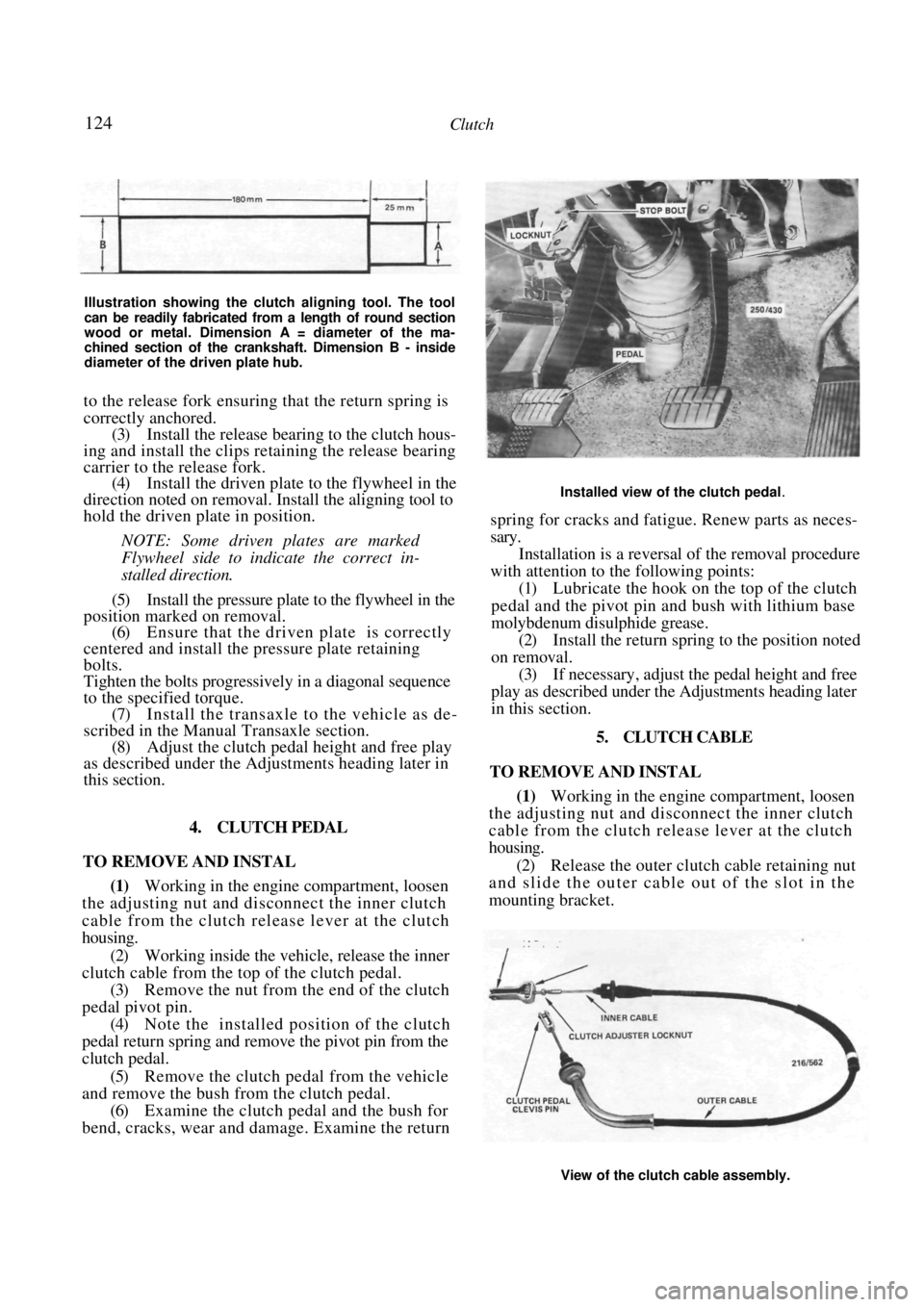
Illustration showing the clutch aligning tool. The tool
can be readily fabricated from a length of round section
wood or metal. Dimension A = diameter of the ma-
chined section of the crankshaft. Dimension B - inside
diameter of the driven plate hub.
to the release fork ensuring that the return spring is
correctly anchored.
(3) Install the release bearing to the clutch hous-
ing and install the clips re taining the release bearing
carrier to the release fork. (4) Install the driven plate to the flywheel in the
direction noted on removal. Install the aligning tool to
hold the driven plate in position.
NOTE: Some driven plates are marked
Flywheel side to indicate the correct in-
stalled direction.
(5) Install the pressure plate to the flywheel in the
position marked on removal. (6) Ensure that the driven plate is correctly
centered and install the pressure plate retaining
bolts.
Tighten the bolts progressively in a diagonal sequence
to the specified torque. (7) Install the transaxle to the vehicle as de-
scribed in the Manual Transaxle section. (8) Adjust the clutch pedal height and free play
as described under the Adjustments heading later in
this section.
4. CLUTCH PEDAL
TO REMOVE AND INSTAL
(1) Working in the engine compartment, loosen
the adjusting nut and disconnect the inner clutch
cable from the clutch release lever at the clutch
housing.
(2) Working inside the vehicle, release the inner
clutch cable from the top of the clutch pedal.
(3) Remove the nut from the end of the clutch
pedal pivot pin. (4) Note the installed position of the clutch
pedal return spring and remove the pivot pin from the
clutch pedal.
(5) Remove the clutch pedal from the vehicle
and remove the bush from the clutch pedal. (6) Examine the clutch pedal and the bush for
bend, cracks, wear and damage. Examine the return
Installed view of the clutch pedal.
spring for cracks and fatigue. Renew parts as neces-
sary.
Installation is a reversal of the removal procedure
with attention to the following points:
(1) Lubricate the hook on the top of the clutch
pedal and the pivot pin and bush with lithium base
molybdenum disulphide grease. (2) Install the return spring to the position noted
on removal. (3) If necessary, adjust the pedal height and free
play as described under the Adjustments heading later
in this section.
5. CLUTCH CABLE
TO REMOVE AND INSTAL
(1) Working in the engine compartment, loosen
the adjusting nut and disconnect the inner clutch
cable from the clutch release lever at the clutch
housing.
(2) Release the outer clutch cable retaining nut
and slide the outer cable out of the slot in the
mounting bracket.
View of the clutch cable assembly.
Page 139 of 238
Manual Transaxle and Drive Shafts 139
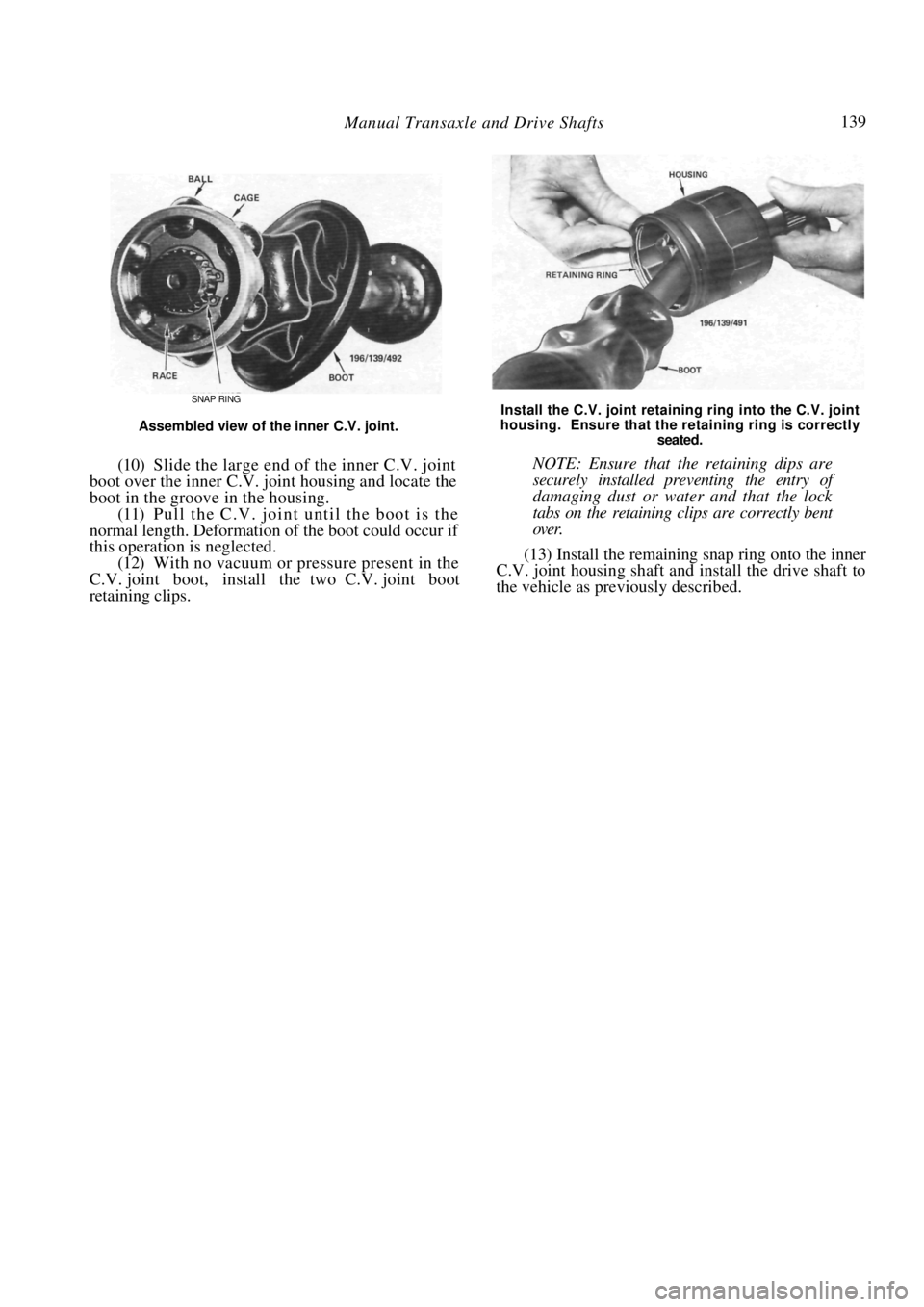
SNAP RING
Assembled view of the inner C.V. joint.
(10) Slide the large end of the inner C.V. joint
boot over the inner C.V. joint housing and locate the
boot in the groove in the housing.
(11) Pull the C.V. joint until the boot is the
normal length. Deformation of the boot could occur if
this operation is neglected. (12) With no vacuum or pressure present in the
C.V. joint boot, install the two C.V. joint boot
retaining clips.
Install the C.V. joint retain ing ring into the C.V. joint
housing. Ensure that the retaining ring is correctly
seated.
NOTE: Ensure that the retaining dips are
securely installed preven ting the entry of
damaging dust or water and that the lock
tabs on the retaining clips are correctly bent
over.
(13) Install the remaining snap ring onto the inner
C.V. joint housing shaft and install the drive shaft to
the vehicle as previously described.
Page 147 of 238
147
PART 2. MANUAL STEERING
SPECIFICATIONS
Steering gear type ............................ Rack and pinion
Steering column type ...................... Energy absorbing
collapsible and tilt adjustable
Steering wheel free play
(maximum ) ...................................................... 35 mm
Linkage........................... Direct from rack ends to t i e
rods and steering knuckles
Turns lock to lock ................................................. 3.6
Steering column length .................. 534.7-537.3 mm
Steering gear lubricant.............. Castrol EPL 1 grease
TORQUE WRENCH SETTINGS
Steering wheel retaining nut ............................ 39 Nm
Steering gear to bulkhead
mounting bolts .............................................. 108 Nm
Tie rod to steering knuckle nut...................... 98 Nm
Tie rod to tie rod end locknut ....................... 98 Nm
Tie rod ball housing to rack............................ 88 Nm
Steering column to mounting
bracket bolt ...................................................... 14 Nm
Steering column universal
coupling joint pinch bolts ............................... 29 Nm
2. STEERING WHEEL
Special Equipment Required:
To Remove Steering Wheel - Steering wheel
puller
TO REMOVE AND INSTAL
(1) Disconnect the negative battery terminal.
(2) Using a small screwdriver, carefully prise the
centre ornament from the steering wheel.
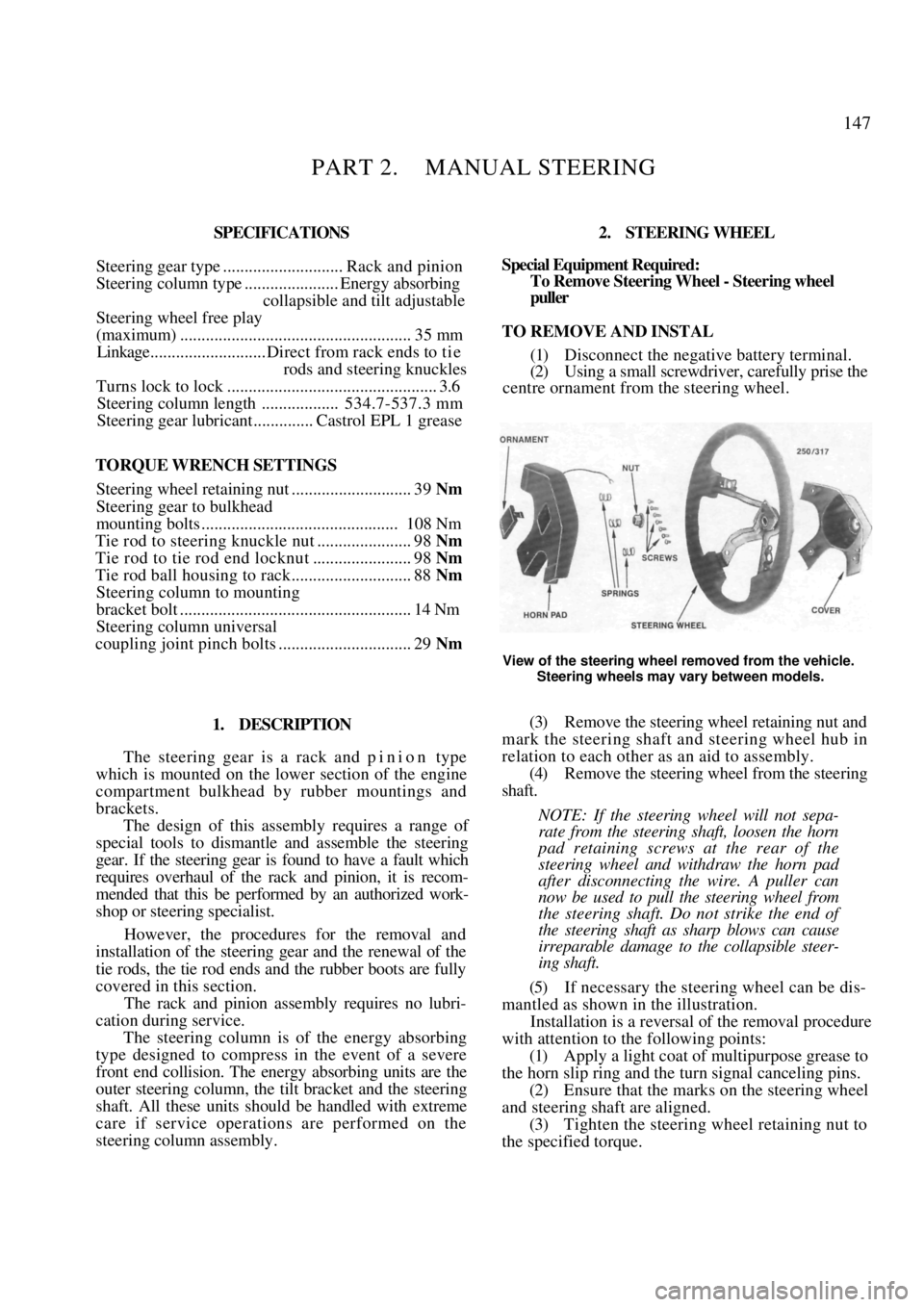
View of the steering wheel removed from the vehicle.
Steering wheels may vary between models.
1. DESCRIPTION
The steering gear is a rack and p i n i o n type
which is mounted on the lower section of the engine
compartment bulkhead by rubber mountings and
brackets.
The design of this assembly requires a range of
special tools to dismantle and assemble the steering
gear. If the steering gear is found to have a fault which
requires overhaul of the rack and pinion, it is recom-
mended that this be performed by an authorized work-
shop or steering specialist.
However, the procedures for the removal and
installation of the steering gear and the renewal of the
tie rods, the tie rod ends and the rubber boots are fully
covered in this section.
The rack and pinion assembly requires no lubri-
cation during service.
The steering column is of the energy absorbing
type designed to compress in the event of a severe
front end collision. The energy absorbing units are the
outer steering column, the tilt bracket and the steering
shaft. All these units shoul d be handled with extreme
care if service operations are performed on the
steering column assembly.
(3) Remove the steering wh eel retaining nut and
mark the steering shaft and steering wheel hub in
relation to each other as an aid to assembly.
(4) Remove the steering wheel from the steering
shaft.
NOTE: If the steering wheel will not sepa-
rate from the steering shaft, loosen the horn
pad retaining screws at the rear of the
steering wheel and withdraw the horn pad
after disconnecting the wire. A puller can
now be used to pull the steering wheel from
the steering shaft. Do not strike the end of
the steering shaft as sharp blows can cause
irreparable damage to the collapsible steer-
ing shaft.
(5) If necessary the steering wheel can be dis-
mantled as shown in the illustration.
Installation is a reversal of the removal procedure
with attention to the following points:
(1) Apply a light coat of multipurpose grease to
the horn slip ring and the turn signal canceling pins.
(2) Ensure that the marks on the steering wheel
and steering shaf t are aligned.
(3) Tighten the steering wheel retaining nut to
the specified torque.
Page 148 of 238
148 Steering — Part 2
3. STEERING COLUMN
Special Equipment Required:
To Remove Steering Wheel — Steering wheel
puller
TO REMOVE AND INSTAL
(1) Disconnect the negative battery terminal.
(2) Working in the engine compartment, mark
the relationship between the steering shaft universal
coupling joint and the steering gear pinion shaft. (3) Remove the pinch bolts from the universal
joint. (4) Working inside the vehi cle, remove the steer-
ing wheel as previously described. (5) Remove the steering column shroud screws,
unclip the lower and upper covers and remove them
from the steering column. (6) Disconnect all the steering column wiring
connectors. (7) Remove the lower trim from underneath the
steering column.
(8) Fold back the insulator and remove the nuts
from the steering colu mn floor bracket.
(9) Remove the nuts from the lower steering
column bracket. (10) Remove the bolts from the tilt bracket
assembly. (11) Maneuver the steering column from the
vehicle.
Installation is a reversal of the removal procedure
with attention to the following points:
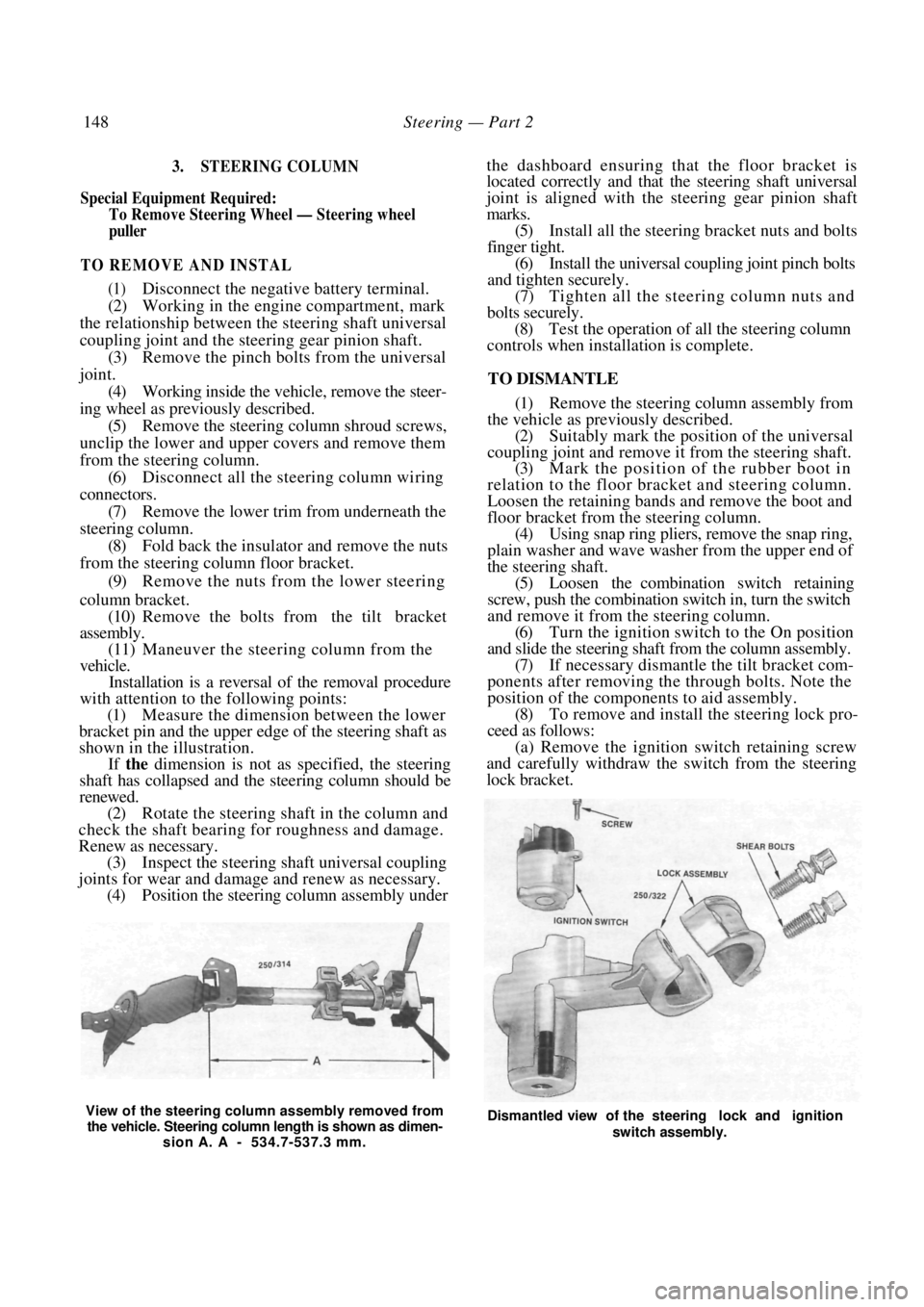
(1) Measure the dimension between the lower
bracket pin and the upper edge of the steering shaft as
shown in the illustration.
If the dimension is not as specified, the steering
shaft has collapsed and the steering column should be
renewed.
(2) Rotate the steering shaft in the column and
check the shaft bearing for roughness and damage.
Renew as necessary. (3) Inspect the steering shaft universal coupling
joints for wear and damage and renew as necessary. (4) Position the steering column assembly under
the dashboard ensuring that the floor bracket is
located correctly and that the steering shaft universal
joint is aligned with the steering gear pinion shaft
marks.
(5) Install all the steering bracket nuts and bolts
finger tight. (6) Install the universal coupling joint pinch bolts
and tighten securely.
(7) Tighten all the stee ring column nuts and
bolts securely. (8) Test the operation of all the steering column
controls when installation is complete.
TO DISMANTLE
(1) Remove the steering column assembly from
the vehicle as previously described. (2) Suitably mark the position of the universal
coupling joint and remove it from the steering shaft. (3) Mark the position of the rubber boot in
relation to the floor bracket and steering column.
Loosen the retaining bands and remove the boot and
floor bracket from th e steering column.
(4) Using snap ring pliers, remove the snap ring,
plain washer and wave washer from the upper end of
the steering shaft. (5) Loosen the combination switch retaining
screw, push the combination switch in, turn the switch
and remove it from the steering column. (6) Turn the ignition switch to the On position
and slide the steering shaft from the column assembly. (7) If necessary dismantle the tilt bracket com-
ponents after removing the through bolts. Note the
position of the components to aid assembly. (8) To remove and install the steering lock pro-
ceed as follows: (a) Remove the ignition switch retaining screw
and carefully withdraw the switch from the steering
lock bracket.
View of the steering column assembly removed from
the vehicle. Steering column length is shown as dimen- sion A. A - 534.7-537.3 mm. Dismantled view of the steering lock and ignition
switch assembly.
Page 149 of 238
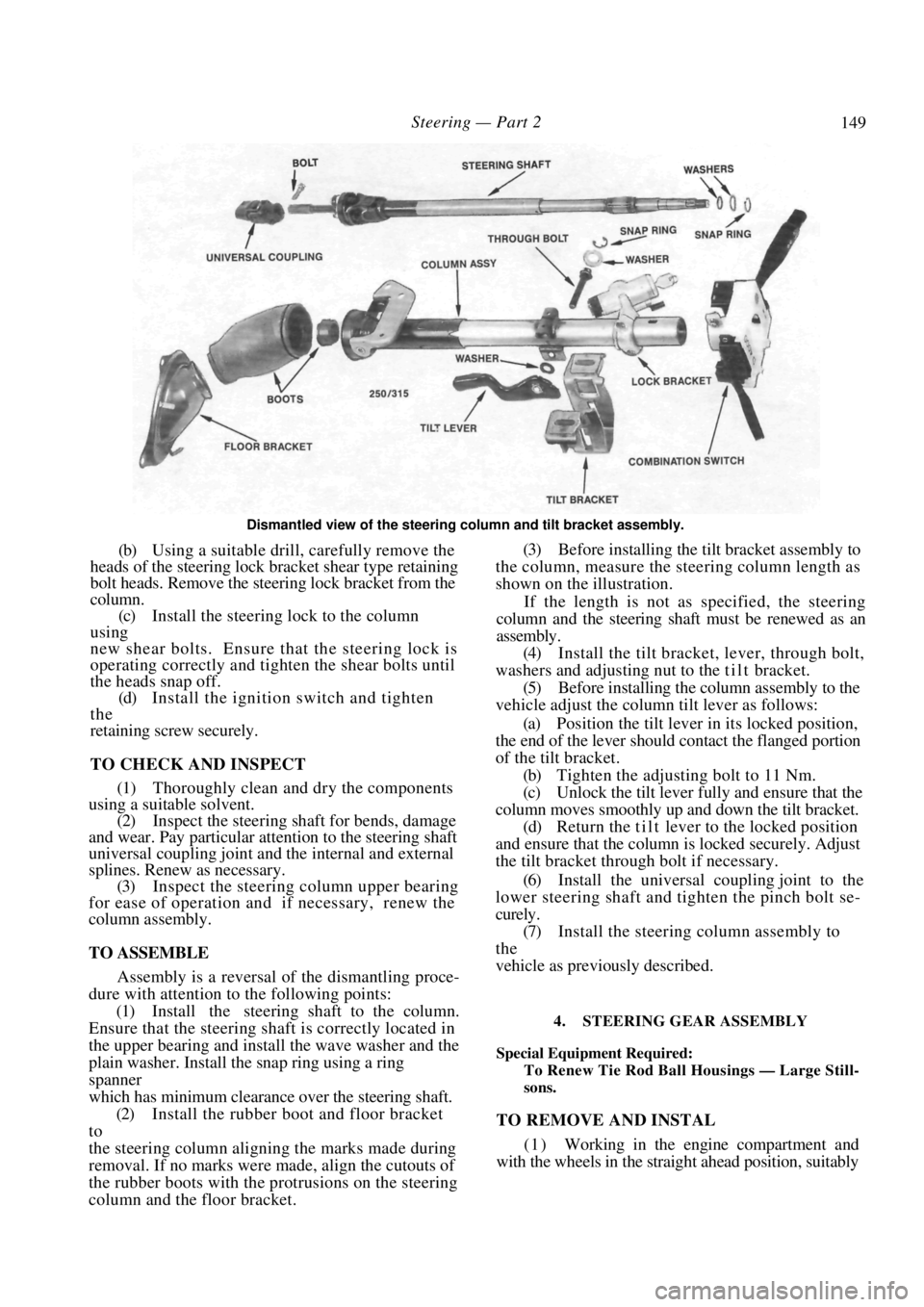
Steering — Part 2 149
Dismantled view of the steering column and tilt bracket assembly.
(b) Using a suitable drill, carefully remove the
heads of the steering lock br acket shear type retaining
bolt heads. Remove the steering lock bracket from the
column.
(c) Install the steering lock to the column
using
new shear bolts. Ensure that the steering lock is
operating correctly and tigh ten the shear bolts until
the heads snap off.
(d) Install the ignition switch and tighten
the
retaining screw securely.
TO CHECK AND INSPECT
(1) Thoroughly clean and dry the components
using a suitable solvent.
(2) Inspect the steering shaft for bends, damage
and wear. Pay particular attention to the steering shaft
universal coupling joint and the internal and external
splines. Renew as necessary. (3) Inspect the steering column upper bearing
for ease of operation and if necessary, renew the
column assembly.
TO ASSEMBLE
Assembly is a reversal of the dismantling proce-
dure with attention to the following points:
(1) Install the steering shaft to the column.
Ensure that the steering shaft is correctly located in
the upper bearing and insta ll the wave washer and the
plain washer. Install the snap ring using a ring
spanner
which has minimum clearan ce over the steering shaft.
(2) Install the rubber boot and floor bracket
to
the steering column aligning the marks made during
removal. If no marks were made, align the cutouts of
the rubber boots with the protrusions on the steering
column and the floor bracket. (3) Before installing the tilt bracket assembly to
the column, measure the steering column length as
shown on the illustration.
If the length is not as specified, the steering
column and the steering shaft must be renewed as an
assembly.
(4) Install the tilt bracket, lever, through bolt,
washers and adjusting nu t to the t i l t bracket.
(5) Before installing the column assembly to the
vehicle adjust the column tilt lever as follows:
(a) Position the tilt lever in its locked position,
the end of the lever should contact the flanged portion
of the tilt bracket.
(b) Tighten the adjusting bolt to 11 Nm.
(c) Unlock the tilt lever fully and ensure that the
column moves smoothly up and down the tilt bracket. (d) Return the tilt lever to the locked position
and ensure that the column is locked securely. Adjust
the tilt bracket thro ugh bolt if necessary.
(6) Install the universal coupling joint to the
lower steering shaft and tighten the pinch bolt se-
curely.
(7) Install the steering column assembly to
the
vehicle as previously described.
4. STEERING GEAR ASSEMBLY
Special Equipment Required:
To Renew Tie Rod Ball Housings — Large Still-
sons.
TO REMOVE AND INSTAL
( 1 ) Working in the engine compartment and
with the wheels in the straight ahead position, suitably
Page 157 of 238

Front Suspension 157
Check the stabilizer bar links for wear and damage.
(3) Incorrect front end alignment: Check and
adjust the alignment as necessary. (4) Defective stabilizer bar mounting rubbers or
worn link ball joints: Renew component as necessary. (5) Weak or broken front coil spring: Renew
both springs as a matching pair. (6) Broken or weak rear coil spring: Renew both
springs as matching pair. (7) Drive shaft bent or distorted: Check and
renew as necessary. (8) Tie rod end worn or damaged: Check and
renew as necessary.
(9) Control arm ball joint worn or damaged:
Check and renew as necessary.
(10) Control arm mounting bolts loose: Tighten
the control arm bolts. (11) Wheel hub bearing worn: Check and renew
as necessary. NOTE: As a quick guide to suspension unit
condition, bounce the front of the vehicle up
and down (one side at a time), the vehicle
should come to rest in a single movement. If
it bounces two or three times before stop-
ping, the suspension unit should be renewed.
If the from of the vehicle is tower on one
side than the other, remove the coil spring
and check its free length against a new
spring. If the spring is found to be unservice-
able it is good practice to install two new
springs as a matching pair. This also applies
to the springs on the rear of the vehicle.
2. DESCRIPTION
The front suspension is an independent type
comprising two Macpherson strut suspension units
mounted vertically on each side of the vehicle. The
lower end of the suspension unit is bolted to the
steering knuckle, which in turn houses the front hub
bearings. The steering knuckle pivots on the control
arm by means of a ball joint.
The control arm pivots at its inner ends on rubber
bushes.
A stabilizer bar is attached to both ends of the
control arms using ball joint links. The stabilizer bar
is attached to the front underbody by brackets and
mounting rubbers.
Each front suspension unit assembly comprises a
tubular shock absorber type suspension unit, sur-
rounded at the upper end by a coil spring. On top of
the coil spring is the upper mounting which attaches
to the underside of the inner mudguard panel. The
piston rod of the suspensi on unit is attached to the
centre of the upper mounting by a rubber mounted
bearing.
When a suspension unit is found to be defective it
is recommended that both suspension units be re-
newed as a pair.
Camber is adjusted by means of a cam on the
upper steering knuckle to suspension unit mounting
bolt.
The kingpin inclination and caster are set in
production and cannot be adjusted. Any variation in
these angles will be caused by worn or damaged
components.
3. STEERING KNUCKLE
Special Equipment Required:
To Renew Wheel Bearing — Press and press plates
and suitable tubes and mandrels
To Check Hub End Float — Dial gauge
TO REMOVE AND INSTAL
(1) Raise the front of the vehicle and support it
on chassis stands. Remove the front wheel.
Checking the control arm bolts for security.