length NISSAN PULSAR 1987 Owner's Manual
[x] Cancel search | Manufacturer: NISSAN, Model Year: 1987, Model line: PULSAR, Model: NISSAN PULSAR 1987Pages: 238, PDF Size: 28.91 MB
Page 163 of 238
Front Suspension 163
(2) Ensure that the stabilizer bar links are in
good condition. Renew if necessary.
(3) When installing the stabilizer bar ensure that
the links are installed perpendicular to the control arm
with the ball joint socket face parallel to the end of the
stabilizer bar. (4) Ensure that the brackets are installed with
the flat portion facing towards the front of the vehicle.
Tighten the retaining bolts securely.
7. SUSPENSION AND STEERING ANGLES
ADJUSTMENT
NOTE: Extensive knowledge and special-
ised equipment are required to measure and
correct the suspension and steering angles
with the exception of the front wheel toe in.
Therefore, as it is not a viable proposition
for the average person to carry out a com-
plete wheel alignment, the vehicle should be
taken to a wheel alignment specialist.
Prior to carrying out a wheel alignment, a thor-
ough inspection of the steering linkage, front hub
bearings, ball joints and suspension units should be
carried out. Faulty components should be renewed or
repaired as necessary.
The tread of the front ti res should be examined
for excessive or uneven wear as certain conditions of
tire wear are indicative of damaged or worn compo-
nents in the suspension, stee ring linkage and/or wheels
and bearings. Refer to the heading Tire Wear Trouble
Shooting in the Wheels and Tires section. If the tires
are found to be defective, renew them with serviceable
lyres.
TO CHECK AND ADJUST TOE IN/OUT
NOTE: The vehicle s hould be unladen ex-
cept for the normal amount of fuel and with
the tires inflated to the correct pressures.
(1) With the vehicle on a level floor, raise the
front of the vehicle and s upport it on chassis stands.
(2) Spin each front wheel in turn and using a
piece of chalk, mark a line around the periphery of
each tire as near to the centre as possible. (3) Lower the vehicle to the ground and bounce
the front several times to stabilize the suspension. (4) Set the wheels in the straight ahead position.
(5) Mark the centre chalk line on both tires at a
point approximately 200 mm above the floor and
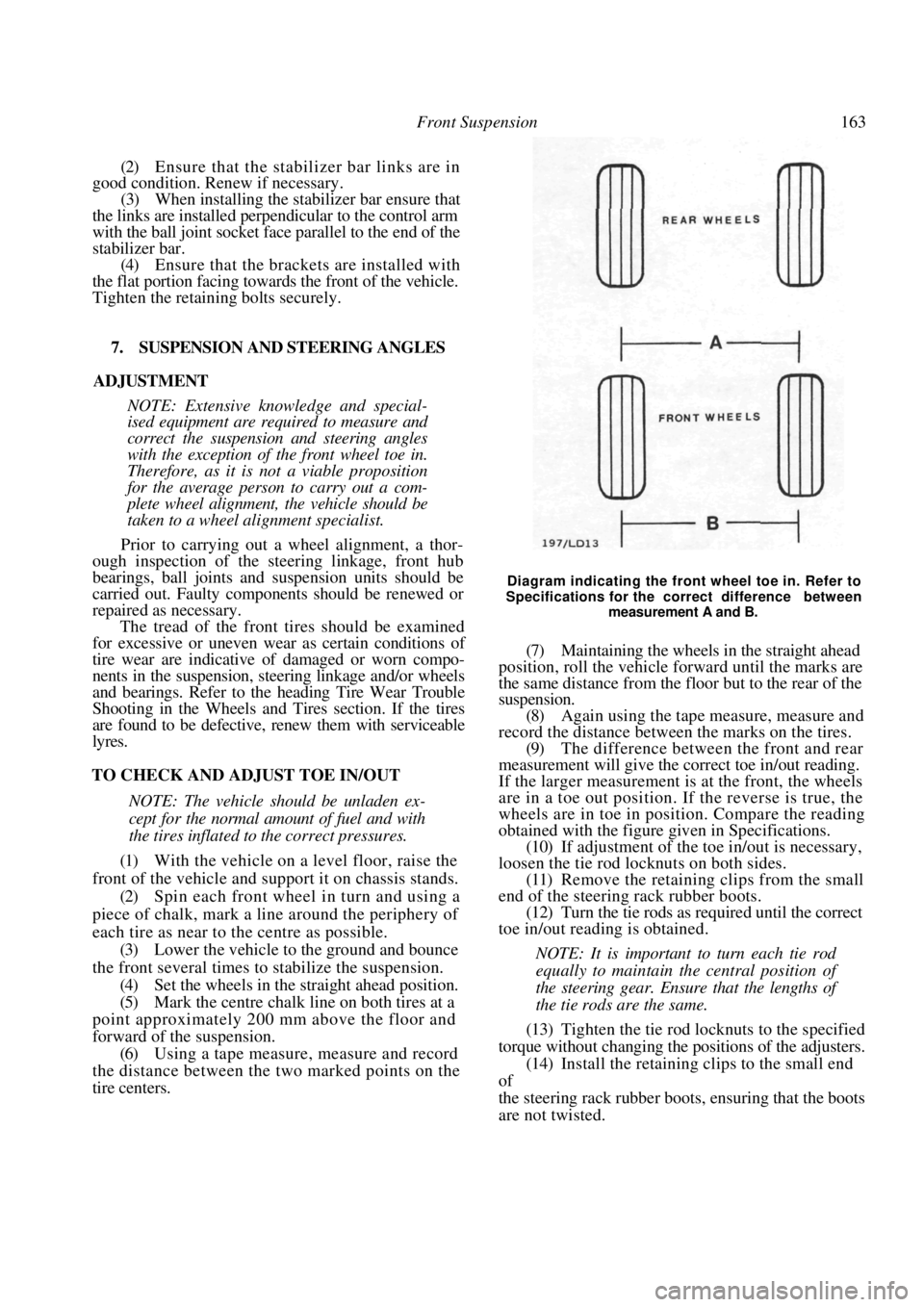
forward of the suspension. (6) Using a tape measure, measure and record
the distance between the two marked points on the
tire centers.
Diagram indicating the front wheel toe in. Refer to
Specifications for the correct difference between
measurement A and B.
(7) Maintaining the wheels in the straight ahead
position, roll the vehicle forward until the marks are
the same distance from the floor but to the rear of the
suspension. (8) Again using the tape measure, measure and
record the distance between the marks on the tires.
(9) The difference between the front and rear
measurement will give the correct toe in/out reading.
If the larger measurement is at the front, the wheels
are in a toe out position. If the reverse is true, the
wheels are in toe in position. Compare the reading
obtained with the figure given in Specifications.
(10) If adjustment of the to e in/out is necessary,
loosen the tie rod locknuts on both sides. (11) Remove the retaining clips from the small
end of the steering rack rubber boots. (12) Turn the tie rods as required until the correct
toe in/out reading is obtained.
NOTE: It is important to turn each tie rod
equally to maintain the central position of
the steering gear. Ensure that the lengths of
the tie rods are the same.
(13) Tighten the tie rod locknuts to the specified
torque without changing the positions of the adjusters.
(14) Install the retaining clips to the small end
of
the steering rack rubber boots, ensuring that the boots
are not twisted.
Page 167 of 238

Rear Suspension 167
NOTE: When a wheel bearing has been
removed from the hub it must be renewed.
(5) Press the new bearing into the hub, ensuring
that pressure is not exerted on the inner race of the
bearing and that the bearin g seal is not damaged. Do
not apply grease or oil to the mating surfaces of the
bearing and the hub.
NOTE: When installing the new bearing,
the press load must not exceed 3 tonnes.
(6) Inspect the snap ring for wear or cracks and
renew as necessary. Install the snap ring into the hub
ensuring that it is secur ely located in the groove.
(7) Apply multi-purpose grease to the bearing
sealing lip and install the hub as previously described.
4. SUSPENSION UNIT
Special Equipment Required:
To Dismantle — Spring compressor
TO REMOVE AND DISMANTLE
(1) On hatchback models, remove the rear par-
cel shelf and lower the rear seat backrests. Remove the
parcel shelf side panel re taining screws and remove
the relevant side panel.
(2) On sedan models, prise out the parcel shelf
retaining buttons using a suitable instrument and
withdraw the parcel shelf from the vehicle. If the rear
radio speakers are installed, remove the speaker grille
retaining screws and separate the speaker grilles from
the speakers prior to withdrawing the parcel shelf
from the vehicle. (3) Raise the rear of the vehicle and support it
on chassis stands as describe d in the Wheels and Tires
section. Remove the rear wheel from the vehicle.
View of the suspension unit with the spring compres-
sors installed.
(4) Remove the clip securing the brake hose to
the suspension unit and disengage the hose from the
suspension unit. (5) Support the weight of the knuckle assembly
and remove the bolts and nuts securing the suspension
unit to the knuckle assembly.
(6) Remove the nuts securing the suspension
unit to the body panel and maneuver the suspension
unit from the vehicle. (7) Thoroughly clean the suspension unit and
secure it in a soft jawed vice.
(8) Remove the dust cap from the upper mount-
ing and while holding the end of the piston rod with
an adjustable spanner, loosen the upper mounting
retaining nut. Do not re move the retaining nut.
(9) Using a suitable spring compressor, com-
press the coil spring and remove the upper mounting
retaining nut and washer. (10) Remove the upper mounting, insulator and
spring seat from th e suspension unit.
(11) Withdraw the upper insulator, coil spring,
lower insulator and dust cover from the suspension
unit. (12) Check the coil spring for cracks, deformation
and damage. Compare the free length with a new coil
spring and renew as necessary.
Location of the suspension unit retaining nuts. Hatch-
back model.
Page 171 of 238
Rear Suspension 171
Installation is a reversal of the removal procedure
with attention to the following points:
(1) When installing the stabilizer bar to the
knuckle assembly bushes, ensu re that the thicker bush
is installed to the front of the knuckle assembly. Install
the rear bush, washers and nut but do not tighten at
this stage. (2) Install the stabil izer bar mounting
brackets,
ensuring that the end with the large bevel is facing the
front of the vehicle. Tighte n the retaining bolts to the
specified torque. (3) Using a new gasket, install the intermediate
exhaust pipe to the catalytic converter, ensuring that
the earth wire terminal is installed, and tighten the
bolts securely. Install the exhaust mounting
retaining
bolt. (4) Install the rear wheels and lower the
vehicle
to the ground. With the wei ght of the vehicle on the
road wheels, tighten the stabilizer bar retaining nuts to
the specified torque.
8. REAR WHEEL ALIGNMENT
Specialized equipment is required to measure the
rear wheel alignment. It is therefore recommended
that the vehicle be referred to a specialist suspension
workshop or an authorized dealer for measurement
and adjustment. The suspension components should
be inspected and renewed as necessary prior to having
the wheel alignment checked. If any suspension com-
ponents are renewed, the re ar wheel toe out may be
temporarily adjusted as described below.
TO INSPECT
Examine the tread of the tires. Excessive or
uneven wear will indicate misalignment or damaged
or worn components. Refer to the Tire Wear Trouble
Shooting Chart in the Wheels and Tires section for
possible causes and renew the faulty components.
Badly worn tires should be renewed prior to
having the wheel alignment checked.
TO CHECK AND ADJUST TOE OUT
NOTE: The following procedures are only a
temporary measure. Th e vehicle should be
referred to a specialis t suspension work-
shop or authorized dealer for accurate
measurement and adjustment.
(1) Position the vehicle on a level floor and
bounce the vehicle several tim es to settle the suspen-
sion. (2) Move the vehicle forward approximately 5
meters, with the front wheels straight ahead, to settle
the tires and suspension to the normal running
position.
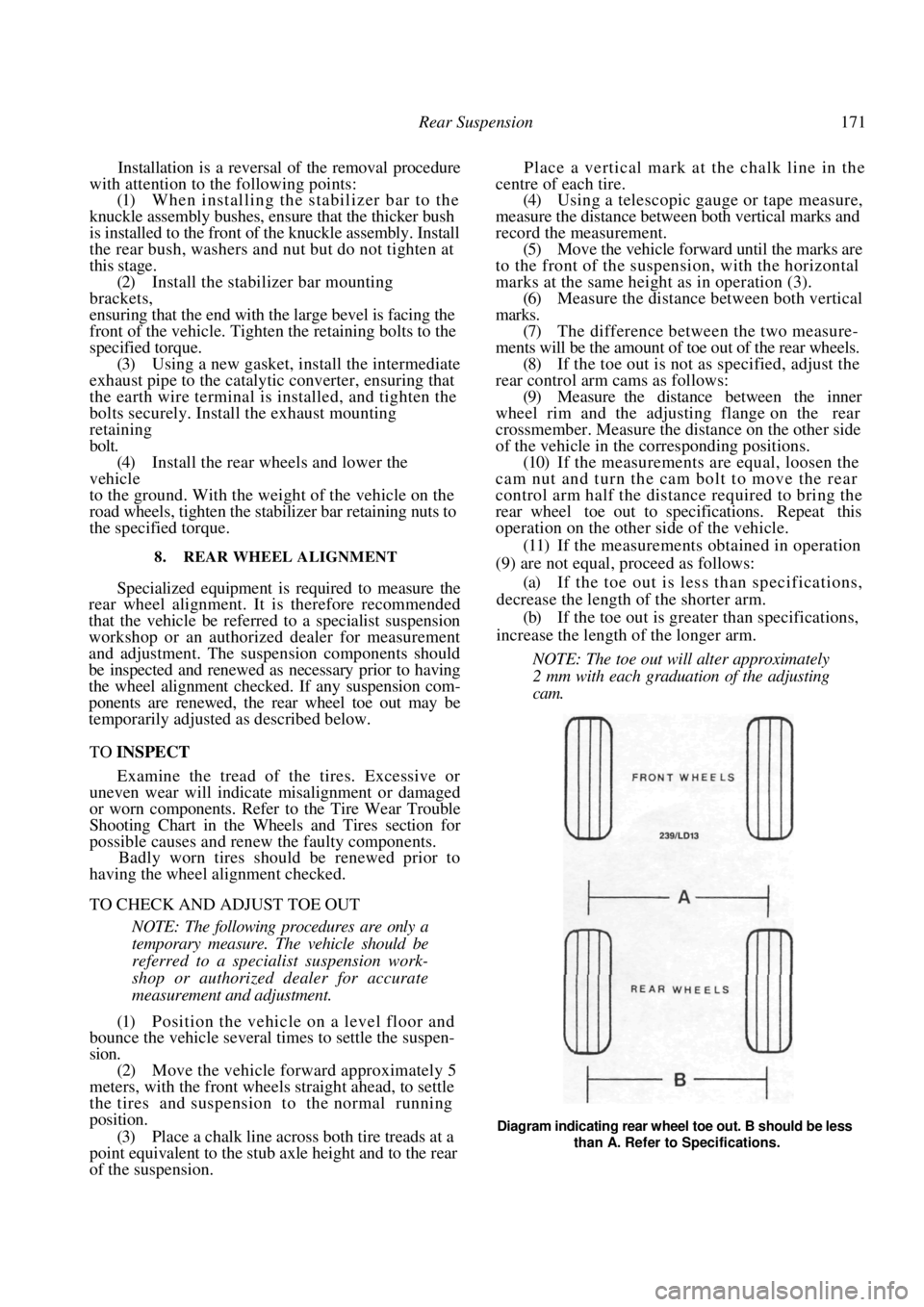
(3) Place a chalk line across both tire treads at a
point equivalent to the stub axle height and to the rear
of the suspension. Place a vertical mark at the chalk line in the
centre of each tire.
(4) Using a telescopic gauge or tape measure,
measure the distance between both vertical marks and
record the measurement. (5) Move the vehicle forward until the marks are
to the front of the suspen sion, with the horizontal
marks at the same height as in operation (3). (6) Measure the distance between both vertical
marks. (7) The difference between the two measure-
ments will be the amount of toe out of the rear wheels. (8) If the toe out is not as specified, adjust the
rear control arm cams as follows: (9) Measure the distance between the inner
wheel rim and the adjusting flange on the rear
crossmember. Measure the distance on the other side
of the vehicle in the corresponding positions. (10) If the measurements are equal, loosen the
cam nut and turn the cam bolt to move the rear
control arm half the distance required to bring the
rear wheel toe out to specifications. Repeat this
operation on the other side of the vehicle.
(11) If the measurements obtained in operation
(9) are not equal, proceed as follows:
(a) If the toe out is less than specifications,
decrease the length of the shorter arm.
(b) If the toe out is greater than specifications,
increase the length of the longer arm.
NOTE: The toe out will alter approximately
2 mm with each graduation of the adjusting
cam.
Diagram indicating rear wheel toe out. B should be less than A. Refer to Specifications.
Page 173 of 238
Brakes 173
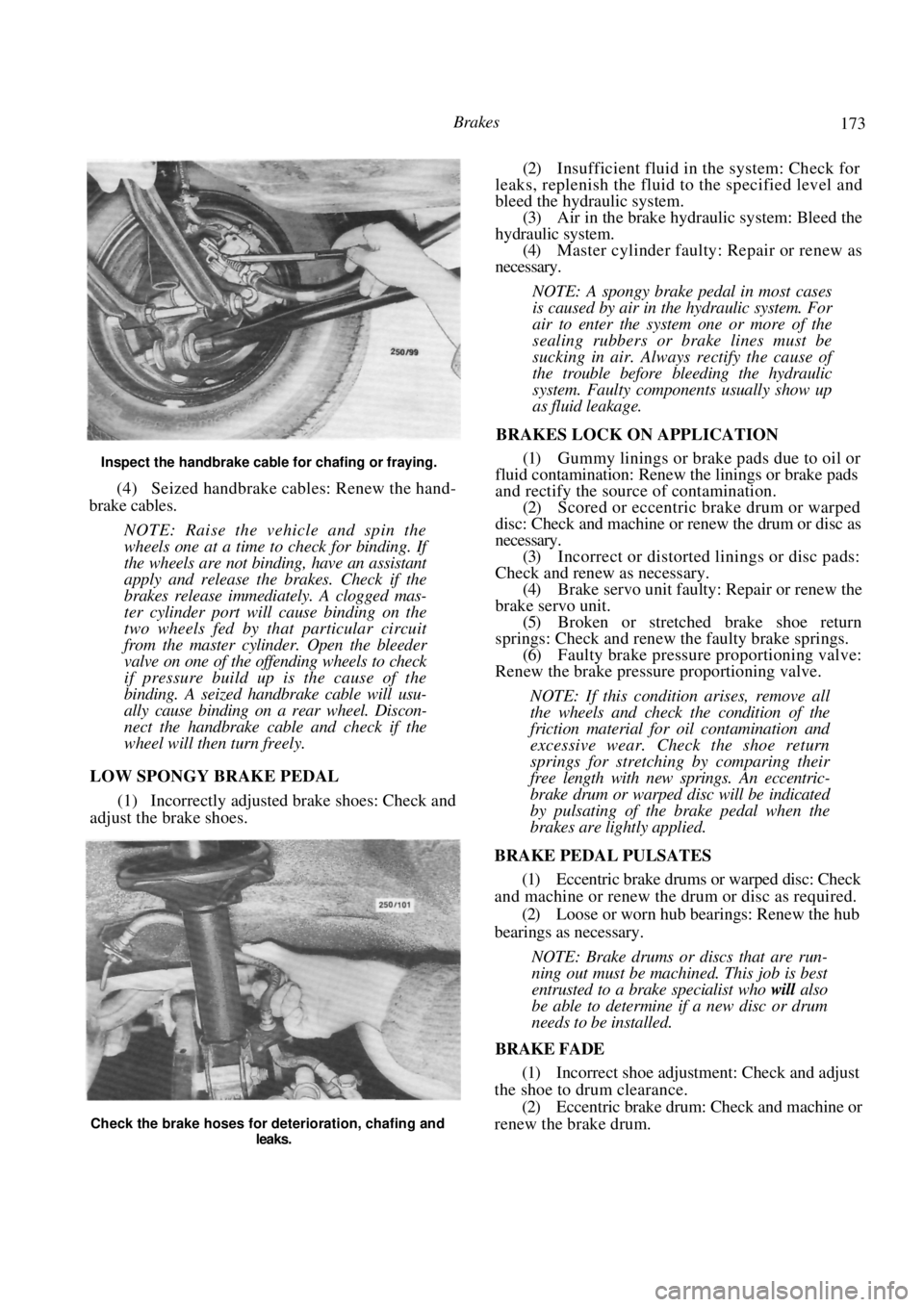
Inspect the handbrake cable for chafing or fraying.
(4) Seized handbrake cables: Renew the hand-
brake cables.
NOTE: Raise the vehicle and spin the
wheels one at a time to check for binding. If
the wheels are not binding, have an assistant
apply and release the brakes. Check if the
brakes release immediately. A clogged mas-
ter cylinder port will cause binding on the
two wheels fed by that particular circuit
from the master cylinder. Open the bleeder
valve on one of the o ffending wheels to check
if pressure build up is the cause of the
binding. A seized handbrake cable will usu-
ally cause binding on a rear wheel. Discon-
nect the handbrake cable and check if the
wheel will then turn freely.
LOW SPONGY BRAKE PEDAL
(1) Incorrectly adjusted brake shoes: Check and
adjust the brake shoes.
(2) Insufficient fluid in the system: Check for
leaks, replenish the fluid to the specified level and
bleed the hydraulic system.
(3) Air in the brake hydraulic system: Bleed the
hydraulic system. (4) Master cylinder faulty: Repair or renew as
necessary.
NOTE: A spongy brake pedal in most cases
is caused by air in the hydraulic system. For
air to enter the system one or more of the
sealing rubbers or brake lines must be
sucking in air. Always rectify the cause of
the trouble before bleeding the hydraulic
system. Faulty components usually show up
as fluid leakage.
BRAKES LOCK ON APPLICATION
(1) Gummy linings or brake pads due to oil or
fluid contamination: Renew the linings or brake pads
and rectify the source of contamination. (2) Scored or eccentric brake drum or warped
disc: Check and machine or renew the drum or disc as
necessary.
(3) Incorrect or distorted linings or disc pads:
Check and renew as necessary. (4) Brake servo unit faulty: Repair or renew the
brake servo unit. (5) Broken or stretched brake shoe return
springs: Check and renew th e faulty brake springs.
(6) Faulty brake pressure proportioning valve:
Renew the brake pressure proportioning valve.
NOTE: If this condition arises, remove all
the wheels and check the condition of the
friction material for oil contamination and
excessive wear. Check the shoe return
springs for stretching by comparing their
free length with new sp rings. An eccentric-
brake drum or warped disc will be indicated
by pulsating of the brake pedal when the
brakes are lightly applied.
BRAKE PEDAL PULSATES
(1) Eccentric brake drums or warped disc: Check
and machine or renew the drum or disc as required.
(2) Loose or worn hub bearings: Renew the hub
bearings as necessary.
NOTE: Brake drums or discs that are run-
ning out must be machined. This job is best
entrusted to a brake specialist who will also
be able to determine if a new disc or drum
needs to be installed.
BRAKE FADE
(1) Incorrect shoe adjustment: Check and adjust
the shoe to drum clearance. (2) Eccentric brake drum: Check and machine or
renew the brake drum.
Check the brake hoses for deterioration, chafing and
leaks.
Page 175 of 238
Brakes 175
A pressure proportioning valve is incorporated in
each circuit to prevent premature locking of the rear
wheels during severe braking.
The four wheel hydraulically operated brakes
utilize disc brakes on each front wheel and disc brakes
or leading and trailing drum brake shoes on each rear
wheel.
The front disc brakes comprise a disc attached to
the hub assembly and a caliper bolted to the steering
knuckle.
The rear disc brakes comprise a disc and hub
assembly attached to the rear stub axle and a caliper
and anchor plate bolted to the backing plate.
The front and rear calipers are of the sliding type.
As pad wear takes place, the caliper piston is allowed
to slide outwards through the seal to take up a new
position in the caliper bore. Elastic deformation of the
seal takes place when the brakes are applied, which
returns the piston slightly when the brakes are re-
leased. Thus a constant clearance is maintained
between the pads and the disc when the brakes are in
the off position.
The disc brakes do not require periodical adjust-
ment in service to compensate for pad wear as they
are self adjusting.
The leading and trailing shoe drum brakes on the
rear wheels use a double ended wheel cylinder to
operate both brake shoes at the top. The lower end of
each brake shoe abuts a fixed anchor point. The brake
shoes are automatically adju sted when the brakes are
operated.
The handbrake operates the rear brakes via a
cable arrangement.
3. MASTER CYLINDER
Special Equipment Required:
To Install New Seals — Suitable machined drift
TO REMOVE
(1) Depress the brake pedal several times to
deplete the vacuum from the system.
(2) Raise the bonnet and install covers to
both
the front mudguards. Cover the areas of paintwork
beneath the master cylinder with absorbent cloth.
(3) Disconnect the wiring from the pressure
sensing switch. (4) Disconnect the brake pipes from the master
cylinder and plug the outlets and pipes to prevent the
loss of fluid and the ingress of dirt.
(5) Remove the nuts retaining the master cylin-
der to the brake servo unit and remove the master
cylinder from the vehicle.
TO DISMANTLE
(1) Remove the master cylinder as previously
described. (2) Remove the reservoir cap and diaphragm,
drain and discard the brake fluid from the reservoir. (3) Carefully remove the reservoir from the
master cylinder by pulling it from the reservoir
retainers by hand. Remove and discard the retainers
from the master cylinder. (4) Using internal snap ring pliers, remove the
snap ring from the primary reservoir port. (5) Remove the fast fill valve assembly and the
O ring from the port. Remove and discard the valve
washer from the fast fill valve.
(6) Remove the proportioning valve plugs and
the O rings. Discard the O rings. Withdraw the springs
and valve plungers from the master cylinder. Remove
and discard the seals from the valve plungers. (7) Remove the pressure sensing switch and
lever assembly from the master cylinder. {8) Remove the cylinder end plug from the
master cylinder. Remove and discard the O ring from
the plug.
(9) Carefully tap the front of the master cylinder
vertically on a block of wo od and remove the pressure
differential pistons from the master cylinder. Remove
and discard the O rings from the pistons. (10) Push the primary piston forward in the
cylinder with a blunt rod and while holding the
pressure, remove the stop pin from the master cylin-
der.
(11) The primary piston may now be withdrawn
from the cylinder bore. The secondary piston, retainer
and spring can also be withdrawn by carefully tapping
the master cylinder on a block of wood. (12) Prise the legs of the seal retainer upwards
and remove it from the primary piston. Remove the
seal and guide. Discard the seal and retainer.
NOTE: The secondary piston must no! be
dismantled by removing the screw. This
assembly has a factory p reset length and the
screw must not be altered in service.
(13) Remove the main seal and the guide from
the front of the secondary piston. Stretch the rear seal
from the groove and remove it from the piston. Take
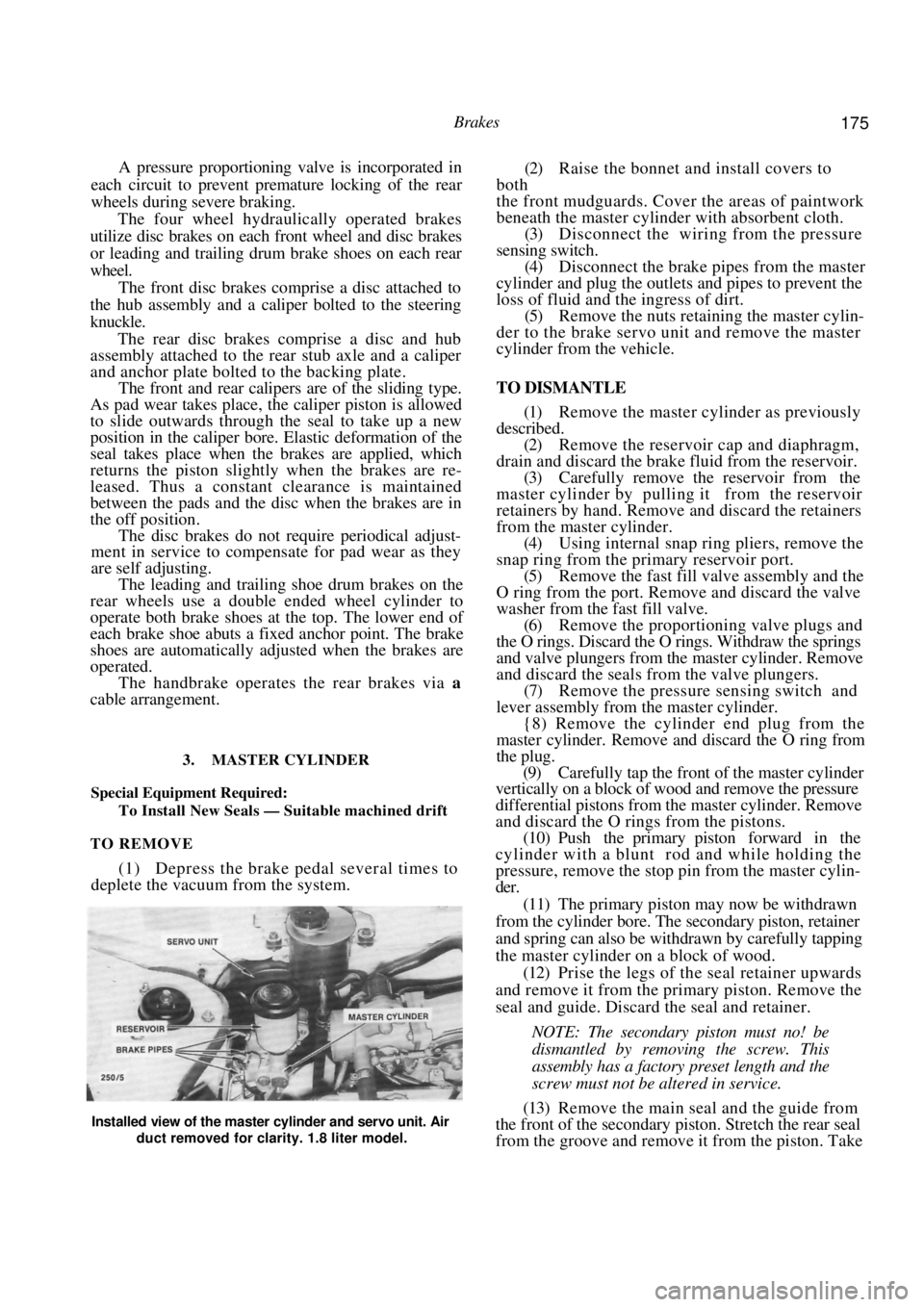
Installed view of the master cylinder and servo unit. Air
duct removed for clarity. 1.8 liter model.
Page 184 of 238
184 Brakes
than 0.05 mm. If the wheel hub end float exceeds
Specifications, the bearing must be renewed as de-
scribed in the Rear Suspension section.
(3) Position the dial gauge plunger against the
centre of the brake disc contact area. Rotate the hub
and measure the runout. Ma ximum allowable runout
is 0.07 mm. (4) If the runout exceeds the specified amount,
machine or renew the brake disc. (5) Install the rear wheel and lower the vehicle to
the ground. (6) Road test the vehicle and check for correct
brake operation.
To Remove and Install
(1) Raise the rear of the vehicle and support it
on chassis stands. Remove the relevant rear wheel.
(2) Remove the clip securing the brake hose to
the suspension unit and disengage the hose. (3) Remove the bolts retaining the caliper an-
chor plate. (4) Slide the caliper from the brake disc and
suspend the caliper clear of the work area using wire
or cord.
NOTE: Do not allow the caliper to hang on
the brake hose.
(5) Remove the grease cap from the rear hub.
(6) Remove the split pin, nut retainer, hub nut
and washer from the stub axle. (7) Remove the hub assembly from the stud
axle. Installation is a reversal of the removal procedure
with attention to the following points:
(1) Tighten the rear hub to the specified torque.
(2) Install the brake caliper and tighten all the
bolts to the specified torque. (3) Rotate the hub and check for roughness. If
the hub does not rotate smoothly, renew the hub
bearing as described in the Rear Suspension section. (4) Install the rear wheel and lower the vehicle to
the ground.
(5) Road test the vehicle and check for correct
brake operation.
To Inspect
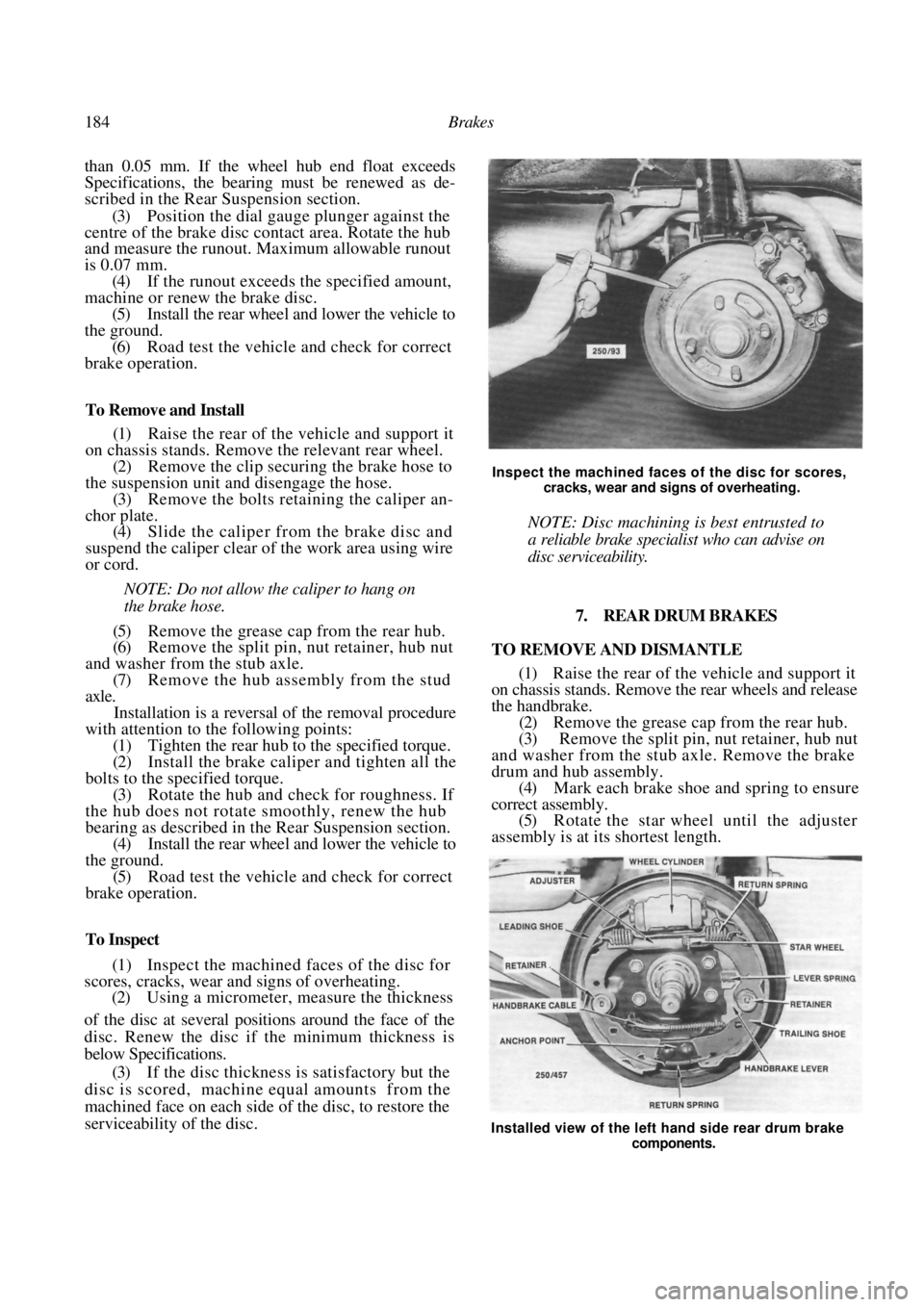
(1) Inspect the machined faces of the disc for
scores, cracks, wear and signs of overheating. (2) Using a micrometer, measure the thickness
of the disc at several posit ions around the face of the
disc. Renew the disc if the minimum thickness is
below Specifications.
(3) If the disc thickness is satisfactory but the
disc is scored, machine equal amounts from the
machined face on each side of the disc, to restore the
serviceability of the disc.
Inspect the machined faces of the disc for scores,
cracks, wear and signs of overheating.
NOTE: Disc machining is best entrusted to
a reliable brake specialist who can advise on
disc serviceability.
7. REAR DRUM BRAKES
TO REMOVE AND DISMANTLE
(1) Raise the rear of the vehicle and support it
on chassis stands. Remove th e rear wheels and release
the handbrake.
(2) Remove the grease cap from the rear hub.
(3) Remove the split pin, nut retainer, hub nut
and washer from the stub axle. Remove the brake
drum and hub assembly.
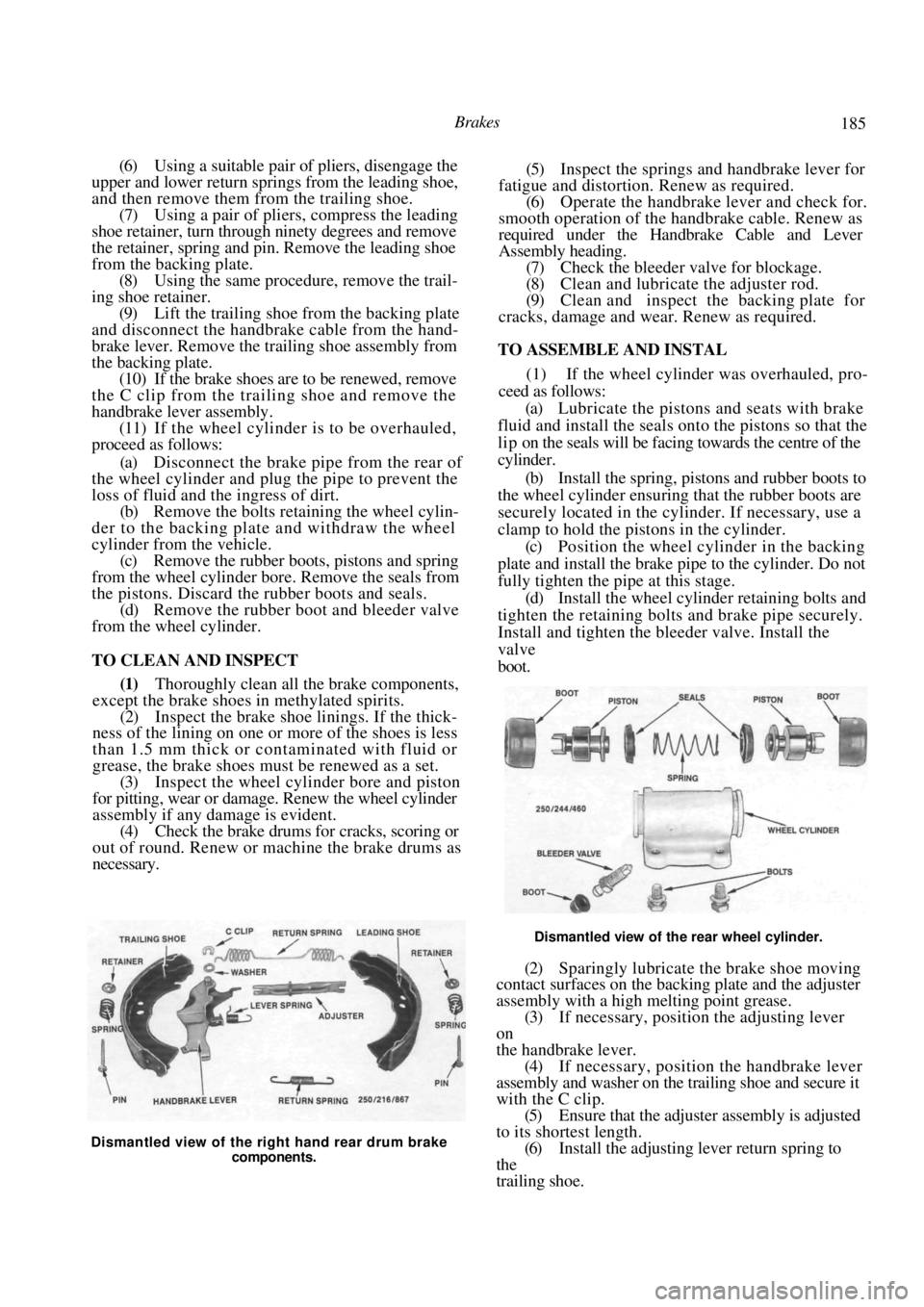
(4) Mark each brake shoe and spring to ensure
correct assembly. (5) Rotate the star wheel until the adjuster
assembly is at its shortest length.
Installed view of the left hand side rear drum brake
components.
Page 185 of 238
Brakes 185
(6) Using a suitable pair of pliers, disengage the
upper and lower return springs from the leading shoe,
and then remove them from the trailing shoe. (7) Using a pair of pliers, compress the leading
shoe retainer, turn through ninety degrees and remove
the retainer, spring and pin. Remove the leading shoe
from the backing plate. (8) Using the same procedure, remove the trail-
ing shoe retainer. (9) Lift the trailing shoe from the backing plate
and disconnect the handbrake cable from the hand-
brake lever. Remove the trailing shoe assembly from
the backing plate.
(10) If the brake shoes are to be renewed, remove
the C clip from the trailing shoe and remove the
handbrake lever assembly. (11) If the wheel cylinder is to be overhauled,
proceed as follows:
(a) Disconnect the brake pipe from the rear of
the wheel cylinder and plug the pipe to prevent the
loss of fluid and the ingress of dirt. (b) Remove the bolts retaining the wheel cylin-
der to the backing plate and withdraw the wheel
cylinder from the vehicle. (c) Remove the rubber boots, pistons and spring
from the wheel cylinder bore. Remove the seals from
the pistons. Discard th e rubber boots and seals.
(d) Remove the rubber boot and bleeder valve
from the wheel cylinder.
TO CLEAN AND INSPECT
(1) Thoroughly clean all the brake components,
except the brake shoes in methylated spirits.
(2) Inspect the brake shoe linings. If the thick-
ness of the lining on one or more of the shoes is less
than 1.5 mm thick or contaminated with fluid or
grease, the brake shoes must be renewed as a set. (3) Inspect the wheel cylinder bore and piston
for pitting, wear or damage. Renew the wheel cylinder
assembly if any damage is evident. (4) Check the brake drums for cracks, scoring or
out of round. Renew or machine the brake drums as
necessary.
(5) Inspect the springs and handbrake lever for
fatigue and distortion. Renew as required. (6) Operate the handbrake lever and check for.
smooth operation of the handbrake cable. Renew as
required under the Hand brake Cable and Lever
Assembly heading. (7) Check the bleeder valve for blockage.
(8) Clean and lubricate the adjuster rod.
(9) Clean and inspect the backing plate for
cracks, damage and wear. Renew as required.
TO ASSEMBLE AND INSTAL
(1) If the wheel cylinder was overhauled, pro-
ceed as follows:
(a) Lubricate the pistons and seats with brake
fluid and install the seals on to the pistons so that the
l i p on the seals will be facing towards the centre of the
cylinder.
(b) Install the spring, pistons and rubber boots to
the wheel cylinder ensuring that the rubber boots are
securely located in the cy linder. If necessary, use a
clamp to hold the pistons in the cylinder.
(c) Position the wheel cylinder in the backing
plate and install the brake pi pe to the cylinder. Do not
fully tighten the pipe at this stage. (d) Install the wheel cylinder retaining bolts and
tighten the retaining bolts and brake pipe securely.
Install and tighten the bleeder valve. Install the
valve
boot.
Dismantled view of the right hand rear drum brake
components. Dismantled view of the rear wheel cylinder.
(2) Sparingly lubricate the brake shoe moving
contact surfaces on the backing plate and the adjuster
assembly with a high melting point grease.
(3) If necessary, position the adjusting lever
on
the handbrake lever. (4) If necessary, position the handbrake lever
assembly and washer on the trailing shoe and secure it
with the C clip.
(5) Ensure that the adjuster assembly is adjusted
to its shortest length. (6) Install the adjusting lever return spring to
the
trailing shoe.
Page 190 of 238

190
ELECTRICAL SYSTEM
CAUTION: To prevent severe electrical shock extreme care must be taken when
working on or near the electronic ignition system as dangerous high tension voltages
are produced in both the primary and secondary circuits. See the text fo\
r
precautionary notes.
SPECIFICATIONS
BATTERY
Type ..................................................12 volt lead acid
Polarity to earth .................................... Negative ( - )
Specific gravity:
Fully charged ................................... A bove 1.250
Fully discharged ................................Below 1.130
ALTERNATOR
Make .................................................Bosch or Hitachi
Maximum output .......................................... 70 amps
Polarity to earth .................................... Negative ( - )
Stator windings ......................................... Star wound
Regulator type ................................................ Integral
Brush length minimum:
Bosch ........................................................ 5.0 mm
Hitachi ............................. 6.0 mm or limit mark
STARTER MOTOR
Make .................................................Hitach i or Bosch
Type ............................ 4 pole 4 brush reduction gear
Operation control.................................. Solenoid and
overrunning clutch
Undercut of commutator (maximum):
Hitachi ...................................................... 0.8 mm
Brush length (minimum):
Bosch ........................................................ 8.0 mm
Hitachi ........................................................11 mm
Brush spring tension;
Hitachi ............................................... 15.7-19.6 N
Hitachi:
Drive pinion stopper clearance ........ 0.3-1.5 mm
Selective fit adjuster plates ........ 0.5 and 0.8 mm
IGNITION SYSTEM
The ignition system is an integral part of the
engine management system. The Specifications, testing
and overhaul procedures are fully covered in the Fuel
and Engine Management section.
TORQUE WRENCH SETTINGS
Alternator pulley retaining nut:
Bosch ......................................................... 50 Nm
Hitachi ....................................................... 59 Nm
1. BATTERY AND CHARGING SYSTEM
TROUBLE SHOOTING
BATTERY UNDERCHARGED
3. Loose or broken drive belt: Adjust or renew
the drive belt. 4. Faulty alternator regulator; Renew the regu-
lator unit.
5. Faulty battery: Install a new battery of
the
recommended type and capacity. 6. Faulty alternator: Overhaul or renew the
alternator. 7. Fault in the charging circuit wiring: Check
and repair or renew the wiring harness. 8. Faulty connections in the charging circuit:
Check and repair the connections. 9. Fusible link blown; Rectify the fault and
renew as necessary.
NOTE: Check the state of charge (specific
gravity) of the battery- as described under
the
Battery heading in this section. If the battery
is undercharged, check the possible causes in
the order given.
BATTERY OVERCHARGED
• Faulty alternator regulator unit:
Renew the
regulator unit.
• Faulty alternator: Overhaul or
renew the
alternator. • Faulty charging circuit wiring or
connec-
tions: Check and renew or repair the faulty
compo-
nents.
NOTE: An overcharged battery is indicated
by continual loss of water through boiling.
Page 193 of 238
Electrical System 193
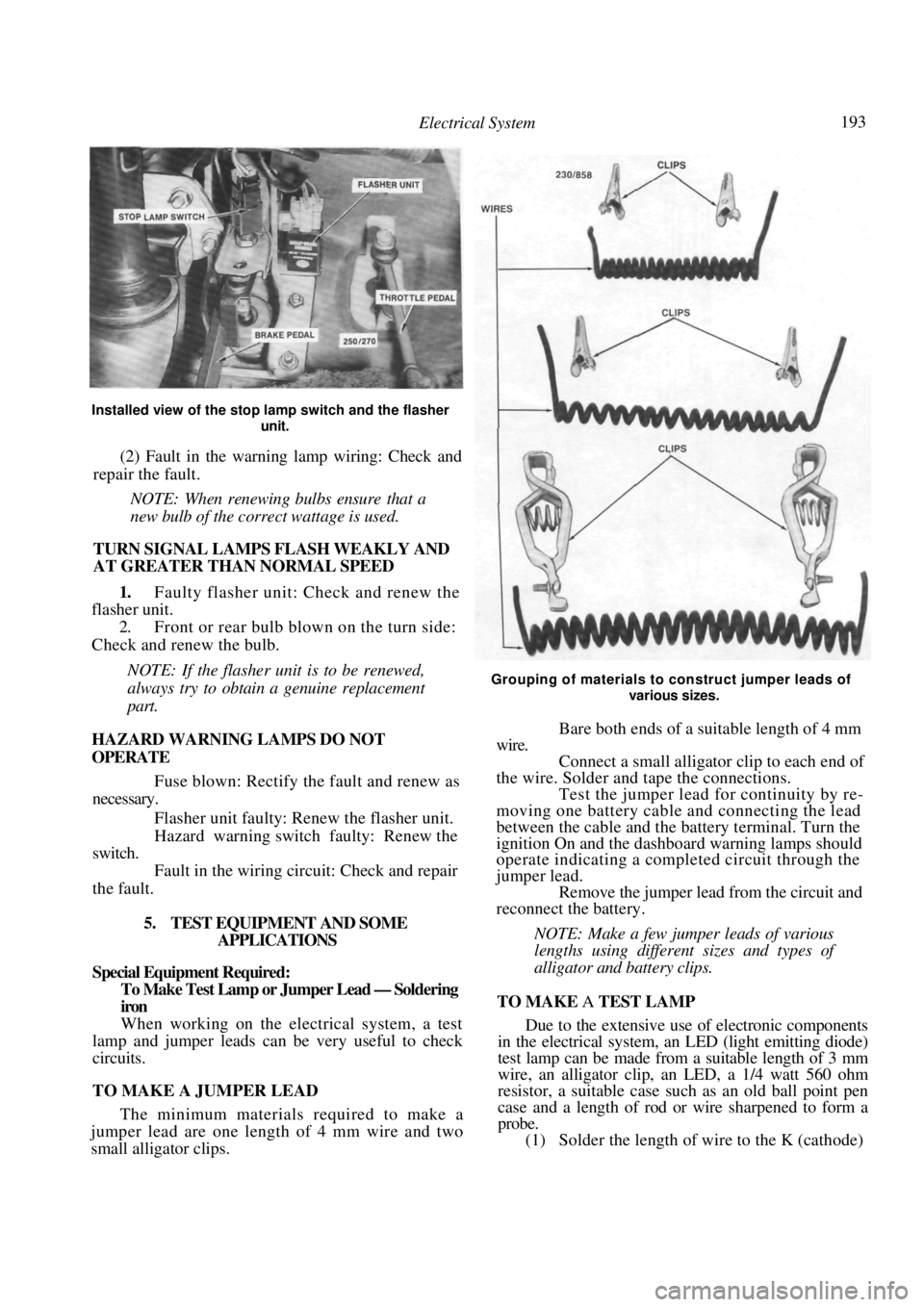
Installed view of the stop lamp switch and the flasher
unit.
(2) Fault in the warning lamp wiring: Check and
repair the fault.
NOTE: When renewing bulbs ensure that a
new bulb of the correct wattage is used.
TURN SIGNAL LAMPS FLASH WEAKLY AND
AT GREATER THAN NORMAL SPEED
1. Faulty flasher unit: Check and renew the
flasher unit.
2. Front or rear bulb blown on the turn side:
Check and renew the bulb.
NOTE: If the flasher unit is to be renewed,
always try to obtain a genuine replacement
part.
HAZARD WARNING LAMPS DO NOT
OPERATE
Fuse blown: Rectify the fault and renew as
necessary.
Flasher unit faulty: Re new the flasher unit.
Hazard warning switch faulty: Renew the
switch.
Fault in the wiring circuit: Check and repair
the fault.
5. TEST EQUIPMENT AND SOME APPLICATIONS
Special Equipment Required:
To Make Test Lamp or Jumper Lead — Soldering
iron
When working on the electrical system, a test
lamp and jumper leads can be very useful to check
circuits.
TO MAKE A JUMPER LEAD
The minimum materials required to make a
jumper lead are one length of 4 mm wire and two
small alligator clips.
Grouping of materials to construct jumper leads of
various sizes.
Bare both ends of a suitable length of 4 mm
wire. Connect a small alligato r clip to each end of
the wire. Solder and tape the connections. Test the jumper lead for continuity by re-
moving one battery cable and connecting the lead
between the cable and the battery terminal. Turn the
ignition On and the dashboard warning lamps should
operate indicating a completed circuit through the
jumper lead. Remove the jumper lead from the circuit and
reconnect the battery.
NOTE: Make a few jumper leads of various
lengths using different sizes and types of
alligator and battery clips.
TO MAKE A TEST LAMP
Due to the extensive use of electronic components
in the electrical system, an LED (light emitting diode)
test lamp can be made from a suitable length of 3 mm
wire, an alligator clip, an LED, a 1/4 watt 560 ohm
resistor, a suitable case such as an old ball point pen
case and a length of rod or wire sharpened to form a
probe.
(1) Solder the length of wire to the K (cathode)
Page 194 of 238
194 Electrical System
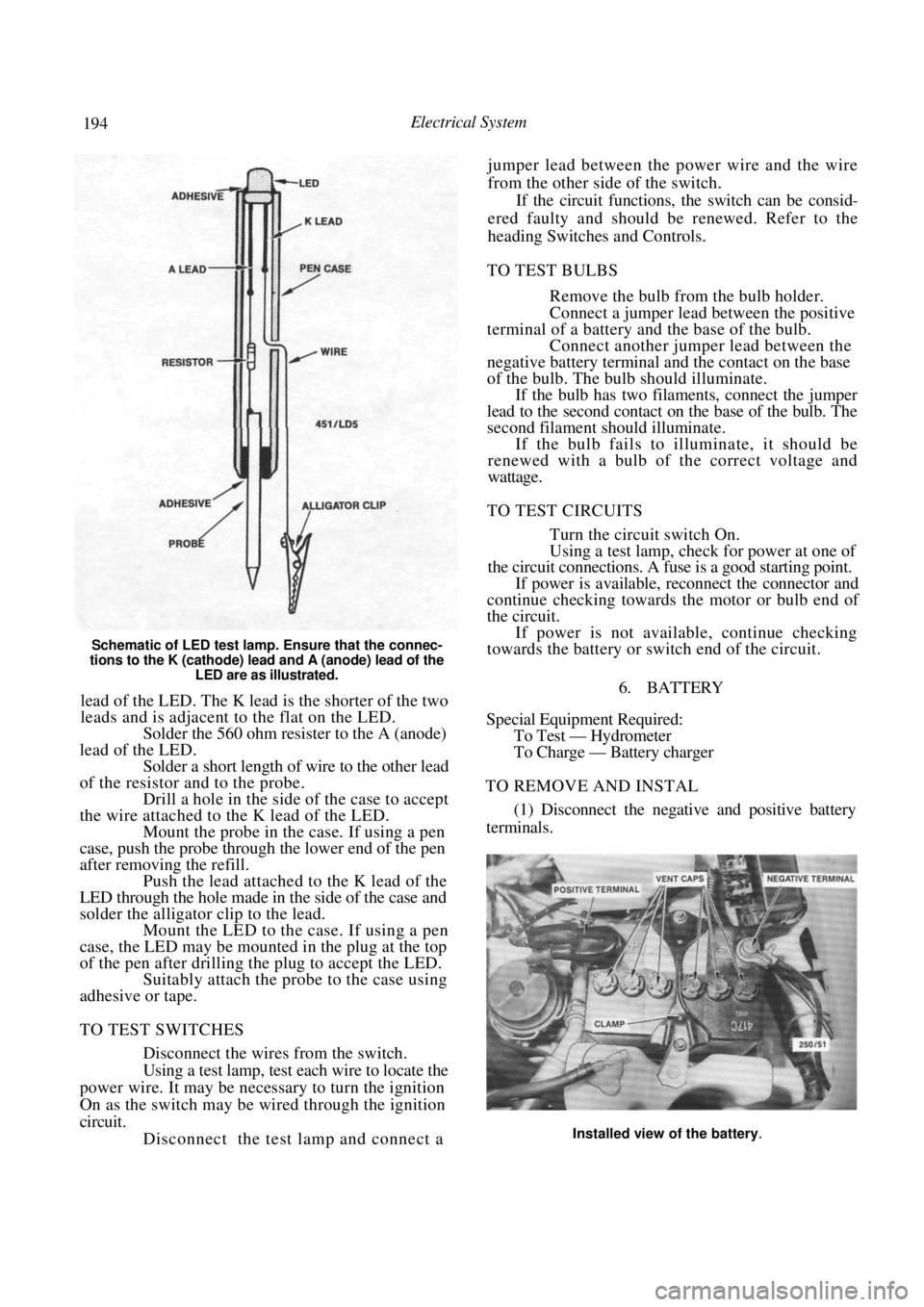
Schematic of LED test lamp. Ensure that the connec-
tions to the K (cathode) lead and A (anode) lead of the LED are as illustrated.
lead of the LED. The K lead is the shorter of the two
leads and is adjacent to the flat on the LED.
Solder the 560 ohm resister to the A (anode)
lead of the LED. Solder a short length of wire to the other lead
of the resistor and to the probe. Drill a hole in the side of the case to accept
the wire attached to the K lead of the LED. Mount the probe in the case. If using a pen
case, push the probe through the lower end of the pen
after removing the refill. Push the lead attached to the K lead of the
LED through the hole made in the side of the case and
solder the alligator clip to the lead.
Mount the LED to the case. If using a pen
case, the LED may be mounted in the plug at the top
of the pen after drilling the plug to accept the LED. Suitably attach the probe to the case using
adhesive or tape.
TO TEST SWITCHES
Disconnect the wires from the switch.
Using a test lamp, test each wire to locate the
power wire. It may be nec essary to turn the ignition
On as the switch may be wired through the ignition
circuit. Disconnect the test lamp and connect a jumper lead between the power wire and the wire
from the other side of the switch.
If the circuit functions, the switch can be consid-
ered faulty and should be renewed. Refer to the
heading Switches and Controls.
TO TEST BULBS
Remove the bulb from the bulb holder.
Connect a jumper lead between the positive
terminal of a battery a nd the base of the bulb.
Connect another jumper lead between the
negative battery terminal and the contact on the base
of the bulb. The bulb should illuminate. If the bulb has two filaments, connect the jumper
lead to the second contact on the base of the bulb. The
second filament should illuminate.
If the bulb fails to illuminate, it should be
renewed with a bulb of the correct voltage and
wattage.
TO TEST CIRCUITS
Turn the circuit switch On.
Using a test lamp, check for power at one of
the circuit connections. A fuse is a good starting point.
If power is available, reconnect the connector and
continue checking towards the motor or bulb end of
the circuit.
If power is not available, continue checking
towards the battery or switch end of the circuit.
6. BATTERY
Special Equipment Required: To Test — Hydrometer
To Charge — Battery charger
TO REMOVE AND INSTAL
(1) Disconnect the negative and positive battery
terminals.
Installed view of the battery.