drive belt NISSAN QASHQAI 2016 Owner´s Manual
[x] Cancel search | Manufacturer: NISSAN, Model Year: 2016, Model line: QASHQAI, Model: NISSAN QASHQAI 2016Pages: 338, PDF Size: 4.87 MB
Page 2 of 338
Foreword
Welcome to the growing family of new NISSAN owners. This vehicle has been delivered to you with confidence. It has been produced using the latest techniques
and strict quality control.
This manual was prepared to help you understand the operation and maintenance of your vehicle so that you may enjoy many kilometres (miles) of driving pleasure.
Please read through this manual before operating your vehicle.
A separate Warranty Information & Maintenance Booklet explains in detail the warranty coverage that applies to your vehicle.
Your NISSAN dealer knows your vehicle best. When you require any service or have any questions, your NISSAN dealer will be glad to assist you with the extensive
resources available for you.
IMPORTANT SAFETY INFORMATION
REMINDERS FOR SAFETY!
Follow these important driving rules to help ensure a safe and complete trip for
you and your passengers!
•NEVER drive under the influence of alcohol or drugs.
•ALWAYS observe posted speed limits and never drive too fast for condi-
tions.
•ALWAYS use your seat belts and appropriate child restraint systems.
Preteen children should be seated in the rear seat.
•ALWAYS provide information about the proper use of vehicle safety fea-
tures to all occupants of the vehicle.
•ALWAYS review this Owner’s Manual for important safety information.
WHEN READING THE MANUAL
This manual includes information for all options available on this model. There-
fore, you may find some information that does not apply to your vehicle.
All information, specifications and illustrations in this manual are those in effect
at the time of printing. NISSAN reserves the right to change specifications or
designs at any time without notice and without obligation.
MODIFICATION OF YOUR VEHICLE
This vehicle should not be modified. Modifications could affect its performance,
safety or durability, and may even violate governmental regulations. In addition,
damage or performance problems resulting from modifications may not be cov-
ered under NISSAN warranties.
READ FIRST — THEN DRIVE SAFELY
Before driving your vehicle, read this Owner’s Manual carefully. This will ensure
familiarity with controls and maintenance requirements, assisting you in the safe
operation of your vehicle.
Throughout this manual the following symbols and words are used:
WARNING
Indicates the presence of a hazard that could cause death or serious per-
sonal injury. To avoid or reduce the risk, the procedures described must be
followed precisely.
CAUTION
Indicates the presence of a hazard that could cause minor or moderate per-
sonal injury, or damage to your vehicle. To avoid or reduce the risk, the pro-
cedures described must be followed carefully.
NOTE
Indicates additional helpful information.
Page 7 of 338
0Illustrated table of contentsIllustrated table of contents
Seat belts and supplemental restraint system ........... 0-2
Exterior front ............................................................ 0-3
Exterior rear ............................................................. 0-4
Passenger compartment .......................................... 0-5
Cockpit ................................................................... 0-6
Left hand drive.................................................... 0-6
Right hand drive ................................................. 0-7
Instrument and control layout ................................... 0-8Left hand drive.................................................... 0-8
Right hand drive ................................................. 0-9
Meters and gauges .................................................. 0-10
Engine compartment ................................................ 0-11
HRA2DDT engine ............................................... 0-12
MR20DD engine ................................................. 0-12
K9K engine......................................................... 0-13
R9M engine ........................................................ 0-14
Page 22 of 338
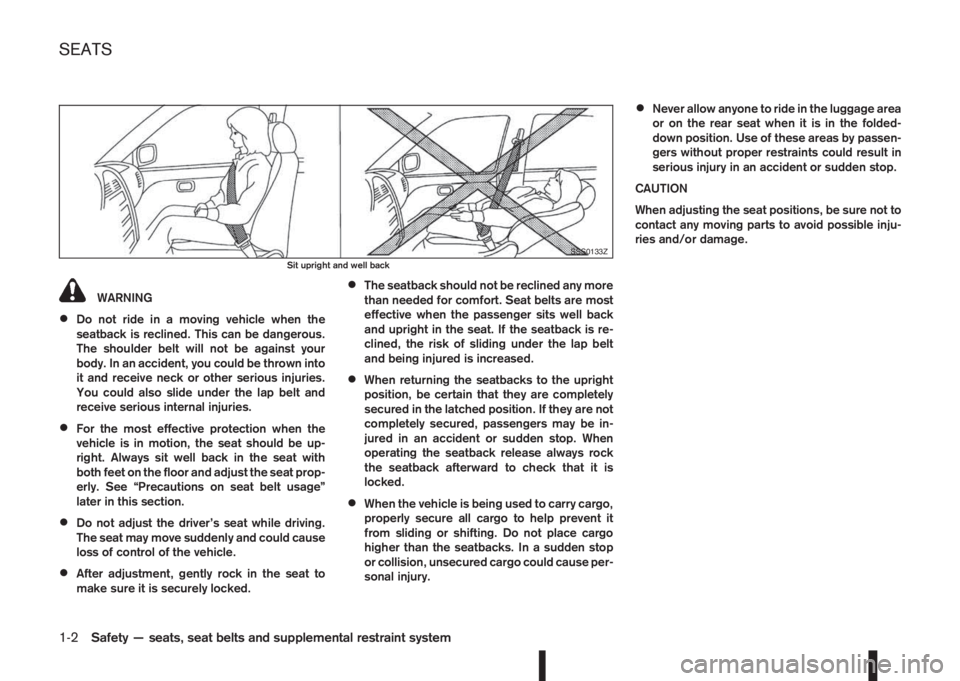
WARNING
•Do not ride in a moving vehicle when the
seatback is reclined. This can be dangerous.
The shoulder belt will not be against your
body. In an accident, you could be thrown into
it and receive neck or other serious injuries.
You could also slide under the lap belt and
receive serious internal injuries.
•For the most effective protection when the
vehicle is in motion, the seat should be up-
right. Always sit well back in the seat with
both feet on the floor and adjust the seat prop-
erly. See “Precautions on seat belt usage”
later in this section.
•Do not adjust the driver’s seat while driving.
The seat may move suddenly and could cause
loss of control of the vehicle.
•After adjustment, gently rock in the seat to
make sure it is securely locked.
•The seatback should not be reclined any more
than needed for comfort. Seat belts are most
effective when the passenger sits well back
and upright in the seat. If the seatback is re-
clined, the risk of sliding under the lap belt
and being injured is increased.
•When returning the seatbacks to the upright
position, be certain that they are completely
secured in the latched position. If they are not
completely secured, passengers may be in-
jured in an accident or sudden stop. When
operating the seatback release always rock
the seatback afterward to check that it is
locked.
•When the vehicle is being used to carry cargo,
properly secure all cargo to help prevent it
from sliding or shifting. Do not place cargo
higher than the seatbacks. In a sudden stop
or collision, unsecured cargo could cause per-
sonal injury.
•Never allow anyone to ride in the luggage area
or on the rear seat when it is in the folded-
down position. Use of these areas by passen-
gers without proper restraints could result in
serious injury in an accident or sudden stop.
CAUTION
When adjusting the seat positions, be sure not to
contact any moving parts to avoid possible inju-
ries and/or damage.
SSS0133ZSit upright and well back
SEATS
1-2Safety — seats, seat belts and supplemental restraint system
Page 23 of 338
FRONT SEATS
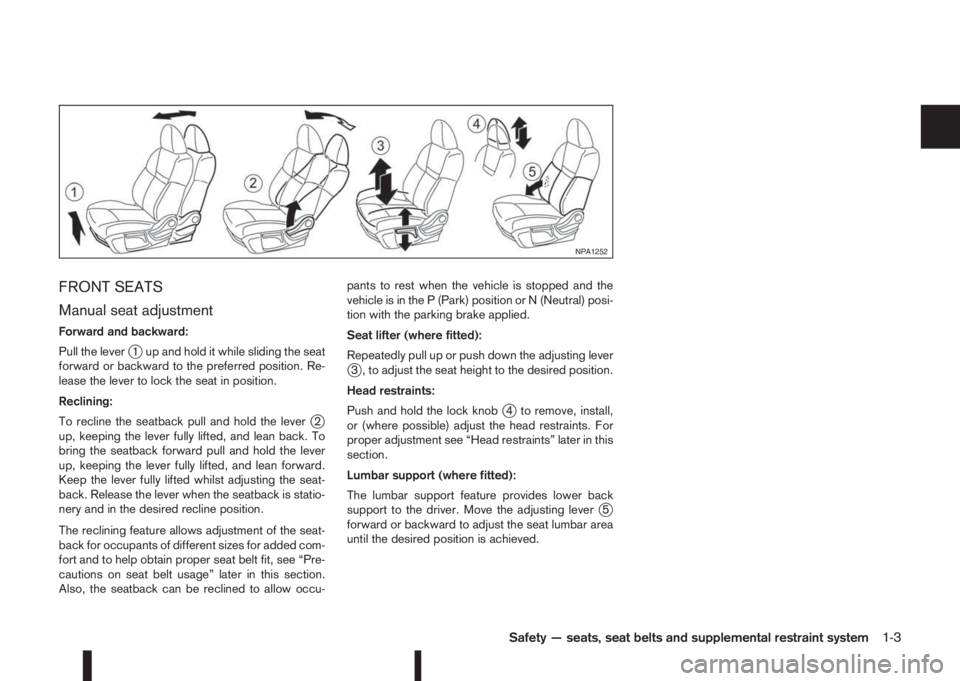
Manual seat adjustment
Forward and backward:
Pull the lever
j1 up and hold it while sliding the seat
forward or backward to the preferred position. Re-
lease the lever to lock the seat in position.
Reclining:
To recline the seatback pull and hold the lever
j2
up, keeping the lever fully lifted, and lean back. To
bring the seatback forward pull and hold the lever
up, keeping the lever fully lifted, and lean forward.
Keep the lever fully lifted whilst adjusting the seat-
back. Release the lever when the seatback is statio-
nery and in the desired recline position.
The reclining feature allows adjustment of the seat-
back for occupants of different sizes for added com-
fort and to help obtain proper seat belt fit, see “Pre-
cautions on seat belt usage” later in this section.
Also, the seatback can be reclined to allow occu-pants to rest when the vehicle is stopped and the
vehicle is in the P (Park) position or N (Neutral) posi-
tion with the parking brake applied.
Seat lifter (where fitted):
Repeatedly pull up or push down the adjusting lever
j3 , to adjust the seat height to the desired position.
Head restraints:
Push and hold the lock knob
j4 to remove, install,
or (where possible) adjust the head restraints. For
proper adjustment see “Head restraints” later in this
section.
Lumbar support (where fitted):
The lumbar support feature provides lower back
support to the driver. Move the adjusting lever
j5
forward or backward to adjust the seat lumbar area
until the desired position is achieved.
NPA1252
Safety — seats, seat belts and supplemental restraint system1-3
Page 28 of 338
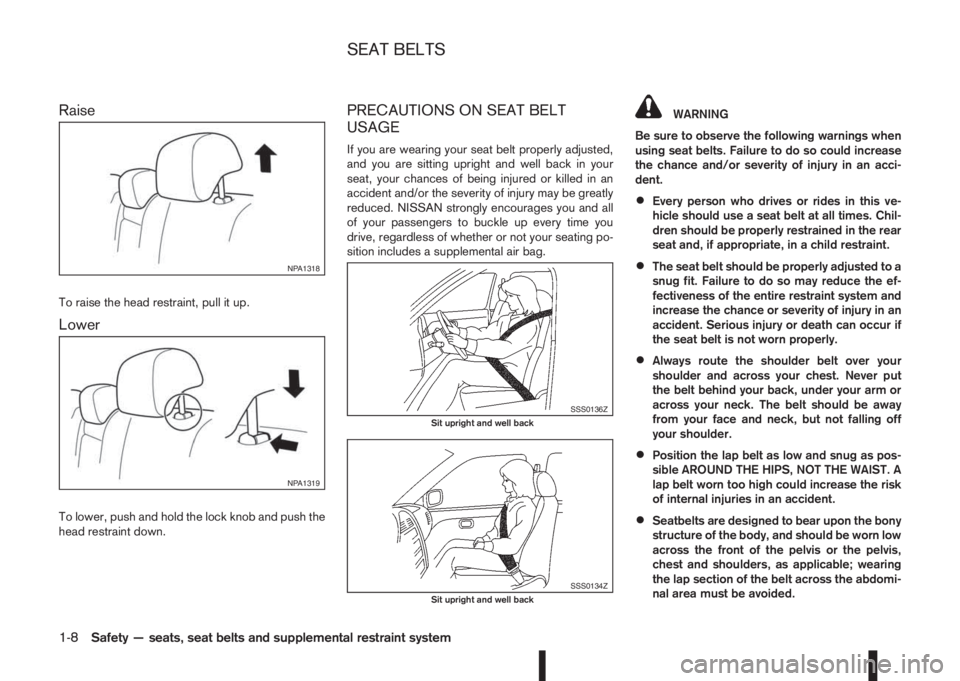
Raise
To raise the head restraint, pull it up.
Lower
To lower, push and hold the lock knob and push the
head restraint down.
PRECAUTIONS ON SEAT BELT
USAGE
If you are wearing your seat belt properly adjusted,
and you are sitting upright and well back in your
seat, your chances of being injured or killed in an
accident and/or the severity of injury may be greatly
reduced. NISSAN strongly encourages you and all
of your passengers to buckle up every time you
drive, regardless of whether or not your seating po-
sition includes a supplemental air bag.
WARNING
Be sure to observe the following warnings when
using seat belts. Failure to do so could increase
the chance and/or severity of injury in an acci-
dent.
•Every person who drives or rides in this ve-
hicle should use a seat belt at all times. Chil-
dren should be properly restrained in the rear
seat and, if appropriate, in a child restraint.
•The seat belt should be properly adjusted to a
snug fit. Failure to do so may reduce the ef-
fectiveness of the entire restraint system and
increase the chance or severity of injury in an
accident. Serious injury or death can occur if
the seat belt is not worn properly.
•Always route the shoulder belt over your
shoulder and across your chest. Never put
the belt behind your back, under your arm or
across your neck. The belt should be away
from your face and neck, but not falling off
your shoulder.
•Position the lap belt as low and snug as pos-
sible AROUND THE HIPS, NOT THE WAIST. A
lap belt worn too high could increase the risk
of internal injuries in an accident.
•Seatbelts are designed to bear upon the bony
structure of the body, and should be worn low
across the front of the pelvis or the pelvis,
chest and shoulders, as applicable; wearing
the lap section of the belt across the abdomi-
nal area must be avoided.
NPA1318
NPA1319
SSS0136ZSit upright and well back
SSS0134ZSit upright and well back
SEAT BELTS
1-8Safety — seats, seat belts and supplemental restraint system
Page 30 of 338
Children
Children who are too large for child restraints should
be seated and restrained by the seat belts that are
provided.
The use of a booster seat (commercially available)
may help to avoid the shoulder belt coming across
the face or neck area of a child’s seating position.
The booster seat should raise the child so that the
shoulder belt is properly positioned across the top,
middle portion of the shoulder and the lap belt is low
on the hips. The booster seat should fit the vehicle’s
seat. Once the child has grown so the shoulder belt
is no longer on or near the face and neck, use the
shoulder belt without the booster seat.
WARNING
Never let a child stand or kneel on any seat and
do not allow a child in the cargo areas while the
vehicle is moving.
PREGNANT WOMEN
NISSAN recommends that pregnant women use
seat belts. The seat belt should be worn snug, and
always position the lap belt as low as possible
around the hips, not the waist. Place the shoulder
belt over your shoulder and across your chest. Never
put the lap/shoulder belt over your abdominal area.
Contact your doctor for specific recommendations.
INJURED PERSONS
NISSAN recommends that injured persons use seat
belts, depending on the injury. Check with your doc-
tor for specific recommendations.
SEAT BELT WARNINGS
Driver and front passenger
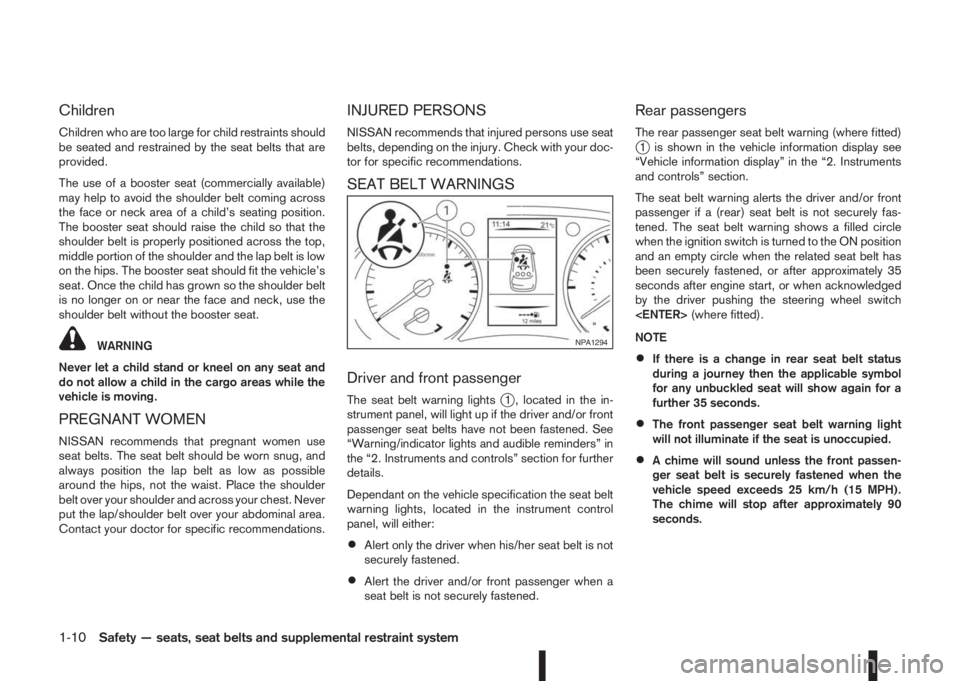
The seat belt warning lightsj1 , located in the in-
strument panel, will light up if the driver and/or front
passenger seat belts have not been fastened. See
“Warning/indicator lights and audible reminders” in
the “2. Instruments and controls” section for further
details.
Dependant on the vehicle specification the seat belt
warning lights, located in the instrument control
panel, will either:
•Alert only the driver when his/her seat belt is not
securely fastened.
•Alert the driver and/or front passenger when a
seat belt is not securely fastened.
Rear passengers
The rear passenger seat belt warning (where fitted)j1 is shown in the vehicle information display see
“Vehicle information display” in the “2. Instruments
and controls” section.
The seat belt warning alerts the driver and/or front
passenger if a (rear) seat belt is not securely fas-
tened. The seat belt warning shows a filled circle
when the ignition switch is turned to the ON position
and an empty circle when the related seat belt has
been securely fastened, or after approximately 35
seconds after engine start, or when acknowledged
by the driver pushing the steering wheel switch
NOTE
•If there is a change in rear seat belt status
during a journey then the applicable symbol
for any unbuckled seat will show again for a
further 35 seconds.
•The front passenger seat belt warning light
will not illuminate if the seat is unoccupied.
•A chime will sound unless the front passen-
ger seat belt is securely fastened when the
vehicle speed exceeds 25 km/h (15 MPH).
The chime will stop after approximately 90
seconds.
NPA1294
1-10Safety — seats, seat belts and supplemental restraint system
Page 33 of 338
•If dirt builds up in the shoulder belt guideof
the seat belt anchors, the seat belts may retract
slowly. Wipe the shoulder belt guide with a clean,
dry cloth.
•Periodically check to see that the seat belt
and the metal components, such as buckles,
tongues, retractors, flexible wires and anchors,
work properly. If loose parts, deterioration, cuts
or other damage on the webbing is found, the
entire seat belt assembly should be replaced.
WARNING
•The pre-tensioner seat belt cannot be reused
after activation. It must be replaced together
with the retractor as a unit.
•If the vehicle is involved in a frontal collision
but the pre-tensioner is not activated, be sure
to have the pre-tensioner system checked
and, if necessary, replaced by a NISSAN
dealer or qualified workshop.
•No unauthorised changes should be made to
any components or wiring of the pre-tensioner
seat belt system. This is to prevent accidental
activation of the pre-tensioner seat belt or
damage to the pre-tensioner seat belt opera-
tion. Tampering with the pre-tensioner seat
belt system may result in serious personal in-
jury.
•Work on and around the pre-tensioner system
should be done by an authorised NISSAN
dealer or qualified workshop. Installation of
electrical equipment should also be done by a
NISSAN dealer or qualified workshop. Unau-
thorised electrical test equipment and prob-
ing devices should not be used on the pre-
tensioner seat belt system.
•If you need to dispose of the pre-tensioner or
scrap the vehicle, contact a NISSAN dealer or
qualified workshop. Correct pre-tensioner
disposal procedures are set forth in the ap-propriate NISSAN Service Manual. Incorrect
disposal procedures could cause personal in-
jury.
The front seat pre-tensioner seat belt system is acti-
vated in conjunction with the front air bag system. It
helps tighten the seat belt when the vehicle is in-
volved in certain types of collisions by restraining
the seat occupants via the seat belt retractor.
The pre-tensioner is encased with the seat belt’s
retractor. These seat belts are used in the same way
as conventional seat belts.
Additionally, the driver’s side pre-tensioner seat belt
system is also equipped with a lap pre-tensioner.
Both the retractor pre-tensioner and lap pre-ten-
sioner provide significant protection against injury in
an accident and increase the safety performance of
your vehicle.
When the pre-tensioner seat belt system activates,
smoke is released and a loud noise may be heard.
The smoke is harmless, but care should be taken
not to inhale it as it may cause irritation and choking.
When the ignition switch is in the ON or START
position, the Supplemental Restraint System (SRS)
air bag warning light will illuminate. The SRS air bag
warning light will turn off after approximately 7 sec-
onds if the system is operational. If any of the follow-
ing conditions occur, the air bag and/or pre-ten-
sioner seat belt need servicing and your vehicle must
be taken to the nearest NISSAN dealer or qualified
workshop.
PRE-TENSIONER SEAT BELT
SYSTEM
Safety — seats, seat belts and supplemental restraint system1-13
Page 49 of 338
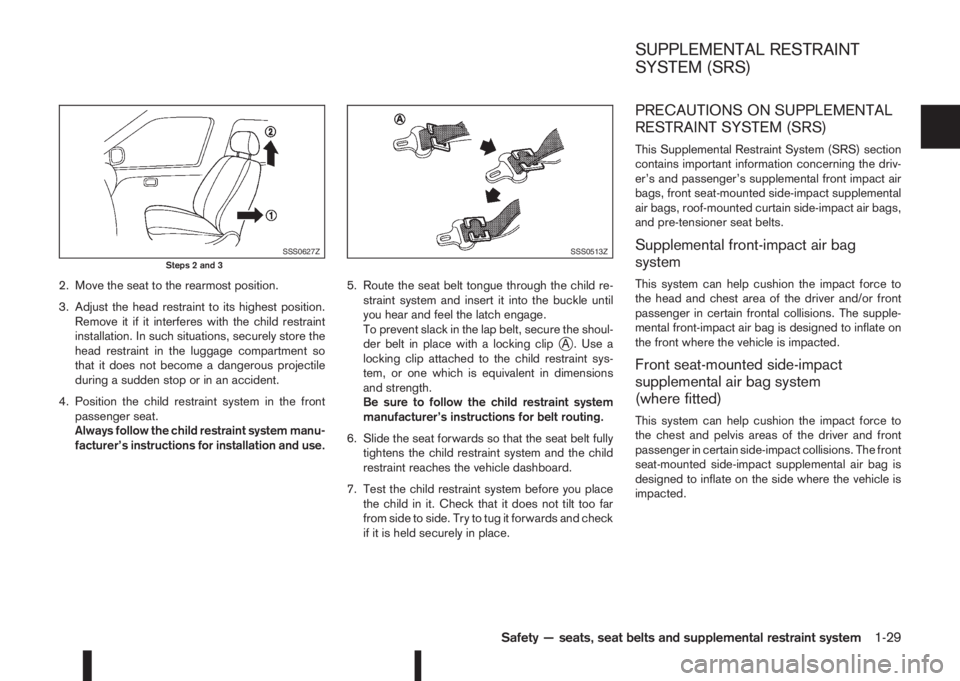
2. Move the seat to the rearmost position.
3. Adjust the head restraint to its highest position.
Remove it if it interferes with the child restraint
installation. In such situations, securely store the
head restraint in the luggage compartment so
that it does not become a dangerous projectile
during a sudden stop or in an accident.
4. Position the child restraint system in the front
passenger seat.
Always follow the child restraint system manu-
facturer’s instructions for installation and use.5. Route the seat belt tongue through the child re-
straint system and insert it into the buckle until
you hear and feel the latch engage.
To prevent slack in the lap belt, secure the shoul-
der belt in place with a locking clip
jA . Use a
locking clip attached to the child restraint sys-
tem, or one which is equivalent in dimensions
and strength.
Be sure to follow the child restraint system
manufacturer’s instructions for belt routing.
6. Slide the seat forwards so that the seat belt fully
tightens the child restraint system and the child
restraint reaches the vehicle dashboard.
7. Test the child restraint system before you place
the child in it. Check that it does not tilt too far
from side to side. Try to tug it forwards and check
if it is held securely in place.
PRECAUTIONS ON SUPPLEMENTAL
RESTRAINT SYSTEM (SRS)
This Supplemental Restraint System (SRS) section
contains important information concerning the driv-
er’s and passenger’s supplemental front impact air
bags, front seat-mounted side-impact supplemental
air bags, roof-mounted curtain side-impact air bags,
and pre-tensioner seat belts.
Supplemental front-impact air bag
system
This system can help cushion the impact force to
the head and chest area of the driver and/or front
passenger in certain frontal collisions. The supple-
mental front-impact air bag is designed to inflate on
the front where the vehicle is impacted.
Front seat-mounted side-impact
supplemental air bag system
(where fitted)
This system can help cushion the impact force to
the chest and pelvis areas of the driver and front
passenger in certain side-impact collisions. The front
seat-mounted side-impact supplemental air bag is
designed to inflate on the side where the vehicle is
impacted.
SSS0627ZSteps 2 and 3SSS0513Z
SUPPLEMENTAL RESTRAINT
SYSTEM (SRS)
Safety — seats, seat belts and supplemental restraint system1-29
Page 50 of 338
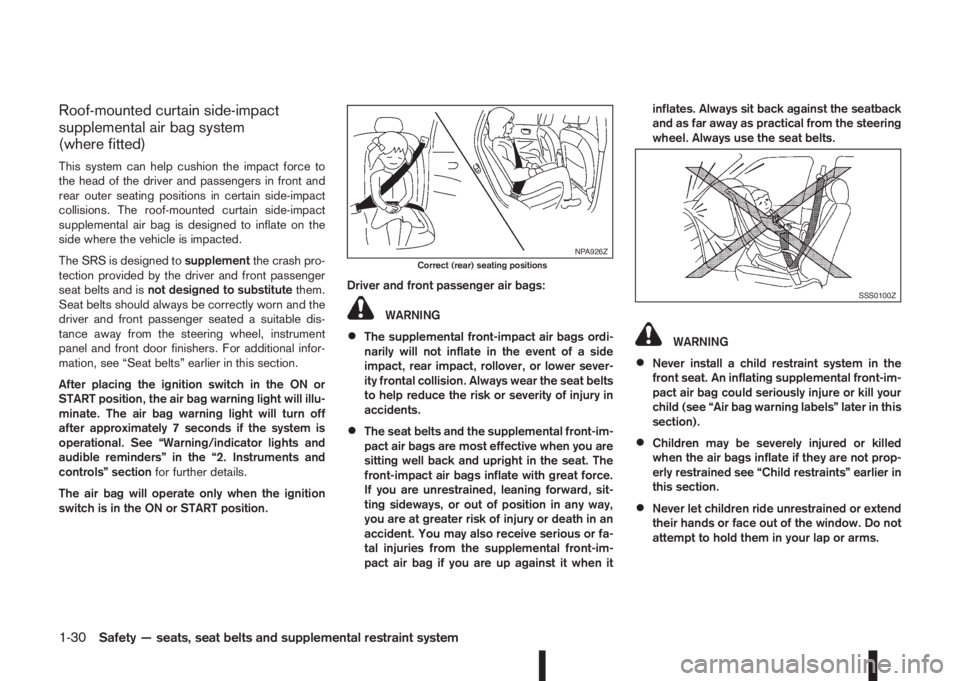
Roof-mounted curtain side-impact
supplemental air bag system
(where fitted)
This system can help cushion the impact force to
the head of the driver and passengers in front and
rear outer seating positions in certain side-impact
collisions. The roof-mounted curtain side-impact
supplemental air bag is designed to inflate on the
side where the vehicle is impacted.
The SRS is designed tosupplementthe crash pro-
tection provided by the driver and front passenger
seat belts and isnot designed to substitutethem.
Seat belts should always be correctly worn and the
driver and front passenger seated a suitable dis-
tance away from the steering wheel, instrument
panel and front door finishers. For additional infor-
mation, see “Seat belts” earlier in this section.
After placing the ignition switch in the ON or
START position, the air bag warning light will illu-
minate. The air bag warning light will turn off
after approximately 7 seconds if the system is
operational. See “Warning/indicator lights and
audible reminders” in the “2. Instruments and
controls” sectionfor further details.
The air bag will operate only when the ignition
switch is in the ON or START position.Driver and front passenger air bags:
WARNING
•The supplemental front-impact air bags ordi-
narily will not inflate in the event of a side
impact, rear impact, rollover, or lower sever-
ity frontal collision. Always wear the seat belts
to help reduce the risk or severity of injury in
accidents.
•The seat belts and the supplemental front-im-
pact air bags are most effective when you are
sitting well back and upright in the seat. The
front-impact air bags inflate with great force.
If you are unrestrained, leaning forward, sit-
ting sideways, or out of position in any way,
you are at greater risk of injury or death in an
accident. You may also receive serious or fa-
tal injuries from the supplemental front-im-
pact air bag if you are up against it when itinflates. Always sit back against the seatback
and as far away as practical from the steering
wheel. Always use the seat belts.
WARNING
•Never install a child restraint system in the
front seat. An inflating supplemental front-im-
pact air bag could seriously injure or kill your
child (see “Air bag warning labels” later in this
section).
•Children may be severely injured or killed
when the air bags inflate if they are not prop-
erly restrained see “Child restraints” earlier in
this section.
•Never let children ride unrestrained or extend
their hands or face out of the window. Do not
attempt to hold them in your lap or arms.
NPA926ZCorrect (rear) seating positions
SSS0100Z
1-30Safety — seats, seat belts and supplemental restraint system
Page 53 of 338
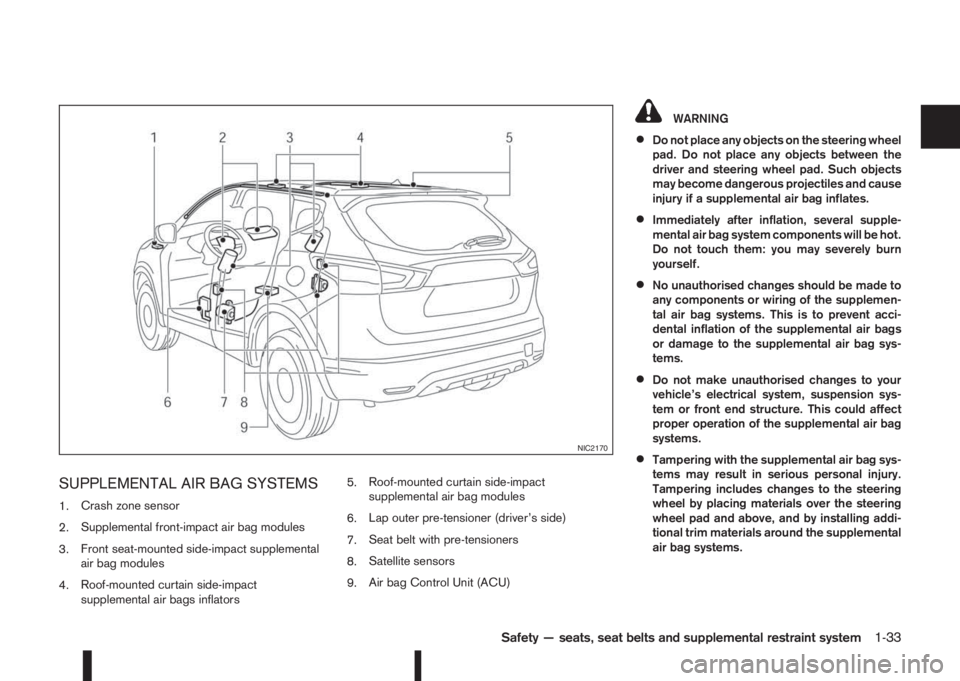
SUPPLEMENTAL AIR BAG SYSTEMS
1.Crash zone sensor
2.Supplemental front-impact air bag modules
3.Front seat-mounted side-impact supplemental
air bag modules
4.Roof-mounted curtain side-impact
supplemental air bags inflators5.Roof-mounted curtain side-impact
supplemental air bag modules
6.Lap outer pre-tensioner (driver’s side)
7.Seat belt with pre-tensioners
8.Satellite sensors
9.Air bag Control Unit (ACU)
WARNING
•Do not place any objects on the steering wheel
pad. Do not place any objects between the
driver and steering wheel pad. Such objects
may become dangerous projectiles and cause
injury if a supplemental air bag inflates.
•Immediately after inflation, several supple-
mental air bag system components will be hot.
Do not touch them: you may severely burn
yourself.
•No unauthorised changes should be made to
any components or wiring of the supplemen-
tal air bag systems. This is to prevent acci-
dental inflation of the supplemental air bags
or damage to the supplemental air bag sys-
tems.
•Do not make unauthorised changes to your
vehicle’s electrical system, suspension sys-
tem or front end structure. This could affect
proper operation of the supplemental air bag
systems.
•Tampering with the supplemental air bag sys-
tems may result in serious personal injury.
Tampering includes changes to the steering
wheel by placing materials over the steering
wheel pad and above, and by installing addi-
tional trim materials around the supplemental
air bag systems.NIC2170
Safety — seats, seat belts and supplemental restraint system1-33