lock NISSAN QASHQAI 2017 Owner´s Manual
[x] Cancel search | Manufacturer: NISSAN, Model Year: 2017, Model line: QASHQAI, Model: NISSAN QASHQAI 2017Pages: 508, PDF Size: 2.68 MB
Page 52 of 508
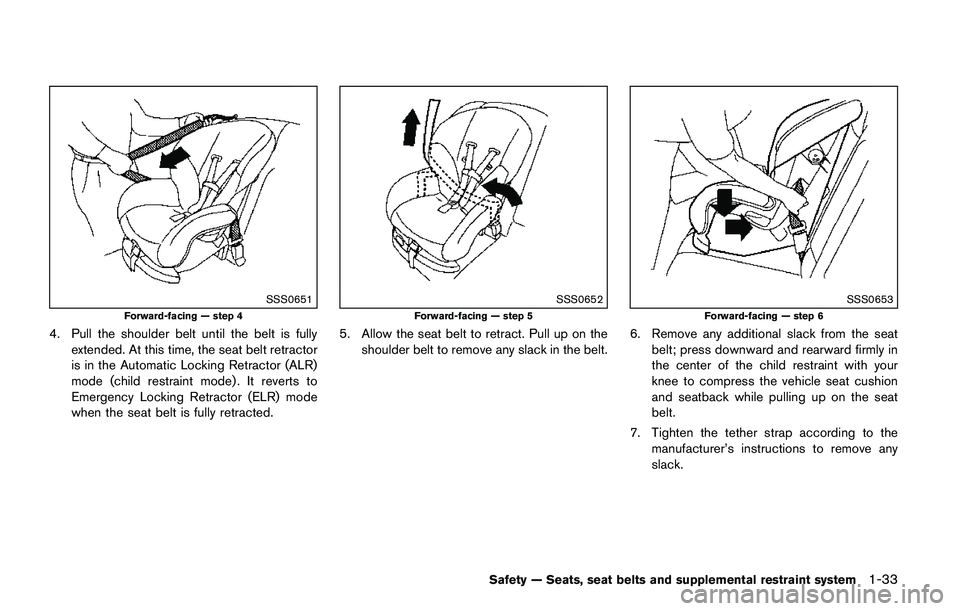
SSS0651
Forward-facing — step 4
4. Pull the shoulder belt until the belt is fully
extended. At this time, the seat belt retractor
is in the Automatic Locking Retractor (ALR)
mode (child restraint mode) . It reverts to
Emergency Locking Retractor (ELR) mode
when the seat belt is fully retracted.
SSS0652
Forward-facing — step 5
5. Allow the seat belt to retract. Pull up on the
shoulder belt to remove any slack in the belt.
SSS0653
Forward-facing — step 6
6. Remove any additional slack from the seat
belt; press downward and rearward firmly in
the center of the child restraint with your
knee to compress the vehicle seat cushion
and seatback while pulling up on the seat
belt.
7. Tighten the tether strap according to the
manufacturer’s instructions to remove any
slack.
Safety — Seats, seat belts and supplemental restraint system1-33
Page 53 of 508
1-34Safety — Seats, seat belts and supplemental restraint system
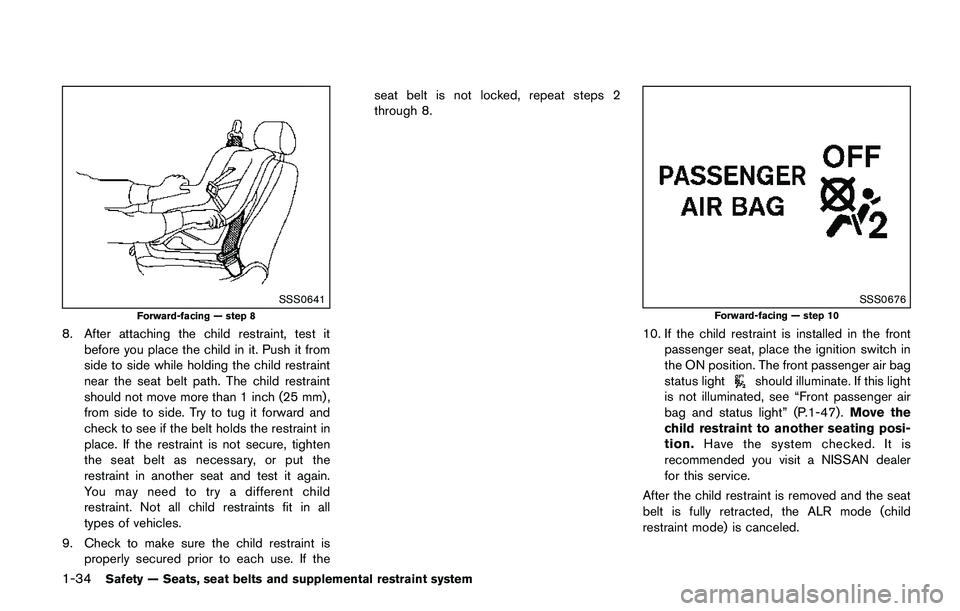
SSS0641
Forward-facing — step 8
8. After attaching the child restraint, test it
before you place the child in it. Push it from
side to side while holding the child restraint
near the seat belt path. The child restraint
should not move more than 1 inch (25 mm) ,
from side to side. Try to tug it forward and
check to see if the belt holds the restraint in
place. If the restraint is not secure, tighten
the seat belt as necessary, or put the
restraint in another seat and test it again.
You may need to try a different child
restraint. Not all child restraints fit in all
types of vehicles.
9. Check to make sure the child restraint is
properly secured prior to each use. If theseat belt is not locked, repeat steps 2
through 8.
SSS0676
Forward-facing — step 10
10. If the child restraint is installed in the front
passenger seat, place the ignition switch in
the ON position. The front passenger air bag
status light
should illuminate. If this light
is not illuminated, see “Front passenger air
bag and status light” (P.1-47) .Move the
child restraint to another seating posi-
tion.Have the system checked. It is
recommended you visit a NISSAN dealer
for this service.
After the child restraint is removed and the seat
belt is fully retracted, the ALR mode (child
restraint mode) is canceled.
Page 56 of 508
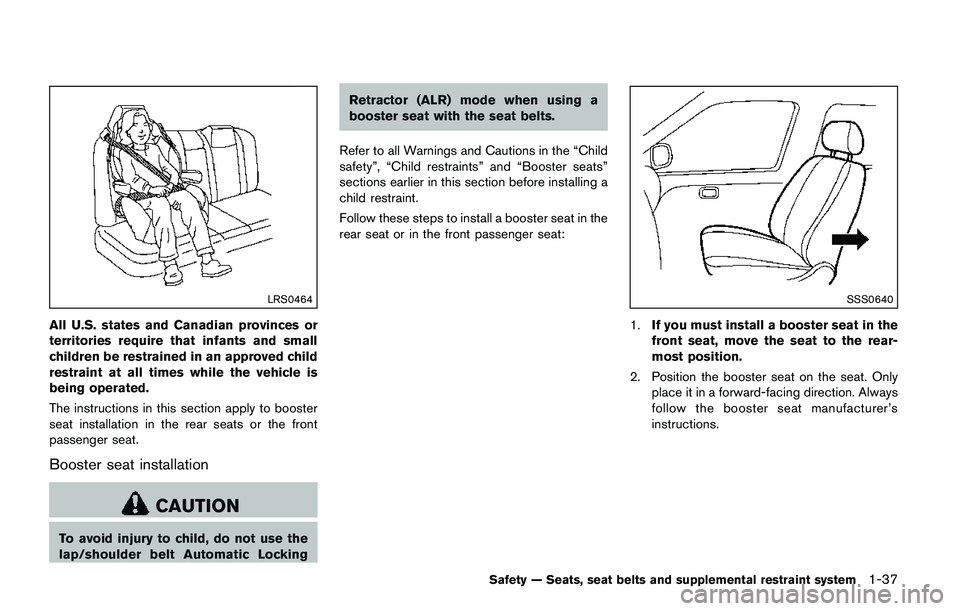
LRS0464
All U.S. states and Canadian provinces or
territories require that infants and small
children be restrained in an approved child
restraint at all times while the vehicle is
being operated.
The instructions in this section apply to booster
seat installation in the rear seats or the front
passenger seat.
Booster seat installation
CAUTION
To avoid injury to child, do not use the
lap/shoulder belt Automatic LockingRetractor (ALR) mode when using a
booster seat with the seat belts.
Refer to all Warnings and Cautions in the “Child
safety”, “Child restraints” and “Booster seats”
sections earlier in this section before installing a
child restraint.
Follow these steps to install a booster seat in the
rear seat or in the front passenger seat:
SSS0640
1.If you must install a booster seat in the
front seat, move the seat to the rear-
most position.
2. Position the booster seat on the seat. Only
place it in a forward-facing direction. Always
follow the booster seat manufacturer’s
instructions.
Safety — Seats, seat belts and supplemental restraint system1-37
Page 68 of 508
however, if the occupant does not sit in the seat
properly (for example, by not sitting upright, by
sitting on an edge of the seat, or by otherwise
being out of position) , this could cause the
sensors to turn the air bag OFF. Always be sure
to be seated and wearing the seat belt properly
for the most effective protection by the seat belt
and supplemental air bag.
NISSAN recommends that pre-teens and chil-
dren be properly restrained in a rear seat.
NISSAN also recommends that appropriate
child restraints and booster seats be properly
installed in a rear seat. If this is not possible, the
occupant classification sensors are designed to
operate as described above to turn the front
passenger air bag OFF for specified child
restraints. Failing to properly secure child
restraints and to use the Automatic Locking
Retractor (ALR) mode (child restraint mode)
may allow the restraint to tip or move in an
accident or sudden stop. This can also result in
the passenger air bag inflating in a crash instead
of being OFF. (See “Child restraints” (P.1-19)
for proper use and installation.)
If the front passenger seat is not occupied, the
passenger air bag is designed not to inflate in a
crash. However, heavy objects placed on the
seat could result in air bag inflation, because of
the object being detected by the occupant
classification sensors. Other conditions couldalso result in air bag inflation, such as if a child is
standing on the seat, or if two children are on the
seat, contrary to the instructions in this manual.
Always be sure that you and all vehicle
occupants are seated and restrained properly.
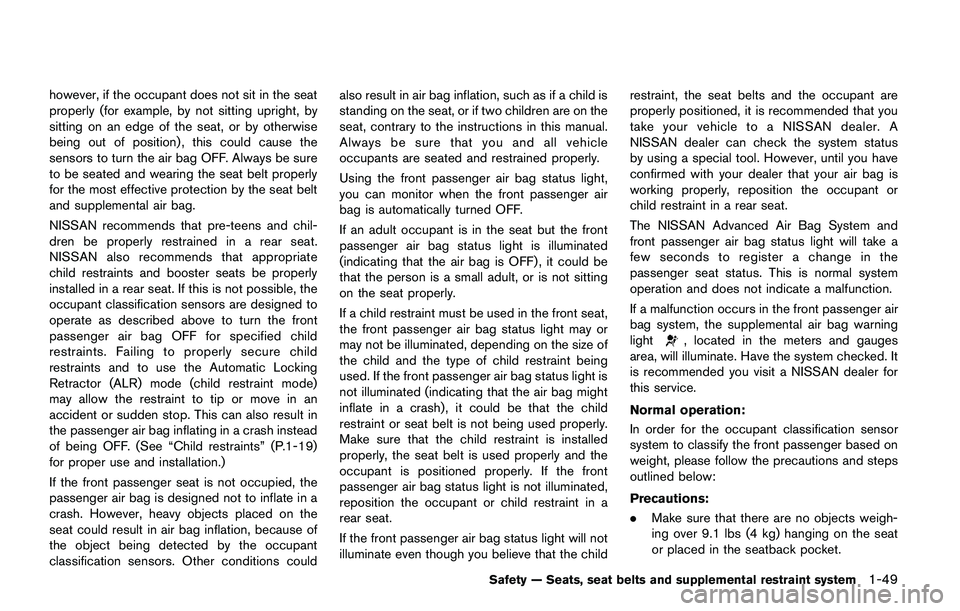
Using the front passenger air bag status light,
you can monitor when the front passenger air
bag is automatically turned OFF.
If an adult occupant is in the seat but the front
passenger air bag status light is illuminated
(indicating that the air bag is OFF) , it could be
that the person is a small adult, or is not sitting
on the seat properly.
If a child restraint must be used in the front seat,
the front passenger air bag status light may or
may not be illuminated, depending on the size of
the child and the type of child restraint being
used. If the front passenger air bag status light is
not illuminated (indicating that the air bag might
inflate in a crash) , it could be that the child
restraint or seat belt is not being used properly.
Make sure that the child restraint is installed
properly, the seat belt is used properly and the
occupant is positioned properly. If the front
passenger air bag status light is not illuminated,
reposition the occupant or child restraint in a
rear seat.
If the front passenger air bag status light will not
illuminate even though you believe that the childrestraint, the seat belts and the occupant are
properly positioned, it is recommended that you
take your vehicle to a NISSAN dealer. A
NISSAN dealer can check the system status
by using a special tool. However, until you have
confirmed with your dealer that your air bag is
working properly, reposition the occupant or
child restraint in a rear seat.
The NISSAN Advanced Air Bag System and
front passenger air bag status light will take a
few seconds to register a change in the
passenger seat status. This is normal system
operation and does not indicate a malfunction.
If a malfunction occurs in the front passenger air
bag system, the supplemental air bag warning
light
, located in the meters and gauges
area, will illuminate. Have the system checked. It
is recommended you visit a NISSAN dealer for
this service.
Normal operation:
In order for the occupant classification sensor
system to classify the front passenger based on
weight, please follow the precautions and steps
outlined below:
Precautions:
.Make sure that there are no objects weigh-
ing over 9.1 lbs (4 kg) hanging on the seat
or placed in the seatback pocket.
Safety — Seats, seat belts and supplemental restraint system1-49
Page 69 of 508
1-50Safety — Seats, seat belts and supplemental restraint system
.Make sure that a child restraint or other
object is not pressing against the rear of the
seatback.
.Make sure that a rear passenger is not
pushing or pulling on the back of the front
passenger seat.
.Make sure that the front passenger seat or
seatback is not forced back against an
object on the seat or floor behind it.
.Make sure that there is no object placed
under the front passenger seat.
.Make sure that the front passenger seat
head restraint does not contact the roof
when adjusting the front passenger seat.
Steps:
1. Adjust the seat as outlined. (See “Seats”
(P.1-2) .) Sit upright, leaning against the
seatback, and centered on the seat cushion
with your feet comfortably extended to the
floor.
2. Make sure there are no objects on your lap.
3. Fasten the seat belt as outlined. (See “Seat
belts” (P.1-10) .)
4. Remain in this position for 30 seconds
allowing the system to classify the front
passenger before the vehicle is put into
motion.5. Ensure proper classification by checking the
front passenger air bag status light.
NOTE:
This vehicle’s occupant classification sen-
sor system locks the classification during
driving so it is important that you confirm
that the front passenger is properly classi-
fied prior to driving. Also, the occupant
classification sensor system may recalcu-
late the weight of the occupant under
some conditions (both while driving and
when stopped) , so the front passenger
seat occupant should continue to remain
seated as outlined above.
Troubleshooting:
If you think the front passenger air bag status
light is incorrect:
1. If the light is ON with an adult occupying the
front passenger seat:
.Occupant is a small adult — the front
passenger air bag status light is functioning
as intended. The front passenger air bag is
suppressed.
However, if the occupant is not a small adult,
then this may be due to the following conditions
that may be interfering with the weight sensors:
.Occupant is not sitting upright, leaning
against the seatback, and centered on the
seat cushion with his/her feet comfortablyextended to the floor.
.A child restraint or other object pressing
against the rear of the seatback.
.A rear passenger pushing or pulling on the
back of the front passenger seat.
.Forcing the front seat or seatback against an
object on the seat or floor behind it.
.An object placed under the front passenger
seat.
.An object placed between the seat cushion
and center console or between the seat
cushion and the door.
If the vehicle is moving, please come to a stop
when it is safe to do so. Check and correct any
of the above conditions. Restart the vehicle and
wait 1 minute.
NOTE:
A system check will be performed during
which the front passenger air bag status
light will remain lit for about 7 seconds
initially.
If the light is still ON after this, the person should
be advised not to ride in the front passenger
seat and it is recommended that the vehicle
should be checked by a NISSAN dealer as soon
as possible.
2. If the light is OFF with a small adult, child or child
restraint occupying the front passenger seat.
Page 76 of 508
REPAIR AND REPLACEMENT PRO-
CEDURE
The front air bags, side air bags, curtain air bags
and pretensioners are designed to activate on a
one-time-only basis. As a reminder, unless it is
damaged, the supplemental air bag warning light
will remain illuminated after inflation has oc-
curred. These systems should be repaired and/
or replaced as soon as possible. It is recom-
mended you visit a NISSAN dealer for this
service.
When maintenance work is required on the
vehicle, the front air bags, side air bags, curtain
air bags and pretensioners and related parts
should be pointed out to the person performing
the maintenance. The ignition switch should
always be in the LOCK position when working
under the hood or inside the vehicle.
WARNING
.Once a front air bag, side air bag or
curtain air bag has inflated, the air
bag module will not function again
and must be replaced. Additionally,
the activated pretensioners must
also be replaced. The air bag mod-
ule and pretensioner should be
replaced. It is recommended youvisit a NISSAN dealer for this ser-
vice. However, the air bag modules
and pretensioner system cannot be
repaired.
.The front air bag, side air bag and
curtain air bag systems, and preten-
sioner system should be inspected
if there is any damage to the front
end or side portion of the vehicle. It
is recommended you visit a NISSAN
dealer for this service.
.If you need to dispose of a supple-
mental air bag or pretensioner or
scrap the vehicle, it is recommended
you visit a NISSAN dealer. Correct
supplemental air bag and preten-
sioner system disposal procedures
are set forth in the appropriate
NISSAN Service Manual. Incorrect
disposal procedures could cause
personal injury.
.If there is an impact to your vehicle
from any direction, your Occupant
Classification Sensor (OCS) should
be checked to verify it is still
functioning correctly. It is recom-
mended that you visit a NISSAN
dealer for this service. The OCS
should be checked even if no airbags deploy as a result of the
impact. Failure to verify proper
OCS function may result in an
improper air bag deployment result-
ing in injury or death.
Safety — Seats, seat belts and supplemental restraint system1-57
Page 80 of 508
2 Instruments and controls
Cockpit ........................................................................................ 2-3
Instrument panel ........................................................................ 2-4
Meters and gauges ................................................................... 2-5
Speedometer and odometer ............................................ 2-6
Tachometer ........................................................................... 2-7
Engine coolant temperature gauge ................................ 2-7
Fuel gauge ............................................................................ 2-8
Instrument brightness control .......................................... 2-9
Continuously Variable Transmission (CVT) position
indicator (if so equipped) .................................................. 2-9
Warning lights, indicator lights and
audible reminders ................................................................... 2-10
Checking lights ................................................................. 2-10
Warning lights ................................................................... 2-10
Indicator lights ................................................................... 2-16
Audible reminders ............................................................ 2-17
Vehicle information display .................................................. 2-18
How to use the vehicle information display .............. 2-19
Startup display .................................................................. 2-19
Settings ............................................................................... 2-19
Vehicle information display warnings
and indicators .................................................................... 2-28
Trip computer .................................................................... 2-34
Clock and outside air temperature .............................. 2-36Security systems ................................................................... 2-36
Vehicle Security System ............................................... 2-36
NISSAN Vehicle Immobilizer System ........................ 2-38
Wiper and washer switch ................................................... 2-39
Windshield wiper and washer operation ................. 2-40
Rear window wiper and washer switch .......................... 2-41
Rear window and outside mirror defroster switch ....... 2-42
Headlight and turn signal switch ....................................... 2-43
Headlight switch ............................................................ 2-43
Turn signal switch .......................................................... 2-48
Fog light switch (if so equipped) .............................. 2-48
Horn .......................................................................................... 2-49
Heated steering wheel (if so equipped) ......................... 2-49
Heated seats (if so equipped) ........................................... 2-50
Lane Departure Prevention (LDP) switch (if
so equipped) .......................................................................... 2-51
Blind Spot Warning (BSW) switch (if so equipped) ..... 2-51
Vehicle Dynamic Control (VDC) off switch .................... 2-52
All-wheel drive (AWD) lock switch (if so equipped) ..... 2-52
ECO mode switch ................................................................ 2-52
Power outlet ............................................................................ 2-53
Storage .................................................................................... 2-54
Cup holders ..................................................................... 2-54
Soft bottle holders ......................................................... 2-54
Cargo area (if so equipped) ....................................... 2-55
Page 82 of 508
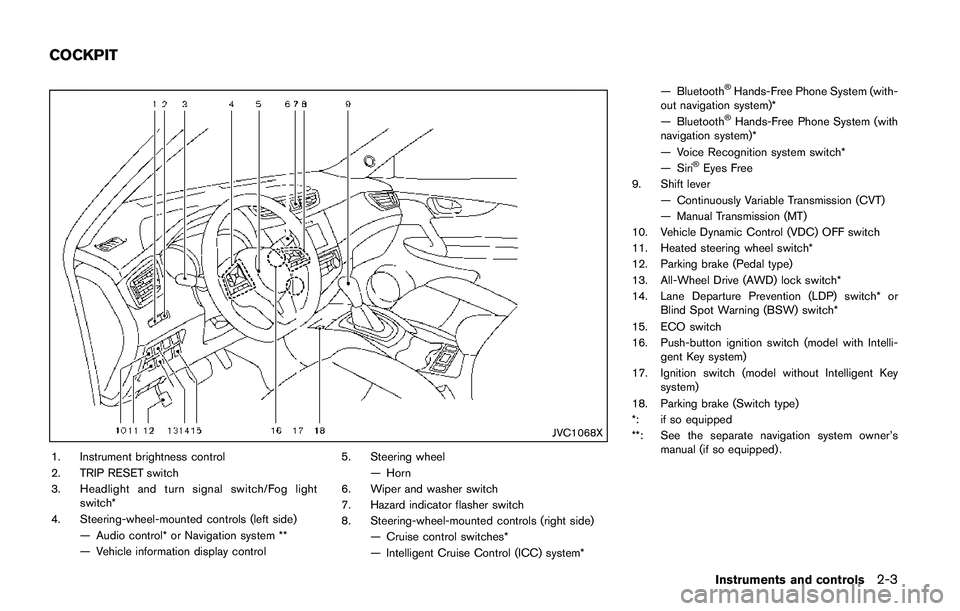
JVC1068X
1. Instrument brightness control
2. TRIP RESET switch
3. Headlight and turn signal switch/Fog light
switch*
4. Steering-wheel-mounted controls (left side)
— Audio control* or Navigation system **
— Vehicle information display control5. Steering wheel
— Horn
6. Wiper and washer switch
7. Hazard indicator flasher switch
8. Steering-wheel-mounted controls (right side)
— Cruise control switches*
— Intelligent Cruise Control (ICC) system*— Bluetooth
ŠHands-Free Phone System (with-
out navigation system)*
— Bluetooth
ŠHands-Free Phone System (with
navigation system)*
— Voice Recognition system switch*
— Siri
ŠEyes Free
9. Shift lever
— Continuously Variable Transmission (CVT)
— Manual Transmission (MT)
10. Vehicle Dynamic Control (VDC) OFF switch
11. Heated steering wheel switch*
12. Parking brake (Pedal type)
13. All-Wheel Drive (AWD) lock switch*
14. Lane Departure Prevention (LDP) switch* or
Blind Spot Warning (BSW) switch*
15. ECO switch
16. Push-button ignition switch (model with Intelli-
gent Key system)
17. Ignition switch (model without Intelligent Key
system)
18. Parking brake (Switch type)
*: if so equipped
**: See the separate navigation system owner’s
manual (if so equipped) .
Instruments and controls2-3
COCKPIT
Page 83 of 508
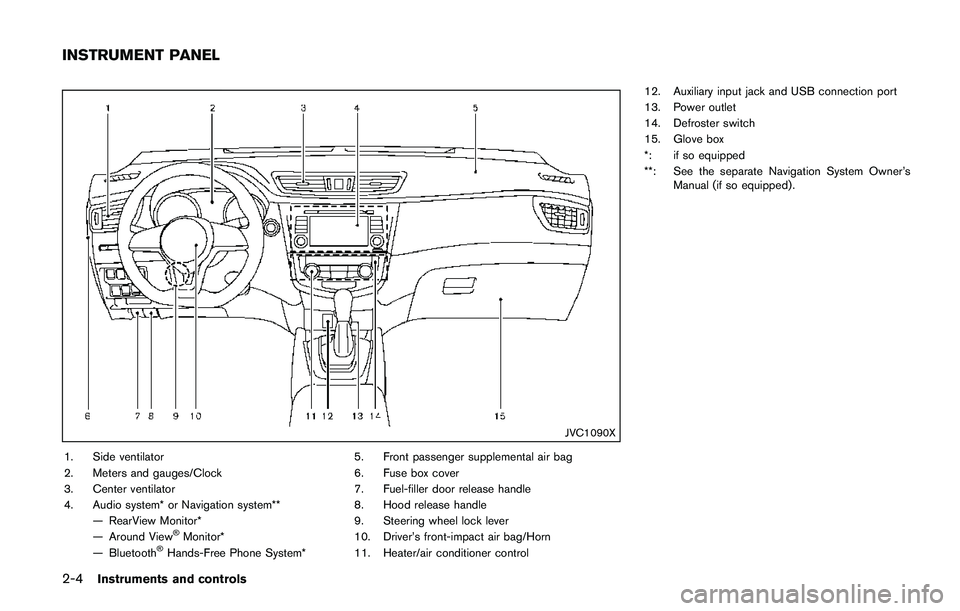
2-4Instruments and controls
JVC1090X
1. Side ventilator
2. Meters and gauges/Clock
3. Center ventilator
4. Audio system* or Navigation system**
— RearView Monitor*
— Around View
ŠMonitor*
— BluetoothŠHands-Free Phone System*5. Front passenger supplemental air bag
6. Fuse box cover
7. Fuel-filler door release handle
8. Hood release handle
9. Steering wheel lock lever
10. Driver’s front-impact air bag/Horn
11. Heater/air conditioner control12. Auxiliary input jack and USB connection port
13. Power outlet
14. Defroster switch
15. Glove box
*: if so equipped
**: See the separate Navigation System Owner’s
Manual (if so equipped) .
INSTRUMENT PANEL
Page 84 of 508
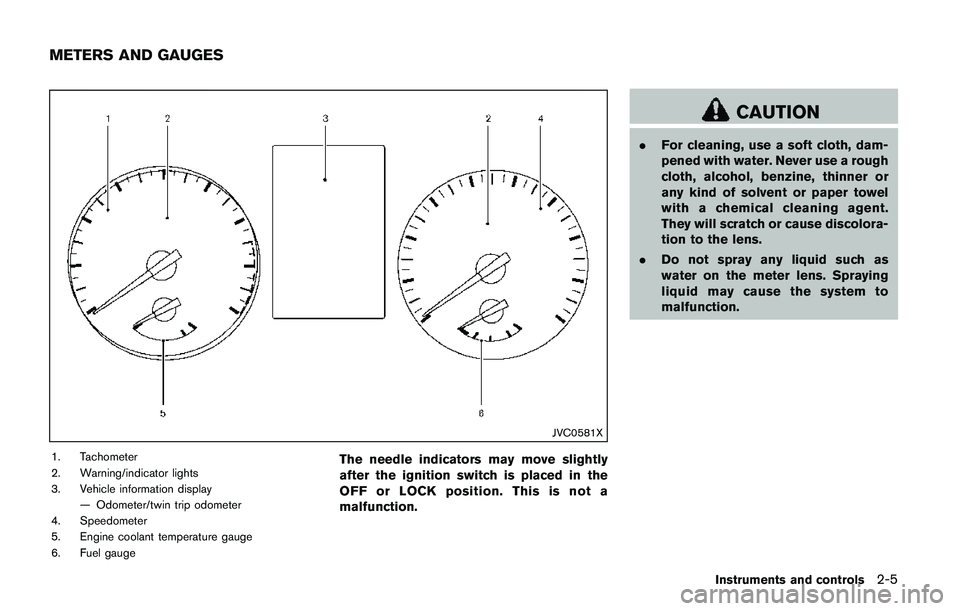
JVC0581X
1. Tachometer
2. Warning/indicator lights
3. Vehicle information display
— Odometer/twin trip odometer
4. Speedometer
5. Engine coolant temperature gauge
6. Fuel gaugeThe needle indicators may move slightly
after the ignition switch is placed in the
OFF or LOCK position. This is not a
malfunction.
CAUTION
.For cleaning, use a soft cloth, dam-
pened with water. Never use a rough
cloth, alcohol, benzine, thinner or
any kind of solvent or paper towel
with a chemical cleaning agent.
They will scratch or cause discolora-
tion to the lens.
.Do not spray any liquid such as
water on the meter lens. Spraying
liquid may cause the system to
malfunction.
Instruments and controls2-5
METERS AND GAUGES