belt NISSAN QASHQAI 2017 Owner´s Manual
[x] Cancel search | Manufacturer: NISSAN, Model Year: 2017, Model line: QASHQAI, Model: NISSAN QASHQAI 2017Pages: 508, PDF Size: 2.68 MB
Page 44 of 508
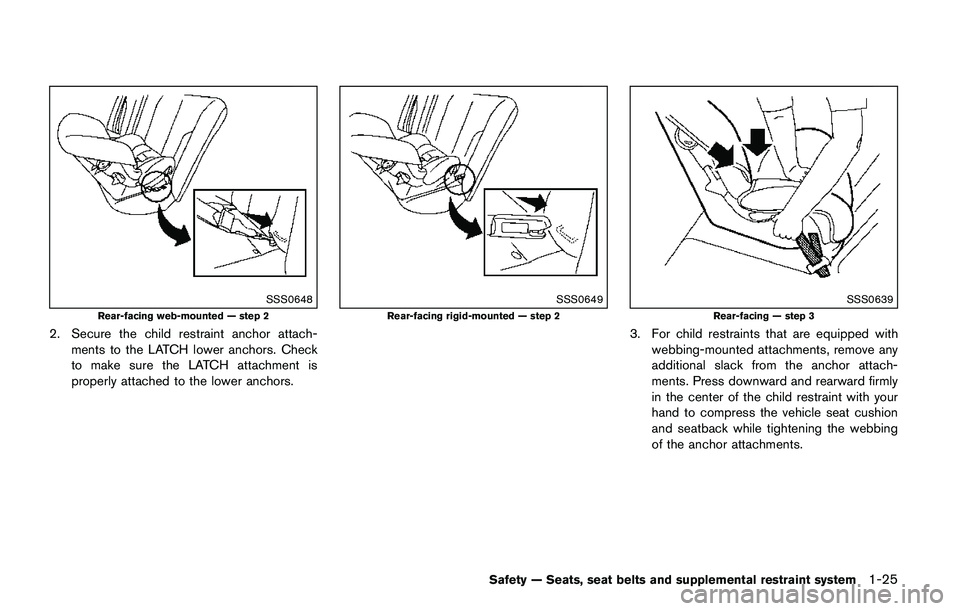
SSS0648
Rear-facing web-mounted — step 2
2. Secure the child restraint anchor attach-
ments to the LATCH lower anchors. Check
to make sure the LATCH attachment is
properly attached to the lower anchors.
SSS0649
Rear-facing rigid-mounted — step 2
SSS0639
Rear-facing — step 3
3. For child restraints that are equipped with
webbing-mounted attachments, remove any
additional slack from the anchor attach-
ments. Press downward and rearward firmly
in the center of the child restraint with your
hand to compress the vehicle seat cushion
and seatback while tightening the webbing
of the anchor attachments.
Safety — Seats, seat belts and supplemental restraint system1-25
Page 45 of 508
1-26Safety — Seats, seat belts and supplemental restraint system
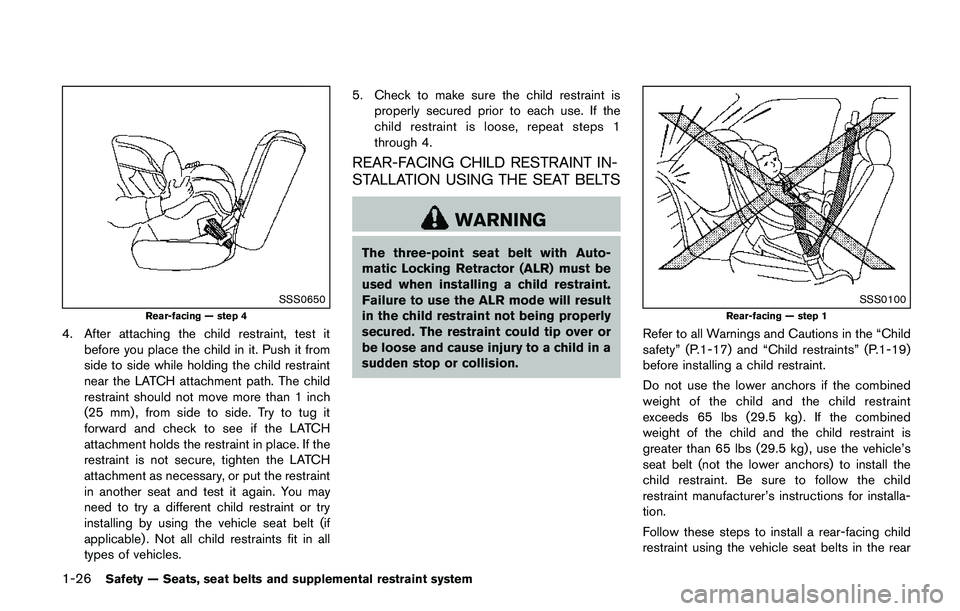
SSS0650
Rear-facing — step 4
4. After attaching the child restraint, test it
before you place the child in it. Push it from
side to side while holding the child restraint
near the LATCH attachment path. The child
restraint should not move more than 1 inch
(25 mm) , from side to side. Try to tug it
forward and check to see if the LATCH
attachment holds the restraint in place. If the
restraint is not secure, tighten the LATCH
attachment as necessary, or put the restraint
in another seat and test it again. You may
need to try a different child restraint or try
installing by using the vehicle seat belt (if
applicable) . Not all child restraints fit in all
types of vehicles.5. Check to make sure the child restraint is
properly secured prior to each use. If the
child restraint is loose, repeat steps 1
through 4.
REAR-FACING CHILD RESTRAINT IN-
STALLATION USING THE SEAT BELTS
WARNING
The three-point seat belt with Auto-
matic Locking Retractor (ALR) must be
used when installing a child restraint.
Failure to use the ALR mode will result
in the child restraint not being properly
secured. The restraint could tip over or
be loose and cause injury to a child in a
sudden stop or collision.
SSS0100
Rear-facing — step 1
Refer to all Warnings and Cautions in the “Child
safety” (P.1-17) and “Child restraints” (P.1-19)
before installing a child restraint.
Do not use the lower anchors if the combined
weight of the child and the child restraint
exceeds 65 lbs (29.5 kg) . If the combined
weight of the child and the child restraint is
greater than 65 lbs (29.5 kg) , use the vehicle’s
seat belt (not the lower anchors) to install the
child restraint. Be sure to follow the child
restraint manufacturer’s instructions for installa-
tion.
Follow these steps to install a rear-facing child
restraint using the vehicle seat belts in the rear
Page 46 of 508
seats:
1.Child restraints for infants must be
used in the rear-facing direction and
therefore must not be used in the front
seat.Position the child restraint on the seat.
Always follow the restraint manufacturer’s
instructions.
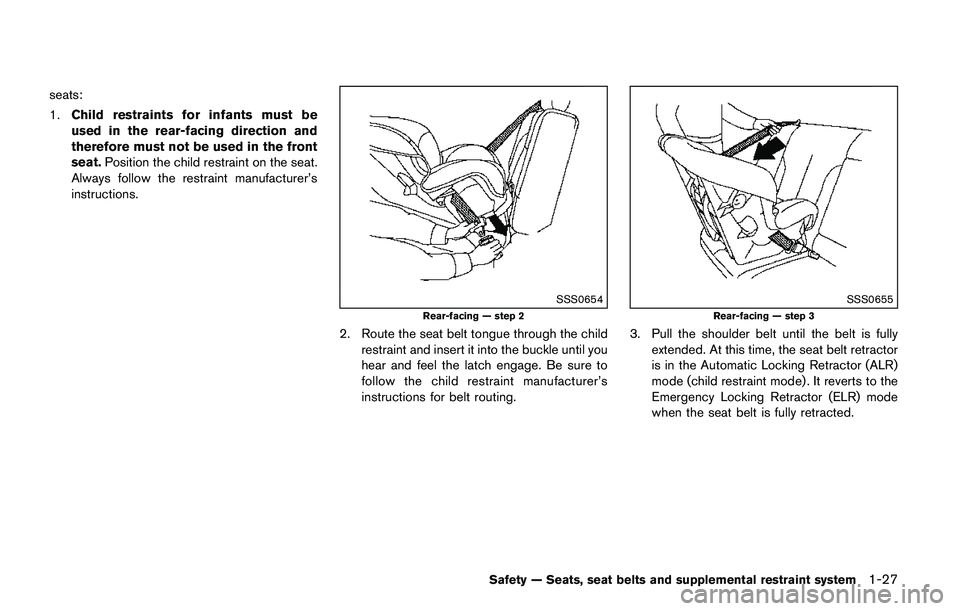
SSS0654
Rear-facing — step 2
2. Route the seat belt tongue through the child
restraint and insert it into the buckle until you
hear and feel the latch engage. Be sure to
follow the child restraint manufacturer’s
instructions for belt routing.
SSS0655
Rear-facing — step 3
3. Pull the shoulder belt until the belt is fully
extended. At this time, the seat belt retractor
is in the Automatic Locking Retractor (ALR)
mode (child restraint mode) . It reverts to the
Emergency Locking Retractor (ELR) mode
when the seat belt is fully retracted.
Safety — Seats, seat belts and supplemental restraint system1-27
Page 47 of 508
1-28Safety — Seats, seat belts and supplemental restraint system
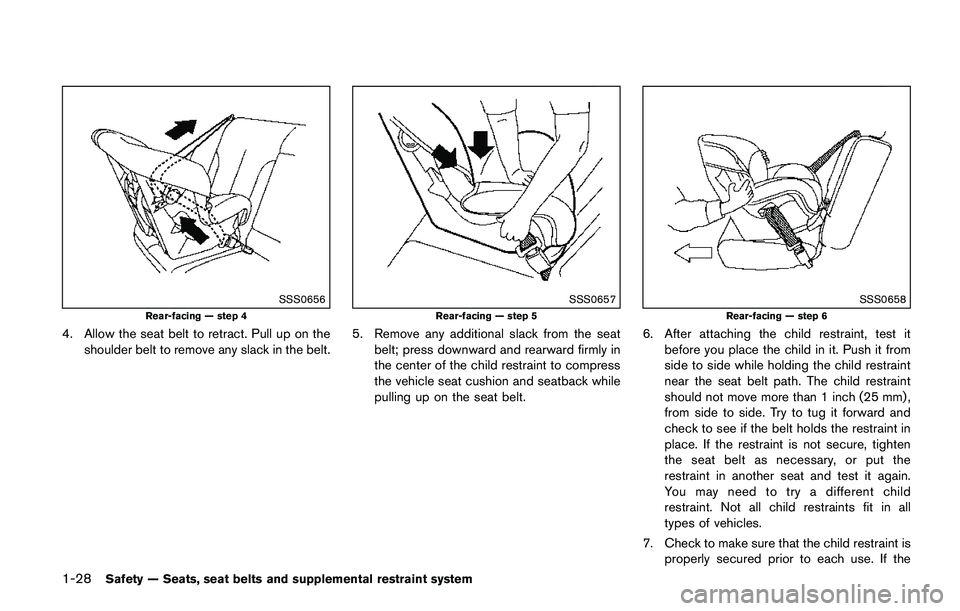
SSS0656
Rear-facing — step 4
4. Allow the seat belt to retract. Pull up on the
shoulder belt to remove any slack in the belt.
SSS0657
Rear-facing — step 5
5. Remove any additional slack from the seat
belt; press downward and rearward firmly in
the center of the child restraint to compress
the vehicle seat cushion and seatback while
pulling up on the seat belt.
SSS0658
Rear-facing — step 6
6. After attaching the child restraint, test it
before you place the child in it. Push it from
side to side while holding the child restraint
near the seat belt path. The child restraint
should not move more than 1 inch (25 mm) ,
from side to side. Try to tug it forward and
check to see if the belt holds the restraint in
place. If the restraint is not secure, tighten
the seat belt as necessary, or put the
restraint in another seat and test it again.
You may need to try a different child
restraint. Not all child restraints fit in all
types of vehicles.
7. Check to make sure that the child restraint is
properly secured prior to each use. If the
Page 48 of 508
seat belt is not locked, repeat steps 1
through 6.
After the child restraint is removed and the seat
belt fully retracted, the ALR mode (child restraint
mode) is canceled.
FORWARD-FACING CHILD RE-
STRAINT INSTALLATION USING
LATCH
Refer to all Warnings and Cautions in the “Child
safety” and “Child restraints” sections before
installing a child restraint.
Do not use the lower anchors if the combined
weight of the child and the child restraint
exceeds 65 lbs (29.5 kg) . If the combined
weight of the child and the child restraint is
greater than 65 lbs (29.5 kg) , use the vehicle’s
seat belt (not the lower anchors) to install the
child restraint. Be sure to follow the child
restraint manufacturer’s instructions for installa-
tion.
Follow these steps to install a forward-facing
child restraint using the LATCH system:
1. Position the child restraint on the seat.
Always follow the child restraint manufac-
turer’s instructions.
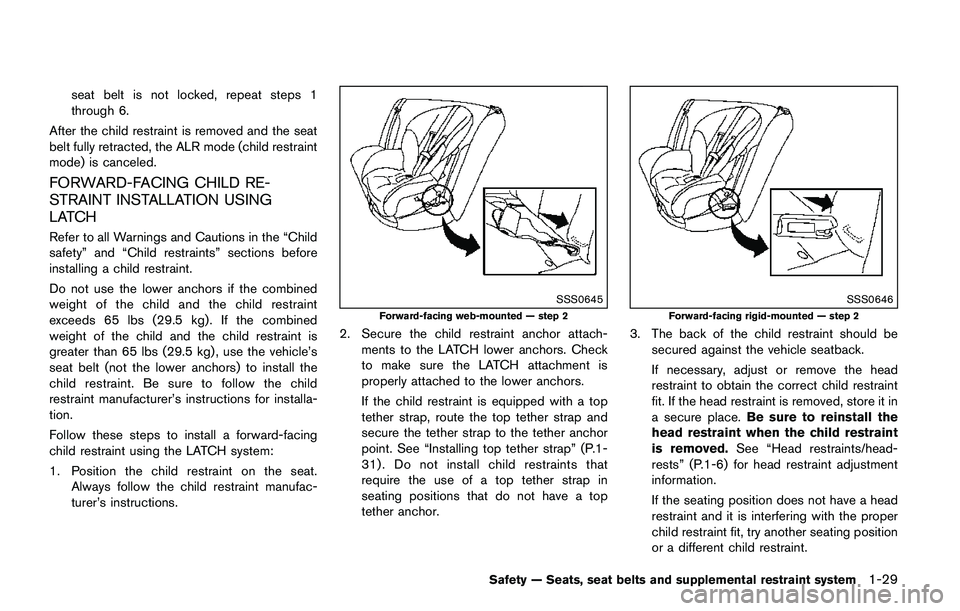
SSS0645
Forward-facing web-mounted — step 2
2. Secure the child restraint anchor attach-
ments to the LATCH lower anchors. Check
to make sure the LATCH attachment is
properly attached to the lower anchors.
If the child restraint is equipped with a top
tether strap, route the top tether strap and
secure the tether strap to the tether anchor
point. See “Installing top tether strap” (P.1-
31) . Do not install child restraints that
require the use of a top tether strap in
seating positions that do not have a top
tether anchor.
SSS0646
Forward-facing rigid-mounted — step 2
3. The back of the child restraint should be
secured against the vehicle seatback.
If necessary, adjust or remove the head
restraint to obtain the correct child restraint
fit. If the head restraint is removed, store it in
a secure place.Be sure to reinstall the
head restraint when the child restraint
is removed.See “Head restraints/head-
rests” (P.1-6) for head restraint adjustment
information.
If the seating position does not have a head
restraint and it is interfering with the proper
child restraint fit, try another seating position
or a different child restraint.
Safety — Seats, seat belts and supplemental restraint system1-29
Page 49 of 508
1-30Safety — Seats, seat belts and supplemental restraint system
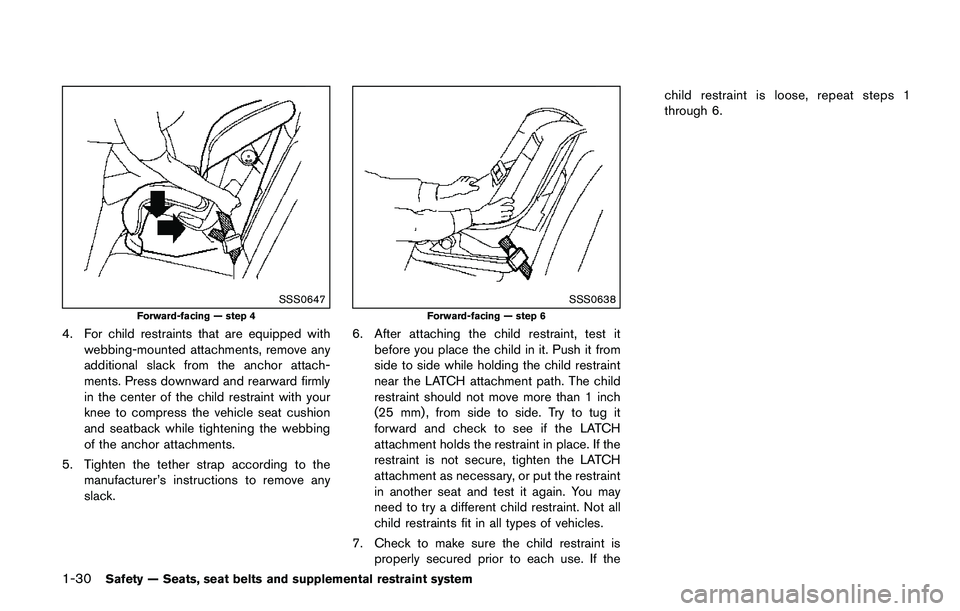
SSS0647
Forward-facing — step 4
4. For child restraints that are equipped with
webbing-mounted attachments, remove any
additional slack from the anchor attach-
ments. Press downward and rearward firmly
in the center of the child restraint with your
knee to compress the vehicle seat cushion
and seatback while tightening the webbing
of the anchor attachments.
5. Tighten the tether strap according to the
manufacturer’s instructions to remove any
slack.
SSS0638
Forward-facing — step 6
6. After attaching the child restraint, test it
before you place the child in it. Push it from
side to side while holding the child restraint
near the LATCH attachment path. The child
restraint should not move more than 1 inch
(25 mm) , from side to side. Try to tug it
forward and check to see if the LATCH
attachment holds the restraint in place. If the
restraint is not secure, tighten the LATCH
attachment as necessary, or put the restraint
in another seat and test it again. You may
need to try a different child restraint. Not all
child restraints fit in all types of vehicles.
7. Check to make sure the child restraint is
properly secured prior to each use. If thechild restraint is loose, repeat steps 1
through 6.
Page 50 of 508
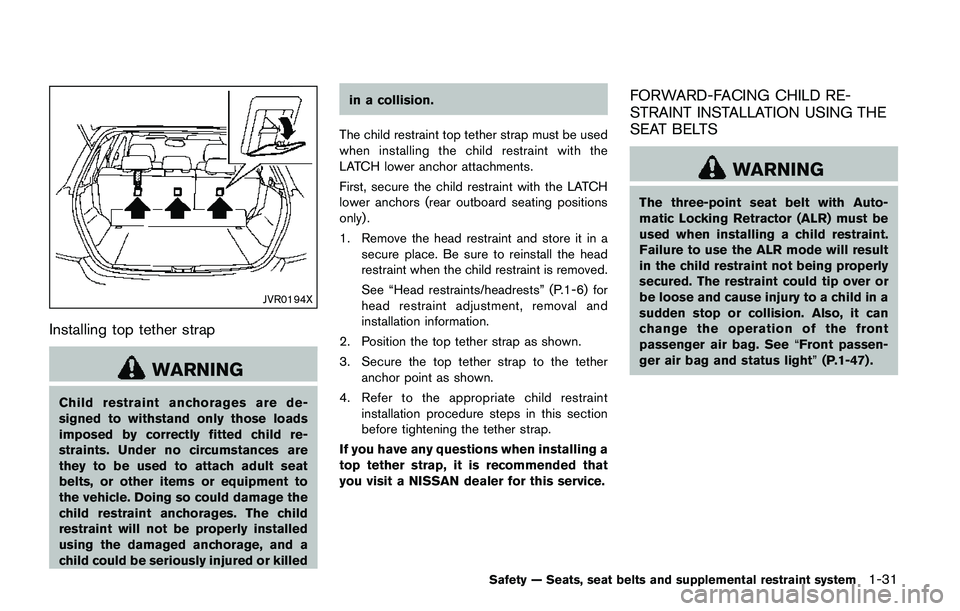
JVR0194X
Installing top tether strap
WARNING
Child restraint anchorages are de-
signed to withstand only those loads
imposed by correctly fitted child re-
straints. Under no circumstances are
they to be used to attach adult seat
belts, or other items or equipment to
the vehicle. Doing so could damage the
child restraint anchorages. The child
restraint will not be properly installed
using the damaged anchorage, and a
child could be seriously injured or killedin a collision.
The child restraint top tether strap must be used
when installing the child restraint with the
LATCH lower anchor attachments.
First, secure the child restraint with the LATCH
lower anchors (rear outboard seating positions
only) .
1. Remove the head restraint and store it in a
secure place. Be sure to reinstall the head
restraint when the child restraint is removed.
See “Head restraints/headrests” (P.1-6) for
head restraint adjustment, removal and
installation information.
2. Position the top tether strap as shown.
3. Secure the top tether strap to the tether
anchor point as shown.
4. Refer to the appropriate child restraint
installation procedure steps in this section
before tightening the tether strap.
If you have any questions when installing a
top tether strap, it is recommended that
you visit a NISSAN dealer for this service.
FORWARD-FACING CHILD RE-
STRAINT INSTALLATION USING THE
SEAT BELTS
WARNING
The three-point seat belt with Auto-
matic Locking Retractor (ALR) must be
used when installing a child restraint.
Failure to use the ALR mode will result
in the child restraint not being properly
secured. The restraint could tip over or
be loose and cause injury to a child in a
sudden stop or collision. Also, it can
change the operation of the front
passenger air bag. See“Front passen-
ger air bag and status light”(P.1-47) .
Safety — Seats, seat belts and supplemental restraint system1-31
Page 51 of 508
1-32Safety — Seats, seat belts and supplemental restraint system
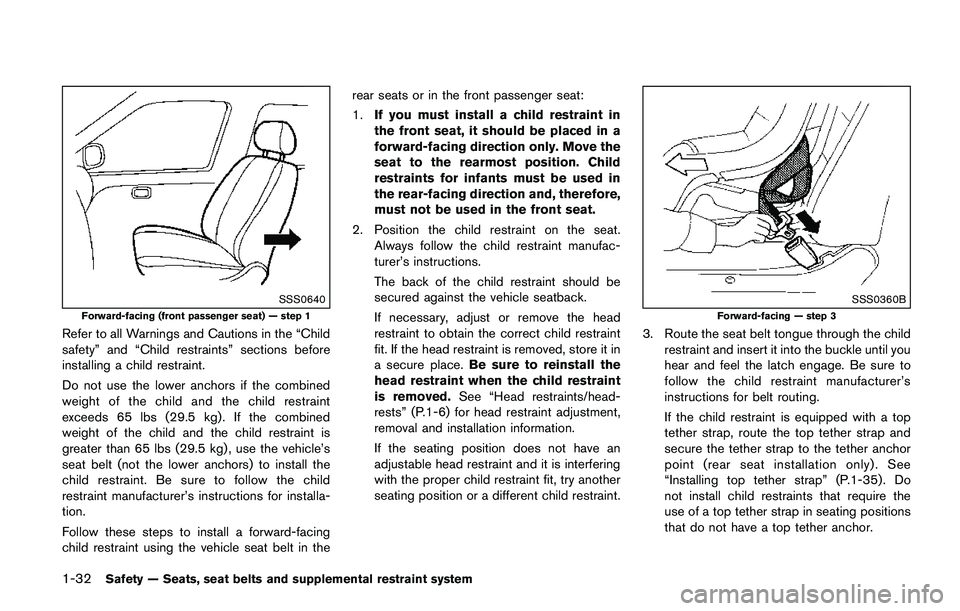
SSS0640
Forward-facing (front passenger seat) — step 1
Refer to all Warnings and Cautions in the “Child
safety” and “Child restraints” sections before
installing a child restraint.
Do not use the lower anchors if the combined
weight of the child and the child restraint
exceeds 65 lbs (29.5 kg) . If the combined
weight of the child and the child restraint is
greater than 65 lbs (29.5 kg) , use the vehicle’s
seat belt (not the lower anchors) to install the
child restraint. Be sure to follow the child
restraint manufacturer’s instructions for installa-
tion.
Follow these steps to install a forward-facing
child restraint using the vehicle seat belt in therear seats or in the front passenger seat:
1.If you must install a child restraint in
the front seat, it should be placed in a
forward-facing direction only. Move the
seat to the rearmost position. Child
restraints for infants must be used in
the rear-facing direction and, therefore,
must not be used in the front seat.
2. Position the child restraint on the seat.
Always follow the child restraint manufac-
turer’s instructions.
The back of the child restraint should be
secured against the vehicle seatback.
If necessary, adjust or remove the head
restraint to obtain the correct child restraint
fit. If the head restraint is removed, store it in
a secure place.Be sure to reinstall the
head restraint when the child restraint
is removed.See “Head restraints/head-
rests” (P.1-6) for head restraint adjustment,
removal and installation information.
If the seating position does not have an
adjustable head restraint and it is interfering
with the proper child restraint fit, try another
seating position or a different child restraint.
SSS0360B
Forward-facing — step 3
3. Route the seat belt tongue through the child
restraint and insert it into the buckle until you
hear and feel the latch engage. Be sure to
follow the child restraint manufacturer’s
instructions for belt routing.
If the child restraint is equipped with a top
tether strap, route the top tether strap and
secure the tether strap to the tether anchor
point (rear seat installation only) . See
“Installing top tether strap” (P.1-35) . Do
not install child restraints that require the
use of a top tether strap in seating positions
that do not have a top tether anchor.
Page 52 of 508
SSS0651
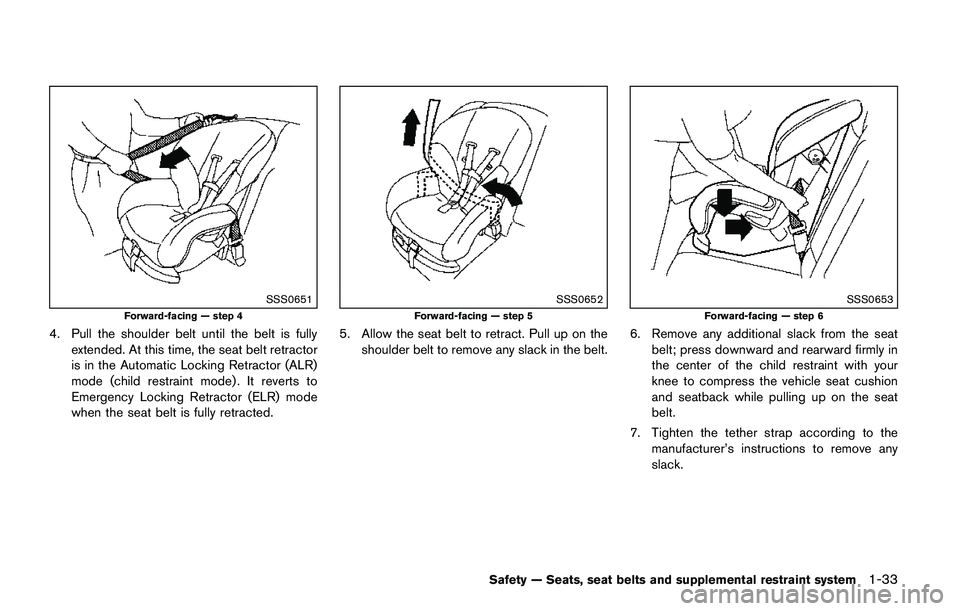
Forward-facing — step 4
4. Pull the shoulder belt until the belt is fully
extended. At this time, the seat belt retractor
is in the Automatic Locking Retractor (ALR)
mode (child restraint mode) . It reverts to
Emergency Locking Retractor (ELR) mode
when the seat belt is fully retracted.
SSS0652
Forward-facing — step 5
5. Allow the seat belt to retract. Pull up on the
shoulder belt to remove any slack in the belt.
SSS0653
Forward-facing — step 6
6. Remove any additional slack from the seat
belt; press downward and rearward firmly in
the center of the child restraint with your
knee to compress the vehicle seat cushion
and seatback while pulling up on the seat
belt.
7. Tighten the tether strap according to the
manufacturer’s instructions to remove any
slack.
Safety — Seats, seat belts and supplemental restraint system1-33
Page 53 of 508
1-34Safety — Seats, seat belts and supplemental restraint system
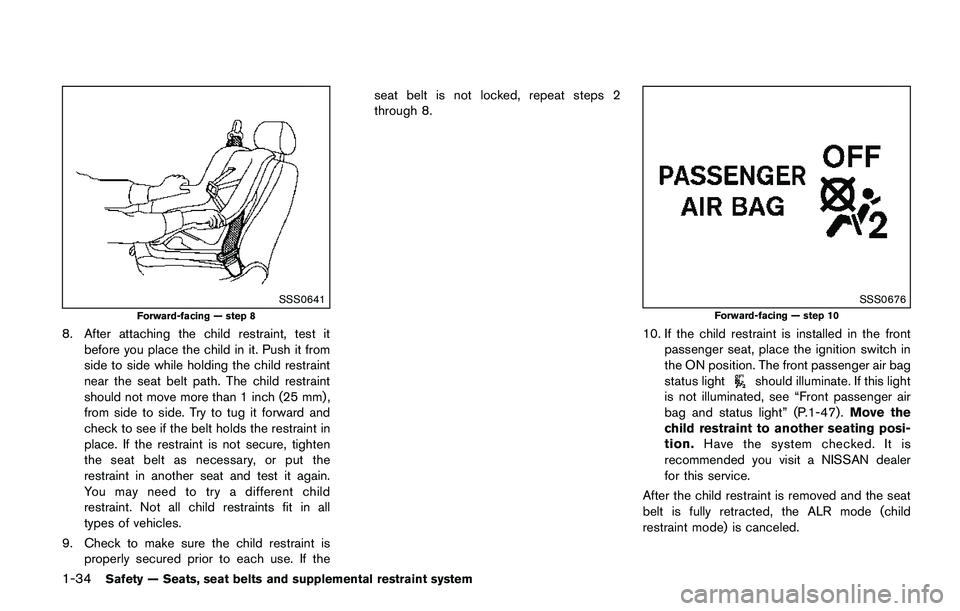
SSS0641
Forward-facing — step 8
8. After attaching the child restraint, test it
before you place the child in it. Push it from
side to side while holding the child restraint
near the seat belt path. The child restraint
should not move more than 1 inch (25 mm) ,
from side to side. Try to tug it forward and
check to see if the belt holds the restraint in
place. If the restraint is not secure, tighten
the seat belt as necessary, or put the
restraint in another seat and test it again.
You may need to try a different child
restraint. Not all child restraints fit in all
types of vehicles.
9. Check to make sure the child restraint is
properly secured prior to each use. If theseat belt is not locked, repeat steps 2
through 8.
SSS0676
Forward-facing — step 10
10. If the child restraint is installed in the front
passenger seat, place the ignition switch in
the ON position. The front passenger air bag
status light
should illuminate. If this light
is not illuminated, see “Front passenger air
bag and status light” (P.1-47) .Move the
child restraint to another seating posi-
tion.Have the system checked. It is
recommended you visit a NISSAN dealer
for this service.
After the child restraint is removed and the seat
belt is fully retracted, the ALR mode (child
restraint mode) is canceled.