ECU NISSAN QASHQAI 2017 Owner´s Manual
[x] Cancel search | Manufacturer: NISSAN, Model Year: 2017, Model line: QASHQAI, Model: NISSAN QASHQAI 2017Pages: 508, PDF Size: 2.68 MB
Page 459 of 508
8-36Do-it-yourself
Warranty Information Booklet.
.Always use tires of the same type,
size, brand, construction and tread
pattern on all four wheels. Failure to
do so may result in a circumference
difference between tires on the
front and rear axles which can cause
the Vehicle Dynamic Control (VDC)
system to malfunction resulting in
personal injury or death, excessive
tire wear and may damage the
transmission, transfer case and dif-
ferential gears.
All season tires
NISSAN specifies all season tires on some
models to provide good performance all year,
including snowy and icy road conditions. All
Season tires are identified by ALL SEASON
and/or M&S (Mud and Snow) on the tire
sidewall. Snow tires have better snow traction
than All Season tires and may be more appro-
priate in some areas.
Summer tires
NISSAN specifies summer tires on some
models to provide superior performance on dry
roads. Summer tire performance is substantially
reduced in snow and ice. Summer tires do not
have the tire traction rating M&S on the tire
sidewall.
If you plan to operate your vehicle in snowy or
icy conditions, NISSAN recommends the use of
SNOW tires or ALL SEASON tires on all four
wheels.
Snow tires
If snow tires are needed, it is necessary to select
tires equivalent in size and load rating to the
original equipment tires. If you do not, it can
adversely affect the safety and handling of your
vehicle.
Generally, snow tires will have lower speed
ratings than factory equipped tires and may not
match the potential maximum vehicle speed.
Never exceed the maximum speed rating of the
tire.
If you install snow tires, they must be the same
size, brand, construction and tread pattern on all
four wheels.
For additional traction on icy roads, studded
tires may be used. However, some U.S. states
and Canadian provinces prohibit their use.Check local, state and provincial laws before
installing studded tires. Skid and traction cap-
abilities of studded snow tires, on wet or dry
surfaces, may be poorer than that of non-
studded snow tires.
TIRE CHAINS
Use of tire chains may be prohibited according
to location. Check the local laws before instal-
ling tire chains. When installing tire chains, make
sure they are the proper size for the tires on your
vehicle and are installed according to the chain
manufacturer’s suggestions.Use only SAE
Class S chains.Class “S” chains are used on
vehicles with restricted tire to vehicle clearance.
Vehicles that can use Class “S” chains are
designed to meet the SAE standard minimum
clearances between the tire and the closest
vehicle suspension or body component required
to accommodate the use of a winter traction
device (tire chains or cables) . The minimum
clearances are determined using the factory
equipped tire size. Other types may damage
your vehicle. Use chain tensioners when re-
commended by the tire chain manufacturer to
ensure a tight fit. Loose end links of the tire
chain must be secured or removed to prevent
the possibility of whipping action damage to the
fenders or underbody. If possible, avoid fully
loading your vehicle when using tire chains. In
addition, drive at a reduced speed. Otherwise,
Page 465 of 508
9-2Maintenance and schedules
Some day-to-day and regular maintenance is
essential to maintain your vehicle good mechan-
ical condition, as well as its emission and engine
performance.
It is the owner’s responsibility to make sure that
the scheduled maintenance, as well as general
maintenance, is performed.
As the vehicle owner, you are the only one who
can ensure that your vehicle receives the proper
maintenance care. You are a vital link in the
maintenance chain.
GENERAL MAINTENANCE
General maintenance includes those items
which should be checked during normal day-
to-day operation. They are essential for proper
vehicle operation. It is your responsibility to
perform these procedures regularly as pre-
scribed.
Performing general maintenance checks re-
quires minimal mechanical skill and only a few
general automotive tools.
These checks or inspections can be done by
yourself, a qualified technician or, if you prefer, a
NISSAN dealer.
SCHEDULED MAINTENANCE
The maintenance items listed in this section are
required to be serviced at regular intervals.
However, under severe driving conditions, addi-
tional or more frequent maintenance will be
required.
WHERE TO GO FOR SERVICE
If maintenance service is required or your vehicle
appears to malfunction, have the systems
checked and serviced. It is recommended you
visit a NISSAN dealer for this service.
NISSAN technicians are well-trained specialists
and are kept up-to-date with the latest service
information through technical bulletins, service
tips, and training programs. They are completely
qualified to work on NISSAN vehiclesbefore
work begins.
You can be confident that a NISSAN dealer’s
service department performs the best job to
meet the maintenance requirements on your
vehicle.During the normal day-to-day operation of the
vehicle, general maintenance should be per-
formed regularly as prescribed in this section. If
you detect any unusual sounds, vibrations or
smells, be sure to check for the cause or have a
NISSAN dealer do it promptly. In addition, it is
recommended that you visit a NISSAN dealer if
you think that repairs are required.
When performing any checks or maintenance
work, see “Maintenance precautions” (P.8-2) .
EXPLANATION OF GENERAL MAIN-
TENANCE ITEMS
Additional information on the following
items with “*” is found in the “8. Do-it
yourself” section of this manual.
Outside the vehicle
The maintenance items listed here should be
performed from time to time, unless otherwise
specified.
Doors and engine hood:Check that all doors
and the engine hood operate properly. Also
ensure that all latches lock securely. Lubricate
hinges, latches, latch pins, rollers and links if
necessary. Make sure that the secondary latch
keeps the hood from opening when the primary
latch is released.
When driving in areas using road salt or other
corrosive materials, check lubrication frequently.
MAINTENANCE REQUIREMENT GENERAL MAINTENANCE
Page 466 of 508
Lights*:Clean the headlights on a regular basis.
Make sure that the headlights, stop lights, tail
lights, turn signal lights, and other lights are all
operating properly and installed securely. Also
check headlight aim.
Road wheel nuts (lug nuts)*:When checking
the tires, make sure no wheel nuts are missing,
and check for any loose wheel nuts. Tighten if
necessary.
Tire rotation*:Tires should be rotated every
5,000 miles (8,000 km) .
Tires*:Check the pressure with a gauge often
and always prior to long distance trips. If
necessary, adjust the pressure in all tires,
including the spare, to the pressure specified.
Check carefully for damage, cuts or excessive
wear.
Tire Pressure Monitoring System (TPMS)
transmitter components:Replace the TPMS
transmitter grommet seal, valve core and cap
when the tires are replaced due to wear or age.
Wheel alignment and balance:If the vehicle
should pull to either side while driving on a
straight and level road, or if you detect uneven or
abnormal tire wear, there may be a need for
wheel alignment.
If the steering wheel or seat vibrates at normal
highway speeds, wheel balancing may be
needed.For additional information regarding tires, refer
to “Important Tire Safety Information” (US) or
“Tire Safety Information” (Canada) in the
NISSAN Warranty Information Booklet.
Windshield:Clean the windshield on a regular
basis. Check the windshield at least every six
months for cracks or other damage. Have a
damaged windshield repaired by a qualified
repair facility.
Windshield wiper blades*:Check for cracks
or wear if they do not wipe properly.
Inside the vehicle
The maintenance items listed here should be
checked on a regular basis, such as when
performing scheduled maintenance, cleaning
the vehicle, etc.
Accelerator pedal:Check the pedal for
smooth operation and make sure the pedal
does not catch or require uneven effort. Keep
the floor mat away from the pedal.
Brake pedal:Check the pedal for smooth
operation. If the brake pedal suddenly goes
down further than normal, the pedal feels
spongy or the vehicle seems to take longer to
stop, have your vehicle checked immediately. It
is recommended you visit a NISSAN dealer for
this service. Keep the floor mat away from the
pedal.Brakes:Check that the brakes do not pull the
vehicle to one side when applied.
Continuously Variable Transmission (CVT)
P (Park) mechanism:On a fairly steep hill,
check that the vehicle is held securely with the
shift lever in the P (Park) position without
applying any brakes.
Parking brake:Check the parking brake
operation regularly. The vehicle should be
securely held on a fairly steep hill with only the
parking brake applied. If the parking brake needs
adjusted, it is recommended you visit a NISSAN
dealer for this service.
Seat belts:Check that all parts of the seat belt
system (for example, buckles, anchors, adjusters
and retractors) operate properly and smoothly,
and are installed securely. Check the belt
webbing for cuts, fraying, wear or damage.
Seats:Check seat position controls such as
seat adjusters, seatback recliners, etc. to ensure
they operate smoothly and that all latches lock
securely in every position. Check that the head
restraints move up and down smoothly and that
the locks (if so equipped) hold securely in all
latched positions.
Steering wheel:Check for changes in the
steering conditions, such as excessive free play,
hard steering or strange noises.
Maintenance and schedules9-3
Page 480 of 508
10 Technical and consumer information
Capacities and recommended fluids/lubricants ............. 10-2
Fuel information ................................................................ 10-3
Engine oil and oil filter recommendation .................... 10-5
Air conditioning system refrigerant and
lubricant recommendations ............................................ 10-6
Specifications .......................................................................... 10-7
Engine ................................................................................. 10-7
Wheels and tires .............................................................. 10-7
Dimensions and weights ................................................ 10-8
When traveling or registering in another country .......... 10-8
Vehicle identification .............................................................. 10-8
Vehicle Identification Number (VIN) plate .................. 10-8
Vehicle identification number (chassis number) ....... 10-9
Engine serial number ....................................................... 10-9
F.M.V.S.S./C.M.V.S.S. certification label .................... 10-9
Emission control information label ............................ 10-10
Tire and Loading Information label ........................... 10-10
Air conditioner specification label ............................. 10-10
Installing front license plate .............................................. 10-11Vehicle loading information .............................................. 10-11
Terms .............................................................................. 10-11
Vehicle load capacity ................................................. 10-12
Securing the load ....................................................... 10-13
Loading tips .................................................................. 10-13
Measurement of weights ........................................... 10-14
Towing a trailer .................................................................... 10-14
Flat towing ............................................................................ 10-15
Flat towing for All–Wheel Drive vehicle (if
so equipped) ................................................................ 10-15
Flat towing for Front-Wheel Drive vehicle (if
so equipped) ................................................................ 10-15
Uniform tire quality grading .............................................. 10-16
Treadwear ..................................................................... 10-16
Traction AA, A, B and C ........................................... 10-16
Temperature A, B and C ........................................... 10-16
Emission control system warranty .................................. 10-17
Reporting safety defects .................................................. 10-17
Readiness for Inspection/Maintenance (I/M) test ...... 10-18
Event Data Recorders (EDR) .......................................... 10-19
Owner’s manual/service manual order information ..... 10-19
Page 492 of 508
4.The resulting figure equals the avail-
able amount of cargo and luggage
load capacity. For example, if the XXX
amount equals 1400 lbs. and there
will be five 150 lb. passengers in your
vehicle, the amount of available cargo
and luggage load capacity is 650 lbs.
(1400í750 (5 x 150) = 650 lbs) or
(640í340 (5 x 70) = 300 kg.)
5.Determine the combined weight of
luggage and cargo being loaded on
the vehicle. That weight may not
safely exceed the available cargo
and luggage load capacity calculated
in Step 4.
Before driving a loaded vehicle, confirm
that you do not exceed the Gross Vehicle
Weight Rating (GVWR) or the Gross
Axle Weight Rating (GAWR) for your
vehicle. (See “Measurement of weights”
(P.10-14) .)
Also check tires for proper inflation
pressures. See the Tire and Loading
Information label.
JVI1686X
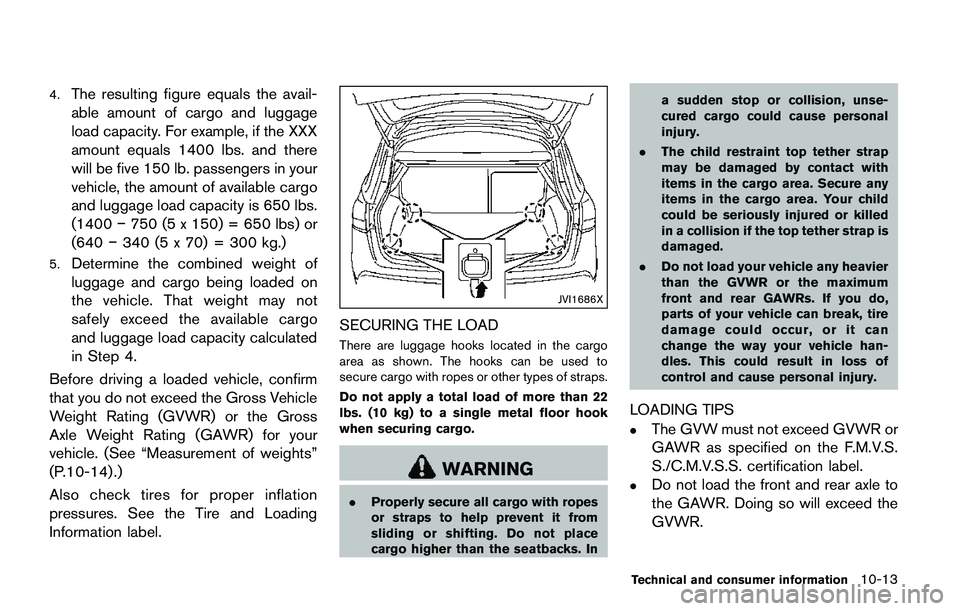
SECURING THE LOAD
There are luggage hooks located in the cargo
area as shown. The hooks can be used to
secure cargo with ropes or other types of straps.
Do not apply a total load of more than 22
lbs. (10 kg) to a single metal floor hook
when securing cargo.
WARNING
.Properly secure all cargo with ropes
or straps to help prevent it from
sliding or shifting. Do not place
cargo higher than the seatbacks. Ina sudden stop or collision, unse-
cured cargo could cause personal
injury.
.The child restraint top tether strap
may be damaged by contact with
items in the cargo area. Secure any
items in the cargo area. Your child
could be seriously injured or killed
in a collision if the top tether strap is
damaged.
.Do not load your vehicle any heavier
than the GVWR or the maximum
front and rear GAWRs. If you do,
parts of your vehicle can break, tire
damage could occur, or it can
change the way your vehicle han-
dles. This could result in loss of
control and cause personal injury.
LOADING TIPS
.The GVW must not exceed GVWR or
GAWR as specified on the F.M.V.S.
S./C.M.V.S.S. certification label.
.Do not load the front and rear axle to
the GAWR. Doing so will exceed the
GVWR.
Technical and consumer information10-13
Page 493 of 508
10-14Technical and consumer information
WARNING
.Properly secure all cargo with
ropes or straps to help prevent
it from sliding or shifting. Do
not place cargo higher than
the seatbacks. In a sudden
stop or collision, unsecured
cargo could cause personal
injury.
.Do not load your vehicle any
heavier than the GVWR or the
maximum front and rear
GAWRs. If you do, parts of
your vehicle can break, tire
damage could occur, or it can
change the way your vehicle
handles. This could result in
loss of control and cause per-
sonal injury.
.Overloading not only can
shorten the life of your vehicle
and the tire, but can cause
unsafe vehicle handling and
longer braking distances. Thismay cause a premature tire
failure, which could result in a
serious accident and personal
injury. Failures caused by
overloading are not covered
by the vehicle’s warranty.
MEASUREMENT OF WEIGHTS
Secure loose items to prevent weight
shifts that could affect the balance of
your vehicle. When the vehicle is loaded,
drive to a scale and weigh the front and
the rear wheels separately to determine
axle loads. Individual axle loads should
not exceed either of the Gross Axle
Weight Ratings (GAWR) . The total of
the axle loads should not exceed the
Gross Vehicle Weight Rating (GVWR) .
These ratings are given on the vehicle
certification label. If weight ratings are
exceeded, move or remove items to bring
all weights below the ratings.Do not tow a trailer with your
vehicle. TOWING A TRAILER
Page 497 of 508
10-18Technical and consumer information
Additional information concerning motor
vehicle safety may be obtained from
Transport Canada’s Road Safety Infor-
mation Centre at 1-800-333-0371 or
online at www.tc.gc.ca/roadsafety (Eng-
lish speakers) or www.tc.gc.ca/securiter-
outiere (French speakers) .
To notify NISSAN of any safety concerns
please contact our Consumer Informa-
tion Centre toll free at 1-800-387-0122.
WARNING
A vehicle equipped with All-Wheel Drive
(AWD) should never be tested using a
two wheel dynamometer (such as the
dynamometers used by some states for
emissions testing) , or similar equip-
ment. Make sure you inform test facility
personnel that your vehicle is equipped
with AWD before it is placed on a
dynamometer. Using the wrong test
equipment may result in transmission
damage or unexpected vehicle move-
ment which could result in serious
vehicle damage or personal injury.
Due to legal requirements in some states/areas
or provinces, your vehicle may be required to be
in what is called the “ready condition” for an
Inspection/Maintenance (I/M) test of the emis-
sion control system.
The vehicle is set to the “ready condition” when
it is driven through certain driving patterns.
Usually, the “ready condition” can be obtained
by ordinary usage of the vehicle.
If a powertrain system component is repaired or
the battery is disconnected, the vehicle may be
reset to a “not ready condition”. Before takingthe I/M test, check the vehicle’s inspection/
maintenance test readiness condition. Place the
ignition switch in the ON position without
starting the engine. If the Malfunction Indicator
Light (MIL) comes on steady for 20 seconds and
then blinks for 10 seconds, the I/M test
condition is “not ready”. If the MIL does not
blink after 20 seconds, the I/M test condition is
“ready”.
It is recommended you visit a NISSAN dealer to
set “ready condition” or to prepare the vehicle
for testing.
READINESS FOR INSPECTION/
MAINTENANCE (I/M) TEST
Page 500 of 508
11 Index
A
ABS (Anti-lock Braking System) ......................... 5-102
Active Engine Brake ............................................... 5-107
Active Ride Control ................................................. 5-108
Active Trace Control ............................................... 5-106
Advanced air bag system ......................................... 1-45
Air bag system
Advanced air bag system .................................. 1-45
Front passenger air bag and status light ...... 1-47
Front-seat mounted side-impact
supplemental air bag system ............................ 1-53
Roof-mounted curtain side-impact
supplemental air bag system ............................ 1-53
Air bag warning labels .............................................. 1-55
Air bag warning light ..................................... 1-56, 2-15
Air cleaner housing filter ........................................... 8-14
Air conditioner
Air conditioner operation ................................... 4-30
Air conditioner service ....................................... 4-37
Air conditioner specification label ................. 10-10
Air conditioning system refrigerant and
lubricant recommendations .................... 4-37, 10-6
Alarm, How to stop alarm (see vehicle
security system) .......................................................... 2-38
Alcohol, drugs and driving ....................................... 5-10
All-wheel drive (AWD) .............................................. 5-96
Antenna ......................................................................... 4-75
Anti-lock Braking System (ABS) ......................... 5-102
Anti-lock braking system (ABS) warning light .... 2-10
Appearance care
Exterior appearance care ..................................... 7-2
Interior appearance care ....................................... 7-4
Application download ................................................ 4-77
Armrest ............................................................................ 1-6Around View
ŠMonitor .............................................. 4-14
Audible reminders ...................................................... 2-17
Audio operation precautions ................................... 4-38
Audio system ............................................................... 4-38
Steering wheel audio controls ......................... 4-74
Autolight system ......................................................... 2-43
Automatic
Door locks ................................................................ 3-7
Automatic air conditioner ......................................... 4-34
AUX (Auxiliary) input jack ......................................... 4-73
Average speed ............................................................ 2-34
Avoiding collision and rollover .................................. 5-8
B
Battery ........................................................................... 8-11
Battery replacement, Intelligent Key ............... 8-23
Battery replacement, Key fob ........................... 8-21
Battery saver system .......................................... 2-47
Variable voltage control system ....................... 8-13
Before starting the engine ....................................... 5-17
Blind Spot Warning (BSW) .................................... 5-42
Bluetooth
ŠHands-Free Phone System .... 4-82, 4-92
Booster seats .............................................................. 1-35
Brake
Anti-lock Braking System (ABS) ................... 5-102
Brake and clutch fluid ........................................... 8-9
Brake system ...................................................... 5-102
Electronic parking brake system
warning light ......................................................... 2-12
Parking brake ........................................................ 5-26
Press Brake Pedal warning (for electronic
parking brake equipped models) .................... 2-32
Warning light ........................................................ 2-11
Break-in schedule ....................................................... 5-95Brightness control
Instrument panel ..................................................... 2-9
Bulb check/instrument panel ................................... 2-10
Bulb replacement ....................................................... 8-25
C
Capacities and
recommended fluids/lubricants ............................... 10-2
Car phone or CB radio ............................................. 4-82
Card holder .................................................................. 2-57
Cargo area ................................................................... 2-55
Catalytic converter, Three way catalyst .................. 5-5
CD/USB memory care and cleaning ..................... 4-76
Chassis and body maintenance ............................. 9-11
Chassis control ............................................. 2-35, 5-106
Child restraints ............................................................ 1-19
Booster seats ....................................................... 1-35
LATCH system ..................................................... 1-21
Precautions on child restraints ........................ 1-19
Child safety .................................................................. 1-17
Child safety rear door lock ........................................ 3-7
Chimes, Audible reminders ...................................... 2-17
Circuit breaker, Fusible link ..................................... 8-19
Cleaning exterior and interior ........................... 7-2, 7-4
Clock ............................................................................. 2-36
Clutch fluid ..................................................................... 8-9
Cockpit ............................................................................ 2-3
Cold weather driving .............................................. 5-110
Console box ................................................................. 2-56
Console light ............................................................... 2-66
Continuously Variable Transmission (CVT) fluid ... 8-9
Continuously Variable Transmission (CVT)
position indicator .......................................................... 2-9
Control buttons and function .................................... 4-3
Controls, Steering wheel audio controls .............. 4-74
Page 504 of 508
Child restraints ..................................................... 1-19
Cruise control ....................................................... 5-58
Driving safety ........................................................ 5-10
Maintenance ............................................................. 8-2
On-pavement and off-road driving ..................... 5-8
Seat belt usage .................................................... 1-10
SRS ......................................................................... 1-39
When starting and driving .................................... 5-4
Push starting ................................................................ 6-11
Push-button ignition switch ..................................... 5-14
R
Radio ............................................................................. 4-38
Car phone or CB radio ...................................... 4-82
Steering wheel audio controls ......................... 4-74
Rapid air pressure loss ............................................... 5-9
Readiness for inspection/maintenance
(I/M) test .................................................................... 10-18
Rear Cross Traffic Alert (RCTA) ............................. 5-51
Rear door lock, Child safety rear door lock .......... 3-7
Rear seats ...................................................................... 1-5
Rear window and outside mirror
defroster switch .......................................................... 2-42
Rear window wiper and washer switch ............... 2-41
RearView Monitor ......................................................... 4-8
Recorders, Event data ............................................ 10-19
Registering in another country ................................ 10-8
Registering with NissanConnect Mobile Apps .... 4-76
Remote engine start .................................................. 3-22
Remote keyless entry function, For Intelligent
Key system ................................................................... 3-18
Remote keyless entry system .................................... 3-8
Reporting safety defects ....................................... 10-17
Roadside assistance program ................................... 6-2
Rollover ........................................................................... 5-8Roof
Moonroof ............................................................... 2-64
Roof rail ......................................................................... 2-60
Room light .................................................................... 2-67
S
Safety
Child seat belts .................................................... 1-17
Reporting safety defects ................................. 10-17
Seat adjustment
Front manual seat adjustment ............................. 1-3
Front seats ............................................................... 1-3
Seat belt(s)
Child safety ........................................................... 1-17
Infants ..................................................................... 1-17
Injured persons .................................................... 1-13
Larger children ..................................................... 1-18
Precautions on seat belt usage ....................... 1-10
Pregnant women .................................................. 1-13
Seat belt cleaning .................................................. 7-6
Seat belt extenders ............................................. 1-16
Seat belt maintenance ....................................... 1-16
Seat belt warning light ....................................... 2-15
Seat belts .............................................................. 1-10
Seat belts with pretensioners .......................... 1-54
Shoulder belt height adjustment ..................... 1-15
Small children ....................................................... 1-18
Three-point type .................................................. 1-13
Seat(s)
Heated seats ........................................................ 2-50
Seats .......................................................................... 1-2
Security system (NISSAN Vehicle Immobilizer
System) , Engine start ................................................ 2-38
Security system, Vehicle security system ............. 2-36
Servicing air conditioner ........................................... 4-37Shift lever
Shift lock release ................................................. 5-24
Shift lock release
Transmission ......................................................... 5-24
Shifting
CVT (Continuously Variable Transmission) .... 5-20
Manual transmission ........................................... 5-25
Shoulder belt height adjustment, For
front seats .................................................................... 1-15
Siri
ŠEyes Free ............................................................ 4-78
Soft bottle holders ..................................................... 2-54
Spare tire .......................................................... 8-40, 10-7
Spark plugs .................................................................. 8-14
Speedometer ................................................................. 2-6
SRS
Precautions on SRS ........................................... 1-39
Standard maintenance ................................................ 9-7
Starting
Before starting the engine ................................ 5-17
Jump starting ........................................................... 6-9
Precautions when starting and driving ............. 5-4
Push starting ......................................................... 6-11
Starting the engine .................................. 5-17, 5-18
Status light, Front passenger air bag .................... 1-47
Steering
Electric power steering .................................... 5-101
Heated steering wheel ....................................... 2-49
Steering wheel switch for audio controls ..... 4-74
Tilt/telescopic steering ....................................... 3-29
Storage ......................................................................... 2-54
Sun visors ..................................................................... 3-30
Sunglasses holder ...................................................... 2-57
Supplemental air bag warning labels .................... 1-55
Supplemental air bag warning light ........... 1-56, 2-15
Supplemental Restraint System (SRS) ................ 1-39
Switch
All-wheel drive (AWD) lock switch ................. 2-52
11-5
Page 505 of 508
11-6
Audio control steering wheel switch .............. 4-74
Autolight switch ................................................... 2-43
Blind Spot Warning (BSW) switch ................ 2-51
Fog light switch ................................................... 2-48
Hazard warning flasher switch ............................ 6-2
Headlight switch .................................................. 2-43
Ignition switch ...................................................... 5-12
Lane Departure Prevention (LDP) switch .... 2-51
Power door lock switch ........................................ 3-7
Rear window and outside mirror
defroster switch ................................................... 2-42
Turn signal switch ................................................ 2-48
Vehicle dynamic control (VDC) off switch .... 2-52
T
Tachometer ..................................................................... 2-7
Temperature gauge, Engine coolant
temperature gauge ....................................................... 2-7
Theft (NISSAN Vehicle Immobilizer System) ,
Engine start .................................................................. 2-38
Three-way catalyst ....................................................... 5-5
Tilt/telescopic steering .............................................. 3-29
Tire pressure, Low tire pressure warning light .... 2-13
Tires
Flat tire ...................................................................... 6-3
Low tire pressure warning system ..................... 5-5
Tire and Loading information label .... 8-30, 10-10
Tire chains ............................................................. 8-36
Tire dressing ............................................................ 7-4
Tire pressure ......................................................... 8-29
Tire pressure monitoring
system (TPMS) .............................................. 5-5, 6-3
Tire rotation ........................................................... 8-37
Types of tires ........................................................ 8-35
Uniform tire quality grading ............................. 10-16
Wheel/tire size ..................................................... 10-7Wheels and tires ................................................. 8-29
Touch screen ................................................................. 4-4
Towing
Tow truck towing ................................................. 6-13
Towing a trailer ................................................... 10-14
TPMS, Tire pressure monitoring system ................ 5-5
TPMS with Easy Fill Tire Alert ............................ 5-7
TPMS, Tire pressure warning system ..................... 6-3
Trailer towing ............................................................ 10-14
Transmission
Continuously Variable Transmission ............... 5-13
Continuously Variable Transmission
(CVT) fluid ................................................................ 8-9
Driving with CVT (Continuously
Variable Transmission) ....................................... 5-20
Driving with manual transmission .................... 5-25
Transmission shift lever lock release .............. 5-24
Transmitter (See remote keyless entry system) .... 3-8
Transmitter, With Intelligent Key system
(See Intelligent Key system) .................................... 3-18
Traveling or registering in another country........... 10-8
Trip computer .............................................................. 2-34
Trip odometer .............................................................. 2-34
Turn signal switch ....................................................... 2-48
U
Underbody cleaning ..................................................... 7-3
Uniform tire quality grading ................................... 10-16
USB (Universal Serial Bus) connection port ....... 4-72
V
Vanity mirror ................................................................. 3-33
Vanity mirror lights ...................................................... 2-67
Variable voltage control system .............................. 8-13Vehicle
Dimensions and weights ................................... 10-8
Identification number (VIN) ............................... 10-8
Loading information .......................................... 10-11
Recovery (freeing a stuck vehicle) .................. 6-16
Security system .................................................... 2-36
Vehicle dynamic control (VDC) off switch .... 2-52
Vehicle dynamic control (VDC) system ....... 5-104
Vehicle information display ....................................... 2-18
How to use the vehicle information display .... 2-19
Settings .................................................................. 2-19
Startup display ..................................................... 2-19
Vehicle information display warnings
and indicators ....................................................... 2-28
Ventilators ..................................................................... 4-29
Voice Prompt Interrupt .................................. 4-86, 4-94
W
Warning
Hazard warning flasher switch ............................ 6-2
Lights ...................................................................... 2-10
Low tire pressure warning ................................ 2-29
Tire pressure monitoring
system (TPMS) .............................................. 5-5, 6-3
Vehicle information display ................................ 2-18
Warning lights, indicator lights and
audible reminders ................................................ 2-10
Warning labels, Air bag warning labels ................ 1-55
Warning light
Air bag warning light ............................... 1-56, 2-15
Anti-lock braking system (ABS)
warning light ......................................................... 2-10
Brake warning light ............................................. 2-11
Electric power steering warning light ............. 2-12
Electronic parking brake system
warning light ......................................................... 2-12