check engine light NISSAN QUEST 2014 RE52 / 4.G Owner's Manual
[x] Cancel search | Manufacturer: NISSAN, Model Year: 2014, Model line: QUEST, Model: NISSAN QUEST 2014 RE52 / 4.GPages: 482, PDF Size: 2.42 MB
Page 406 of 482
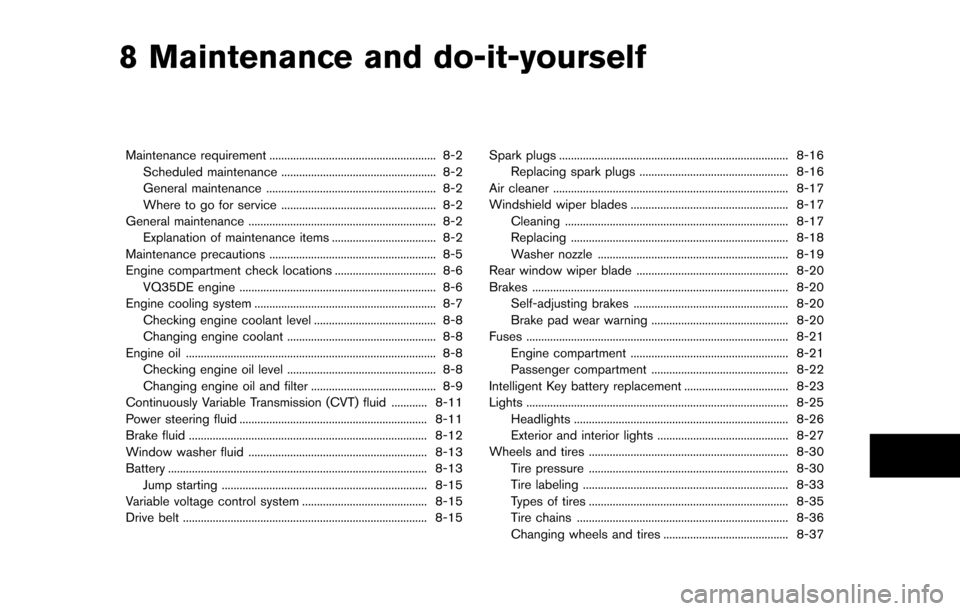
8 Maintenance and do-it-yourself
Maintenance requirement ........................................................ 8-2Scheduled maintenance .................................................... 8-2
General maintenance ......................................................... 8-2
Where to go for service .................................................... 8-2
General maintenance ............................................................... 8-2 Explanation of maintenance items ................................... 8-2
Maintenance precautions ........................................................ 8-5
Engine compartment check locations .................................. 8-6 VQ35DE engine .................................................................. 8-6
Engine cooling system ............................................................. 8-7
Checking engine coolant level ......................................... 8-8
Changing engine coolant .................................................. 8-8
Engine oil ........................................................................\
............ 8-8
Checking engine oil level .................................................. 8-8
Changing engine oil and filter .......................................... 8-9
Continuously Variable Transmission (CVT) fluid ............ 8-11
Power steering fluid ............................................................... 8-11
Brake fluid ........................................................................\
........ 8-12
Window washer fluid ............................................................ 8-13
Battery ........................................................................\
............... 8-13
Jump starting ..................................................................... 8-15
Variable voltage control system .......................................... 8-15
Drive belt ........................................................................\
.......... 8-15 Spark plugs ........................................................................\
..... 8-16
Replacing spark plugs .................................................. 8-16
Air cleaner ........................................................................\
....... 8-17
Windshield wiper blades ..................................................... 8-17 Cleaning ........................................................................\
... 8-17
Replacing ........................................................................\
. 8-18
Washer nozzle ................................................................ 8-19
Rear window wiper blade ................................................... 8-20
Brakes ........................................................................\
.............. 8-20 Self-adjusting brakes .................................................... 8-20
Brake pad wear warning .............................................. 8-20
Fuses ........................................................................\
................ 8-21 Engine compartment ..................................................... 8-21
Passenger compartment .............................................. 8-22
Intelligent Key battery replacement ................................... 8-23
Lights ........................................................................\
................ 8-25
Headlights ........................................................................\
8-26
Exterior and interior lights ............................................ 8-27
Wheels and tires ................................................................... 8-30 Tire pressure ................................................................... 8-30
Tire labeling ..................................................................... 8-33
Types of tires ................................................................... 8-35
Tire chains ....................................................................... 8-36
Changing wheels and tires .......................................... 8-37
Page 415 of 482
8-10Maintenance and do-it-yourself
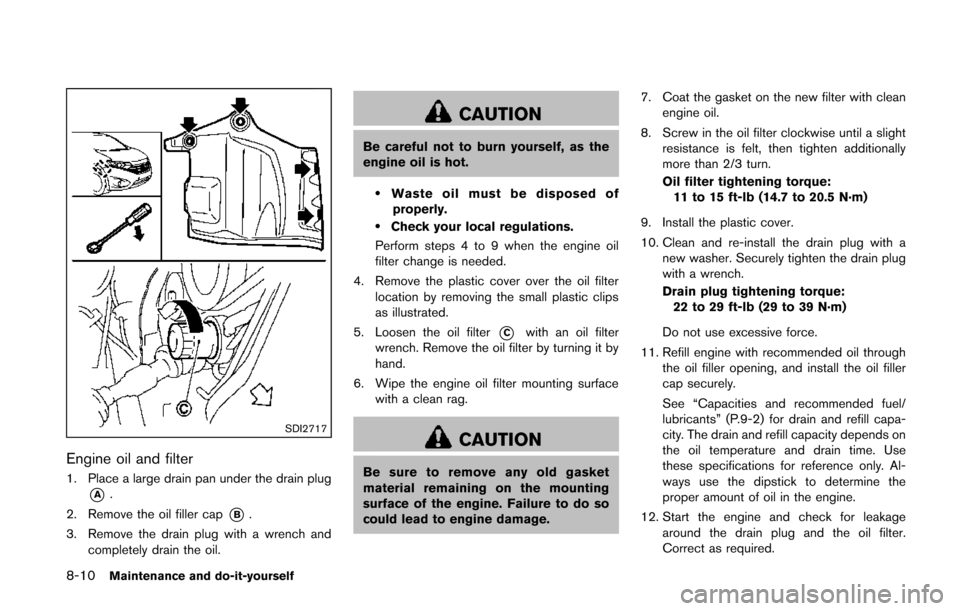
SDI2717
Engine oil and filter
1. Place a large drain pan under the drain plug
*A.
2. Remove the oil filler cap
*B.
3. Remove the drain plug with a wrench and completely drain the oil.
CAUTION
Be careful not to burn yourself, as the
engine oil is hot.
.Waste oil must be disposed of
properly.
.Check your local regulations.
Perform steps 4 to 9 when the engine oil
filter change is needed.
4. Remove the plastic cover over the oil filter location by removing the small plastic clips
as illustrated.
5. Loosen the oil filter
*Cwith an oil filter
wrench. Remove the oil filter by turning it by
hand.
6. Wipe the engine oil filter mounting surface with a clean rag.
CAUTION
Be sure to remove any old gasket
material remaining on the mounting
surface of the engine. Failure to do so
could lead to engine damage. 7. Coat the gasket on the new filter with clean
engine oil.
8. Screw in the oil filter clockwise until a slight resistance is felt, then tighten additionally
more than 2/3 turn.
Oil filter tightening torque:
11 to 15 ft-lb (14.7 to 20.5 N·m)
9. Install the plastic cover.
10. Clean and re-install the drain plug with a new washer. Securely tighten the drain plug
with a wrench.
Drain plug tightening torque:22 to 29 ft-lb (29 to 39 N·m)
Do not use excessive force.
11. Refill engine with recommended oil through the oil filler opening, and install the oil filler
cap securely.
See “Capacities and recommended fuel/
lubricants” (P.9-2) for drain and refill capa-
city. The drain and refill capacity depends on
the oil temperature and drain time. Use
these specifications for reference only. Al-
ways use the dipstick to determine the
proper amount of oil in the engine.
12. Start the engine and check for leakage around the drain plug and the oil filter.
Correct as required.
Page 426 of 482
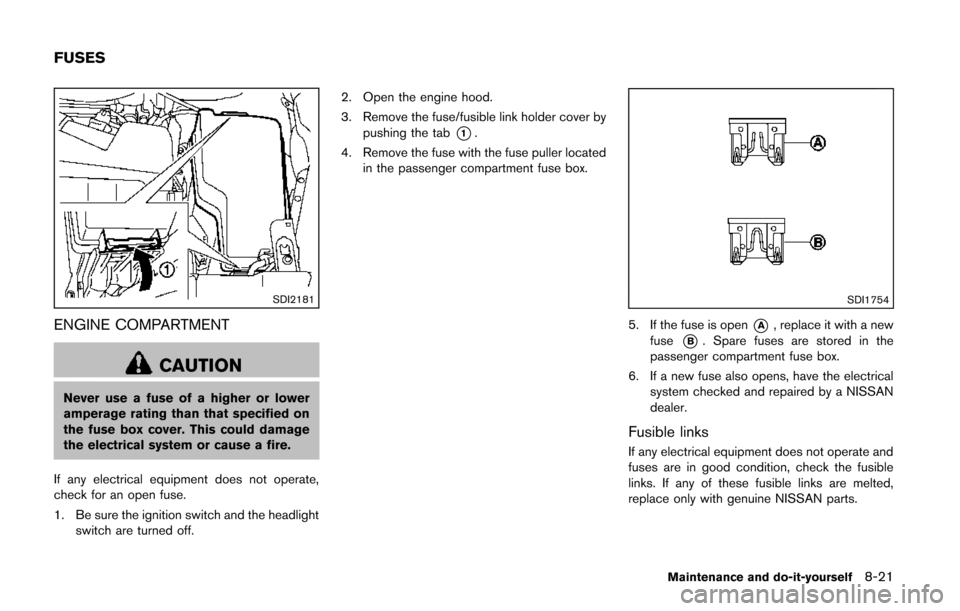
SDI2181
ENGINE COMPARTMENT
CAUTION
Never use a fuse of a higher or lower
amperage rating than that specified on
the fuse box cover. This could damage
the electrical system or cause a fire.
If any electrical equipment does not operate,
check for an open fuse.
1. Be sure the ignition switch and the headlight switch are turned off. 2. Open the engine hood.
3. Remove the fuse/fusible link holder cover by
pushing the tab
*1.
4. Remove the fuse with the fuse puller located in the passenger compartment fuse box.
SDI1754
5. If the fuse is open*A, replace it with a new
fuse
*B. Spare fuses are stored in the
passenger compartment fuse box.
6. If a new fuse also opens, have the electrical system checked and repaired by a NISSAN
dealer.
Fusible links
If any electrical equipment does not operate and
fuses are in good condition, check the fusible
links. If any of these fusible links are melted,
replace only with genuine NISSAN parts.
Maintenance and do-it-yourself8-21
FUSES
Page 449 of 482
9-4Technical and consumer information
blends may cause fuel system damage
and/or vehicle performance problems.
At this time, sufficient data is not
available to ensure that all methanol
blends are suitable for use in NISSAN
vehicles.
If any driveability problems such as engine
stalling and difficult hot-starting are experienced
after using oxygenate-blend fuels, immediately
change to a non-oxygenate fuel or a fuel with a
low blend of MTBE.
Take care not to spill gasoline during
refueling. Gasoline containing oxygenates
can cause paint damage.
E-15 fuel
E-15 fuel is a mixture of approximately 15% fuel
ethanol and 85% unleaded gasoline. E-15 can
only be used in vehicles designed to run on E-
15 fuel. Do not use E-15 in your vehicle. U.S.
government regulations require fuel ethanol
dispensing pumps to be identified with small,
square, orange and black label with the common
abbreviation or the appropriate percentage for
that region.
E-85 fuel
E-85 fuel is a mixture of approximately 85% fuel
ethanol and 15% unleaded gasoline. E-85 can
only be used in a Flexible Fuel Vehicle (FFV) . Do
not use E-85 fuel in your vehicle. U.S. govern-
ment regulations require fuel ethanol dispensing
pumps to be identified by a small, square,
orange and black label with the common
abbreviation or the appropriate percentage for
that region.
Aftermarket fuel additives
NISSAN does not recommend the use of any
aftermarket fuel additives (for example, fuel
injector cleaner, octane booster, intake valve
deposit removers, etc.) which are sold commer-
cially. Many of these additives intended for gum,
varnish or deposit removal may contain active
solvent or similar ingredients that can be harmful
to the fuel system and engine.
Octane rating tips
Using unleaded gasoline with an octane
rating lower than recommended can cause
persistent, heavy “spark knock”. (Spark
knock is a metallic rapping noise.) If
severe, this can lead to engine damage. If
you detect a persistent heavy spark knock
even when using gasoline of the stated
octane rating, or if you hear steady spark knock while holding a steady speed on
level roads, have a NISSAN dealer correct
the condition. Failure to correct the condi-
tion is misuse of the vehicle, for which
NISSAN is not responsible.
Incorrect ignition timing will result in spark
knock, after-run and/or overheating, which may
cause excessive fuel consumption or engine
damage. If any of the above symptoms are
encountered, have your vehicle checked at a
NISSAN dealer.
However, now and then you may notice
light spark knock for a short time while
accelerating or driving up hills. This is not a
cause for concern, because you get the
greatest fuel benefit when there is light
spark knock for a short time under heavy
engine load.
Page 467 of 482
9-22Technical and consumer information
.Check your hitch, trailer tire pressure,
vehicle tire pressure, trailer light operation,
and trailer wheel lug nuts every time you
attach a trailer to the vehicle.
. Be certain your rearview mirrors conform to
all federal, state or local regulations. If not,
install any mirrors required for towing before
driving the vehicle.
. Determine the overall height of the vehicle
and trailer so the required clearance is
known.
Trailer towing tips
In order to gain skill and an understanding of the
vehicle’s behavior, you should practice turning,
stopping and backing up in an area which is free
from traffic. Steering stability, and braking
performance will be somewhat different than
under normal driving conditions.
.Always secure items in the trailer to prevent
load shift while driving.
. Lock the trailer hitch coupler with a pin or
lock to prevent the coupler from inadver-
tently becoming unlatched.
. Avoid abrupt starts, acceleration or stops.
. Avoid sharp turns or lane changes.
. Always drive your vehicle at a moderate
speed. Some states or provinces have
specific speed limits for vehicles that are towing trailers. Obey the local speed limits.
. When backing up, hold the bottom of the
steering wheel with one hand. Move your
hand in the direction in which you want the
trailer to go. Make small corrections and
back up slowly. If possible, have someone
guide you when you are backing up.
Always block the wheels on both vehicle and
trailer when parking. Parking on a slope is not
recommended; however, if you must do so:
CAUTION
If you move the shift lever to the P
(Park) position before blocking the
wheels and applying the parking brake,
transmission damage could occur.
1. Apply and hold the brake pedal.
2. Have someone place blocks on the downhill side of the vehicle and trailer wheels.
3. After the wheel blocks are in place, slowly release the brake pedal until the blocks
absorb the vehicle load.
4. Apply the parking brake.
5. Shift the transmission into P (Park) . 6. Turn off the engine.
To drive away:
1. Apply and hold the brake pedal.
2. Start the engine.
3. Shift the transmission into gear.
4. Release the parking brake.
5. Drive slowly until the vehicle and trailer are
clear from the blocks.
6. Apply and hold the brake pedal.
7. Have someone retrieve and store the blocks.
. When going down a hill, shift into a lower
gear and use the engine braking effect.
When going up a long grade, downshift the
transmission to a lower gear and reduce
speed to reduce chances of engine over-
loading and/or overheating.
. If the engine coolant rises to an extremely
high temperature when the air conditioning
system is on, turn off the air conditioner.
Coolant heat can be additionally vented by
opening the windows, switching the fan
control to high and setting the temperature
control to the HOT position.
. Trailer towing requires more fuel than normal
circumstances.
. Avoid towing a trailer for the first 500 miles
(800 km) .
Page 468 of 482
.Have your vehicle serviced more often than
at intervals specified in the recommended
maintenance schedule in the NISSAN Ser-
vice and Maintenance Guide.
. When making a turn, your trailer wheels will
be closer to the inside of the turn than your
vehicle wheels. To compensate for this,
make a larger than normal turning radius
during the turn.
. Crosswinds and rough roads will adversely
affect vehicle/trailer handling, possibly caus-
ing vehicle sway. When being passed by
larger vehicles, be prepared for possible
changes in crosswinds that could affect
vehicle handling. If swaying does occur,
firmly grip the steering wheel, steer straight
ahead, and immediately (but gradually)
reduce vehicle speed. This combination will
help stabilize the vehicle. Never increase
speed.
Do the following if the trailer begins to sway:
1. Take your foot off the accelerator pedal to allow the vehicle to coast and steer as
straight ahead as the road conditions allow.
This combination will help stabilize the
vehicle.
.Do not correct trailer sway by steering orapplying the brakes. 2. When the trailer sway stops, gently apply
the brakes and pull to the side of the road in
a safe area.
3. Try to rearrange the trailer load so it is balanced as described earlier in this section.
. Be careful when passing other vehicles.
Passing while towing a trailer requires
considerably more distance than normal
passing. Remember the length of the trailer
must also pass the other vehicle before you
can safely change lanes.
. Down shift the transmission to a lower gear
for engine braking when driving down steep
or long hills. This will help slow the vehicle
without applying the brakes.
. Avoid holding the brake pedal down too
long or too frequently. This could cause the
brakes to overheat, resulting in reduced
braking efficiency.
. Increase your following distance to allow for
greater stopping distances while towing a
trailer. Anticipate stops and brake gradually.
. Do not use cruise control while towing a
trailer.
. Some states or provinces have specific
regulations and speed limits for vehicles
that are towing trailers. Obey the local
speed limits. .
Check your hitch, trailer wiring harness
connections, and trailer wheel lug nuts after
50 miles (80 km) of travel and at every
break.
. When stopped in traffic for long periods of
time in hot weather, put the vehicle in the P
(Park) position.
. When launching a boat, don’t allow the
water level to go over the exhaust tail pipe or
rear bumper.
. Make sure you disconnect the trailer lights
before backing the trailer into the water or
the trailer lights may burn out.
When towing a trailer, the transmission
fluid should be changed more frequently.
For additional information, see the “8.
Maintenance and do-it-yourself” section
earlier in this manual.
Technical and consumer information9-23
Page 472 of 482
Due to legal requirements in some states/areas
or provinces, your vehicle may be required to be
in what is called the “ready condition” for an
Inspection/Maintenance (I/M) test of the emis-
sion control system.
The vehicle is set to the “ready condition” when
it is driven through certain driving patterns.
Usually, the “ready condition” can be obtained
by ordinary usage of the vehicle.
If a powertrain system component is repaired or
the battery is disconnected, the vehicle may be
reset to a “not ready condition”. Before taking
the I/M test, check the vehicle’s inspection/
maintenance test readiness condition. Place the
ignition switch in the ON position without
starting the engine. If the Malfunction Indicator
Light (MIL) comes on steady for 20 seconds and
then blinks for 10 seconds, the I/M test
condition is “not ready”. If the MIL does not
blink after 20 seconds, the I/M test condition is
“ready”.
Contact a NISSAN dealer to set “ready condi-
tion” or to prepare the vehicle for testing.This vehicle is equipped with an Event Data
Recorder (EDR) . The main purpose of an EDR is
to record, in certain crash or near crash-like
situations, such as an air bag deployment or
hitting a road obstacle, data that will assist in
understanding how a vehicle’s systems per-
formed. The EDR is designed to record data
related to vehicle dynamics and safety systems
for a short period of time, typically 30 seconds
or less. The EDR in this vehicle is designed to
record such data as:
.
How various systems in your vehicle were
operating;
. Whether or not the driver and passenger
safety belts were buckled/fastened;
. How far (if at all) the driver was depressing
the accelerator and/or brake pedal; and,
. How fast the vehicle was traveling.
. Sounds are not recorded.
These data can help provide a better under-
standing of the circumstances in which crashes
and injuries occur.
NOTE: EDR data are recorded by your vehicle
only if a nontrivial crash situation occurs; no data
are recorded by the EDR under normal driving
conditions and no personal data (e.g. name,
gender, age and crash location) are recorded.
However, other parties, such as law enforce-
ment, could combine the EDR data with the type of personally identifying data routinely acquired
during a crash investigation.
To read data recorded by an EDR, special
equipment is required and access to the vehicle
or the EDR is needed. In addition to the vehicle
manufacturer and NISSAN dealer, other parties,
such as law enforcement, that have the special
equipment, can read the information if they have
access to the vehicle or the EDR. EDR data will
only be accessed with the consent of the vehicle
owner or lessee or as otherwise required or
permitted by law.
Technical and consumer information9-27
READINESS FOR INSPECTION/
MAINTENANCE (I/M) TEST
EVENT DATA RECORDERS (EDR)
Page 474 of 482
10 Index
A
A/C (Air Conditioner) operation.............................. 4-42
ABS (Anti-lock Braking System) ............................ 5-30
Advanced air bag system ......................................... 1-52
Aiming control, Headlights........................................ 2-36
Air bag systemAdvanced air bag system .................................. 1-52
Front passenger air bag and status light....... 1-53
Front-seat mounted side-impact
supplemental air bag system ............................ 1-57
Roof-mounted curtain side-impact
supplemental air bag system ............................ 1-57
Air bag warning labels............................................... 1-59
Air bag warning light...................................... 1-59, 2-15
Air cleaner housing filter ........................................... 8-17
Air conditioner Air conditioner operation.................................... 4-39
Air conditioner service ........................................ 4-52
Air conditioner specification label.................... 9-10
Air conditioning system refrigerant and
lubricant recommendations....................... 4-52, 9-6
In-cabin microfilter ............................................... 4-53
Alarm, How to stop alarm (see vehicle
security system)........................................................... 2-29
Alcohol, drugs and driving.......................................... 5-8
Antenna....................................................................... 4-101
Anti-lock Braking System (ABS) ............................ 5-30
Anti-lock braking system (ABS) warning light..... 2-12
Appearance care Exterior appearance care ...................................... 7-2
Interior appearance care ....................................... 7-4
Armrests .......................................................................... 1-7
Around view
TMmonitor.............................................. 4-29
Audible reminders....................................................... 2-18
Audio operation precautions.................................... 4-53 Audio system................................................................ 4-53
Steering wheel audio controls........................ 4-100
Auto closure ................................................................. 3-29
Autolight system.......................................................... 2-34
Automatic Air conditioner....................................................... 4-46
Door locks................................................................. 3-7
Drive positioner..................................................... 3-37
Moonroof................................................................ 2-53
Seat positioner...................................................... 3-37
AUX (Auxiliary) input................................................... 4-75
Avoiding collision and rollover ................................... 5-6
B
Back door (See lift gate) .......................................... 3-26
Battery............................................................................ 8-13 Battery saver system........................................... 2-35
Intelligent Key........................................................ 8-23
Variable voltage control system........................ 8-15
Before starting the engine........................................ 5-12
Blind Spot Warning (BSW) system....................... 5-17
Blind Spot Warning (BSW) system
warning light................................................................. 2-12
Bluetooth
®hands-free phone system
(models with navigation system).......................... 4-114
Bluetooth
®hands-free phone system
(models without navigation system) .................... 4-124
Bluetooth
®streaming audio ..................................... 4-91
Booster seats............................................................... 1-43
Brake Anti-lock Braking System (ABS) ..................... 5-30
Brake fluid.............................................................. 8-12
Brake system......................................................... 5-29
Parking brake operation ..................................... 5-17
Warning light......................................................... 2-12 Break-in schedule ....................................................... 5-26
Brightness control
Display ON/OFF button ........................................ 4-8
Instrument panel................................................... 2-37
Bulb check/instrument panel ................................... 2-12
Bulb replacement........................................................ 8-25
C
Cabin air filter............................................................... 4-53
Capacities and recommended fuel/lubricants ....... 9-2
Car phone or CB radio .......................................... 4-113
Cargo floor box............................................................ 2-47
Cargo lights.................................................................. 2-58
Catalytic converter, Three way catalyst................... 5-3
CD/CF/USB memory care and cleaning .............. 4-99
Center multi-function control panel.......................... 4-3
Child restraints............................................................. 1-26 Booster seats........................................................ 1-43
LATCH system...................................................... 1-28
Precautions on child restraints......................... 1-27
Top tether strap.................................................... 1-31
Child safety................................................................... 1-24
Chimes Audible reminders................................................ 2-18
Seat belt warning light and chime................... 2-15
Circuit breaker, Fusible link...................................... 8-21
Cleaning exterior and interior............................ 7-2, 7-4
Clock.............................................................................. 4-72
Coat hooks ................................................................... 2-50
Cockpit ............................................................................ 2-3
Cold weather driving.................................................. 5-33
Communication mirror................................................ 3-36
Compact Disc (CD) player (See
audio system)................................................... 4-74, 4-82
Compass......................................................................... 2-8
Page 475 of 482
10-2
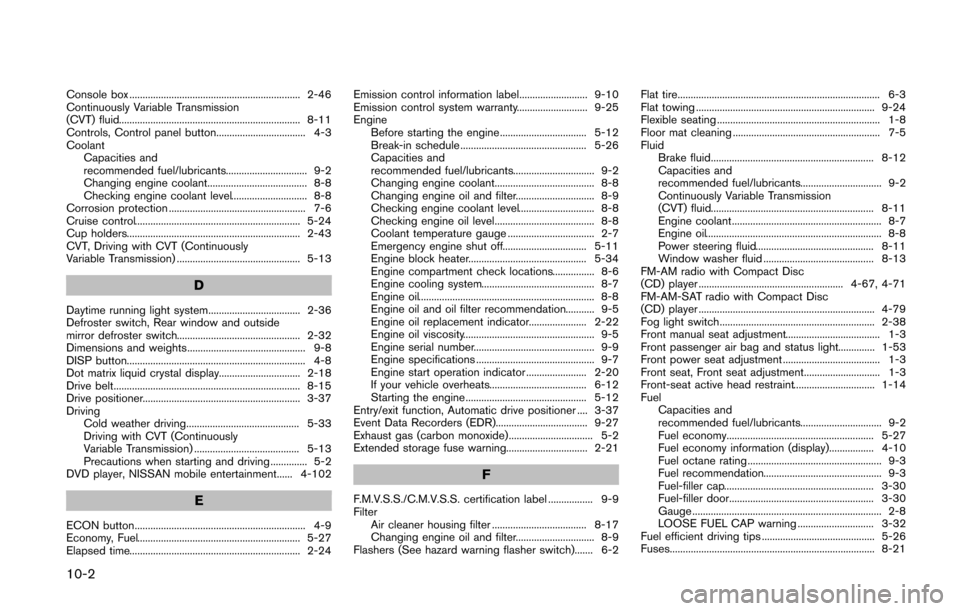
Console box ................................................................. 2-46
Continuously Variable Transmission
(CVT) fluid..................................................................... 8-11
Controls, Control panel button.................................. 4-3
Coolant Capacities and
recommended fuel/lubricants............................... 9-2
Changing engine coolant...................................... 8-8
Checking engine coolant level............................. 8-8
Corrosion protection .................................................... 7-6
Cruise control............................................................... 5-24
Cup holders.................................................................. 2-43
CVT, Driving with CVT (Continuously
Variable Transmission) ............................................... 5-13
D
Daytime running light system................................... 2-36
Defroster switch, Rear window and outside
mirror defroster switch............................................... 2-32
Dimensions and weights............................................. 9-8
DISP button.................................................................... 4-8
Dot matrix liquid crystal display............................... 2-18
Drive belt....................................................................... 8-15
Drive positioner............................................................ 3-37
Driving Cold weather driving........................................... 5-33
Driving with CVT (Continuously
Variable Transmission) ........................................ 5-13
Precautions when starting and driving .............. 5-2
DVD player, NISSAN mobile entertainment...... 4-102
E
ECON button................................................................. 4-9
Economy, Fuel.............................................................. 5-27
Elapsed time................................................................. 2-24 Emission control information label.......................... 9-10
Emission control system warranty........................... 9-25
Engine Before starting the engine................................. 5-12
Break-in schedule ................................................ 5-26
Capacities and
recommended fuel/lubricants............................... 9-2
Changing engine coolant...................................... 8-8
Changing engine oil and filter.............................. 8-9
Checking engine coolant level............................. 8-8
Checking engine oil level...................................... 8-8
Coolant temperature gauge ................................. 2-7
Emergency engine shut off................................ 5-11
Engine block heater............................................. 5-34
Engine compartment check locations................ 8-6
Engine cooling system........................................... 8-7
Engine oil................................................................... 8-8
Engine oil and oil filter recommendation........... 9-5
Engine oil replacement indicator...................... 2-22
Engine oil viscosity.................................................. 9-5
Engine serial number.............................................. 9-9
Engine specifications ............................................. 9-7
Engine start operation indicator ....................... 2-20
If your vehicle overheats..................................... 6-12
Starting the engine .............................................. 5-12
Entry/exit function, Automatic drive positioner .... 3-37
Event Data Recorders (EDR)................................... 9-27
Exhaust gas (carbon monoxide)................................ 5-2
Extended storage fuse warning............................... 2-21
F
F.M.V.S.S./C.M.V.S.S. certification label ................. 9-9
Filter Air cleaner housing filter .................................... 8-17
Changing engine oil and filter.............................. 8-9
Flashers (See hazard warning flasher switch)....... 6-2 Flat tire............................................................................. 6-3
Flat towing .................................................................... 9-24
Flexible seating .............................................................. 1-8
Floor mat cleaning ........................................................ 7-5
Fluid Brake fluid.............................................................. 8-12
Capacities and
recommended fuel/lubricants............................... 9-2
Continuously Variable Transmission
(CVT) fluid.............................................................. 8-11
Engine coolant......................................................... 8-7
Engine oil................................................................... 8-8
Power steering fluid............................................. 8-11
Window washer fluid .......................................... 8-13
FM-AM radio with Compact Disc
(CD) player ....................................................... 4-67, 4-71
FM-AM-SAT radio with Compact Disc
(CD) player ................................................................... 4-79
Fog light switch........................................................... 2-38
Front manual seat adjustment.................................... 1-3
Front passenger air bag and status light.............. 1-53
Front power seat adjustment ..................................... 1-3
Front seat, Front seat adjustment............................. 1-3
Front-seat active head restraint............................... 1-14
Fuel Capacities and
recommended fuel/lubricants............................... 9-2
Fuel economy........................................................ 5-27
Fuel economy information (display)................. 4-10
Fuel octane rating ................................................... 9-3
Fuel recommendation............................................. 9-3
Fuel-filler cap......................................................... 3-30
Fuel-filler door....................................................... 3-30
Gauge ........................................................................ 2-8
LOOSE FUEL CAP warning ............................. 3-32
Fuel efficient driving tips ........................................... 5-26
Fuses.............................................................................. 8-21
Page 477 of 482
10-4
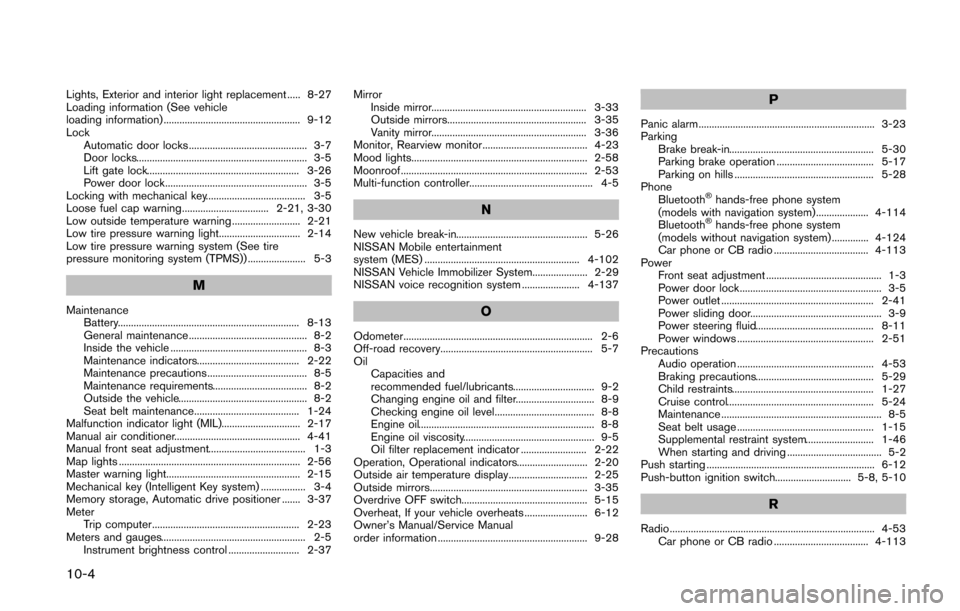
Lights, Exterior and interior light replacement ..... 8-27
Loading information (See vehicle
loading information) .................................................... 9-12
LockAutomatic door locks ............................................. 3-7
Door locks................................................................. 3-5
Lift gate lock.......................................................... 3-26
Power door lock...................................................... 3-5
Locking with mechanical key...................................... 3-5
Loose fuel cap warning................................. 2-21, 3-30
Low outside temperature warning .......................... 2-21
Low tire pressure warning light............................... 2-14
Low tire pressure warning system (See tire
pressure monitoring system (TPMS)) ...................... 5-3
M
Maintenance Battery..................................................................... 8-13
General maintenance ............................................. 8-2
Inside the vehicle .................................................... 8-3
Maintenance indicators....................................... 2-22
Maintenance precautions...................................... 8-5
Maintenance requirements.................................... 8-2
Outside the vehicle................................................. 8-2
Seat belt maintenance........................................ 1-24
Malfunction indicator light (MIL).............................. 2-17
Manual air conditioner................................................ 4-41
Manual front seat adjustment..................................... 1-3
Map lights ..................................................................... 2-56
Master warning light................................................... 2-15
Mechanical key (Intelligent Key system) ................. 3-4
Memory storage, Automatic drive positioner ....... 3-37
Meter Trip computer........................................................ 2-23
Meters and gauges....................................................... 2-5 Instrument brightness control ........................... 2-37 Mirror
Inside mirror........................................................... 3-33
Outside mirrors..................................................... 3-35
Vanity mirror........................................................... 3-36
Monitor, Rearview monitor........................................ 4-23
Mood lights................................................................... 2-58
Moonroof....................................................................... 2-53
Multi-function controller............................................... 4-5
N
New vehicle break-in.................................................. 5-26
NISSAN Mobile entertainment
system (MES) ........................................................... 4-102
NISSAN Vehicle Immobilizer System..................... 2-29
NISSAN voice recognition system ...................... 4-137
O
Odometer........................................................................ 2-6
Off-road recovery.......................................................... 5-7
Oil Capacities and
recommended fuel/lubricants............................... 9-2
Changing engine oil and filter.............................. 8-9
Checking engine oil level...................................... 8-8
Engine oil................................................................... 8-8
Engine oil viscosity.................................................. 9-5
Oil filter replacement indicator ......................... 2-22
Operation, Operational indicators........................... 2-20
Outside air temperature display.............................. 2-25
Outside mirrors............................................................ 3-35
Overdrive OFF switch................................................ 5-15
Overheat, If your vehicle overheats ........................ 6-12
Owner’s Manual/Service Manual
order information ......................................................... 9-28
P
Panic alarm................................................................... 3-23
Parking Brake break-in....................................................... 5-30
Parking brake operation ..................................... 5-17
Parking on hills ..................................................... 5-28
Phone Bluetooth
®hands-free phone system
(models with navigation system).................... 4-114
Bluetooth
®hands-free phone system
(models without navigation system) .............. 4-124
Car phone or CB radio .................................... 4-113
Power Front seat adjustment ............................................ 1-3
Power door lock...................................................... 3-5
Power outlet .......................................................... 2-41
Power sliding door.................................................. 3-9
Power steering fluid............................................. 8-11
Power windows .................................................... 2-51
Precautions Audio operation .................................................... 4-53
Braking precautions............................................. 5-29
Child restraints...................................................... 1-27
Cruise control........................................................ 5-24
Maintenance ............................................................. 8-5
Seat belt usage .................................................... 1-15
Supplemental restraint system.......................... 1-46
When starting and driving .................................... 5-2
Push starting ................................................................ 6-12
Push-button ignition switch............................. 5-8, 5-10
R
Radio.............................................................................. 4-53 Car phone or CB radio .................................... 4-113