change time NISSAN ROGUE 2009 Owner´s Manual
[x] Cancel search | Manufacturer: NISSAN, Model Year: 2009, Model line: ROGUE, Model: NISSAN ROGUE 2009Pages: 316, PDF Size: 4.26 MB
Page 169 of 316
Black plate (167,1)
Model "S35-D" EDITED: 2008/ 7/ 24
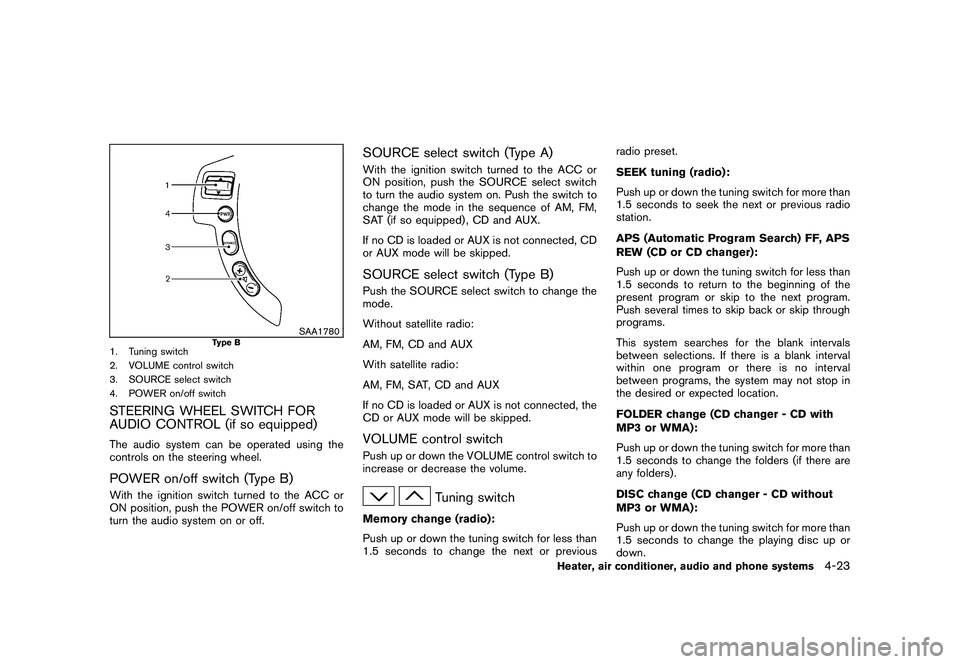
SAA1780
Type B
1. Tuning switch
2. VOLUME control switch
3. SOURCE select switch
4. POWER on/off switchSTEERING WHEEL SWITCH FOR
AUDIO CONTROL (if so equipped)The audio system can be operated using the
controls on the steering wheel.POWER on/off switch (Type B)With the ignition switch turned to the ACC or
ON position, push the POWER on/off switch to
turn the audio system on or off.
SOURCE select switch (Type A)With the ignition switch turned to the ACC or
ON position, push the SOURCE select switch
to turn the audio system on. Push the switch to
change the mode in the sequence of AM, FM,
SAT (if so equipped) , CD and AUX.
If no CD is loaded or AUX is not connected, CD
or AUX mode will be skipped.SOURCE select switch (Type B)Push the SOURCE select switch to change the
mode.
Without satellite radio:
AM, FM, CD and AUX
With satellite radio:
AM, FM, SAT, CD and AUX
If no CD is loaded or AUX is not connected, the
CD or AUX mode will be skipped.VOLUME control switchPush up or down the VOLUME control switch to
increase or decrease the volume.
Tuning switch
Memory change (radio):
Push up or down the tuning switch for less than
1.5 seconds to change the next or previousradio preset.
SEEK tuning (radio):
Push up or down the tuning switch for more than
1.5 seconds to seek the next or previous radio
station.
APS (Automatic Program Search) FF, APS
REW (CD or CD changer):
Push up or down the tuning switch for less than
1.5 seconds to return to the beginning of the
present program or skip to the next program.
Push several times to skip back or skip through
programs.
This system searches for the blank intervals
between selections. If there is a blank interval
within one program or there is no interval
between programs, the system may not stop in
the desired or expected location.
FOLDER change (CD changer - CD with
MP3 or WMA):
Push up or down the tuning switch for more than
1.5 seconds to change the folders (if there are
any folders) .
DISC change (CD changer - CD without
MP3 or WMA):
Push up or down the tuning switch for more than
1.5 seconds to change the playing disc up or
down.
Heater, air conditioner, audio and phone systems
4-23
Page 181 of 316
Black plate (179,1)
Model "S35-D" EDITED: 2008/ 7/ 24
If the memo pad is full, the system asks if you
wish to record over the oldest memo.
“Delete”
*C
The Delete command erases all memos. The
system asks you to confirm this action before
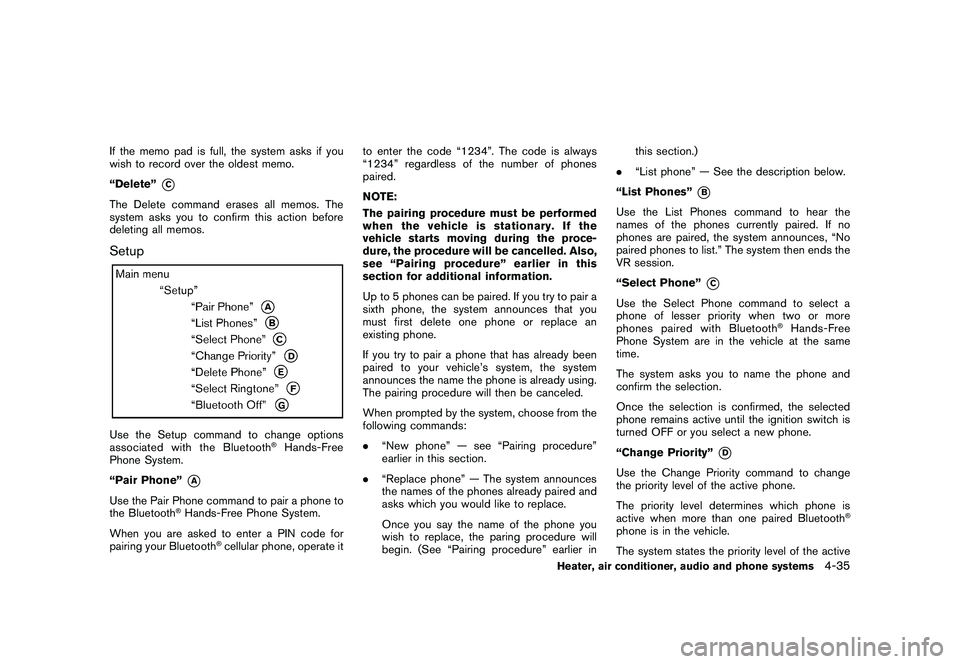
deleting all memos.SetupUse the Setup command to change options
associated with the Bluetooth
®Hands-Free
Phone System.
“Pair Phone”
*A
Use the Pair Phone command to pair a phone to
the Bluetooth
®Hands-Free Phone System.
When you are asked to enter a PIN code for
pairing your Bluetooth
®cellular phone, operate itto enter the code “1234”. The code is always
“1234” regardless of the number of phones
paired.
NOTE:
The pairing procedure must be performed
when the vehicle is stationary. If the
vehicle starts moving during the proce-
dure, the procedure will be cancelled. Also,
see “Pairing procedure” earlier in this
section for additional information.
Up to 5 phones can be paired. If you try to pair a
sixth phone, the system announces that you
must first delete one phone or replace an
existing phone.
If you try to pair a phone that has already been
paired to your vehicle’s system, the system
announces the name the phone is already using.
The pairing procedure will then be canceled.
When prompted by the system, choose from the
following commands:
.“New phone” — see “Pairing procedure”
earlier in this section.
.“Replace phone” — The system announces
the names of the phones already paired and
asks which you would like to replace.
Once you say the name of the phone you
wish to replace, the paring procedure will
begin. (See “Pairing procedure” earlier inthis section.)
.“List phone” — See the description below.
“List Phones”
*B
Use the List Phones command to hear the
names of the phones currently paired. If no
phones are paired, the system announces, “No
paired phones to list.” The system then ends the
VR session.
“Select Phone”
*C
Use the Select Phone command to select a
phone of lesser priority when two or more
phones paired with Bluetooth
®Hands-Free
Phone System are in the vehicle at the same
time.
The system asks you to name the phone and
confirm the selection.
Once the selection is confirmed, the selected
phone remains active until the ignition switch is
turned OFF or you select a new phone.
“Change Priority”
*D
Use the Change Priority command to change
the priority level of the active phone.
The priority level determines which phone is
active when more than one paired Bluetooth
®
phone is in the vehicle.
The system states the priority level of the active
Heater, air conditioner, audio and phone systems
4-35
Page 188 of 316
Black plate (186,1)
Model "S35-D" EDITED: 2008/ 7/ 24
WARNING
.Do not leave children or adults who
would normally require the support
of others alone in your vehicle. Pets
should not be left alone either. They
could accidentally injure themselves
or others through inadvertent op-
eration of the vehicle. Also, on hot,
sunny days, temperatures in a
closed vehicle could quickly become
high enough to cause severe or
possibly fatal injuries to people or
animals.
.Properly secure all cargo with ropes
or straps to help prevent it from
sliding or shifting. Do not place
cargo higher than the seatbacks. In
a sudden stop or collision, unse-
cured cargo could cause personal
injury.EXHAUST GAS (carbon monoxide)
WARNING
.Do not breathe exhaust gases; they
contain colorless and odorless car-
bon monoxide. Carbon monoxide isdangerous. It can cause uncon-
sciousness or death.
.If you suspect that exhaust fumes
are entering the vehicle, drive with
all windows fully open, and have the
vehicle inspected immediately.
.Do not run the engine in closed
spaces such as a garage.
.Do not park the vehicle with the
engine running for any extended
length of time.
.Keep the lift gate closed while
driving, otherwise exhaust gases
could be drawn into the passenger
compartment. If you must drive with
the lift gate open, follow these
precautions:
1. Open all the windows.
2. Set the
air recirculation to off
and the fan control to high to
circulate the air.
.If electrical wiring or other cable
connections must pass to a trailer
through the seal on the lift gate or
the body, follow the manufacturer’s
recommendation to prevent carbon
monoxide entry into the vehicle..If a special body, camper or other
equipment is added for recreational
or other usage, follow the manufac-
turer’s recommendation to prevent
carbon monoxide entry into the
vehicle. (Some recreational vehicle
appliances such as stoves, refrig-
erators, heaters, etc. may also gen-
erate carbon monoxide.)
.The exhaust system and body
should be inspected by a qualified
mechanic whenever:
— The vehicle is raised for service.
— You suspect that exhaust fumes
are entering into the passenger
compartment.
— You notice a change in the
sound of the exhaust system.
— You have had an accident invol-
ving damage to the exhaust
system, underbody, or rear of
the vehicle.
THREE-WAY CATALYSTThe three-way catalyst is an emission control
device installed in the exhaust system. Exhaust
gases in the three-way catalyst are burned at
high temperatures to help reduce pollutants.
PRECAUTIONS WHEN STARTING
AND DRIVING5-2
Starting and driving
Page 191 of 316
Black plate (189,1)
Model "S35-D" EDITED: 2008/ 7/ 24
pressure sensors, and the TPMS will
not function properly.
Some devices and transmitters may temporarily
interfere with the operation of the TPMS and
cause the low tire pressure warning light to
illuminate. Some examples are:
.Facilities or electric devices using similar
radio frequencies are near the vehicle.
.If a transmitter set to similar frequencies is
being used in or near the vehicle.
.If a computer (or similar equipment) or a DC/
AC converter is being used in or near the
vehicle.
FCC Notice:
Changes or modifications not expressly
approved by the party responsible for
compliance could void the user’s authority
to operate the equipment.
This device complies with Part 15 of the
FCC Rules and RSS-210 of Industry Cana-
da.
Operation is subject to the following two
conditions: (1) This device may not cause
harmful interference, and (2) this device
must accept any interference received,
including interference that may cause un-
desired operation of the device.
AVOIDING COLLISION AND ROLL-
OVER
WARNING
Failure to operate this vehicle in a safe
and prudent manner may result in loss
of control or an accident.
Be alert and drive defensively at all times. Obey
all traffic regulations. Avoid excessive speed,
high speed cornering, or sudden steering
maneuvers, because these driving practices
could cause you to lose control of your vehicle.
As with any vehicle, a loss of control could
result in a collision with other vehicles or
objects, or cause the vehicle to rollover,
particularly if the loss of control causes the
vehicle to slide sideways.Be attentive at all
times, and avoid driving when tired. Never drive
when under the influence of alcohol or drugs
(including prescription or over-the-counter
drugs which may cause drowsiness) . Always
wear your seat belt as outlined in the “SEAT
BELTS” in the “1. Safety — Seats, seat belts and
supplemental restraint system” section of this
manual, and also instruct your passengers to do
so.
Seat belts help reduce the risk of injury in
collisions and rollovers.In a rollover crash, an
unbelted or improperly belted person issignificantly more likely to be injured or
killed than a person properly wearing a
seat belt.
ON-PAVEMENT AND OFF-ROAD
DRIVING PRECAUTIONSUtility vehicles have a significantly higher
rollover rate than other types of vehicles.
They have higher ground clearance than pas-
senger cars to make them capable of performing
in a variety of on-pavement and off-road
applications. This gives them a higher center of
gravity than ordinary cars. An advantage of
higher ground clearance is a better view of the
road, allowing you to anticipate problems.
However, they are not designed for cornering
at the same speeds as conventional passenger
cars any more than low-slung sports cars are
designed to perform satisfactorily under off-road
conditions. If at all possible, avoid sharp turns or
abrupt maneuvers, particularly at high speeds.
As with other vehicles of this type, failure to
operate this vehicle correctly may result in loss
of control or vehicle rollover. Seat belts help
reduce the risk of injury in collisions and
rollovers. In a rollover crash, an unbelted or
improperly belted person is significantly more
likely to be injured or killed than a person
properly wearing a seat belt.
Be sure to read “DRIVING SAFETY PRECAU-
TIONS” later in this section.
Starting and driving
5-5
Page 250 of 316
Black plate (248,1)
Model "S35-D" EDITED: 2008/ 7/ 24
.Waste oil must be disposed of
properly.
.Check your local regulations.
Perform steps 4 to 9 when the engine oil
filter change is needed.
4. Remove the plastic cover over the oil filter
location by removing the small plastic clips.
5. Loosen the oil filter with an oil filter wrench.
Remove the oil filter by turning it by hand.
6. Wipe the engine oil filter mounting surface
with a clean rag.
CAUTION
Be sure to remove any old gasket
material remaining on the mounting
surface of the engine. Failure to do so
could lead to engine damage.
7. Coat the gasket on the new filter with clean
engine oil.
8. Screw in the oil filter clockwise until a slight
resistance is felt, then tighten additionally
more than 2/3 turn.
Oil filter tightening torque:
11 to 15 ft-lb
(14.7 to 20.5 N·m)
9. Install the plastic cover.10. Clean and re-install the drain plug with a
new washer. Securely tighten the drain plug
with a wrench.
Drain plug tightening torque:
22 to 29 ft-lb
(29 to 39 N·m)
Do not use excessive force.
11. Refill engine with recommended oil through
the oil filler opening, and install the oil filler
cap securely.
See “CAPACITIES AND RECOMMENDED
FUEL/LUBRICANTS” in the “9. Technical
and consumer information” section for drain
and refill capacity. The drain and refill
capacity depends on the oil temperature
and drain time. Use these specifications for
reference only. Always use the dipstick to
determine the proper amount of oil in the
engine.
12. Start the engine and check for leakage
around the drain plug and the oil filter.
Correct as required.
13. Turn the engine off and wait more than 10
minutes. Check the oil level with the dipstick.
Add engine oil if necessary.
After the operation1. Lower the vehicle carefully to the ground.
2. Dispose of waste oil and filter properly.
WARNING
.Prolonged and repeated contact
with used engine oil may cause skin
cancer.
.Try to avoid direct skin contact with
used oil. If skin contact is made,
wash thoroughly with soap or hand
cleaner as soon as possible.
.Keep used engine oil out of reach of
children.
8-10
Maintenance and do-it-yourself
Page 283 of 316
Black plate (283,1)
Model "S35-D" EDITED: 2008/ 7/ 24
FUEL RECOMMENDATIONUse unleaded regular gasoline with an octane
rating of at least 87 AKI (Anti-Knock Index)
number (Research octane number 91) .
CAUTION
.Using a fuel other than that speci-
fied could adversely affect the emis-
sion control system, and may also
affect warranty coverage.
.Under no circumstances should a
leaded gasoline be used, because
this will damage the three-way cat-
alyst.
.Do not use E-85 fuel in your vehicle.
Your vehicle is not designed to run
on E-85 fuel. Using E-85 fuel can
damage the fuel system compo-
nents and is not covered by the
NISSAN new vehicle limited war-
ranty.Gasoline specificationsNISSAN recommends using gasoline that meets
the World-Wide Fuel Charter (WWFC) speci-
fications where it is available. Many of the
automobile manufacturers developed this spe-
cification to improve emission control systemand vehicle performance. Ask your service
station manager if the gasoline meets the
WWFC specifications.
Reformulated gasolineSome fuel suppliers are now producing refor-
mulated gasolines. These gasolines are specially
designed to reduce vehicle emissions. NISSAN
supports efforts towards cleaner air and sug-
gests that you use reformulated gasoline when
available.Gasoline containing oxygenatesSome fuel suppliers sell gasoline containing
oxygenates such as ethanol, MTBE and metha-
nol with or without advertising their presence.
NISSAN does not recommend the use of fuels
of which the oxygenate content and the fuel
compatibility for your NISSAN cannot be readily
determined. If in doubt, ask your service station
manager.
If you use oxygenate-blend gasoline, please take
the following precautions as the usage of such
fuels may cause vehicle performance problems
and/or fuel system damage.
.The fuel should be unleaded and have
an octane rating no lower than that
recommended for unleaded gasoline.
.If an oxygenate-blend, other than
methanol blend is used, it should
contain no more than 10% oxygenate.(MTBE may, however, be added up to
15%.)
.If a methanol blend is used, it should
contain no more than 5% methanol
(methyl alcohol, wood alcohol) . It
should also contain a suitable amount
of appropriate cosolvents and corro-
sion inhibitors. If not properly formu-
lated with appropriate cosolvents and
corrosion inhibitors, such methanol
blends may cause fuel system damage
and/or vehicle performance problems.
At this time, sufficient data is not
available to ensure that all methanol
blends are suitable for use in NISSAN
vehicles.
If any driveability problems such as engine
stalling and difficult hot-starting are experienced
after using oxygenate-blend fuels, immediately
change to a non-oxygenate fuel or a fuel with a
low blend of MTBE.
Take care not to spill gasoline during
refueling. Gasoline containing oxygenates
can cause paint damage.
E-85 fuelE-85 fuel is a mixture of approximately 85% fuel
ethanol and 15% unleaded gasoline. E-85 can
only be used in a Flexible Fuel Vehicle (FFV) . Do
not use E-85 fuel in your vehicle. U.S. govern-
ment regulations require fuel ethanol dispensing
Technical and consumer information
9-3
Page 302 of 316
Black plate (302,1)
Model "S35-D" EDITED: 2008/ 7/ 24
Trailer lights
CAUTION
When splicing into the vehicle electrical
system, a commercially available
power-type module/converter must be
used to provide power for all trailer
lighting. This unit uses the vehicle
battery as a direct power source for all
trailer lights while using the vehicle tail
light, stoplight and turn signal circuits
as a signal source. The module/con-
verter must draw no more than 15
milliamps from the stop and tail lamp
circuits. Using a module/converter that
exceeds these power requirements may
damage the vehicle’s electrical system.
See a reputable trailer dealer to obtain
the proper equipment and to have it
installed.
Trailer lights should comply with federal and/or
local regulations. For assistance in hooking up
trailer lights, contact a NISSAN dealer or
reputable trailer dealer.Trailer brakesIf your trailer is equipped with a braking system,
make sure it conforms to federal and/or local
regulations and that it is properly installed.
WARNING
Never connect a trailer brake system
directly to the vehicle brake system.Pre-towing tips.Be certain your vehicle maintains a level
position when a loaded or unloaded trailer is
hitched. Do not drive the vehicle if it has an
abnormal nose-up or nose-down condition;
check for improper tongue load, overload,
worn suspension or other possible causes
of either condition.
.Always secure items in the trailer to prevent
load shift while driving.
.Keep the cargo load as low as possible in
the trailer to keep the trailer center of gravity
low.
.Load the trailer so approximately 60% of the
trailer load is in the front half and 40% is in
the back half. Also make sure the load is
balanced side to side.
.Check your hitch, trailer tire pressure,
vehicle tire pressure, trailer light operation,
and trailer wheel lug nuts every time you
attach a trailer to the vehicle.
.Be certain your rearview mirrors conform to
all federal, state or local regulations. If not,install any mirrors required for towing before
driving the vehicle.
.Determine the overall height of the vehicle
and trailer so the required clearance is
known.
Trailer towing tipsIn order to gain skill and an understanding of the
vehicle’s behavior, you should practice turning,
stopping and backing up in an area which is free
from traffic. Steering stability, and braking
performance will be somewhat different than
under normal driving conditions.
.Always secure items in the trailer to prevent
load shift while driving.
.Lock the trailer hitch coupler with a pin or
lock to prevent the coupler from inadver-
tently becoming unlatched.
.Avoid abrupt starts, acceleration or stops.
.Avoid sharp turns or lane changes.
.Always drive your vehicle at a moderate
speed. Some states or provinces have
specific speed limits for vehicles that are
towing trailers. Obey the local speed limits.
.When backing up, hold the bottom of the
steering wheel with one hand. Move your
hand in the direction in which you want the
trailer to go. Make small corrections and
9-22
Technical and consumer information
Page 304 of 316
Black plate (304,1)
Model "S35-D" EDITED: 2008/ 7/ 24
.Be careful when passing other vehicles.
Passing while towing a trailer requires
considerably more distance than normal
passing. Remember the length of the trailer
must also pass the other vehicle before you
can safely change lanes.
.Down shift the transmission to a lower gear
for engine braking when driving down steep
or long hills. This will help slow the vehicle
without applying the brakes.
.Avoid holding the brake pedal down too
long or too frequently. This could cause the
brakes to overheat, resulting in reduced
braking efficiency.
.Increase your following distance to allow for
greater stopping distances while towing a
trailer. Anticipate stops and brake gradually.
.Do not use cruise control while towing a
trailer.
.Some states or provinces have specific
regulations and speed limits for vehicles
that are towing trailers. Obey the local
speed limits.
.Check your hitch, trailer wiring harness
connections, and trailer wheel lug nuts after
50 miles (80 km) of travel and at every
break.
.When stopped in traffic for long periods oftime in hot weather, put the vehicle in the P
(Park) position.
.When launching a boat, don’t allow the
water level to go over the exhaust tail pipe or
rear bumper.
.Make sure you disconnect the trailer lights
before backing the trailer into the water or
the trailer lights may burn out.
When towing a trailer, the transmission
fluid should be changed more frequently.
For additional information, see the “8.
Maintenance and do-it-yourself” section
earlier in this manual.
FLAT TOWINGTowing your vehicle with all four wheels on the
ground is sometimes called flat towing. This
method is sometimes used when towing a
vehicle behind a recreational vehicle, such as a
motor home.
CAUTION
.Failure to follow these guidelines
can result in severe transmission
damage.
.Whenever flat towing your vehicle,
always tow forward, never back-
ward..DO NOT tow any continuously vari-
able transmission vehicle with all
four wheels on the ground (flat
towing) . Doing so WILL DAMAGE
internal transmission parts due to
lack of transmission lubrication.
.DO NOT tow an All-Wheel Drive
(AWD) vehicle with any of the
wheels on the ground. Doing so
may cause serious and expensive
damage to the powertrain.
.For emergency towing procedures
refer to “TOWING RECOMMENDED
BY NISSAN” in the “6. In case of
emergency” section of this manual.
Continuously Variable Transmission
(CVT)All-Wheel Drive (AWD) models:
Do not tow an AWD vehicle with any of the
wheels on the ground.
Two-Wheel Drive (2WD) models:
To tow a vehicle equipped with a Continuously
Variable Transmission (CVT) , an appropriate
vehicle dollyMUSTbe placed under the towed
vehicle’s driving wheels.Alwaysfollow the dolly
manufacturer’s recommendations when using
9-24
Technical and consumer information
Page 311 of 316
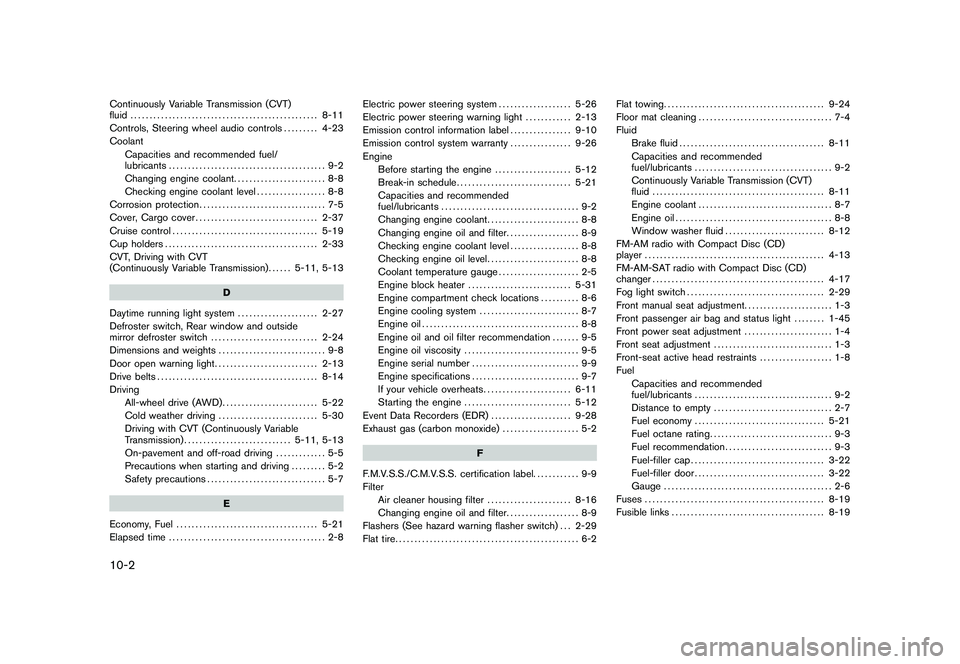
Black plate (2,1)
10-2Continuously Variable Transmission (CVT)
fluid................................................. 8-11
Controls, Steering wheel audio controls......... 4-23
Coolant
Capacities and recommended fuel/
lubricants......................................... 9-2
Changing engine coolant........................ 8-8
Checking engine coolant level.................. 8-8
Corrosion protection................................. 7-5
Cover, Cargo cover................................ 2-37
Cruise control...................................... 5-19
Cup holders........................................ 2-33
CVT, Driving with CVT
(Continuously Variable Transmission)...... 5-11, 5-13
D
Daytime running light system..................... 2-27
Defroster switch, Rear window and outside
mirror defroster switch............................ 2-24
Dimensions and weights............................ 9-8
Door open warning light........................... 2-13
Drive belts.......................................... 8-14
Driving
All-wheel drive (AWD)......................... 5-22
Cold weather driving.......................... 5-30
Driving with CVT (Continuously Variable
Transmission)............................ 5-11, 5-13
On-pavement and off-road driving............. 5-5
Precautions when starting and driving......... 5-2
Safety precautions............................... 5-7
E
Economy, Fuel ..................................... 5-21
Elapsed time ......................................... 2-8Electric power steering system................... 5-26
Electric power steering warning light............ 2-13
Emission control information label................ 9-10
Emission control system warranty................ 9-26
Engine
Before starting the engine.................... 5-12
Break-in schedule.............................. 5-21
Capacities and recommended
fuel/lubricants.................................... 9-2
Changing engine coolant........................ 8-8
Changing engine oil and filter................... 8-9
Checking engine coolant level.................. 8-8
Checking engine oil level........................ 8-8
Coolant temperature gauge..................... 2-5
Engine block heater........................... 5-31
Engine compartment check locations.......... 8-6
Engine cooling system.......................... 8-7
Engine oil......................................... 8-8
Engine oil and oil filter recommendation....... 9-5
Engine oil viscosity.............................. 9-5
Engine serial number............................ 9-9
Engine specifications............................ 9-7
If your vehicle overheats....................... 6-11
Starting the engine............................ 5-12
Event Data Recorders (EDR)..................... 9-28
Exhaust gas (carbon monoxide).................... 5-2
F
F.M.V.S.S./C.M.V.S.S. certification label............ 9-9
Filter
Air cleaner housing filter...................... 8-16
Changing engine oil and filter................... 8-9
Flashers (See hazard warning flasher switch) . . . 2-29
Flat tire................................................ 6-2Flat towing.......................................... 9-24
Floor mat cleaning................................... 7-4
Fluid
Brake fluid...................................... 8-11
Capacities and recommended
fuel/lubricants.................................... 9-2
Continuously Variable Transmission (CVT)
fluid............................................. 8-11
Engine coolant ................................... 8-7
Engine oil......................................... 8-8
Window washer fluid .......................... 8-12
FM-AM radio with Compact Disc (CD)
player............................................... 4-13
FM-AM-SAT radio with Compact Disc (CD)
changer............................................. 4-17
Fog light switch.................................... 2-29
Front manual seat adjustment....................... 1-3
Front passenger air bag and status light........ 1-45
Front power seat adjustment....................... 1-4
Front seat adjustment............................... 1-3
Front-seat active head restraints................... 1-8
Fuel
Capacities and recommended
fuel/lubricants.................................... 9-2
Distance to empty............................... 2-7
Fuel economy.................................. 5-21
Fuel octane rating................................ 9-3
Fuel recommendation............................ 9-3
Fuel-filler cap................................... 3-22
Fuel-filler door.................................. 3-22
Gauge ............................................ 2-6
Fuses............................................... 8-19
Fusible links........................................ 8-19
Model "S35-D" EDITED: 2008/ 6/ 3